

What Is a Doctor of Education?
Definition and Meaning of a Doctor of Education
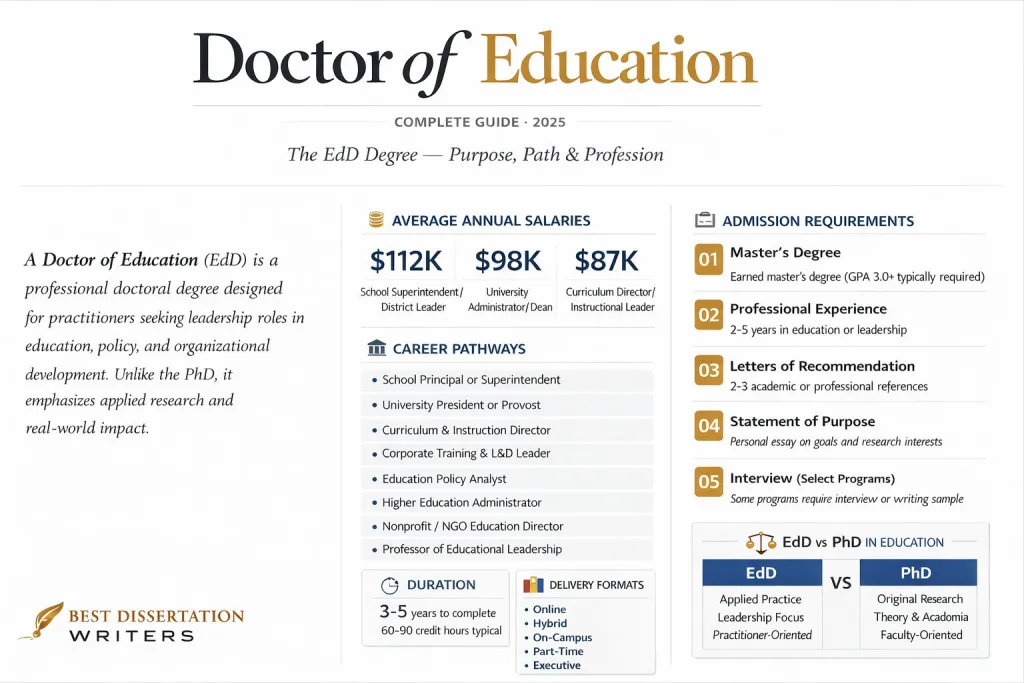
- A Doctor of Education (EdD) is a terminal professional doctorate in education
- It represents the highest academic qualification in the field of education for practitioners.
- It is designed for experienced professionals who want to apply research to solve real-world problems in schools, colleges, universities, corporations, nonprofits, and government agencies.
- It focuses on leadership, policy, and organizational improvement rather than purely theoretical research.
- The EdD emphasizes applied research and practical impact. It is an important type of PhD.
- Students learn to identify pressing issues in educational settings such as low student achievement, inequitable access, curriculum gaps, leadership challenges, and policy implementation barriers.
- The program trains candidates to use evidence-based strategies to design solutions that improve systems and outcomes.
- Research conducted in an EdD program often addresses real challenges faced by institutions or communities.
- The degree is distinct from a Doctor of Philosophy (PhD) in Education
- A PhD typically focuses on generating new theoretical knowledge and preparing scholars for academic research careers.
- An EdD focuses on applying existing research to improve practice and leadership.
- While both degrees require rigorous coursework and a doctoral-level research project, the EdD is more practice-oriented.
- Common career paths for EdD graduates include
- School district superintendents and principals.
- Higher education administrators such as deans and provosts.
- Policy analysts and educational consultants.
- Corporate training directors and learning and development leaders.
- Leaders in nonprofit and community education organizations.
- Core competencies developed in an EdD program
- Strategic leadership and decision-making.
- Data-driven analysis and assessment.
- Organizational change management.
- Ethical leadership and equity-focused practice.
- Advanced communication and stakeholder engagement.
History and Evolution of the Doctor of Education
- Origins of the EdD degree
- The Doctor of Education degree was first introduced in the United States in the early twentieth century.
- It was created to meet the growing demand for highly trained educational leaders during a time of rapid expansion in public education.
- The first EdD was awarded by Harvard University in 1921.
- Expansion during the twentieth century
- As public school systems grew, so did the need for professional administrators with advanced training.
- Universities began offering EdD programs to prepare leaders in school management, curriculum development, and policy administration.
- The degree became widely recognized as a pathway for experienced educators seeking leadership roles.
- Debate between EdD and PhD in education
- Over time, discussions emerged about the distinction between the EdD and the PhD.
- Some institutions structured their EdD programs similarly to PhD programs, creating overlap in research requirements.
- Others intentionally redesigned the EdD to focus more on applied problem-solving and professional practice.
- Shift toward practitioner-focused models
- In recent decades, many universities have refined their EdD programs to emphasize real-world impact.
- Programs now often include cohort-based learning models that encourage collaboration among professionals from diverse sectors.
- The dissertation format has evolved in some institutions into a “dissertation in practice” or capstone project that addresses a specific organizational problem.
- Global development of the EdD
- While originally developed in the United States, the EdD has expanded internationally.
- Countries such as the United Kingdom, Australia, and Canada now offer EdD programs tailored to their educational systems.
- International programs often integrate leadership development with context-specific policy and governance studies.
- Modern focus on equity and innovation
- Contemporary EdD programs increasingly emphasize diversity, equity, inclusion, and social justice.
- Digital transformation, educational technology, and global learning systems are now common areas of study.
- The degree continues to evolve in response to changing educational landscapes.
Need Expert Dissertation Writing Support?
Get professional academic assistance from Best Dissertation Writers .
Order Your Dissertation NowKey Focus Areas in a Doctor of Education Program
- Educational Leadership
- Preparing leaders to manage schools, districts, universities, and training organizations effectively.
- Developing strategic planning skills and the ability to align vision with measurable outcomes.
- Strengthening crisis management and change leadership capabilities.
- Curriculum and Instruction
- Designing and evaluating curriculum aligned with academic standards and learner needs.
- Implementing evidence-based teaching strategies.
- Assessing student performance and instructional effectiveness.
- Educational Policy and Reform
- Analyzing local, national, and global education policies.
- Understanding the impact of legislation on institutions and communities.
- Leading policy implementation initiatives within organizations.
- Organizational Development and Change
- Applying systems thinking to improve institutional performance.
- Leading large-scale transformation efforts.
- Building collaborative cultures that support innovation and accountability.
- Equity, Diversity, and Inclusion
- Addressing disparities in access, achievement, and representation.
- Designing programs that support underserved populations.
- Promoting culturally responsive leadership practices.
- Research Methods and Data Analysis
- Learning qualitative and quantitative research methods.
- Conducting needs assessments and program evaluations.
- Interpreting data to inform strategic decisions.
- Technology and Innovation in Education
- Integrating digital tools to enhance learning outcomes.
- Managing online and hybrid education environments.
- Evaluating the effectiveness of emerging educational technologies.
- Capstone or Dissertation in Practice
- Identifying a real-world problem within an educational context.
- Designing, implementing, and evaluating an evidence-based intervention.
- Demonstrating measurable impact on organizational performance or student outcomes.
Why Pursue a Doctor of Education?
Career Opportunities with a Doctor of Education
- Senior Leadership in K–12 Education
- Positions such as superintendent, assistant superintendent, principal, and district director.
- Oversight of curriculum implementation, budgeting, staffing, and strategic planning.
- Leading school improvement initiatives and accountability systems.
- Shaping district-wide policies that impact student achievement and teacher development.
- Higher Education Administration
- Roles including dean, provost, vice president of academic affairs, or director of student services.
- Managing enrollment strategies, accreditation processes, and institutional effectiveness plans.
- Leading faculty development and academic innovation initiatives.
- Designing long-term institutional strategies aligned with mission and governance structures.
- Educational Policy and Government Roles
- Policy analyst, education advisor, or program director within government agencies.
- Evaluating education reform proposals and legislative initiatives.
- Designing and assessing public programs aimed at improving educational access and quality.
- Influencing large-scale systemic change through data-informed decision-making.
- Corporate Learning and Organizational Development
- Director of learning and development, chief learning officer, or training executive.
- Designing professional development frameworks for large organizations.
- Leading talent management and workforce upskilling strategies.
- Applying adult learning theory to improve employee performance and retention.
- Nonprofit and Community Leadership
- Executive director or program leader in education-focused nonprofit organizations.
- Developing community-based learning initiatives and grant-funded programs.
- Measuring program effectiveness and ensuring sustainability.
- Advocating for underserved or marginalized populations.
- Consulting and Independent Practice
- Educational consultant specializing in school improvement, leadership coaching, or curriculum redesign.
- Conducting organizational audits and needs assessments.
- Advising institutions on accreditation, compliance, and performance metrics.
- Providing strategic planning and change management support.
- Academic Teaching and Applied Research Roles
- Teaching in universities, particularly in leadership or practitioner-based programs.
- Supervising applied doctoral research projects.
- Publishing practice-oriented research and contributing to professional discourse.
Skills You Gain in a Doctor of Education Program
- Advanced Leadership and Strategic Thinking
- Developing the ability to create and communicate a compelling organizational vision.
- Aligning institutional goals with measurable outcomes and accountability systems.
- Leading teams through complex change processes.
- Balancing innovation with regulatory and policy constraints.
- Data-Driven Decision-Making
- Interpreting quantitative and qualitative research findings.
- Conducting program evaluations and impact assessments.
- Using data dashboards and analytics tools to guide strategic planning.
- Translating research insights into actionable organizational improvements.
- Applied Research Expertise
- Designing research studies that address real-world problems.
- Applying mixed-method approaches to capture complex educational challenges.
- Producing a dissertation in practice that demonstrates measurable organizational impact.
- Critically evaluating existing literature to inform evidence-based solutions.
- Organizational Change Management
- Applying systems thinking to analyze institutional structures.
- Leading restructuring initiatives and cultural transformation efforts.
- Managing resistance and building stakeholder buy-in.
- Implementing sustainable improvement strategies.
- Policy Analysis and Implementation
- Understanding how local, national, and global policies shape educational practice.
- Evaluating policy effectiveness through data and stakeholder feedback.
- Translating policy mandates into operational strategies.
- Advocating for equitable and inclusive reforms.
- Communication and Stakeholder Engagement
- Writing high-level reports, proposals, and strategic plans.
- Presenting findings to boards, government agencies, and executive teams.
- Facilitating collaborative discussions among diverse stakeholder groups.
- Navigating complex political and organizational environments.
- Equity-Focused Leadership
- Identifying structural barriers affecting marginalized groups.
- Designing inclusive initiatives that improve access and outcomes.
- Embedding diversity, equity, and inclusion principles into strategic planning.
- Evaluating institutional practices through an ethical and social justice lens.
- Resilience and Professional Growth
- Strengthening time management and project management skills.
- Building confidence in high-stakes leadership environments.
- Developing reflective practice habits that support continuous improvement.
- Expanding professional networks through cohort-based learning models.

Who Should Consider a Doctor of Education?
- Experienced Educators Seeking Leadership Roles
- Teachers who aspire to become principals, superintendents, or district leaders.
- Instructional coaches or department heads aiming to influence system-wide reform.
- Professionals ready to transition from classroom practice to executive leadership.
- Higher Education Professionals
- Academic advisors, student affairs professionals, and administrators seeking advancement.
- Faculty members interested in leadership positions within universities.
- Professionals involved in accreditation, assessment, or institutional research.
- Corporate and Organizational Leaders
- Learning and development professionals managing training programs.
- Human resources leaders interested in workforce development strategies.
- Executives responsible for organizational learning and performance improvement.
- Policy-Minded Professionals
- Individuals passionate about education reform and systemic change.
- Professionals working in government agencies or advocacy organizations.
- Leaders seeking the analytical tools to influence policy through evidence.
- Nonprofit and Community Change Agents
- Program directors leading education-focused community initiatives.
- Advocates working to reduce educational inequities.
- Leaders seeking sustainable, research-informed solutions to local challenges.
- Professionals Seeking Applied Impact Rather Than Pure Theory
- Individuals who prefer solving practical problems over conducting purely theoretical research.
- Leaders motivated by measurable organizational outcomes.
- Professionals who want a doctorate that enhances leadership credibility and applied expertise.
- Individuals Ready for Rigorous Academic and Professional Commitment
- Candidates prepared for intensive coursework, research, and dissertation work.
- Professionals capable of balancing doctoral study with career responsibilities.
- Leaders committed to long-term professional transformation and systemic impact.
How to Earn a Doctor of Education
Admission Requirements for a Doctor of Education
- Earn a relevant master’s degree first
- Most programs require a master’s degree in education, leadership, public administration, psychology, or a related field.
- Some universities may consider applicants from corporate leadership or nonprofit management backgrounds if experience aligns with program goals.
- A strong academic record is typically expected, often with a minimum Grade Point Average requirement.
- Demonstrate professional experience
- Many programs prefer or require several years of leadership or administrative experience.
- Experience in schools, universities, corporate training departments, or nonprofit organizations strengthens an application.
- Leadership responsibilities such as supervising staff, managing budgets, or leading initiatives are highly valued.
- Submit official transcripts
- Applicants must provide transcripts from all previously attended institutions.
- Admissions committees evaluate academic performance and readiness for doctoral-level work.
- Provide letters of recommendation
- Usually two to three professional or academic references are required.
- Strong letters highlight leadership ability, analytical skills, and readiness for advanced study.
- Recommenders often include supervisors, professors, or senior administrators.
- Write a statement of purpose
- Applicants explain their career goals, leadership experience, and research interests.
- The statement should clearly connect professional aspirations with the EdD program’s focus.
- Admissions committees assess clarity of goals and commitment to educational improvement.
- Submit a resume or curriculum vitae
- A detailed record of professional roles, leadership responsibilities, certifications, and achievements.
- Demonstrates career progression and practical experience relevant to doctoral study.
- Interview process
- Some programs require interviews to assess leadership potential and communication skills.
- Faculty may evaluate alignment between applicant goals and program outcomes.
- Standardized test requirements
- Some institutions require Graduate Record Examination scores, while many have removed this requirement.
- Programs increasingly focus on professional experience and academic history rather than test scores.
Program Structure and Timeline
- Cohort-based learning model
- Many Doctor of Education programs follow a cohort model.
- Students begin and progress through the program together, fostering collaboration and peer support.
- Cohorts often include professionals from diverse sectors, enriching discussions and networking opportunities.
- Core coursework phase
- Early stages focus on foundational subjects such as leadership theory, research methods, policy analysis, and organizational change.
- Courses develop advanced writing, analytical, and critical thinking skills.
- Assignments often connect directly to real workplace challenges.
- Research and methodology training
- Students learn qualitative, quantitative, and mixed-method research approaches.
- Emphasis is placed on designing studies that address real-world organizational problems.
- Coursework prepares candidates for independent doctoral research.
- Comprehensive or qualifying assessments
- Some programs require written or oral examinations to assess mastery of core concepts.
- These assessments determine readiness to move into the dissertation phase.
- Dissertation in practice or applied capstone
- The final phase involves identifying a significant problem within an educational or organizational setting.
- Students conduct research, implement evidence-based solutions, and evaluate outcomes.
- The project culminates in a formal dissertation document and oral defense.
- Flexible delivery formats
- Programs may be offered fully online, hybrid, or on campus.
- Online formats often accommodate working professionals through asynchronous learning.
- Hybrid models combine virtual coursework with periodic in-person residencies.
- Typical timeline
- Most programs require three to four years of part-time study.
- Full-time options may allow completion in approximately three years.
- Timeline varies based on dissertation progress and professional commitments.
Need Expert Dissertation Writing Support?
Get professional academic assistance from Best Dissertation Writers .
Order Your Dissertation NowCost, Accreditation, and Choosing the Right Doctor of Education Program
- Understanding program costs
- Tuition varies widely depending on institution type and location.
- Public universities may offer lower tuition for in-state students.
- Private institutions often have higher tuition but may provide scholarships or assistantships.
- Additional costs may include books, research expenses, residency fees, and technology requirements.
- Financial planning considerations
- Employers may offer tuition reimbursement for leadership-focused degrees.
- Federal and private student loans are common funding sources.
- Some institutions provide grants or doctoral fellowships.
- Importance of accreditation
- Choose programs accredited by recognized regional or national accrediting bodies.
- Accreditation ensures academic quality and institutional credibility.
- Graduating from an accredited program strengthens career mobility and professional recognition.
- Program specialization and focus areas
- Some programs specialize in K–12 leadership, higher education administration, curriculum and instruction, or organizational leadership.
- Select a specialization aligned with long-term career goals.
- Review course offerings and faculty expertise.
- Faculty qualifications and mentorship
- Examine faculty research interests and professional backgrounds.
- Strong mentorship can significantly impact dissertation success and career advancement.
- Consider faculty accessibility and support systems.
- Program flexibility and format
- Working professionals should evaluate schedule demands and residency requirements.
- Online or hybrid programs may offer greater flexibility.
- Ensure program structure supports work-life balance.
- Alumni outcomes and reputation
- Investigate career outcomes of graduates.
- Review alumni leadership roles and professional achievements.
- Institutional reputation can influence networking and career opportunities.
- Support services and resources
- Assess availability of writing centers, research support, and academic advising.
- Strong doctoral support systems enhance retention and completion rates.
- Cohort community and networking opportunities add long-term value.