

What Is a Doctor of Veterinary Medicine Program?
- A doctor of veterinary medicine is a professional graduate-level credential for people who want to become a veterinarian.
- This degree program is the standard academic path for training in animal health, diagnosis, treatment, surgery, and disease prevention.
- In the United States, the doctor of veterinary medicine program is usually completed after prior undergraduate study and is considered a four-year professional program.
- The goal of the program is to prepare veterinary students for both licensing and professional practice in a wide range of settings.
- A doctor of veterinary medicine program is usually offered through a college of veterinary medicine or a school of veterinary medicine.
- These institutions are often part of a larger college or university system and are designed specifically for advanced veterinary medical training.
- Many veterinary colleges combine classroom learning, laboratory work, hospital-based instruction, and research opportunities in one setting.
- This structure helps students move from academic theory into real-world patient care and decision-making.
- The doctor of veterinary medicine is also commonly called the DVM or DVM degree.
- These terms refer to the same professional credential.
- When students apply to a DVM program, they are entering a structured pathway that blends science, clinical training, and professional skill development.
- The program is built to support the next generation of veterinary professionals through both academic preparation and practical experience.
Understanding the DVM Degree Program
- The DVM program begins with a strong foundation in science.
- Early coursework usually focuses on subjects that support veterinary medical education, such as anatomy, physiology, microbiology, pathology, pharmacology, and animal nutrition.
- These subjects help veterinary students understand how healthy animal bodies function and how illness develops.
- This science-based preparation is essential because a future veterinarian must be able to connect symptoms, diagnoses, and treatment plans accurately.
- The DVM curriculum is designed to build knowledge in stages.
- In the first part of the doctor of veterinary medicine program, students usually focus on foundational biomedical and animal health concepts.
- In later stages, the curriculum becomes more applied and starts emphasizing patient care, diagnostics, surgery, imaging, and case management.
- This gradual progression helps students develop confidence before entering more demanding clinical settings.
- The doctor of veterinary medicine is a professional degree focused on career readiness.
- Unlike a purely academic program, this professional program is meant to train students for direct practice in animal health and related fields.
- Students are taught not only what to know, but also how to apply that knowledge in hands-on and real-world situations.
- This is one reason the doctor of veterinary medicine is regarded as a rigorous and highly practical professional veterinary pathway.
- The doctor of veterinary medicine program supports multiple areas of career development.
- A graduate may go on to work in companion animal practice, large animal medicine, research, industry, government service, or public health.
- Because the DVM degree is broad in scope, it allows students to explore several paths while still gaining the core training required to become a licensed veterinarian.
- This flexibility makes the program valuable for students interested in both traditional and emerging areas of the profession.
How a Doctor of Veterinary Medicine Program Supports Veterinary Education
- A strong doctor of veterinary medicine program supports veterinary medical education through structured academic training.
- Students receive instruction that connects foundational science to practical animal care.
- This supports long-term learning by helping students understand not just facts, but also how to use those facts in diagnosis and treatment.
- In this way, the doctor of veterinary medicine helps create a more capable and informed professional workforce.
- A college of veterinary medicine supports learning through expert faculty.
- Faculty members often include researchers, clinicians, and specialists with deep experience in veterinary medical practice and teaching.
- Their role is not limited to delivering lectures. They also mentor current students, supervise clinical training, and model professional standards.
- Strong faculty guidance is essential in helping students connect classroom learning with real-world medical challenges.
- A doctor of veterinary medicine program strengthens veterinary teaching by using multiple learning methods.
- Many programs combine lectures, anatomy labs, simulation exercises, hospital rounds, and case-based discussions.
- These approaches are often considered best practices in veterinary medical instruction because they promote deeper understanding and stronger retention.
- An innovative learning environment can also help students adapt more effectively to changing demands in animal care and medicine.
- The doctor of veterinary medicine also supports the next generation of leaders in animal health.
- Students are often encouraged to build skills in communication, ethics, teamwork, and community engagement.
- These areas are important because a modern veterinarian must do more than treat animals. They must also educate owners, collaborate with peers, and support broader health systems.
- By focusing on these areas, the doctor of veterinary medicine program helps prepare the next generation of veterinary professionals for leadership and service.
Science, Public Health, and Clinical Learning in a Professional Program
- The science component of a doctor of veterinary medicine program gives students the knowledge needed for sound medical judgment.
- Subjects like physiology, pathology, microbiology, immunology, and pharmacology help students understand disease mechanisms and treatment options.
- This scientific foundation supports every stage of the DVM curriculum, from early classroom study to advanced patient care.
- Without a strong base in science, students would not be fully prepared for the complexity of clinical veterinary work.
- Public health is an important part of the doctor of veterinary medicine because animal health and human health are closely connected.
- Students learn how zoonotic diseases, food safety, disease surveillance, and environmental health affect communities.
- This means the doctor of veterinary medicine program goes beyond individual animal care and addresses broader health systems as well.
- Training in public health helps future professionals understand their role in protecting both animals and people.
- Clinical learning is where students begin applying their knowledge in supervised settings.
- In many veterinary colleges, students participate in hospital rotations, diagnostic labs, ambulatory care, and case evaluations.
- These hands-on experiences are critical because they expose students to the pace and complexity of real-world practice.
- Through clinical work, veterinary students learn how to assess symptoms, interpret findings, communicate with clients, and make informed treatment decisions.
- A doctor of veterinary medicine program is strengthened by accreditation.
- Accreditation helps confirm that the degree program meets accepted standards for academic quality, training resources, and student support.
- In the United States, many programs are aligned with standards associated with the American Veterinary Medical Association.
- This connection matters because it helps ensure students receive high-quality veterinary medical education that supports future licensure and professional advancement.
- The full value of a doctor of veterinary medicine comes from the integration of all these elements.
- The program combines science, public health, clinical experience, expert faculty guidance, and structured curriculum design.
- It is meant to prepare students not only to earn a DVM degree, but also to serve successfully in a demanding and evolving field.
- For students interested in animal care, community impact, and professional veterinary excellence, the doctor of veterinary medicine remains one of the most important pathways in higher education.
Need help with your veterinary medicine paper, dissertation, or research project? Best Dissertation Writers offers fast, professional writing support for doctor of veterinary medicine topics.
DVM Program Curriculum, Accreditation, and Student Experience
- A strong doctor of veterinary medicine curriculum is structured to help students progress from foundational learners to capable future professionals.
- The program is designed to build knowledge, professional judgment, and practical ability in a step-by-step format.
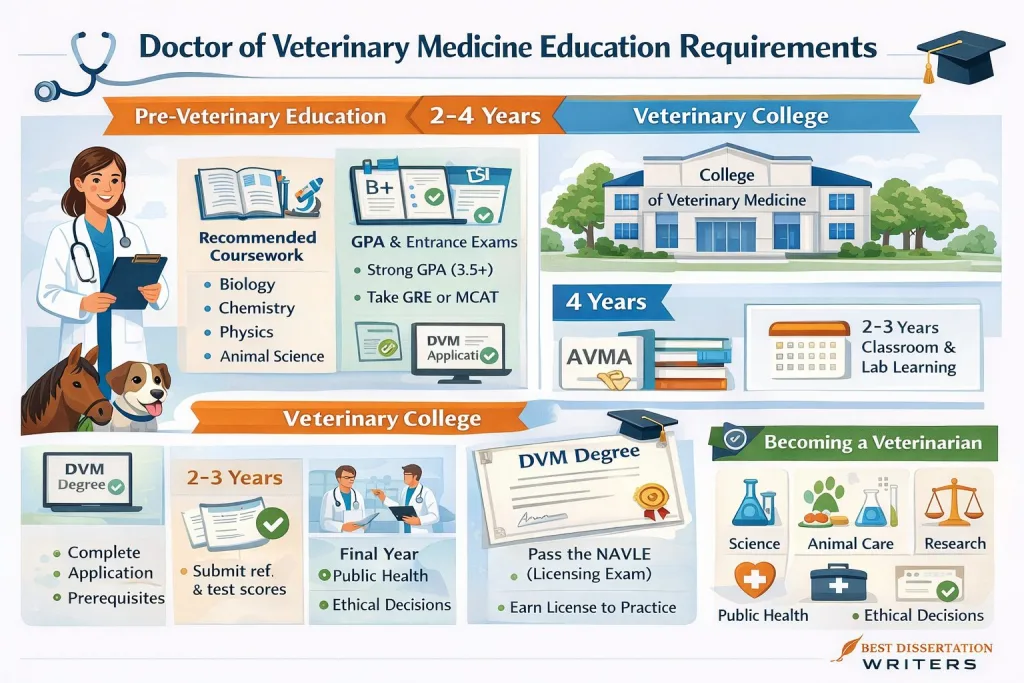
- In most cases, the doctor of veterinary medicine is a four-year program completed after four years of pre-professional preparation or equivalent undergraduate prerequisites.
- This means the full path to a veterinary degree program often includes several years of academic preparation before students begin the professional phase.
- The overall purpose is to develop competent, day-one, and practice-ready graduates who can serve the health of animals in many settings.
- The curriculum usually combines classroom instruction, lab work, applied learning, and clinical education.
- Early coursework often emphasizes biomedical and animal health sciences that form the base of veterinary medicine.
- As students move through the program, they begin applying this knowledge through team-based learning, case analysis, simulation, and supervised training.
- This approach supports critical thinking, problem-solving, and sound clinical reasoning, all of which are essential in veterinary practice.
- These methods reflect leading practices in veterinary medical education because they help students learn how to use knowledge in realistic settings.
- The progression through the curriculum is intentional and practical.
- In many programs, the third-year becomes more integrated and clinically focused, helping students transition from theory into patient-centered application.
- Students begin preparing for the clinical year, where they will rotate through different services and specialties.
- By the time they reach advanced stages of the doctor of veterinary medicine, they are expected to demonstrate greater independence, stronger clinical skills, and increasing competency in patient assessment and treatment planning.
- This structured progression helps create confident graduates who are ready for the demands of the profession.
Clinical Training in a College of Veterinary Medicine
- Clinical training is one of the most important parts of a doctor of veterinary medicine experience.
- A college of veterinary medicine often provides a learning environment where students can move from classroom-based learning into supervised patient care.
- This practical training helps students connect medical knowledge with the realities of diagnosis, treatment, and communication.
- It also gives students direct exposure to the pace and complexity of professional veterinary settings.
- For many students, this is where the transition from academic learner to future veterinarian becomes most visible.
- Much of this training takes place in a veterinary teaching hospital.
- A veterinary teaching hospital gives students access to real-world clinical cases under the guidance of experienced clinicians and instructional staff.
- Students may work with small animal, mixed animal, and equine patients, depending on the institution and its clinical resources.
- These settings are especially valuable because they allow students to observe routine care, urgent care, specialty services, and complex case management in one environment.
- This kind of hands-on clinical experience is central to preparing ready veterinarians.
- The clinical year is often organized through rotations.
- During the clinical year, students usually rotate through services such as surgery, internal medicine, emergency care, anesthesia, diagnostic imaging, and primary care.
- These rotations strengthen clinical skills by exposing students to varied medical problems, patient populations, and treatment plans.
- Students also gain practical experience with referral cases, which often involve more advanced diagnostics and specialty care.
- This training helps ensure graduates enter the profession with stronger confidence and better applied judgment.
- Clinical education also introduces students to broader professional responsibilities.
- Students learn how to manage cases involving infectious diseases, preventive medicine, and hospital safety protocols.
- They are often trained in biosecurity procedures to reduce the risk of disease spread in hospital and field settings.
- These experiences show students how veterinary medicine goes beyond technical treatment and includes safety, ethics, and population-level awareness.
- This balance helps produce professionals who are better prepared to protect both individual patients and the wider health of animals.
- Many schools also connect clinical training to the concept of one health.
- One health emphasizes the connection between animal health, human health, and environmental systems.
- In a doctor of veterinary medicine setting, this means students learn how animal disease, food systems, and public safety can affect communities.
- This perspective strengthens professional training by helping students understand the wider implications of veterinary care.
- It also helps prepare the next generation of veterinarians for a profession that is becoming increasingly interdisciplinary.
AVMA Accreditation and Excellence in Veterinary Education
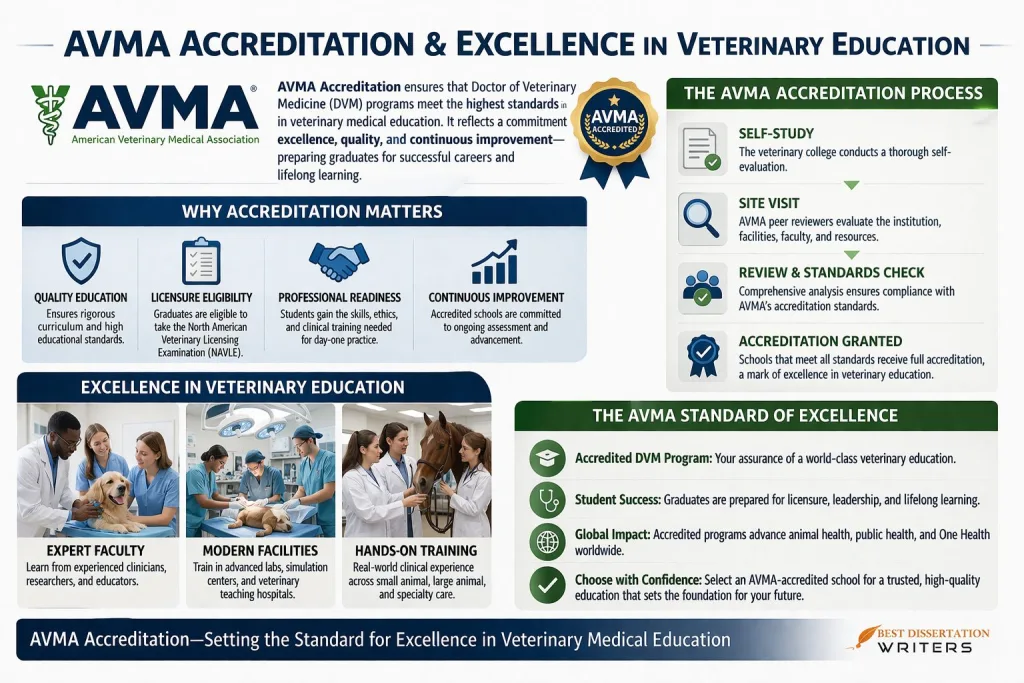
- Accreditation is one of the strongest indicators of quality in a doctor of veterinary medicine program.
- To accredit a program means to evaluate whether it meets established standards for curriculum, teaching, facilities, assessment, and student outcomes.
- In veterinary medicine, accreditation is closely tied to standards associated with the American Veterinary Medical Association.
- These standards help ensure that students in a doctor of veterinary medicine program receive an education that is rigorous, current, and professionally relevant.
- For prospective students, accreditation is often one of the most important factors to review when comparing schools.
- The accreditation process involves detailed review.
- Schools must demonstrate that their curriculum, clinical resources, student support systems, and outcomes align with accepted expectations for veterinary education.
- This process often includes documentation reviews, assessment of teaching quality, and a formal site visit.
- A site visit allows reviewers to examine facilities, clinical settings, academic systems, and overall institutional effectiveness.
- This helps confirm that a doctor of veterinary medicine pathway is prepared to train students to professional standards.
- Accreditation also supports excellence in teaching and outcomes.
- It encourages the use of evidence-based instruction, reliable assessment, and continuous quality improvement.
- Accredited schools are expected to maintain strong standards in both classroom teaching and clinical education.
- This ensures students are developing the knowledge, judgment, and competency needed for modern veterinary practice.
- In this way, accreditation supports the development of competent and confident graduates.
- Accreditation promotes long-term professional growth.
- A high-quality doctor of veterinary medicine program should not only prepare students for licensure, but also support lifelong learning.
- Veterinary medicine changes over time, so graduates must be able to keep learning, adapt to new evidence, and apply updated standards of care.
- Accredited programs help reinforce these habits by building strong academic and professional foundations from the beginning.
- This is essential for preparing the next generation of veterinarians to serve in a changing healthcare environment.
Faculty Support, Wellness, and Resources for Current Students
- Strong faculty support is a major part of student success in a doctor of veterinary medicine program.
- Faculty members often include clinicians, researchers, and educators who guide students through academic and clinical learning.
- Their work includes teaching core content, supervising rotations, mentoring students, and modeling professional behavior.
- This support helps students build confidence while improving their reasoning, communication, and practical performance.
- For many learners, faculty mentorship is one of the most valuable parts of the educational experience.
- Faculty also help students build professional habits.
- In addition to medical instruction, faculty often teach ethical decision-making, case communication, and professional accountability.
- These skills are essential because veterinary practice often requires balancing animal welfare, client expectations, cost concerns, and medical judgment.
- Through this guidance, students learn how to approach difficult decisions with professionalism and care.
- This makes faculty support important not only for academics, but also for character and career development.
- Resources for incoming and current students play a major role in the student experience.
- Many schools provide academic advising, tutoring, skills labs, and orientation support for incoming and current learners.
- These services help students adjust to the pace and expectations of a demanding professional environment.
- Schools may also provide career support, peer mentoring, and access to research or leadership opportunities.
- Together, these resources help students feel supported throughout the full doctor of veterinary medicine journey.
- Student well-being is now recognized as an essential part of veterinary education.
- A rigorous doctor of veterinary medicine program can be demanding, so wellness support is important for personal resilience and academic success.
- Many schools offer counseling, time-management support, peer programs, and wellness initiatives aimed at improving well-being.
- These services help students manage stress while staying engaged in a cutting-edge educational environment.
- Supporting well-being is an important part of developing sustainable, healthy, and reflective professionals.
Tuition and Costs in a Doctor of Veterinary Medicine Degree Program
- Tuition is a major consideration when evaluating a doctor of veterinary medicine pathway.
- The cost of a doctor of veterinary medicine can vary significantly depending on the school, residency status, and available clinical resources.
- Public institutions and private institutions may have very different tuition structures, and students should compare these carefully.
- In addition to base tuition, schools may charge fees related to labs, equipment, insurance, and clinical training.
- Reviewing these costs in advance helps prospective students make more informed choices.
- The total cost includes more than tuition alone.
- Students should also consider books, supplies, housing, transportation, food, and other living expenses over the duration of the four-year program.
- Because the educational pathway is intensive, managing these expenses requires planning and financial awareness.
- Looking at the full cost of attendance helps students better understand the real investment involved in earning a doctor of veterinary medicine.
- This broader view is important when comparing the value of one school to another.
- Cost should be considered alongside educational quality and outcomes.
- A school with strong faculty, robust clinical education, accreditation, and support services may provide greater long-term value than cost alone suggests.
- Students should assess whether a program offers strong preparation in hands-on clinical training, evidence-based learning, and professional readiness.
- Choosing a program is not only about affordability, but also about the quality of preparation for a future as a veterinarian.
- When students weigh tuition against academic support, student resources, and career readiness, they are better positioned to choose the right doctor of veterinary medicine program for their goals.
Career Paths and Salary After a Doctor of Veterinary Medicine Program
- A doctor of veterinary medicine opens the door to a wide range of professional paths beyond traditional animal care.
- While many people associate a doctor of veterinary medicine with private practice, the degree also supports careers in research, academia, government, industry, and public health.
- This makes the doctor of veterinary medicine a flexible professional credential for graduates with different interests, strengths, and long-term goals.
- Because the field continues to evolve, a doctor of veterinary medicine can lead to both established and emerging roles across animal and human health systems.
- For many graduates, the value of a doctor of veterinary medicine lies in its ability to combine purpose, versatility, and long-term professional growth.
- Career direction often depends on training, interests, and clinical exposure during the program.
- Some students enter veterinary school with a clear goal, such as companion animal practice or equine medicine.
- Others discover their interests during rotations, mentorship, research, or field experiences.
- The structure of a doctor of veterinary medicine program helps students explore different pathways while building a strong common foundation.
- This exploration is important because it helps graduates choose roles that match both their skills and professional values.
- The career outlook for DVM graduates remains broad because animal health services are needed in many sectors.
- Communities need veterinarians to care for pets, livestock, wildlife, and specialty species.
- Employers also need trained professionals who understand disease prevention, food systems, biosecurity, regulation, and population health.
- As a result, the doctor of veterinary medicine supports work in both direct patient care and larger health-related systems.
- This diversity makes the degree valuable for graduates seeking a meaningful and adaptable profession.
Need help writing about doctor of veterinary medicine topics? Best Dissertation Writers offers quick, professional support for essays, research papers, and dissertations.
Doctor of Veterinary Medicine Salary and Career Outlook
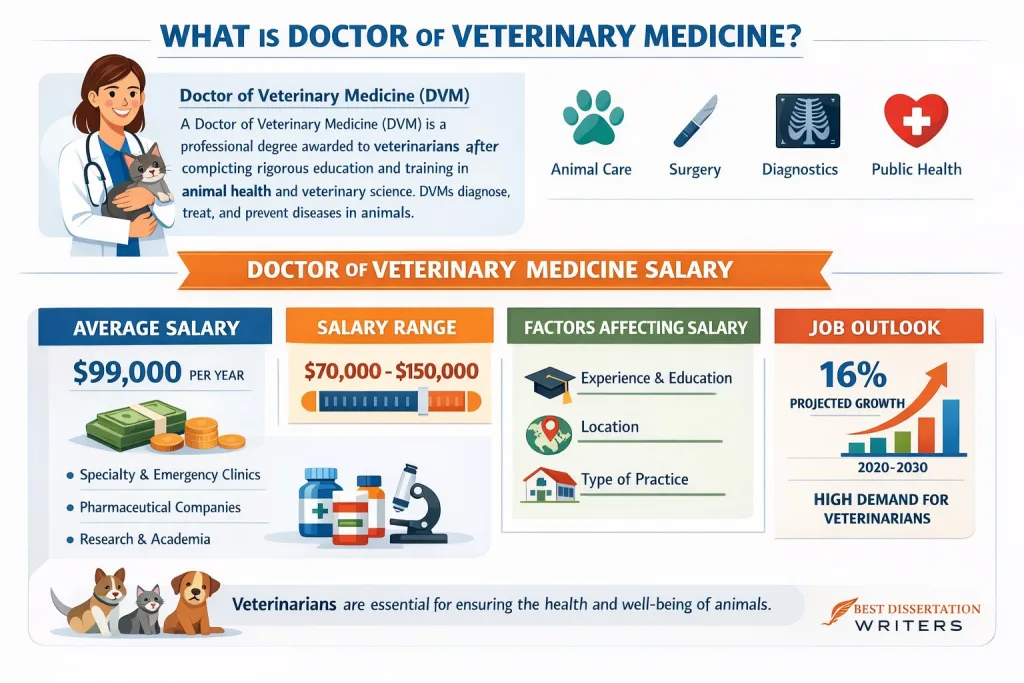
- Doctor of veterinary medicine salary can vary widely depending on several factors.
- Salary levels are often influenced by geographic location, practice type, years of experience, specialty training, and employment setting.
- A graduate working in a rural mixed animal practice may earn differently from one working in urban companion animal medicine or a government agency.
- Because of this, doctor of veterinary medicine salary should be viewed as a range rather than a single fixed number.
- Understanding these differences helps students set realistic expectations about income and growth over time.
- Type of practice is one of the biggest influences on earnings.
- Veterinarians in clinical practice may work in small animal, large animal, mixed animal, emergency, or specialty settings.
- General practice roles may offer one salary path, while emergency or board-certified specialty roles may offer another.
- Ownership, leadership responsibilities, and advanced certifications can also affect long-term earning potential.
- This means doctor of veterinary medicine salary often grows with experience, expertise, and professional development.
- Career outlook should be considered alongside salary, not separate from it.
- Some graduates may choose a path with moderate starting pay but strong long-term fulfillment, stability, or advancement potential.
- Others may prioritize a fast-paced specialty environment, research opportunities, or public service.
- The best career decision after earning a doctor of veterinary medicine often depends on how graduates balance compensation, lifestyle, interests, and impact.
- Looking at both salary and role satisfaction gives a more complete picture of career success.
- Financial growth may improve over time with added experience and credentials.
- New graduates often begin in entry-level positions where they continue developing confidence and practical skills.
- Over time, increased case responsibility, stronger efficiency, and additional training may lead to higher compensation.
- A doctor of veterinary medicine can also support advancement into leadership, ownership, consulting, or specialized fields.
- This means doctor of veterinary medicine salary is often tied not only to the first job, but also to long-term professional strategy.
Clinical and Public Health Opportunities for DVM Graduates
- Many graduates use a doctor of veterinary medicine to enter clinical practice.
- Clinical roles often include diagnosing illness, performing procedures, prescribing treatment, and guiding animal owners through preventive care.
- These roles may be found in private clinics, animal hospitals, specialty centers, emergency hospitals, and mobile veterinary services.
- For graduates who enjoy direct patient care and client interaction, clinical work remains one of the most common and rewarding paths.
- This is the career route most people picture when they think about a doctor of veterinary medicine.
- Clinical work itself offers several distinct options.
- Small animal practice focuses mainly on pets such as dogs and cats.
- Large animal and mixed animal practice may involve livestock, farm animals, and sometimes equine patients.
- Specialty and referral practice may involve fields such as surgery, oncology, cardiology, dermatology, or internal medicine.
- These choices allow graduates with a doctor of veterinary medicine to align their careers with the species, pace, and case complexity they prefer.
- A doctor of veterinary medicine also creates opportunities in public health.
- Veterinarians can contribute to food safety, disease surveillance, zoonotic disease response, regulatory systems, and community health education.
- These roles are especially important because animal health and human health are closely connected.
- In public service settings, DVM graduates may help monitor outbreaks, support biosecurity efforts, or contribute to policy and prevention strategies.
- This shows how a doctor of veterinary medicine can support population-level health as well as individual patient care.
- Non-clinical career paths are also valuable for DVM graduates.
- Some graduates move into research, pharmaceutical development, diagnostics, animal nutrition, or biomedical innovation.
- Others work in academia, training future veterinarians or contributing to veterinary education and scientific discovery.
- Government agencies, nonprofit organizations, and international health programs may also seek professionals with veterinary expertise.
- These roles demonstrate that a doctor of veterinary medicine can lead to influence far beyond the exam room.
How Faculty, Accreditation, and Excellence Shape Professional Growth
- Faculty support plays a major role in shaping professional direction after graduation.
- Faculty mentors often help students identify strengths, career interests, and opportunities for growth.
- Through teaching, supervision, and advising, they help students understand what different sectors of veterinary medicine require.
- This guidance can influence whether a student chooses general practice, advanced training, public service, or another professional path.
- In this way, faculty support can directly affect how a doctor of veterinary medicine translates into career success.
- Accreditation contributes to professional readiness and long-term credibility.
- A well-accredited doctor of veterinary medicine program helps ensure that graduates are trained to recognized academic and professional standards.
- This matters because employers and licensing systems depend on that educational quality.
- Accreditation also supports consistency in curriculum, clinical preparation, and student outcomes.
- As a result, it strengthens the foundation graduates need for both first-job readiness and future advancement.
- Excellence in training shapes confidence and growth after graduation.
- Students who experience strong curriculum design, robust clinical exposure, and supportive mentorship often enter the workforce with greater confidence.
- They are more likely to communicate effectively, solve problems under pressure, and continue learning as the field evolves.
- This kind of preparation is important because veterinary medicine requires both technical skill and adaptability.
- A high-quality doctor of veterinary medicine experience does not only prepare graduates to begin working; it prepares them to keep growing.
- Professional growth continues well beyond the degree itself.
- After earning a doctor of veterinary medicine, many professionals build additional expertise through internships, residencies, certifications, research, or leadership roles.
- Others expand their careers through teaching, mentoring, business ownership, or public service.
- The strongest graduates often see the doctor of veterinary medicine as the beginning of a professional journey rather than the final step.
- With the right support, experience, and commitment to excellence, the degree can lead to a long and impactful career.