

What Is Empirical Data – Key Takeaways
Empirical data refers to information collected through direct observation, experience, measurement, or experimentation rather than theory or intuition. It forms the foundation of scientific research and evidence‑based decision‑making across disciplines. Here’s a concise overview of its core elements:
- Definition & Core Concept:
- Empirical Data: Information gathered from the real world through observation, experiments, surveys, or measurements. It is grounded in sensory evidence rather than assumptions or abstract reasoning.
- How Empirical Data Is Collected:
- Observation: Recording what is seen, heard, or measured in natural or experimental settings.
- Experiments: Controlled procedures that manipulate variables to test hypotheses.
- Surveys/Questionnaires: Structured tools to collect responses from participants. These methods produce data that can be analyzed and verified.
- Types of Empirical Data:
- Quantitative Data: Numerical measurements used for statistical analysis and hypothesis testing.
- Qualitative Data: Descriptive information gathered from interviews, case studies, and observations that provide contextual insights.
- Both types support evidence‑based conclusions.
- Importance in Research & Decision‑Making:
- Empirical data enhances validity and reproducibility because findings are based on observable facts.
- It helps researchers and policymakers make reliable, data‑driven decisions rather than relying on subjective opinions.
- Transparent methods and reproducible results increase confidence in research outcomes.
- Practical Examples of Use:
- In healthcare, clinical trials collect empirical evidence to evaluate treatment effectiveness.
- In business, customer behavior is measured through surveys to inform strategy.
- Everyday decisions, like wearing a jacket based on observed temperature, involve empirical observations.
- Why Empirical Data Matters:
- It provides an objective basis for testing theories, answering research questions, and building scientific knowledge.
- Empirical data is often considered more trustworthy than anecdotal or theoretical information because it is observable and measurable.
Empirical data is foundational for building knowledge across scientific, academic, and practical fields. It enables researchers to move from theory to fact, ensuring conclusions and decisions are backed by solid, verifiable evidence.
Empirical Data Vs Empirical Research in Scientific Studies
What Is Empirical Research?
- Empirical research is a method of investigation that relies on direct experience, observation and experimentation, and measurable facts rather than assumption alone.
- The term empirical refers to knowledge gained from what is observable, testable, and verifiable in the real world.
- In academic writing, the definition of empirical usually emphasizes evidence that comes from actual study, rather than from purely theoretical discussion.
- Put simply, empirical research is based on collecting and interpreting real-world information through a structured research process.
- A researcher may begin with a hypothesis, review earlier empirical studies, and then select a suitable research design to test an idea.
- This approach is central to science because it helps scholars move from abstract questions to tested conclusions.
- For example:
- A psychology researcher may test whether sleep affects memory performance.
- A sociologist may use a survey to examine public attitudes toward social change.
- An education scholar may compare classroom strategies through case studies or an ethnographic research design.
- In each case, the goal is to gather reliable evidence and use it to support, refine, or challenge a claim.
What Is Empirical Data?
- Empirical data is the actual information collected during a study.
- It includes facts, measurements, responses, recordings, behaviors, and observations gathered during the investigation.
- While empirical research is the broader method, empirical data is the material produced by that method.
- This means a study may involve:
- numerical or statistical data
- interview responses
- field notes
- laboratory results
- images, texts, or documents used in textual analysis
- In scientific studies, empirical data gives researchers something concrete to evaluate.
- It turns a question into evidence and helps determine whether a hypothesis is supported.
- A study is empirical when it uses such evidence to answer a research question rather than relying only on opinion, speculation, or a purely theoretical argument.
- The idea also connects closely to empiricism, which holds that knowledge develops through experience and evidence.
- In simple terms:
- Empirical research is the method.
- Empirical data is the information collected.
- Empirical evidence is the meaning drawn from that information after careful analysis.
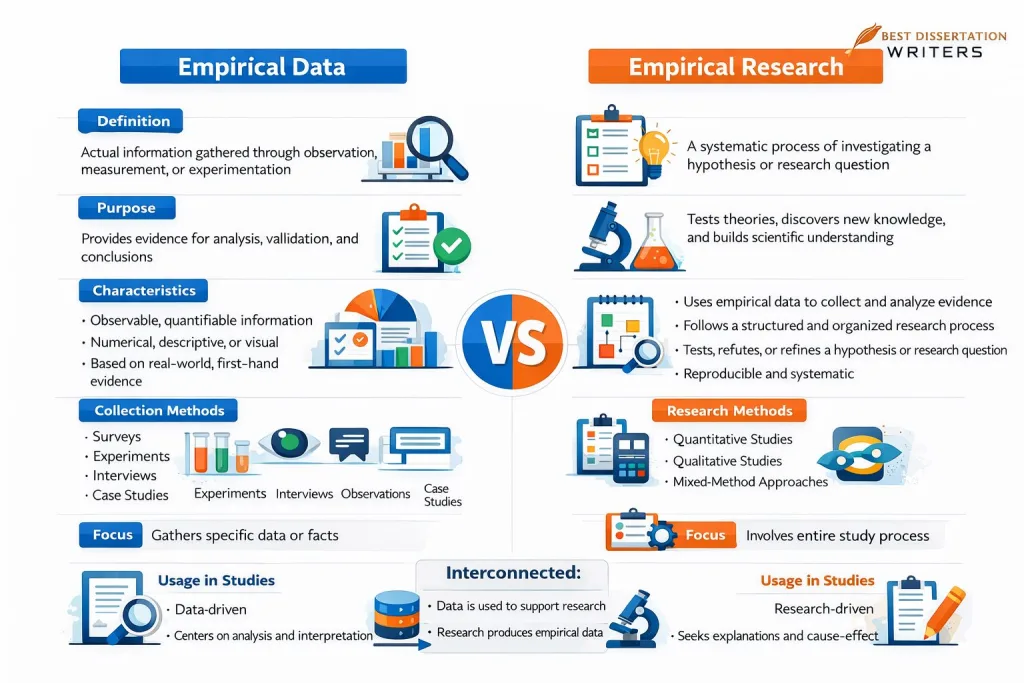
| Empirical Data | Empirical Research |
|---|---|
| Empirical data is the actual evidence collected from the real world. | Empirical research is the full study process that collects and analyzes that evidence. |
| It includes facts, observations, measurements, responses, and recorded experiences. | It includes the research question, methodology, data collection, analysis, and conclusions. |
| It is the material researchers work with during a study. | It is the structured approach researchers use to investigate a topic. |
| It can be qualitative or quantitative, such as interview answers, survey results, field notes, or test scores. | It can also be qualitative or quantitative, depending on how the study is designed. |
| Its main purpose is to provide observable support for an argument, claim, or finding. | Its main purpose is to answer a research question or test a hypothesis using real-world evidence. |
| It is one part of the research process. | It is the complete research process. |
| It answers the question: What evidence was collected? | It answers the question: How was the topic studied? |
| By itself, it does not explain the full study. | It gives meaning to the data by organizing, interpreting, and evaluating it. |
| Example: student survey responses, lab results, interview transcripts, or observation notes. | Example: an experiment, survey-based study, case study, or ethnographic investigation. |
Empirical data is the evidence, while empirical research is the method used to gather and interpret that evidence.
Why Empirical Evidence Matters in Science
- Empirical evidence matters because science depends on tested claims, not unsupported belief.
- Researchers use scientific evidence to assess whether an explanation fits reality.
- This is essential for building and refining scientific theory.
- The importance of empirical evidence can be seen in several ways:
- It tests ideas against reality
- A theory may seem logical, but science requires proof.
- Empirical data allows researchers to compare ideas with actual outcomes.
- It helps confirm or reject a hypothesis
- Through observation and experimentation, researchers examine whether the expected result appears.
- If the results do not support the prediction, the theory may need revision.
- It strengthens the concept of evidence
- In science, the concept of evidence is tied to what can be checked, repeated, and examined by others.
- This makes scientific conclusions more trustworthy.
- It reduces weak reasoning
- A claim supported by statistical results, field observations, or repeated experiments is stronger than a claim based only on assumption.
- This is why strong science values rigorous evidence collection and analysis.
- Sources such as Britannica, an encyclopedia, and university LibGuides often explain that scientific knowledge grows through tested and reviewable findings, not just abstract reasoning.
Need Help With Your Dissertation?
Get professional academic support from Best Dissertation Writers . Our expert team is ready to help you with high-quality dissertation writing services tailored to your academic goals.
Get Dissertation HelpHow Researchers Evaluate Empirical Findings
- Researchers carefully examine the strength of evidence before accepting conclusions.
- Even when a project produces useful empirical data, the quality of the findings depends on how the study was conducted.
- Key factors include:
- Research design
- A clear research design helps match the method to the question.
- Researchers ask whether the chosen approach fits the topic and whether it can produce meaningful evidence.
- Data quality
- Researchers examine whether the information is complete, relevant, and accurate.
- Weak or limited empirical data may lead to weak interpretations.
- Bias
- Bias can enter the study through sampling, observation, question wording, or interpretation.
- Good research tries to reduce bias so the results better reflect the real phenomenon under investigation.
- Analytical method
- Strong analytical methods are essential.
- Quantitative work may rely on statistical tests and comparison of statistical data.
- Qualitative work may involve coding, interpretation, and textual analysis.
- Connection to previous scholarship
- Researchers compare their work with earlier empirical studies through the literature review.
- This helps place the findings in a broader scholarly context.
- Strength of the conclusion
- Researchers ask whether the evidence truly supports the claim made in the article, report, or thesis.
- A sound conclusion should match the quality and scope of the data collected.
Verification in Empirical Research
- Verification is the process of checking whether findings are trustworthy and supported by sufficient evidence.
- In science, this step is necessary because one result alone may not be enough to establish reliable knowledge.
- Verification often includes:
- repeating experimentation
- comparing outcomes across studies
- reviewing methods for consistency
- checking whether results can be used to confirm a claim
- Verification is especially important when research aims to support or challenge a scientific theory.
- A rigorous study gives enough detail for others to examine the method and assess the quality of the evidence.
Key Empirical Data Examples
- Survey responses
- A survey on student stress levels generates percentages, ratings, and comments.
- These are forms of empirical data because they come directly from participants.
- Laboratory measurements
- Temperature changes, reaction times, or test scores collected during experimentation are empirical data.
- These measurements can later be used in data analysis.
- Observation notes
- A researcher recording classroom behavior gathers observable evidence from real-life situations.
- This may be especially useful in social science research.
- Texts and documents
- In some studies, written materials are examined using textual analysis.
- The extracted patterns or themes also function as empirical data.
Key Empirical Research Examples
- Correlational research
- A study examining the link between exercise and mood is an example of correlational research.
- It identifies relationships between variables without proving direct cause.
- Causal-comparative research
- A researcher comparing academic outcomes between two naturally occurring groups is using causal-comparative research.
- This helps explore possible explanations when experiments are not practical.
- Cross-sectional research
- A study collecting data from different age groups at one point in time is cross-sectional research.
- It allows efficient comparison across populations.
- Case studies
- Case studies provide deep analysis of one person, group, event, or institution.
- They are valuable when detailed understanding matters more than broad generalization.
- Ethnographic research design
- An ethnographic research design involves close observation of a group or community over time.
- It helps researchers understand behavior, meanings, and social patterns in natural settings.
- Together, these examples show that empirical research provides the framework for investigation, while empirical data provides the evidence that makes scientific understanding possible.
What Is the Process of Collecting Empirical Data?
The process of collecting empirical data follows a structured path that helps researchers gather real-world evidence in a clear, reliable, and meaningful way. In both science and the social sciences, empirical research depends on direct observation, measurement, and experience rather than theory alone. This makes the research process more rigorous, evidence-based, and suitable for testing a hypothesis or evaluating a specific phenomenon.
In simple terms, collecting empirical data means identifying a problem, choosing the right methodology, gathering observable information, and analyzing it carefully to reach a valid conclusion. Below is a clear 7-step process that explains how researchers collect and use empirical data in scientific studies.
7 Steps in the Process of Collecting Empirical Data
This process applies to many forms of empirical research, whether the study is qualitative, quantitative, or mixed-method in design. Each step plays an important role in making sure the evidence is useful, credible, and appropriate for the research question.
Step 1: Identify the Research Problem
The first step in collecting empirical data is to define the research problem clearly. This means identifying the issue, question, or phenomenon the researcher wants to study. A well-defined problem gives direction to the entire research process and helps determine what kind of empirical evidence will be needed.
At this stage, researchers often begin by reviewing the topic in context and asking what needs to be explained, measured, or evaluated. The clearer the problem, the easier it becomes to design a focused and rigorous study.
- It sets the foundation for the full research process.
- It helps narrow the scope of the study.
- It ensures that the empirical data collected will be relevant and purposeful.
Step 2: Form a Research Question or Hypothesis
Once the problem is identified, the next step is to create a research question or a hypothesis. The research question explains what the study wants to find out, while the hypothesis gives a prediction that can be tested through observation and experimentation.
This step is essential because it turns a broad topic into a focused investigation. In empirical research, a strong hypothesis helps researchers decide what kind of empirical data should be collected and how the evidence will later be used to confirm or challenge a claim.
- A research question guides exploration and analysis.
- A hypothesis helps test cause, pattern, or relationship.
- This step connects theoretical thinking with measurable investigation.
Step 3: Choose the Research Design
After defining the question, the researcher chooses an appropriate research design. This is the overall plan for how the study will be conducted. The design depends on the nature of the study, the type of data needed, and whether the research will follow a qualitative, quantitative, or mixed-method approach.
For example, a researcher may use surveys for broad numerical patterns, interviews for deeper personal insight, or experimentation for testing cause-effect relationships. Choosing the right design improves the quality of the empirical data and strengthens the final research findings.
- Qualitative design focuses on meaning, behavior, and context.
- Quantitative design focuses on measurement, variables, and statistical data.
- Mixed-method design combines both for broader understanding.
Step 4: Select the Data Collection Method
In this step, the researcher decides how the empirical data will actually be gathered. The method should match the research question, the study design, and the type of information needed. This is one of the most important parts of the process because the value of the final evidence depends heavily on how it is collected.
Common methods include surveys, interviews, observations, experiments, focus groups, case studies, and document analysis. Each method provides different forms of empirical evidence, so the choice should be based on relevance, accuracy, and the nature of the phenomenon being studied.
- Survey: useful for collecting responses from a large group.
- Interviews: helpful for detailed answers and personal experiences.
- Observation: useful for studying real-world behavior as it happens.
- Experimentation: ideal for testing a hypothesis in controlled conditions.
Step 5: Choose the Sample and Research Tools
The next step is to identify who or what will be studied and prepare the tools used to gather the evidence. The sample refers to the participants, cases, groups, or materials included in the study. The tools may include questionnaires, interview guides, observation checklists, lab instruments, or digital testing instruments.
A clear sampling method helps reduce bias and improves the credibility of the results. The tools must also be suitable for the study so that the empirical data collected is accurate, consistent, and useful for later data analysis.
- Select participants or sources that match the research purpose.
- Use appropriate instruments for gathering observable evidence.
- Make sure the process is organized and rigorous from the start.
Step 6: Collect and Record the Data
This is the stage where the researcher gathers the actual empirical data. Depending on the study, this may involve asking survey questions, conducting interviews, observing behavior, measuring outcomes, or recording results from experimentation.
It is important to collect and record the information systematically so that it can be used reliably during analysis. Poor record-keeping can weaken the study, even if the research design was strong. Researchers therefore often use forms, spreadsheets, transcripts, coding sheets, or software tools to store the collected evidence.
- Record all information clearly and consistently.
- Organize responses, measurements, or observations in a usable format.
- Protect the quality of the empirical data for later evaluation and verification.
Step 7: Analyze and Interpret the Data
Once the empirical data has been collected, the final step is to analyze and interpret it. This means examining the evidence to find patterns, relationships, meanings, or trends. In quantitative studies, this may involve statistical analysis. In qualitative studies, it may involve thematic coding, comparison, or interpretation of responses and observations.
The goal is to use the data to answer the research question or test the hypothesis. At this stage, researchers also evaluate the strength of the evidence, consider possible bias, and determine whether the findings support a broader scientific explanation or conclusion.
- Use data analysis to identify useful patterns and relationships.
- Interpret the findings in relation to the original research problem.
- Decide whether the evidence helps confirm, revise, or reject the hypothesis.
Why This Process Matters in Empirical Research
A structured process for collecting empirical data is important because it improves the accuracy, reliability, and educational value of a study. Empirical research is based on observable facts, not on assumption alone. When researchers follow a clear process, they are more likely to produce rigorous findings that others can evaluate, replicate, and use in future studies.
This is especially important in science, where empirical evidence is used to test ideas, build knowledge, and support scientific theory. It is also important in the social sciences, where researchers often need to interpret human behavior, context, and meaning while still relying on well-organized evidence.
Quick Summary Table
| Step | What Happens | Why It Matters |
|---|---|---|
| 1. Identify the problem | Define what needs to be studied. | Creates focus and direction. |
| 2. Form the question or hypothesis | State what the study aims to answer or test. | Guides the investigation. |
| 3. Choose the research design | Select the methodology and study structure. | Ensures the right approach is used. |
| 4. Select collection method | Choose surveys, observation, interviews, or experiments. | Determines the type of empirical evidence gathered. |
| 5. Choose sample and tools | Identify participants and prepare instruments. | Improves relevance and consistency. |
| 6. Collect and record data | Gather and organize the empirical data. | Preserves quality for analysis. |
| 7. Analyze and interpret | Examine patterns and explain findings. | Turns raw data into useful knowledge. |
Final Note
The process of collecting empirical data is more than just gathering facts. It is a careful and structured method for producing reliable evidence that can support analysis, interpretation, and scientific understanding. When done properly, empirical research helps transform real-world observation into meaningful knowledge that is educational, testable, and valuable across many fields of study.
Qualitative and Quantitative Research Methodology
- Qualitative and quantitative research methodology refers to the structured ways researchers collect, interpret, and present evidence in a study.
- In simple terms, methodology explains how the study is carried out, why certain methods are selected, and how the research findings are validated.
- In many academic fields, both approaches are used to understand the external world, test ideas, and produce knowledge that is based on experience rather than only on theory or belief.
- This links closely to evidentialism, which emphasizes that conclusions should rest on evidence rather than unsupported claims.
- In practice, a strong methodology helps researchers apply the scientific method, make careful inference, and organize the study in a logical form, often following structures such as IMRAD in formal writing.
- For any researcher working with empirical data, methodology is not just a technical choice. It shapes what kind of evidence can be gathered, how that evidence is analyzed, and how persuasive the final conclusion will be.
What Is Qualitative Research?
- Qualitative research is a method used to explore meaning, experience, behavior, and interpretation in depth.
- It focuses on non-numerical evidence and is especially useful when researchers want to understand how people think, feel, or act in specific situations.
- Rather than relying mainly on numbers, qualitative work examines language, behavior, social interaction, and setting.
- This means qualitative research is often:
- observational
- interpretive
- context-sensitive
- rich in description
- Researchers commonly use qualitative methods when they want to understand a complex issue that cannot easily be reduced to measurement.
- Common methods include:
- focus groups, where several participants discuss a topic together
- interviews, where researchers ask open-ended questions
- field observation, where behavior is examined in real settings
- document or content analysis, where written materials are studied
- For example:
- A researcher may use focus groups to understand how university students feel about remote learning.
- A public health scholar may observe how a local community responds to a vaccination campaign.
- A media researcher may analyze articles, online posts, or policy texts to identify recurring themes.
- Qualitative research is valuable because it produces detailed insight that numbers alone may miss.
- It often explains the “why” and “how” behind social patterns.
- In many previous studies, qualitative methods have helped researchers identify motives, experiences, and meanings that later guide broader investigation.
- Because qualitative work relies heavily on interpretation, researchers must be clear about their methodological choices, participant recruitment, and coding process.
- This may include stating including selection criteria for participants, describing the context of the study, and explaining how validation was handled.
What Is Quantitative Research?
- Quantitative research is a method that focuses on numerical measurement, patterns, comparisons, and statistical testing.
- It is used when a researcher wants to measure variables, estimate relationships, or test whether one factor influences another.
- This approach is often associated with the scientific method because it emphasizes structure, measurement, and repeatable procedures.
- Quantitative research usually involves:
- numerical surveys
- experiments
- large datasets
- structured observations
- formal testing instruments
- This type of research is often more mathematical and computational than qualitative work.
- Researchers use it to examine trends, calculate differences, and make broader claims about populations.
- For example:
- A researcher may distribute a questionnaire to 1,000 respondents and analyze the results statistically.
- A psychologist may run scientific experimentation to test whether sleep affects memory performance.
- An economist may use national data to examine income and employment patterns over time.
- Quantitative research is especially useful for identifying cause-effect relationships, testing a hypothesis, and estimating generalizability across larger groups.
- It often uses analytical tools such as statistical software, modeling techniques, charts, and structured measurement scales.
- In some cases, researchers also conduct longitudinal studies, which track participants over time to observe change, development, or repeated patterns.
- These methods help strengthen the reliability of empirical data because they produce consistent measures that can be compared and tested.
- When reporting quantitative work, researchers often explain sampling, variable definition, measurement tools, and replication procedures so that others can assess the strength of the evidence.
Need Help With Your Dissertation?
Get professional academic support from Best Dissertation Writers . Our expert team is ready to help you with high-quality dissertation writing services tailored to your academic goals.
Get Dissertation HelpQualitative and Quantitative Research: Key Differences
- Although both approaches aim to produce knowledge, they differ in purpose, data type, and style of analysis.
- Understanding these differences helps readers interpret empirical data more effectively.
- Type of data
- Qualitative research uses words, observations, discussions, and interpretations.
- Quantitative research uses numbers, counts, percentages, and measurable variables.
- Main purpose
- Qualitative research explores meanings, perceptions, and experiences.
- Quantitative research measures patterns, tests relationships, and supports formal inference.
- Research logic
- Qualitative work often develops insights from the ground up.
- Quantitative work may follow a more deductive pattern, where a researcher starts with a hypothesis and then tests it using evidence.
- In this sense, it often connects more directly with deduction and formal testing.
- Methods used
- Qualitative studies often rely on interviews, focus groups, observations, and textual interpretation.
- Quantitative studies often rely on surveys, experiments, structured datasets, and standardized testing instruments.
- Outcome produced
- Qualitative studies produce rich explanation and contextual understanding.
- Quantitative studies produce measurable comparisons and more formalized conclusions.
- Strength of application
- Qualitative work is strong when exploring depth and context.
- Quantitative work is strong when testing scope, trend, and generalizability.
- These differences do not mean one method is better than the other.
- Instead, each approach answers different types of questions and serves different research goals.
- In both cases, careful methodology is necessary for producing trustworthy research findings from empirical data.
Choosing the Right Methodology
- Choosing the right methodology depends on the question being asked, the type of evidence needed, and the purpose of the study.
- Researchers usually make this choice by considering several factors:
- Nature of the research question
- If the goal is to understand experiences or meanings, qualitative methods may be more suitable.
- If the goal is to test relationships, compare groups, or estimate patterns, quantitative methods may be stronger.
- Type of evidence needed
- Studies requiring detailed explanation often benefit from interviews or observations.
- Studies requiring measurable comparison often benefit from surveys, experiments, or numerical datasets.
- Availability of tools and participants
- Some methods require large samples, specialized software, or specific analytical tools.
- Others depend more on access to participants, settings, and narrative materials.
- Need for validation and replication
- If a study aims for stronger replication and wider generalizability, quantitative methods may offer advantages.
- If a study seeks depth and interpretive understanding, qualitative methods may be more appropriate, though careful validation is still essential.
- Relationship to previous research
- Researchers often review previous studies, publisher resources such as Routledge, a field handbook, or academic library guides to determine which methods are commonly accepted in the field.
- These sources help researchers justify their methodological choices and align the study with scholarly standards.
Using Qualitative and Quantitative Research Together
- In many cases, the strongest studies use both qualitative and quantitative approaches together.
- This is often called a mixed-method strategy, and it allows researchers to combine breadth with depth.
- Using both methods together can improve the quality of empirical data and strengthen the final interpretation.
- Quantitative data provides measurement
- Numerical evidence can show patterns, frequencies, and relationships across a large sample.
- This helps researchers identify broad trends and possible cause-effect relationships.
- Qualitative data provides explanation
- Interviews, focus groups, or observations can explain why those patterns appear and how participants understand them.
- This adds meaning to the numbers.
- Together they improve interpretation
- Quantitative evidence may show that a pattern exists.
- Qualitative evidence may explain the social or personal reasons behind it.
- This makes the final research findings more complete.
- Together they support stronger validation
- When results from different methods point in the same direction, the findings often become more persuasive.
- This strengthens the credibility of the conclusions drawn from empirical data.
- For example:
- A study on online learning may begin with a survey measuring student satisfaction.
- The researcher may then conduct interviews or focus groups to understand the reasons behind the responses.
- The combination produces both measurable trends and detailed explanation.
- Overall, qualitative and quantitative methods are not rivals. They are complementary tools within the broader scientific method.
- When selected carefully and applied with clarity, both approaches help researchers move from theory or belief to evidence, from assumption to tested explanation, and from raw empirical data to meaningful knowledge.