

Best College Majors in 2026 – Key Takeaways
Choosing the right college major can shape your career trajectory by aligning your interests with job market demand, salary potential, and long‑term growth opportunities. The article highlights high‑demand fields with strong employment prospects and earnings, helping students make informed decisions about their academic pathways.
- What Makes a College Major “Best”:
- Best majors combine job growth, high earning potential, and skill relevance in the modern economy.
- Fields like STEM, healthcare, business, and technology consistently rank as top choices due to strong demand and career opportunity.
- Top College Majors for 2026:
- Computer Science – careers in software development, AI, and cybersecurity.
- Data Science & Information Systems – high demand for data analysis and IT management.
- Engineering (Electrical, Mechanical, Chemical) – technical problem‑solving and design roles.
- Nursing & Healthcare Administration – strong growth in healthcare services.
- Business & Finance – versatile majors with opportunities in management and corporate finance.
- Cybersecurity – critical need for digital protection and risk management specialists.
- Salary & Job Market Trends:
- Majors in data science, cybersecurity, and nursing tend to have higher median salaries and growth projections.
- Technical and analytical skills remain highly valued by employers across industries.
- How to Choose the Right Major:
- Assess your interests, strengths, and career goals to find a major that keeps you engaged and motivated.
- Research job market trends and future employment projections to ensure demand for your chosen field.
- Consider majors that integrate hands‑on learning, internships, and real‑world experience for better job readiness.
- Importance of Career Alignment:
- Selecting a major aligned with your passion, strengths, and long‑term career vision increases the likelihood of satisfaction and success post‑graduation.
- Flexibility and skill adaptability are key as technology and industries constantly evolve.
Choosing a college major is a significant decision that can influence your career success and job satisfaction. By focusing on high-demand fields and aligning your personal interests with market trends, you can set yourself up for a fulfilling and prosperous future.
What Makes a College Major the Best College Major in 2026?
- High Demand in the Job Market
- Best college majors in 2026 are aligned with sustained job growth, ensuring strong hiring trends for graduates.
- Fields such as healthcare, computer science majors, and STEM disciplines are projected to grow faster than the national average due to technological advancements, an aging population, and expanding industries.
- Clear Career Opportunities After Graduation
- Majors that lead to clear career opportunities, such as nurse practitioners, data scientists, and information systems professionals, rank highly among best college majors.
- These majors equip students with skills that employers need now and in the future, helping graduates secure jobs quickly after college.
- High Earning Potential and Salary Trends
- One of the defining features of the best college majors is strong salary potential, including both starting salaries and median salary growth throughout a career.
- STEM fields, biomedical engineering, and healthcare majors tend to offer median salaries well above the national average.
- Skill Relevance and Problem-Solving
- Strong majors focus on developing critical thinking, data analysis, hands-on learning, and problem-solving skills.
- Employers value these skills highly, as they prepare graduates to tackle real-world challenges in their professions.
- Adaptability to Future Trends
- The job market of 2026, influenced by artificial intelligence, automation, and digital transformation, favors graduates who can continuously learn and adapt.
- Majors that provide real-world experience, such as internships or data science projects, help students remain competitive even as job requirements evolve.
Best College Majors for the Future vs Traditional Fields of Study: High-Demand Fields of Study
Here are 20 of the best college majors for 2026, with explanations of why they are top college majors and the potential career outcomes for each:
- Computer Science
- Prepares students for software development, cybersecurity, artificial intelligence, and machine learning.
- Equips graduates with coding, problem-solving, and data analysis skills.
- Career Outcomes: Software developer, AI engineer, cybersecurity analyst, systems architect, cloud engineer.
- Computer Engineering
- Combines software programming with hardware design to develop digital systems and electronics.
- Provides hands-on skills for designing and testing technology solutions.
- Career Outcomes: Hardware engineer, embedded systems engineer, robotics engineer, IoT developer, systems engineer.
- Data Science
- Trains students to analyze and interpret large datasets, using predictive modeling and statistical techniques.
- Focuses on developing analytical thinking, problem-solving, and data visualization skills.
- Career Outcomes: Data scientist, business intelligence analyst, data analyst, machine learning engineer, quantitative analyst.
- Information Systems
- Integrates technology with business operations to optimize organizational performance.
- Teaches IT management, system analysis, and digital problem-solving.
- Career Outcomes: IT manager, systems analyst, information security analyst, business analyst, technology consultant.
- Electrical Engineering
- Covers electrical circuits, digital systems, power distribution, and communications technology.
- Develops critical thinking and hands-on engineering skills.
- Career Outcomes: Electrical engineer, power systems engineer, telecommunications engineer, control systems engineer, electronics designer.
- Biomedical Engineering
- Combines healthcare and engineering to design medical devices, diagnostics, and healthcare technologies.
- Students gain experience in medical technology and medical device development.
- Career Outcomes: Biomedical engineer, medical device designer, clinical engineer, research scientist, healthcare technology consultant.
- Mechanical Engineering
- Teaches design, manufacturing, thermodynamics, and materials science.
- Encourages problem-solving and hands-on experimentation.
- Career Outcomes: Mechanical engineer, automotive engineer, aerospace engineer, product design engineer, manufacturing engineer.
- Chemical Engineering
- Focuses on chemical processes for pharmaceuticals, energy production, and materials development.
- Prepares students to solve complex industrial and laboratory problems.
- Career Outcomes: Process engineer, chemical engineer, pharmaceutical engineer, environmental engineer, research scientist.
- Nursing (BSN)
- Provides clinical training and skills for direct patient care.
- Prepares students to meet the growing demand for healthcare professionals.
- Career Outcomes: Registered nurse, clinical nurse specialist, nurse educator, case manager, hospital staff nurse.
- Nurse Practitioners (Graduate)
- Offers advanced clinical and leadership skills for managing patient care.
- Focuses on diagnostic, treatment, and healthcare management skills.
- Career Outcomes: Nurse practitioner, family nurse practitioner, pediatric nurse practitioner, nurse manager, healthcare consultant.
- Healthcare Administration
- Teaches management, policy, finance, and operations in healthcare settings.
- Prepares graduates to lead hospitals, clinics, and healthcare programs.
- Career Outcomes: Healthcare administrator, hospital manager, clinic director, health services manager, policy analyst.
- Finance
- Develops skills in financial analysis, investment strategy, and corporate finance.
- Focuses on strategic decision-making and economic problem-solving.
- Career Outcomes: Financial analyst, investment banker, financial planner, risk analyst, corporate finance manager.
- Business Administration
- Provides broad management and leadership skills for multiple industries.
- Emphasizes problem-solving, project management, and organizational leadership.
- Career Outcomes: Business manager, operations manager, project manager, management consultant, entrepreneur.
- Human Resources
- Prepares graduates to manage recruitment, employee development, and workplace culture.
- Teaches communication, conflict resolution, and organizational strategy.
- Career Outcomes: HR manager, talent acquisition specialist, employee relations manager, training and development coordinator, HR consultant.
- Economics
- Focuses on market analysis, economic policy, and forecasting.
- Develops analytical and quantitative skills for business and government roles.
- Career Outcomes: Economist, policy analyst, financial analyst, market researcher, economic consultant.
- Statistics and Applied Mathematics
- Trains students to use statistical and mathematical models to solve complex problems.
- Prepares graduates for data-driven decision-making roles.
- Career Outcomes: Statistician, data analyst, actuary, quantitative researcher, operations research analyst.
- Cybersecurity
- Focuses on protecting systems from cyber threats, vulnerabilities, and attacks.
- Students gain skills in digital security, risk assessment, and threat management.
- Career Outcomes: Cybersecurity analyst, information security manager, penetration tester, network security engineer, chief information security officer.
- Physics
- Provides foundational knowledge in mechanics, electromagnetism, and quantum theory.
- Prepares students for analytical and research-oriented roles.
- Career Outcomes: Physicist, research scientist, laboratory technician, aerospace engineer, data analyst.
- Marketing
- Teaches branding, consumer behavior, market research, and digital marketing strategies.
- Focuses on data-driven decision-making and real-world campaign management.
- Career Outcomes: Marketing manager, brand strategist, digital marketing specialist, market researcher, advertising coordinator.
- Industrial and Systems Engineering
- Teaches process optimization, workflow management, and systems efficiency.
- Students learn to integrate technology, human factors, and operational research.
- Career Outcomes: Industrial engineer, systems analyst, supply chain manager, operations manager, process improvement consultant.
Best College Majors 2026 and Top Universities
Prepare for careers in software development, artificial intelligence, cybersecurity, and data analytics. Develop strong problem-solving, programming, and analytical skills for high-demand roles.
Top Universities:
Explore mechanical, electrical, civil, and chemical engineering. Develop technical problem-solving skills and hands-on experience that prepare you for innovation, design, and infrastructure roles.
Top Universities:
Prepare for healthcare roles including patient care, clinical research, and administration. Programs combine classroom instruction with hands-on clinical experience to equip students for high-demand jobs.
Top Universities:
Gain leadership, analytical, and management skills. Careers in finance, marketing, consulting, and entrepreneurship benefit from strong problem-solving and decision-making skills.
Top Universities:
Learn to extract insights from data using statistics, analytics, and machine learning. Data scientists are in high demand across industries like finance, tech, healthcare, and consulting.
Top Universities:
Focus on integrating business processes with technology. Develop skills in systems analysis, IT management, and digital problem-solving for corporate leadership roles.
Top Universities:
Combine engineering and healthcare to design medical devices and diagnostics. Programs emphasize lab work, clinical applications, and innovation in medical technology.
Top Universities:
Develop skills in media, public relations, and strategic communication. Careers span marketing, media, journalism, and corporate communication with high **job opportunities**.
Top Universities:
Study markets, policies, and data analysis to prepare for careers in finance, consulting, and public policy. Graduates develop analytical and decision-making skills that are **transferable across industries**.
Top Universities:
Learn to protect digital systems from cyber threats. Programs emphasize risk assessment, network security, and ethical hacking, preparing students for **high-demand, well-paying jobs**.
Top Universities:
Salary and Job Market Trends by College Major
This section provides detailed median salary data, job market trends, and potential career outcomes for each of the best college majors for 2026. The information reflects industry trends, high-demand sectors, and future projections, helping students understand the earning potential and career opportunities associated with each field of study.
1. Computer Science
- Median Salary: $78,000–$90,000 starting; early-career $120,000+; mid-career $130,000–$150,000.
- Job Market Trend: Very strong demand due to digital transformation, AI, cloud computing, and cybersecurity needs; projected growth 22% through 2026.
- Key Skills Developed: Programming, data analysis, algorithmic problem-solving, software development.
- Industry Trends: AI, machine learning, and automation are driving continuous demand across tech, healthcare, finance, and government sectors.
- Job Market Considerations: High demand in metropolitan tech hubs; remote work opportunities are expanding.
2. Computer Engineering
- Median Salary: $80,000–$95,000 starting; mid-career $120,000–$140,000.
- Job Market Trend: Increasing demand for embedded systems, robotics, and smart devices; projected growth 8–10% through 2026.
- Key Skills Developed: Hardware and software integration, systems design, troubleshooting, hands-on engineering.
- Industry Trends: Expansion of robotics, IoT, and smart devices boosts employment opportunities.
- Job Market Considerations: Concentrated demand in technology manufacturing centers and electronics industries.
3. Data Science
- Median Salary: $112,590 average; early-career $110,000+; mid-career $135,000–$150,000.
- Job Market Trend: Rapid growth as companies leverage big data and predictive analytics; projected growth 31% through 2026.
- Key Skills Developed: Data analysis, statistics, machine learning, data visualization, critical thinking.
- Industry Trends: Strong demand in finance, healthcare, consulting, and technology; AI integration increases the need for skilled analysts.
- Job Market Considerations: Practical experience with datasets and proficiency in Python, R, SQL, and cloud platforms highly valued.
4. Information Systems
- Median Salary: $65,000–$80,000 starting; mid-career $100,000+.
- Job Market Trend: Growing demand for IT managers, systems analysts, and tech consultants; projected growth 11–13%.
- Key Skills Developed: Systems analysis, IT management, business-technology integration, troubleshooting.
- Industry Trends: Digital transformation and business process optimization increase demand for IS professionals.
- Job Market Considerations: Employers favor graduates who understand both business and technology.
Need Help With Your Dissertation?
Get professional academic support from Best Dissertation Writers . Our expert team is ready to help you with high-quality dissertation writing services tailored to your academic goals.
Get Dissertation Help5. Electrical Engineering
- Median Salary: $70,000–$95,000 starting; mid-career $100,000+.
- Job Market Trend: Steady growth from energy, communications, and automation industries; projected growth 7–9%.
- Key Skills Developed: Circuit design, digital systems, problem-solving, hands-on lab experience.
- Industry Trends: Renewable energy, telecommunications, and IoT expansion increase employment opportunities.
- Job Market Considerations: High demand in manufacturing, energy, and technology hubs.
6. Mechanical Engineering
- Median Salary: $68,000–$90,000 starting; mid-career $100,000+.
- Job Market Trend: Strong growth in manufacturing, aerospace, automotive, and industrial design; projected growth 6–8%.
- Key Skills Developed: Thermodynamics, design, materials science, problem-solving, hands-on experimentation.
- Industry Trends: Automation, robotics, and sustainable manufacturing drive demand.
- Job Market Considerations: Graduates with interdisciplinary knowledge (mechatronics, CAD) are highly competitive.
7. Chemical Engineering
- Median Salary: $72,000–$95,000 starting; mid-career $110,000+.
- Job Market Trend: Consistent growth due to pharmaceuticals, energy, and materials sectors; projected growth 6–7%.
- Key Skills Developed: Process engineering, safety management, analytical problem-solving, laboratory skills.
- Industry Trends: Renewable energy, sustainable chemical production, and pharmaceuticals drive demand.
- Job Market Considerations: Positions concentrated in chemical plants, pharmaceutical companies, and research labs.
8. Industrial and Systems Engineering
- Median Salary: $70,000–$92,000 starting; mid-career $110,000+.
- Job Market Trend: Strong growth in logistics, manufacturing, and supply chain optimization; projected growth 10–12%.
- Key Skills Developed: Workflow analysis, process optimization, systems thinking, analytical problem-solving.
- Industry Trends: Companies are seeking efficiency improvements in production, warehousing, and operations.
- Job Market Considerations: High demand for graduates with ERP, Lean, and Six Sigma experience.
9. Biomedical Engineering
- Median Salary: $75,000 starting; mid-career $100,000+.
- Job Market Trend: High demand in healthcare, medical devices, and research; projected growth 10–13%.
- Key Skills Developed: Medical device design, healthcare technology, clinical research, problem-solving.
- Industry Trends: Rapid medical technology innovation, including wearables, diagnostics, and medical robotics.
- Job Market Considerations: Positions concentrated in hospitals, medical device companies, and research labs.
10. Nursing (BSN)
- Median Salary: $93,600 average; early-career $70,000–$80,000; mid-career $100,000+.
- Job Market Trend: Sustained high demand due to aging population and healthcare expansion; projected growth 15% through 2026.
- Key Skills Developed: Patient care, clinical decision-making, communication, critical thinking.
- Industry Trends: Expansion of hospitals, outpatient clinics, and telehealth services.
- Job Market Considerations: High demand nationwide, especially in rural and underserved regions.
11. Nurse Practitioners (Graduate)
- Median Salary: $110,000+ starting; experienced $130,000–$150,000.
- Job Market Trend: Very high demand for advanced clinical care; projected growth 26–28%.
- Key Skills Developed: Diagnostic assessment, treatment planning, leadership, patient management.
- Industry Trends: Expanded roles in primary care, telehealth, and specialized healthcare services.
- Job Market Considerations: Opportunities concentrated in clinics, hospitals, and private practices.
12. Healthcare Administration
- Median Salary: $80,000–$100,000 starting; mid-career $120,000+.
- Job Market Trend: Increasing need for management of healthcare organizations; projected growth 18%.
- Key Skills Developed: Leadership, financial management, policy implementation, operational efficiency.
- Industry Trends: Healthcare system expansion and regulatory compliance drive demand.
- Job Market Considerations: Urban hospitals, clinics, and large healthcare networks offer most opportunities.
13. Finance
- Median Salary: $60,000+ starting; mid-career $100,000–$120,000.
- Job Market Trend: Stable demand in corporate finance, investment, and banking; projected growth 7–9%.
- Key Skills Developed: Financial analysis, investment strategy, quantitative problem-solving, decision-making.
- Industry Trends: Digital finance, fintech, and data-driven investing increase demand.
- Job Market Considerations: High competition for entry-level analyst positions; professional certifications help.
14. Business Administration
- Median Salary: $60,000–$75,000 starting; mid-career $100,000–$120,000.
- Job Market Trend: Consistent demand for management roles; projected growth 8–10%.
- Key Skills Developed: Leadership, strategic planning, project management, communication.
- Industry Trends: Organizational efficiency and entrepreneurship drive demand for versatile managers.
- Job Market Considerations: Broad applicability across industries; experience in analytics or digital tools boosts employability.
15. Human Resources
- Median Salary: $65,000–$80,000 starting; mid-career $95,000–$110,000.
- Job Market Trend: Steady demand as companies invest in talent acquisition and workforce development; projected growth 6–8%.
- Key Skills Developed: Employee relations, conflict resolution, organizational strategy, communication.
- Industry Trends: Digital HR platforms and remote workforce management are increasing demand for skilled HR professionals.
- Job Market Considerations: High demand in corporate, healthcare, and technology sectors.
16. Economics
- Median Salary: $70,000–$90,000 starting; mid-career $110,000+.
- Job Market Trend: Strong demand for analytical skills in finance, policy, and consulting; projected growth 6–8%.
- Key Skills Developed: Market analysis, forecasting, quantitative reasoning, problem-solving.
- Industry Trends: Increasing focus on data-driven decision-making in government and corporate sectors.
- Job Market Considerations: Versatile degree; demand highest in financial and consulting hubs.
17. Statistics and Applied Mathematics
- Median Salary: $70,000–$85,000 starting; mid-career $110,000+.
- Job Market Trend: High growth in data-driven industries; projected growth 30%+.
- Key Skills Developed: Statistical modeling, data analysis, problem-solving, quantitative reasoning.
- Industry Trends: Analytics, AI, and data visualization tools increase demand for mathematically skilled professionals.
- Job Market Considerations: Opportunities across finance, tech, healthcare, and government.
18. Cybersecurity
- Median Salary: $100,000+ starting; mid-career $130,000–$140,000.
- Job Market Trend: Rapid growth due to rising cyber threats; projected growth 31–32%.
- Key Skills Developed: Threat analysis, risk assessment, network defense, problem-solving.
- Industry Trends: Increasing adoption of cloud services, AI, and digital platforms drives cybersecurity demand.
- Job Market Considerations: High demand in corporate, government, and tech sectors; certifications improve employability.
19. Physics
- Median Salary: $57,000–$110,000 mid-career.
- Job Market Trend: Steady growth for research, engineering, and technical roles; projected growth 6–8%.
- Key Skills Developed: Analytical reasoning, quantitative problem-solving, experimental research.
- Industry Trends: Demand in aerospace, technology, energy, and research labs.
- Job Market Considerations: Graduate studies or specialization often increase employability.
20. Marketing
- Median Salary: $55,000–$70,000 starting; mid-career $90,000–$110,000.
- Job Market Trend: Strong demand in digital marketing, analytics, and branding; projected growth 10–12%.
- Key Skills Developed: Market research, data-driven decision-making, campaign management, communication.
- Industry Trends: Social media, digital marketing platforms, and data analytics expand marketing roles.
- Job Market Considerations: High demand in tech, retail, healthcare, and advertising sectors; practical experience is highly valued.
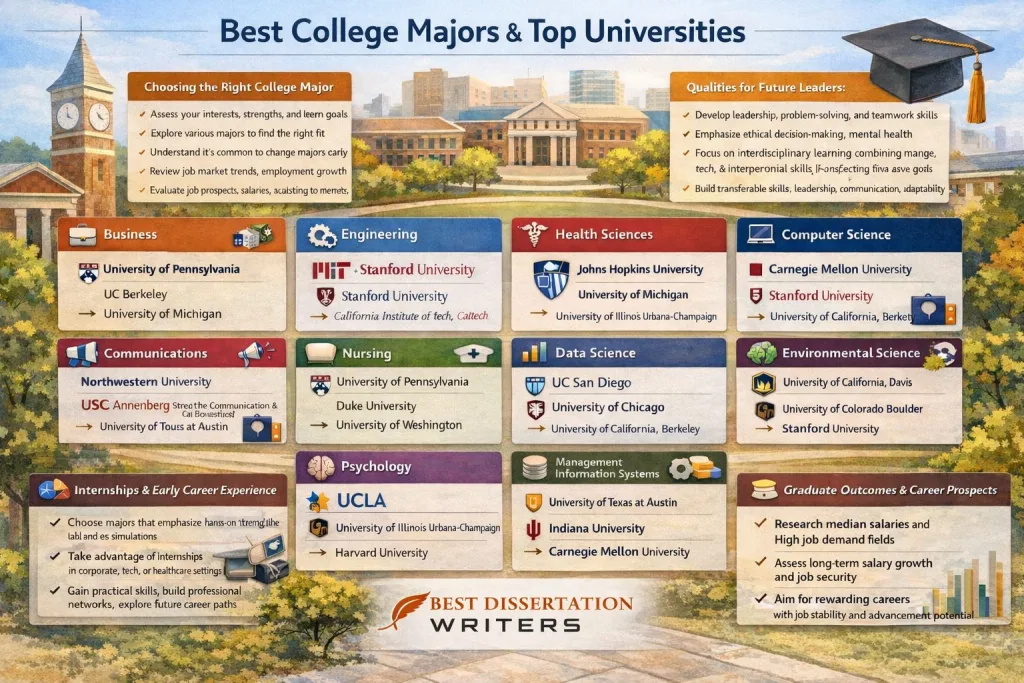
How to Choose a Major: Factors to Consider When Choosing a College Major
1. Assess Your Interests and Strengths
- Understanding your personal interests and natural strengths is the foundation of choosing a major.
- A major that aligns with what you enjoy and excel at ensures long-term engagement, keeps you motivated, and increases the likelihood of job satisfaction after graduation.
- For example, if you enjoy problem-solving and technical challenges, engineering majors or physics majors may be a good fit. If you enjoy communication and collaboration, communications majors or business majors may better align with your strengths.
2. Explore Different Majors to Find the Right Fit
- Take the time to research and explore different majors, including business majors, engineering majors, physics majors, communications majors, and health professions and related programs.
- Learning about the curriculum, course requirements, and potential career paths of each major helps you find the right fit for your skills and interests.
- Exploring different options also exposes you to fields you may not have considered, helping you make an informed decision that aligns with your goals.
3. Recognize That Many Students Change Their Majors
- It’s common for students to change their majors at least once during college. Understanding this helps reduce stress and encourages exploration.
- Early reflection and research allow you to select a major that aligns with your personal and professional objectives, minimizing unnecessary changes and helping you stay on track.
- Being flexible and open to new possibilities ensures that you ultimately choose a major that matches both your interests and strengths and your career aspirations.
4. Consider the Rapidly Changing Job Market
- The job market is evolving quickly due to technology, globalization, and new industries, making it essential to research employment growth, job availability, and future job trends.
- Resources like the Bureau of Labor Statistics and the National Center for Education Statistics provide reliable data to assess which fields have high job prospects.
- Understanding the market helps you anticipate future jobs in high-demand sectors and select a major that equips you with skills relevant to a rapidly changing job market.
5. Evaluate Key Factors Like Job Prospects, Salary, and Job Security
- When choosing a major, consider job prospects, salary prospects, and job security for the field.
- Evaluate how graduates of the major earn median salaries, the range of employment opportunities across industries, and how the major prepares students for long-term career stability.
- Also consider whether the major allows you to make a meaningful contribution in your field, combining financial stability with personal fulfillment.
Aligning Your Career Path with the Best College Major
1. Select a Major That Aligns with Your Interests, Strengths, and Goals
- Choosing a major that aligns with your personal interests, natural strengths, and long-term career goals is critical for achieving job satisfaction and career success.
- A major aligned with your skills increases motivation, helps you perform better academically, and sets a strong foundation for future jobs in 2025 and beyond.
- For example, students with analytical strengths may thrive in engineering and computer science, physics majors, or management information systems, while those with strong interpersonal skills may excel in business majors or health professions and related programs.
2. Focus on Top Majors in Demand
- Prioritize top majors that are currently in demand and projected to grow in the job market, ensuring better job prospects and employment growth.
- Fields such as business and engineering, management information systems, and health professions and related programs are among the most sought after.
- These majors not only offer strong job opportunities but also provide a rewarding salary, combining financial stability with meaningful work.
- Research from the Bureau of Labor Statistics and the National Center for Education Statistics can help you understand which sectors have high job availability and future job growth.
3. Ensure the Major Equips Students with Critical Thinking and Hands-On Experience
- The best college majors prepare students with practical, real-world skills alongside theoretical knowledge.
- Look for programs that emphasize hands-on learning, laboratory work, or internships to gain experience that employers value.
- Majors like engineering and computer science, health professions, and management information systems often equip students with critical thinking and problem-solving abilities essential for success in a rapidly changing job market.
4. Consider the Personal and Professional Skills You Will Develop
- Beyond technical skills, consider how your chosen major will develop personal and professional skills that are transferable across industries.
- Skills such as leadership, communication, teamwork, and analytical reasoning enhance job satisfaction and open opportunities for advancement.
- Majors like business majors and communications majors often emphasize these soft skills, preparing students to excel in management, collaborative projects, or cross-functional roles.
5. Research Median Salaries and Long-Term Salary Growth
- Assess median salaries around each field to understand your earning potential over time.
- Consider both entry-level pay and long-term growth when evaluating majors. For instance, nursing, engineering, and management information systems often provide good salary prospects and opportunities to increase earnings with experience and specialization.
- Understanding salary prospects helps ensure that your major aligns with your financial goals and provides long-term stability and security.
Internship Opportunities and Early Career Experience
1. Choose Majors That Provide Hands-On Learning
- Selecting a major with a strong emphasis on practical, hands-on learning helps students develop essential critical thinking and real-world problem-solving skills.
- Programs that include lab work, simulations, project-based courses, or design challenges allow students to apply theoretical knowledge in practical scenarios, reinforcing learning and skill mastery.
- For example, engineering majors may include labs where students build circuits, prototype devices, or test mechanical systems, while health professions and related programs often include clinical simulations or patient care labs.
- Hands-on learning prepares students to adapt to real-world challenges in their careers and makes them more competitive in the rapidly changing job market.
2. Take Advantage of Internship Opportunities
- Internships provide an early glimpse into the professional world, letting students test their skills in real work environments and explore potential career paths.
- They give students the chance to experience different roles and industries, helping clarify which majors and career paths align with their interests and strengths.
- Internship participation also builds professional networks and connections, which can directly influence job prospects and employability after graduation.
- Exposure to workplace culture, team dynamics, and industry-specific expectations helps students understand future job trends and the skills employers value most.
- Internships are particularly valuable in fields like business majors, engineering and computer science, and health professions, where hands-on experience is crucial for career preparation.
3. Consider Industry-Specific Internships
- Some majors have highly specialized internship opportunities that are directly tied to industry standards.
- Business majors may intern in corporate offices, consulting firms, or financial institutions, gaining experience in project management, operations, or strategic planning.
- Engineering majors often intern in technical or industrial settings, working on real-world design, manufacturing, or systems projects.
- Health professions and related programs provide clinical rotations for nursing students and other health-related roles, giving hands-on exposure to patient care, hospital operations, and healthcare workflows.
- These industry-specific internships ensure that students gain practical skills and critical thinking abilities valued across multiple sectors, including healthcare, technology, and business.
- Students who complete these internships are better prepared to navigate the workforce, understand job expectations, and identify which majors and specialties align with their career goals.
4. Gain Early Career Experience to Discover the Right Fit
- Engaging in internships, co-ops, research projects, or volunteer opportunities early in your academic career helps you discover which majors truly fit your skills and interests.
- Early exposure allows students to test the realities of a profession before committing fully, which is especially important as many students change their majors at least once during college.
- Participating in real-world projects provides insight into employment growth, job availability, and salary prospects, helping you make a more informed decision about which major aligns with your long-term goals.
- Through early career experience, students can better evaluate future job trends, assess which industries are expanding, and understand the types of roles they may enjoy and excel in.
- This experience ultimately allows students to discover the best college majors for their strengths, ensuring both personal satisfaction and strong job prospects after graduation.
Need Help With Your Dissertation?
Get professional academic support from Best Dissertation Writers . Our expert team is ready to help you with high-quality dissertation writing services tailored to your academic goals.
Get Dissertation HelpWhat Future Leaders Should Look for in a College Major
1. Develop Leadership and Critical Skills
- Choose majors that develop leadership, critical thinking, problem-solving, and teamwork skills, which are essential for managerial or strategic roles in any industry.
- Majors should train students to analyze complex problems, make informed decisions, and communicate effectively with teams and stakeholders.
- For example, business majors often provide opportunities for leadership in projects, while engineering and computer science programs teach structured problem-solving and decision-making under technical constraints.
- Developing these skills early ensures graduates are prepared for future jobs in 2025 and beyond, where leadership, strategy, and adaptability are increasingly critical.
2. Emphasis on Ethical Decision-Making and Collaboration
- Look for programs that integrate ethical decision-making, mental health awareness, and collaboration across disciplines.
- Courses emphasizing ethics and mental health equip students to navigate real-world challenges with integrity and social awareness.
- Collaborative projects and interdisciplinary learning foster empathy, professional judgment, and teamwork, essential qualities for future leaders.
- Majors like communications majors, health professions and related programs, and business majors often embed these principles into their curriculum, preparing graduates to lead responsibly in rapidly changing job markets.
3. Focus on High-Demand, Impactful Majors
- Select top majors that are not only in demand but also allow you to make a meaningful contribution to your field.
- High-demand majors for future leaders include business and health professions, engineering and computer science, and communications majors.
- These fields combine skill development with strong job opportunities, employment growth, and good salary prospects, ensuring students are both competitive and impactful in their industries.
- Choosing a major in a high-demand field also provides long-term career security and relevance as industries evolve.
4. Integrate Interdisciplinary Learning
- Programs that combine technical skills, management principles, and interpersonal development help students develop a versatile skill set.
- Interdisciplinary learning encourages adaptability, allowing students to pivot into different roles or industries as the job market evolves.
- For instance, a management information systems major blends business strategy, computer science, and data analysis, preparing students for leadership roles that require both technical and managerial expertise.
- Such majors equip students with critical thinking skills essential for tackling challenges in a rapidly changing job market.
5. Build Transferable Personal and Professional Skills
- Consider how a major develops transferable skills such as leadership, communication, teamwork, and adaptability.
- These skills enhance job satisfaction, career growth, and long-term employment stability.
- Majors like business majors, engineering majors, and health professions and related programs cultivate both technical expertise and personal development, allowing graduates to thrive across various industries.
- Developing strong soft skills ensures students are prepared not only for technical roles but also for management, collaboration, and strategic decision-making, all of which are highly valued by employers.