

What Is a Value Hypothesis? – Key Takeaways
A value hypothesis is a testable assumption about why a product, feature, or service will matter to a specific group of users. It connects a target customer, a clear pain point, a proposed solution, and an expected outcome such as sign-ups, usage, retention, or purchases. In product development, it helps teams avoid building blindly by focusing on what value users may actually care about and then testing that assumption with real evidence.
- What a Value Hypothesis Is:
- It answers one core question: why will customers care?
- It identifies the customer segment, the problem, the value offered, and the expected result.
- It is meant to be specific, clear, and testable, not just a vague idea.
- Why It Matters in Product Development:
- It helps teams focus on the most important features instead of building too much too soon.
- It supports better decisions during MVP development, early testing, and product iteration.
- It is one of the first steps toward product-market fit, because it forces teams to define success before scaling.
- Value Hypothesis vs. Value Proposition:
- A value proposition explains what the product offers and the benefit it promises.
- A value hypothesis is the assumption that this promise will actually matter to users in the real market.
- In simple terms, the proposition says what you offer, and the hypothesis says why users will respond to it.
- How to Create a Strong Value Hypothesis:
- Identify the target audience.
- Define the main pain point or unmet need.
- Explain the solution and value the product provides.
- State the expected outcome, such as better retention, stronger adoption, or higher conversion.
- How to Validate It:
- Use customer interviews, surveys, and feedback to test whether the idea resonates.
- Launch an MVP or pilot to observe real behavior.
- Track metrics such as conversion rates, engagement, retention, and feature usage.
- Use A/B testing and experiments to check whether assumptions hold up in practice.
- How It Improves Over Time:
- A value hypothesis should be refined through metrics, user feedback, and iteration.
- Small changes based on real evidence can strengthen the product’s relevance and usefulness.
- Once value is validated, teams can connect it to a growth hypothesis and test how the product can scale successfully.
A value hypothesis is an essential tool for testing the assumption that a product or service will resonate with users. By validating these assumptions through real-world data and user feedback, teams can ensure they are building something truly valuable for their target audience.
What Is a Value Hypothesis? Understanding Its Role in Product Development
- A value hypothesis is a clear statement that explains why a product, service, or feature should matter to a specific group of people. It is an educated guess about the value to customers, the main pain point being solved, and the compelling reason they would choose your solution over another option.
- A value hypothesis is not just a random idea. It should be well-crafted, focused, and testable. That means you should be able to measure whether your assumption is true by looking at real user behavior, customer feedback, conversion rates, feature adoption, and other signals from the market.
- In product development, the value hypothesis helps teams avoid building blindly. Instead of assuming people will love a feature, teams define a clear hypothesis first, then use market research, customer interviews, and early experiments to see whether the product truly creates unique value.
- This matters especially when launching a minimum viable product. Your first version of your product should not try to do everything. It should include only the key product features needed to test a value hypothesis and learn whether your idea fits real customer needs.
- A strong value hypothesis also helps identify the right customer segment. Not every product is for everyone. When you understand your target audience’s struggles, goals, and buying behavior, you can better explain the value proposition of your product and define the exact market for your product.
What Is a Value Hypothesis?
- Simply put, a value hypothesis answers one core question: Why will customers care? It states what benefit you believe customers will receive, who those customers are, and why that benefit will make them act.
- A good value hypothesis usually includes these elements:
- the specific user or customer segment you want to serve
- the main pain point or unmet need
- the specific value proposition you are offering
- the expected result, such as sign-ups, purchases, retention, or stronger feature adoption
- For example, if you are building a budgeting app, your value hypothesis could be that busy freelancers will use your app because automatic expense sorting saves time and reduces money stress. This connects the user, the problem, and the value your product delivers.
- The purpose is not to prove you are right immediately. The purpose is to create something focused enough that you can test, learn, and adjust your hypothesis if needed. This is how smart teams move forward with product development without wasting time and budget.
The Importance of Value Hypotheses in Achieving Product-Market Fit
- Product-market fit happens when your solution matches real demand in the market. A value hypothesis is one of the first steps toward that fit because it forces you to define what success should look like before you build too much.
- When teams skip this step, they often create attractive products with weak relevance. A product may look polished, but if it does not solve a real problem or deliver validated value, users will not stay.
- With a value hypothesis, teams can focus on:
- understanding customer needs
- choosing the most important product features
- gathering real customer feedback
- improving the minimum viable product
- deciding whether to continue, pivot, or adjust your hypothesis
- This process is also part of validating your value. Instead of relying on opinions, you test hypotheses through experiments, customer interviews, surveys, onboarding behavior, and usage data. Over time, this turns an initial assumption into validated value.
Value Proposition vs. Value Hypothesis: Understanding the Difference
- A value proposition explains the promise of your product. It describes the benefit your solution offers and the unique value it claims to bring.
- A value hypothesis, on the other hand, is your assumption that this promise will actually matter to users in the real world. In simple terms:
- the value proposition of your product says what you offer
- the value hypothesis says why you believe people will respond to it
- One useful way to understand this difference is to compare it to an academic Introduction chapter. The background of the study gives context, much like your value proposition explains your product. The research problem/statement, research objectives, and research questions are similar to defining what you want to test in the market. The significance of the study, scope and delimitations, theoretical framework, methodology overview, and even the structure of the dissertation all reflect a structured way of thinking before action.
- In the same way, a strong product team does not rush. It uses market research to build a specific value proposition, forms a clear hypothesis, tests it through an MVP, and then decides how to move forward with product development based on evidence. That is what makes a good value hypothesis so important.
Struggling with Your Dissertation Introduction Chapter?
Get expert assistance with your dissertation introduction chapter from Best Dissertation Writers . Our team specializes in writing compelling and well-structured introduction chapters tailored to your research goals. Visit our site for more details: Best Dissertation Writers .
Get Dissertation Introduction HelpSteps to Creating and Validating a Strong Value Hypothesis
Creating and validating a value hypothesis is an essential process in product development. It helps ensure that you are building something that truly resonates with your target audience’s needs and creates the right value to customers. Here are the key steps to follow when crafting and validating your value hypothesis:
Steps to Creating a Great Value Hypothesis: Key Elements to Include
- Identify the Target Audience
- The first step in creating a value hypothesis is to define the customer segment you want to serve. Who is your product for? What are their characteristics? Understanding the specific target audience’s pain points will allow you to create a more relevant and focused value hypothesis.
- Example: “Our value hypothesis is that busy professionals will use our time management tool to streamline their daily tasks and increase productivity.”
- Define the Customer Problem or Pain Point
- A value hypothesis should clearly outline the pain point or unmet need that your product will solve. This helps ensure that the solution you are proposing has real demand in the market.
- For example, “Professionals struggle to keep track of their time due to disorganized calendars and task management systems.”
- Propose the Solution and the Value Your Product Offers
- After identifying the pain point, explain the product or service that will solve the problem. This is where your value hypothesis starts to shine. You need to clearly state how your product will bring value to customers and why they should care.
- Example: “Our app provides an all-in-one task and time management platform that helps users easily organize their workday and maximize productivity.”
- State the Expected Outcome or Result
- In this step, describe what you expect to happen after introducing your solution to the market. This could be anything from higher conversion rates, increased customer retention, or improved product usage.
- Example: “We hypothesize that after using the app for a week, users will experience a 25% increase in their productivity.”
How to Validate a Value Hypothesis: Methods and Best Practices
Validating a value hypothesis is the process of testing whether your assumptions hold true in the real world. Here are the methods and best practices for validating your hypothesis:
- Customer Interviews
- One of the best ways to test your value hypothesis is by speaking directly with potential customers. Conduct customer interviews to gain insights into their pain points, needs, and whether your proposed solution resonates with them.
- Ask questions like: “How do you currently solve this problem?” or “Would you be willing to pay for a solution like ours?”
- Surveys and Feedback
- After gathering initial responses, use surveys to reach a broader audience and gain quantitative feedback. This helps you understand whether your value hypothesis applies to a larger segment of your target audience.
- Example: You can ask participants to rate the importance of your proposed features and how likely they are to use the product.
- Run a Small Test (Pilot or MVP)
- Launch a minimum viable product (MVP) or a pilot version of your product. An MVP allows you to test your value hypothesis with a real customer base, ensuring you’re gathering customer feedback and learning about feature adoption in the wild.
- This helps you evaluate how well your product aligns with the value hypothesis you proposed.
- Track Usage Metrics and Behavior
- Use data analytics tools to track how users interact with your product. Metrics like conversion rates, feature adoption, and user retention can provide strong evidence of whether your value hypothesis holds.
- For example, if users are engaging with key features that address their pain points, this validates your assumptions.
Strong Value Hypothesis: Characteristics and How to Build One
A strong value hypothesis should be based on clarity, specificity, and testability. Here are the key characteristics of a strong value hypothesis:
- Clear and Concise
- Your value hypothesis should be easily understood. Avoid jargon and complexity. The clearer and more direct your hypothesis, the easier it will be to validate.
- Example: “We believe that providing a simple, intuitive interface will help users save time by 30%.”
- Testable
- A value hypothesis needs to be measurable and testable. If you can’t test it, you can’t validate it.
- Example: “We will measure success by tracking the time saved by users and their satisfaction rates after using the product.”
- Specific
- A good value hypothesis focuses on a particular problem and solution. It should be specific enough to make it easy to assess its validity.
- Example: “Our solution helps small business owners streamline their invoicing process, reducing administrative time by 40%.”
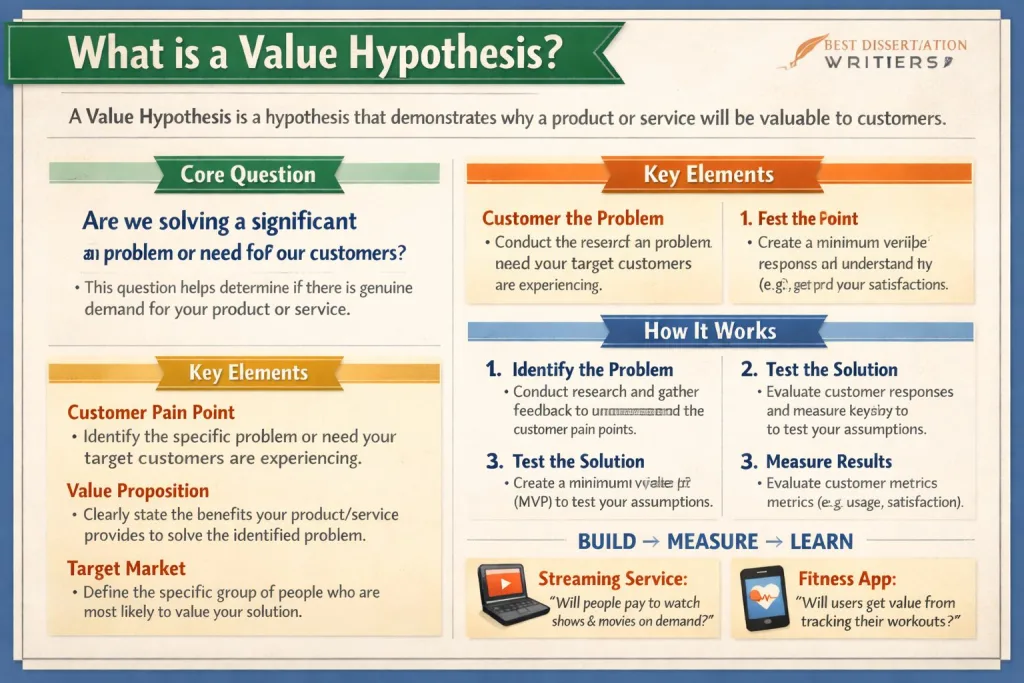
Validating the Value Hypothesis: Testing Its Assumptions
Once you’ve crafted your value hypothesis, it’s time to test its assumptions. Here’s how you can do that effectively:
- Run Experiments to Test Your Hypothesis
- Set up controlled experiments that test the assumptions in your value hypothesis. For example, A/B testing can be used to compare the impact of two versions of your product or feature.
- Example: Test two versions of your product’s interface and measure which one leads to higher conversion rates.
- Gather Qualitative and Quantitative Data
- Collect both qualitative (customer stories, feedback) and quantitative (usage metrics, surveys) data to get a holistic view of how your value hypothesis is performing.
- Example: You can compare customer satisfaction ratings after implementing a new feature to gauge its impact.
- Refine Your Hypothesis
- Based on the results of your tests, refine your value hypothesis. If the results don’t align with your initial assumptions, adjust your approach and iterate. The key is to remain flexible and responsive to customer needs.
By testing and refining your value hypothesis, you’re setting yourself up for a product that not only meets real customer needs but also builds a solid foundation for achieving product-market fit.
Using Metrics, Feedback, and Iteration to Refine Your Value Hypothesis
A value hypothesis is an essential tool for understanding whether your product or service will resonate with your target audience. However, a strong value hypothesis isn’t static—it must be tested, refined, and iterated over time. The process of using metrics, gathering user feedback, and continuously iterating helps ensure that your product development aligns with real-world customer needs. Below, we’ll explore how to effectively use these tools to refine and strengthen your value hypothesis.
How to Use Metrics to Test Your Value Hypothesis Effectively
- Define Key Metrics Early
- To effectively test your value hypothesis, start by identifying the metrics that will indicate whether your assumptions are correct. These could include conversion rates, user engagement, customer retention, and other relevant data points.
- Example: If your value hypothesis is that a time-saving tool will help users become more productive, you could measure user productivity by tracking task completion rates or time saved compared to before using the tool.
- Monitor User Behavior
- Once your product is live or in a minimum viable product (MVP) stage, track user interactions through analytics tools. By monitoring metrics such as page views, sign-ups, clicks, and feature usage, you can assess if your product aligns with your value hypothesis.
- Example: Track how often users engage with the key features of your app that were designed to solve their specific pain points. If these features are being used regularly, it suggests your value hypothesis is on target.
- A/B Testing
- A/B testing involves creating two variations of a product or feature to see which one performs better. This can be an effective way to test different aspects of your value hypothesis, such as design, messaging, or features.
- Example: Test two versions of a sign-up flow to determine which version results in higher conversion rates. This test can help you understand whether your value hypothesis about user convenience is valid.
- Use Data to Make Decisions
- Analyze the collected data carefully. Metrics will help you determine whether to proceed with the current version of your product or adjust your approach. If the metrics are not aligning with your value hypothesis, you may need to pivot or adjust your hypothesis accordingly.
Struggling with Your Dissertation Introduction Chapter?
Get expert assistance with your dissertation introduction chapter from Best Dissertation Writers . Our team specializes in writing compelling and well-structured introduction chapters tailored to your research goals. Visit our site for more details: Best Dissertation Writers .
Get Dissertation Introduction HelpThe Growth Hypothesis: Connecting It with Your Value Hypothesis
- What is a Growth Hypothesis?
- A growth hypothesis focuses on how your product will scale over time. It connects the value hypothesis to business growth by identifying strategies for increasing user acquisition, retention, and revenue.
- For example, your growth hypothesis might state that offering a referral program will accelerate growth by attracting more users who value the product.
- Connecting Growth to Value
- Your value hypothesis is the starting point for your growth hypothesis. Once you validate that your product delivers value, the next step is to determine how you can expand that value to a larger audience. For instance, if your value hypothesis is validated, you might use metrics and feedback to identify the most effective channels for growth, whether it’s social media, partnerships, or paid ads.
- Test Growth Strategies
- Growth experiments can be integrated into the validation process of your value hypothesis. Test different marketing or expansion strategies to see which one leads to the most significant increases in engagement or sales.
- Example: Test various strategies, such as content marketing vs. paid search ads, to determine which one provides the highest return on investment and aligns with your validated value hypothesis.
Iterate and Improve: Evolving Your Value Hypothesis Over Time
- Why Iteration is Crucial
- Iteration is the process of refining and improving your value hypothesis based on real-world testing and data. The market changes, customer preferences evolve, and new competitors enter the scene, so your value hypothesis should be flexible enough to adapt.
- Start with your initial hypothesis, but use customer insights, data, and market trends to continually iterate and improve.
- Gathering Ongoing Feedback
- Customer feedback is essential in the iteration process. Regularly reach out to your customers to gather their insights on how well the product meets their needs. Incorporate both qualitative feedback (like interviews) and quantitative data (like surveys or usage metrics) into your iteration process.
- Example: If feedback reveals that users love one feature but are not using another, adjust your hypothesis to reflect which features offer the most value to your target audience.
- Small Changes, Big Impact
- Small, incremental changes can lead to significant improvements over time. By continuously testing new ideas, you refine your value hypothesis and move closer to achieving a true product-market fit.
- Example: If users say they find a particular aspect of your app confusing, consider updating the interface or adding new instructional content. Monitor whether these changes improve engagement and validate your value hypothesis.
Using User Feedback to Refine and Strengthen Your Value Hypothesis
- Customer Interviews
- Conduct regular customer interviews to better understand the challenges your users face and how your product fits into their daily lives. This qualitative data will give you deeper insights into how your product can evolve to meet their needs.
- Ask open-ended questions like, “What do you like most about our product?” and “What’s missing from your perspective?”
- Survey Your Audience
- Surveys are an efficient way to gather quantitative feedback from a larger group of users. Use surveys to measure satisfaction, pain points, and product features that users find most valuable.
- Example: A survey could ask customers how likely they are to recommend your product, giving you insight into the value proposition of your product and how it resonates with users.
- User Testing
- Regularly test new features or product updates with real users before full-scale release. This allows you to gather feedback and identify any usability issues or improvements before launching to a broader audience.
Create and Test: The Final Steps to Confirming a Great Value Hypothesis
- Refine Based on Data
- After running tests and gathering user feedback, take the time to refine your value hypothesis. If your initial assumptions are proven incorrect, adjust your value hypothesis accordingly.
- Example: If the feedback reveals that the product is too complex for your target audience, consider simplifying the user interface or adding tutorials to make it more accessible.
- Confirm Through Iteration
- Once you’ve refined your value hypothesis, continue to test it through further iterations. As you move forward, the goal is to continuously confirm that your product is solving real problems and delivering genuine value to customers.
By using metrics, gathering user feedback, and iterating based on data, you can build a value hypothesis that not only reflects the needs of your target audience but also evolves with the market to ensure long-term success.
References
- Null and Alternative Hypotheses – University of Connecticut Neag School of Education – https://researchbasics.education.uconn.edu/null-and-alternative-hypotheses/ ([researchbasics.education.uconn.edu](https://researchbasics.education.uconn.edu/null-and-alternative-hypotheses/?utm_source=chatgpt.com))
- 1. Formulation of Research Hypothesis (Oakland University) – PDF Guide – https://www.oakland.edu/Assets/upload/docs/AIS/Syllabi/Tayler_Research_Hypothesis.pdf ([oakland.edu](https://www.oakland.edu/Assets/upload/docs/AIS/Syllabi/Tayler_Research_Hypothesis.pdf?utm_source=chatgpt.com))