

Directional vs Non-Directional Hypothesis – Key Takeaways
Directional vs non directional hypothesis are two forms of research hypotheses used to express what a researcher expects to find in a study. The main difference is whether the hypothesis predicts a specific direction in the relationship or difference between variables, or simply states that a relationship or difference exists. This choice affects the wording of the hypothesis, the research design, and the statistical test used in analysis.
- What a Hypothesis Is:
- A hypothesis is a clear, focused, and testable statement about what a researcher expects in a study.
- It identifies the variables and guides data collection, analysis, and statistical testing.
- In most studies, it works alongside the null hypothesis and alternative hypothesis.
- What a Directional Hypothesis Means:
- A directional hypothesis predicts both the existence and the direction of an effect or relationship.
- It states whether one variable will increase, decrease, be higher, or be lower than another.
- Example form: students who study longer will score higher on tests.
- It is usually linked to a one-tailed test.
- What a Non-Directional Hypothesis Means:
- A non-directional hypothesis says a difference or relationship exists but does not predict the direction.
- It does not say whether the effect will be positive or negative, higher or lower.
- Example form: there is a difference in anxiety levels between two groups.
- It is usually linked to a two-tailed test.
- Key Differences Between Them:
- Directional = predicts the outcome’s direction.
- Non-directional = predicts only that something will happen.
- Directional hypotheses are stronger when supported by theory or prior evidence.
- Non-directional hypotheses are more suitable in exploratory studies or when the direction is uncertain.
- Steps in Formulating Them:
- Understand the research problem.
- Identify the independent and dependent variables.
- Decide whether the study justifies a directional or non-directional prediction.
- Write the hypothesis in a clear testable form and choose the matching statistical test.
- When to Use Each Type:
- Use a directional hypothesis when past studies or theory strongly suggest a likely result.
- Use a non-directional hypothesis when there is not enough evidence to predict the exact direction.
- Choosing correctly helps ensure more accurate interpretation of p-values, significance, and final conclusions.
A clear understanding of the directional and non-directional hypotheses can guide the choice of appropriate research design and statistical analysis, contributing to more precise and insightful results in research studies.
Introduction to Directional vs Non Directional Hypotheses in Research
- Directional vs non directional hypothesis is an important topic in research because it helps a researcher decide how to frame a research hypothesis before data collection begins. In simple terms, the difference between the two depends on whether the hypothesis predicts a specific direction in the relationship between variables or whether it only states that a relationship exists.
- When students write the introduction chapter, background of the study, or significance of the study, they often need to explain the type of hypothesis used in the study. This is where directional vs non directional hypothesis becomes especially important, because the choice affects the research design, the statistical test, and the logic of hypothesis testing.
- In research, hypotheses are not random guesses. A good hypothesis is a testable statement that comes from research questions, earlier studies, observation, or ideas derived from theory. It tells readers exactly what the researcher expects to find out whether a difference or relationship exists between two variables or even two or more variables.
- Understanding directional vs non directional hypothesis also matters for statistical decision-making:
- A directional hypothesis usually leads the researcher to use one-tailed analysis or a one-tailed hypothesis.
- A non-directional hypothesis usually requires a two-tailed approach.
- This choice influences the p-value, the interpretation of the expected outcome, and whether researchers can reject the null hypothesis.
- In other words, directional vs non directional hypothesis is not just about wording. It shapes how researchers design studies, select statistical methods, perform data analysis, and interpret whether results are meaningful or simply due to chance.
What is a Hypothesis?
- A hypothesis is a clear, focused, and testable statement about what the researcher expects to happen in a study. It usually explains a possible relationship between two variables or predicts a possible difference between groups.
- A hypothesis is central to many types of research hypotheses, especially in experimental research and other studies that involve inferential analysis.
- The main idea is simple:
- A hypothesis tells the researcher what to look for.
- It helps specify the variables.
- It guides data collection and data analysis.
- It helps researchers decide what statistical test to use.
- A good hypothesis must:
- Be connected to the purpose of the study.
- Be linked to the research questions.
- Be based on evidence, logic, or ideas based on theory.
- State the expected relationship or difference between variables.
- Be measurable, so the researcher knows exactly what to measure.
- In most studies, the hypothesis includes:
- The independent variable: the factor the researcher changes or compares.
- The dependent variable or DV: the outcome that may change as a result.
- Example:
- Independent variable: study time
- Dependent variable (dv): test scores
- Hypothesis: students who study for more hours will score higher on a test.
- In statistical terms, hypotheses often appear in two forms:
- Null hypothesis (H₀): this is the statement that no effect, no difference, or no relationship exists.
- Alternative hypothesis (H₁ or Ha): this is also called the alternative or experimental hypothesis, and it states that an effect, difference, or relationship exists.
- Example of a statistical hypothesis:
- Null hypothesis states: H0:μ1=μ2H_0: \mu_1 = \mu_2H0:μ1=μ2
- Alternative hypothesis: H1:μ1≠μ2H_1: \mu_1 \neq \mu_2H1:μ1=μ2
- This means the null hypothesis says there is no difference between two group means, while the alternative hypothesis says “there is a difference”.
- This foundation is necessary before discussing directional vs non directional hypothesis, because both forms still work within the larger system of hypothesis testing.
What is Directional Hypothesis?
- A directional hypothesis is a research hypothesis that predicts not only that a relationship or difference exists, but also predict the direction of that result.
- In this type of statement, the researcher does more than simply state that variables are related. The hypothesis specifies the expected pattern clearly.
- A directional hypothesis would:
- Specify the direction of the effect.
- Predict whether the result will be positive or negative.
- Predict whether one group will score higher or lower than another.
- Be useful when earlier evidence strongly suggests an expected outcome.
- This means the direction of the relationship is clearly stated.
- Example: increased exercise leads to lower stress.
- Example: female students perform better than male students in language tests.
- Example involving males and females: females will report higher reading comprehension scores than males.
- Formula and symbols for a directional hypothesis:
- If the researcher expects one mean to be greater than another:
- H0:μ1≤μ2H_0: \mu_1 \leq \mu_2H0:μ1≤μ2
- H1:μ1>μ2H_1: \mu_1 > \mu_2H1:μ1>μ2
- If the researcher expects one mean to be lower:
- H0:μ1≥μ2H_0: \mu_1 \geq \mu_2H0:μ1≥μ2
- H1:μ1<μ2H_1: \mu_1 < \mu_2H1:μ1<μ2
- If the researcher expects one mean to be greater than another:
- For correlation:
- Positive direction:
- H0:ρ≤0H_0: \rho \leq 0H0:ρ≤0
- H1:ρ>0H_1: \rho > 0H1:ρ>0
- Negative direction:
- H0:ρ≥0H_0: \rho \geq 0H0:ρ≥0
- H1:ρ<0H_1: \rho < 0H1:ρ<0
- Positive direction:
- Because a directional hypothesis predicts a specific direction, researchers often use one-tailed analysis:
- This is also called a one-tailed hypothesis or one-tailed test.
- Researchers use a one-tailed test when they want to test a directional hypothesis.
- In practice, this means the rejection region falls on only one side of the sampling distribution.
- Example:
- Research hypothesis: students taught with digital simulations will score higher than students taught with lectures only.
- Statistical form:
- H0:μsimulation≤μlectureH_0: \mu_{\text{simulation}} \leq \mu_{\text{lecture}}H0:μsimulation≤μlecture
- H1:μsimulation>μlectureH_1: \mu_{\text{simulation}} > \mu_{\text{lecture}}H1:μsimulation>μlecture
- A directional hypothesis is strongest when it is derived from theory, previous findings, or a very clear logical argument. It should not be chosen just to make results easier to find significant at 0.05.
- In directional vs non directional hypothesis, the directional form is best when the researcher already has a strong reason to specify the direction.
Struggling with Your Dissertation Introduction Chapter?
Get expert assistance with your dissertation introduction chapter from Best Dissertation Writers . Our team specializes in writing compelling and well-structured introduction chapters tailored to your research goals. Visit our site for more details: Best Dissertation Writers .
Get Dissertation Introduction HelpWhat is Non-Directional Hypothesis?
- Non-directional hypotheses state that a difference or relationship exists, but they do so without predicting the direction.
- In other words, the researcher believes that the relationship exists without saying whether it will be positive or negative, higher or lower, stronger or weaker.
- A non-directional hypothesis is useful when:
- Past studies are limited or inconsistent.
- The study is more exploratory.
- The researcher expects a result but cannot confidently specify the exact direction.
- The focus is to find out whether a relationship or difference exists at all.
- This means the statement refers to variables but does not specify which way the effect will go.
- Example:
- There is a significant relationship between sleep quality and academic performance.
- There is a significant difference in anxiety levels between online learners and face-to-face learners.
- Notice that both statements say something may happen, but they do not say which group is higher or whether the relationship is positive or negative.
- Formula and symbols for non-directional hypotheses:
- For mean difference:
- H0:μ1=μ2H_0: \mu_1 = \mu_2H0:μ1=μ2
- H1:μ1≠μ2H_1: \mu_1 \neq \mu_2H1:μ1=μ2
- For correlation:
- H0:ρ=0H_0: \rho = 0H0:ρ=0
- H1:ρ≠0H_1: \rho \neq 0H1:ρ=0
- For mean difference:
- The symbol ≠ is important because it shows that a relationship exists without predicting the direction.
- Since the researcher is not predicting direction, non-directional hypotheses usually require a two-tailed test:
- A two-tailed statistical test checks both sides of the distribution.
- It asks whether the value is significantly higher or significantly lower.
- This approach fits a hypothesis that only says “there is a difference”.
- Example:
- H0:μmale=μfemaleH_0: \mu_{\text{male}} = \mu_{\text{female}}H0:μmale=μfemale
- H1:μmale≠μfemaleH_1: \mu_{\text{male}} \neq \mu_{\text{female}}H1:μmale=μfemale
- In directional vs non directional hypothesis, the non-directional form is often safer in early-stage studies because it avoids overcommitting to a pattern that may later be unsupported.
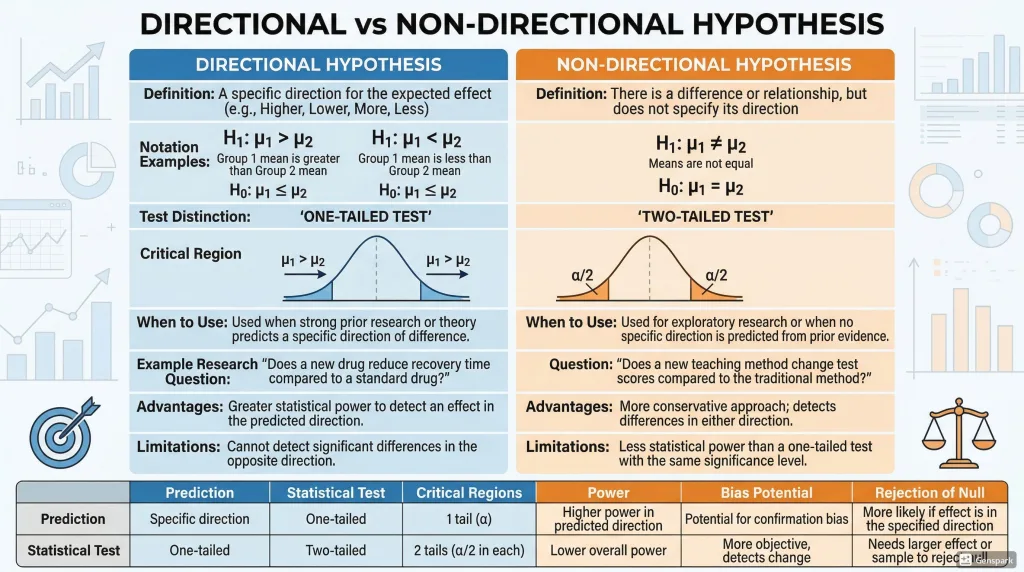
Directional vs Non Directional Hypothesis: Key Differences
- Directional vs non directional hypothesis can be understood more clearly by looking at the difference between the two in practical research terms.
- 1. Meaning
- A directional hypothesis predicts a specific direction.
- A non-directional hypothesis says a difference or relationship exists without predicting the direction.
- 2. Wording
- Directional: “Students using method A will score higher than students using method B.”
- Non-directional: “There will be a difference in scores between students using method A and method B.”
- 3. Statistical form
- Directional: H1:μ1>μ2H_1: \mu_1 > \mu_2H1:μ1>μ2 or H1:μ1<μ2H_1: \mu_1 < \mu_2H1:μ1<μ2
- Non-directional: H1:μ1≠μ2H_1: \mu_1 \neq \mu_2H1:μ1=μ2
- 4. Type of test
- Directional hypotheses usually use one-tailed tests.
- Non-directional hypotheses usually use two-tailed tests.
- 5. Best use
- Directional hypotheses are best when predictions are strongly based on theory or prior evidence.
- Non-directional hypotheses are best in exploratory research or when the researcher is unsure.
- 6. Research examples
- Directional example: caffeine intake increases alertness among university students.
- Non-directional example: caffeine intake affects alertness among university students.
- 7. Role in analysis
- In SPSS or other software, the hypothesis choice influences how researchers interpret p-value, effect sizes, confidence in findings, and whether evidence supports the hypothesis.
- If the p-value is less than 0.05, researchers may reject the null hypothesis, depending on the chosen test and assumptions.
- 8. Link to statistical methods
- Common statistical methods include t-tests, correlation, regression, and sometimes anova.
- For example, ANOVA may show whether groups differ, but additional analysis may still be needed to interpret direction.
- 9. Practical importance
- In directional and non-directional hypotheses, the wording affects everything from literature review logic to final interpretation.
- These different types of research hypotheses help researchers frame the relationship between two, one variable, or two or more variables in a clear way.
- 10. Final takeaway
- The core idea in directional vs non directional hypothesis is simple:
- A directional hypothesis says what the researcher expects and where the result will go.
- A non-directional hypothesis says something will happen, but not exactly how.
- That is why directional and non directional, directional and non-directional hypotheses, and directional vs non-directional thinking are essential in every serious study.
- The core idea in directional vs non directional hypothesis is simple:
- When used correctly, hypotheses guide researchers from the background of the study to the final conclusion. They help researchers disprove weak assumptions, confirm strong predictions, and show whether a finding is statistically meaningful rather than due to chance.
| Aspect | Directional Hypothesis | Non-Directional Hypothesis |
|---|---|---|
| Definition | Predicts a specific direction (positive or negative) of the relationship between variables. | Predicts that a relationship or difference exists, but does not specify the direction. |
| Predicts the Direction | Yes, specifies whether the relationship is positive or negative. | No, does not predict the direction of the effect. |
| Example | “Increased exercise will lead to lower stress levels.” | “There will be a difference in stress levels between exercisers and non-exercisers.” |
| Statistical Test | Uses a one-tailed test (focuses on one side of the distribution). | Uses a two-tailed test (examines both sides of the distribution). |
| Type of Research | Typically used when there is a strong basis (e.g., theory, past research) for predicting the direction. | Used when the researcher is unsure about the direction of the relationship or in exploratory studies. |
| Statistical Hypothesis |
H₁: μ₁ > μ₂ or H₁: μ₁ < μ₂
|
H₁: μ₁ ≠ μ₂
|
| Testable Statement | A clear and specific statement that defines the direction of the effect. | States that a difference or relationship exists, but without specifying the direction. |
| Examples in Research | "The more hours a student studies, the higher their test scores will be." | "There is a difference in test scores between students who study and those who do not." |
| Usage in Statistical Analysis | Researchers test for a specific direction of the effect. | Researchers check for a significant difference regardless of direction. |
Steps in Formulating Directional and Non-Directional Hypotheses
- Understand the Research Problem
- The first step in formulating directional vs non directional hypothesis is to understand the research problem thoroughly.
- Review the research questions and background of the study to identify whether the researcher is exploring a specific direction in the relationship between two variables or simply testing for a difference or relationship without predicting a direction.
- Consider whether there is enough previous evidence or theory to specify the direction of the relationship.
- Identify the Variables
- Define the independent variable (IV) and dependent variable (DV).
- Example: In a study examining the impact of study hours on test scores, the independent variable would be study hours (the factor being manipulated), and the dependent variable would be test scores (the outcome being measured).
- If the relationship between two variables is expected to be in a specific positive or negative direction, a directional hypothesis is used. If not, a non-directional hypothesis is appropriate.
- Define the independent variable (IV) and dependent variable (DV).
- Determine the Type of Hypothesis (Directional or Non-Directional)
- If you predict a specific direction of the relationship between two variables, then directional hypotheses should be formulated.
- Example: “Increased exercise will reduce stress levels” is a directional hypothesis because it predicts the direction of the relationship (reduction of stress).
- If you do not have a specific expectation about the direction, then formulate a non-directional hypothesis.
- Example: “There will be a difference in stress levels between people who exercise and people who do not” is non-directional, as it does not specify the direction of the effect (whether exercise will reduce or increase stress).
- Formulate the Hypothesis
- Directional hypothesis:
- State the expected relationship between the variables and the direction.
- Example formula: H1:μ1>μ2H_1: \mu_1 > \mu_2H1:μ1>μ2 (if the researcher expects a greater mean in group 1 than in group 2).
- Non-directional hypothesis:
- Simply state that a difference or relationship exists, without specifying the direction.
- Example formula: H1:μ1≠μ2H_1: \mu_1 \neq \mu_2H1:μ1=μ2 (if the researcher expects a difference but does not predict whether it will be greater or smaller).
- Directional hypothesis:
- Choose the Statistical Test
- Based on the directionality of the hypothesis, choose between one-tailed or two-tailed tests:
- Directional hypotheses often use a one-tailed hypothesis, which tests for a relationship in one direction (positive or negative).
- Non-directional hypotheses use a two-tailed test, which tests for any difference, regardless of direction.
- Based on the directionality of the hypothesis, choose between one-tailed or two-tailed tests:
- Test the Hypothesis
- Once the hypothesis is formulated, data collection and data analysis proceed.
- Use statistical methods like ANOVA, t-tests, or regression analysis to test the hypothesis and analyze if the p-value is below the significance level (usually 0.05).
- If the null hypothesis is rejected, it supports the alternative hypothesis (whether directional or non-directional).
Types of Research Hypotheses: Exploring the Variations
- Null Hypothesis (H₀):
- The null hypothesis states that there is no significant difference or relationship between variables.
- Example: H0:μ1=μ2H_0: \mu_1 = \mu_2H0:μ1=μ2 (no difference between the means of the two groups).
- Alternative or Experimental Hypothesis (H₁ or Ha):
- The alternative hypothesis is the opposite of the null hypothesis and proposes that a significant relationship or difference exists between variables.
- It is the research hypothesis being tested.
- Example: H1:μ1≠μ2H_1: \mu_1 \neq \mu_2H1:μ1=μ2 (there is a difference between the two groups).
- Directional Hypothesis:
- A directional hypothesis predicts the direction of the relationship (positive or negative) between two variables.
- Example: “A higher level of physical activity will reduce stress levels.”
- Formula: H1:μ1>μ2H_1: \mu_1 > \mu_2H1:μ1>μ2 (if group 1 is expected to score higher than group 2).
- Non-Directional Hypothesis:
- A non-directional hypothesis does not predict the direction of the relationship between variables but only suggests that a difference or relationship exists.
- Example: “There will be a difference in stress levels between those who exercise and those who do not.”
- Formula: H1:μ1≠μ2H_1: \mu_1 \neq \mu_2H1:μ1=μ2 (if there is a difference between the two groups, without specifying which group will be higher).
- Statistical Hypothesis:
- This involves formulating a statistical hypothesis for hypothesis testing, which is evaluated using inferential statistics.
- Involves a null hypothesis and an alternative hypothesis.
- The statistical test used depends on the type of hypothesis (directional or non-directional) and the nature of the data (nominal, ordinal, interval, ratio).
- Research Hypothesis:
- A research hypothesis is a statement about the expected relationship between two variables. It is the foundation for hypothesis testing.
- It could be either directional (predicting a specific relationship) or non-directional (simply stating a relationship exists).
Directional vs Non-Directional Hypothesis: When to Use Each
- When to Use a Directional Hypothesis:
- Use a directional hypothesis when:
- Past research or theory strongly suggests a specific direction in the relationship between variables.
- You expect the direction of the effect (positive or negative) to be consistent based on previous findings.
- Example: “Increased study time will result in higher test scores” is a directional hypothesis because it specifies the expected direction of the effect (positive).
- Statistical test: Typically requires a one-tailed hypothesis test.
- Use a directional hypothesis when:
- When to Use a Non-Directional Hypothesis:
- Use a non-directional hypothesis when:
- There is no strong basis to predict the direction of the relationship between variables.
- The study is more exploratory or the researcher does not have enough prior information to confidently specify the direction.
- Example: “There will be a difference in stress levels between students who engage in exercise and those who do not” is non-directional because it does not predict the direction of the relationship.
- Statistical test: Requires a two-tailed hypothesis test to detect any significant difference or relationship.
- Use a non-directional hypothesis when:
- Choosing Between Directional and Non-Directional:
- Consider the purpose of the study: If the study aims to test a well-established theory or model, directional hypotheses are appropriate.
- Consider the research questions: If the researcher is uncertain about the relationship, a non-directional hypothesis is more suitable.
- Consider the statistical test: Choose a one-tailed test for directional hypotheses and a two-tailed test for non-directional hypotheses.
Struggling with Your Dissertation Introduction Chapter?
Get expert assistance with your dissertation introduction chapter from Best Dissertation Writers . Our team specializes in writing compelling and well-structured introduction chapters tailored to your research goals. Visit our site for more details: Best Dissertation Writers .
Get Dissertation Introduction HelpConclusion: Final Thoughts on Directional vs Non-Directional Hypothesis in Research
- Key Differences Recap:
- Directional hypotheses specify not only that a relationship exists but also the direction (positive or negative) of the relationship.
- Non-directional hypotheses simply state that a relationship exists without predicting the direction of the effect.
- Directional vs non-directional is a crucial decision when formulating a hypothesis as it impacts statistical testing (one-tailed vs two-tailed) and the overall research design.
- Hypotheses Guide the Research Process:
- A hypothesis provides a foundation for the research design and data collection. It helps to clarify the expected outcomes and statistical methods to be used.
- The correct choice between directional and non-directional hypotheses ensures that the research is focused, and results can be properly interpreted.
- Application in Statistical Analysis:
- Choosing between directional vs non-directional hypothesis also determines the approach used during data analysis. This can affect the ability to reject the null hypothesis and the statistical significance of the results.
- The researcher must be clear on whether to use a one-tailed or two-tailed test, as it will determine the p-value and influence whether the null hypothesis is accepted or rejected.
- Final Takeaway:
- In the end, whether you use a directional hypothesis or a non-directional hypothesis depends on the purpose of the study, the direction of the relationship, and the level of certainty in your predictions. Both forms are valuable tools for guiding research and ensuring robust and meaningful statistical analysis.
References
- Hypothesis Definition & Examples – National University Resources - https://resources.nu.edu/statsresources/hypothesis
- Null and Alternative Hypotheses – Minitab Support - https://support.minitab.com/en-us/minitab/help-and-how-to/statistics/basic-statistics/supporting-topics/basics/null-and-alternative-hypotheses/
- The Null and the Alternative Hypotheses – Florida SouthWestern State College (PDF) - https://www.tsc.fl.edu/media/divisions/learning-commons/resources-by-subject/math/statistics/The-Null-and-the-Alternative-Hypotheses.pdf
- Simple Null Hypothesis – ScienceDirect Topics (Elsevier) - https://www.sciencedirect.com/topics/mathematics/simple-null-hypothesis