

What Is a Doctor of Psychology (PsyD)?
- A doctor of psychology or a PsyD refer to the same doctor of psychology degree, designed for advanced work in the psychology field at the doctoral level.
- Many people choose the doctor of psychology program when they want a practice-focused path in the broader field of psychology.
- A doctor of psychology degree program sits within doctoral psychology as a terminal degree that prepares graduates for professional roles rather than entry-level work.
- You complete this doctoral pathway through a structured doctoral program that emphasizes hands-on preparation alongside academic foundations.
- Most students enter a psychology doctoral track after completing earlier programs in psychology, then move into specialized training aligned with clinical roles.
- A psychology doctoral program often sits among doctoral programs in clinical psychology, which focus on developing advanced clinical competence.
- Some universities offer multiple options within programs in clinical psychology, but the doctor of psychology pathway typically prioritizes applied preparation over heavy research output.
- In many schools, the PsyD is treated as a terminal degree because it represents the highest professional training credential for clinical-focused work.
- Because the doctor of psychology is a doctoral level qualification, the training expectations and professional standards are higher than those in master’s pathways.
- In short, the PsyD is a doctor of psychology degree that fits within the psychology field as a practice-oriented doctoral program.
Definition of a Doctorate in Psychology
- A doctor of psychology or PsyD is one type of doctorate, meaning it is an advanced credential earned at the doctoral tier of education.
- A doctorate in this area usually results in a doctoral degree, which signals the highest level of academic and professional preparation in the field of psychology.
- Many students earn a doctoral degree from a program that aligns with national training standards, which helps support professional credibility and mobility.
- A PsyD can be completed through an apa-accredited doctoral degree pathway when the program meets recognized quality benchmarks.
- The American Psychological Association (often referenced as the american psychological association) plays a central role in how some programs are reviewed and recognized.
- Programs that accredit through recognized processes typically follow structured requirements for curriculum, supervision, and training quality.
- A doctorate is different from a graduate degree such as a master’s because it requires deeper specialization, advanced professional competencies, and more rigorous evaluation.
- Within the range of degrees in psychology, a doctoral credential represents the highest stage of formal education and professional readiness.
- Even though “doctorate” is broad, the doctor of psychology specifically refers to a professional psychology degree focused on preparing practitioners.
- Earning this psychology degree strengthens a person’s understanding of psychology by combining advanced theory, ethical foundations, and applied learning.
- Overall, a doctor of psychology is a doctorate and a doctoral degree that sits at the top of degrees in psychology within the field of psychology.
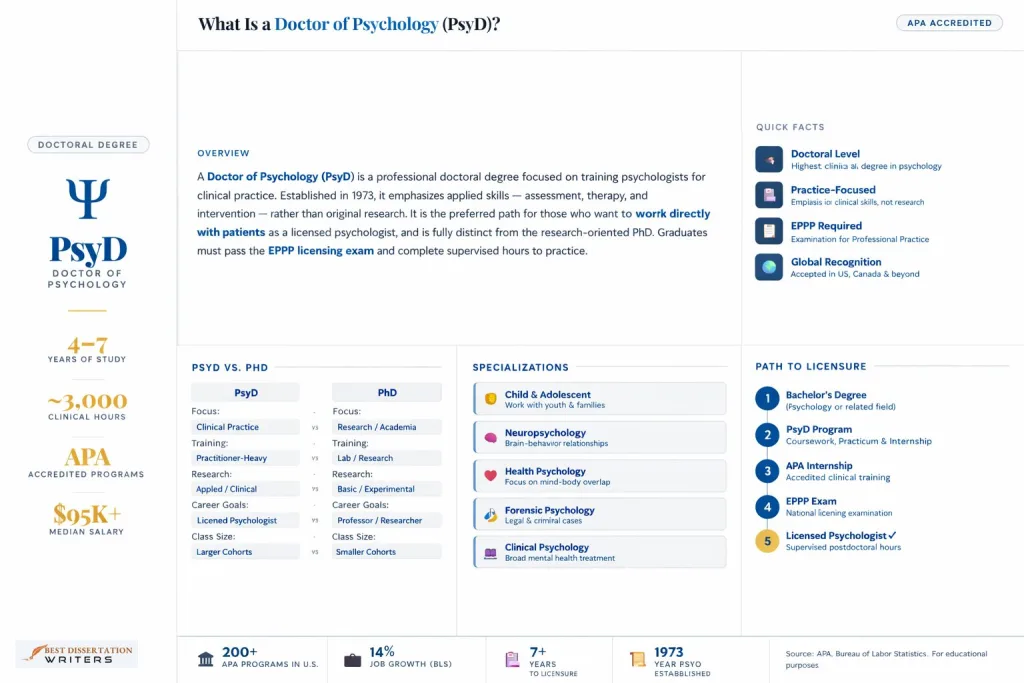
PsyD in Clinical Psychology and Applied Psychology
- A doctor of psychology commonly appears as a PsyD in clinical psychology, which is built to prepare clinicians for real-world service delivery.
- This pathway emphasizes psychology in clinical work, meaning students learn how psychological science translates into client-centered care.
- Many programs frame the credential as a degree in clinical psychology, which positions graduates for specialized roles in the field of clinical psychology.
- Because a doctor of psychology often stresses application, it overlaps strongly with applied psychology and practice-driven outcomes.
- In many institutions, the PsyD sits within professional psychology, which prioritizes ethical practice and service effectiveness.
- Schools may label the pathway as a professional psychology program, especially when the mission centers on preparing clinicians for direct service roles.
- Some students enroll through a school of professional psychology, where the structure, supervision model, and clinical focus support intensive practice preparation.
- Within a professional psychology program, coursework can align with multiple practice directions while keeping strong grounding in clinical fundamentals.
- Some learners integrate interests from counseling psychology, especially when focusing on adjustment, life transitions, and strengths-based care approaches.
- Others explore specialized options such as forensic psychology, especially when future work involves courts, corrections, evaluations, or legal settings.
- Some also connect PsyD work to organizational psychology when career goals include leadership assessment, workplace well-being, or organizational consulting.
- Across these paths, the doctor of psychology centers on the practice of psychology, not only academic theory.
- The overall focus supports the professional practice of psychology, meaning graduates learn applied skills, ethics, and standards needed for real clients.
- In summary, the PsyD supports professional practice through a clinical and applied training identity.
Clinical Training in a Clinical Psychology Program
- A doctor of psychology is strongly tied to hands-on preparation inside a clinical psychology program with real-world learning expectations.
- Many programs in clinical psychology structure training so that students repeatedly apply knowledge through supervised clinical training experiences.
- This approach builds sustained psychology training, which combines evidence-informed methods, ethics, and structured supervision.
- In most models, PsyD training includes increasing responsibility over time, so students grow from observation to independent clinical decision-making.
- The emphasis on clinical practice helps learners move beyond theory into client-facing competence and professional confidence.
- Programs often teach clinical intervention approaches, including interviewing, case conceptualization, treatment planning, and outcome monitoring.
- Strong clinical skills development is a core goal, including assessment skills, communication, cultural responsiveness, and ethical reasoning.
- Students learn in multiple clinical settings, which can include community clinics, hospitals, university clinics, and integrated care environments.
- Most training plans include an internship, which is typically the most immersive full-time clinical experience in the program sequence.
- The goal is to prepare students for the realities of professional work, including complex cases, interdisciplinary collaboration, and high standards of care.
- Programs also prepare learners for ongoing growth, supervision, and lifelong learning as part of responsible professional identity.
- Many students choose the PsyD because they want to practice and spend most of their time working directly with clients.
- These experiences help graduates practice psychology with stronger competence, better judgment, and clearer professional boundaries.
- Throughout the process, training consistently reinforces the practice of psychology as ethical, evidence-informed, and client-centered.
PsyD Program Requirements and How to Get a PsyD
- If you want to get a PsyD, start by understanding that a doctor of psychology and a PsyD are the same credential, and both follow a structured degree program path.
- A typical PsyD program sits inside a broader psychology doctoral program structure, which is designed as a practice-oriented doctoral program.
- Many universities run doctoral programs in clinical psychology where the PsyD track emphasizes applied preparation more than intensive research.
- PsyD programs offer a professional route for people who want strong clinical preparation and direct service training within the degree requirements.
- PsyD programs may differ by school in length, clinical placement systems, and emphasis areas, but all aim to build professional readiness.
- A PsyD may be a better fit than some alternatives when your main goal is hands-on practice and structured clinical development.
- When comparing a PsyD pathway choice, look at outcomes, training intensity, and whether the program aligns with licensure requirements.
- For many PsyD students, the decision starts with being considering a career in psychology and wanting a clear, practice-centered route.
- The most practical way to decide if the PsyD degree is right is to compare program structure, training expectations, and career goals.
Psychology Program Admissions and Prerequisites
- Admission to a PsyD usually begins with applying to a psychology program that offers a clinical-focused doctoral pathway.
- Many applicants evaluate multiple programs in psychology to find the right balance of training, cost, location, and fit with long-term goals.
- Each degree program sets its own entry requirements, so you should confirm what the doctor of psychology track expects before applying.
- Some applicants enter after earning a graduate degree, while other schools accept students directly from a bachelor’s pathway depending on the program design.
- Admissions committees often review prior coursework in psychology, research exposure, and evidence of readiness for doctoral-level academic work.
- A program may require specific foundational topics such as statistics, research methods, abnormal psychology, and developmental psychology.
- Programs also evaluate experience that shows commitment to client-focused work, such as volunteer service, crisis support, or mental health-related roles.
- A strong PsyD application shows readiness for intensive psychology training that blends theory, ethics, and applied learning.
- Some schools compare applicants across tracks, so you might see differences in expectations between PhD students and PsyD students within the same department.
- In many cases, admissions criteria for doctor of psychology applicants highlight applied readiness and professional goals more than a heavy research portfolio.
Dissertation Writing Help You Can Trust
Get expert, research-driven dissertation support from Best Dissertation Writers . We help you strengthen your topic, refine your proposal, structure chapters, and polish your final draft to meet graduate-level standards.
Get Dissertation Help NowPsyD Degree Curriculum and Clinical Training Hours
- The doctor of psychology degree typically includes structured coursework that builds clinical competence and ethical decision-making.
- Most curricula combine academic learning with supervised clinical training, so skills develop through repeated practice rather than theory alone.
- Programs often sequence learning so that early courses build core clinical skills, then later experiences emphasize complex assessment, treatment planning, and case management.
- Many PsyD tracks focus on clinical intervention, including evidence-informed therapies and strategies for diverse clinical presentations.
- Throughout the program, students engage in supervised clinical practice to apply classroom learning to real client needs.
- The program design emphasizes the practice of psychology, meaning students learn to integrate science, ethics, and professional standards into care decisions.
- Training also supports the professional practice of psychology by reinforcing documentation standards, consultation skills, and culturally responsive care.
- Most doctor of psychology tracks include an internship, which is a major full-time supervised experience near the end of training.
- Some PsyD tracks include a capstone project and do not require a traditional dissertation, although some schools may still include a research component depending on the model.
License Pathway to Become a Licensed Psychologist
- If your goal after the doctor of psychology is independent clinical work, you must meet your jurisdiction’s license requirements.
- The process typically includes meeting academic criteria, supervised training requirements, and formal licensure steps after graduation.
- Most pathways require licensure as a psychologist, which confirms that you meet the professional standard to practice independently.
- States often require that the doctor of psychology be earned through an APA-accredited doctoral degree or an equivalent recognized training standard.
- Many licensing boards also verify that you earned a doctoral degree from a program with appropriate supervision and training structure.
- After earning the degree, graduates complete additional supervised practice leading toward licensure as a psychologist in the state where they plan to work.
- Exams and supervised hours usually remain central parts of licensure as a psychologist, even after completing doctoral clinical training.
- Once licensed, you can work as a licensed psychologist in many settings, depending on your training focus and state regulations.
- Many graduates aim to become a clinical psychologist, especially when the PsyD program emphasized clinical service delivery.
- A licensed psychologist can work in agencies, hospitals, or community roles, and many also pursue professional practice in clinics or group settings.
- Some graduates choose private practice after meeting all requirements, since the doctor of psychology training path commonly supports this long-term goal.
- Because rules vary, always confirm your state’s specific licensure as a psychologist requirements early so your PsyD choices stay aligned with licensure outcomes.
PsyD vs PhD in Psychology
- When people compare a doctor of psychology (PsyD) to a Doctor of Philosophy (PhD) in psychology, they usually ask what’s the difference between training goals and career outcomes.
- The most practical starting point is to look at PsyD and a PhD side by side and decide which pathway matches your long-term goals.
- Many applicants ask whether they should choose PsyD and PhD options based on clinical work, research intensity, or a blend of both.
- If you feel stuck between PsyD or PhD, focus on what your day-to-day work should look like after graduation.
- The PhD vs PsyD comparison often comes down to whether you prefer research production or extensive applied training.
- In many universities, PhD and PsyD programs sit in the same department, but they can still have different expectations and assessment methods.
- A common question is the difference between a PsyD and a PhD in how much research is required and how training is structured.
- Another frequent question is the difference between a PhD and PsyD in terms of admissions competitiveness and long-term career direction.
- Because many PhD tracks prioritize research output and academic development, students should evaluate program design carefully before committing.
- PsyD paths often focus more on applied readiness, while the PhD route often prioritizes research competency and scholarly publication.
- When deciding which degree is right, treat the choice as a fit question rather than a prestige question.
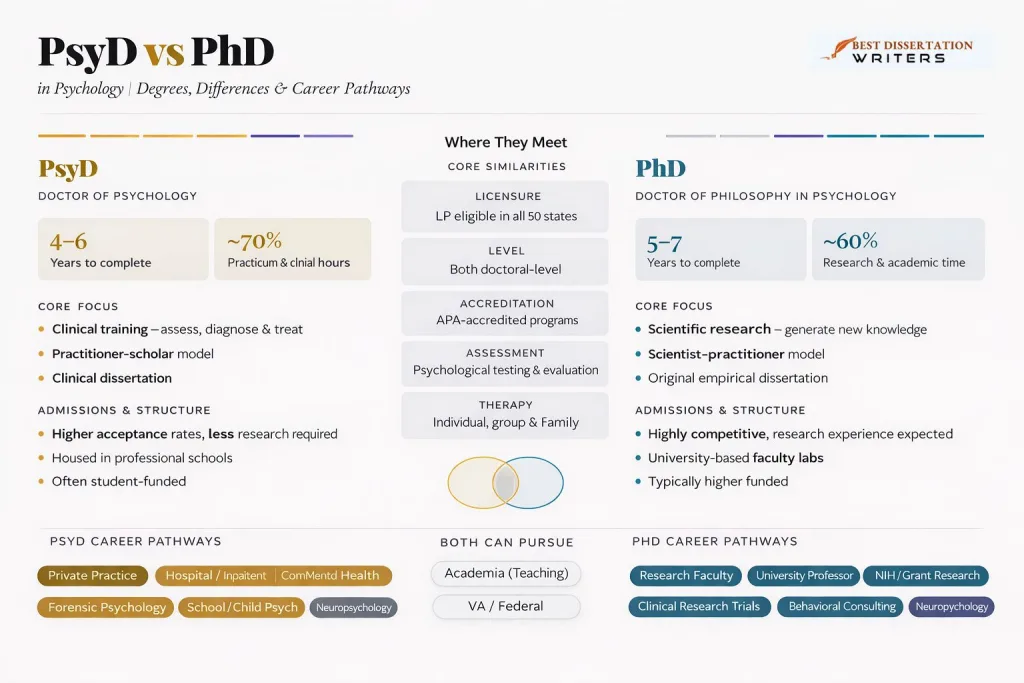
Key Difference Between a PhD and a PsyD Degree
- Training mission: PsyD and a PhD differ in purpose. A PsyD trains for clinical service and applied care. A PhD trains for research production and scientific contribution.
- Primary daily work: PsyD and PhD paths shape routines. PsyD students spend more time in supervised practice. PhD students spend more time in labs and research teams.
- Research expectations: The difference between a PsyD and a PhD includes output. PsyD programs usually require research literacy with limited publication pressure. A PhD program often expects publications, grants, and a research portfolio.
- Clinical intensity: PsyD or PhD choices affect clinical hours. PsyD programs emphasize clinical contact and skill-building. PhD tracks include clinical training but balance it with research demands.
- Career pathway: PhD vs PsyD leads to different identities. PsyD graduates typically pursue practice-focused roles. PhD graduates often pursue academia, research leadership, or combined roles.
- Program “success” measures: What’s the difference in evaluation? PsyD and PhD programs assess clinical competence versus research productivity.
Clinical Psychology Program vs Research-Focused PhD
- In a doctor of psychology or PsyD track, programs often build training around direct clinical preparation, while the PhD route often centers clinical psychology research.
- A typical PhD program places strong weight on research methods, theory building, and producing new knowledge through published studies.
- Many PhD students spend significant time in labs, research teams, data analysis, and writing projects that support publication and grant-related skills.
- Most research-focused tracks require a dissertation, which is a large research project that demonstrates the ability to design, conduct, and defend original research.
- Because the PhD pathway is research-intensive, PhD graduates often pursue roles in academia, including faculty positions, research leadership, or advanced research institutes.
- In contrast, doctor of psychology models more commonly emphasize readiness for professional practice, especially in client-facing settings.
- Many PsyD programs emphasize clinical preparation by prioritizing supervised practice hours, applied assessment, and treatment delivery skills.
- PsyD pathways often ensure that PsyD programs offer extensive supervised placement experiences throughout training.
- Both pathways include clinical training, but the balance differs, with PsyD leaning toward applied hours and PhD leaning toward research productivity.
- Both can include meaningful clinical practice, but the training structure often shapes what graduates feel most confident doing immediately after graduation.
- Whether you choose a PhD, you should review programs in clinical psychology carefully to see how the curriculum is designed.
- Since each psychology doctoral program can vary widely, look at internship match outcomes, faculty focus, and required research expectations before deciding.
Career Outcomes for a Psychologist and Licensed Psychologist
- Both the PsyD and the PhD can lead to careers as a psychologist, but the roles often differ in emphasis.
- Many graduates pursue licensure and work as a licensed psychologist, which supports independent clinical work when state requirements are met.
- Doctor of psychology graduates commonly train for direct service roles and often work as a clinical psychologist in client-focused settings.
- Many graduates apply their skills in clinical settings such as hospitals, outpatient clinics, community agencies, and integrated care systems.
- Once licensed, many choose professional practice routes that focus on therapy, assessment, consultation, and specialized clinical services.
- Some build careers in private practice, especially when they want long-term autonomy and a clinical service-focused workload.
- Both degrees support work in professional psychology, which includes clinical care, consultation, ethics, supervision, and applied assessment.
- If you want to practice and spend most working hours in client services, PsyD training may fit better for that daily work style.
- If you want to practice psychology and also lead research programs, the PhD route may provide stronger preparation for research-heavy roles.
- According to the Bureau of Labor Statistics, employment information for psychologists varies by specialty area, work setting, and level of experience, so outcomes depend on your focus and location.
- In general, PsyD graduates typically move toward applied service roles sooner, while PhD graduates may balance applied work with research or teaching depending on training and goals.
- Because PhD graduates often pursue research leadership or academic roles, they may spend more time publishing, teaching, and directing research programs.
- Strong programs in both pathways aim to prepare students for ethical practice, competence, and long-term career growth, but the right choice depends on your personal goals and fit.