

Understanding the Juris Doctor Degree
What a Juris Doctor Degree Is in Law School
The Juris Doctor (JD) is the primary professional degree required to practise law in the United States and Canada. It is earned by completing law school and serves as the foundational credential for legal careers.
- First professional law degree — The JD is the entry-level degree for anyone seeking to become a licensed attorney.
- Three-year program — Most law schools require three years of full-time study after completing an undergraduate degree.
- Required for bar admission — Graduates must hold a JD from an accredited law school to sit for the bar exam in most U.S. states.
- Covers core areas of law — Curriculum includes contracts, torts, constitutional law, civil procedure, criminal law, property law, and legal writing.
- Accredited by the ABA — Law schools offering the JD must be accredited by the American Bar Association to ensure educational standards.
- Prepares graduates for diverse roles — JD holders work in litigation, corporate law, government, academia, non-profit sectors, and business.
- Replaced the LLB — The JD was introduced to elevate the status of legal education and replaced the Bachelor of Laws (LLB) as the standard U.S. law degree in the 20th century.
Juris Doctor vs. JD Degree in a Degree Program
While “Juris Doctor” and “JD” refer to the same credential, there are important distinctions in how the degree is understood, positioned, and compared within broader academic degree programs.
- Same credential, different context — “Juris Doctor” is the full Latin name; “JD” is simply the abbreviated form used on transcripts, resumes, and professional documents.
- Graduate-level professional degree — The JD sits within graduate studies, positioned above the bachelor’s degree but functioning as a professional degree rather than a research degree.
- Requires an undergraduate degree — Unlike some professional programs, the JD demands prior completion of a four-year bachelor’s degree, making it a post-baccalaureate credential.
- Not equivalent to a master’s — Though graduate-level, the JD is not classified as a Master of Laws (LLM). The LLM is a separate advanced degree requiring the JD as a prerequisite.
- Distinct from an SJD or JSD — The Doctor of Juridical Science (SJD/JSD) is the true academic research doctorate in law; it is separate and more advanced than the JD.
- Dual-degree options available — Some universities allow students to combine a JD with an MBA, MPH, or other graduate degrees, resulting in combined degree programs that expand career options.
- Recognized internationally — While the JD is primarily a North American degree, it is increasingly recognized globally in legal and business settings, especially in multinational corporate law.
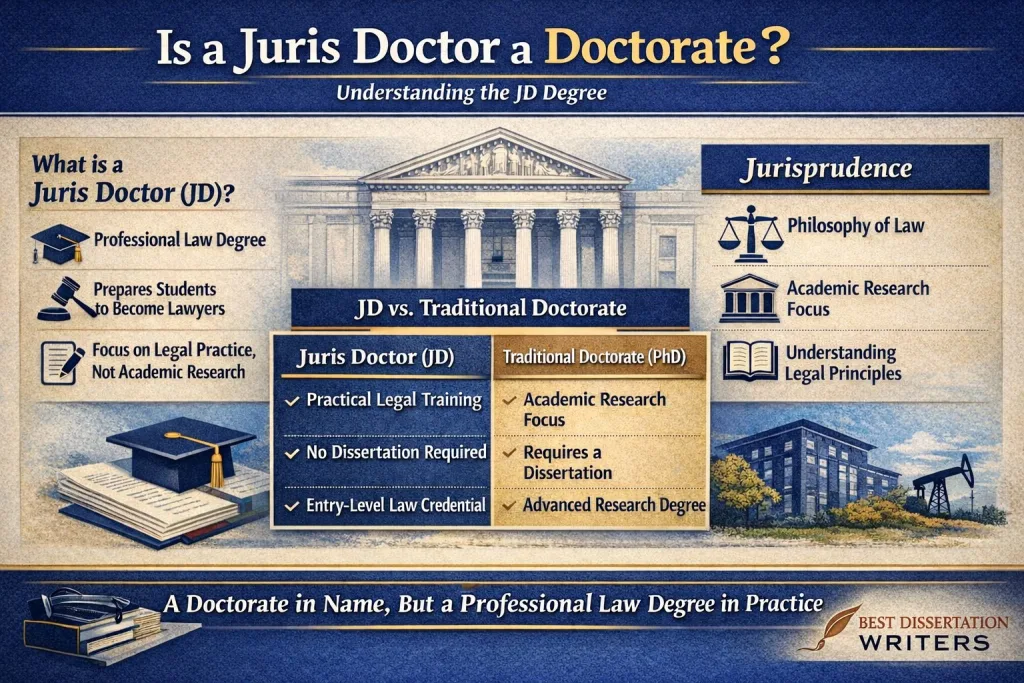
Why the Juris Doctor Degree Is Not a Traditional Doctorate
Despite carrying the title “Doctor,” the JD is classified as a professional doctorate, not a traditional research doctorate. This distinction is important for understanding its academic and professional standing.
- No original research dissertation required — Traditional doctorates (such as the PhD) demand an original research thesis that contributes new knowledge to a field. The JD does not require this.
- Professional practice focus — The JD is designed to train practicing lawyers, not academic researchers or scholars. Its core purpose is professional preparation, not knowledge production.
- Classified as a first professional degree — In the U.S. educational system, the JD is officially categorized alongside the MD (medicine) and DDS (dentistry) as a first professional degree.
- Does not qualify for “Dr.” title in academic settings — In most professional and academic contexts, JD holders do not use the “Dr.” prefix, unlike holders of PhDs or medical doctorates.
- Historical academic debate — Scholars and universities have long debated the JD’s status. Some law schools and faculty members argue it deserves greater academic recognition as a doctoral credential.
- Curriculum is prescribed, not self-directed — PhD students design independent research; JD students follow a structured curriculum set by the law school, reinforcing its professional training model.
- SJD is the true research doctorate in law — Those seeking a research-based legal doctorate pursue the Doctor of Juridical Science (SJD), which requires an original dissertation and is used primarily in legal academia.
Jurisprudence and the Meaning Behind the Juris Doctor Degree
The title “Juris Doctor” is rooted in Latin and connected to the philosophical tradition of jurisprudence — the study of law as a system of principles, ethics, and societal purpose.
- Latin origin of the name — “Juris” means “of law” or “of right” in Latin; “Doctor” means “teacher” or “learned one.” Together, the degree title means a learned expert in the law.
- Rooted in jurisprudence — Jurisprudence is the philosophy and theory of law. It examines what law is, how it develops, and its moral and social foundations. The JD draws on this intellectual tradition.
- Three key schools of jurisprudence — Students studying the meaning of the JD engage with natural law theory (law derived from morality), legal positivism (law as man-made rules), and realism (law as shaped by social forces).
- The JD reflects mastery of legal reasoning — Beyond memorizing statutes, the degree represents the ability to reason legally, apply precedent, analyze conflicting principles, and construct legal arguments.
- Connection to justice and rights — Jurisprudence connects law to broader concepts of justice, rights, and ethics. The JD embeds these values by training lawyers to understand law’s role in society, not just its technicalities.
- Elevated status over the former LLB — When the JD replaced the LLB in the U.S., it was partly an effort to reflect that legal education had evolved into a serious, rigorous academic and professional pursuit worthy of doctoral standing.
- The degree carries symbolic weight — Earning a JD signals not only professional readiness but also immersion in the principles, language, and philosophical traditions that have shaped Western legal systems for centuries.
Is the JD a Doctorate for a Lawyer in Legal Practice
Academic Classification of the JD
Terminal Professional Degree
- The JD is classified as a terminal professional degree in law
- Represents the highest degree needed to practice law in the United States
- Equivalent to other professional doctorates like MD (Doctor of Medicine) or DDS (Doctor of Dental Surgery)
- Does not require a master’s degree as a prerequisite
Doctoral-Level Credential
- The American Bar Association recognizes the JD as a doctorate
- Department of Education classifies it as a doctoral-level degree
- Takes approximately three years of post-graduate study to complete
- Involves rigorous academic training comparable to other doctoral programs
Professional vs. Research Doctorate
- The JD is a professional doctorate, not a research doctorate like a PhD
- Focuses on practical legal skills rather than original academic research
- Does not require a dissertation or thesis in most programs
- Prepares graduates for legal practice rather than academic scholarship
Using “Doctorate” After a JD in a Law Firm
Standard Practice in Legal Settings
Reasons lawyers typically don’t use “Dr.” title:
- Professional convention: The legal profession traditionally uses “Esquire” (Esq.) or “Attorney” instead
- Client expectations: Clients expect to address lawyers as “Attorney” or by name, not “Doctor”
- Avoiding confusion: The “Dr.” title is strongly associated with medical doctors in American culture
- Bar association norms: Most state bars and legal organizations use attorney designations exclusively
Academic and Formal Contexts
When JD holders may use doctoral titles:
- University settings: Law professors often use “Dr.” in academic environments
- Official documents: Some legal documents may reference “Juris Doctor” formally
- International practice: Countries where doctorate titles are standard for all doctoral degrees
- Personal choice: Technically permissible but rarely exercised in traditional law firms
Workplace Implications
- Using “Dr.” in a law firm may appear pretentious to colleagues and clients
- Could create confusion about whether the attorney has medical training
- Most legal letterhead and business cards use “Attorney at Law” or “Esq.”
- Firm culture and regional norms heavily influence title usage
How the JD Degree Supports Litigation and Legal Practice
Core Legal Skills Developed
Essential competencies acquired through JD training:
- Legal analysis: Ability to read, interpret, and apply complex statutes and case law
- Critical thinking: Evaluating arguments, identifying weaknesses, and constructing counterarguments
- Legal writing: Drafting briefs, motions, contracts, and other legal documents with precision
- Oral advocacy: Developing courtroom presentation and persuasive speaking skills
Litigation-Specific Preparation
JD curriculum elements supporting trial work:
- Civil procedure: Understanding rules governing lawsuits from filing through appeal
- Evidence: Learning what information can be presented in court and how
- Trial advocacy: Practicing opening statements, cross-examination, and closing arguments
- Legal research: Mastering databases and methods to find relevant case precedents
Dissertation Writing Help You Can Trust
Get expert, research-driven dissertation support from Best Dissertation Writers . We help you strengthen your topic, refine your proposal, structure chapters, and polish your final draft to meet graduate-level standards.
Get Dissertation Help NowPractical Application in Law Firms
- JD training provides foundation for drafting pleadings and discovery requests
- Case law analysis skills enable attorneys to predict litigation outcomes
- Moot court experience prepares lawyers for actual courtroom appearances
- Clinical programs offer supervised experience handling real client matters
Transactional and Advisory Work
- Contract drafting skills learned in JD programs apply to business transactions
- Regulatory knowledge supports compliance counseling for corporate clients
- Negotiation training helps attorneys broker settlements and business deals
- Ethics education ensures professional responsibility in all practice areas
Juris Doctorate Status Across Civil Law and Jurisprudence Degree Systems
Common Law vs. Civil Law Systems
Key differences in legal education:
- Common law countries: JD or LLB serves as primary law degree (US, UK, Canada, Australia)
- Civil law countries: Law is often an undergraduate degree followed by specialized training (France, Germany, Italy)
- Degree nomenclature: Civil law systems may use “Licence” or “Magister” for law degrees
- Professional training: Both systems require additional bar exams or apprenticeships
International Recognition Challenges
Factors affecting JD equivalency abroad:
- Educational frameworks: Different countries classify degrees using distinct qualification levels
- Practice requirements: Some nations don’t recognize foreign law degrees for immediate practice
- Credential evaluation: Professional agencies must assess JD equivalency for immigration or employment
- Reciprocity agreements: Limited treaties exist for mutual recognition of legal qualifications
LLB vs. JD Distinction
- The Bachelor of Laws (LLB) is the standard law degree in many Commonwealth countries
- United States transitioned from LLB to JD in the 1960s to reflect graduate-level status
- Both degrees generally qualify holders for bar admission in their respective jurisdictions
- Some countries offer both undergraduate LLB and graduate-entry JD programs
Global Legal Practice Considerations
- Lawyers with JD degrees may need additional qualifications to practice internationally
- European Union has some harmonization of legal education standards
- Many civil law countries require knowledge of local legal codes and languages
- International firms value JD credentials but may require local bar admission
- Cross-border practice often involves working with local counsel rather than direct representation
Advanced Legal Degrees
- LLM (Master of Laws) provides specialized study after JD or LLB
- SJD or PhD in Law represents research doctorate beyond professional degrees
- Civil law countries may offer “Doctorate in Law” requiring dissertation
- These research degrees focus on legal scholarship rather than practice preparation

Careers With a JD Degree Beyond Basic Legal Practice
Non-Traditional Career Paths
Business and Corporate Roles
Alternative careers leveraging JD training:
- Compliance officer: Ensuring companies follow regulations and internal policies
- Contract manager: Overseeing agreement negotiations and vendor relationships without courtroom work
- Risk management: Identifying legal and operational risks for businesses
- Human resources executive: Using legal knowledge for employee relations and labor issues
Government and Policy Positions
Public sector opportunities for JD holders:
- Legislative aide: Drafting bills and analyzing proposed legislation for lawmakers
- Policy analyst: Researching and recommending government policy changes
- Regulatory affairs: Working with agencies like FDA, EPA, or SEC on compliance
- Diplomatic service: Representing government interests in international negotiations
Academia and Education
- Law school professors teach future attorneys and conduct legal research
- University administrators use legal expertise for institutional governance
- Legal writing instructors train students in research and communication skills
- Continuing legal education providers develop training for practicing lawyers
Media and Publishing
- Legal journalists report on court decisions and regulatory developments
- Legal editors review and fact-check law-related publications
- Television legal analysts provide expert commentary on high-profile cases
- Authors write legal thrillers, non-fiction, or practice guides
Entrepreneurship and Consulting
- Legal technology startups create software solutions for law firms
- Legal consultants advise businesses without traditional attorney-client relationships
- Mediation and arbitration specialists offer alternative dispute resolution services
- Legal recruiters match attorneys with firms using industry knowledge
Corporate Law Pathways for a Juris Doctor Degree Holder
In-House Counsel Positions
Advantages of corporate legal departments:
- Single client focus: Developing deep expertise in one company’s business
- Work-life balance: Generally more predictable hours than law firm practice
- Business integration: Participating in strategic decisions beyond pure legal issues
- Compensation packages: Often includes stock options and corporate benefits
Mergers and Acquisitions (M&A)
Specialized roles in corporate transactions:
- Due diligence: Investigating target companies for legal and financial risks
- Deal structuring: Designing transaction terms to optimize tax and regulatory outcomes
- Negotiation: Representing buyers or sellers in purchase agreement discussions
- Post-merger integration: Ensuring legal compliance during company combinations
Securities and Finance Law
- Securities lawyers help companies issue stocks and bonds in capital markets
- Disclosure specialists ensure proper financial reporting to shareholders and regulators
- Investment advisors provide legal guidance on fund structures and regulations
- Banking attorneys draft loan agreements and manage lender relationships
Corporate Governance
- Board advisors counsel directors on fiduciary duties and decision-making
- Shareholder relations specialists handle proxy statements and annual meetings
- Ethics and compliance professionals develop internal policies and training programs
- Executive compensation lawyers structure pay packages within legal boundaries
Intellectual Property in Corporations
- Patent attorneys protect innovations and manage patent portfolios (often requires technical degree)
- Trademark counsel maintains brand protection and licensing agreements
- Copyright specialists handle content ownership for media and technology companies
- Trade secret managers develop policies to safeguard confidential information
Employment Law Roles for a JD Lawyer
Employee-Side Representation
Advocating for workers’ rights:
- Discrimination claims: Representing employees facing bias based on protected characteristics
- Wage and hour disputes: Recovering unpaid overtime and minimum wage violations
- Wrongful termination: Challenging illegal firings and seeking damages or reinstatement
- Harassment cases: Pursuing claims for hostile work environment and retaliation
Employer-Side Defense
Protecting businesses from liability:
- Policy development: Creating employee handbooks and workplace procedures
- Training programs: Educating managers on discrimination and harassment prevention
- Litigation defense: Representing companies in lawsuits brought by employees
- Union negotiations: Bargaining collective agreements and handling labor disputes
Benefits and Compensation Law
- ERISA attorneys manage pension plans and employee benefit programs
- Health insurance specialists ensure compliance with healthcare regulations
- Retirement plan advisors structure 401(k) and defined benefit programs
- Executive compensation lawyers design incentive packages for senior leadership
Workplace Safety and Compliance
- OSHA compliance specialists help companies meet occupational safety standards
- Workers’ compensation attorneys handle injury claims and insurance disputes
- Disability accommodation advisors ensure ADA compliance in hiring and facilities
- Leave management specialists navigate FMLA, sick leave, and parental leave laws
Government Employment Agencies
- EEOC investigators examine discrimination complaints and enforce civil rights laws
- Department of Labor attorneys enforce wage, hour, and safety regulations
- State labor board attorneys adjudicate unemployment and workers’ rights claims
- Immigration compliance officers verify employment eligibility and visa status
Natural Resources Law Options with a Juris Doctor Degree
Energy Law Specializations
Career paths in energy sector:
- Oil and gas: Negotiating mineral rights leases and royalty agreements
- Renewable energy: Structuring solar, wind, and hydroelectric project financing
- Utilities regulation: Advising electric and water companies on rate setting and compliance
- Energy trading: Managing legal aspects of commodity markets and derivatives
Environmental Regulatory Practice
Protecting natural resources through law:
- Clean Air Act compliance: Helping industries meet emissions standards
- Water quality regulation: Navigating discharge permits and watershed protection
- Endangered species: Advising on habitat conservation and development restrictions
- Environmental impact: Preparing assessments for major construction and industrial projects
Mining and Mineral Rights
- Mining attorneys secure permits and negotiate extraction agreements
- Mineral rights specialists handle ownership disputes and lease arrangements
- Reclamation lawyers ensure proper land restoration after resource extraction
- International mining counsel navigates laws in foreign jurisdictions
Public Lands and Conservation
- Government attorneys manage federal lands including forests and national parks
- Conservation organizations employ lawyers to protect wilderness and wildlife
- Land trust attorneys facilitate conservation easements and habitat preservation
- Recreation law specialists handle permits for outdoor activities on public lands
Climate Change and Sustainability
- Carbon credit lawyers structure emissions trading and offset programs
- Sustainability consultants help corporations reduce environmental footprints legally
- Climate litigation attorneys pursue cases against major polluters
- Green building specialists ensure construction meets environmental certification standards
Water Rights and Maritime Law
- Water rights attorneys resolve allocation disputes in drought-prone regions
- Hydropower specialists negotiate dam operations and river management
- Maritime lawyers handle shipping, navigation, and offshore resource extraction
- Fisheries attorneys manage commercial fishing regulations and conservation quotas