

Null vs Alternative Hypothesis – Key Takeaways
The null hypothesis and the alternative hypothesis are the two core statements used in hypothesis testing. The null hypothesis (H₀) represents no effect, no difference, or no relationship, while the alternative hypothesis (H₁) represents a significant effect, difference, or relationship. These two hypotheses are mutually exclusive and guide researchers in making evidence-based decisions from sample data.
- What the Null and Alternative Hypotheses Mean:
- The null hypothesis (H₀) assumes nothing meaningful is happening, such as no difference between groups or no relationship between variables.
- The alternative hypothesis (H₁) suggests that a real effect, difference, or relationship exists.
- In hypothesis testing, researchers usually test whether there is enough evidence to reject the null hypothesis.
- How Hypothesis Testing Works:
- Start by stating H₀ and H₁ clearly.
- Choose a significance level, often 0.05.
- Select the right statistical test, such as a t-test, chi-square test, or ANOVA.
- Calculate the test statistic and p-value.
- If the p-value is below the significance level, reject the null hypothesis; if not, fail to reject it.
- One-Tailed vs Two-Tailed Tests:
- A one-tailed test is used when the researcher expects a specific direction, such as one group performing better than another.
- A two-tailed test is used when the researcher only wants to test whether a difference exists, without predicting the direction.
- The choice depends on the research question and hypothesis.
- Why Data and Sample Matter:
- Sample data is used to make conclusions about a larger population.
- A larger, representative sample increases the reliability of results.
- Small or biased samples can lead to weak or misleading conclusions.
- Common Errors in Hypothesis Testing:
- Type I error: rejecting the null hypothesis when it is actually true.
- Type II error: failing to reject the null hypothesis when it is actually false.
- Good research design, correct hypothesis formulation, and proper sample size help reduce these errors.
- Real-World Use of Null and Alternative Hypotheses:
- These hypotheses are used in medical, education, social science, and business research.
- Examples include testing whether a new drug works better, whether a teaching method improves performance, or whether a marketing campaign increases sales.
- They provide a structured way to turn research questions into testable statistical decisions.
In summary, understanding the null and alternative hypotheses is essential for hypothesis testing. They are crucial in determining whether research results are statistically significant and whether there is enough evidence to make informed decisions based on data.
Introduction to Hypotheses: What Are Null and Alternative Hypotheses?
- A hypothesis is a statement or assumption made by a researcher about a population parameter or the relationship between variables. It is the foundation of hypothesis testing, a statistical method used to make inferences or draw conclusions about populations based on sample data.
- There are two primary types of hypotheses in statistics:
- Null Hypothesis (H₀): This is a statement that there is no effect or no difference between groups, or that there is no relationship between variables. The null hypothesis is typically the hypothesis that the researcher seeks to reject or fail to reject.
- Alternative Hypothesis (H₁): This hypothesis represents a statement that suggests there is a significant effect, difference, or relationship between groups or variables. The alternative hypothesis is what the researcher aims to support with statistical evidence.
- Null hypothesis vs alternative hypothesis: These two hypotheses are mutually exclusive. If one is true, the other must be false. The null hypothesis states that there is no effect, while the alternative hypothesis states that there is an effect. They can be used to create a strong value hypotheses for business research.
How Null and Alternative Hypotheses Are Tested in Statistics
Hypothesis testing is a critical statistical method used to assess whether the sample data provide enough evidence to reject the null hypothesis in favor of the alternative hypothesis. This process helps researchers make decisions about population parameters based on sample data. Testing Procedure:
- State the Hypotheses:
- The first step is to clearly define both the null hypothesis (H₀) and the alternative hypothesis (H₁).
- Null Hypothesis (H₀): This is a statement that there is no effect or no difference between the groups or variables being studied.
- Alternative Hypothesis (H₁): This hypothesis proposes that there is a significant effect or difference between the groups or variables.
- Choose the Significance Level (α):
- The significance level (α) represents the probability of committing a Type I error, which is the error of incorrectly rejecting the null hypothesis.
- It is typically set at 0.05 (5%), meaning there’s a 5% chance of rejecting the null hypothesis when it is actually true.
- Select the Appropriate Statistical Test:
- Depending on the type of data and the nature of the research question, a suitable statistical test must be chosen. Common tests include:
- t-tests for comparing means between two groups.
- Chi-square tests for categorical data.
- ANOVA for comparing means across more than two groups.
- Depending on the type of data and the nature of the research question, a suitable statistical test must be chosen. Common tests include:
- Calculate the Test Statistic:
- Using the sample data and the chosen statistical test, a test statistic is calculated. This statistic summarizes the difference between the observed data and what is expected under the null hypothesis.
- Determine the P-Value:
- The p-value indicates the probability of obtaining the observed data, assuming the null hypothesis is true.
- A low p-value suggests strong evidence against the null hypothesis, while a high p-value suggests weak evidence.
- Make a Decision:
- If the p-value is less than the significance level (α), you reject the null hypothesis and accept the alternative hypothesis.
- If the p-value is greater than α, you fail to reject the null hypothesis.
Formulas and Symbols:
- Null Hypothesis (H₀): For example, “the mean of population A is equal to the mean of population B” can be represented as H₀: μ₁ = μ₂.
- Alternative Hypothesis (H₁): The statement “the mean of population A is not equal to the mean of population B” is represented as H₁: μ₁ ≠ μ₂.
The Role of Null and Alternative Hypotheses in Hypothesis Testing
- Fundamental to Hypothesis Testing:
- Null and alternative hypotheses are central to the hypothesis testing process in statistics.
- They help researchers answer research questions about the population parameter being tested.
- Purpose of Hypotheses:
- Null Hypothesis (H₀): States that there is no effect or no difference between groups, or no relationship between variables.
- Alternative Hypothesis (H₁): Suggests that there is a significant effect, difference, or relationship between groups or variables.
- Answering Research Questions:
- Researchers use these hypotheses to determine if a significant difference exists between groups or if a relationship exists between variables.
- Example: Investigating whether a new drug works better than an existing one or if there’s a difference between two teaching methods.
- Guiding Statistical Test Selection:
- The null and alternative hypotheses help determine which statistical test to use (e.g., t-test, ANOVA, chi-square).
- The choice of test depends on the type of data and the nature of the hypotheses.
- Testing the Hypotheses:
- Statistical tests compare the observed sample data to what would be expected if the null hypothesis were true.
- The goal is to assess whether the data provide enough evidence to reject the null hypothesis or fail to reject it.
- Role of the P-Value:
- The p-value represents the probability of observing the sample data, assuming the null hypothesis is true.
- A small p-value (typically less than 0.05) suggests that the null hypothesis is unlikely to be true.
- Making the Decision:
- Reject the Null Hypothesis:
- If the p-value is small (typically ≤ 0.05), the evidence is strong enough to reject the null hypothesis.
- This supports the alternative hypothesis, indicating a significant effect or relationship.
- Fail to Reject the Null Hypothesis:
- If the p-value is large (typically > 0.05), the evidence is insufficient to reject the null hypothesis.
- This means there’s not enough evidence to support the alternative hypothesis.
- Reject the Null Hypothesis:
Struggling with Your Dissertation Introduction Chapter?
Get expert assistance with your dissertation introduction chapter from Best Dissertation Writers . Our team specializes in writing compelling and well-structured introduction chapters tailored to your research goals. Visit our site for more details: Best Dissertation Writers .
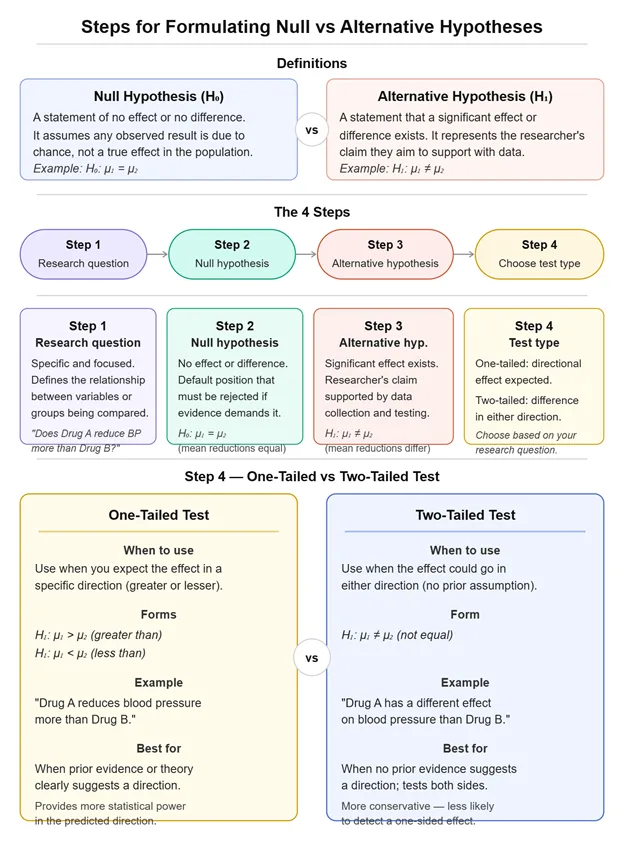
Get Dissertation Introduction HelpSteps for Formulating Null vs Alternative Hypotheses
Step 1: Define Your Research Question
- Clearly defining the research question is the first and most critical step in hypothesis testing. This question will guide the entire process of hypothesis formulation and statistical testing.
- The research question must be specific and focused on the relationship between variables or the difference between groups.
- Example: If you’re studying the impact of a new drug on blood pressure, your research question might be:
- “Does the new drug reduce blood pressure more effectively than the existing drug?”
- This question seeks to compare the effects of two drugs on blood pressure and sets the stage for formulating hypotheses.
Step 2: Formulate the Null Hypothesis
- The null hypothesis (H₀) is typically a statement of no effect or no difference. It represents the idea that any observed effect in the sample data is due to random chance rather than a true effect or relationship in the population.
- Key points:
- The null hypothesis assumes that no relationship or no difference exists between the groups or variables being compared.
- It is the default position that must be rejected if sufficient evidence is found against it.
- Example: If you’re testing the impact of a new drug on blood pressure, the null hypothesis could be:
- H₀: The mean blood pressure reduction from the new drug is equal to the mean reduction from the existing drug.
- Mathematically: H₀: μ₁ = μ₂, where μ₁ is the mean reduction from the new drug, and μ₂ is the mean reduction from the existing drug.
- Important: The null hypothesis is often formulated as a statement of equality, as it suggests that there is no significant difference between the groups.
Step 3: Develop the Alternative Hypothesis
- The alternative hypothesis (H₁) proposes that there is a significant effect or difference between the groups or variables being tested. It is what the researcher aims to support with data.
- Key points:
- The alternative hypothesis assumes that there is a true relationship or difference that exists in the population.
- It represents the researcher’s research hypothesis.
- Example: In the case of the new drug’s impact on blood pressure, the alternative hypothesis could be:
- H₁: The mean blood pressure reduction from the new drug is different from that of the existing drug.
- Mathematically: H₁: μ₁ ≠ μ₂.
Step 4: Use One-Tailed vs Two-Tailed Hypothesis Testing Methods
- In hypothesis testing, you can perform either a one-tailed or two-tailed test, depending on the nature of your research hypothesis.
- One-Tailed Test: This test is used when you expect a specific direction of the effect or difference (e.g., one group is greater than the other). In this case, the alternative hypothesis is directional, either “greater than” (H₁: μ₁ > μ₂) or “less than” (H₁: μ₁ < μ₂).
- Example of one-tailed hypothesis: H₁: The new drug reduces blood pressure more than the existing drug (μ₁ > μ₂).
- Two-Tailed Test: A two-tailed test is used when the researcher is testing for the possibility of an effect in either direction. Here, the alternative hypothesis states that there is a difference, but it does not specify whether one group is greater or smaller than the other.
- Example of two-tailed hypothesis: H₁: The new drug has a different effect on blood pressure than the existing drug (μ₁ ≠ μ₂).
- One-Tailed Test: This test is used when you expect a specific direction of the effect or difference (e.g., one group is greater than the other). In this case, the alternative hypothesis is directional, either “greater than” (H₁: μ₁ > μ₂) or “less than” (H₁: μ₁ < μ₂).
- Choosing between one-tailed vs two-tailed: The choice between these methods depends on the research question. If the hypothesis suggests that the effect could be in either direction, a two-tailed test is appropriate. If the hypothesis specifies the direction of the effect, a one-tailed test should be used.
Understanding the Importance of Data and Sample in Hypothesis Testing
- Data and Sample Play a Critical Role:
- In hypothesis testing, the data collected from the sample is fundamental in deciding whether to reject or fail to reject the null hypothesis.
- The sample is used to estimate characteristics of the larger population, and the accuracy of these estimates depends on the sample size and the quality of the data.
- The Sample Size Matters:
- A larger sample size increases the accuracy of the statistical test and makes it more likely to detect a true effect if one exists.
- A small sample size may lead to unreliable results, making it difficult to detect significant differences or relationships, even when they do exist.
- Small samples can also lead to a higher error rate (Type I or Type II errors), meaning the risk of making incorrect decisions increases.
- Representative Data:
- The sample data must be representative of the population to ensure the null hypothesis and alternative hypothesis reflect true relationships or differences in the population.
- If the data is biased or not randomly selected, the results will not be statistically valid, and any conclusions drawn may be inaccurate.
- Hypothesized Value:
- When formulating the null hypothesis (H₀), a hypothesized value (like the population mean or proportion) is used to compare the sample data.
- The alternative hypothesis (H₁) will suggest that the observed value differs significantly from this hypothesized value.
- Example: If you’re testing whether a new teaching method affects student performance, the null hypothesis might state that there is no difference in student performance between the new method and the traditional one. The alternative hypothesis would state that there is a significant difference in performance.
Statistical Errors: Common Mistakes with Null and Alternative Hypotheses
- Type I Error (False Positive):
- A Type I error occurs when you reject the null hypothesis (H₀) when it is actually true.
- This is also known as a false positive, where a difference or effect is detected when there is none.
- Example: A researcher may falsely conclude that a new drug is more effective than an existing one, even though there is no actual difference in the efficacy.
- Type II Error (False Negative):
- A Type II error happens when you fail to reject the null hypothesis (H₀) when it is actually false.
- This is also called a false negative, where a true difference or effect is missed because the test failed to detect it.
- Example: A researcher might fail to detect that a new drug is more effective than an existing one because the sample size was too small or the test was not sensitive enough.
- Error Rate and Significance Level (α):
- The significance level (α) is the probability of making a Type I error, and is typically set at 0.05 (5% chance).
- The error rate is the likelihood of making either a Type I or Type II error.
- When performing hypothesis testing, researchers aim to minimize these errors by selecting appropriate statistical tests, determining an acceptable sample size, and using proper data collection methods.
- Incorrect Formulation of Hypotheses:
- A common mistake in hypothesis testing is incorrectly formulating the null hypothesis or alternative hypothesis.
- For example, the null hypothesis may be stated as H₀: μ₁ = μ₂ when it should be H₀: μ₁ ≥ μ₂, depending on the directionality of the research question.
- Inaccurate hypotheses can lead to incorrect conclusions and poor statistical decisions.
Examples of Null and Alternative Hypotheses in Real-World Research
- Example 1: Medical Research:
- Research Question: Does a new drug lower blood pressure more effectively than the existing drug?
- Null Hypothesis (H₀): There is no difference in the mean blood pressure reduction between the two drugs.
- Mathematically: H₀: μ₁ = μ₂, where μ₁ is the mean reduction from the new drug and μ₂ is the mean reduction from the existing drug.
- Alternative Hypothesis (H₁): There is a significant difference in the mean blood pressure reduction between the two drugs.
- Mathematically: H₁: μ₁ ≠ μ₂.
- This is an example of a two-sided test, where the alternative hypothesis considers the possibility of a difference in either direction (the new drug could be better or worse than the existing one).
- Example 2: Education Research:
- Research Question: Does a new teaching method improve student performance?
- Null Hypothesis (H₀): The mean test scores of students taught with the new method are equal to those taught with the traditional method.
- Mathematically: H₀: μ₁ = μ₂.
- Alternative Hypothesis (H₁): The mean test scores of students taught with the new method are higher than those taught with the traditional method.
- Mathematically: H₁: μ₁ > μ₂ (one-sided test).
- Example 3: Social Science:
- Research Question: Does increased social media use lead to higher levels of anxiety in teenagers?
- Null Hypothesis (H₀): Social media use has no effect on anxiety levels in teenagers.
- Mathematically: H₀: μ₁ = μ₂.
- Alternative Hypothesis (H₁): Increased social media use leads to higher levels of anxiety in teenagers.
- Mathematically: H₁: μ₁ > μ₂ (one-sided test).
- Example 4: Business:
- Research Question: Does a marketing campaign increase product sales?
- Null Hypothesis (H₀): The marketing campaign does not affect product sales.
- Mathematically: H₀: μ₁ = μ₂.
- Alternative Hypothesis (H₁): The marketing campaign increases product sales.
- Mathematically: H₁: μ₁ > μ₂ (one-sided test).
Struggling with Your Dissertation Introduction Chapter?
Get expert assistance with your dissertation introduction chapter from Best Dissertation Writers . Our team specializes in writing compelling and well-structured introduction chapters tailored to your research goals. Visit our site for more details: Best Dissertation Writers .
Get Dissertation Introduction HelpConclusion: The Significance of Null vs Alternative Hypotheses in Statistical Analysis
- Critical Role in Research:
- The null hypothesis and alternative hypothesis are essential components of statistical analysis and hypothesis testing. They help researchers evaluate the evidence against the null hypothesis and determine whether there is enough data to support the alternative hypothesis. It is essential to state both you null and alternative hypotheses in the dissertation introduction chapter.
- Data-Driven Decisions:
- Hypothesis testing enables researchers to make data-driven decisions that can inform scientific discovery, public policy, business strategies, and medical advancements.
- The process helps answer the research question by providing statistical evidence about the presence or absence of a significant effect or relationship between variables.
- Minimizing Errors:
- By understanding the types of statistical errors, including Type I and Type II errors, and using appropriate statistical tests, researchers can minimize mistakes in hypothesis testing.
- A well-constructed sample size, combined with accurate data and hypothesis formulation, ensures valid conclusions that contribute to the knowledge base.
- Summary:
- In conclusion, null vs alternative hypothesis testing is a cornerstone of statistics, providing a structured approach to answering research questions. Whether you’re exploring the impact of a new drug, analyzing student performance, or testing business strategies, this process is crucial for drawing valid, evidence-based conclusions.
By carefully defining your hypotheses, selecting appropriate statistical tests, and interpreting the results, you can ensure that your findings are statistically significant and offer valuable insights.
References
- Hypothesis Definition & Examples – National University Resources – https://resources.nu.edu/statsresources/hypothesis
- Null and Alternative Hypotheses – Minitab Support – https://support.minitab.com/en-us/minitab/help-and-how-to/statistics/basic-statistics/supporting-topics/basics/null-and-alternative-hypotheses/
- The Null and the Alternative Hypotheses – Florida SouthWestern State College (PDF) – https://www.tsc.fl.edu/media/divisions/learning-commons/resources-by-subject/math/statistics/The-Null-and-the-Alternative-Hypotheses.pdf
- Simple Null Hypothesis – ScienceDirect Topics (Elsevier) – https://www.sciencedirect.com/topics/mathematics/simple-null-hypothesis