

Oceanography Degree Programs in 2026 – Key Takeaways
An oceanography degree focuses on the scientific study of the ocean’s physical, chemical, biological, and geological processes. It prepares students for careers in research, environmental management, marine conservation, and related fields where understanding the ocean is critical. Below is a clear overview of the major points about oceanography degree programs:
- What Oceanography Is:
- Definition: Oceanography is the multidisciplinary study of oceans, including their ecosystems, chemistry, geology, and physical dynamics.
- Purpose: Graduates analyze marine environments, understand climate interactions, and support conservation and resource management.
- Types of Oceanography Degrees:
- Bachelor’s Degrees: Provide foundational knowledge in ocean science, math, and research methods.
- Master’s Degrees: Offer advanced study and specialization in areas like marine biology, chemical oceanography, or marine geology.
- Ph.D. Programs: Focus on original research, preparing students for academic, scientific, or high‑level industry roles.
- Core Curriculum & Skills:
- Course topics often include marine ecology, ocean circulation, marine geology, chemistry of seawater, and data analysis.
- Hands‑on training through labs and fieldwork (e.g., research cruises, sampling techniques) is essential to build practical skills.
- Career Opportunities:
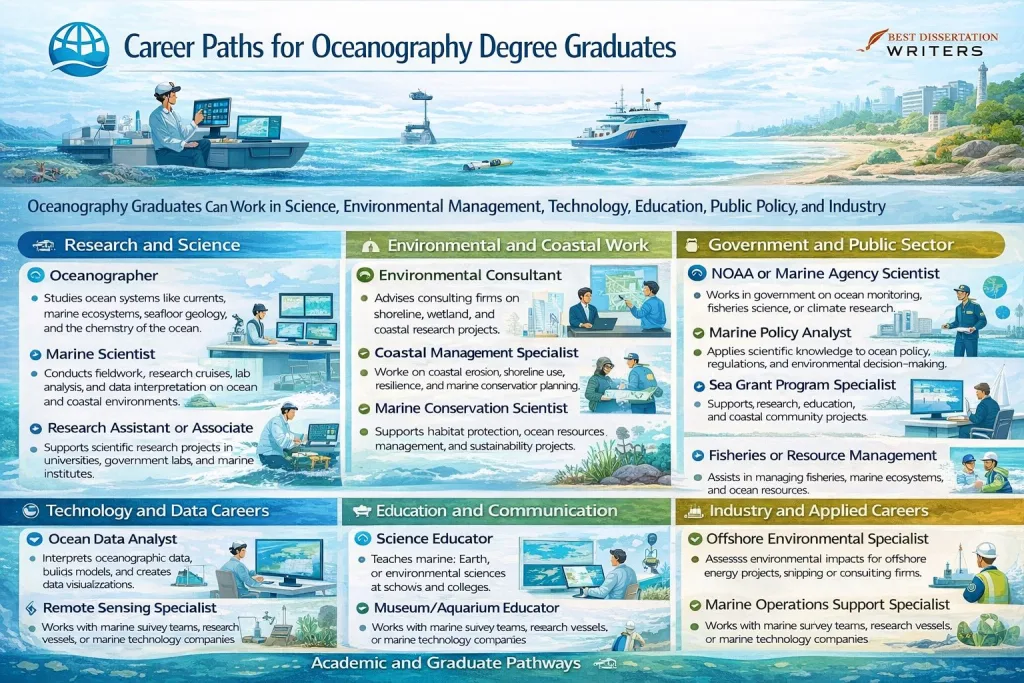
- Oceanography graduates work in research institutions, government agencies (like NOAA), environmental consulting firms, and marine conservation organizations.
- Common roles include marine scientist, environmental analyst, oceanographer, and research technician.
- Salary & Job Outlook:
- Salaries vary by education level, experience, and sector, with advanced degrees generally offering higher earnings.
- Job growth is supported by rising demand for climate research, environmental protection, and sustainable ocean management.
- Importance of Accreditation:
- Choosing an accredited program ensures quality education and better access to research opportunities and professional licensure.
Oceanography is a diverse field offering exciting career opportunities for those passionate about the oceans. Whether you’re interested in research, conservation, or environmental management, an oceanography degree provides the knowledge and skills to make a meaningful impact.
Overview of Oceanography Degree Programs
Oceanography degree programs are designed for students who want to study the ocean as a complex and interconnected system. Because the ocean influences climate, ecosystems, weather patterns, coastlines, and global resources, oceanography has become an important field within marine science and environmental science.
A degree in oceanography typically combines multiple scientific disciplines, giving students the opportunity to understand the biological, chemical, physical, and geological processes that shape marine environments. This interdisciplinary structure is one of the defining features of oceanography degree programs and one of the main reasons they appeal to students with broad scientific interests.
Unlike programs that focus on only one branch of science, oceanography programs usually encourage students to think across fields. A student may study marine organisms in one course, ocean circulation in another, and coastal geology or chemical cycles in another. This makes the oceanography degree especially valuable for students who want a STEM education that is both specialized and wide-ranging.
Whether a student is considering bachelor’s programs in oceanography or more advanced graduate oceanography programs, the field offers a strong academic foundation and multiple career pathways.
What Is an Oceanography Degree?
An oceanography degree is an academic program focused on the scientific study of the ocean. It examines how ocean systems work, how marine environments change over time, and how the ocean interacts with the atmosphere, the seafloor, marine life, and human activity. In simple terms, a degree in oceanography teaches students how to study the ocean using scientific methods, data analysis, fieldwork, and research.
Oceanography is often described as an interdisciplinary marine science field because it draws from several areas of study. These commonly include:
- Biology
This helps students understand marine organisms, ecosystems, food webs, and biodiversity. - Chemistry
This focuses on seawater composition, nutrient cycles, pollution, and chemical interactions in ocean systems. - Physics
This is essential for studying waves, tides, currents, ocean circulation, and the movement of heat and energy. - Geology
This helps explain the structure of the ocean floor, coastal landforms, marine sediments, and tectonic activity. - Mathematics and calculus
These support modeling, measurement, data interpretation, and quantitative scientific analysis.
Because of this wide scope, oceanography degree programs often attract students who are interested in both marine science and broader Earth systems. Some programs use the term oceanography, while others may use related terms such as marine science, marine and environmental science, or Earth and ocean sciences. Even when the program title differs, the core idea remains the same: students learn to analyze ocean environments through scientific inquiry.
Types of Oceanography Degree Programs
There are several types of oceanography degree programs, and they generally vary by academic level, research intensity, and specialization. Understanding these differences is important for students deciding which degree path best fits their goals.
The main types of oceanography programs include:
- Undergraduate programs
These are designed for students beginning higher education and usually lead to a bachelor’s degree. - Graduate programs
These include master’s and doctoral pathways for students seeking advanced training, research experience, or academic specialization. - Professional and interdisciplinary marine science programs
Some institutions offer related degrees that overlap with oceanography, especially in marine science, environmental science, coastal science, or Earth systems.
Each type of program serves a different purpose.
- Undergraduate oceanography programs usually introduce students to the major branches of ocean science while building a strong base in core STEM subjects.
- Graduate oceanography programs focus more heavily on research, specialization, and advanced analytical skills.
- Related marine science programs may appeal to students whose interests overlap with oceanography but also include conservation, environmental policy, fisheries, or climate systems.
This range of options is one reason oceanography degree programs appeal to such a wide group of students. Some students want a broad introduction to marine science, while others already know they want to pursue advanced ocean research or a highly specialized concentration.
Bachelor’s Programs in Oceanography
Bachelor’s programs in oceanography are undergraduate degree programs designed to give students a strong scientific foundation in marine and ocean systems. These programs are usually ideal for students who know early on that they want to study the ocean, marine environments, or related environmental processes.
A bachelor’s degree in oceanography typically includes coursework in:
- biology
- chemistry
- physics
- geology
- mathematics
- calculus
- statistics
- environmental science
- introductory oceanography
In many bachelor’s programs, students start with general science requirements and then move into more ocean-focused coursework as they progress. This structure helps students build the scientific skills needed to understand more advanced marine science topics later in the degree.
Need Help With Your Dissertation?
Get professional academic support from Best Dissertation Writers . Our expert team is ready to help you with high-quality dissertation writing services tailored to your academic goals.
Get Dissertation HelpBachelor’s programs in oceanography often emphasize several important areas:
- Core scientific literacy
Students learn the major principles behind ocean systems and scientific reasoning. - Laboratory and field experience
Many programs include lab work, coastal observation, field courses, or practical scientific training. - Quantitative skill development
Since oceanography relies on data, students often develop skills in mathematics, measurement, and analysis. - Preparation for employment or graduate study
A bachelor’s degree may support entry-level roles, but it also serves as preparation for graduate oceanography programs.
For many students, the undergraduate level is where they begin identifying their strongest interests. One student may be drawn to marine organisms and ecosystems, while another may become more interested in ocean currents, chemical processes, or the geology of the seafloor. Bachelor’s programs help students discover these interests while still keeping their education broad enough to support multiple future directions.
Graduate Programs in Oceanography
Graduate programs in oceanography are intended for students who want advanced scientific training beyond the bachelor’s level. These programs are usually more research-focused and often require students to enter with a stronger academic background in science, mathematics, and marine science-related subjects.
The main graduate options include:
- Master’s programs
These usually provide advanced coursework, research training, and sometimes a thesis or capstone project. - Doctoral programs
These are more research-intensive and are often designed for students planning careers in scientific research, academia, or high-level technical work.
Graduate oceanography programs are typically more specialized than bachelor’s programs. While undergraduate programs introduce the full field, graduate study often expects students to narrow their focus and develop expertise in a particular area of oceanography. Students may work closely with faculty, participate in laboratory research, conduct field studies, analyze complex data, and contribute to scientific publications or presentations.
These programs are often a good fit for students who want to:
- conduct ocean research
- pursue marine science careers at a higher level
- specialize in a branch of oceanography
- prepare for doctoral study or university teaching
- contribute to climate, coastal, or environmental science research
A major advantage of graduate oceanography programs is the chance to move from learning existing knowledge to producing new knowledge. That shift is important for students who see themselves not only studying the ocean, but also contributing to how it is understood.
Common Specializations in Oceanography
One of the most appealing features of a degree in oceanography is the ability to specialize. Since the field covers many aspects of the marine environment, students often choose a concentration based on their academic strengths and long-term interests.
Common specializations in oceanography include:
- Biological oceanography
This area focuses on marine organisms, ecosystems, productivity, food webs, and ecological relationships in the ocean. - Chemical oceanography
This examines the chemical composition of seawater, nutrient cycles, pollutants, and chemical exchanges between the ocean and atmosphere. - Physical oceanography
This specialization studies waves, tides, currents, ocean circulation, heat transfer, and other physical processes in marine systems. - Geological oceanography
This area explores the seafloor, sediment movement, coastal landforms, tectonic activity, and marine geology.
Each specialization gives students a different lens through which to study the ocean. For example:
- A student interested in marine ecosystems may prefer biological oceanography.
- A student who enjoys chemistry and laboratory science may be better suited to chemical oceanography.
- A student with strength in mathematics and physics may find physical oceanography especially appealing.
- A student drawn to Earth science and landform processes may prefer geological oceanography.
These specializations also help explain why oceanography degree programs require such a broad science background. The field is diverse, and students may move toward very different academic and career paths depending on which area they pursue.
Why Students Choose a Degree in Oceanography
Students choose oceanography degree programs for many reasons, but most are drawn by a combination of scientific curiosity, environmental relevance, and academic flexibility. The field offers the chance to study one of the most important systems on Earth while developing strong scientific and analytical skills.
Common reasons students choose a degree in oceanography include:
- Interest in the ocean and marine life
Many students are naturally drawn to marine environments and want to understand how they function. - Desire for an interdisciplinary science degree
Oceanography combines biology, chemistry, physics, geology, and mathematics in a way that few other degrees do. - Passion for environmental and climate issues
The ocean plays a central role in climate systems, sustainability, and ecological balance. - Interest in research and discovery
Oceanography remains a field with many unanswered questions, which appeals to students who enjoy investigation and scientific exploration. - Career and graduate school preparation
Oceanography programs can prepare students for advanced marine science study, environmental work, research support, and related scientific fields.
Another reason students choose bachelor’s and graduate programs in oceanography is that the field feels both specialized and meaningful. It gives students the opportunity to focus on the ocean while also engaging with major global concerns such as climate change, coastal resilience, biodiversity, and marine conservation.
In that sense, oceanography degree programs are more than just academic pathways. They are programs for students who want to understand the ocean scientifically and apply that knowledge in ways that matter.
Absolutely — here is a revised version of that section in a clearer list-and-explain format, with each key requirement presented one by one and then explained in detail.
2026 Admission Requirements for Oceanography Degree Programs
Students interested in oceanography degree programs should understand that admission is usually based on a combination of academic preparation, science readiness, application quality, and relevant experience. Because oceanography is an interdisciplinary science, schools often evaluate applicants from multiple angles rather than relying on just one factor.
Whether a student is applying for a bachelor degree, a B.S., a BS, or a graduate-level degree in oceanography, the admissions process typically focuses on whether the student is prepared to succeed in a rigorous marine science environment.
Oceanography programs are designed to help students study the ocean through biology, chemistry, physics, geology, mathematics, and environmental analysis. As a result, the degree requirements for an oceanography major often begin with a science-heavy foundation and then expand into specialized topics such as marine biology, marine policy, coastal systems, estuarine science, and oceanographic technology.
Many schools publish these expectations in the program catalog, which is one of the best places for applicants to review required coursework, possible concentration areas, and the types of elective options available to help students tailor their studies.
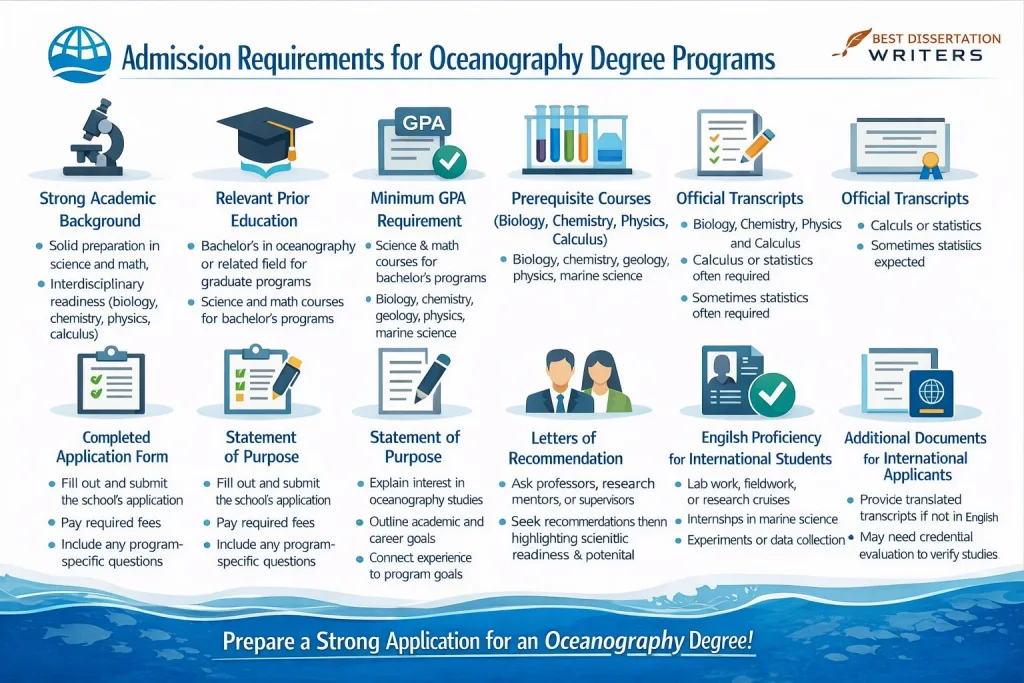
Academic Background Required for Admission
One of the first things admissions committees review is academic background. This helps them determine whether an applicant is prepared for the scientific and technical demands of the program.
Key academic background factors often include:
- Completion of a strong science foundation
Oceanography degree programs usually expect applicants to show prior success in science subjects. This is especially important because students in this field often move quickly into marine science, ocean processes, environmental systems, and data-based coursework. - Preparation in mathematics
Math readiness matters because oceanography includes modeling, measurement, analysis, and scientific interpretation. A student who struggles with math may find parts of the curriculum difficult, especially in physical or chemical oceanography. - Relevant prior degree or coursework for graduate admission
Graduate students are often expected to hold a bachelor’s degree in oceanography or a related field such as marine science, geology, biology, chemistry, environmental science, or physics. Even when the exact degree title is different, admissions committees want evidence that the student can enter advanced study with the right background. - Ability to succeed in an interdisciplinary field
Since oceanography combines several sciences, applicants need to show they can handle an academic environment where multiple disciplines are constantly connected. This is one reason programs often value broad STEM preparation rather than narrow specialization too early.
In short, academic background is not only about what degree a student holds. It is also about whether that background supports success in a field where students may study aquatic ecosystems, the shoreline, the wetland-estuary transition, ocean circulation, and environmental change within the same program.
GPA Requirements for Bachelor’s and Graduate Applicants
GPA is another major requirement in oceanography admission. It gives schools a quick way to measure consistency, effort, and readiness for academic challenge.
Key GPA factors often include:
- Overall GPA
Admissions teams often begin by looking at the overall GPA to determine whether the applicant meets the program’s general academic threshold. For bachelor’s applicants, this reflects high school performance. For graduate applicants, it reflects undergraduate academic performance. - Science and math GPA
In oceanography programs, grades in science and mathematics may matter just as much as the overall GPA. A student applying to an oceanography major is expected to do well in subjects that support the field directly. - Grade trend over time
A rising GPA can strengthen an application. If a student performed weakly early on but improved later, admissions committees may interpret that as evidence of growth, maturity, and better academic preparation. - Graduate-level academic readiness
For graduate programs, GPA is often used as a sign of whether the applicant can handle research-based work, independent study, and advanced scientific reading and writing.
A GPA is rarely reviewed in isolation. Admissions reviewers often compare it against course rigor, academic background, and the student’s intended area of study. A student interested in highly quantitative oceanographic work may be judged more carefully on physics and calculus performance than a student whose interests lean more toward ecology or marine policy. Even so, a strong GPA remains one of the clearest signals that a student can meet the academic expectations of the program.
Prerequisite Courses in Biology, Chemistry, Physics, and Calculus
Prerequisite courses are often among the most important admission requirements for oceanography degree programs. These courses prepare students for the scientific depth of the field and help ensure they can handle advanced material after enrollment.
The most common prerequisite subjects include:
- Biology
Biology is important because many oceanography students study marine organisms, ecosystems, food webs, and life processes in the ocean. This is especially relevant for students interested in marine biology, estuarine ecology, or broader aquatic systems. - Chemistry
Chemistry supports the study of seawater composition, nutrient cycles, marine pollution, and chemical interactions in ocean systems. It is especially useful for students interested in chemical oceanography and environmental analysis. - Physics
Physics is needed for understanding waves, tides, currents, motion, heat transfer, and other physical ocean processes. It is especially important for students drawn to observational and quantitative ocean science. - Calculus
Calculus provides the mathematical base for scientific modeling, analysis, and interpretation. It is often essential in programs that involve ocean circulation, data modeling, and other advanced oceanographic topics.
These courses matter because students in oceanography are expected to integrate knowledge from multiple scientific areas. For example, a coastal issue may involve biological responses, physical circulation, chemical changes, and geological processes at the same time. Without the right foundation, students may struggle when moving into upper-level study.
Students should also understand that many programs divide coursework into a core course sequence and an elective sequence. The core course structure gives all students the same scientific foundation, while electives help them tailor the degree to specific interests. Depending on the institution, elective areas may include marine ecology, estuarine science, climate systems, coastal geology, data visualization, or marine policy. Reviewing the official catalog is the best way to understand how these degree requirements are structured.
Required Application Materials
Application materials are another major part of the admissions process. Even a well-qualified student can weaken an application if required documents are incomplete, vague, or poorly prepared.
The most common required materials include:
- Official transcripts
Transcripts show the student’s academic history, completed coursework, and performance across subjects. They are especially important because admissions committees use them to verify science and math preparation. - Application form
This may seem basic, but it is still important. The form provides the official structure for submitting academic history, intended major, and institutional information. - Statement of purpose or personal statement
This is where the applicant explains why they want to study oceanography and what they hope to do with the degree. A strong statement should connect academic interests to future goals and show genuine understanding of the field. - Letters of recommendation
These help admissions teams understand the student’s potential from the perspective of teachers, mentors, supervisors, or an academic advisor. Strong letters usually explain work ethic, scientific ability, curiosity, and readiness for advanced study. - Résumé or CV
A résumé or CV helps applicants present research experience, technical skills, volunteer work, leadership, and academic projects in a clear format. - Additional program-specific documents
Some programs may request writing samples, short-answer responses, or other supporting documents depending on the school and degree level.
When preparing these materials, students should not only list achievements but also explain them clearly. For example, if an applicant completed an internship, joined a coastal monitoring project, or worked on a marine lab assignment, that experience should be described in a way that shows relevance to oceanography. Strong applicants use the application materials to demonstrate both preparation and direction.
Standardized Test and English Proficiency Requirements
Standardized testing policies vary across schools, so applicants should never assume all oceanography degree programs follow the same rule. Still, test requirements remain an important part of the admissions review process for some programs.
Key testing-related requirements may include:
- General standardized admission tests
Some graduate programs may still ask for a standardized test, while others have made such exams optional or removed them completely. This is why checking each school’s most current admissions page and program catalog is essential. - English proficiency tests for international students
International students are often required to show proof of English ability if their previous education was completed in another language. This requirement is separate from general academic testing. - Communication readiness
Oceanography students must often develop strong written and oral skills because the field involves lab reports, presentations, scientific discussion, and collaboration with peers and faculty members.
Even when general standardized tests are no longer required, schools may still want to see evidence that the student can communicate clearly in academic settings. This matters because oceanography students often need to present research findings, explain data, write scientific summaries, and collaborate on projects with classmates, faculty, and research teams.
Research Experience, Internships, and Fieldwork
Experience outside the classroom can make an application much stronger, especially for graduate programs. Because oceanography is deeply connected to scientific investigation, programs often value students who already have some type of practical exposure to the field.
Need Help With Your Dissertation?
Get professional academic support from Best Dissertation Writers . Our expert team is ready to help you with high-quality dissertation writing services tailored to your academic goals.
Get Dissertation HelpThe most valuable types of experience may include:
- Research experience
Students who help conduct research often gain a stronger understanding of scientific process, problem-solving, and evidence-based thinking. This can be a major advantage in admissions. - Internship experience
An internship can show that the student has already explored real-world applications of marine science, environmental work, or oceanographic study. - Fieldwork and hands-on learning
Hands-on experience is especially valuable in oceanography because the field often includes field observation, marine sampling, and environmental measurement. - Coastal and estuarine experience
Students who have worked in an estuarine environment, an estuary, a wetland, or along the shoreline may already understand some of the systems studied in oceanography. - Marine technology exposure
Experience with a sensor, data platforms, visualization tools, or autonomous underwater vehicles can help show readiness for modern ocean science. - Research cruises and observational work
Participation in research cruises or other observational projects can strengthen an application because it shows direct exposure to how oceanographic work is carried out. - Faculty-connected research opportunities
Programs often value students who have already participated in research opportunities under the guidance of teachers, mentors, or faculty members.
Students should also remember that valuable experience does not always need to come from a university lab. Relevant work may come from nonprofit environmental groups, local coastal projects, conservation efforts, Sea Grant programs, monitoring programs, or internships with consulting firms involved in coastal and marine work. What matters most is that the student can explain what they did, what they learned, and how the experience connects to their interest in oceanography.
Admission Requirements for International Students
International applicants usually complete the same main application as domestic students, but they often have a few additional requirements.
The most common requirements for international students include:
- Proof of English proficiency
This helps schools confirm that students can function successfully in an English-speaking academic setting. - Translated academic records
If transcripts or certificates are not in English, official translations may be required. - Credential evaluation
Some schools ask for formal review of international academic records so they can determine equivalency with local degree standards. - Financial documentation
Some institutions require proof of financial readiness as part of the admission or visa process. - Additional time for document processing
International applications often involve more administrative steps, so planning early is especially important.
For international students, meeting these requirements is not just about paperwork. It is also about showing that they are ready to succeed in a rigorous academic environment where communication, technical coursework, and independent study all matter.
How to Prepare a Strong Oceanography Admission Application
Meeting minimum requirements is important, but strong applicants usually go further. They show that they understand the field, have explored their interests, and are ready for the demands of the program.
The best ways to prepare a strong application include:
- Build a strong science foundation
Focus on biology, chemistry, physics, and calculus because these subjects support nearly every area of oceanography. - Review the catalog and degree requirements carefully
Understanding the published curriculum helps students choose the right courses and see how the program is structured. - Clarify your academic direction
Students should think about whether they are more interested in marine ecosystems, marine biology, marine policy, oceanographic technology, coastal systems, or management of ocean resources. - Gain hands-on experience
Joining research, fieldwork, or an internship helps show commitment and readiness. - Work with an advisor or mentor
A trusted advisor can help students strengthen course selection, identify weak areas, and refine application strategy. - Learn from faculty members, graduate students, and alumni
Speaking with faculty members, graduate students, or even an alumnus can help applicants understand the program’s expectations, culture, and career areas. - Demonstrate collaboration and communication
Oceanography often involves teamwork, so students should show they can collaborate, communicate, and work in research or applied science settings. - Connect the degree to future goals
A strong application explains how the degree fits long-term plans in research, coastal science, environmental work, public service, education, nonprofit leadership, or work with consulting firms.
Students who prepare carefully often submit stronger applications because they do more than meet formal standards. They show that they understand what oceanography involves. They understand that the field may include underwater exploration, coastal and estuarine systems, marine ecosystems, policy questions, oceanographic data, and scientific teamwork. They show that they are ready not only to complete the coursework, but also to grow in a field that studies some of the most important systems on Earth.