

Post-Positivism as a Theory: A Clear and Practical Guide for Research
- Post-positivism is a research philosophy about how knowledge is produced and tested.
- It is widely used in social sciences, education, health studies, psychology, nursing, and policy research.
- It supports systematic evidence-gathering, but it does not claim certainty.
- It argues that reality exists, yet human knowledge of it is always imperfect.
- It treats research results as the best available explanation based on current evidence.
- It encourages careful methods, transparency, and constant improvement of theories.
- It is especially useful when research questions involve patterns, causes, outcomes, or effectiveness.
What Is Post-Positivism?
- Post-positivism is a philosophical stance about:
- what exists in the world (ontology)
- how we can know it (epistemology)
- how we should study it (methodology)
- It accepts the existence of an objective reality.
- It also accepts that humans cannot access reality directly.
- Knowledge is formed through measurement, observation, theory, and interpretation.
- Because humans and tools are imperfect, findings always carry uncertainty.
- Research aims to reduce error and bias, not eliminate them fully.
Key ideas explained clearly
- Reality exists independently of human perception
- The world does not depend on whether people believe in it.
- Social phenomena also have “real” effects, even if they are complex.
- example: poverty, stress, discrimination, and disease outcomes affect lives, even if they are interpreted differently across groups
- Researchers assume there are real patterns and mechanisms behind what is observed.
- However, what we observe is a partial view of that reality.
- Tools and measures capture signals, but also include noise.
- example: a survey measures depression symptoms, but may miss cultural expressions of distress
- This view supports realism, but avoids claiming perfect access to truth.
- Knowledge is provisional, not absolute
- Findings are treated as “best current estimates.”
- Conclusions can change when:
- better instruments are developed
- new samples are studied
- better designs reduce bias
- new evidence contradicts earlier claims
- This is not weakness. It is how science improves.
- Researchers should avoid final language such as “proved” or “confirmed forever.”
- Instead, researchers use cautious language such as:
- “supports,” “suggests,” “is consistent with,” “likely,” “indicates”
- Observation is theory-laden
- Researchers do not enter a study with an empty mind.
- Prior assumptions influence:
- what questions seem important
- what variables are selected
- what counts as “evidence”
- how results are interpreted
- Theories influence what is measured.
- example: if you believe burnout is mainly organizational, you will measure workload and staffing
- if you believe burnout is mainly individual, you may focus on coping style and resilience
- Instruments embed assumptions.
- example: a “job satisfaction” scale assumes satisfaction can be captured through set items
- Post-positivism responds by demanding transparency:
- state assumptions clearly
- justify measures
- report limitations
- Science aims for explanation, not final truth
- The goal is to build explanations that are:
- logically coherent
- supported by evidence
- capable of being tested
- useful for prediction or decision-making
- Explanations are valued because they reduce uncertainty.
- Researchers prioritize:
- identifying patterns
- estimating effects
- testing models
- comparing alternative explanations
- Explanations remain open to revision as better evidence appears.
Need expert dissertation writing support?
Get structured guidance, clear academic writing, and on-time delivery with Best Dissertation Writers .
Get Started NowHistorical Origins of Post-Positivism
- Post-positivism developed as researchers recognized problems with strict positivism.
- Traditional positivism often assumed:
- direct observation gives objective truth
- researchers can be neutral
- social realities behave like physical laws
- Social and health research exposed limits:
- human meaning is complex
- contexts vary
- measurement is imperfect
- values influence study design
- Post-positivism emerged to keep scientific rigor while acknowledging these realities.
Key historical influences
- Reaction to logical positivism
- Logical positivism emphasized verification through observation.
- It struggled with:
- unobservable concepts (attitudes, beliefs, motivation)
- complex causality (multiple interacting causes)
- context effects (culture, environment, time)
- Many claims in social science cannot be “verified” in a strict sense.
- Post-positivism offered a more realistic approach:
- knowledge is still evidence-based
- but never perfectly certain
- Influence of philosophers of science
- Karl Popper contributed the idea of falsification.
- theories cannot be proven true
- they can be tested and potentially refuted
- strong theories survive tough testing
- Thomas Kuhn emphasized paradigms.
- science is influenced by dominant frameworks
- frameworks change when anomalies accumulate
- Imre Lakatos emphasized research programs.
- science progresses through evolving programs of inquiry
- not isolated studies
- Together, these ideas supported a view of science as:
- evolving
- self-correcting
- shaped by theory and context
- Recognition of scientific fallibility
- Researchers began acknowledging systematic errors such as:
- sampling bias
- measurement error
- confounding variables
- researcher expectancy effects
- In response, post-positivism emphasized:
- stronger designs
- replication
- statistical controls
- transparent reporting
- Shift toward critical realism
- Critical realism helped formalize the idea that:
- reality exists
- but it is known through imperfect human methods
- This supported cautious causality:
- causes exist
- but they operate differently across contexts
- mechanisms may be hidden or indirect
Core Assumptions of Post-Positivism
- These assumptions guide how studies are planned and how findings are interpreted.
- Critical realism
- Reality exists independently of our knowledge of it.
- Observations provide incomplete access to that reality.
- Research aims to approximate reality through improved methods.
- The best research reduces error, but never removes it completely.
- Fallibility of human knowledge
- All studies contain uncertainty.
- Errors can come from:
- participants (memory, social desirability)
- tools (poor reliability)
- researchers (bias, expectations)
- settings (context variability)
- Good research manages fallibility through strategies such as:
- pilot testing instruments
- using validated measures
- training data collectors
- blinding where possible
- sensitivity analysis
- Importance of theory testing
- Research is not just “collecting facts.”
- Research tests ideas about how the world works.
- Studies should be designed to:
- challenge a theory, not protect it
- compare explanations, not assume one is correct
- refine models based on results
- Probabilistic reasoning
- Findings are expressed in terms of likelihood and magnitude.
- Researchers accept that:
- effects can be small but meaningful
- effects can vary across groups
- results can differ in new contexts
- Statistical inference is used to estimate:
- effect sizes
- confidence intervals
- probability of observing results under assumptions
- Objectivity as a goal, not a guarantee
- Complete neutrality is unrealistic.
- Objectivity is pursued through:
- systematic methods
- explicit criteria
- peer review
- transparency
- Stronger credibility comes from:
- clear documentation
- reproducible steps
- justified decisions
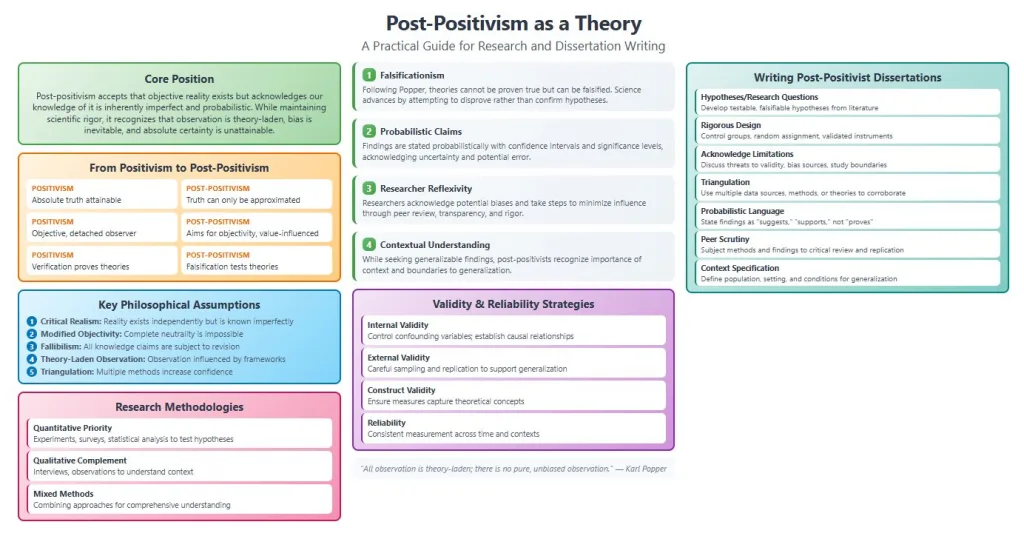
Key Concepts Associated with Post-Positivism
- Falsification rather than verification
- Theories should be tested in ways that could show them wrong.
- Good hypotheses are:
- specific
- measurable
- risky (they could fail)
- Researchers should welcome disconfirming evidence.
- A theory that survives strong tests becomes more credible.
- Triangulation
- Triangulation reduces dependence on one method or one data source.
- Types of triangulation include:
- method triangulation (survey + interviews)
- data triangulation (multiple sites, groups, time points)
- investigator triangulation (more than one analyst)
- theory triangulation (interpret findings using competing theories)
- If results converge across sources, confidence increases.
- If results diverge, researchers learn where context or measurement matters.
- Validity and reliability as approximations
- Reliability asks: does the instrument measure consistently?
- example: does a scale give similar results across repeated testing when the trait is stable?
- Validity asks: does the instrument measure what it claims to measure?
- example: does an anxiety scale actually capture anxiety rather than general distress?
- In post-positivism:
- reliability is never assumed
- validity is never perfect
- measures improve over time
- Causal explanation with caution
- Causality is important, but complex.
- Causes can be:
- multiple
- interacting
- indirect
- context-dependent
- Researchers strengthen causal claims by:
- using experimental or quasi-experimental designs
- controlling confounders
- using longitudinal data
- testing mediation and moderation
- Even then, conclusions remain cautious.
Post-Positivism Compared to Positivism
- Certainty vs uncertainty
- Positivism leans toward certainty and strong objectivity claims.
- Post-positivism accepts uncertainty and avoids absolute conclusions.
- Neutral observer vs influenced researcher
- Positivism assumes researchers can be detached.
- Post-positivism accepts researcher influence and manages it through rigor.
- Fixed laws vs evolving explanations
- Positivism seeks stable laws similar to physics.
- Post-positivism accepts that social patterns can shift across time and context.
- Verification vs critical testing
- Positivism emphasizes confirming.
- Post-positivism emphasizes challenging, comparing, and refining.
Methodological Implications of Post-Positivism
- Preference for structured methods
- Common designs include:
- experiments and randomized trials
- quasi-experiments
- cross-sectional surveys
- longitudinal studies
- statistical modeling and prediction
- Structured methods help reduce bias through:
- standardized procedures
- consistent measurement
- replicable analysis
- Compatibility with mixed methods
- Mixed methods can strengthen explanation.
- Quantitative methods provide:
- estimates of magnitude
- patterns across large samples
- tests of hypotheses
- Qualitative methods provide:
- context and meaning
- mechanisms and processes
- insight into why patterns occur
- Integration can happen at:
- design stage (sequential or concurrent)
- analysis stage (merging results)
- interpretation stage (explaining patterns)
- Emphasis on rigor and transparency
- Rigor includes:
- clear research questions
- appropriate sampling
- justified measures
- valid statistical techniques
- Transparency includes:
- reporting missing data handling
- reporting limitations
- reporting assumptions
- documenting analysis decisions
- Use of controls and comparisons
- Controls reduce alternative explanations.
- Comparisons improve inference.
- Examples of controls include:
- random assignment
- matching groups
- statistical controls
- stratification by key variables
Strengths of Post-Positivism
- Balances realism and skepticism
- It preserves the idea of a real world.
- It avoids claiming perfect truth.
- It supports practical research while staying intellectually honest.
- Supports evidence-based decision-making
- It aligns well with applied fields.
- It supports program evaluation and intervention research.
- It helps policymakers estimate what is likely to work.
- Encourages methodological discipline
- It prioritizes:
- clear hypotheses
- careful measurement
- robust analysis
- replication and peer review
- This strengthens trustworthiness.
- Allows theory refinement
- Theories improve through:
- repeated testing
- cross-context comparison
- methodological improvements
- Knowledge becomes stronger over time.
Criticisms and Limitations of Post-Positivism
- Residual objectivism
- Critics argue it still prioritizes “scientific” forms of evidence.
- Some experiences may be difficult to capture in structured measures.
- Lived experience can be underweighted.
- Limited attention to power and culture
- Critical theories often focus more on:
- inequality
- oppression
- power relations
- structural injustice
- Post-positivist studies can address these topics, but may not center them unless designed to.
- Measurement challenges
- Complex human constructs can be hard to operationalize.
- Some constructs change across cultures and contexts.
- Instruments may not transfer well without adaptation.
- Risk of methodological rigidity
- Overreliance on standardized methods can:
- narrow the research question
- ignore unexpected insights
- under-explore context
- This is why mixed methods and strong theory use are often recommended.
Using Post-Positivism as a Theoretical Framework in Research
- This is how to apply it clearly in a research paper or dissertation.
- Clarify your ontological stance
- Write that:
- reality exists independently of observation
- the study aims to approximate reality through evidence
- Example framing points you can adapt:
- the phenomenon has real effects
- observations are partial and imperfect
- conclusions are probabilistic
- Clarify your epistemological stance
- State that:
- knowledge is built through empirical investigation
- measurements contain error
- findings remain open to revision
- Include how you will handle uncertainty:
- acknowledge limitations
- use multiple sources of evidence
- design for bias reduction
- Link the framework to your research problem
- Explain why this stance fits your topic.
- It fits well when your topic involves:
- testing relationships
- evaluating an intervention
- measuring outcomes
- estimating predictors of an effect
- Form research questions and hypotheses correctly
- Good post-positivist questions are:
- specific
- measurable
- testable
- Example structures:
- what is the relationship between X and Y?
- to what extent does X predict Y?
- does intervention A improve outcome B compared to control?
- what factors explain variation in outcome Y?
- Justify methodological choices
- Explain how your methods support:
- theory testing
- bias reduction
- careful estimation
- If quantitative:
- justify sampling approach
- justify instrument selection
- justify statistical model
- If mixed methods:
- explain how qualitative data will add explanation
- explain how integration will occur
- Build rigor into design
- Strategies include:
- validated instruments
- pilot testing
- standardized protocols
- training for data collection
- inter-rater reliability where needed
- pre-specified analysis plan where appropriate
- Address validity and reliability directly
- Explain:
- how reliability will be assessed or supported
- how validity evidence is established
- how bias will be reduced
- Include common threats and responses:
- selection bias (use randomization or matching)
- confounding (control variables, design choices)
- measurement bias (validated tools, consistent procedures)
- Use triangulation to strengthen claims
- Examples:
- compare survey outcomes with administrative records
- combine outcomes data with participant interviews
- use multiple sites to test generalizability
- Explain what you will do if results disagree:
- re-check assumptions
- explore context differences
- examine measurement issues
- Interpret findings cautiously
- Show how results support or challenge theory.
- Avoid absolute statements.
- Include:
- effect size and uncertainty
- alternative explanations
- limitations and implications for further testing
- Write a clear framework paragraph for your dissertation
- You can structure it as points like this:
- the study assumes an external reality
- the study accepts imperfect knowledge
- the study uses empirical methods to reduce error
- the study tests hypotheses derived from theory
- the study uses strategies to strengthen validity
- the study interprets results as provisional explanations
When Post-Positivism Is Most Appropriate
- It is a strong match when:
- you need to estimate relationships between variables
- you need to test an intervention or program
- you need generalizable conclusions, but you will state limitations clearly
- you need structured measurement and statistical inference
- you accept complexity and want cautious causality
Key Takeaways
- Post-positivism keeps the strengths of scientific inquiry while acknowledging human limits.
- It assumes reality exists, but knowledge is always partial.
- It values rigorous methods, but demands humility in interpretation.
- It strengthens research by encouraging:
- critical testing
- transparent reporting
- bias reduction
- theory refinement over time
- When applied carefully, it supports credible and ethically responsible research that can improve with new evidence.