

Postcolonial theory: a practical, point-form guide to power, identity, and knowledge after empire
- Postcolonial theory is a field of ideas that examines how colonialism shaped (and still shapes) power, culture, identity, and knowledge.
- Postcolonial theory studies what happened during colonial rule and what continues after formal independence.
- Postcolonial theory asks why colonial patterns can persist in language, education, media, borders, economics, and everyday life.
- Postcolonial theory focuses on representation: who gets to speak, who is believed, and how stories about “others” are constructed.
- Postcolonial theory treats stereotypes and “common sense” narratives as political, not neutral.
- Postcolonial theory shows how images, textbooks, films, and policies can reproduce colonial hierarchies.
- Postcolonial theory is not only about the past; it is about ongoing structures.
- Postcolonial theory connects history to present-day inequality, development models, and global cultural flows.
- Postcolonial theory helps explain why independence does not automatically produce equal power relations.
Why postcolonial theory matters today
- It helps explain why global inequality often follows old imperial routes.
- Postcolonial theory links colonization to extractive economies and uneven development.
- Postcolonial theory shows how “modernization” can sometimes repeat colonial assumptions.
- It clarifies how identity politics are shaped by colonial categories.
- Postcolonial theory examines how colonial states classified people by race, ethnicity, tribe, and religion.
- Postcolonial theory explores how those labels can remain in law, bureaucracy, and social life.
- It improves how we read media, policy, and research.
- Postcolonial theory trains you to spot whose interests are centered in “objective” accounts.
- Postcolonial theory questions what is treated as normal, civilized, advanced, or backward.
What postcolonial theory is (and what it is not)
- Postcolonial theory is not simply “anti-West.”
- Postcolonial theory can critique colonial power while still valuing human rights, democracy, science, and universal dignity.
- Postcolonial theory targets domination, not entire cultures.
- Postcolonial theory is not only literary analysis.
- Postcolonial theory began with strong links to literature and cultural studies, but it is widely used in sociology, politics, education, geography, anthropology, and public health.
- Postcolonial theory can be applied to real institutions, not only novels.
- Postcolonial theory is not a single viewpoint.
- Postcolonial theory is a broad umbrella with multiple scholars, debates, and methods.
- Postcolonial theory includes tensions: activism vs. critique, material economics vs. discourse, nationalism vs. hybridity.
Core themes you will keep seeing in postcolonial theory
- Power and domination
- Postcolonial theory examines how colonial rule used military force, law, and economics.
- Postcolonial theory also studies “soft power,” such as education systems and cultural standards.
- Knowledge and epistemology
- Postcolonial theory asks how colonialism defined what counts as “knowledge,” “truth,” and “expertise.”
- Postcolonial theory highlights how indigenous knowledge was often dismissed as superstition or folklore.
- Representation and the “Other”
- Postcolonial theory analyzes how colonized people were described as inferior, exotic, or childlike.
- Postcolonial theory shows how those representations justified control and exploitation.
- Identity, subjectivity, and agency
- Postcolonial theory explores how colonized people negotiated identity under pressure.
- Postcolonial theory emphasizes resistance, adaptation, and survival, not only victimhood.
- Language and translation
- Postcolonial theory studies how colonial languages became official languages in many states.
- Postcolonial theory examines how language can open opportunities while also marginalizing local languages.
- Hybridity and cultural mixing
- Postcolonial theory argues that colonial encounters produced mixed cultures and identities.
- Postcolonial theory treats culture as dynamic, not pure or fixed.
- Nationalism and the post-independence state
- Postcolonial theory critiques how postcolonial elites sometimes reproduce colonial governance styles.
- Postcolonial theory examines the promises and disappointments of independence.
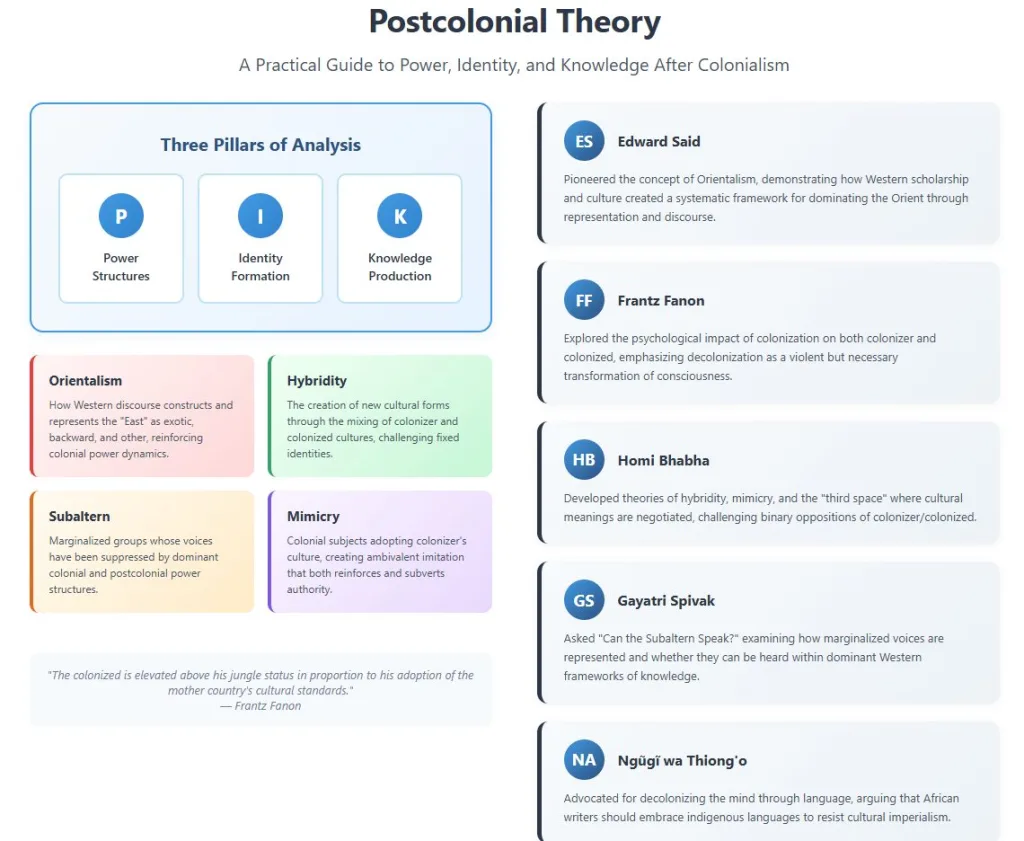
Key thinkers often associated with postcolonial theory (in simple terms)
- Edward Said
- Postcolonial theory draws on his critique of “Orientalism,” meaning a pattern where the “East” is depicted through Western fantasies and power interests.
- Postcolonial theory uses this to analyze stereotypes and knowledge systems that support domination.
- Gayatri Chakravorty Spivak
- Postcolonial theory uses her work on the “subaltern,” focusing on voices that are systematically excluded from dominant narratives.
- Postcolonial theory asks how representation can silence people even when it claims to speak for them.
- Homi K. Bhabha
- Postcolonial theory draws on ideas like hybridity and “third space,” exploring identity formation under colonial conditions.
- Postcolonial theory uses this to analyze cultural negotiation and the instability of colonial authority.
- Frantz Fanon
- Postcolonial theory uses his analysis of the psychological impacts of colonial violence, racism, and dehumanization.
- Postcolonial theory draws on his insights about liberation, identity, and structural inequality.
- Important note for readers
- Postcolonial theory includes many other scholars and regional traditions.
- Postcolonial theory is strongest when you connect ideas to a specific place, period, and power structure.
Postcolonial theory vocabulary you should know
- Colonialism
- Direct control of territory, labor, and resources by an external power.
- Postcolonial theory studies both the obvious control and the deeper cultural control.
- Imperialism
- A broader system of political and economic domination, sometimes without direct rule.
- Postcolonial theory often treats imperialism as a continuing global structure.
- Decolonization
- The process of formal political independence and the struggle to undo colonial structures.
- Postcolonial theory shows that decolonization is political, cultural, economic, and psychological.
- Neo-colonialism
- Continued domination through debt, trade rules, corporate power, military alliances, and cultural influence.
- Postcolonial theory helps reveal how power persists without formal empire.
- Subaltern
- Groups pushed to the margins who lack access to dominant institutions of representation.
- Postcolonial theory asks how research can include these voices without appropriating them.
- Hybridity
- The mixing of cultural forms in colonial and postcolonial contexts.
- Postcolonial theory uses hybridity to challenge ideas of cultural purity.
- Orientalism
- A pattern of portraying the “East” as exotic, backward, or dangerous to justify Western authority.
- Postcolonial theory uses this to critique media, scholarship, and policy narratives.
Need expert dissertation writing support?
Get structured guidance, clear academic writing, and on-time delivery with Best Dissertation Writers .
Get Started NowHow to apply postcolonial theory: a clear, practical process
- Step 1: Identify the colonial history connected to your topic
- Name the colonial power(s), timeline, and key institutions created under colonial rule.
- Postcolonial theory becomes more convincing when you are specific, not general.
- Step 2: Map the system of power
- Ask who benefited from colonial extraction and who carried the costs.
- Postcolonial theory examines how laws, land ownership, education, and labor were organized.
- Step 3: Analyze representation
- Look at how groups are described: civilized/uncivilized, modern/traditional, rational/emotional.
- Postcolonial theory treats these binaries as political tools.
- Step 4: Examine knowledge production
- Identify which sources are treated as authoritative and which are ignored.
- Postcolonial theory asks: whose methods and languages dominate the field?
- Step 5: Look for resistance and agency
- Do not treat communities as passive.
- Postcolonial theory highlights everyday resistance, cultural survival, and alternative epistemologies.
- Step 6: Track continuity into the present
- Identify the “afterlife” of colonialism: borders, inequality, police systems, school curricula.
- Postcolonial theory focuses on how the past is active inside current structures.
Common examples where postcolonial theory is useful
- Education
- Postcolonial theory analyzes whether curricula center European histories while marginalizing local histories.
- Postcolonial theory explores how language policies can privilege colonial languages over indigenous languages.
- Development and aid
- Postcolonial theory critiques “savior” narratives and one-way models of expertise.
- Postcolonial theory examines how funding priorities can shape local policy choices.
- Media and popular culture
- Postcolonial theory reveals exoticism, fetishization, and the politics of casting, accents, and storylines.
- Postcolonial theory also explores who owns distribution platforms and whose stories get investment.
- Health and medicine
- Postcolonial theory examines how global health agendas can reproduce power imbalances.
- Postcolonial theory asks whether communities are partners or merely data sources.
- Borders, migration, and citizenship
- Postcolonial theory links many border systems to imperial mapping and labor control.
- Postcolonial theory explains how “belonging” can be shaped by colonial-era identity categories.
- Environment and resource extraction
- Postcolonial theory connects mining, plantations, and land dispossession to continuing ecological harm.
- Postcolonial theory explores how “conservation” can sometimes displace local communities.
Critiques and limits of postcolonial theory (and how to handle them)
- Critique: It focuses too much on discourse and not enough on material economics
- Some critics argue postcolonial theory can overemphasize language and representation.
- A strong postcolonial theory approach balances discourse analysis with political economy (jobs, land, debt, trade).
- Critique: It can generalize “the West” and “the rest”
- Postcolonial theory is strongest when it avoids treating regions as uniform blocks.
- Use specific institutions, policies, and historical cases to prevent flattening complexity.
- Critique: It may underplay internal forms of oppression
- Postcolonial theory can be strengthened by examining class, gender, ethnicity, disability, and sexuality within postcolonial states.
- Pairing postcolonial theory with feminist or intersectional lenses can add depth.
- Critique: It can be difficult to translate into policy solutions
- Postcolonial theory is excellent for diagnosis; solutions require careful design.
- Use postcolonial theory to guide ethical principles, stakeholder engagement, and structural reforms.
How postcolonial theory improves research quality
- It strengthens your problem statement
- Postcolonial theory helps you show why a problem is not random, but historically produced.
- Postcolonial theory supports a deeper justification for why the topic matters.
- It improves conceptual clarity
- Postcolonial theory gives you language for power, representation, and knowledge.
- Postcolonial theory helps you define key constructs like identity, marginalization, and legitimacy.
- It reduces hidden bias
- Postcolonial theory encourages reflexivity: how your position, training, and sources shape interpretation.
- Postcolonial theory helps you avoid treating Western categories as universal defaults.
Using postcolonial theory as a theoretical framework in a research paper or dissertation
1) Where postcolonial theory fits in the dissertation structure
- Introduction / background
- Use postcolonial theory to show historical context and ongoing structural patterns.
- Explain how colonial institutions shaped the domain you are studying (education, health, law, media, economics).
- Literature review
- Use postcolonial theory to organize literature by themes:
- Representation and discourse
- Institutional continuity
- Agency and resistance
- Knowledge production
- Show debates within postcolonial theory (for example, material vs. discursive emphasis).
- Use postcolonial theory to organize literature by themes:
- Theoretical framework chapter
- Define postcolonial theory clearly and justify why it is appropriate for your research questions.
- Present a conceptual model (a simple diagram can help) showing:
- Colonial legacy factors (for example, language policy, curriculum design, legal categories)
- Mediators (for example, identity negotiation, institutional access, stigma)
- Outcomes (for example, equity, participation, wellbeing, legitimacy)
2) How to build research questions using postcolonial theory
- Ask power-centered “how” and “why” questions
- How do colonial-era institutions continue to shape present outcomes?
- How are groups represented in official discourse, and what does that enable or limit?
- How do marginalized groups resist, adapt, or create alternative narratives?
- Include questions about knowledge
- Which knowledge counts in policy and practice?
- Whose voices are missing, and what structures produce that absence?
- How does language shape access to opportunity?
3) How to operationalize postcolonial theory in methods
- Qualitative designs that align well with postcolonial theory
- Critical discourse analysis (policy documents, media texts, curricula)
- Thematic analysis with attention to power and representation
- Narrative inquiry focused on identity, voice, and lived experience
- Ethnography or case study with reflexive positioning
- Quantitative or mixed methods possibilities
- Postcolonial theory can guide variable selection and interpretation.
- Example:
- Use historical indicators (colonial education policy legacy) to interpret present disparities.
- Use surveys but interpret results through structural context, not only individual attitudes.
- Sampling and ethics
- Postcolonial theory emphasizes avoiding extractive research.
- Prioritize community partnership, fair compensation, local dissemination, and meaningful consent processes.
4) How to analyze and discuss findings using postcolonial theory
- Interpret results as system-level patterns
- Connect themes back to colonial legacies and institutional continuity.
- Use postcolonial theory to explain why certain narratives dominate and others struggle for legitimacy.
- Balance critique with evidence
- Keep claims grounded in your data (quotes, document excerpts, statistics).
- Postcolonial theory becomes academically strong when it is used as a lens, not as a replacement for evidence.
- Derive recommendations that target structures
- Curriculum revision, language access, institutional representation, policy redesign.
- Postcolonial theory supports recommendations that address power, not only behavior.
5) A simple template paragraph for your dissertation framework section
- Template (adapt to your topic)
- “This study is guided by postcolonial theory, which examines how colonial power relations shape contemporary institutions, identities, and knowledge systems. Postcolonial theory is used here to analyze (a) the historical formation of (your domain), (b) the representational practices that normalize particular hierarchies, and (c) the ways marginalized groups negotiate and resist these structures. This framework supports an interpretation of findings that emphasizes structural continuity, contested narratives, and the politics of legitimacy.”