

Systems Thinking: The Practical Guide to Understanding Complexity and Creating Better Outcomes
- Systems thinking is a way of understanding reality by focusing on relationships, patterns, and interdependence.
- Instead of treating a problem as a single “thing,” systems thinking asks you to see how parts interact over time.
- When you practice systems thinking, you stop asking only “What is broken?” and start asking “What is producing this result?”
- Systems thinking is especially useful when problems are messy, recurring, or hard to solve with simple fixes.
- If a problem keeps coming back, systems thinking helps you identify the deeper structure that keeps recreating it.
- If quick solutions create new problems later, systems thinking helps you anticipate those delayed effects.
Why systems thinking matters right now
- Modern problems are increasingly interconnected.
- Business, health, education, climate, and technology are tightly linked.
- Systems thinking helps you avoid narrow decisions that look good locally but cause damage elsewhere.
- Many “failures” are actually predictable outcomes of system design.
- A system is perfectly designed to produce the results it produces.
- Systems thinking helps you redesign processes, incentives, and feedback so the results improve.
- It reduces wasted effort from treating symptoms instead of causes.
- Symptoms are the visible signals: delays, errors, burnout, complaints, churn, rework.
- Systems thinking helps you find the structural drivers underneath those symptoms.
What systems thinking is (and what it is not)
- Systems thinking is not just “thinking big.”
- It is not vague, philosophical, or only for academics.
- Systems thinking is practical: it gives you tools to map, test, and improve real-world systems.
- Systems thinking is not about blaming individuals.
- It shifts attention from “who messed up” to “what conditions made this outcome likely.”
- It supports learning and improvement rather than fear and punishment.
- Systems thinking is not the same as complicated planning.
- You do not need a huge model to start.
- Systems thinking often begins with a simple map of relationships and feedback loops.
Need expert dissertation writing support?
Get structured guidance, clear academic writing, and on-time delivery with Best Dissertation Writers .
Get Started NowThe core principles of systems thinking
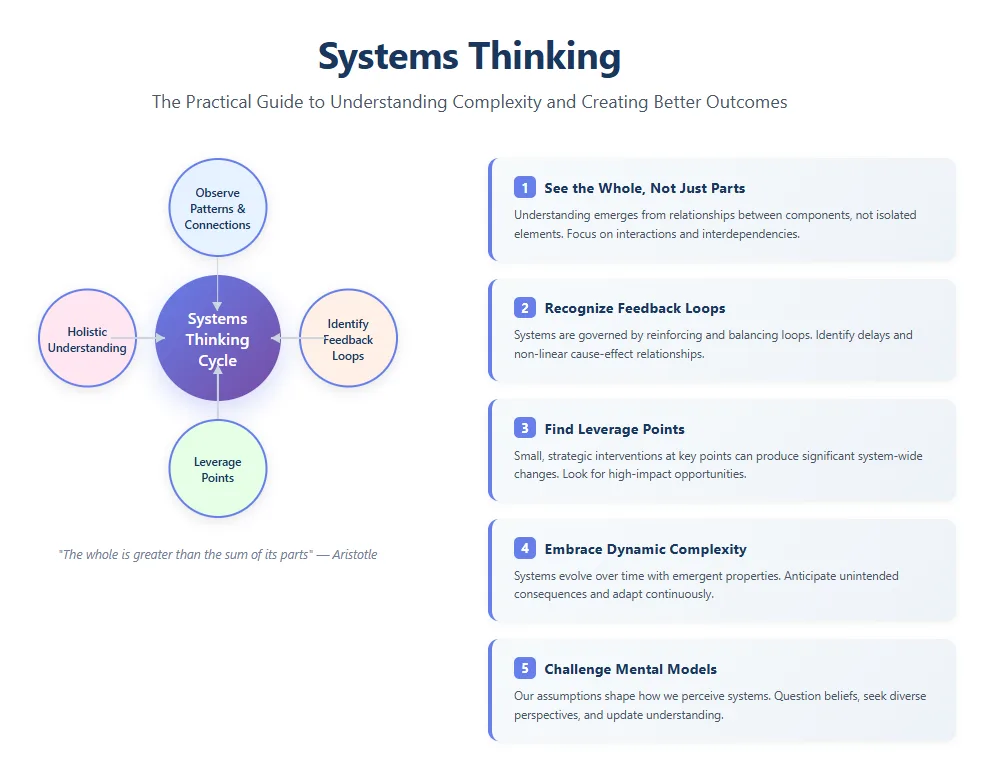
- Focus on relationships, not isolated parts.
- In systems thinking, the connections often matter more than the components.
- A small change in how parts interact can create a large change in outcomes.
- Look for patterns over time, not snapshots.
- A single moment can mislead you.
- Systems thinking pushes you to ask, “What has been happening over weeks, months, or years?”
- Identify feedback loops.
- Feedback loops explain why a system grows, stabilizes, or spirals.
- Systems thinking separates two loop types:
- Reinforcing loops: changes amplify themselves (growth or decline).
- Balancing loops: changes resist themselves (stabilization or goal-seeking).
- Expect delays.
- Many actions take time to show results.
- Systems thinking warns you not to overreact before the system responds.
- Watch for unintended consequences.
- A fix in one area can trigger side effects in another.
- Systems thinking trains you to ask, “What could this decision break later?”
- Find leverage points.
- Some places in a system create outsized impact.
- Systems thinking helps you stop pushing harder in low-impact areas and start nudging high-impact ones.
Key concepts you should know to practice systems thinking
- System
- A set of parts that interact to produce outcomes.
- In systems thinking, outcomes emerge from structure, not from a single cause.
- Stocks and flows
- Stocks are accumulations (inventory, trust, fatigue, savings, knowledge).
- Flows change stocks (sales, recovery, spending, learning).
- Systems thinking uses stocks and flows to explain why change can feel slow and then suddenly accelerate.
- Boundaries
- Every analysis chooses what to include and exclude.
- Systems thinking encourages flexible boundaries: start small, then expand if the system pushes effects across your boundary.
- Emergence
- System-level behavior that cannot be explained by any one part alone.
- Systems thinking highlights how “culture,” “traffic,” or “market behavior” emerges from many interactions.
- Nonlinearity
- Cause and effect are not always proportional.
- Systems thinking prepares you for tipping points, thresholds, and sudden shifts.
A simple step-by-step method for applying systems thinking
- Step 1: Define the outcome you want (and the outcome you have).
- Write the current result in plain language.
- Write the desired result with a measurable direction (increase, decrease, stabilize).
- Step 2: Describe the behavior over time.
- Sketch a quick timeline: is the problem rising, falling, cycling, or stuck?
- Systems thinking begins with trends because trends reveal system behavior.
- Step 3: List the key variables that influence the outcome.
- Include both “hard” variables (time, cost, staffing) and “soft” variables (trust, morale, perceived fairness).
- Systems thinking works best when you include human factors, not just numbers.
- Step 4: Map causal relationships.
- Use simple arrows: “A increases B,” “A decreases B.”
- Do not aim for perfection. Systems thinking maps are working drafts.
- Step 5: Find reinforcing loops and balancing loops.
- Look for circular chains where effects come back to influence the cause.
- Systems thinking becomes powerful when you can say, “This loop is driving the pattern.”
- Step 6: Identify leverage points.
- Ask: “Where can a small change reduce the harmful loops or strengthen the helpful loops?”
- Systems thinking favors policy, incentives, information flows, and constraints over motivational speeches.
- Step 7: Test changes safely.
- Use pilots, simulations, or staged rollouts.
- Systems thinking respects risk: you learn without breaking the system.
- Step 8: Measure and adapt.
- Track leading indicators, not only final outcomes.
- Systems thinking treats improvement as ongoing learning, not a one-time project.
Practical tools used in systems thinking (with easy examples)
- Causal loop diagrams
- A visual map of cause-and-effect feedback loops.
- Example:
- More workload → more stress → more mistakes → more rework → more workload.
- Systems thinking uses this to show why teams feel trapped.
- Stock-and-flow diagrams
- Useful when accumulation matters.
- Example:
- Customer support backlog (stock) grows when new tickets (inflow) exceed resolved tickets (outflow).
- Systems thinking uses this to explain why “working harder” may not reduce backlog without changing inflow or capacity.
- Iceberg model
- A way to see deeper layers:
- Events → patterns → system structures → mental models.
- Systems thinking uses it to move from reacting to redesigning.
- A way to see deeper layers:
- Leverage point analysis
- A method to prioritize interventions.
- Systems thinking helps you choose interventions that change structure rather than surface activity.
- Scenario testing
- “If we change X, what happens to Y over time?”
- Systems thinking is stronger when paired with clear hypotheses and monitoring.
Common mistakes that weaken systems thinking
- Mistake: Confusing activity with impact.
- Being busy does not mean the system is improving.
- Systems thinking asks, “What changed in the feedback loops?”
- Mistake: Treating the map as the truth.
- A map is a tool for learning, not a final answer.
- Systems thinking stays humble and updates based on evidence.
- Mistake: Ignoring delays.
- People often abandon a good change too early.
- Systems thinking encourages patience paired with measurement.
- Mistake: Fixing one point while the system adapts around it.
- Systems resist change when incentives and constraints remain the same.
- Systems thinking requires aligning rules, metrics, and behaviors.
- Mistake: Leaving out power, incentives, and information.
- Real systems are shaped by who decides, who benefits, and who knows what.
- Systems thinking must include decision rights and information flows.
Real-world examples of systems thinking in action
- Business operations
- Systems thinking reveals how short-term cost cutting can reduce quality, increase returns, overload support, and finally increase total cost.
- A systems thinking response might include improving upstream quality, redesigning workflow, and adjusting performance measures.
- Healthcare and patient outcomes
- Systems thinking shows how staffing ratios, documentation burden, and communication patterns influence errors and burnout.
- A systems thinking approach might reduce low-value tasks, improve handoffs, and strengthen learning systems.
- Education and student performance
- Systems thinking highlights how attendance, family support, sleep, mental health, classroom climate, and assessment practices interact.
- A systems thinking intervention might target early warning indicators, not only test preparation.
- Technology and product development
- Systems thinking explains why shipping faster can increase defects, which increases hotfixes, which reduces future capacity.
- A systems thinking strategy might rebalance speed and stability through automated testing, clearer definitions of done, and smarter backlog rules.
- Personal productivity
- Systems thinking helps you see burnout loops: overcommitment → poor sleep → lower focus → longer work hours → more overcommitment.
- A systems thinking fix targets the structure: limits, recovery time, and fewer hidden inflows of commitments.
How to use systems thinking as a theoretical framework in a research paper or dissertation
- Position systems thinking as your lens for explaining complex relationships.
- Systems thinking works well when your topic involves multiple interacting variables and feedback.
- It supports explanations that go beyond single-cause reasoning.
- Define the system you are studying with a clear boundary and rationale.
- State what is inside the system (actors, processes, environments).
- State what is outside the system and why.
- Systems thinking becomes academically strong when your boundary choices are transparent.
- Develop a conceptual model grounded in systems thinking.
- Present a causal loop diagram or a logic map that shows key variables and feedback loops.
- Explain how reinforcing loops and balancing loops relate to the phenomenon.
- This is where systems thinking moves from “idea” to “framework.”
- Formulate research questions that match systems thinking logic.
- Good systems thinking research questions often:
- Explore interactions (“How do factors A and B jointly influence outcome C over time?”).
- Examine feedback (“What feedback mechanisms sustain this pattern?”).
- Identify leverage (“Which structural conditions could shift outcomes most effectively?”).
- Good systems thinking research questions often:
- Translate your systems thinking model into testable propositions or themes.
- For quantitative research:
- Convert key links into hypotheses (for example, increases in workload predict increases in error rates, mediated by fatigue).
- For qualitative research:
- Convert system links into interview or coding categories (for example, incentives, information gaps, delays, adaptation behaviors).
- Systems thinking supports mixed methods well because it welcomes multiple data types.
- For quantitative research:
- Use systems thinking to guide data collection.
- Collect data across different levels, not just one.
- Example levels:
- Individual experiences
- Team workflow
- Organizational policy
- External environment
- Systems thinking helps justify why multi-level data is necessary.
- Use systems thinking to structure analysis and interpretation.
- Instead of reporting variables in isolation, interpret findings as system behavior.
- Explain how loops and delays create the observed outcomes.
- Systems thinking improves discussion chapters because it connects results into a coherent mechanism.
- Use systems thinking to design recommendations that address structure.
- Recommendations should target leverage points:
- Incentives and metrics
- Information flows and transparency
- Constraints and bottlenecks
- Rules, policies, and decision rights
- Systems thinking strengthens practical impact because it avoids shallow “train people more” solutions.
- Recommendations should target leverage points:
- Be explicit about limitations using systems thinking language.
- Acknowledge boundary limits, measurement gaps, and dynamic complexity.
- Explain which parts of the system were not captured and how that might influence conclusions.
- Systems thinking frameworks look more credible when limitations are openly discussed.
Closing takeaways
- Systems thinking helps you solve the right problem, not just the visible one.
- It reveals feedback loops, delays, and unintended consequences.
- Systems thinking improves decisions by shifting focus from blame to structure.
- You can redesign incentives, information, and constraints to get better outcomes.
- Systems thinking is both practical and research-ready.
- It can guide your research questions, your conceptual model, your analysis, and your recommendations.