

Thematic statement definition
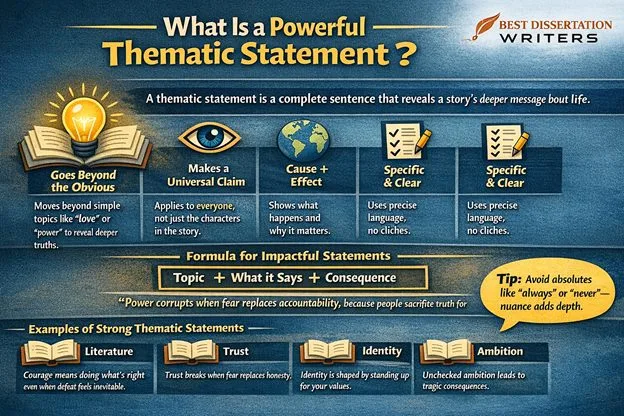
- A thematic statement is a single sentence that explains a central idea a story explores through plot, character’s choices, and consequence.
- It is a clear, universal message the author is trying to express, written as a claim a reader can agree or disagree with.
- It is not a topic word, not a question, and not a summary of action.
- It usually names a central theme (such as loyalty, trust, identity, freedom, safety, or choice) and states what the story suggests about human nature.
- It should compel the reader because it connects a specific journey to a deeper concept that can apply directly to real life.
- A strong thematic statement is specific, evidence-based (supported by events), and shaped by conflict in the setting.
What is a thematic statement?
- Think of it as the “meaning layer” under the plot.
- Plot = what happens in the story (events, battle, decision, action, finish).
- Theme statement = what those events demonstrate about people and life, ultimately.
- It answers the hidden question: “What is the author is trying to show about this topic?”
- It is often built from three parts:
- The theme (the big concept).
- The claim (what the author suggests about that concept).
- The consequence (why it matters, or what happens when people ignore it).
- It should be one sentence because a single sentence forces clarity and removes obvious filler.
Why thematic statement matters in content and story
- For learning and teaching
- Helps a teacher guide discussion beyond “I liked the book.”
- Helps a writer plan a novel or short story with purpose.
- Helps readers identify what ideas underlie the scenes, not just what happened directly.
- For writing and revision
- Keeps content focused on a central theme, not random plot episodes.
- Prevents a story from becoming a list of events with no message the author is trying to express.
- Makes it easier to choose which scenes to keep, cut, or expand in detail.
- For analysis and literary skills
- Gives a guide for collecting evidence (scenes, dialogue, decisions) that demonstrate the theme.
- Improves how you write theme statements in essays, book reports, and class posts.
- Strengthens how you explain the author is trying to communicate something universal.
Understanding the concept of theme, topic, and thematic statement
- Theme
- The central idea about life a story explores (for example: trust, loyalty, identity, freedom).
- Usually universal and emotional, because it connects to human experience.
- Topic
- The subject area the story talks about (for example: war, family, school, money, nature).
- A topic is a category, not a message.
- Thematic statement
- The sentence that turns theme into meaning.
- It states what the story argues about the theme, based on plot and conflict.
Differences between theme vs topic
- Topic is a label; theme is an insight.
- Topic: “family”
- Theme: “family loyalty can demand sacrifice”
- Topic is what you can point to; theme is what you have to infer.
- Topic: “a boy in a new school”
- Theme: “identity strengthens when a person chooses integrity over approval”
- Topic is often concrete; theme is often abstract.
- Topic: “a battle to conquer a kingdom”
- Theme: “power gained through fear destroys trust and safety”
- Topic can be one word; theme needs explanation.
- Topic: “freedom”
- Theme: “freedom requires responsibility, or it becomes chaos”
Differences between theme statements vs plot summary
- Plot summary
- Tells what happens, in order.
- Focuses on setting, characters, events, and outcomes.
- Example: “A boy leaves home, faces a battle, and returns changed.”
- Theme statements
- Explain what those events mean.
- Focus on choice, consequence, and the central message.
- Example: “A difficult journey shapes identity when a person chooses courage over comfort.”
- A quick test
- If your sentence can be answered with “Then what?” it is probably plot.
- If your sentence can be debated in a discussion, it is probably theme.
Where character fits in a theme statement
- Character is the engine that turns theme into story.
- Theme becomes visible through what a character does under pressure.
- Conflict forces decision, and decision reveals values.
- Character-based meaning
- A character’s fear, loyalty, trust, or desire for freedom creates the emotional core.
- The theme emerges from consequence: what the character gains, loses, or learns.
- Use character without naming the character
- Instead of naming a person, describe the type of person:
- “A leader,” “a child,” “a friend,” “a newcomer,” “a parent,” “a writer.”
- Instead of naming a person, describe the type of person:
- Tie character to evidence
- Choose moments where the character’s choice changes the plot and demonstrates the central theme.
Need help writing a strong thematic statement?
Get clear, step-by-step support to turn a theme topic into a precise, one-sentence claim (with examples, feedback, and revisions) from Best Dissertation Writers .
- Theme vs topic explained in simple terms
- A ready-to-use formula: topic + what it says + consequence
- Polished thematic statement examples for your story or novel
- Quick edits to improve clarity, specificity, and depth
Types of thematic statement
- Not every story needs the same type.
- Different types help you match the sentence to what the author is trying to do.
Universal theme statement
- Focuses on people in general, not one specific character.
- Works best when the theme is broad and applies across settings.
- Signals words you may use:
- “People,” “we,” “humans,” “society,” “individuals,” “anyone.”
- Example structure
- “When people __________, they often __________, because __________.”
- Example
- “When people value loyalty over truth, they can protect relationships short-term but destroy trust long-term.”
Character-based thematic statement
- Focuses on how a character’s inner change reveals meaning.
- Works best for coming-of-age stories, identity arcs, and moral conflicts.
- Example structure
- “A person discovers __________ when they choose __________ over __________.”
- Example
- “A person strengthens identity when they choose self-respect over approval, even when the consequence is loneliness.”
Conflict-based thematic statement
- Focuses on how conflict exposes values and creates consequence.
- Works best for high-stakes plot, external threats, and ethical dilemmas.
- Example structure
- “In the face of __________, __________ leads to __________.”
- Example
- “In the face of injustice, silence enables harm, while action protects safety and freedom.”
How to write thematic statements
- Use this as a practical guide you can apply to any book, novel, or short story.
- Aim for one sentence, clear logic, and a claim supported by evidence from the plot.
Step 1: Choose a theme topic
- Identify the topic first, then move deeper.
- Ask: “What keeps repeating in the story?”
- Look for repeated choices, arguments, symbols, or consequences.
- Common theme topics to start with
- Loyalty, trust, identity, freedom, safety, power, love, fear, justice, belonging.
- Fast prompts to find the theme topic
- What does the character want most?
- What does the character fear losing?
- What conflict forces the hardest decision?
- What lesson seems to underlie the ending?
Step 2: Turn the topic into a clear sentence
- Convert a single word topic into a claim.
- Topic: “trust”
- Sentence draft: “Trust is fragile.”
- Improve clarity by specifying conditions.
- “Trust breaks when people hide the truth to avoid short-term conflict.”
- Keep it one sentence
- One sentence prevents you from stacking multiple themes into one unclear paragraph.
- Avoid obvious statements
- If it sounds like a generic poster line, it may be too vague.
Step 3: Add a universal insight that compels
- Make it universal
- Remove names, unique places, or one-time events.
- Keep the insight applicable to real life.
- Make it compelling
- Show stakes: what is gained or lost.
- Connect to emotion: fear, love, pride, shame, hope.
- Useful “compel” tools
- Add consequence: “which leads to…”
- Add contrast: “but…”
- Add cause-and-effect: “because…”
- Example upgrade
- Basic: “Freedom matters.”
- Compelling: “Freedom becomes meaningful only when a person accepts responsibility for the consequence of their choice.”
Step 4: Check the statement for clarity and specificity
- Clarity checks
- Can a reader understand it without reading the plot summary?
- Does every word earn its place in the sentence?
- Is the statement directly connected to what happens in the story?
- Specificity checks
- Does it say how or why, not just what?
- Does it avoid cliche phrases like “love conquers all” unless the story demonstrates it in a fresh way?
- Evidence checks
- Can you point to at least three moments that demonstrate the claim?
- Do those moments show conflict, decision, and consequence?
Thematic statement examples
Example 1: Theme statement examples for common themes
- Loyalty
- “Loyalty becomes harmful when it demands silence about wrongdoing, because protection without honesty destroys trust.”
- Trust
- “Trust is built through consistent truth-telling, and it collapses when fear turns relationships into performance.”
- Identity
- “Identity strengthens when a person stops chasing approval and chooses values, even when the cost is rejection.”
- Freedom
- “Freedom without responsibility becomes selfishness, but freedom with accountability creates safety for others.”
- Choice
- “A single choice can shape a life more than talent, because decision reveals character under pressure.”
- Nature
- “When people treat nature as a tool instead of a living system, they inherit consequences they cannot control.”
Theme statement examples for common themes
A theme statement is the sentence that explains what the story suggests about a theme. The highlighted line below is the thematic statement.
Theme: Trust
Thematic statement: Trust breaks when fear replaces honesty, because relationships cannot survive constant suspicion.
Example (in a story): A friend hides the truth to avoid conflict, but the lie grows and ruins the friendship.
Theme: Loyalty
Thematic statement: Loyalty becomes harmful when it demands silence about wrongdoing, because it destroys trust over time.
Example (in a story): A character protects a friend’s mistake, but the cover-up hurts everyone involved.
Theme: Identity
Thematic statement: Identity strengthens when a person chooses values over approval, even when the cost is rejection.
Example (in a story): A student stops performing for others and makes a difficult decision that reflects self-respect.
Tip: The thematic statement is the sentence that makes a universal claim (not a plot summary).
Example 2: Thematic statement examples by story type
- Short story
- “In a short story, small actions reveal big truths: a single moment of honesty can restore trust after long avoidance.”
- Coming-of-age story
- “Growing up means learning that identity is not given by others, but chosen through everyday courage.”
- Mystery story
- “The search for truth exposes how lies multiply conflict, because each hidden detail creates new consequence.”
- Romance story
- “Love fails when it becomes control, because possession cannot coexist with freedom.”
- Adventure story
- “A journey tests character, and the hardest battle is often the decision to keep going when doubt is louder than hope.”
- War or battle story
- “Violence may help someone conquer a goal, but it often leaves emotional damage that reshapes identity long after the fight ends.”
- Dystopian novel
- “When a society trades freedom for safety without limits, it creates a system where fear becomes the central tool of control.”
Thematic statement examples by story type
Below, each example includes the story type, then a highlighted line showing the thematic statement. A short story idea is included to show how it could appear in a plot.
Story type: Coming-of-age
Thematic statement: Growing up means choosing values over approval, because identity is built through hard decisions.
Example plot idea: A student risks losing friends by refusing to participate in bullying, and discovers self-respect.
Story type: Mystery
Thematic statement: Truth is uncovered when people face discomfort, because hiding facts allows conflict and harm to grow.
Example plot idea: A detective finds that each lie protects someone briefly, but creates bigger consequences later.
Story type: Romance
Thematic statement: Love fails when it becomes control, because respect and freedom are the foundation of trust.
Example plot idea: One partner tries to “protect” the other by limiting choices, and the relationship breaks down.
Story type: Adventure
Thematic statement: A journey reveals character, because courage is proven by the choices people make under pressure.
Example plot idea: A team must choose between easy success and doing what is right, even when it risks failure.
Tip: If you change the plot, the thematic statement should still remain true for the story type.
Example 3: Statement examples for different characters and conflicts
- A boy facing peer pressure (identity conflict)
- “A boy learns that identity is stronger than popularity when he chooses integrity and accepts the consequence of standing alone.”
- A leader facing betrayal (trust conflict)
- “Trust breaks when power becomes more important than people, because leadership without empathy turns loyalty into fear.”
- A friend group after a lie (loyalty conflict)
- “Loyalty is proven through truth, not secrecy, because protecting a lie harms the relationship more than admitting it.”
- A family in crisis (choice conflict)
- “In crisis, the choices people make reveal their values, and those values shape the future more than the crisis itself.”
- A character vs setting (nature conflict)
- “When survival depends on nature, arrogance collapses, and humility becomes the difference between danger and safety.”
Statement examples for different characters and conflicts
Each section below lists a character type and the conflict, then highlights the thematic statement. A brief plot hook shows how the idea could appear in a story.
Character: A boy new to school • Conflict: identity vs approval
Thematic statement: Identity becomes stronger when a person chooses integrity over popularity, even when rejection feels unbearable.
Plot hook: He refuses to join a cruel prank, loses “friends,” and discovers self-respect.
Character: A leader • Conflict: trust vs power
Thematic statement: Trust collapses when power becomes more important than people, because fear cannot create real loyalty.
Plot hook: The leader demands obedience, but betrayal grows until the group breaks apart.
Character: Two best friends • Conflict: loyalty vs honesty
Thematic statement: Loyalty is proven through truth, not secrecy, because protecting a lie harms relationships more than admitting it.
Plot hook: One friend covers up a mistake “to help,” but the hidden truth causes a bigger fallout later.
Character: A parent • Conflict: safety vs freedom
Thematic statement: Safety becomes fragile when fear limits freedom, because control cannot protect people from every consequence.
Plot hook: A parent restricts every choice, and the child becomes unprepared for real-world risk.
Character: A rival pair • Conflict: ambition vs consequence
Thematic statement: Ambition turns destructive when winning matters more than integrity, because success gained by harm carries lasting consequences.
Plot hook: One rival cheats to conquer the competition, but the victory costs reputation, trust, and peace.
Tip: A strong thematic statement links character choice to conflict and consequence, without summarizing every plot event.
How to revise and strengthen a theme statement
- Revision is where a good sentence becomes powerful.
- Use these tips to remove obvious phrasing, increase clarity, and tighten logic.
Tip 1: Make the sentence more precise
- Replace vague words with specific meaning.
- Vague: “bad,” “good,” “things,” “stuff.”
- Precise: “betrayal,” “risk,” “responsibility,” “isolation,” “accountability.”
- Add conditions.
- “Trust matters” → “Trust matters most when conflict makes honesty costly.”
- Limit to one central theme
- If your sentence includes three big ideas, you probably have three theme statements.
Tip 2: Avoid vague or moralizing statements
- Avoid preaching tone that sounds like a teacher scolding a class.
- Avoid “always/never” unless the story truly supports it.
- Avoid cliche morals that do not match the story’s detail.
- If the plot shows mixed outcomes, your statement should reflect complexity.
- Aim for an insight, not a lecture.
- “People should be nice” is obvious.
- “Kindness becomes courage when it risks social punishment” is more literary.
Tip 3: Test the statement against the story
- Evidence test
- List 3–5 moments from the plot that support the claim.
- Include at least one turning-point decision.
- Counterexample test
- Ask: “Does any scene contradict my claim?”
- If yes, refine the sentence so it matches what the author is trying to show.
- Reader test
- Ask: “Would a reader who disagrees still find this debatable?”
- If yes, your statement has discussion value.
Tip 4: Make sure all the thematic statement checklists are met
- Checklist for a strong thematic statement
- One sentence, not a paragraph.
- States a universal claim, not a topic.
- Connects theme to conflict, choice, and consequence.
- Avoids plot summary and names.
- Uses clear cause-and-effect language.
- Can be supported by evidence from the story.
- Feels compelling, not obvious.
- Quick “tighten” moves
- Remove extra adjectives.
- Replace “is about” with a direct claim.
- Add “because” or “which leads to” when logic is missing.
Common mistakes to avoid when writing a thematic statement
- Mistake: Writing a topic instead of a statement
- Topic: “freedom”
- Better: “Freedom becomes dangerous when it ignores responsibility.”
- Mistake: Writing plot summary
- Plot: “The character leaves home and returns.”
- Theme: “A journey changes identity when a person confronts fear instead of running from it.”
- Mistake: Making it too moralizing
- Moralizing: “People should always tell the truth.”
- Stronger: “Truth can threaten comfort, but hiding it creates conflict that grows over time.”
- Mistake: Using a cliche without proof
- Cliche: “Love conquers all.”
- Stronger: “Love can heal conflict, but only when it respects freedom and refuses control.”
- Mistake: Being too broad or too obvious
- Too broad: “Life is hard.”
- Better: “When people avoid hard decisions, they often create consequences that are harder than the truth.”
- Mistake: Ignoring character’s role
- If the character’s decisions do not shape the meaning, your theme will feel disconnected.
- Mistake: Forgetting the author’s purpose
- Keep returning to: “What is the author is trying to reveal through this conflict?”
- Track the message the author is trying to express, not just what happens directly.
Frequently asked questions about thematic statements
Can a story have more than one theme statement?
- Yes, many stories explore multiple themes, especially a novel with several characters and subplots.
- A practical approach
- Choose one central theme statement for the whole book.
- Add 1–2 secondary theme statements for major character arcs or conflicts.
- How to know which one is central
- The central one is supported by the most evidence.
- It shapes the ending and the character’s final decision.
- It is the idea that underlies the biggest consequences.
How long should a thematic statement sentence be?
- Most strong options fit in 15–30 words.
- Short is good, but not at the cost of clarity.
- Too short: “Trust matters.”
- Better: “Trust breaks when fear replaces honesty, because relationships cannot survive constant suspicion.”
- If it becomes too long
- You may be trying to fit more than one theme into a single sentence.
- Split and choose the strongest claim.
How many thematic statement examples should I include?
- For a blog post or guide, 10–20 statement examples is usually enough to support learning.
- A smart mix includes
- Common themes (trust, loyalty, identity, freedom).
- Different story types (short story, novel).
- Different conflicts (internal, interpersonal, society vs individual, character vs nature).
- Quality matters more than quantity
- Each example should demonstrate clear logic, show consequence, and feel connected to a believable plot.
Quick wrap-up
- Identify the topic, then explore what it means in the story.
- Focus on character’s choice under conflict and the consequence that follows.
- Write one clear sentence that states a universal claim.
- Support it with evidence from the plot and revise until it feels precise, compelling, and directly tied to the central theme.