

Closed Questions in Research – Key Takeaways
Closed questions in research are structured questions with predefined answer choices, such as yes/no options, multiple choice, rating scales, and Likert scales. They are widely used in surveys and questionnaires because they make responses easier to compare, measure, and analyze. They are especially useful in user research, market research, customer feedback, and large-scale quantitative studies.
- What Closed Questions Are:
- Closed questions limit respondents to a fixed set of answers.
- They are designed to collect clear, consistent, and quantifiable data.
- Common formats include yes/no, true/false, multiple choice, rank order, rating scales, and Net Promoter Score (NPS) questions.
- Why They Are Useful in Research:
- They make it easier to gather data from a large number of respondents quickly.
- Responses are easier to compare across groups and turn into numerical results for analysis.
- They help researchers identify patterns, trends, preferences, and satisfaction levels efficiently.
- Main Advantages:
- Easy to analyze because answers are already structured.
- Time-efficient for both respondents and researchers.
- Consistent and scalable across large surveys.
- Can reduce bias when written neutrally and paired with balanced response options.
- Best Practices for Writing Closed Questions:
- Keep questions simple, direct, and clear.
- Make sure answer options are balanced, mutually exclusive, and easy to understand.
- Avoid leading, biased, vague, or overly complex wording.
- Test questions with a small group before using them broadly.
- Common Mistakes to Avoid:
- Using ambiguous wording that confuses respondents.
- Providing too many answer choices.
- Creating overlapping response options.
- Asking biased questions such as ones that push people toward a positive or negative answer.
- Closed vs. Open-Ended Questions:
- Closed questions work best when the goal is quantifiable, fast, and comparable data.
- Open-ended questions are better when deeper explanations, opinions, or experiences are needed.
- A strong survey often uses both: closed questions for measurement and open-ended questions for detail and context.
Closed questions are a practical tool for collecting structured and measurable data in research. When written clearly and combined with thoughtful response options, they help researchers gather reliable insights efficiently while making large-scale analysis much easier.
Understanding Closed Questions in Research
Closed questions in research are a key component of surveys and questionnaires, particularly when collecting data that can be easily quantified. These types of questions are structured with predefined answers that limit the responses of the respondents, making them valuable for gathering consistent and reliable data.
What is a Closed Question?
- A closed question is a survey question that limits the responses to a set of predefined options.
- These questions are designed to generate specific, quantifiable answers that can be easily analyzed, making them an excellent tool for quantitative data collection.
- A closed-ended question can be simple with binary responses (e.g., yes or no) or more complex, offering multiple response choices (e.g., multiple-choice questions, Likert scale, rating scale).
- These questions help to ensure consistency in responses, making them easier to analyze and interpret.
- Closed-ended questions are particularly helpful in market research and user research where the goal is to obtain measurable data across a large sample.
The Importance of Closed-Ended Questions in User Research
- Closed questions in research provide structure in the data collection process, allowing for the easy comparison of responses across a group of respondents.
- These questions offer a clear way to collect quantitative data, which is crucial for statistical analysis and decision-making.
- Closed-ended questions allow you to use close-ended questions to gather quantitative data, such as satisfaction levels, opinions on a product, or preferences among different options.
- The use of questions like Likert scales or Net Promoter Score (NPS) provides specific, measurable data on customer satisfaction and loyalty.
- Multiple-choice questions are another popular form of closed questions. They provide respondents with several choices, each offering a quantifiable answer that simplifies analysis.
- These research questions are essential in survey templates, where predefined responses allow for quick data entry and easier interpretation.
- Closed questions are especially useful when conducting large-scale surveys or polls where time is limited and data needs to be processed quickly.
When to Use Closed-Ended Questions: Advantages and Best Practices
- When to Use:
- Use closed questions in research when you need quantitative data or when you are focused on obtaining clear, easily comparable answers.
- They are useful when the objective is to collect survey responses in large quantities, such as customer feedback, product ratings, or satisfaction surveys.
- Closed-ended questions are ideal when you need a quick snapshot of a specific opinion or behavior without the need for lengthy explanations from respondents.
- If the research goal is to identify trends, patterns, or significant differences between different groups, closed-ended questions are the best option.
- Advantages:
- Clear and Concise Responses: Respondents are not required to think deeply or give open-ended answers, making it easier to gather consistent responses.
- Easier to Analyze: Data from closed-ended questions can be easily transformed into numerical data for analysis, particularly useful for statistical methods.
- Time-Efficient: Respondents can answer quickly, which is ideal for large-scale surveys or studies where time is limited.
- Data Comparison: Closed questions allow for a straightforward comparison between different groups, such as in market research or customer satisfaction surveys.
- Reduced Bias: By offering fixed response options, closed questions can limit potential bias, ensuring a more objective result.
- Scalable: You can use multiple-choice questions, rating scales, and other closed-ended formats to reach a large number of respondents across different regions or demographics.
- Best Practices:
- Use Simple and Clear Answer Options: Ensure that the answer choices are easy to understand and cover all potential responses.
- Avoid Leading Questions: Questions should be neutral and not guide respondents toward a specific answer. For example, instead of asking “How much do you love our product?”, ask “How satisfied are you with our product?”
- Provide a Range of Options: For questions that ask about opinion or preference, it’s important to include a range of options, like agree or disagree, or a rating scale to capture varying levels of sentiment.
- Test Your Questions: Before distributing the survey, test your survey questions with a small group to ensure they are clear and unambiguous.
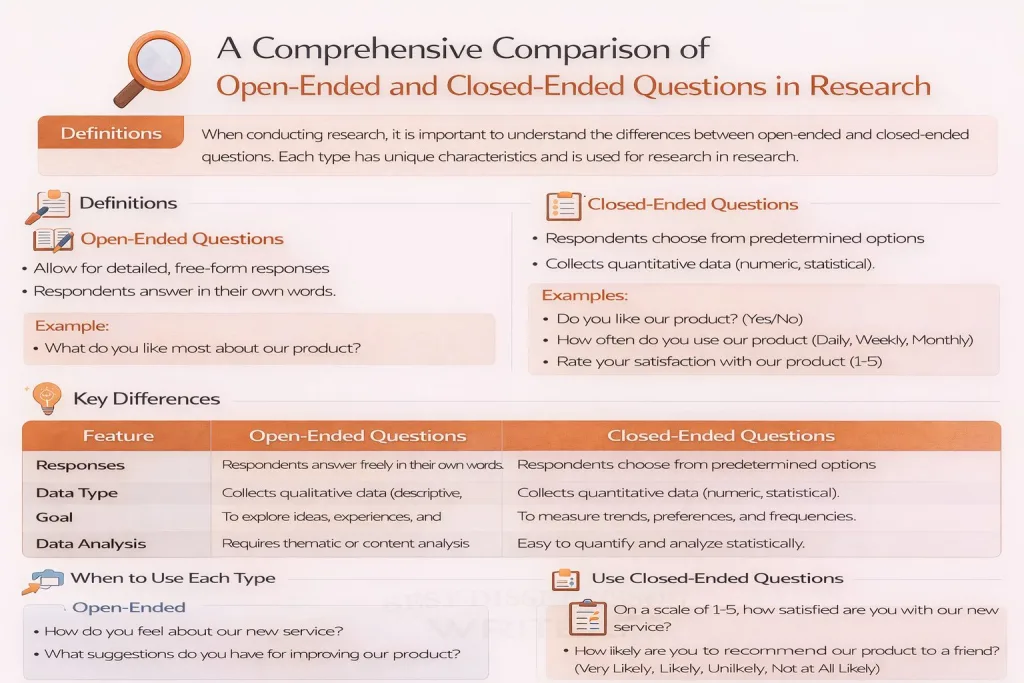
Types of Closed-Ended Questions: Exploring the Different Options
- Multiple-Choice Questions:
- Respondents are given several choices to choose from. These can be single-answer (where only one option is selected) or multiple-answer (where multiple options can be selected).
- Example: “Which of these brands have you purchased from in the last year? (Choose all that apply)”
- Likert Scale:
- This is a popular rating scale where respondents are asked to indicate their level of agreement with a statement on a scale (e.g., strongly agree to strongly disagree).
- Example: “I am satisfied with the customer service I received.” (1 – Strongly Disagree to 5 – Strongly Agree)
- Net Promoter Score (NPS):
- This is used to measure customer loyalty by asking respondents how likely they are to recommend a product or service to others, typically on a 0-10 scale.
- Example: “On a scale of 0 to 10, how likely are you to recommend our service to others?”
- Rank Order Questions:
- These questions ask respondents to rank a list of items in order of preference.
- Example: “Please rank the following features in order of importance: Price, Quality, Customer Service.”
- Yes/No Questions:
- This is a closed-ended question that gives respondents two choices: “yes” or “no.”
- Example: “Do you use our product regularly?”
- True/False Questions:
- This type of question asks respondents to answer with either “true” or “false.”
- Example: “Our product is available internationally. True or False?”
By utilizing the various types of closed-ended questions, researchers can collect quantitative data that is clear, concise, and easily comparable. These questions are essential for gathering actionable insights in user research, market research, and customer satisfaction surveys. They allow you to measure sentiments, behaviors, and opinions with precision, providing invaluable data for decision-making.
Need Help With Your Dissertation?
Get professional academic support from Best Dissertation Writers . Our expert team is ready to help you with high-quality dissertation writing services tailored to your academic goals.
Get Dissertation HelpUsing Closed Questions in Surveys and Questionnaires
Closed questions are a staple of many research studies because they provide researchers with easily quantifiable data, which makes analyzing results straightforward and efficient. These types of questions are particularly useful in surveys and questionnaires, where the goal is to gather information quickly and from a broad group of people. Here’s a detailed breakdown of how to effectively use closed questions in research.
How to Use Closed Questions in Surveys and Questionnaires
- Set Clear Research Goals: Before crafting closed questions, define what you are trying to achieve with the survey. Closed questions in research are often used to measure a respondent’s opinion, behavior, or preferences based on a structured set of answers.
- Use Simple and Direct Questions: Closed-ended questions should be easy for respondents to understand. Avoid complex language, and focus on asking clear questions that directly relate to the research objective.
- Choose the Right Format: Depending on the nature of your study, you may want to use a variety of closed-ended question types such as:
- Multiple Choice Questions: Provide a set of predefined answers where the respondent can select one or more options. These are useful for collecting quantitative data.
- Dichotomous Questions: Offer only two options, such as “Yes/No” or “True/False.” These questions work well when you want a simple, clear-cut response.
- Likert Scale Questions: Typically used in rating scale formats, these allow respondents to rate their level of agreement or satisfaction with a statement on a scale (e.g., from “Strongly Agree” to “Strongly Disagree”).
- Rating Scale Questions: Similar to Likert scales, but often used for evaluating specific attributes (e.g., satisfaction with a product on a 1-5 scale).
- Matrix Questions: These are great for gathering responses on multiple similar items within a single table format.
- Survey Question Order: The sequence in which you present your survey questions matters. Start with easier questions and move to more complex ones to avoid respondent fatigue. Group similar types of closed-ended questions together, like all multiple-choice questions in one section.
- Ensure a Balanced Set of Answer Choices: When crafting closed-ended questions, make sure to provide a balanced set of response options. For example, avoid only offering positive options in a satisfaction survey.
Survey Responses Within a Limited Framework: The Role of Closed-Ended Questions
- Creating a Limited Response Framework: Closed-ended questions inherently limit the range of answers by offering a set of responses. This is useful when the goal is to gather quantitative data from a large group of respondents.
- Structured Responses: By restricting answers to a fixed set, closed-ended questions make it easier for researchers to analyze the survey data. Survey respondents can choose from predefined answers, which simplifies the data analysis process and makes it more objective.
- Defining the Limited Framework: This limited set of responses should still cover all possible relevant answers. For example, when asking about satisfaction, you should include a range of answers like:
- Very Satisfied
- Somewhat Satisfied
- Neutral
- Somewhat Dissatisfied
- Very Dissatisfied
- Qualitative Data in a Quantitative Framework: While closed questions generally yield quantitative data, they can still capture qualitative feedback if properly designed. For example, you can include an “Other” option for survey questions where respondents can specify their answer.
Common Mistakes When Using Closed Questions and How to Avoid Them
- Overly Complex or Ambiguous Questions: When creating closed-ended questions, make sure each question is clear and to the point. Ambiguous questions can confuse respondents and lead to unreliable data.
- Mistake: “How often do you use our service on a weekly or monthly basis?”
- Solution: “How often do you use our service? (Daily, Weekly, Monthly, Never)”
- Too Many Choices: Offering too many response options can overwhelm respondents. Limit your answer choices to a manageable number (usually no more than 7 options).
- Mistake: “What’s your favorite type of cuisine?” (with 50+ options)
- Solution: Narrow it down to 10-12 options or use a categorization method like “Italian, Mexican, Chinese, etc.”
- Biased or Leading Questions: Avoid questions that influence respondents to answer in a particular way. For instance, don’t use terms like “amazing” or “terrible,” which can imply judgment.
- Mistake: “How amazing is our product?”
- Solution: “How would you rate our product?”
Steps to Formulating Closed-Ended Research Questions
Formulating effective closed-ended research questions is crucial to ensuring your survey questions yield reliable and valuable insights. Here are the steps to consider:
Step 1: Identify the Research Objective
- Understand the purpose of your research study. What do you want to measure or learn from the survey respondents? Clearly define your research question to ensure that the closed questions are aligned with your objectives.
- Example: If your goal is to assess customer satisfaction with a product, your questions should focus on satisfaction, ease of use, and feature preferences.
Step 2: Design Simple and Clear Questions
- Keep your questions short and straightforward to avoid confusion. If the question is complex or requires multiple parts, break it down into simpler parts.
- Good Example: “How satisfied are you with our service?”
- Bad Example: “How satisfied are you with the service, the response time, and the quality of our customer support?”
Step 3: Define Answer Choices Clearly
- Answer choices must be specific, clear, and exhaustive. Be sure to include all potential answers, including options like “Not Applicable” or “I don’t know” when appropriate.
- For example: When asking about frequency, provide options like:
- Never, Rarely, Occasionally, Frequently, Always
- This provides a set of responses that cover all possibilities and makes data interpretation more consistent.
- For example: When asking about frequency, provide options like:
Step 4: Ensure Answer Choices are Mutually Exclusive
- Make sure the options you provide in your closed-ended question do not overlap. This ensures each respondent can select only one answer.
- Example: Avoid: “How often do you visit us? (Daily, Weekly, Occasionally, Once a week).”
- Solution: Revise the options so they don’t overlap, e.g., “How often do you visit us? (Daily, Weekly, Monthly, Rarely).”
Step 5: Test and Revise for Clarity
- Once you’ve designed your closed-ended questions, test them with a small group of people to ensure clarity. Ask them if the question makes sense and if the answer options are clear.
- Revise your questions based on feedback to improve readability and remove any potential confusion. This testing ensures your survey questions are effective before sending them out to a larger group.
- Closed questions in research are a vital tool for obtaining structured, easily quantifiable data in surveys and questionnaires. By ensuring that your survey questions are clear, concise, and well-structured, you can gather reliable data that will inform decision-making and drive the success of your research projects.
- The use of close-ended survey questions provides a clear framework for respondents, allowing them to answer within a limited frame of options. This makes data collection faster, easier, and more reliable.
- Remember to avoid common pitfalls, like overly complex or ambiguous questions, and follow the steps for formulating effective closed-ended research questions to maximize the quality of your research.
Comparing Closed-Ended and Open-Ended Questions
When designing surveys or research questionnaires, one of the most important decisions is whether to use closed-ended questions or open-ended questions. Both types of questions serve different purposes and can provide unique insights depending on the research objectives. Here’s a detailed comparison to help you decide which question type to choose for your next research project.
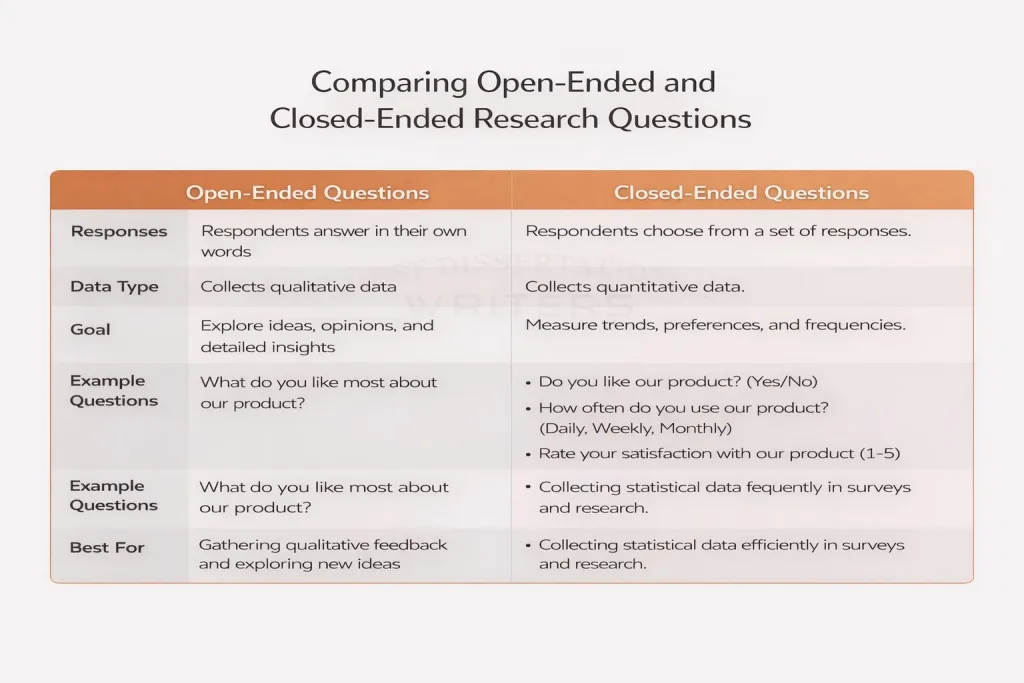
Closed-Ended Questions vs. Open-Ended Questions: Which to Choose?
- Closed-Ended Questions:
- Predefined Answers: Closed-ended questions offer respondents a set of predefined options to choose from. These options could include multiple-choice answers, yes/no responses, or rating scales.
- Quantifiable Data: The main advantage of closed-ended questions in research is that they provide data that is easy to quantify. This is particularly useful for quantitative research, where you need to analyze trends, patterns, or percentages across a large sample.
- Clear and Direct: These questions are straightforward, making it easy for respondents to answer without needing much thought. This simplicity makes closed-ended questions ideal for large-scale surveys or when you need quick responses.
- Efficient for Large Groups: With closed questions in research, you can easily collect data from a large group of respondents in a short time. Responses can be tallied quickly and analyzed effectively.
- Open-Ended Questions:
- Flexibility: Open-ended questions, on the other hand, allow respondents to answer in their own words. These questions are particularly useful when you want to explore deeper, more personal insights or gather qualitative feedback.
- Detailed Responses: Since respondents can elaborate on their thoughts, open-ended questions are excellent for qualitative research, where the goal is to gather detailed opinions or explore complex issues in-depth.
- Time-Consuming: While open-ended questions can provide rich insights, they take more time to answer. This can make them less efficient when you need a large volume of responses in a short period.
- Difficult to Quantify: Analyzing responses from open-ended questions can be more time-consuming, as you have to interpret and categorize qualitative data manually.
Which to Choose?
- Use closed-ended questions when you need quantifiable, easily analyzable data from a large sample. These questions are best suited for research projects that focus on measuring specific attributes, like satisfaction or frequency.
- Use open-ended questions when the goal is to gain insights into employee experience, personal opinions, or detailed explanations that can’t be captured by simple answer choices.
Steps to Creating Open-Ended Research Questions
While closed questions in research are great for collecting data with predefined answers, open-ended questions can provide valuable qualitative insights. Here’s how to formulate effective open-ended research questions:
Step 1: Define the Topic
- The first step is to clearly define what you want to learn from your research participants. What is the main topic or issue you want to explore?
- Open-ended questions should be designed to help uncover insights related to your topic. For example, if you’re conducting research on employee satisfaction, your questions should focus on how employees feel about different aspects of their work environment or job role.
- Example Question: “What do you like most about your job?”
Step 2: Focus on Key Areas to Explore
- After defining the topic, identify the key areas you want to explore in greater detail. These could be broad themes or specific aspects of the topic that require more explanation or exploration.
- For instance, in a survey about employee experience, you may want to focus on aspects like team collaboration, management, or career growth opportunities.
- Example Question: “How would you describe the level of communication between teams in your department?”
Step 3: Craft Open-Ended Questions That Invite Detailed Responses
- Open-ended questions allow respondents to express their thoughts in a detailed manner, so it’s important to phrase your questions in a way that invites rich responses.
- Avoid questions that are too vague or general, as they may result in responses that don’t provide much insight.
- Example Question: “Can you describe any challenges you have faced in your current role and how you overcame them?”
Step 4: Avoid Leading or Biased Questions
- Be careful not to frame open-ended questions in a way that might lead respondents toward a particular answer. Leading questions can bias the data and result in unbalanced responses.
- Example of a Leading Question: “What do you think about the excellent support you’ve received from your manager?”
- Instead, ask neutral questions like: “Can you describe the support you’ve received from your manager?”
Types and Examples of Closed and Open-Ended Questions in User Research
Both closed-ended and open-ended questions are valuable tools for user research. Here are some examples and types of each question that can be used depending on the type of data you’re trying to collect:
Types of Closed-Ended Questions
- Multiple-Choice Questions:
- These questions ask respondents to choose from a list of options. The options can be single-answer or multiple-answer.
- Example: “Which of the following features do you use most frequently? (Select all that apply)”
- Dichotomous Questions:
- These are simple yes/no questions or true/false questions.
- Example: “Do you find the product easy to use? (Yes/No)”
- Rating Scale Questions:
- These questions ask respondents to rate something on a scale, often from 1 to 5 or 1 to 7.
- Example: “On a scale from 1-5, how satisfied are you with the customer service you received?”
- Likert Scale Questions:
- These questions ask respondents to indicate their level of agreement with a statement.
- Example: “I am satisfied with the quality of the product. (Strongly Agree, Agree, Neutral, Disagree, Strongly Disagree)”
Types of Open-Ended Questions
- Exploratory Questions:
- These questions ask respondents to describe their experiences or thoughts in detail.
- Example: “What challenges do you face when using this product?”
- Opinion-Based Questions:
- These questions encourage respondents to share their views on a particular topic.
- Example: “How do you feel about the new features introduced in the latest product update?”
- Experience-Based Questions:
- These questions ask respondents to share their experiences or feelings about a particular event or situation.
- Example: “Can you describe a time when you encountered a problem using this product, and how you resolved it?”
Choosing between closed-ended and open-ended questions depends on the goals of your research and the type of data you want to collect. Closed-ended questions are great for gathering structured, quantifiable data that can be easily analyzed, while open-ended questions provide the flexibility needed for qualitative research that uncovers deeper insights. By understanding the strengths and limitations of each type, you can design a survey that maximizes the effectiveness of your data collection.
References
- Significance of the Study (University of Minnesota PDF) – https://www.cehd.umn.edu/sites/cehd/files/Significance-of-the-Study.pdf :contentReference[oaicite:0]{index=0}
- Dissertation Guide – Regent University (Significance of the Study section) – https://www.regent.edu/wp-content/uploads/2020/12/dissertation_guidelines.pdf :contentReference[oaicite:1]{index=1}
- Sample Dissertation Overview – College of William & Mary (Significance of the Study explained) – https://education.wm.edu/documents/doctoral/Sample%20Dissertation%20Overview.pdf :contentReference[oaicite:2]{index=2}
- Thesis Writing Guide – Western Kentucky University (significance & need of study) – https://www.wku.edu/msetm/pdfs/thesis_writing_guide_rev1.pdf :contentReference[oaicite:3]{index=3}