

How to Write a Research Paper Outline in 7 Easy Steps
- Brainstorm Your Ideas
- Begin by brainstorming all the key ideas you want to explore in your research paper. Consider specific arguments, evidence, and the topics you plan to cover.
- Think about your thesis statement and what major points will support it.
- Ask yourself: What is the goal of my research paper? What key points will support my thesis?
- Determine the Outline Format
- Alphanumeric Outline: Uses Roman numerals (I, II, III), capital letters (A, B, C), Arabic numerals (1, 2, 3), and lowercase letters (a, b, c) for organizing sections.
- Decimal Outline: Follows a numbering system (1.1, 1.2, 1.3) for a more structured hierarchy.
- Pick the format that best helps you organize your ideas and structure your research paper effectively.
- Organize the Outline Hierarchy
- Start with major sections of your research paper, such as Introduction, Literature Review, Methodology, Results, Discussion, and Conclusion.
- Break down each section into key points and subpoints to maintain a clear flow.
- Ensure that your outline reflects a logical flow, where each section builds on the previous one.
- Include Topic Sentences
- Start each main section with a topic sentence that summarizes the key point. This helps organize your ideas and ensures each section stays focused on its main argument.
- Write Full Sentences or Phrases
- If you are using a full-sentence outline, write complete sentences to clarify your ideas. This makes the outline easier to follow when you begin drafting the paper.
- Example: “In the Introduction, I will introduce the topic by explaining its relevance in modern research trends.”
- Draft Your Outline
- Fill in your outline with detailed information, citing relevant sources where necessary. Include specific evidence you will use in each section, such as citation and examples.
- Refer to prior research and relevant theories, especially if your research paper is in fields like APA or MLA styles.
- Revise and Streamline
- After your initial draft, review the outline to check for missing information or issues with logical flow.
- Ensure your outline has clarity, particularly when breaking down complex ideas or presenting detailed data, so it’s easier to write your research paper.
What is a Research Paper Outline?
- A research paper outline is a systematic plan that helps organize the structure and content of your paper before you start writing.
- Think of it as a blueprint that provides a clear roadmap for how you will develop your ideas, research findings, and evidence.
- The purpose of the outline is to ensure that your research paper is well-organized, follows a logical progression, and adheres to academic writing standards.
Why You Need a Research Paper Outline
- Clarifies Your Structure: A well-structured research paper outline ensures that your research paper follows a logical flow, helping you keep track of your main points and subpoints.
- Improves Writing Efficiency: By organizing your thoughts beforehand, you save time when writing the actual paper, as the outline already guides the flow of the paper.
- Ensures Comprehensive Coverage: A research paper outline forces you to think about all the aspects of your topic, ensuring that you cover all the necessary information and present it cohesively.
- Provides a Focused Writing Approach: It allows you to break down complex information into manageable sections, helping you stay focused on the task at hand without straying off-topic.
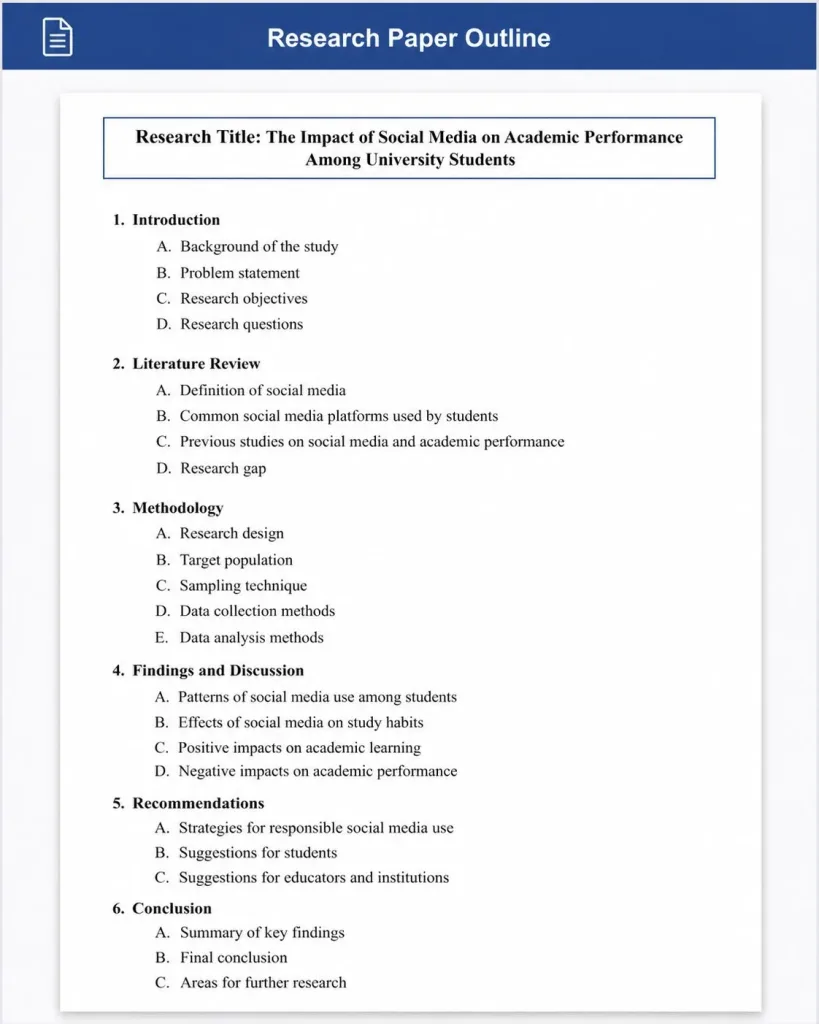
How to Write a Research Paper Outline: Step-by-Step Guide
Writing a research paper outline is an essential part of the writing process that helps you organize your ideas and research. Follow these steps to create an effective outline:
- Brainstorm Your Ideas:
- Start by brainstorming and jotting down all the ideas you want to explore in your research paper. This could include specific arguments, evidence, and topics you want to cover.
- Think about your thesis statement and the main points you will need to make to support it.
- Ask yourself: What is the goal of my research paper? What key points will support my thesis?
- Determine the Outline Format:
- Decide on the type of outline you want to use. The most common formats are the alphanumeric outline and the decimal outline.
- Alphanumeric Outline: Uses Roman numerals (I, II, III), capital letters (A, B, C), Arabic numerals (1, 2, 3), and lowercase letters (a, b, c) to organize sections and sub-sections.
- Decimal Outline: Follows a numbering system with decimals (1.1, 1.2, 1.3) for a clear hierarchical structure.
- Choose the format that best suits the organization of your ideas and research.
- Decide on the type of outline you want to use. The most common formats are the alphanumeric outline and the decimal outline.
- Organize the Outline Hierarchy:
- Start with the major sections of your research paper, such as Introduction, Literature Review, Methodology, Results, Discussion, and Conclusion.
- Within each major section, break down the information into key points and subpoints.
- Ensure that your outline reflects a logical flow of ideas, with each section building on the previous one.
- Include Topic Sentences:
- Each main section and sub-section should start with a topic sentence that summarizes the key point for that section.
- The topic sentence will guide your writing by keeping you focused on the main point of the paragraph or section.
- Write Full Sentences or Phrases:
- Some outlines, particularly the full-sentence outline, require that you write out complete sentences. This approach is helpful in ensuring clarity and providing a detailed overview of your paper’s arguments.
- For instance, if you’re working on the Introduction section, you might write: “Introduce the topic by explaining its relevance in the context of current research trends.”
- Draft Your Outline:
- Based on the structure and hierarchy you’ve established, begin filling in the details of your outline.
- Include specific evidence, data, or examples you intend to use in each section. This will make it easier to write your paper later as you’ll already have your evidence organized.
- Refer to prior research and important theories or concepts in the field, especially if you are writing in a field like social sciences or conducting a quantitative or qualitative study.
- Revise and Streamline:
- After completing your initial draft, review the outline and look for any missing information or logical flow issues.
- Make sure your outline creates a logical flow, with each section and subpoint clearly supporting the thesis.
- Ensure the outline for clarity, particularly when breaking down complex ideas or presenting detailed data, to ensure you don’t overwhelm your reader.
Struggling with Your Research Paper?
Get expert assistance with your research paper writing from Best Dissertation Writers . Our team specializes in providing research paper writing services , ensuring well-structured, high-quality papers tailored to your academic needs. Visit our site to get professional guidance and elevate the quality of your research paper.
Get Professional HelpMajor Sections to Include When Creating a Research Paper Outline
- Introduction Section:
- Purpose: The introduction introduces your topic, outlines the significance of the research, and presents your thesis statement.
- Content to Include: Start by introducing your research question and explaining why it is relevant. Briefly discuss the background of your topic, and then end with your thesis statement.
- Key Point: Make sure the introduction sets the tone for the rest of your paper and provides an overview of what is to come.
- Literature Review:
- Purpose: Summarizes the research that has already been conducted on your topic.
- Content to Include: Cite relevant sources that have contributed to the field, discuss methodologies, and present prior research that informs your current study.
- Key Point: Use the Purdue OWL or other trusted citation guides for formatting your citations correctly.
- Methodology Section:
- Purpose: Explains how you conducted your research, including the study design, data collection methods, and analysis techniques.
- Content to Include: Specify whether your research is quantitative or qualitative, and outline your data collection tools (e.g., surveys, experiments).
- Key Point: Make sure your methodology section clearly explains how you approached your research question.
- Results:
- Purpose: Presents the findings of your research.
- Content to Include: Present data, figures, and findings, and interpret them in the context of your research.
- Key Point: Use tables, graphs, or other visuals to represent the data clearly.
- Discussion Section:
- Purpose: Interprets your results and places them within the broader context of existing research.
- Content to Include: Analyze the implications of your findings, highlight key insights, and discuss any limitations of your research.
- Key Point: Focus on the significance of your findings and their contributions to the field.
- Conclusion:
- Purpose: Summarizes your key findings and suggests areas for future research.
- Content to Include: Restate your thesis and summarize the findings of your research. Offer suggestions for future studies or real-world applications of your research.
- Key Point: Provide a clear conclusion that wraps up the paper and reinforces the research paper outline’s central thesis.
Types of Research Paper Outlines: Full-Sentence vs. Decimal Format
When creating a research paper outline, it’s essential to choose the right format to organize your ideas effectively. There are several outline styles, but the two most commonly used are the full-sentence outline and the decimal outline.
- Full-Sentence Outline:
- Definition: A full-sentence outline requires you to write complete sentences rather than phrases or keywords.
- Advantages:
- Clarity: This format helps in fully developing ideas before writing the research paper.
- Thoroughness: It forces you to think deeply about your topic, ensuring that all aspects of the paper are covered in full detail.
- Perfect for complex research: If your research paper outline includes complex information or many subsections, a full-sentence outline is beneficial for clarity and depth.
- Example:
- I will introduce the topic by explaining the significance of the study on climate change and its global effects.
- When to use: This format is especially useful for high school students or those who are new to academic writing and need to organize their thoughts comprehensively.
- Decimal Outline:
- Definition: The decimal outline uses a numbering system with decimals (1.1, 1.2, 2.1, etc.) to organize sections and sub-sections.
- Advantages:
- Structured hierarchy: It provides a clear hierarchy that’s easy to follow, making it perfect for research that involves several major sections and subsections.
- Easier revisions: The numbered system allows for easier revisions, as you can simply move sections without losing the overall organization.
- Example:
- Introduction
- 1.1 Background of the Study
- 1.2 Purpose of the Research
- Literature Review
- When to use: This format is ideal for research papers that need to follow specific assignment requirements, particularly in fields such as social sciences or quantitative studies.
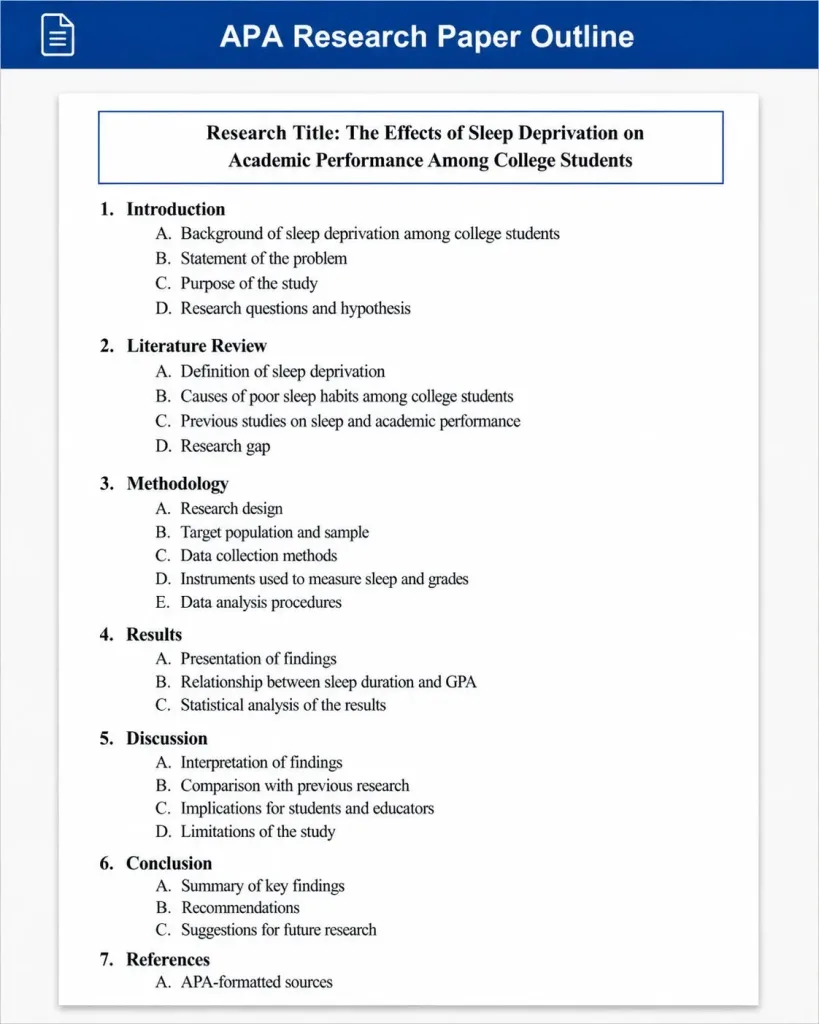
APA Research Paper Outline: Formatting Tips
The American Psychological Association (APA) is a widely used citation style, particularly in the social sciences. Here’s how to structure your research paper outline in APA format:
- Heading Structure:
- Level 1 Heading: Used for main sections such as the Introduction, Literature Review, Methodology, etc. These should be centered and bold.
- Level 2 Heading: Used for subsections under each major section. These should be left-aligned and bold.
- Level 3 Heading: Used for further breakdowns of subsections. These should be indented, bold, and followed by a period.
- Outline Format:
- Use either the alphanumeric or decimal outline format based on your preference and the writing process.
- Each major section (e.g., Introduction, Literature Review, Methodology) should begin with a thesis statement or overview.
- Evidence you will use: Clearly indicate which evidence or data will be included in each section of the outline.
- Additional Tips:
- Use complete sentences for clarity and depth, especially when outlining complex sections like the Discussion or Conclusion.
- Refer to APA guidelines for the correct citation of sources within the outline itself, as it helps prepare for the bibliography section later.
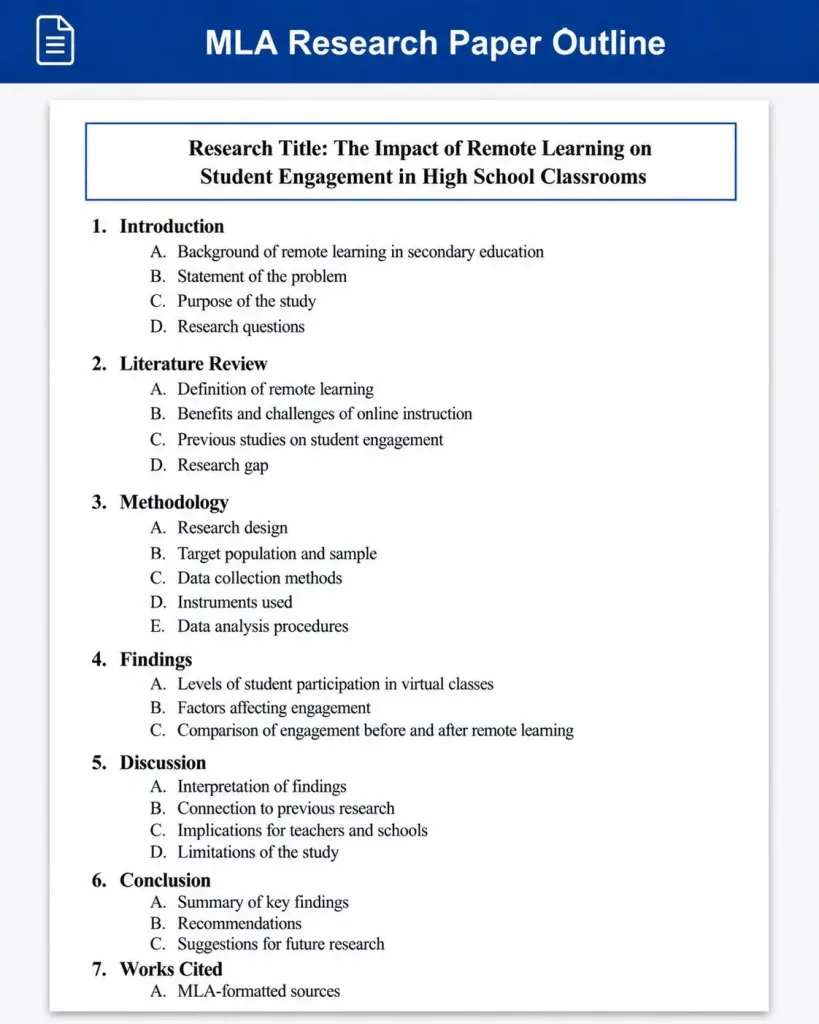
MLA Research Paper Outline Format
The Modern Language Association (MLA) format is commonly used in humanities subjects. The MLA outline format has distinct guidelines that help organize a research paper efficiently:
- Heading Structure:
- Use Roman numerals (I, II, III) for major sections and capital letters (A, B, C) for subsections.
- If further detail is needed, Arabic numerals (1, 2, 3) can be used for additional subpoints.
- Outline Structure:
- Introduction Section: Start with the general idea and thesis statement.
- Literature Review: Discuss key works related to your topic, citing reliable sources.
- Methodology/Approach: Explain your research design or method of investigation.
- Ensure that each point under a major section is relevant to the thesis and assignment requirements.
- Formatting Tips:
- Double-space your outline.
- Indent each subpoint for clarity.
- Use MLA citation guidelines to structure any references you include in the outline.
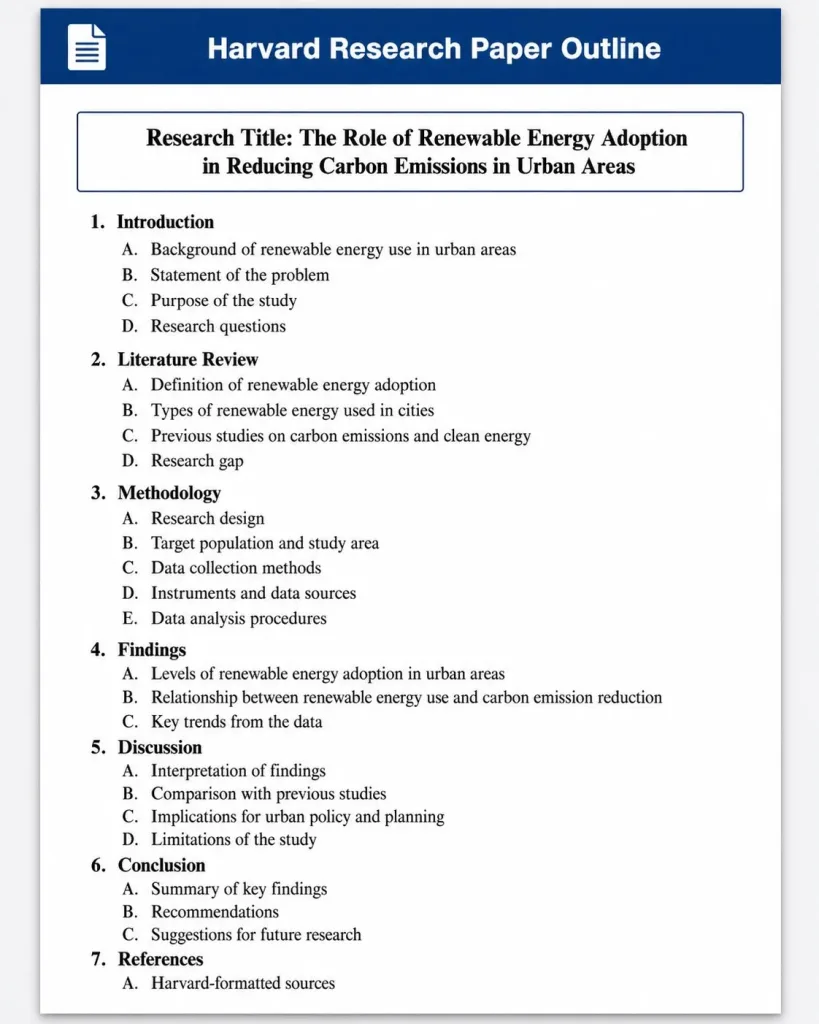
Harvard Research Paper Outline Format
The Harvard referencing style is another popular format, particularly in academic settings. Here’s how to create a research paper outline using Harvard style:
- Heading Structure:
- Use bolded headings for major sections and ensure they are aligned to the left.
- For subsections, use italicized headings.
- Outline Format:
- Introduction: Present your topic, initial ideas, and thesis statement.
- Main Body: Organize the body of your paper into sections like the Literature Review, Methodology, and Results.
- Subsections: Break down each major section into further subsections for more detailed arguments.
- Citation in Harvard Style:
- The Harvard format often requires the inclusion of in-text citations within your outline. Use short-form citations (author, year) to cite sources directly in your outline.
- Ensure that each subsection has related evidence, including dataset information, statistics, and reliable sources that will be elaborated on in the research paper.
Struggling with Your Research Paper?
Get expert assistance with your research paper writing from Best Dissertation Writers . Our team specializes in providing research paper writing services , ensuring well-structured, high-quality papers tailored to your academic needs. Visit our site to get professional guidance and elevate the quality of your research paper.
Get Professional HelpHow to Cite Sources in Your Research Paper Outline
Citing sources in your research paper outline is essential to ensure proper academic writing and help you avoid plagiarism. Here’s how to include citations effectively:
- Incorporate citations early: As you organize your outline and draft your thesis, start identifying relevant sources and integrating them into your sections. This will help you stay organized when the time comes to write your final paper.
- Cite your ideas, not just quotes: Whether you are referring to the findings of a previous study or summarizing a dataset, always include a citation.
- Choose a citation style: Use APA, MLA, Harvard, or any other citation style as per your research field or professor’s guidelines. Each style has its rules for citing sources in text and in the bibliography.
- For example, in APA style, you would use parenthetical citations like this: (Author, year).
- Use an outline generator: Consider using an outline generator for help with structuring your outline, especially when formatting citations correctly. This can save you time and reduce errors.
Conclusion: Mastering the Research Paper Outline for Success
- A research paper outline is an essential tool that helps you organize your thoughts, structure your writing, and ensure your paper meets the necessary academic standards.
- Whether you are using a full-sentence outline, a decimal outline, or a specific style like APA, MLA, or Harvard, the key to success lies in structuring your ideas into a clear, logical flow.
- By carefully organizing your ideas, breaking down the writing process into manageable sections, and including citations as you go, you will streamline the process of drafting your paper and ensure that your final document is well-organized and cohesive.
- Remember, a research paper outline is not just a formality—it’s a crucial part of the writing process that will guide your research and writing journey, ultimately leading to a well-structured and thoroughly researched paper.
References
- How to Write a Research Paper – Cambridge Research Blog – https://cambridge-research.org/blogs/how-to-write-a-research-paper/
- Tips on Writing a Good Research Paper – American Public University – https://www.apu.apus.edu/area-of-study/education/resources/tips-on-writing-a-good-research-paper/
- Writing a Research Paper – NCBI – https://pmc.ncbi.nlm.nih.gov/articles/PMC3907284/
- Research Writing Tips for Students – EBSCO – https://connect.ebsco.com/s/article/Research-Writing-Tips-for-Students?language=en_US