

Nursing Practice, Education and Service Models to Reduce Catheter-Associated Urinary Tract Infection in Adults: A Literature Review
 By Dr. Robertson Prime, Research Fellow
This dissertation is a worked example that shows the structure and standard of a 5,000-word literature-based Independent Project. It is provided for learning and is not to be submitted as a student’s own work.
Abstract
Background: Urinary catheters are widely used in hospitals, the community and care homes, and catheter-associated urinary tract infection makes up a large share of healthcare-associated infection. The quality of urinary catheter care depends on what nurses and services do, but UK evidence on practice, education and service models has not been brought together in one place.
Aim: To critically review UK evidence on nursing practice, education and service models in urinary catheter care.
Methods: A structured literature review using the Population, Exposure and Outcome framework. OpenAlex was searched twice on 9 November 2026, because CINAHL could not be accessed and a planned MEDLINE search was not completed. The first 40 records of each search were screened: 80 records were identified, 71 screened after duplicates were removed and 10 UK studies included. Quality was considered using Critical Appraisal Skills Programme questions, and findings were combined by thematic synthesis.
Findings: The included studies of urinary catheter care (n = 10) comprised three prevalence and management studies, one education survey, three service evaluations and three qualitative studies. Catheter use and management varied widely between organisations, half of catheterised patients on district nursing caseloads had no removal plan and training was not standardised. Decision tools and passports were linked to better practice, and patients described a heavy burden and gaps in information and communication.
Conclusions and implications for practice: For urinary catheter care, nurses can ask why each catheter is in place and whether a removal plan exists, give patients clear information, and help services to protect time for education and to identify residents with catheters. The evidence is limited by the restricted search, single-reviewer screening, reliance on abstracts and the observational design of most studies.
Keywords: urinary catheter care; catheter-associated infection; community nursing; adult nursing; literature review.
Brief at a glance
- Framework
- PEO
- Design
- Literature review (PEO)
- Studies included
- 10
- Field
- Adult Nursing
Introduction
Urinary catheters drain the bladder when it cannot empty itself, and they are among the most widely used invasive devices in nursing care. Foley catheters, which are held in place by a balloon, are used by about 3% of people living in the community and 13% of care home residents in England, Wales and Northern Ireland (Feneley et al., 2015). The same review links these catheters to bacterial colonisation, recurrent infection, blockage, bladder stones and sepsis, and estimates that the harm they cause costs the NHS between £1.0 billion and £2.5 billion a year. Catheter-associated urinary tract infections make up a large share of healthcare-associated infections, and the risk rises the longer a catheter stays in place (NICE, 2014). Urinary catheter care is therefore a matter of safety as well as comfort, and understanding how nursing practice shapes that safety is a priority for adult nursing.
Nurses carry much of this work. Registered nurses are expected to promote health and prevent ill health, to assess needs and plan care, and to provide and evaluate care (NMC, 2018), and national guidelines ask local services to turn broad infection-prevention principles into protocols and to audit practice so that variation is reduced (Loveday et al., 2014). This dissertation reviews UK research on nursing practice, education and service models in urinary catheter care, and on how they are linked to catheter use, infection and patient experience. It follows a structured process so that each decision can be checked. Another review examines compassionate nursing care, an aspect of practice that is closely tied to intimate procedures such as catheterisation. The review is limited to the UK so that its conclusions fit NHS services.
Background and Justification
A urinary catheter is a thin, flexible tube that drains urine from the bladder. Clean intermittent self-catheterisation is considered the best option for people with impaired bladder function who are able to manage it, because it imitates normal filling and emptying and reduces the risk of infection, whereas people who need an indwelling catheter almost always receive a self-retaining Foley catheter (Feneley et al., 2015). NICE distinguishes short-term catheters, which stay in for 28 days or less, from long-term catheters, which stay in for more than 28 days, and sets out procedures for safe insertion, ongoing care and removal for both (NICE, 2014).
The harms of indwelling catheters are well described. Bacterial colonisation follows quickly, since short-term catheterisation carries a daily infection rate of about 5%, and roughly 95% of patients are colonised after one month (Feneley et al., 2015). Bacteria that produce urease can form crystals that block the catheter, which the review describes as a medical emergency, and trauma can allow bacteria to enter the blood. Because the risk of infection rises with the time a catheter is in place, NICE advises that a catheter should be removed as soon as it is no longer needed (NICE, 2014). Avoiding unnecessary catheterisation is therefore the most direct way to prevent harm.
NICE sets out the steps that staff should complete in urinary catheter care. These include considering alternatives before catheterising, reviewing the clinical need regularly, removing the catheter as early as possible and documenting the reason for catheterisation along with insertion, changes and care (NICE, 2014). Staff are also expected to decontaminate their hands and put on clean gloves before handling the catheter, to clean the meatus and use a single-use lubricant at insertion, and to keep a closed drainage system with the bag below bladder level. These steps sit within the nursing duties to assess needs and plan care (NMC, 2018). Each step is simple, but together they require time, equipment and clear responsibility.
The standard also describes what services must provide. Providers are expected to put systems and facilities in place so that staff can complete the procedures, and commissioners to commission services in which they are carried out, while people with catheters are expected to benefit from clean hands, lubricant, timely emptying of the bag and prompt removal (NICE, 2014). No national dataset is routinely collected on whether these steps are completed, so local protocols and audit are the main source of assurance. National guidance makes the same point, since local services need to turn broad principles into their own protocols and to audit them to reduce variation in practice (Loveday et al., 2014).
Two strategies are described as reducing catheter-associated infection: avoiding unnecessary catheterisation, for example by confirming retention with a scan, and using daily checklists that prompt staff to remove catheters, which together can reduce infection rates by about 25% (Feneley et al., 2015). Both depend on nurses who notice and question the need for each catheter at every contact. NICE similarly expects the need for a catheter to be reviewed regularly and its removal to be timely, so the evidence base for practice is strongest on one message: a catheter that is not needed should not stay (NICE, 2014). Neither strategy requires new technology, only attention to why a catheter is in place.
Professional standards give nurses a clear part in this work. The Nursing and Midwifery Council standards of proficiency require registered nurses to promote health and prevent ill health (Platform 2), to assess needs and plan care (Platform 3) and to provide and evaluate care (Platform 4) (NMC, 2018). The national infection-prevention guidelines were developed by researchers and specialist clinicians led by nurses (Loveday et al., 2014). The review of catheter technology also notes the considerable nursing time that some catheter systems demand (Feneley et al., 2015). Together these standards make nurses accountable for the quality of catheter care that patients receive, whether in hospital, at home or in a care home.
Catheters are used far beyond hospital wards, since the Foley catheter is used by about 3% of people in the community and 13% of care home residents (Feneley et al., 2015). Practice in these settings therefore matters as much as practice in hospital. Guidelines and quality standards say what should happen, but they do not show how often it happens or what patients and staff make of it. A review of UK research on nursing practice, education and service models can address that gap, provided its method is stated clearly (Aveyard, 2023). A framework that separates the population, the exposure and the outcome helps to keep the question focused (Methley et al., 2014). The same question of how services reach patients arises in cardiac rehabilitation.
Title, Aim and Objectives
What does UK evidence show about nursing practice, education and service models in urinary catheter care, and how are they linked to catheter use, infection and patient experience?
Title explained
The title names the nursing practice, education and service models under review, the outcome of catheter-associated urinary tract infection, the adult population, and the literature review design that structures the whole work.
Aim
To critically review UK evidence on nursing practice, education and service models in urinary catheter care.
Objectives
- To identify and appraise UK research on urinary catheter care.
- To synthesise findings on practice, education, services and patient experience.
- To make recommendations for nursing practice.
Methodology
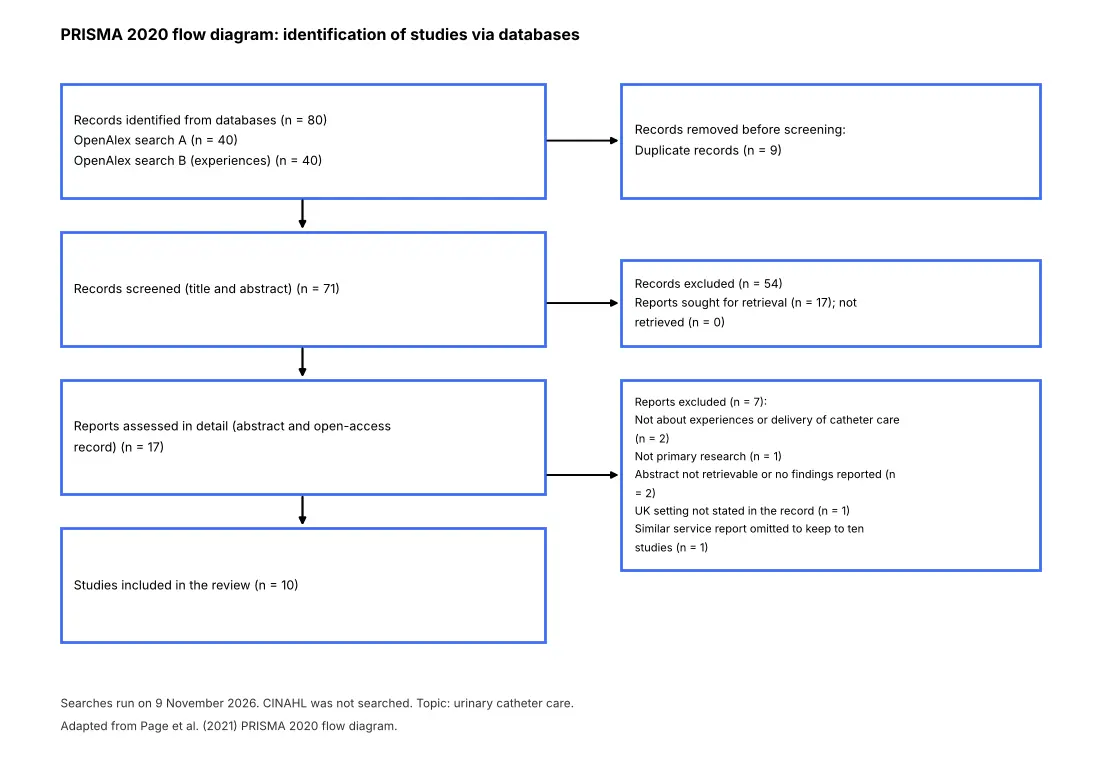
This literature-based dissertation is a structured review of published primary research on urinary catheter care. It aims to be transparent and reproducible, but it is smaller in scope than a full systematic review, which would normally involve several reviewers, many more databases and exhaustive searching (Aveyard, 2023). The review is reported with reference to the PRISMA 2020 statement, which lists the items that should be described and recommends a flow diagram showing how records move through identification, screening and inclusion (Page et al., 2021). Appendix D presents that flow diagram, Appendix A records each search string, Appendix B tabulates the included studies and Appendix C gives a worked critical appraisal. Together, the appendices allow another reader to check each decision and to repeat the process.
The review question was framed using the Population, Exposure and Outcome (PEO) structure, which suits questions about experiences and influencing factors rather than the effects of a treatment. The population was adults living with urinary catheters, together with the nurses and care staff who look after them. The exposures were nursing practice, education and service models, and the outcomes were catheter use, infection and patient experience. Structured frameworks help to translate a broad topic into searchable concepts, although the choice of framework affects how sensitive a search is (Methley et al., 2014; Aveyard, 2023). Because the evidence included interviews, surveys, audits and service evaluations, qualitative, quantitative and mixed-methods research was eligible for inclusion.
Two searches were run on 9 November 2026 in OpenAlex, an open index of scholarly works that covers a large and growing proportion of the published literature (Priem et al., 2022). The first search used the words urinary catheter care. The second combined the words urinary catheter with experiences and qualitative, to capture patient and staff views. Both searches were limited to open-access records published between 2015 and 2026 with at least one author affiliated to a UK institution. A first version of the second search that added the word nurses was refused by the service and was replaced by the simpler version reported here. Both searches were restricted to journal articles. Combining more than one source is advised because a single database misses relevant studies (Bramer et al., 2017). The exact strings and settings are given in Appendix A.
CINAHL, the main nursing database, could not be accessed, and a planned search of MEDLINE through Europe PMC was not completed because the service refused repeated requests on the day of searching. The second OpenAlex search was therefore used in its place. These gaps mean that some relevant nursing studies may not have been found, a risk that is well recognised when the combination of databases is restricted (Bramer et al., 2017). OpenAlex matches terms anywhere in the text, so many records were not relevant. It also ranks records by relevance, and the two searches matched 4,024 and 808 records. Only the first 40 records of the first search and the first 40 of the second, 80 in total, were screened, so the review should be read as a structured sample of the literature and not as a complete search (Aveyard, 2023).
Studies were eligible if they involved adults with urinary catheters, or the staff who care for them, in the UK and reported primary data on nursing practice, education, services, catheter use, infection or patient experience of urinary catheter care. Reports had to be peer-reviewed, written in English, open access and published from 2015 onwards. UK origin was judged from the stated setting and, where the abstract did not name one, from author affiliations. Reviews, protocols, commentaries, guidance articles, device studies and trials of treatment effects were excluded. Where more than ten reports qualified, one similar service report was left out to keep to ten studies. Clear criteria applied consistently reduce selection bias and allow the decisions to be audited. The extraction table is presented in Appendix B so that readers can compare studies at a glance (Page et al., 2021; Aveyard, 2023).
All 80 records were exported into a screening log, and 9 duplicates were removed, leaving 71 titles to screen. Titles that clearly described device development, laboratory work, animal studies, other conditions, conference abstracts or non-UK settings were excluded at this stage. That left 17 reports for closer assessment against the criteria. The abstract and open-access record of each of these reports were read, and the reason for every exclusion was recorded. The log lists every record by its identifier, the search in which it appeared and the decision reached, so that each exclusion can be traced. Ten studies met the criteria, and the numbers at each stage reconcile in the flow diagram (Page et al., 2021). Screening was carried out by one reviewer, which is a recognised limitation of student reviews because a second reviewer would normally check each decision (Aveyard, 2023).
Quality was considered using the Critical Appraisal Skills Programme checklists, which ask structured questions about the aims, design, conduct, results and value of a study (CASP, 2024). The qualitative checklist was completed in full for one study, as a worked example in Appendix C, and indicative quality notes for every study are recorded in Appendix B. Those notes are based on the abstract and, for one study, the open full text, so they are judgements of reporting and not a full audit of how the research was conducted. No study was excluded on quality alone, since appraisal was used to weigh the strength of the findings, which is a common approach in nursing reviews (Aveyard, 2023).
Data were extracted into a standard table covering aims, design, sample, setting, methods, findings and limitations. Numerical results were copied as reported and were not recalculated, and extraction was rechecked once against the source records, a step that reduces transcription errors but does not replace independent checking. Findings were grouped into themes by thematic synthesis, with the audit and survey results reported alongside the qualitative themes because the review combined interview, survey and routine-data evidence (Thomas and Harden, 2008; Braun and Clarke, 2006). The review used published data only and involved no participants, so ethical approval was not required, although the findings of the included studies are reported accurately and with full attribution (Aveyard, 2023).
Findings
Ten UK studies met the inclusion criteria, published between 2017 and 2026. Three described how common catheters are and how they are managed. A national analysis used the NHS Safety Thermometer over 46 months and covered 9,266,284 patients in 1,314 organisations (Shackley et al., 2017). A survey of district nursing caseloads, on a single day, covered 49,575 patients and 5,352 catheters (Prieto et al., 2020), and an audit of all 52 care homes in Leicester recorded 159 residents with catheters (Howson et al., 2026). The first two give very large numbers, whereas the third describes a single city and relies on reports from home managers.
Three studies examined education and services. A survey of registered nurses received 72 responses on the education they were offered (Wills-Lee and Dunleavy, 2023). A study of a community catheter service combined staff questionnaires with patient interviews (Oswald et al., 2020), and a service evaluation of a community trial without catheter service sent a questionnaire to 56 participants (Zaker and Carson, 2025). A fourth study, a quality improvement project in a community nursing team, is described below. All of these came from services in which nurses took a lead, although none of them reported randomised comparisons, and they covered different parts of the service, so they cannot be compared directly.
Three studies explored patients’ experiences. Twenty-six adults who used clean intermittent self-catheterisation were interviewed after taking part in a trial of antibiotic prophylaxis (McClurg et al., 2018), and 30 users recruited from 12 general practices in Hampshire and Dorset described their urinary tract infections (Okamoto et al., 2017). A qualitative study by De Jaeger et al. (2017) of a patient-held catheter passport used interviews, focus groups and questionnaires with patients, hospital nurses and community nurses. The three studies covered users of intermittent catheters and a mixed group of patients leaving hospital, so they differ in the kind of catheter involved. Together they place the patient at the centre of urinary catheter care.
Where urinary catheter care is needed
The national analysis found that 12.9% of patients were catheterised, and use varied by setting and group: it was higher in men than women (15.7% against 10.7%), higher in hospital settings (18.6%) and highest in critical care (76.6%). Most catheters had been in place for under 28 days (72.9%), and no clinically significant change in use was seen over the 46 months (Shackley et al., 2017). On district nursing caseloads, 10.8% of patients had a catheter, with prevalence ranging from 2.36% to 22.02% between organisations (Prieto et al., 2020). Catheter use therefore differed widely between places, which suggests that local practice and not only patient need shaped it.
The district nursing survey also described how catheters were managed. Of the catheters in the survey, 5% were newly placed within four weeks and 77% of these had a documented indication, but only half of all catheterised patients had a removal plan, and the proportion of patients with a plan ranged from 20% to 96% between organisations (Prieto et al., 2020). In Leicester care homes, 47 homes had a daily catheter care plan but only one used a catheter passport, and only 14 had staff trained to insert or remove catheters (Howson et al., 2026). Almost three quarters of the homes had experienced a catheter-associated infection, and about half of these resulted in a hospital admission.
Education and confidence in catheter care
Education was reported as widespread but not standard. Of 72 registered nurses, 96% had been offered education in catheter insertion and management, which included theory, practical training, competency assessment and ongoing education, but only 51% reported receiving it frequently, and the authors concluded that it was not standardised across the UK (Wills-Lee and Dunleavy, 2023). The Leicester audit likewise found that standards of catheter care in care homes were generally good, but that staff training varied and that many residents with catheters were not identified by any central system (Howson et al., 2026). Variation in training is therefore a consistent finding across hospital and care home settings.
One project suggested that education combined with a decision tool could change practice. In 2023 a community nursing team found that 21% of its patients had a catheter and that the clinical indication was unknown for at least 44%. The team trained staff in a decision support checklist, created catheter champions and a multidisciplinary support group, and then assessed 43 of 83 catheters, of which 22 (51%) were judged inappropriate and removed, which reduced the catheter caseload by 24% in three months (Nash and Wilson, 2026). The finding that half of all patients lacked a removal plan in the national survey shows why such work matters (Prieto et al., 2020).
Service models and patient views of urinary catheter care
In the study of a community catheter service, most staff said that they followed local guidelines, but many did not follow them for urine culture sampling. Staff were generally satisfied with care but identified weaknesses in handover, communication and documentation, whereas long-term catheter users reported higher satisfaction than staff and described effects on hygiene, independence, dignity and happiness that were mostly neutral. Staff and patients differed on which improvements mattered most, with staff more often favouring service changes and patients design changes (Oswald et al., 2020). Patients and staff therefore judged the same service by different standards. The district nursing survey likewise found wide variation between organisations in the use of removal plans (Prieto et al., 2020).
A community trial without catheter service delivered at home was equally well regarded. Among 56 questionnaire respondents, 90% agreed or strongly agreed that home was their preferred place for the procedure, and all reported satisfaction with the overall care they received, although themes of communication, stress and anxiety, and the effect on quality of life pointed to the need for better communication before the procedure (Zaker and Carson, 2025). High satisfaction was also reported in the community catheter service studied earlier, where the weaknesses lay in communication and documentation (Oswald et al., 2020). Satisfaction and good communication did not always go together.
Information was a theme across patient-focused studies. In the qualitative study of the catheter passport by De Jaeger et al. (2017), patients, hospital nurses and community nurses described three themes, namely informing patients and nurses, improving catheter care while promoting self-management, and supporting transition, and the authors concluded that the passport could bridge the information gap if it was complemented by ongoing nurse input. However, only about 13% of the patients in the district nursing survey had a patient-held record, and those who did were more likely to have an active removal plan (78% against 46%) (Prieto et al., 2020). In the Leicester audit only one home used a passport (Howson et al., 2026).
Living with a catheter: patient perspectives
Interviews with people who used clean intermittent self-catheterisation showed a heavy burden. Participants described normalisation and perceived burden, held casual attitudes towards antibiotics for urinary tract infection, and had ambivalent views on antibiotic resistance, and the authors concluded that the emotional and practical burden of catheter use and infection was considerable, with opinions often influenced by clinician recommendations (McClurg et al., 2018). Many users in the second interview study found it hard to tell urinary tract infection symptoms from those of their other conditions, often put infection down to poor hygiene, and used a range of self-management strategies, including drinking more and self-medicating with antibiotics (Okamoto et al., 2017).
Patterns across the studies
Three patterns ran through the studies. First, catheter use and management varied widely between organisations and settings, and many patients with catheters lacked a removal plan (Prieto et al., 2020). Second, gaps in communication, information and documentation affected both staff and patients, and patients’ own accounts added the burden of living with a catheter, which service data alone did not show (Oswald et al., 2020). Third, education and decision tools were linked to better practice, although the evidence for this was observational and came from single teams (Nash and Wilson, 2026). Together they suggest that the quality of catheter care is shaped as much by systems as by individual skill.
Quality and limits of the evidence
Several limits qualify these findings. The three prevalence studies were cross-sectional, so they describe how common catheters were and not why, and the national analysis relied on one-day surveys each month in which organisations chose to take part (Shackley et al., 2017; Prieto et al., 2020). The care home audit relied on telephone reports from home managers in one city (Howson et al., 2026). The appraisal in Appendix B is based on abstracts for nine studies and is therefore indicative and not a full audit, and several abstracts did not give sample sizes or confidence intervals. Neither survey could show whether outcomes improved as a result of any change in practice.
The qualitative and service studies had limits of their own. The worked appraisal in Appendix C shows that the study of intermittent catheter users recruited a convenience sample of users who had all had at least one infection, did not use member checking and gave no reflexivity statement (Okamoto et al., 2017). De Jaeger et al. (2017) did not state the sample size or setting of the catheter passport study in the abstract, and the interview study of antibiotic prophylaxis was nested in a trial (McClurg et al., 2018). Both interview studies concerned people who used intermittent catheters, so their findings may not apply to people with long-term indwelling catheters.
The improvement and evaluation studies were small and local. The educational survey had a low response rate and most respondents worked in acute hospitals and the London area (Wills-Lee and Dunleavy, 2023), the trial without catheter evaluation was a single service with 56 respondents (Zaker and Carson, 2025), and the improvement project reported results over three months without a comparison group (Nash and Wilson, 2026). These limits do not make the evidence unusable, but they mean that no single result should carry too much weight. Each design answers a different part of the question and none gives a complete picture of urinary catheter care.
Wider Discussion
The findings suggest that the quality of urinary catheter care depends heavily on local systems. Catheter use ranged from 2.36% to 22.02% of patients between organisations, the proportion of patients with a removal plan ranged from 20% to 96% (Prieto et al., 2020), and care homes varied in whether staff were trained to insert or remove catheters (Howson et al., 2026). Such variation suggests differences in local systems and training and not only in patient need, and it is the problem that NICE tries to address through local protocols and audit (NICE, 2014). The evidence reviewed here shows that these protocols are not yet applied evenly across community and care home settings.
Tools that prompt a decision were associated with better practice. A decision support checklist, catheter champions and a support group were followed by the removal of 51% of the catheters assessed in one community team (Nash and Wilson, 2026), and the passport described by De Jaeger et al. (2017) was linked to better information and, in the national survey, to a higher chance of an active removal plan (Prieto et al., 2020). Infection prevention also depends on basic habits such as the hand hygiene compliance reviewed elsewhere in this series, because every contact with a catheter is an opportunity to introduce infection. None of these tools has been tested in a randomised comparison in the studies reviewed, so the evidence for them is promising but limited.
For nursing practice in urinary catheter care, three priorities follow. First, nurses can ask at each contact why a catheter is in place and whether a removal plan exists, since half of the catheterised patients in the survey had none (Prieto et al., 2020). Second, services can give patients clear written and spoken information, for example through a passport as described by De Jaeger et al. (2017), and explain the symptoms of infection, because users found infection hard to identify and relied on varied self-management (Okamoto et al., 2017). Third, services can protect time for education and for identifying residents with catheters. Each of these actions is within the reach of a single nurse, although the third needs support from managers.
Several limitations qualify these conclusions. Only OpenAlex was searched, in two searches, CINAHL was not accessible and a planned search of MEDLINE through Europe PMC was not completed, so relevant studies may have been missed (Bramer et al., 2017). Only the first 40 records of each search were screened, one report that qualified was left out to keep to ten studies, and one reviewer made all decisions, which is a recognised limitation of student reviews (Aveyard, 2023). Most appraisal relied on abstracts, and two of the ten studies concerned intermittent catheters and not indwelling catheters, so the findings should be applied with care. The conclusions are therefore offered as a structured sample of the evidence and not as a complete account.
Reflection
Before writing this review I thought of catheter care as a technical task, learnt once and then performed. The studies changed that view. What stood out was how much of the problem lay outside the technique: whether anyone asked why a catheter was in place, whether a removal plan existed, whether a patient had been told what to watch for, and whether a care home even knew who had a catheter. That moved me from asking how to insert a catheter safely to asking how a service makes sure that every catheter is needed. The shift was uncomfortable at first, because it meant that safe catheter care could not rest on individual skill alone.
The search was harder than I expected. My first plan for the second search, which added the word nurses, was refused by the service, so I simplified it, and the screening log became my record of what I had actually done. I also found more eligible reports than I could include, so I had to leave one out to keep to ten studies. I wrote that decision into the methodology and the log, because I did not want a tidy result to hide an arbitrary choice. That experience has made me more careful to note what I did and why, since a review that cannot be traced cannot be trusted.
Appraisal taught me the most. Working through the checklist for the study of intermittent catheter users showed that a well-reported interview study can still leave important questions unanswered. The authors described their sampling, interviews and analysis clearly, yet gave no reflexivity statement and did not check their themes with participants. I also noticed that I trusted the large national figures more readily than the interviews, and I had to remind myself that numbers from a one-day survey describe a moment and do not explain it. Appraising one study in full also made me read the abstracts of the other nine more critically, because I could now see what such a summary leaves out.
In practice, I will ask about the reason for a catheter and the removal plan whenever I meet a patient who has one, and I will make sure that the patient knows what to look for and whom to call. I also want to learn to read audit data and prevalence surveys with more confidence, and to search more than one database. These are small changes, but the evidence suggests that small, repeated questions are what keep unnecessary catheters from staying in place. I would also like to ask patients and staff in my own placement what would make catheter care easier, because the studies suggest that their priorities differ. That conversation costs little and could show where practice falls short.
Conclusion
This dissertation set out to review UK evidence on nursing practice, education and service models in urinary catheter care. Ten UK studies, comprising three studies of prevalence and management, one survey of education, three service evaluations and three qualitative studies, showed that catheter use and management varied widely between organisations, that many patients had no removal plan, and that training was not standardised. Patients and staff described gaps in communication, information and documentation, and people who used intermittent catheters described a heavy emotional and practical burden. Taken together, the studies show that the quality of urinary catheter care is shaped by systems as well as by individual skill, and by the information that patients receive.
Decision tools and education were linked to better practice. A community team that introduced a checklist, champions and a support group removed half of the catheters it assessed, and a patient-held passport was linked to better information and to active removal plans. Patients valued home-based services, although they wanted better communication before procedures. These links come from observational and local evidence and do not prove cause. Their value lies in showing what is feasible in routine nursing, and not in proving that one model is best.
For nursing practice, the review supports asking why each catheter is in place and whether a removal plan exists, giving patients clear information, protecting time for education and identifying residents with catheters. The strength of this evidence is limited by the restricted search, single-reviewer screening and reliance on abstracts, so the conclusions are best treated as a well-founded starting point and not as a final answer. Further research using randomised or controlled designs would show which of these approaches reduces infection most.
Reference List
Aveyard, H. (2023) Doing a literature review in health and social care: a practical guide. 5th edn. Open University Press.
Bramer, W.M. et al. (2017) ‘Optimal database combinations for literature searches in systematic reviews: a prospective exploratory study’, Systematic Reviews, 6, article 245. doi:10.1186/s13643-017-0644-y.
Braun, V. and Clarke, V. (2006) ‘Using thematic analysis in psychology’, Qualitative Research in Psychology, 3(2), pp. 77-101. doi:10.1191/1478088706qp063oa.
CASP (2024) CASP checklists. Oxford: Critical Appraisal Skills Programme. Available at: https://casp-uk.net/casp-checklists/ (Accessed: 9 November 2026).
De Jaeger, M. et al. (2017) ‘A qualitative study exploring the value of a catheter passport’, British Journal of Nursing, 26(15), pp. 857-866. doi:10.12968/bjon.2017.26.15.857.
Feneley, R.C.L., Hopley, I.B. and Wells, P.N.T. (2015) ‘Urinary catheters: history, current status, adverse events and research agenda’, Journal of Medical Engineering and Technology, 39(8), pp. 459-470. doi:10.3109/03091902.2015.1085600.
Howson, S. et al. (2026) ‘Catheter’s, catheter care and catheter-associated urinary tract infections (CAUTIs): a cross-sectional audit of Leicester city care homes’, Journal of Infection Prevention, 27(6), pp. 302-308. doi:10.1177/17571774261493855.
Loveday, H.P. et al. (2014) ‘epic3: national evidence-based guidelines for preventing healthcare-associated infections in NHS hospitals in England’, Journal of Hospital Infection, 86(Suppl. 1), pp. S1-S70. doi:10.1016/S0195-6701(13)60012-2.
McClurg, D. et al. (2018) ‘Participant experiences of clean intermittent self-catheterisation, urinary tract infections and antibiotic use on the ANTIC trial: a qualitative study’, International Journal of Nursing Studies, 81, pp. 1-7. doi:10.1016/j.ijnurstu.2018.01.012.
Methley, A.M. et al. (2014) ‘PICO, PICOS and SPIDER: a comparison study of specificity and sensitivity in three search tools for qualitative systematic reviews’, BMC Health Services Research, 14, article 579. doi:10.1186/s12913-014-0579-0.
Nash, R. and Wilson, J.A. (2026) ‘Quality improvement project to reduce the unnecessary use of urinary catheters in patients cared for by a community nursing team’, Journal of Infection Prevention, advance online publication. doi:10.1177/17571774261504309.
National Institute for Health and Care Excellence (NICE) (2014) Infection prevention and control (NICE quality standard QS61). London: NICE. Available at: https://www.nice.org.uk/guidance/qs61 (Accessed: 9 November 2026).
Nursing and Midwifery Council (NMC) (2018) Future nurse: standards of proficiency for registered nurses. London: NMC.
Okamoto, I. et al. (2017) ‘Intermittent catheter users’ symptom identification, description and management of urinary tract infection: a qualitative study’, BMJ Open, 7(9), article e016453. doi:10.1136/bmjopen-2017-016453.
Oswald, F. et al. (2020) ‘Staff and patient perceptions of a community urinary catheter service’, International Journal of Urological Nursing, 14(2), pp. 83-91. doi:10.1111/ijun.12230.
Page, M.J. et al. (2021) ‘The PRISMA 2020 statement: an updated guideline for reporting systematic reviews’, BMJ, 372, article n71. doi:10.1136/bmj.n71.
Priem, J., Piwowar, H. and Orr, R. (2022) ‘OpenAlex: a fully-open index of scholarly works, authors, venues, institutions, and concepts’, arXiv, 2205.01833. doi:10.48550/arXiv.2205.01833.
Prieto, J.A. et al. (2020) ‘A prevalence survey of patients with indwelling urinary catheters on district nursing caseloads in the United Kingdom: the Community Urinary Catheter Management (CCaMa) Study’, Journal of Infection Prevention, 21(4), pp. 129-135. doi:10.1177/1757177420901550.
Shackley, D. et al. (2017) ‘Variation in the prevalence of urinary catheters: a profile of National Health Service patients in England’, BMJ Open, 7(6), article e013842. doi:10.1136/bmjopen-2016-013842.
Thomas, J. and Harden, A. (2008) ‘Methods for the thematic synthesis of qualitative research in systematic reviews’, BMC Medical Research Methodology, 8, article 45. doi:10.1186/1471-2288-8-45.
Wills-Lee, S. and Dunleavy, S. (2023) ‘To what extent is education for urinary catheter insertion and management offered to registered nurses in the United Kingdom?’, International Journal of Urological Nursing, 17(3), pp. 188-198. doi:10.1111/ijun.12364.
Zaker, L. and Carson, O. (2025) ‘Service evaluation of trial without catheter service delivered in the community setting’, International Journal of Urological Nursing, 19(2). doi:10.1111/ijun.70014.
Appendix A: Search strategy
This appendix records the searches run for the urinary catheter care review so that the process can be repeated and checked.
Two searches on urinary catheter care were run on 9 November 2026 using the OpenAlex works API. The first 40 records of the first search and the first 40 of the second, ranked by relevance, were retrieved and screened by title and abstract.
| Database | Platform | Date run | Search string | Limiters | Hits |
|---|---|---|---|---|---|
| OpenAlex search A | OpenAlex API | 9 November 2026 | search=urinary catheter care | Filter: authorships.countries:GB; is_oa:true; publication_year:2015-2026; type:article. 4,024 matches in total; the first 40 by relevance were screened. | 40 |
| OpenAlex search B (experiences) | OpenAlex API | 9 November 2026 | search=urinary catheter experiences qualitative | Filter: authorships.countries:GB; is_oa:true; publication_year:2015-2026; type:article. 808 matches in total; the first 40 by relevance were screened. | 40 |
CINAHL could not be accessed and was not searched, so no CINAHL results are reported. A planned MEDLINE search through Europe PMC was attempted on the same day but the service refused repeated requests, so it was not completed for urinary catheter care; search B, which targeted patient and staff experiences, was used instead.
OpenAlex matches search terms in the title, abstract or full text, and the country filter matches any record with at least one author affiliated to a UK institution. UK setting and relevance were therefore checked for each study at the assessment stage. Records identified: 80 (40 + 40); duplicates removed: 9; records screened: 71.
Appendix B: Data extraction table
The table summarises each study included in this urinary catheter care review: its aim, design, sample, methods, key findings, limitations and relevance to urinary catheter care.
| Author / year / country | Aim | Design | Sample and setting | Methods | Key findings | Limitations / quality | Relevance to urinary catheter care |
|---|---|---|---|---|---|---|---|
| De Jaeger et al. (2017), UK | To explore how a patient-held catheter passport affects patients leaving hospital with a urethral catheter, the hospital nurses who discharge them and the community nurses who provide ongoing care. | Qualitative study with thematic analysis. | Patients, hospital nurses and community nurses; numbers not stated in the abstract. | Interviews, focus groups and questionnaires about urinary catheter care at discharge. | Three themes for urinary catheter care: informing patients and nurses; improving catheter care and promoting self-management; supporting transition. The passport could bridge the information gap, improve care and promote self-care if complemented by nurse input. | Indicative (abstract only): sample size and setting not stated; passport evaluated in urinary catheter care at discharge only. | Shows how information tools support urinary catheter care across hospital and community. |
| Okamoto et al. (2017), UK (Hampshire and Dorset) | To clarify intermittent catheter users’ views on the signs of urinary tract infection, the terms they use, its causes and how they manage it. | Qualitative interview study with thematic analysis. | 30 intermittent catheter users (19 men, 11 women, mean age 66) from 12 general practices, by convenience sampling. | One home interview each about urinary catheter care and infection, 45 to 60 minutes, audio-recorded and transcribed; NVivo; saturation reported. | Users described varied symptoms in lay terms, found it hard to separate infection from other conditions, often blamed hygiene and used varied self-management, including self-medicating with antibiotics. | CASP qualitative appraisal in Appendix C (open full text). Convenience sample of users with at least one infection; one coder; no member checking; no reflexivity statement; recall and self-report. | Patient views that shape urinary catheter care and symptom advice. |
| Shackley et al. (2017), UK (England) | To describe variation in urinary catheter care, measured as the prevalence of urinary catheters, among NHS patients. | Prospective repeated one-day surveys using the NHS Safety Thermometer (July 2012 to April 2016). | 9,266,284 patients in 1,314 organisations (253 trusts). | Staff recorded urinary catheter care measures (catheter presence, duration and type) on one day each month. | 12.9% of patients were catheterised; use was higher in men (15.7% against 10.7%), in hospital (18.6%) and in critical care (76.6%); 72.9% of catheters were in place under 28 days; no clinically significant change over time. | Indicative (abstract only): cross-sectional surveys of urinary catheter care; voluntary participation; shows prevalence, not reasons. | Shows how common and variable urinary catheter care is across the NHS. |
| McClurg et al. (2018), UK | To explore the views and experiences of adults who use clean intermittent self-catheterisation, with a focus on infection and antibiotic use. | Qualitative descriptive study with thematic analysis, nested in the ANTIC trial. | 26 intermittent self-catheter users aged 18 or over, interviewed between August 2015 and January 2016. | Semi-structured interviews about urinary catheter care and antibiotic use. | Three topics in urinary catheter care: experience of self-catheterisation (normalisation, perceived burden); attitudes to antibiotics (nonchalance, ambivalence about resistance); experience of low-dose prophylaxis. The emotional and practical burden was considerable, and views were often influenced by clinicians. | Indicative (abstract only): participants drawn from a trial; intermittent catheter users only; not all findings relate to indwelling urinary catheter care. | Patient burden and decisions about antibiotics in urinary catheter care. |
| Oswald et al. (2020), UK | To compare patients’ experience of a community urinary catheter service with staff perceptions. | Mixed-methods service evaluation with staff questionnaires and patient interviews. | Staff and long-term catheter users; numbers not stated in the abstract. | Questionnaires and interviews about community urinary catheter care. | Most staff followed local guidelines on urinary catheter care but many did not for urine culture sampling; weaknesses in handover, communication and documentation; patients more satisfied than staff; staff favoured service changes and patients design changes. | Indicative (abstract only): sample size not stated; single service; community urinary catheter care only. | Compares staff and patient views of community urinary catheter care. |
| Prieto et al. (2020), UK | To describe how common indwelling urinary catheters are on district nursing caseloads and how urinary catheter care is managed. | Cross-sectional prevalence survey (the CCaMa study), carried out on a single day between November 2017 and January 2018. | 49,575 patients; 5,352 with a catheter. | Electronic survey of urinary catheter care completed through the Infection Prevention Society. | Prevalence 10.8% (range 2.36% to 22.02% between organisations); 5% newly placed, of which 77% had a documented indication; half had a removal plan (20% to 96% between organisations); 13% held a passport, and these were more likely to have a removal plan (78% against 46%). | Indicative (abstract only): volunteer organisations; one-day snapshot of urinary catheter care; no outcomes. | Shows variation in community urinary catheter care. |
| Wills-Lee and Dunleavy (2023), UK | To establish to what extent education for catheter insertion and management is offered to registered nurses in the UK. | Mixed-methods online survey. | 72 registered nurses (61% in acute hospitals, 47% in the London area). | Online questionnaire about education for urinary catheter care. | 96% had been offered education, covering theory, practical training, competency assessment and ongoing education; 51% received it frequently; education for urinary catheter care was not standardised across the UK. | Indicative (abstract only): low response rate; sampling method; mostly acute hospital nurses in urinary catheter care. | Education for urinary catheter care. |
| Zaker and Carson (2025), UK (community bladder and bowel service) | To evaluate urinary catheter care in a community trial without catheter service in terms of patient experience, quality of life and satisfaction. | Service evaluation with a questionnaire (Likert statements and comments). | 56 participants; most commonly catheterised for urinary retention. | Questionnaire about urinary catheter care in the community service. | 90% agreed that home was their preferred place for the procedure and 100% were satisfied with their overall care; themes of communication, stress and anxiety and quality of life; better communication before the procedure was needed. | Indicative (abstract only): single service; small sample; satisfaction measures in urinary catheter care; page numbers not available in the record. | Patient experience of nurse-led urinary catheter care at home. |
| Howson et al. (2026), UK (Leicester) | To audit care homes in Leicester City to understand the extent and management of catheter-associated infection and the standard of urinary catheter care. | Cross-sectional audit. | 52 care homes with 159 residents who had catheters. | Telephone interviews with home managers about urinary catheter care using an online form; descriptive statistics and pragmatic thematic analysis. | 47 homes had a daily catheter care plan but one used a passport; 14 had staff trained to insert or remove catheters; almost three quarters had an infection and half of these were admitted to hospital; many residents were not identified. | Indicative (abstract only): one city; manager report; no outcomes beyond infection and admission in urinary catheter care. | Care home urinary catheter care and training. |
| Nash and Wilson (2026), UK (community nursing team) | To improve urinary catheter care by reducing inappropriate catheters on a community nursing caseload. | Quality improvement project using the model for improvement and plan-do-study-act cycles. | 83 catheters on the caseload; 43 assessed. | Urinary catheter care training on a decision support checklist, catheter champions and a multidisciplinary group; audit and staff questionnaires. | 21% of patients had a catheter in 2023, with the indication unknown for at least 44%; 22 of 43 assessed (51%) were inappropriate and removed; caseload reduced by 24% in three months; staff knowledge and confidence improved. | Indicative (abstract only): single team; three months; no comparison group; volume and pages not available (advance online) in urinary catheter care. | A nurse-led approach to urinary catheter care. |
Appendix C: Critical appraisal checklist
CASP qualitative studies checklist (CASP, 2024), completed for Okamoto et al. (2017), a study included in this urinary catheter care review. Answers: Yes, No or Can’t tell, each with a short justification.
| # | Question | Answer | Justification |
|---|---|---|---|
| Section A: Are the results valid? | |||
| 1 | Was there a clear statement of the aims of the research? | Yes | The aim is stated clearly and bears on urinary catheter care: to clarify intermittent catheter users’ views on how urinary tract infection presents, the terms they use to describe it, what they think causes it and how they manage it. |
| 2 | Is a qualitative methodology appropriate? | Yes | A qualitative approach suits a question about how people describe symptoms, and the authors note that no earlier qualitative study had examined this, although they do not justify the methodology beyond that gap. |
| 3 | Was the research design appropriate to address the aims of the research? | Yes | Semi-structured interviews at home suit a question about urinary catheter care, and the schedule was adapted after the first six interviews to add haematuria to the symptom list, although no piloting of the schedule is reported. |
| 4 | Was the recruitment strategy appropriate to the aims of the research? | Can’t tell | Convenience sampling was used in 12 general practices in Hampshire and Dorset, and 139 users were invited, 74 (53%) replied and 30 were interviewed, but the paper does not say who approached them and users who had never had an infection were excluded. |
| 5 | Was the data collected in a way that addressed the research issue? | Yes | Interviews on urinary catheter care of 45 to 60 minutes were held in participants’ homes, audio-recorded and transcribed verbatim, field notes were taken and recruitment continued until saturation was reached. |
| 6 | Has the relationship between researcher and participants been adequately considered? | No | There is no formal reflexivity statement; the three interviewers, one qualitative researcher and two research nurses, had no earlier contact with participants, but the paper does not discuss how their roles may have shaped what users said about urinary catheter care. |
| Section B: What are the results? | |||
| 7 | Have ethical issues been taken into consideration? | Yes | Approval from an NHS research ethics committee (London, Hampstead) is reported, although no reference number is given, and written consent was obtained from all participants. |
| 8 | Was the data analysis sufficiently rigorous? | Can’t tell | Thematic analysis in NVivo was led by one researcher who had not conducted interviews, an initial framework was built from the first 20 transcripts and refined by team discussion, but there was no member checking or participant involvement in analysis. |
| 9 | Is there a clear statement of findings? | Yes | Three themes about urinary catheter care are presented with quotations identified by participant number and sex, a table maps participants’ words to the symptom list, and divergent views, such as the time taken to contact the general practitioner, are reported. |
| Section C: Will the results help locally? | |||
| 10 | How valuable is the research? | Yes | The study is the first to examine how intermittent catheter users describe infection and adds to urinary catheter care, offers a basis for a self-help tool and states limits such as self-report, a small and mostly older sample and reliance on recall. |
Appendix D: PRISMA flow diagram
This dissertation is a worked example that shows the structure and standard of a 5,000-word literature-based Independent Project. It is provided for learning and is not to be submitted as a student’s own work.