

Experiences of Internationally Educated Nurses Working in the NHS: Integration, Support and Retention
 By Dr. Robertson Prime, Research Fellow
This dissertation is a worked example that shows the structure and standard of a 5,000-word literature-based Independent Project. It is provided for learning and is not to be submitted as a student’s own work.
Abstract
Background: Overseas nurses in the NHS now form a large part of the new nursing workforce, and their recruitment, support and retention are central to workforce policy. Less is known about how recruitment, registration and workplace conditions shape their experiences, progression and retention in UK practice.
Aim: To critically review UK evidence on the recruitment, support, experiences, progression and retention of overseas nurses in the NHS.
Methods: A structured literature review using the Population, Exposure and Outcome framework. OpenAlex was searched twice on 9 November 2026, because CINAHL could not be accessed and a planned MEDLINE search was not completed. The first 40 records of each search were screened: 80 records were identified, 78 screened after the removal of two duplicates and 9 UK studies included. Quality was considered using Critical Appraisal Skills Programme questions, and findings were combined by thematic synthesis.
Findings: The included studies of overseas nurses in the NHS (n = 9) comprised an analysis of trust recruitment, surveys and mixed-methods studies of integration and registration, an interview study, a study of belonging after the 2016 referendum and an analysis of career progression. Many recent arrivals felt supported but met posts that did not match their experience, and international nurses progressed more slowly than domestic nurses.
Conclusions and implications for practice: For overseas nurses in the NHS, employers can recognise prior skills and match posts to qualifications, strengthen support, feedback and mentoring, and make progression processes transparent. The evidence is limited by the restricted search, single-reviewer screening, reliance on abstracts and the lack of studies that followed nurses over time.
Keywords: overseas nurses in the NHS; international recruitment; nurse retention; adult nursing; literature review.
Brief at a glance
- Framework
- PEO
- Design
- Literature review (PEO)
- Studies included
- 9
- Field
- Adult Nursing
Introduction
The NHS depends heavily on nurses who were educated outside the UK. More than 200,000 internationally educated professionals, or 23.8% of the available UK nursing and midwifery workforce, were on the register of the Nursing and Midwifery Council in 2024, with India and the Philippines the most common countries of training (NMC, 2024). About half of the new nursing registrants in England in 2022/23 were trained overseas, and for adult nursing the figure was 57% (NHS England, 2023). The experiences of overseas nurses in the NHS therefore shape the quality of care and the stability of the service. How well these nurses are recruited, supported and retained is a question for adult nursing and for the organisations in which nurses work. Whether they stay depends partly on how they are welcomed, supported and given the chance to progress.
The Nursing and Midwifery Council expects every nurse to practise effectively, preserve safety and promote professionalism and trust (NMC, 2018), so the professional standard is the same for nurses educated at home and abroad. Specialist services also rely on a stable nursing workforce, for example in the care of people with neurological disease described in motor neurone disease care. The NHS Long Term Workforce Plan aims for up to 130,000 fewer staff to leave the NHS over 15 years (NHS England, 2023). This dissertation reviews UK research on the recruitment, support, experiences, progression and retention of overseas nurses in the NHS. It follows a structured process so that each decision can be checked. The review is limited to the UK so that its conclusions fit NHS services, and it includes qualitative, quantitative and mixed-methods studies. It also asks what the evidence implies for nursing practice.
Background and Justification
The scale of international recruitment is large. The register of the Nursing and Midwifery Council stood at a record 841,367 professionals in 2024, and more than 200,000 of them, or 23.8% of the available UK nursing and midwifery workforce, were internationally educated. India accounted for 67,576 and the Philippines for 50,180 of those on the register (NMC, 2024). The NHS Long Term Workforce Plan reported that about half of new nursing registrants in England in 2022/23 were trained overseas, with 57% of new adult nurses recruited from overseas (NHS England, 2023). Overseas nurses in the NHS are therefore a large part of the new nursing workforce, and not a small group at its edge.
Policy documents expect reliance on international recruitment to fall over time while remaining substantial in the short term. The Long Term Workforce Plan projected that overseas recruitment of adult nurses would fall from 57% of new joiners to roughly 15% to 17% by 2036/37, and that ethical international recruitment should stay at least around current levels in the short to medium term (NHS England, 2023). The same plan aimed to ensure that up to 130,000 fewer staff leave the NHS over 15 years, which makes retention as important as recruitment (NHS England, 2023). Register data show that the pace of international joining is slowing, with 12,534 international joiners in the latest six-month period reported in 2024, 16.6% fewer than a year earlier (NMC, 2024).
At the same time, more international professionals were leaving the register. There were 2,573 international leavers in that six-month period, 33% more than a year earlier, which was 1.4% of international professionals on the register, up from 1.2% (NMC, 2024). Leavers who had been on the register for five years or less rose by 48.6%, from 1,211 to 1,799, although they remained 0.2% of the register (NMC, 2024). The register data do not give the reasons for leaving, so they cannot show whether departures reflect experiences at work, immigration rules or personal choice. The Long Term Workforce Plan commits to continuing national funding for professional development for nurses, midwives and allied health professionals (NHS England, 2023).
International recruitment raises ethical questions as well as practical ones. The WHO health workforce support and safeguards list for 2023 identifies 55 countries with the most pressing health workforce needs, defined by a density of doctors, nurses and midwives below the global median of 49 per 10,000 population and by low coverage of health services (WHO, 2023). An expert group advising on the WHO Global Code of Practice recommended that support and safeguards be targeted at these countries, and it asked leading destination countries to commit funds (WHO, 2023). The NHS plan likewise describes the aim as ethical international recruitment (NHS England, 2023). Ethics therefore concern the countries that nurses leave as well as the nurses themselves.
Registered nurses from every country work to the same professional standards. The Code of the Nursing and Midwifery Council requires nurses to prioritise people, practise effectively, preserve safety and promote professionalism and trust (NMC, 2018). Meeting those standards in a new health system depends on more than clinical skill, because nurses must also learn local policies, documentation and team culture. The register data show how many nurses must make that adjustment, with 12,534 international joiners in a single six-month period (NMC, 2024). Support on arrival is therefore part of safe practice and not only a welfare matter, which is why it is a central theme of this review and a practical reason to ask what support helps.
Nursing teams include other roles, and the contribution of unregistered staff is reviewed in healthcare support workers. Overseas nurses in the NHS work alongside these colleagues, and some work in such roles while seeking registration, so the pathway to registration is part of this topic. The Long Term Workforce Plan sets out ambitions for several staff groups, including nurses, midwives and allied health professionals (NHS England, 2023). The Code applies to everyone on the register, whatever their route to it (NMC, 2018). This review therefore does not assume that every internationally educated nurse is registered, and it treats registration as one of the experiences that may shape integration.
Policy documents and register statistics describe how many overseas nurses work in the NHS, but they say less about what UK research shows of their experience. Evidence on this topic is spread across administrative, survey, interview and policy studies. A literature review can bring it together if it follows a transparent method and states its limits clearly (Aveyard, 2023). This review therefore used a structure that separates the population, the exposure and the outcome, because the exposures of interest were recruitment, support and workplace conditions and not a single intervention (Methley et al., 2014). Restricting the review to UK studies allows the findings to be read against one policy and professional context (Aveyard, 2023).
Title, Aim and Objectives
What do UK studies show about the recruitment, support, experiences, progression and retention of overseas nurses in the NHS?
Title explained
The title names the focus on internationally educated nurses, who are also called overseas nurses in the NHS, the NHS setting, the integration, support and retention that are reviewed, and the literature review design that structures the whole work.
Aim
To critically review UK evidence on the recruitment, support, experiences, progression and retention of overseas nurses in the NHS.
Objectives
- To identify and appraise UK research on overseas nurses in the NHS.
- To synthesise findings on recruitment, support, progression and retention.
- To make recommendations for nursing practice.
Methodology
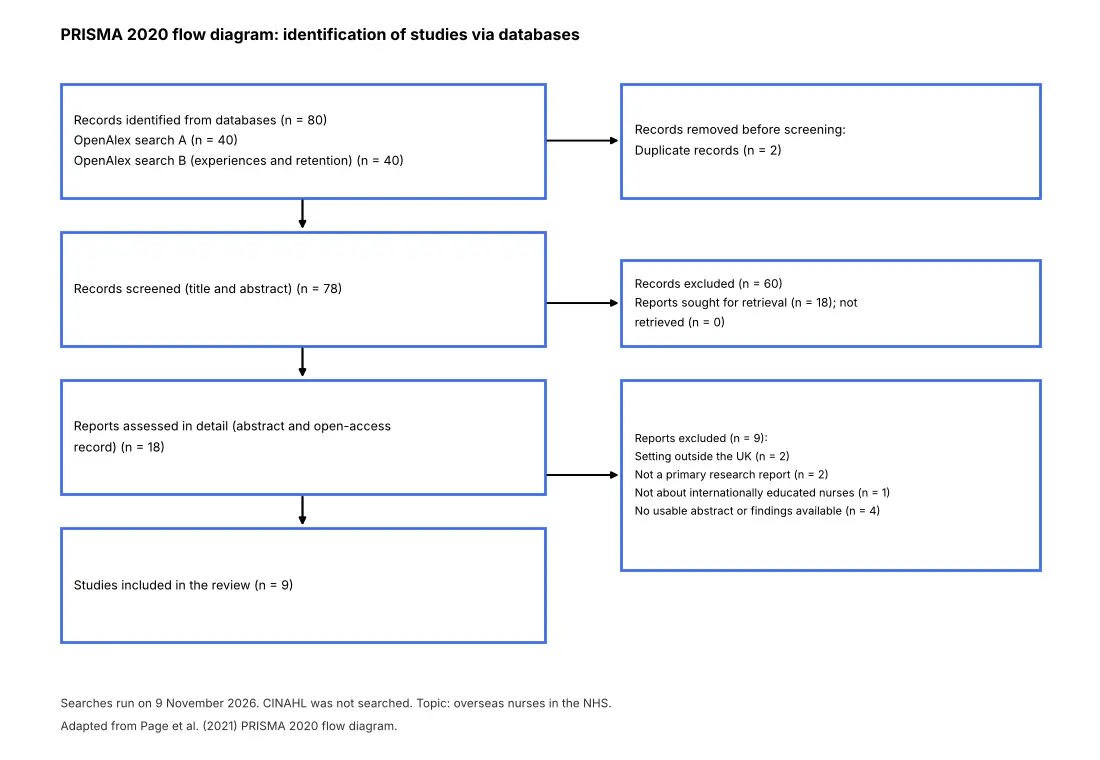
This literature-based dissertation is a structured review of published primary research on overseas nurses in the NHS. It aims to be transparent and reproducible, but it is smaller in scope than a full systematic review, which would normally involve several reviewers, many more databases and exhaustive searching (Aveyard, 2023). The review is reported with reference to the PRISMA 2020 statement, which lists the items that should be described and recommends a flow diagram showing how records move through identification, screening and inclusion (Page et al., 2021). Appendix D presents that flow diagram, Appendix A records each search string, Appendix B tabulates the included studies and Appendix C gives a worked critical appraisal. Together, the appendices allow another reader to check each decision and to repeat the process.
The review question was framed using the Population, Exposure and Outcome (PEO) structure, which suits questions about experiences and influencing factors rather than the effects of a treatment. The population was internationally educated nurses working in or recruited to NHS services in the UK, together with the organisations that recruit and support them. The exposures were the recruitment, registration, support and workplace conditions they met, and the outcomes were their experiences, integration, progression and retention. Structured frameworks help to translate a broad topic into searchable concepts, although the choice of framework affects how sensitive a search is (Methley et al., 2014; Aveyard, 2023). Because the evidence included surveys, interviews, administrative data and requests for information, qualitative, quantitative and mixed-methods research was eligible for inclusion.
Two searches were run on 9 November 2026 in OpenAlex, an open index of scholarly works that covers a large and growing proportion of the published literature (Priem et al., 2022). The first search used the words overseas nurses NHS. The second combined the words internationally educated, nurses, experiences, integration, support and retention, to capture experience after arrival. Both searches were limited to open-access records published between 2015 and 2026 with at least one author affiliated to a UK institution. Both searches were restricted to journal articles. Combining more than one source is advised because a single database misses relevant studies (Bramer et al., 2017). The exact strings and settings are given in Appendix A.
CINAHL, the main nursing database, could not be accessed, and a planned search of MEDLINE through Europe PMC was not completed because the service refused repeated requests on the day of searching. The second OpenAlex search was therefore used in its place. These gaps mean that some relevant nursing studies may not have been found, a risk that is well recognised when the combination of databases is restricted (Bramer et al., 2017). OpenAlex matches terms anywhere in the text, so many records were not relevant. It also ranks records by relevance, and the two searches matched 1,054 and 603 records. Only the first 40 records of the first search and the first 40 of the second, 80 in total, were screened, so the review should be read as a structured sample of the literature and not as a complete search (Aveyard, 2023).
Studies were eligible if they involved internationally educated or overseas nurses recruited to or working in NHS settings in the UK, or the organisations that recruit them, and examined recruitment, support, experiences, progression or retention. Reports had to be peer-reviewed, written in English, open access and published from 2015 onwards. UK origin was judged from the stated setting and, where the abstract did not name one, from author affiliations. Reviews, position papers, commentaries, projects without reported findings, studies of other professions or of ethnic minority staff in general, and studies set outside the UK were excluded. Clear criteria applied consistently reduce selection bias and allow the decisions to be audited. The extraction table is presented in Appendix B so that readers can compare studies at a glance (Page et al., 2021; Aveyard, 2023).
All 80 records were exported into a screening log, and 2 duplicates were removed, leaving 78 titles to screen. Titles that clearly described other professions, medical graduates, ethnic minority staff in general, NHS history, policy commentary, other countries or unrelated topics were excluded at this stage. That left 18 reports for closer assessment against the criteria. The abstract and open-access record of each of these reports were read, and the reason for every exclusion was recorded. The log lists every record by its identifier, the search in which it appeared and the decision reached, so that each exclusion can be traced. Nine studies met the criteria, and the numbers at each stage reconcile in the flow diagram (Page et al., 2021). Screening was carried out by one reviewer, which is a recognised limitation of student reviews because a second reviewer would normally check each decision (Aveyard, 2023).
Quality was considered using the Critical Appraisal Skills Programme checklists, which ask structured questions about the aims, design, conduct, results and value of a study (CASP, 2024). The qualitative checklist was completed in full for the interview phase of one mixed-methods study, as a worked example in Appendix C, and indicative quality notes for every study are recorded in Appendix B. Those notes are based on the abstract and, for one study, the open full text, so they are judgements of reporting and not a full audit of how the research was conducted. No study was excluded on quality alone, since appraisal was used to weigh the strength of the findings, which is a common approach in nursing reviews (Aveyard, 2023).
Data were extracted into a standard table covering aims, design, sample, setting, methods, findings and limitations. Numerical results were copied as reported and were not recalculated, and extraction was rechecked once against the source records, a step that reduces transcription errors but does not replace independent checking. Findings were grouped into themes by thematic synthesis, with the survey, administrative-data and recruitment results reported alongside the qualitative themes because the review combined studies of different designs (Thomas and Harden, 2008; Braun and Clarke, 2006). The review used published data only and involved no participants, so ethical approval was not required, although the findings of the included studies are reported accurately and with full attribution (Aveyard, 2023).
Findings
Nine UK studies met the inclusion criteria, published between 2020 and 2026 and set in UK health services. One analysed Freedom of Information requests to NHS trusts (Gillin and Smith, 2020), one used interviews with Portuguese nurses (Leone et al., 2020) and one explored belonging after the 2016 EU referendum (Spiliopoulos and Timmons, 2023). The others used surveys or mixed methods to study integration, registration, speaking up, the experiences of Filipino nurses and career progression. Each is described below, and the section ends with the quality and limits of the evidence. Three of the reports share a lead author, so they are not necessarily independent.
Recruitment and the first years in the NHS
A Freedom of Information study of 19 acute NHS trusts in England traced their involvement in overseas nurse recruitment from 1998 onward. It found a shift away from active recruitment in the European Union towards countries such as the Philippines and India, which trusts explained by diminishing returns from EU sources, high attrition among EU-recruited nurses and the introduction of English language tests for EU nurses in 2016. Trusts increasingly used direct methods that needed fewer resources and relied more on private recruitment companies (Gillin and Smith, 2020). In 27 interviews, Portuguese nurses working in the English NHS rated their overall experience positively, citing professional achievements and personal support, and some had overcome homesickness (Leone et al., 2020).
Two surveys from one research group described the early years. Among 655 internationally recruited nurses who had recently started work in England, career development and an improved quality of life were the main motivations, and most felt well supported on arrival. However, many faced fluctuating appointment levels and posts that did not match their experience or prior qualifications, and qualitative comments showed that these difficulties could affect mental well-being (Pressley et al., 2023a). A second survey of 773 international nurses in England, collected in 2022, identified recognition of prior professional skills and experience as integral to integration, with induction, career development systems and line managers also important (Pressley et al., 2024).
The second survey also described barriers outside the workplace. Communication barriers were common, participants often had limited time and incomplete insight into human resource policies, and many were dissatisfied with the cost of living, housing and social support in England. Mental well-being scores differed by country of origin, and nurses who had chosen to migrate reported significantly higher scores (Pressley et al., 2024). A descriptive survey of 26 Filipino nurses in the medical and surgical departments of one hospital found that overall experience was positive (grand mean 3.16), that the workplace environment scored highest (mean 3.29) and that cultural adaptation scored lowest (mean 3.08) (Vargas et al., 2026). Taken together, the two surveys describe nurses who were motivated and mostly well supported at first but who met problems with recognition, communication and the cost of living.
Registration, belonging and voice
Registration was a barrier for some. A mixed-methods study surveyed 857 overseas-educated nurses working as unregistered practitioners and interviewed five, and described nurses who worked as health care assistants or support workers for lower pay, with no route to advancement and challenges in registering. The authors concluded that these nurses were caught in a downward occupational spiral and returned to novice status (Davis and Pradeep, 2024). Belonging was also threatened by wider events. EU and non-EU nurses described feeling unwelcomed and unsettled after the 2016 EU referendum, at work and in wider life, and the study argued that Brexit exposed long-standing structural inequalities that disempower migrant healthcare workers (Spiliopoulos and Timmons, 2023).
A survey of overseas trained nurses in the NHS used the CWEQ-2 questionnaire and two vignettes to examine structural empowerment and speaking up. Nurses perceived moderate empowerment in access to opportunity (mean 4.05) and access to information (mean 3.52), and lower empowerment in access to resources (mean 3.04) and support (mean 3.49). Some 95.8% reported high willingness to speak up, and access to opportunity positively influenced speaking up. The authors pointed to inadequate support, including feedback and guidance from co-workers, and to limited resources (Mattukoyya et al., 2025). These concerns echo the finding that induction processes and line managers could be improved (Pressley et al., 2024).
Progression and retention of overseas nurses in the NHS
Progression data came from banding records for 611,912 nurses in England between 2014 and 2021, of whom 496,741 (81.2%) were domestic and 115,171 (18.8%) were international. Among nurses at Band 5, progression was recorded for 43.8% of domestic nurses and 24.4% of international nurses, and the median time to progress was 5.8 years for domestic nurses and 6.8 years for international nurses. Differences were smaller at higher bands, and nurse status was the only nurse-level variable recorded, so age, sex and other factors could not be controlled for (Pressley et al., 2023b). Posts that did not match qualifications, which many recent arrivals reported, could plausibly slow progression (Pressley et al., 2023a).
Interviews with 21 international nurses who had worked in the NHS for at least five years, from India, the Philippines, Spain, Zambia, Romania and Italy, identified three themes before progression: being seen and recognised as able to thrive, not being overlooked, and being embraced as someone still learning. Barriers included feeling an outsider, a lack of international role models, unfamiliar progression processes and unclear interview feedback, whereas supportive managers and mentors, psychologically safe teams and clear feedback helped. After progression, nurses described using power to influence, breaking down barriers and leading and inspiring others (Pressley et al., 2023b). Line managers were also key in the larger survey (Pressley et al., 2024).
Patterns across the studies
Three patterns ran through the studies. First, recruitment was shaped by policy and the market, with trusts shifting their sources and methods as conditions changed (Gillin and Smith, 2020). Second, support and recognition mattered for integration and mental well-being, because posts that did not match experience caused difficulty (Pressley et al., 2023a). Third, structural barriers affected status and progression, from registration pathways to slower promotion (Davis and Pradeep, 2024). Together, these patterns suggest that the experiences of overseas nurses in the NHS depend on organisations and systems as well as on individual nurses, although the evidence is mostly survey based and descriptive.
Differences between source countries and settings also ran through the evidence. Portuguese nurses from the EU rated their experience positively (Leone et al., 2020), whereas EU and non-EU nurses described feeling unwelcomed after the referendum (Spiliopoulos and Timmons, 2023), and Filipino nurses in one hospital scored cultural adaptation lowest (Vargas et al., 2026). These contrasts suggest that the same recruitment policy can produce different experiences depending on the country of origin, the date and the place of work. They also show why the studies cannot be pooled into a single estimate, and why this review reports them side by side.
Quality and limits of the evidence
Several limits qualify these findings. Most studies were surveys or cross-sectional analyses, so they describe experience at one time and cannot show how it changes or whether the problems described persist (Pressley et al., 2023a). Samples were often selected, such as 26 Filipino nurses in one hospital, so they may not represent nurses from other countries or trusts (Vargas et al., 2026). The Portuguese nurses were interviewed in 2015 and 2016, so their experience may not reflect the NHS of today (Leone et al., 2020). Findings from one source country cannot be assumed to apply to nurses from other countries.
The appraisal in Appendix B is based on abstracts for eight studies, so it is indicative and not a full audit. The worked appraisal in Appendix C shows that even a well-reported mixed-methods study had gaps: the paper gave different numbers of interviewees in the methods (22) and the results (21), did not describe the interviewer or the recording, did not state the position of the researchers and gave no ethics approval reference, and Band 5 nurses were under-represented among the interviewees (Pressley et al., 2023b). The abstract of the study of speaking up did not report the sample size (Mattukoyya et al., 2025).
The studies also overlap. Two of the reports by Pressley and colleagues share a lead author, so they may describe overlapping samples and their agreement is not necessarily independent (Pressley et al., 2023a; Pressley et al., 2024). The abstract of the study of unregistered nurses did not name the host country, so UK origin was judged from author affiliations (Davis and Pradeep, 2024). Each report therefore needs to be read with care. These limits do not make the evidence unusable, but no single result should carry too much weight, and no design gives a complete picture of the experiences of overseas nurses in the NHS.
Wider Discussion
The findings suggest that the experience of overseas nurses in the NHS depends on the organisation as much as on the individual nurse. Nurses were motivated by career development and quality of life, yet many found posts that did not match their experience (Pressley et al., 2023a), and progression from Band 5 was slower and less frequent than for domestic nurses (Pressley et al., 2023b). This fits the register data showing rising numbers of international leavers (NMC, 2024). None of these sources proves that treatment at work explains leaving, but together they support attention to recognition of prior experience, to induction and to fair progression. Such attention costs little compared with the cost of replacing nurses who leave, and the steps are practical ones that could be taken locally.
Registration and belonging are matters of equity as well as workforce supply. Nurses working as unregistered practitioners were caught in a downward occupational spiral (Davis and Pradeep, 2024), and migrant nurses described feeling unwelcomed after the 2016 referendum (Spiliopoulos and Timmons, 2023). The WHO expert group asked destination countries to commit funds to support countries with workforce shortages (WHO, 2023), and the same ethical reasoning suggests that the NHS owes fair treatment to those who arrive, which is a question of fairness as well as of retention. A stable workforce also matters for long-term conditions, because community nursing for diabetic foot ulcers depends on enough staff with the right skills.
Three priorities follow for practice. First, employers can recognise prior skills and match posts to qualifications, since mismatch was reported by many recent arrivals (Pressley et al., 2023a). Second, teams can strengthen support, feedback and mentoring, because access to support scored lower than access to opportunity in the speaking up survey (Mattukoyya et al., 2025) and supportive managers and mentors helped progression (Pressley et al., 2023b). Third, organisations can make progression processes transparent, since nurses described unfamiliar processes and unclear interview feedback (Pressley et al., 2023b). None of these needs new evidence, but each needs managers who protect the time to do it. This is an agenda for employers, managers and teams.
Several limitations qualify these conclusions. Only OpenAlex was searched, in two searches, CINAHL was not accessible and a planned search of MEDLINE through Europe PMC was not completed, so relevant nursing studies may have been missed (Bramer et al., 2017). Only the first 40 records of each search were screened, and one reviewer made all decisions, which is a recognised limitation of student reviews (Aveyard, 2023). Most appraisal relied on abstracts, no study followed nurses over time, and studies from other countries were excluded, so the conclusions are offered as a structured sample of the evidence and not as a complete account. The review also cannot say whether the studies reflect all trusts or all source countries. The findings should be applied with care in services unlike those studied.
Reflection
I began this review thinking that the experiences of overseas nurses in the NHS would be mostly about adapting to a new health system. The studies showed otherwise, and that was an uncomfortable realisation. Nurses described being overlooked for promotion, working below their qualifications and feeling unwelcome in wider life, and these were problems of organisations and policy more than of individual adjustment. That changed how I think about the teams I join, because in most wards and community teams I am likely to work with colleagues who trained abroad. I became more aware that I have rarely asked what they need or what they bring with them.
The search was harder than I expected. Several relevant UK studies, including two qualitative studies by the same authors on Filipino nurses and one service-improvement project on retention, had no abstract or no findings in the record, so I could not judge them, and I excluded them for that reason. A study from Saudi Arabia and a programme run in India were also left out under the UK rule. Writing down each decision was slow, but it showed me that a review can lose useful evidence simply because of how records are indexed. Next time I will plan to retrieve full texts when abstracts are missing.
Appraising the study of career progression was the most instructive part of the work. The authors combined records on more than 600,000 nurses with 21 interviews, which I found impressive, yet the paper gave 22 interviewees in one place and 21 in another and did not describe the position of the researchers. I had assumed that a large data set would be more reliable than a small interview study. Instead I saw that large numbers can hide small reporting errors, and I realised that I trust numbers more readily than words. This made me more careful about checking numbers against each other. I now try to ask what was done before I ask what was found, and next time I will agree my appraisal approach in advance.
In practice, I will ask internationally educated colleagues what support they would find useful, and I will not assume that a nurse who is new to the NHS is new to nursing. I will also pay attention to how newcomers are included in teams, because several studies suggested that feeling unseen or overlooked shaped progression. I need to improve my skills in finding full texts and in reading statistical tables, since I found the progression models hard to follow. I also want to learn more about the countries that nurses leave, because the ethics of recruitment matter to me. These goals are modest, but they are within the reach of any nurse working in an NHS team. They are also goals that I can check at the end of each placement.
Conclusion
This dissertation set out to review UK evidence on the recruitment, support, experiences, progression and retention of overseas nurses in the NHS. Nine UK studies, comprising an analysis of recruitment by NHS trusts, surveys and mixed-methods studies of integration and registration, an interview study, a study of belonging after the 2016 referendum and an analysis of career progression, showed that trusts shifted their recruitment sources, that many recent arrivals felt supported but met posts that did not match their experience, and that international nurses progressed more slowly than domestic nurses.
Nurses working as unregistered practitioners faced a downward occupational spiral, migrant nurses felt unwelcomed after the referendum, and access to support and resources was perceived as lower than access to opportunity. These results come from surveys, administrative data and small qualitative samples and do not prove cause, but they agree in pointing to recognition, support and fair progression. Taken together, the studies show that the experiences of overseas nurses in the NHS depend on organisations and systems as well as on individuals. Their value lies in showing where employers can act, and not in proving that one model is best.
For nursing practice, the review supports recognising prior skills and matching posts to qualifications, strengthening support, feedback and mentoring, and making progression processes transparent. The strength of this evidence is limited by the restricted search, single-reviewer screening and reliance on abstracts, so the conclusions are best treated as a well-founded starting point and not as a final answer. Further research that follows nurses over time and compares their retention across trusts would show which approaches work best. These recommendations are within the reach of employers and teams, although they need support from senior managers. Employers who act on these points may also improve the retention of overseas nurses in the NHS, which the workforce plan treats as important.
Reference List
Aveyard, H. (2023) Doing a literature review in health and social care: a practical guide. 5th edn. Open University Press.
Bramer, W.M. et al. (2017) ‘Optimal database combinations for literature searches in systematic reviews: a prospective exploratory study’, Systematic Reviews, 6, article 245. doi:10.1186/s13643-017-0644-y.
Braun, V. and Clarke, V. (2006) ‘Using thematic analysis in psychology’, Qualitative Research in Psychology, 3(2), pp. 77-101. doi:10.1191/1478088706qp063oa.
CASP (2024) CASP checklists. Oxford: Critical Appraisal Skills Programme. Available at: https://casp-uk.net/casp-checklists/ (Accessed: 9 November 2026).
Davis, D.D. and Pradeep, A. (2024) ‘Stripped of their professional status: overseas educated nurses working as unregistered practitioners in their host country’, Contemporary Nurse, 60(4), pp. 409-419. doi:10.1080/10376178.2024.2372358.
Gillin, N. and Smith, D.C. (2020) ‘Overseas recruitment activities of NHS Trusts 2015-2018: findings from FOI requests to 19 acute NHS Trusts in England’, Nursing Inquiry, 27(1), article e12320. doi:10.1111/nin.12320.
Leone, C. et al. (2020) ‘Experience of mobile nursing workforce from Portugal to the NHS in UK: influence of institutions and actors at the system, organization and individual levels’, European Journal of Public Health, 30(Supplement 4), pp. iv18-iv21. doi:10.1093/eurpub/ckaa129.
Mattukoyya, R., Knight-Davidson, P. and Ubah, C.I. (2025) ‘Structural empowerment and speaking up among overseas trained nurses in the United Kingdom, National Health Service’, Science Talks, 15, article 100472. doi:10.1016/j.sctalk.2025.100472.
Methley, A.M. et al. (2014) ‘PICO, PICOS and SPIDER: a comparison study of specificity and sensitivity in three search tools for qualitative systematic reviews’, BMC Health Services Research, 14, article 579. doi:10.1186/s12913-014-0579-0.
NHS England (2023) NHS Long Term Workforce Plan. London: NHS England. Available at: https://www.england.nhs.uk/long-read/nhs-long-term-workforce-plan-2/ (Accessed: 9 November 2026).
Nursing and Midwifery Council (NMC) (2018) The Code: professional standards of practice and behaviour for nurses, midwives and nursing associates. London: NMC. Available at: https://www.nmc.org.uk/standards/code/ (Accessed: 9 November 2026).
Nursing and Midwifery Council (NMC) (2024) Nursing and midwifery register grows but pace of international nurse recruitment slows. News release, 2 December 2024. Available at: https://nmc.org.uk/news/news-and-updates/nursing-and-midwifery-register-grows-but-pace-of-international-nurse-recruitment-slows (Accessed: 9 November 2026).
Page, M.J. et al. (2021) ‘The PRISMA 2020 statement: an updated guideline for reporting systematic reviews’, BMJ, 372, article n71. doi:10.1136/bmj.n71.
Pressley, C. et al. (2023a) ‘Internationally recruited nurses and their initial integration into the healthcare workforce: a mixed methods study’, International Journal of Nursing Studies Advances, 5, article 100154. doi:10.1016/j.ijnsa.2023.100154.
Pressley, C. et al. (2023b) ‘The long-term experiences and career progression of international nurses working in the health sector in England’, Clinical Nursing Studies, 11(1), p. 40. doi:10.5430/cns.v11n1p40.
Pressley, C. et al. (2024) ‘International nurse migration experience of the first two years: a mixed methods study’, Journal of Advanced Nursing, 81(5), pp. 2672-2686. doi:10.1111/jan.16543.
Priem, J., Piwowar, H. and Orr, R. (2022) ‘OpenAlex: a fully-open index of scholarly works, authors, venues, institutions, and concepts’, arXiv, 2205.01833. doi:10.48550/arXiv.2205.01833.
Spiliopoulos, G. and Timmons, S. (2023) ‘Migrant NHS nurses as “tolerated” citizens in post-Brexit Britain’, The Sociological Review, 71(1), pp. 183-200. doi:10.1177/00380261221092199.
Thomas, J. and Harden, A. (2008) ‘Methods for the thematic synthesis of qualitative research in systematic reviews’, BMC Medical Research Methodology, 8, article 45. doi:10.1186/1471-2288-8-45.
Vargas, J.O. et al. (2026) ‘Lived experiences of Filipino nurses working in the medical and surgical departments of Darlington Memorial Hospital, United Kingdom’, Buletin Ilmu Kebidanan dan Keperawatan, 5(1), pp. 40-49. doi:10.56741/bikk.v5i01.1164.
World Health Organization (WHO) (2023) WHO health workforce support and safeguards list 2023. Geneva: WHO. Available at: https://www.who.int/publications/i/item/9789240069787 (Accessed: 9 November 2026).
Appendix A: Search strategy
This appendix records the searches run for the overseas nurses in the NHS review so that the process can be repeated and checked.
Two searches on overseas nurses in the NHS were run on 9 November 2026 using the OpenAlex works API. The first 40 records of the first search and the first 40 of the second, ranked by relevance, were retrieved and screened by title and abstract.
| Database | Platform | Date run | Search string | Limiters | Hits |
|---|---|---|---|---|---|
| OpenAlex search A | OpenAlex API | 9 November 2026 | search=overseas nurses NHS | Filter: authorships.countries:GB; is_oa:true; publication_year:2015-2026; type:article. 1,054 matches in total; the first 40 by relevance were screened. | 40 |
| OpenAlex search B (experiences and retention) | OpenAlex API | 9 November 2026 | search=internationally educated nurses experiences integration support retention | Filter: authorships.countries:GB; is_oa:true; publication_year:2015-2026; type:article. 603 matches in total; the first 40 by relevance were screened. | 40 |
CINAHL could not be accessed and was not searched, so no CINAHL results are reported. A planned MEDLINE search through Europe PMC was attempted on the same day but the service refused repeated requests, so it was not completed for overseas nurses in the NHS; search B, which targeted experience after arrival, was used instead.
OpenAlex matches search terms in the title, abstract or full text, and the country filter matches any record with at least one author affiliated to a UK institution. UK setting and relevance were therefore checked for each study at the assessment stage. Records identified: 80 (40 + 40); duplicates removed: 2; records screened: 78.
Appendix B: Data extraction table
The table summarises each study included in this overseas nurses in the NHS review: its aim, design, sample, methods, key findings, limitations and relevance to overseas nurses in the NHS.
| Author / year / country | Aim | Design | Sample and setting | Methods | Key findings | Limitations / quality | Relevance to overseas nurses in the NHS |
|---|---|---|---|---|---|---|---|
| Gillin and Smith (2020), UK (19 acute NHS trusts in England) | To establish how far acute NHS trusts were involved in recruiting overseas nurses, from 1998 onward and in 2015 to 2018 in particular. | Analysis of responses to Freedom of Information requests. | 19 acute NHS trusts in England recruiting overseas nurses in the NHS. | Freedom of Information requests about the recruitment of overseas nurses in the NHS. | A shift from active EU recruitment towards the Philippines and India; reasons were diminishing returns, high attrition among EU-recruited nurses and English language tests from 2016; more direct methods and private recruitment companies. | Indicative (abstract only): trust-reported data; 19 trusts; says little about overseas nurses in the NHS themselves; design not named in the abstract; print year 2020 (online 2019). | Recruitment context for overseas nurses in the NHS. |
| Leone et al. (2020), UK (English NHS) | To examine how individual, organisational and system factors shape the migration experience, career plans and expectations of Portuguese nurses, a group of overseas nurses in the NHS. | Qualitative interview study. | 27 semi-structured interviews about overseas nurses in the NHS with staff at individual, organisational and policy levels (2015 to 2016). | Semi-structured interviews about Portuguese overseas nurses in the NHS. | Nurses rated their overall experience positively, citing professional achievements and personal support; some overcame homesickness; migration succeeded through interaction between institutions and actors at several levels. | Indicative (abstract only): design not named; one source country; data from 2015 to 2016; paper in a conference supplement about overseas nurses in the NHS. | Experience of EU-trained nurses in the NHS. |
| Pressley et al. (2023a), UK (England) | To examine why internationally recruited nurses migrate and how they settle into the English health system, to inform the retention of overseas nurses in the NHS. | Mixed-methods survey. | 655 internationally recruited nurses (overseas nurses in the NHS) who had recently started work in England. | Survey of demographics, motivations, application, arrival, workplace support and future plans, with qualitative comments from overseas nurses in the NHS. | Career development and quality of life were the main motivations; most felt well supported on arrival; many met fluctuating appointment levels and posts that did not match experience, which could affect mental well-being. | Indicative (abstract only): self-reported survey; recent arrivals only; shares a lead author with the other Pressley reports on overseas nurses in the NHS. | Early integration of overseas nurses in the NHS. |
| Pressley et al. (2023b), UK (NHS in England) | To compare the career progression of international and domestic nurses and to identify enablers and barriers for overseas nurses in the NHS. | Dual-phase mixed methods (banding analysis and interviews). | Banding records for 611,912 nurses (115,171 international); 21 interviews with international nurses with at least five years in the NHS. | Chi-squared and time-to-event analysis of banding records from 2014 to 2021; inductive thematic analysis of virtual interviews with overseas nurses in the NHS. | Median time to progress from Band 5 was 5.8 years for domestic and 6.8 years for international nurses; themes were being seen, not being overlooked and being embraced as learners; mentors and role models helped. | CASP qualitative appraisal in Appendix C (open full text). Nurse status was the only variable recorded; 21 or 22 interviewees reported; researcher position and ethics reference not stated; Band 5 under-represented among overseas nurses in the NHS. | Progression and retention of overseas nurses in the NHS. |
| Pressley et al. (2024), UK (England) | To explore the experience of the first two years for international nurses migrating to England, as a guide to supporting overseas nurses in the NHS. | Exploratory mixed-methods online survey. | 773 international nurses in England (2022), including overseas nurses in the NHS. | Online survey combining quantitative outcomes, including well-being scores, with qualitative analysis. | Recognition of prior skills was integral to integration; induction, career development and line managers could improve; communication barriers and concerns about housing and cost of living; well-being varied by country of origin and was higher for those who chose to migrate. | Indicative (abstract only): self-selected online respondents; self-reported; shares a lead author with the other Pressley reports on overseas nurses in the NHS. | Integration of overseas nurses in the NHS over two years. |
| Spiliopoulos and Timmons (2023), UK (NHS) | To examine how EU and non-EU nurses experienced the 2016 referendum and its aftermath, as a study of migrant nurses in the NHS. | Qualitative study of overseas nurses in the NHS using a situated intersectionality approach. | Not stated in the abstract; migrant nurses, including overseas nurses in the NHS. | Exploration of the lived experiences of overseas nurses in the NHS at work and in wider life; methods not stated in the abstract. | Nurses felt unwelcomed and unsettled; Brexit exposed long-standing structural inequalities that disempower migrant healthcare workers; implications for long-term settlement. | Indicative (abstract only): sample and methods not stated; post-referendum period only; print year 2023 (online 2022). | Belonging among overseas nurses in the NHS. |
| Davis and Pradeep (2024), UK (author affiliations) | To document the characteristics of, and challenges faced by, overseas-educated nurses working as unregistered practitioners. | Explanatory sequential mixed methods. | Survey of 857 unregistered nurses, not all overseas nurses in the NHS, and five in-depth interviews. | Survey followed by interviews, with triangulation of results from overseas nurses in the NHS and similar settings. | Many worked as health care assistants or support workers for lower pay with no route to advancement; challenges in registering; a downward occupational spiral; transition theory paradoxical. | Indicative (abstract only): host country not named, UK judged from author affiliations; five interviewees; not limited to NHS employers of overseas nurses. | Registration barriers for overseas nurses in the NHS. |
| Mattukoyya et al. (2025), UK (NHS) | To examine structural empowerment and willingness to speak up among overseas trained nurses in the NHS. | Survey with vignettes of overseas nurses in the NHS. | Overseas trained nurses in the NHS; number not stated in the abstract. | CWEQ-2 questionnaire and two hypothetical vignettes. | Moderate access to opportunity (mean 4.05) and information (3.52); lower access to resources (3.04) and support (3.49); 95.8% high willingness to speak up; opportunity positively influenced speaking up among overseas nurses in the NHS. | Indicative (abstract only): sample size not stated; self-reported; hypothetical vignettes. | Empowerment and voice of overseas nurses in the NHS. |
| Vargas et al. (2026), UK (Darlington Memorial Hospital) | To describe the lived experiences of Filipino nurses in medical and surgical departments of one hospital, as overseas nurses in the NHS. | Descriptive survey. | 26 Filipino nurses, overseas nurses in the NHS. | Self-developed, expert-validated questionnaire. | Overall experience positive (grand mean 3.16); workplace environment highest (3.29); cultural adaptation lowest (3.08); age and length of service were associated with aspects of experience of overseas nurses in the NHS. | Indicative (abstract only): one hospital; 26 nurses; self-developed instrument; one nationality. | Experience of Filipino overseas nurses in the NHS. |
Appendix C: Critical appraisal checklist
CASP qualitative studies checklist (CASP, 2024), completed for Pressley et al. (2023b), a study included in this overseas nurses in the NHS review. Answers: Yes, No or Can’t tell, each with a short justification.
| # | Question | Answer | Justification |
|---|---|---|---|
| Section A: Are the results valid? | |||
| 1 | Was there a clear statement of the aims of the research? | Yes | The aim is stated clearly: to explore the long-term experiences and career progression of international nurses working in the NHS in England and to compare their progression with that of domestic nurses. |
| 2 | Is a qualitative methodology appropriate? | Yes | A qualitative phase suits a question about experiences of progression, and it was integrated with a quantitative analysis of banding records for overseas nurses in the NHS. |
| 3 | Was the research design appropriate to address the aims of the research? | Yes | Individual virtual in-depth interviews suit the aim, although the justification for the design and the topic guide are not described in detail. |
| 4 | Was the recruitment strategy appropriate to the aims of the research? | Can’t tell | Invitations went by email through NHS England networks and purposive sampling targeted varied bands, roles and countries, but 21 or 22 nurses were interviewed (the paper gives both numbers) and Band 5 was under-represented among overseas nurses in the NHS. |
| 5 | Was the data collected in a way that addressed the research issue? | Can’t tell | Interviews were individual and virtual with nurses from India (12), the Philippines (3), Spain (2), Zambia (2), Romania (1) and Italy (1), but duration, interviewer and recording are not reported. |
| 6 | Has the relationship between researcher and participants been adequately considered? | No | The position of the researchers and their possible influence on what overseas nurses in the NHS said are not discussed. |
| Section B: What are the results? | |||
| 7 | Have ethical issues been taken into consideration? | Yes | The University of Huddersfield ethics committee approved the study, the Health Research Authority tool showed NHS approval was not needed and informed consent was obtained, although no reference number is given. |
| 8 | Was the data analysis sufficiently rigorous? | Can’t tell | For overseas nurses in the NHS, Braun and Clarke’s six-phase inductive thematic analysis with NVivo coding was used and themes were integrated with the numbers, but the coders are not identified and there was no member checking. |
| 9 | Is there a clear statement of findings? | Yes | Three themes before progression and three after are presented with pseudonymised quotations from overseas nurses in the NHS, and barriers and enablers for overseas nurses in the NHS are described. |
| Section C: Will the results help locally? | |||
| 10 | How valuable is the research? | Yes | The study shows that international nurses progressed more slowly (median 6.8 against 5.8 years from Band 5), states its limits and points to role models and empowerment. |
Appendix D: PRISMA flow diagram
This dissertation is a worked example that shows the structure and standard of a 5,000-word literature-based Independent Project. It is provided for learning and is not to be submitted as a student’s own work.