

The Role, Workload and Retention of General Practice Nurses in the UK: A Literature Review
 By Dr. Robertson Prime, Research Fellow
This dissertation is a worked example that shows the structure and standard of a 5,000-word literature-based Independent Project. It is provided for learning and is not to be submitted as a student’s own work.
Abstract
Background: Nurses in general practice have been the focus of national workforce planning, with concern about retirement, recruitment and workload. Less is known about how UK studies describe the role, workload and retention of practice nurses.
Aim: To critically review UK evidence on the role, workload and retention of practice nurses in general practice.
Methods: A structured literature review using the Population, Exposure and Outcome framework. OpenAlex was searched twice on 15 November 2026, because CINAHL could not be accessed and a planned MEDLINE search was not completed. The first 40 records of each search were screened: 80 records were identified, 77 screened after the removal of duplicates and 10 UK studies included. Quality was considered using Critical Appraisal Skills Programme questions, and findings were combined by thematic synthesis.
Findings: The included studies of practice nurses (n = 10) comprised interviews, focus groups, case studies, an ethnography, a scoping study and two surveys. Recognition and value were central to why nurses stayed or left, the role lacked a clear framework for education and progression, and new roles and national schemes changed workload in ways that nurses did not always find helpful.
Conclusions and implications for practice: For practice nurses, employers can protect supervision and support for new graduates, involve nurses in decisions about new roles and make career routes visible. The evidence is limited by the restricted search, single-reviewer screening, reliance on abstracts and the scarcity of studies that follow nurses over time.
Keywords: practice nurses; general practice nursing; nurse retention; adult nursing; literature review.
Brief at a glance
- Framework
- PEO
- Design
- Literature review (PEO)
- Studies included
- 10
- Field
- Adult Nursing
Introduction
Practice nurses are registered nurses who work in general practice, and their numbers, roles and workload have been the subject of national planning in England for some years. NHS England published a ten point action plan for general practice nursing in 2017 to improve recruitment, retention and return to practice (NHS England, 2017), and Health Education England published a workforce development plan earlier in the same year (HEE, 2017). Nurses in general practice also work alongside unregistered colleagues, as explored in healthcare support workers, and the Code of the Nursing and Midwifery Council applies to all of their practice (NMC, 2018). The aim of this review is to bring together UK research on how these changes are experienced by practice nurses themselves and by those who train and employ them. Their work is varied and often unseen by students who spend only a short time in a practice.
This dissertation reviews UK research on the role, workload and retention of practice nurses. A literature review suits the question because the evidence is scattered across interviews, focus groups, surveys and case studies, and a structured process makes each choice visible and open to challenge (Aveyard, 2023). National plans describe what should happen, whereas research can show how it is experienced (HEE, 2017). The review is limited to the UK so that its conclusions can be read against national policy and one professional code, and it includes qualitative, quantitative and mixed-methods studies. It asks how nurses in general practice describe their role and its development, what the evidence says about workload and the introduction of new roles, and which factors appear to keep nurses in general practice or to push them out. It then considers what this means for nursing practice and education.
Background and Justification
General practice nursing has been the subject of national workforce planning in England since 2016. The General Practice Forward View, published in 2016, pledged a major expansion of the primary care workforce, and the ten point action plan for general practice nursing describes the nursing element of that commitment, supported by an investment of £15 million (NHS England, 2017). Health Education England published its own workforce development plan, Recognise, Rethink, Reform, in 2017 to explore the challenges facing the workforce and to recommend ways of supporting it (HEE, 2017). Both documents were written for England, so the policy context for practice nurses in the other UK nations may differ. Nurses in general practice also work in a service that differs in organisation and funding from hospitals, which affects how national plans reach them.
The plan drew on research commissioned by NHS England from Ipsos MORI, which used focus groups to examine the recruitment, retention and return of nurses to general practice. The plan reported that a third of the nurses involved expressed an intention to retire by 2020, and it set this against a national headcount of 23,100 nurses in general practice in 2016 (NHS England, 2017). The plan of Health Education England likewise treated retention and expansion of the workforce as linked, and it identified improving the training available in practice settings and raising the profile of the role as keys to both (HEE, 2017). Retirement intentions are only one source of loss, because nurses may also leave to work in other settings or outside the NHS. Retention is therefore a matter of national policy as well as individual career decisions.
The ten actions in the plan include supporting return to work schemes for nurses, improving the training capacity of general practice, increasing pre-registration nurse placements, enhancing retention and developing a career pathway for general practice nurses and healthcare support workers (NHS England, 2017). Delivery of the plan at local level was to be supported by four regional delivery boards, and each action depends on local employers acting on it (NHS England, 2017). These actions assume that nurses can be supervised, supported and developed in a service that is organised differently from hospital wards, and that those who supervise have time to do so. The Code requires nurses to make sure that anyone to whom they delegate is adequately supervised and supported (NMC, 2018).
The workforce plan of Health Education England puts forward a range of recommendations to support and develop the workforce and to help nurses make effective career choices (HEE, 2017). The Code applies equally to nurses in general practice and elsewhere, and it asks them to recognise and work within the limits of their competence and to finish the necessary training before starting a new role (NMC, 2018). When roles expand or tasks move into general practice, these duties raise questions about preparation, supervision and workload that a review of the evidence can examine, because policy documents describe intentions and do not show how nurses experience their work in practice. Training before a new role is a recurring theme in national documents and professional guidance, and it is a reasonable test of whether expansion is being managed safely.
Evidence on these questions is spread across interviews, surveys, case studies and workforce data, so a structured literature review can bring it together if it states its method and limits (Aveyard, 2023). Workforce questions rarely involve a single intervention with a single outcome, which makes a framework that separates the population, the exposure and the outcome a better fit than one built around a clinical treatment (Methley et al., 2014). That framework also keeps the review focused on the working lives of practice nurses and not on the clinical topics they happen to deliver. The COVID-19 pandemic also changed working conditions in primary care, as discussed in nurses during covid-19, so studies carried out during or after it need to be read with that context in mind.
This review therefore examines UK research on practice nurses against the policy context described above. It is limited to UK studies so that the findings can be read against the national plans and the Code of the Nursing and Midwifery Council (NHS England, 2017; NMC, 2018). It looks at three linked questions: how the role is described and developed, how workload is affected by changes in the workforce, and what the studies suggest about why nurses stay or leave. The Health Education England plan treats these questions as connected, and the review follows that approach (HEE, 2017). It does not assess the effectiveness of particular recruitment schemes, which would need different evidence.
Title, Aim and Objectives
What do UK studies show about the role, workload and retention of practice nurses working in general practice?
Title explained
The title names the focus on general practice nurses, the three aspects of their work that are reviewed (role, workload and retention), the UK boundary of the evidence and the literature review design that structures the whole work.
Aim
To critically review UK evidence on the role, workload and retention of practice nurses in general practice.
Objectives
- To identify and appraise UK research on nurses in general practice.
- To synthesise findings on role, workload and retention.
- To make recommendations for nursing practice.
Methodology
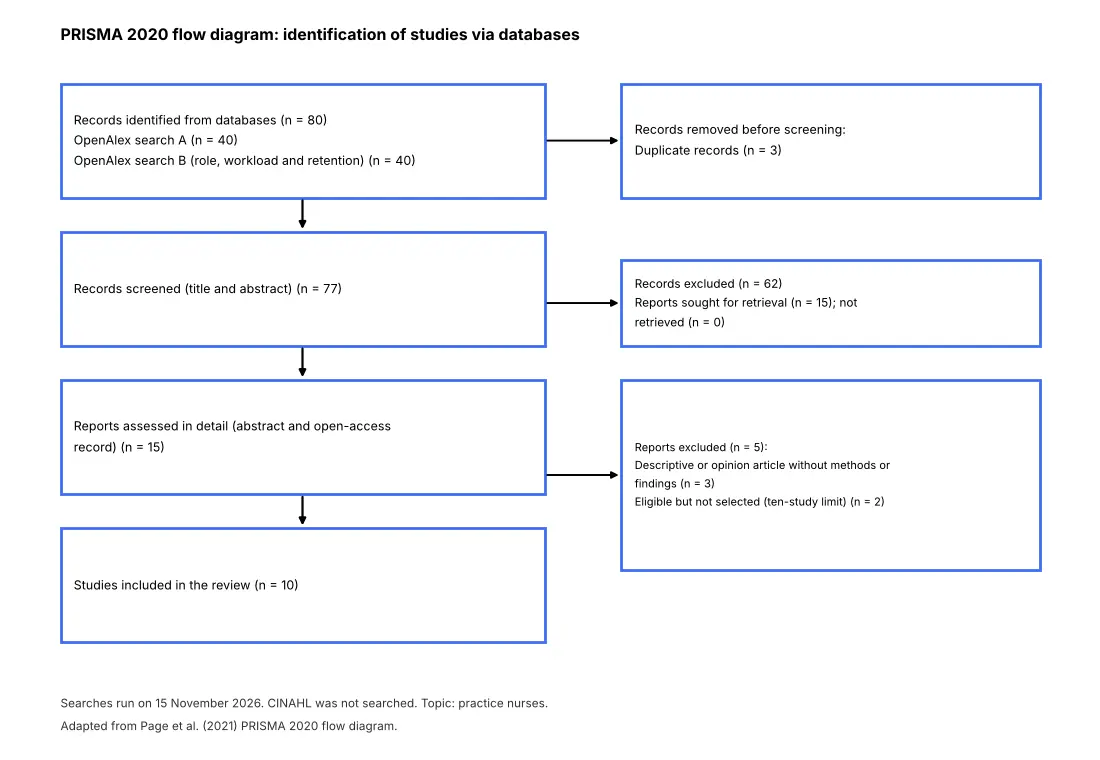
This literature-based dissertation is a structured review of published primary research on practice nurses. It aims to be transparent and reproducible, but it is smaller in scope than a full systematic review, which would normally involve several reviewers, many more databases and exhaustive searching (Aveyard, 2023). The review is reported with reference to the PRISMA 2020 statement, which lists the items that should be described and recommends a flow diagram showing how records move through identification, screening and inclusion (Page et al., 2021). Appendix D presents that flow diagram, Appendix A records each search string, Appendix B tabulates the included studies and Appendix C gives a worked critical appraisal. Together, the appendices allow another reader to check each decision and to repeat the process.
The review question was framed using the Population, Exposure and Outcome (PEO) structure, which suits questions about experiences and influencing factors rather than the effects of a treatment. The population was registered nurses working in general practice in the UK, including trainees and the nurse leaders who support them. The exposures were the role development, education, workforce initiatives and workplace conditions that shape their work, and the outcomes were their roles, workload, wellbeing, career intentions and retention. Structured frameworks help to translate a broad topic into searchable concepts, although the choice of framework affects how sensitive a search is (Methley et al., 2014; Aveyard, 2023). Because the evidence included interviews, focus groups, surveys, an ethnography and case studies, qualitative, quantitative and mixed-methods research was eligible for inclusion.
Two searches were run on 15 November 2026 in OpenAlex, an open index of scholarly works that covers a large and growing proportion of the published literature (Priem et al., 2022). The first search used the words practice nurses. The second combined the words general practice nurses, role, workload and retention, to bring studies of the workforce higher in the results. Both searches were limited to open-access records published between 2015 and 2026 with at least one author affiliated to a UK institution. Both searches were restricted to journal articles. Combining more than one source is advised because a single database misses relevant studies (Bramer et al., 2017). The exact strings and settings are given in Appendix A.
CINAHL, the main nursing database, could not be accessed, and a planned search of MEDLINE through Europe PMC was not completed because the service refused repeated requests on the day of searching. The second OpenAlex search was therefore used in its place. These gaps mean that some relevant nursing studies may not have been found, a risk that is well recognised when the combination of databases is restricted (Bramer et al., 2017). OpenAlex matches terms anywhere in the text, so many records were not relevant. It also ranks records by relevance, and the two searches matched 83,498 and 2,470 records. Only the first 40 records of the first search and the first 40 of the second, 80 in total, were screened, so the review should be read as a structured sample of the literature and not as a complete search (Aveyard, 2023).
Studies were eligible if they involved nurses working in general practice in the UK, or nursing students and trainees considering it, and examined their role, education, workload, wellbeing, career intentions or retention. Reports had to be peer-reviewed, written in English, open access and published from 2015 onwards. UK origin was judged from the stated setting and, where the abstract did not name one, from author affiliations. Reviews, protocols, descriptive or opinion articles without methods, studies of other professions or advanced practice generally, studies set outside the UK and reports without a usable abstract were excluded. Clear criteria applied consistently reduce selection bias and allow the decisions to be audited. The extraction table is presented in Appendix B so that readers can compare studies at a glance (Page et al., 2021; Aveyard, 2023).
All 80 records were exported into a screening log, and 3 duplicates were removed, leaving 77 titles to screen. Titles about other countries, advanced practice generally or other professions were excluded here, and where more than ten eligible studies existed, those most about role, workload and retention were preferred. That left 15 reports for closer assessment against the criteria. The abstract and open-access record of each of these reports were read, and the reason for every exclusion was recorded. The log lists every record by its identifier, the search in which it appeared and the decision reached, so that each exclusion can be traced. Ten studies met the criteria, and the numbers at each stage reconcile in the flow diagram (Page et al., 2021). Screening was carried out by one reviewer, which is a recognised limitation of student reviews because a second reviewer would normally check each decision (Aveyard, 2023).
Quality was considered using the Critical Appraisal Skills Programme checklists, which ask structured questions about the aims, design, conduct, results and value of a study (CASP, 2024). The qualitative checklist was completed in full for one interview study, as a worked example in Appendix C, and indicative quality notes for every study are recorded in Appendix B. Those notes are based on the abstract and, for one study, the open full text, so they are judgements of reporting and not a full audit of how the research was conducted. No study was excluded on quality alone, since appraisal was used to weigh the strength of the findings, which is a common approach in nursing reviews (Aveyard, 2023).
Data were extracted into a standard table covering aims, design, sample, setting, methods, findings and limitations. Numerical results were copied as reported and were not recalculated, and extraction was rechecked once against the source records, a step that reduces transcription errors but does not replace independent checking. Findings were grouped into themes by thematic synthesis, with the survey results reported alongside the qualitative themes because the review combined studies of different designs (Thomas and Harden, 2008; Braun and Clarke, 2006). The review used published data only and involved no participants, so ethical approval was not required, although the findings of the included studies are reported accurately and with full attribution (Aveyard, 2023).
Findings
Ten UK studies met the inclusion criteria, published between 2015 and 2025. Seven were qualitative, using interviews, focus groups, case studies or ethnography, one combined a survey with focus groups and a workshop, and two were surveys. Five examined the role and its development for practice nurses, one examined workload and the introduction of new roles, two examined wellbeing and retention, and two examined the recruitment of students and trainees. Each is described below, and the section ends with the quality and limits of the evidence. Because the studies differ in design, their results are reported side by side and not combined into one estimate (Procter et al., 2017; Leary et al., 2024).
Role, education and development
Across eight London Clinical Commissioning Groups, 272 nurses completed a survey, and focus groups (n = 34) and a workshop (n = 39) explored the education and support needs of nurses in general practice. Nurses reported a lack of career progression, role autonomy and a coherent framework, valued their relationship-centred care of patients over time and would welcome opportunities to develop their roles (Procter et al., 2017). A case study of six UK general practices, each including a nurse, a GP and a manager, found that education, culture, personal characteristics and empowerment shaped how the role developed, and that empowerment was central (Crossman et al., 2015). The two studies used different methods and came from different areas.
An ethnography in two rural UK practices examined how nurses use knowledge. Nurses took a blended approach that combined evidence-based practice with professional judgement, arrangements for sharing knowledge varied, and tensions existed between their position and their knowledge, so they were not always able to adapt knowledge to the needs of individual patients (Carrier, 2020). A qualitative study of clinical academic careers found that awareness was generally poor, that the pathway was seen as unclear and assumed to need a master’s qualification, and that employers needed to understand the value of such roles, which might help to retain nurses and to attract those newly qualified (Jones et al., 2021). Both studies suggest that education needs to be linked to everyday practice.
Workload and the introduction of new roles
A survey of 900 nurses in general practice drawn from the mailing list of the Queen’s Nursing Institute received 531 responses, a response rate of 60%, and examined the effect of the Additional Roles Reimbursement Scheme. Some effects were positive, such as reduced workloads when new roles worked within their original scope, but this was often offset by extra work, and many nurses reported a lack of resources, support, teaching and safety-netting. The authors concluded that the scheme had mostly negative impacts on workload and had introduced pay inequity (Leary et al., 2024). Interviews with 41 nurses also described the commodification of nursing and the growth of other roles (Anderson et al., 2025).
Time was also a theme in a study of nurses who delivered complex physical activity interventions in more than 1,400 consultations. Eleven nurses were interviewed individually and in groups, and five themes covered preparation and training, ongoing support, adherence to the protocol, materials and the engagement of participants. Nurses felt that taking part, especially in training in behaviour change techniques, improved the quality of their advice, although lack of time made this hard to sustain in routine consultations, and the authors concluded that effective delivery needs adequate training throughout (Beighton et al., 2015). Education needs were also a strong finding in London (Procter et al., 2017).
Retention, wellbeing and recruitment
A qualitative study of retention interviewed 41 members of nursing teams, including nurses who had left general practice and nurse leaders, across England and Wales between late 2023 and mid 2024. Recognition of the value of nurses was central to retention at all levels. Themes were the essence of practice, commodification and deprofessionalisation, opportunities for development, employment outside the NHS, lack of voice, precarity and lack of recourse, and tipping points that prompted exit (Anderson et al., 2025). The study was funded by a charitable trust and recruited through professional and social media networks. The same research team had earlier studied wellbeing during the pandemic and reported related concerns about recognition (Anderson et al., 2024).
The wellbeing study involved case studies at three general practice sites in England and national interviews with nurse leaders, with 40 participants and data collected during 2022. Most participants reported challenges to their wellbeing, including lack of recognition, feeling undervalued and little involvement in higher-level decisions, and some showed signs of burnout and stress. Many of these structural and cultural issues predated the pandemic but were worsened by it, and the study followed a reporting standard for qualitative research (Anderson et al., 2024). The concern with involvement echoes the case study in which empowerment was central to role development (Crossman et al., 2015).
Two studies examined recruitment. A survey of 1,120 undergraduate adult nursing students at one university received 462 responses (41%), and of the 90 who had a general practice placement, 92% viewed general practice nursing positively and 77% said it transformed their view of the role (Lewis et al., 2019). In a one-year vocational training scheme, 17 of 21 trainees approached joined four online focus groups over 12 months. They described difficulties finding graduate roles, expected to work effectively quickly and were concerned about supervision, support and long-term development (Lewis, 2023). Neither study reported outcomes after graduation, so actual career choices are unknown. The two studies came from the same region of England.
Patterns across the studies
Three patterns appeared across the studies. First, recognition and value were central to why nurses stayed or left (Anderson et al., 2025). Second, the role lacked a clear framework for education and progression in London (Procter et al., 2017). Third, new roles and national schemes altered workload in ways that nurses did not always find helpful (Leary et al., 2024). Most of the evidence on these patterns is qualitative and local, and it describes experience in depth without showing how common it is. Each pattern appeared in more than one study, which strengthens the case for treating them as real features of the work and not as local accidents, although the studies share some authors and settings.
Differences in perspective are also informative. Students who had a general practice placement viewed the role positively (Lewis et al., 2019), yet trainees worried about supervision and support after their programme (Lewis, 2023), and established nurses reported feeling undervalued (Anderson et al., 2024). These findings do not conflict. They suggest that the attractiveness of general practice nursing at the point of entry is not matched by conditions later in a career, and that recruitment and retention should be planned together and not as separate problems. The contrast matters for workforce planning, because a service that recruits well but retains poorly will not grow.
Quality and limits of the evidence
Several limits qualify these findings. Most studies were qualitative and relied on convenience, network or social media recruitment, so they describe experience in depth but cannot show how common it is. The trainee study used a convenience sample (Lewis, 2023), the retention study recruited through social media and professional networks (Anderson et al., 2025), and the student survey had a response rate of 41% (Lewis et al., 2019). Two reports came from one research team in York and two from one author in South Yorkshire, so their agreement is not necessarily independent. Studies of this kind are useful for generating ideas but cannot estimate how many nurses share a view.
The full-text appraisal in Appendix C of the retention study found a clear aim, a coherent qualitative rationale, ethical approval from a university committee, written consent, interviews of 45 to 90 minutes by one researcher, professional transcription and a framework analysis that sought negative cases (Anderson et al., 2025). Its weaknesses were that the number of nurses approached was not reported, no pilot or member checking was described, saturation was not clearly stated and one researcher coded the data. The other nine studies were appraised from abstracts only, so their quality notes in Appendix B are indicative and should not be read as full audits (Leary et al., 2024).
Design limits matter too. The survey of the new roles scheme cannot show change over time (Leary et al., 2024), the sample of the clinical academic careers study was unclear in the record (Jones et al., 2021), and the ethnography did not state its sample in the abstract (Carrier, 2020). Most studies were set in England, and none measured patient outcomes. Readers should keep these gaps in mind when using the results. Five further reports were assessed in detail and excluded, including three descriptive or opinion articles without methods and two eligible studies not selected under the ten-study limit, so relevant evidence may have been lost.
Wider Discussion
The findings suggest that role and recognition are linked for practice nurses. Nurses in London lacked a coherent framework for progression and wished to develop their roles (Procter et al., 2017), and case study evidence showed that empowerment shaped how the role developed (Crossman et al., 2015). National policy aimed to recognise and develop the roles of nurses in general practice (NHS England, 2017), but the retention interviews suggest that recognition in daily work, including voice and recourse, remains a central concern. None of these sources shows that a framework would improve retention, but together they support clearer routes for education and development. These findings agree even though they come from different methods. A framework agreed locally with nurses might be more credible than one imposed nationally.
Workload and retention also appear to be connected. The introduction of new roles reduced some workloads but added extra work, and nurses reported lack of support, teaching and safety-netting (Leary et al., 2024). Interviews linked the expansion of other roles to a sense of deprofessionalisation (Anderson et al., 2025). The workforce plan had argued that improving training in practice settings and raising the profile of the role were keys to retention (HEE, 2017). The evidence reviewed here suggests that a profile raised in policy may not reach the working day unless time and support are protected, and that new roles should be introduced with teaching and safety-netting. Where the profile of the role has risen, nurses still described little voice, which suggests that recognition needs to be practical and not only symbolic.
Three priorities follow for practice. First, employers can protect supervision and support for new graduates, since trainees worried about support after their programme (Lewis, 2023). Second, practices can involve nurses in decisions about new roles, because nurses felt they had little involvement in higher-level decisions and described devaluation (Anderson et al., 2024). Third, services can make career routes visible, including clinical academic routes (Jones et al., 2021). Nurses in general practice also lead the care of long-term conditions such as those described in chronic breathlessness, which makes protected time for development a patient safety matter for patients. Each priority is within the reach of local teams.
Several limitations qualify these conclusions. Only OpenAlex was searched, in two searches, CINAHL was not accessible and a planned search of MEDLINE through Europe PMC was not completed, so relevant nursing studies may have been missed (Bramer et al., 2017). Only the first 40 records of each search were screened, one reviewer made all decisions, and where more than ten eligible studies existed those most about role, workload and retention were preferred, which is a recognised limitation of student reviews (Aveyard, 2023). Appraisal relied on abstracts for nine studies and the evidence is mostly qualitative and local, so the conclusions are offered as a structured sample of the evidence and not as a complete account. A larger review with a second reviewer would reduce these risks.
Reflection
I began this review thinking that retention in general practice was mostly about pay and hours. The studies changed that view. Nurses described recognition, voice and the chance to develop as much as money, and trainees worried about support after their programme. I realised that my own placement in a general practice was short, and that I saw the nurse’s day but not the pressures behind it. I became more aware that a role can look settled from outside while feeling insecure to the person doing it, and that this affects how I ask colleagues about their work. I had not expected nurses to describe feeling so exposed in a role that looks stable from outside.
The search was harder than I expected. Several relevant UK papers about general practice nursing were descriptive articles without methods, and I excluded three of them because they gave no findings I could appraise. Two further studies, on immunisation and on health checks for people with intellectual disabilities, fitted the criteria, but I had to leave them out under the ten-study limit. I chose the studies that spoke most directly to role, workload and retention, and I tried to be fair about which ones I kept. That was uncomfortable, because each excluded paper had something to teach. I also noticed that I was tempted to keep the studies that confirmed my own expectations, and I had to check that I was not choosing them for that reason. Writing down each decision was slow, but it showed me how much a review depends on its rules, and next time I will agree them in advance.
Appraising the retention study was the most instructive part of the work. It had a clear aim, ethical approval and a careful description of its analysis, yet it did not report how many nurses had been approached, and one researcher coded all the data. I had assumed that a large qualitative study would use several coders, and I was surprised that the authors defended using one. I realised that I tend to trust a paper that sounds thorough, and that is a habit I need to change. I now try to ask what a paper leaves out before I ask what it found, and next time I will make that my first question.
In practice, I will ask nurses in general practice what support they have for new tasks before I assume that a role has been well planned, and I will ask about workload and not only about skills. I need to improve my skills in reading survey results, since the survey of new roles was hard to compare with the interviews, and I want to learn more about how general practices are organised. These goals are modest, but they are within the reach of any student nurse, and I will review them at the end of each placement with my practice supervisor. I will also ask how new nurses are supported when they start in a practice.
Conclusion
This dissertation set out to review UK evidence on the role, workload and retention of practice nurses. Ten UK studies, comprising interviews, focus groups, case studies, an ethnography, a scoping study and two surveys, showed that recognition and value were central to why nurses stayed or left, that the role lacked a clear framework for education and progression, and that new roles and national schemes changed workload in ways that nurses did not always find helpful. Together these findings describe a workforce that is valued in policy but not always supported in daily work.
These results come from small local studies and a few surveys and do not prove cause, but they agree in pointing to recognition, support and clear career routes. They also show that attracting people into general practice nursing is not the same as keeping them, since students and trainees were positive about the role while established nurses reported feeling undervalued. This matters because services cannot expand a workforce that they cannot keep. Their value lies in showing where employers and policy makers can act and not in proving that one approach is best. Even so, the pattern was consistent across settings. Local audit of turnover and reasons for leaving would be a practical first step.
For nursing practice, the review supports protecting supervision and support for new graduates, involving nurses in decisions about new roles and making career routes visible. The strength of this evidence is limited by the restricted search, single-reviewer screening and reliance on abstracts, so the conclusions are best treated as a well-founded starting point and not as a final answer. Further research that follows nurses over time and measures patient outcomes would show which approaches work best, and practices that act on these points may strengthen their own teams and the care of their patients.
Reference List
Anderson, H., Brady, L. and Adamson, J. (2025) ‘Exploring the relationship between cultural and structural workforce issues and retention of nurses in general practice (GenRet): a qualitative interview study’, BMC Primary Care, 26, article 114. doi:10.1186/s12875-025-02813-1.
Anderson, H. et al. (2024) ‘The well-being of nurses working in general practice during the COVID-19 pandemic: a qualitative study (the GenCo study)’, Journal of Advanced Nursing, 80(4), pp. 1574-1591. doi:10.1111/jan.15919.
Aveyard, H. (2023) Doing a literature review in health and social care: a practical guide. 5th edn. Open University Press.
Beighton, C. et al. (2015) ”It’s not just about walking…..it’s the practice nurse that makes it work’: a qualitative exploration of the views of practice nurses delivering complex physical activity interventions in primary care’, BMC Public Health, 15, article 1236. doi:10.1186/s12889-015-2568-6.
Bramer, W.M. et al. (2017) ‘Optimal database combinations for literature searches in systematic reviews: a prospective exploratory study’, Systematic Reviews, 6, article 245. doi:10.1186/s13643-017-0644-y.
Braun, V. and Clarke, V. (2006) ‘Using thematic analysis in psychology’, Qualitative Research in Psychology, 3(2), pp. 77-101. doi:10.1191/1478088706qp063oa.
Carrier, J. (2020) ‘An ethnographic exploration of the social organisation of general practice nurses’ knowledge use: more than ‘mindlines’?’, Journal of Research in Nursing, 25(6-7), pp. 604-615. doi:10.1177/1744987120937411.
CASP (2024) CASP checklists. Oxford: Critical Appraisal Skills Programme. Available at: https://casp-uk.net/casp-checklists/ (Accessed: 9 November 2026).
Crossman, S. et al. (2015) ‘A case study exploring employment factors affecting general practice nurse role development’, Primary Health Care Research and Development, 17(1), pp. 87-97. doi:10.1017/s1463423615000304.
Health Education England (HEE) (2017) The general practice nursing workforce development plan: Recognise, Rethink, Reform. London: HEE. Available at: https://www.hee.nhs.uk/sites/default/files/documents/The%20general%20practice%20nursing%20workforce%20development%20plan.pdf (Accessed: 15 November 2026).
Jones, S. et al. (2021) ‘Clinical academic careers for general practice nurses: a qualitative exploration of associated barriers and enablers’, Journal of Research in Nursing, 26(7), pp. 704-715. doi:10.1177/17449871211024323.
Leary, A. et al. (2024) ‘The impact of the introduction of the Additional Roles Reimbursement Scheme on the general practice nursing workforce in England’, Journal of Primary Care and Community Health, 15, article 21501319241298759. doi:10.1177/21501319241298759.
Lewis, R. (2023) ‘General practice nurse trainees’ perspectives on general practice nursing as a career choice: qualitative findings from a vocational training scheme in the United Kingdom (UK)’, BMC Family Practice, 24, article 216. doi:10.1186/s12875-023-02165-8.
Lewis, R., Ibbotson, R.E. and Kelly, S. (2019) ‘Student nurses’ career intentions following placements in general practice through the advanced training practices scheme (ATPS): findings from an online survey’, BMC Medical Education, 19, article 448. doi:10.1186/s12909-019-1880-8.
Methley, A.M. et al. (2014) ‘PICO, PICOS and SPIDER: a comparison study of specificity and sensitivity in three search tools for qualitative systematic reviews’, BMC Health Services Research, 14, article 579. doi:10.1186/s12913-014-0579-0.
NHS England (2017) General practice: developing confidence, capability and capacity: a ten point action plan for general practice nursing. London: NHS England. Available at: https://www.england.nhs.uk/wp-content/uploads/2018/01/general-practice-nursing-ten-point-plan-v17.pdf (Accessed: 15 November 2026).
Nursing and Midwifery Council (NMC) (2018) The Code: professional standards of practice and behaviour for nurses, midwives and nursing associates. London: NMC. Available at: https://www.nmc.org.uk/standards/code/ (Accessed: 15 November 2026).
Page, M.J. et al. (2021) ‘The PRISMA 2020 statement: an updated guideline for reporting systematic reviews’, BMJ, 372, article n71. doi:10.1136/bmj.n71.
Priem, J., Piwowar, H. and Orr, R. (2022) ‘OpenAlex: a fully-open index of scholarly works, authors, venues, institutions, and concepts’, arXiv, 2205.01833. doi:10.48550/arXiv.2205.01833.
Procter, S. et al. (2017) ‘Scoping the role and education needs of practice nurses in London’, Primary Health Care Research and Development, 18(4), pp. 316-332. doi:10.1017/s1463423617000093.
Thomas, J. and Harden, A. (2008) ‘Methods for the thematic synthesis of qualitative research in systematic reviews’, BMC Medical Research Methodology, 8, article 45. doi:10.1186/1471-2288-8-45.
Appendix A: Search strategy
This appendix records the searches run for the practice nurses review so that the process can be repeated and checked.
Two searches on practice nurses were run on 15 November 2026 using the OpenAlex works API. The first 40 records of the first search and the first 40 of the second, ranked by relevance, were retrieved and screened by title and abstract.
| Database | Platform | Date run | Search string | Limiters | Hits |
|---|---|---|---|---|---|
| OpenAlex search A | OpenAlex API | 15 November 2026 | search=practice nurses | Filter: authorships.countries:GB; is_oa:true; publication_year:2015-2026; type:article. 83,498 matches in total; the first 40 by relevance were screened. | 40 |
| OpenAlex search B (role, workload and retention) | OpenAlex API | 15 November 2026 | search=general practice nurses role workload retention | Filter: authorships.countries:GB; is_oa:true; publication_year:2015-2026; type:article. 2,470 matches in total; the first 40 by relevance were screened. | 40 |
CINAHL could not be accessed and was not searched, so no CINAHL results are reported. A planned MEDLINE search through Europe PMC was attempted on the same day but the service refused repeated requests, so it was not completed for practice nurses; search B, which targeted role, workload and retention, was used instead.
OpenAlex matches search terms in the title, abstract or full text, and the country filter matches any record with at least one author affiliated to a UK institution. UK setting and relevance were therefore checked for each study at the assessment stage. Records identified: 80 (40 + 40); duplicates removed: 3; records screened: 77.
Appendix B: Data extraction table
The table summarises each study included in this practice nurses review: its aim, design, sample, methods, key findings, limitations and relevance to practice nurses.
| Author / year / country | Aim | Design | Sample and setting | Methods | Key findings | Limitations / quality | Relevance to practice nurses |
|---|---|---|---|---|---|---|---|
| Crossman et al. (2015), UK (six general practices; affiliations) | To examine factors affecting the role development of practice nurses, given reports that nurses are disempowered and isolated. | Exploratory case study. | Six UK general practices; each case included a nurse, a GP and a manager. | Case study of employment factors in role development for practice nurses. | Education, culture, personal characteristics and empowerment shaped role development of practice nurses; empowerment was central; an empowering employment principles framework was proposed. | Indicative (abstract only): six practices; numbers of participants not stated; no limitations stated; practice nurses’ role only. | Role development of practice nurses. |
| Beighton et al. (2015), UK (London affiliations; primary care) | To explore the views of practice nurses delivering complex physical activity interventions in primary care. | Qualitative interview study alongside two trials. | 11 practice nurses in nurse groups (n = 4 and n = 5) and individually; more than 1,400 consultations delivered. | Semi-structured interviews by independent facilitators, audio-recorded, transcribed and analysed thematically. | Five themes: preparation and training, support, protocol adherence, materials and participant engagement; improved advice but lack of time in routine consultations. | Indicative (abstract only): nurses in two trials only; no limitations stated; role in delivering interventions rather than the whole role of practice nurses. | Workload and training of practice nurses. |
| Procter et al. (2017), UK (eight London CCGs) | To identify education priorities and the education, development and support needs of practice nurses across eight London Clinical Commissioning Groups. | Mixed-methods scoping study. | 272 survey respondents; three focus groups (n = 34); one workshop (n = 39). | Survey of educational attainment, focus groups and a workshop with practice nurses. | Practice nurses lacked career progression, role autonomy and a coherent framework; relationship-centred care valued; appetite for advanced education. | Indicative (abstract only): London only; self-selected respondents; no limitations stated; further evidence called for. | Role and education of practice nurses. |
| Lewis et al. (2019), UK (one English university) | To examine student nurses’ views of general practice placements and whether they affected intentions to work in general practice after graduating. | Online survey. | 1,120 undergraduate adult nursing students invited; 462 responded (41%); 90 had a placement. | Bespoke online survey; interviews also collected but only the survey is reported. | Of 90 with a placement, 92% viewed practice nurses’ work and general practice nursing general practice nursing positively and 77% said it transformed their view of the role. | Indicative (abstract only): one university; 41% response; self-reported intentions; limits not stated; recruitment into practice nurses’ roles. | Recruitment of practice nurses. |
| Carrier (2020), UK (two rural practices; Cardiff and Adelaide affiliations) | To explore the contextual, organisational and educational issues that affect how general practice nurses access and apply knowledge. | Ethnography. | Two rural UK practices; sample size not stated in the abstract. | Ethnographic methods in everyday practice of nurses in general practice. | Practice nurses made blended use of evidence and judgement; varied arrangements for sharing knowledge; tensions between position and knowledge; nurses not always able to adapt knowledge. | Indicative (abstract only): two practices; sample not stated; limits not stated; practice nurses’ knowledge use only. | Role and knowledge use of practice nurses. |
| Jones et al. (2021), UK (England) | To explore barriers and enablers to clinical academic careers for general practice nurses. | Qualitative interview and focus group study. | Sample unclear in the abstract record (n = 5 shown, but truncated). | Interviews and focus groups; verbatim transcripts analysed thematically. | Four themes: awareness, career pathway, personal and professional attributes, organisational factors; awareness poor and pathway unclear; may aid retention of practice nurses. | Indicative (abstract only): sample size unclear; no limitations stated; career routes for practice nurses. | Career development of practice nurses. |
| Lewis (2023), UK (South Yorkshire) | To explore the views of nurse trainees on general practice nursing as a career choice within a vocational training scheme. | Qualitative focus group study. | 21 trainees approached; 17 took part (convenience sample). | Four online focus groups over 12 months analysed with framework analysis. | Three themes: pathways into practice, learning to be a general practice nurse, and the future of the role; difficulty finding graduate roles; concern about support afterwards. | Indicative (abstract only): convenience sample; one scheme; no limitations stated; career choice of future practice nurses. | Recruitment and early careers of practice nurses. |
| Anderson et al. (2024), UK (England) | To understand how nurses in general practice experienced the COVID-19 pandemic and how it affected their wellbeing. | Exploratory qualitative study with case studies and interviews. | 40 participants: three general practice sites in England and national nurse leaders. | Data collected April to August 2022 and analysed with a framework on the wellbeing needs of nurses at work. | Practice nurses reported lack of recognition, feeling undervalued and little involvement in decisions; some burnout and stress; issues predated and were worsened by the pandemic. | Indicative (abstract only): no limitations stated; same team as the 2025 report; print year 2024 (online 2023); wellbeing of practice nurses. | Wellbeing and retention of practice nurses. |
| Leary et al. (2024), UK (England) | To understand the impact of the Additional Roles Reimbursement Scheme on the general practice nursing workforce. | Cross-sectional workforce survey. | 900 nurses from a Queen’s Nursing Institute mailing list invited; 531 responses (60%). | Pilot survey with descriptive statistics and content analysis on workload and roles of practice nurses. | Practice nurses reported some positive effects but mostly negative impacts on workload; lack of resources and support; devaluation; pay and opportunity inequity. | Indicative (abstract only): one mailing list; self-reported; no limitations stated; practice nurses’ workload. | Workload of practice nurses. |
| Anderson et al. (2025), UK (England and Wales) | To understand the cultural and structural factors that challenge the retention of nurses in general practice and what supports them to stay. | Exploratory qualitative interview study. | 41 members of nursing teams and nurse leaders in England and Wales. | Semi-structured interviews, October 2023 to June 2024, analysed by the framework approach. | Recognition of value was central to retention; six themes including commodification and deprofessionalisation, lack of voice and tipping points. | CASP qualitative appraisal in Appendix C (open full text). Recruitment numbers not reported; single coder; no member checking; social media recruitment of practice nurses. | Retention of practice nurses. |
Appendix C: Critical appraisal checklist
CASP qualitative studies checklist (CASP, 2024), completed for Anderson et al. (2025), a study included in this practice nurses review. Answers: Yes, No or Can’t tell, each with a short justification.
| # | Question | Answer | Justification |
|---|---|---|---|
| Section A: Are the results valid? | |||
| 1 | Was there a clear statement of the aims of the research? | Yes | The aim is stated clearly: to understand the cultural and structural factors that challenge the retention of nurses in general practice and to identify what supports them to stay. |
| 2 | Is a qualitative methodology appropriate? | Yes | A qualitative method suits a question about the effects of workplace culture and structure on retention, a topic with little earlier research, and the work is underpinned by a social constructionist perspective. |
| 3 | Was the research design appropriate to address the aims of the research? | Yes | An exploratory interview study with a framework approach suits the aim, and reporting followed COREQ, although the study of practice nurses did not use a pilot. |
| 4 | Was the recruitment strategy appropriate to the aims of the research? | Can’t tell | Recruitment used professional and social media networks and snowballing, with later purposive sampling for variation, and 41 people took part, but the number approached and the number who declined are not reported. |
| 5 | Was the data collected in a way that addressed the research issue? | Yes | Semi-structured interviews of 45 to 90 minutes were held by video or telephone at the participant’s convenience, used a topic guide, and were audio-recorded and transcribed verbatim by a professional service. |
| 6 | Has the relationship between researcher and participants been adequately considered? | Can’t tell | Two team members are nurses with general practice experience and the authors say this could influence the work, and they used team meetings and memos, but no formal positionality statement is given. |
| Section B: What are the results? | |||
| 7 | Have ethical issues been taken into consideration? | Yes | The University of York governance committee approved the study (reference HSRGC/2023/586/A), written consent was taken, data were pseudonymised and participants were thanked with a voucher. |
| 8 | Was the data analysis sufficiently rigorous? | Yes | The framework approach followed six steps with constant comparison and a search for negative cases, although one researcher coded all data, saturation is not clearly stated and member checking is not reported. |
| 9 | Is there a clear statement of findings? | Yes | Six themes are presented with illustrative quotations from nurses and leaders, and the findings address the aim for practice nurses. |
| Section C: Will the results help locally? | |||
| 10 | How valuable is the research? | Yes | The study adds to knowledge of the retention of nurses in general practice and states its limits (only nurses and leaders interviewed, social media recruitment, a single coder); it was funded by a charitable trust and declares no competing interests. |
Appendix D: PRISMA flow diagram
This dissertation is a worked example that shows the structure and standard of a 5,000-word literature-based Independent Project. It is provided for learning and is not to be submitted as a student’s own work.