

Critical theory: a clear, practical guide for research and writing
- Critical theory is a way of thinking that asks one main question: who benefits from the way society is organized, and who pays the costs.
- Critical theory treats social “common sense” as something that was built over time, not something that is naturally true.
- It focuses on power, inequality, and the everyday systems that shape people’s lives.
- It also focuses on change, not just description. It often asks what could be different, and how.
- In academic work, critical theory is used to analyze institutions, policies, language, media, workplaces, education, health systems, and technology.
What is critical theory?
- Critical theory is a theory that studies how power works in social life.
- It looks at who has authority and control, and how that control is maintained.
- It asks how rules, norms, and traditions shape what people think is “normal.”
- Critical theory argues that society is not neutral.
- Many systems are presented as objective, fair, or merit-based.
- Critical theory checks whether those claims hold up for different groups.
- Critical theory is not only about “ideas.”
- It connects ideas to real conditions, like wages, housing, policing, access to health care, or school discipline.
- It asks how these conditions shape opportunity and life outcomes.
- Critical theory often uses critique as a tool.
- Critique means carefully questioning assumptions and exposing hidden power relations.
- It does not mean criticizing for the sake of negativity. It means clarifying what is happening and why.
Where critical theory comes from
- Critical theory is strongly linked to twentieth-century European social philosophy.
- Early work is often associated with the Frankfurt School.
- Those scholars tried to explain why modern societies can produce both progress and oppression at the same time.
- Critical theory developed as a response to limits of “value-neutral” social science.
- Some research traditions aimed to describe society like a machine.
- Critical theory argued that this can hide injustice by treating it as “just how things are.”
- Critical theory also grew through later traditions.
- Feminist theory, postcolonial theory, critical race theory, disability studies, and queer theory all shaped the broader critical tradition.
- These approaches pushed scholarship to take lived experience and structural inequality seriously.
The central goal of critical theory
- Critical theory aims to reveal how domination and inequality become normal.
- It focuses on the gap between what society claims to value and what society actually does.
- For example, a system may claim to value “equal opportunity,” while practices produce unequal outcomes.
- Critical theory aims to support human freedom and dignity.
- It does not treat people as passive.
- It focuses on agency, resistance, and the possibility of transformation.
- Critical theory is often described as both explanatory and emancipatory.
- Explanatory: it tries to explain how power operates.
- Emancipatory: it aims to reduce harm and expand justice.
Core assumptions you should understand
- Power is built into structures, not only individual actions.
- Discrimination can exist even without “bad intentions.”
- Policies, routines, and institutional habits can still produce unfairness.
- Knowledge is shaped by context.
- What counts as “truth” can be influenced by who has status and voice.
- Some groups are treated as more credible than others.
- Language matters because it can shape reality.
- Words influence how problems are defined and what solutions seem “reasonable.”
- Labels can stigmatize groups or erase their experiences.
- Inequality is reproduced through everyday practices.
- Hiring criteria, grading systems, clinical pathways, surveillance tools, and workplace norms can all reproduce hierarchy.
- These processes often look neutral on the surface.
- Social change is possible, but not automatic.
- Critical theory studies both domination and resistance.
- It asks what conditions make change more likely.
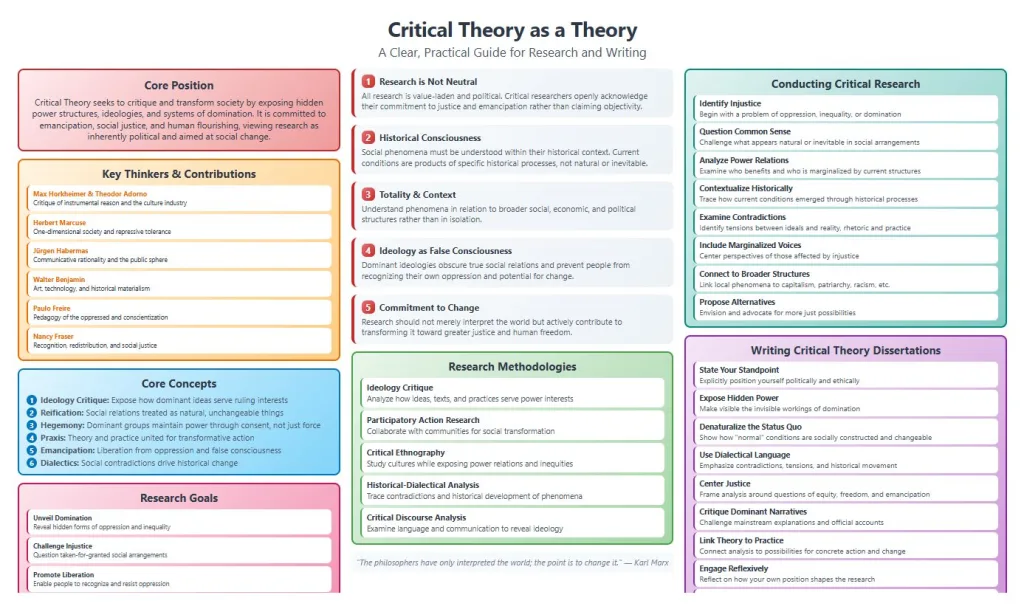
Key concepts explained in simple terms
- Ideology
- Ideology is a set of beliefs that makes unequal arrangements feel natural or inevitable.
- It can show up in slogans like “anyone can succeed if they work hard,” even when barriers are unequal.
- Critical theory examines which beliefs protect the status quo and why.
- Hegemony
- Hegemony is power that works through consent, not just force.
- People may accept unfair systems because they seem normal, moral, or “just the way it is.”
- Critical theory often asks how hegemony is built through schools, media, and culture.
- Domination and oppression
- Domination refers to patterns where some groups control resources, rules, and recognition.
- Oppression includes the harms that follow, such as exclusion, silencing, exploitation, or marginalization.
- Critical theory focuses on these patterns across institutions, not only interpersonal events.
- Social reproduction
- This means inequality can repeat itself across generations.
- For example, unequal schooling can lead to unequal jobs, which leads to unequal housing, which shapes future schooling.
- Critical theory traces these cycles and identifies leverage points for change.
- Intersectionality
- People do not experience inequality in only one way.
- Race, gender, social class, disability, migration status, and sexuality can interact.
- Critical theory often uses intersectionality to avoid oversimplified explanations.
- Emancipation
- Emancipation means reducing domination and expanding human capacity to live well.
- In research, this can mean producing knowledge that helps improve policies and practices.
- Critical theory treats emancipation as a serious research aim, not just a personal opinion.
What critical theory is not
- Critical theory is not the same as being politically “for” or “against” a party.
- It is a scholarly approach with concepts, claims, and methods.
- It can be applied carefully, with evidence.
- Critical theory is not only about criticizing individuals.
- It focuses on systems and structures.
- It asks how institutions shape behavior and outcomes.
- Critical theory is not automatically anti-science.
- It often critiques narrow ideas of objectivity.
- But it still values rigorous reasoning, transparency, and evidence.
How critical theory differs from other theories
- Compared with positivist approaches
- Positivist approaches often focus on measurement and prediction.
- Critical theory focuses on meaning, power, and the social conditions behind the numbers.
- It asks why a pattern exists and who is affected by it.
- Compared with interpretivist approaches
- Interpretivism often centers lived meaning and subjective experience.
- Critical theory also values experience, but it ties experience to structural forces. Use both, but do not stop at description.
- Compared with functionalist approaches
- Functionalism often sees institutions as serving social stability.
- Critical theory asks whether “stability” is being bought through injustice.
Typical research questions shaped by critical theory
- Who has decision-making power in this setting, and who does not?
- What rules or norms appear neutral but create unequal outcomes?
- How is “success” defined, and whose values are embedded in that definition?
- Which groups are silenced or excluded from participation, and how?
- How do people resist, cope, or negotiate power in daily life?
- What reforms are proposed, and do they reduce inequality or simply repackage it?
Methods that fit critical theory
- Critical theory can work with qualitative, quantitative, and mixed methods, but the logic matters.
- The methods should match the aim: revealing power relations and their effects.
- The study should also make clear what “justice” or “equity” means in your context.
- Common qualitative methods
- Interviews and focus groups to capture lived experience and meaning.
- Ethnography to observe power in everyday practices.
- Document analysis to examine policy, institutional language, and official narratives.
- Critical discourse analysis to show how language produces categories, blame, or legitimacy.
- Common quantitative and mixed-method options
- Inequality mapping (for example, disparities in outcomes by group).
- Statistical modeling with attention to structural variables and confounders.
- Surveys combined with qualitative interviews to connect patterns with lived realities.
- Program evaluation focused on equity outcomes, not only overall averages.
Strengths of critical theory in academic writing
- It helps you go deeper than surface explanations.
- It pushes you to ask “what structures produce this problem.”
- It reduces the risk of blaming individuals for structural harm.
- It improves policy and practice relevance.
- Many real-world problems are shaped by institutions.
- Critical theory gives you tools to analyze those institutions clearly.
- It supports ethical research reasoning.
- It highlights voice, participation, and the consequences of knowledge production.
- It encourages you to consider who your research helps.
Need expert dissertation writing support?
Get structured guidance, clear academic writing, and on-time delivery with Best Dissertation Writers .
Get Started NowCommon critiques and how to handle them
- Critique: “It is biased or political.”
- Response: all theories have assumptions. State yours openly.
- Use evidence carefully. Show how your claims follow from data and analysis.
- Critique: “It is too abstract.”
- Response: anchor concepts in concrete examples from your setting.
- Define each key term in your own words and apply it consistently.
- Critique: “It only criticizes and offers no solutions.”
- Response: build an explicit implications section.
- Provide feasible recommendations linked to findings.
- Critique: “It overemphasizes structure and ignores agency.”
- Response: include how people resist, adapt, and create change.
- Show the interaction between structure and individual action.
Where critical theory is commonly applied
- Education
- Analyzing curriculum, school discipline, tracking, and “achievement gaps.”
- Studying how schools can reproduce social class inequality.
- Health and nursing
- Examining access to care, treatment bias, and institutional policies.
- Studying social determinants of health and structural barriers.
- Media and culture
- Analyzing representation, stereotypes, and narrative power.
- Studying how platforms shape attention, identity, and public debate.
- Organizations and workplaces
- Examining organizational hierarchy, inclusion, pay equity, and labor conditions.
- Studying how “professionalism” norms can exclude certain groups.
- Technology and data systems
- Examining algorithmic bias, surveillance, and the politics of “efficiency.”
- Studying how data categories shape what institutions can see and ignore.
Using critical theory as a theoretical framework in a research paper or dissertation
- A theoretical framework is the lens that shapes what you study, how you define concepts, and how you interpret results.
- Critical theory works well as a framework when your topic involves power, inequality, injustice, or institutional harm.
- It can also work when your topic is about “neutral” systems that may produce unequal effects, like policies, grading criteria, or digital tools.
Step 1: State why critical theory is the right lens
- Explain what problem you are studying and why a power-focused lens is needed.
- State what “power” means in your specific topic.
- Power can mean control of resources, decision-making authority, cultural legitimacy, or voice in participation.
- Use critical theory to justify moving beyond individual-level explanations.
Step 2: Define your key concepts as you will use them
- Pick a small set of concepts from critical theory and define them clearly.
- Example concept sets that often work well
- Power, ideology, and hegemony (for institutional normalization)
- Oppression, marginalization, and intersectionality (for group-based inequality)
- Discourse and legitimacy (for language and policy analysis)
- Keep definitions practical. Avoid long philosophical detours unless your dissertation requires it.
Step 3: Turn the theory into research questions
- A strong critical framework produces questions that expose mechanisms.
- Good patterns for critical questions
- What institutional practices produce unequal outcomes in this setting?
- How do policies define the “problem,” and who is blamed or protected?
- How do participants experience, interpret, and resist these structures?
- Make sure your questions can be answered with your data.
Step 4: Align methods with critical theory
- Show how your method will reveal power relations.
- Examples of strong alignment
- Policy document analysis to identify how institutions construct “deserving” vs “undeserving” groups.
- Interviews with those most affected to center lived experience and hidden costs.
- Observations in institutional spaces to capture routine, taken-for-granted practices.
- Mixed methods that connect disparity patterns with explanatory narratives.
Step 5: Build an analysis plan that uses the framework, not just mentions it
- Many students “name-drop” theory and then do not use it. Avoid that.
- Create an analysis structure that explicitly applies concepts from critical theory.
- Code qualitative data for power dynamics, exclusion, voice, legitimacy, and resistance.
- In document analysis, track how language assigns responsibility and authority.
- In quantitative analysis, interpret disparities as signals of structural conditions, not “group deficits.”
Step 6: Show rigor and reflexivity
- Critical research expects you to be transparent about your position.
- Include reflexivity in your dissertation methods chapter
- Your relationship to the topic and participants
- How you handled power dynamics during data collection
- How you protected participants from harm
- How you checked your interpretations (for example, member checking, peer debriefing, audit trail)
Step 7: Write findings and discussion in a theory-driven way
- In findings, show what is happening and provide evidence.
- In discussion, explain what it means through the lens of critical theory.
- Connect micro-level experiences to macro-level structures.
- Show how policies or norms become real consequences.
- Identify mechanisms, not only themes.
Step 8: End with implications that match the framework
- A critical dissertation should not end with vague advice.
- Build recommendations linked to your analysis
- Policy changes (for example, revise criteria that create exclusion)
- Practice changes (for example, training, accountability, redesign of workflows)
- Participation changes (for example, increase stakeholder voice in decision-making)
- Explain what success would look like and how it could be evaluated.
A simple framework template you can copy into your chapter
- Theoretical lens
- Critical theory is used to examine how power relations and institutional practices shape the problem under study.
- Key concepts
- Define 3–5 concepts you will apply consistently (for example, hegemony, ideology, marginalization, intersectionality).
- Analytical focus
- Identify what you will look for in data (for example, rules that appear neutral but create unequal outcomes; language that legitimizes authority; forms of resistance).
- Expected contribution
- Explain how your study will reveal mechanisms and support equitable change.
Common mistakes students make with critical theory
- Using critical theory only in the introduction
- Fix: bring it into your methods, analysis, and discussion sections.
- Being too broad
- Fix: choose a narrow set of concepts and apply them repeatedly and clearly.
- Replacing evidence with slogans
- Fix: treat every claim as something you must support with data or credible sources.
- Treating participants as only victims
- Fix: include agency, coping, and resistance. Human lives are complex.
- Offering unrealistic solutions
- Fix: propose changes that match institutional constraints and stakeholder realities.
Practical writing tips to keep the blog-level clarity in academic work
- Define terms in one or two sentences before you use them.
- Use short paragraphs and clear headings.
- In every chapter, add one “theory link” sentence that explicitly shows how critical theory shaped that section.
- When you present a finding, follow it with a “why this matters” sentence tied to power and structure.
- Keep your tone firm but fair. Aim for clarity, not outrage.
Key Takeaway
- Critical theory is a powerful way to study society because it treats inequality as something built into systems, not only individual behavior.
- It helps you ask deeper questions about institutions, rules, norms, and language.
- It also helps you write research that matters in practice, because it links evidence to change.
- When used carefully, critical theory becomes more than a topic. It becomes a usable framework that guides your questions, methods, analysis, and recommendations.