

How to Become a Meteorologist in 2026 – Key Takeaways
Meteorologists study the atmosphere to forecast weather, analyze climate trends, and help protect lives and property. With increasing demand for weather prediction and climate insights, this field offers diverse career paths, strong job prospects, and valuable scientific work. Here’s a clear overview of the steps, skills, and opportunities involved:
- What Meteorologists Do: Use weather data, radar, and satellite technology to forecast weather. Analyze atmospheric conditions to predict storms, temperature changes, and severe weather. Communicate findings to the public, government, and private sectors.
- Educational Requirements: Minimum Degree: Bachelor’s in meteorology, atmospheric science, or related field (e.g., environmental science). Core subjects include weather forecasting, atmospheric physics, computer modeling, and data analysis. Some roles, especially research or higher-level positions, prefer a master’s or Ph.D.
- Practical Experience: Internships at weather stations, TV/broadcasting outlets, government agencies like NOAA or the National Weather Service boost job prospects. Hands-on forecasting, model interpretation, and communication practice are essential.
- Skills Meteorologists Need: Technical abilities: proficiency with forecasting software and weather models. Analytical thinking: interpreting complex data. Communication skills: explaining forecasts clearly to non-scientific audiences.
- Certifications & Professional Credentials: Optional certifications (e.g., American Meteorological Society certification) can strengthen credibility, especially for broadcast meteorologists.
- Career Paths & Growth: Work settings include TV stations, government agencies, private consulting, aviation, and research. Job growth is fueled by climate change challenges, severe weather demand, and technological advances.
- Salary Outlook: Salaries vary by specialty, experience, and location. Broadcast, government, and private sector roles can offer competitive compensation. Advanced degrees and specialized expertise often lead to higher earnings.
Meteorologists typically work in TV stations, government agencies, private consulting firms, aviation, and research. The field is expanding rapidly due to the increasing need for accurate weather forecasts and climate insights. This career offers opportunities for growth and specialization, with various paths available depending on interests and expertise.
How to Become a Meteorologist
What a Meteorologist Does and Why It Matters
- Meteorologists study weather patterns to forecast weather conditions, helping communities prepare for weather events, from daily forecasts to severe weather warnings.
- Their role impacts life and property: Forecasting severe weather, such as hurricanes, tornadoes, and storms, is crucial for ensuring public safety.
- Meteorologists work across multiple sectors, including national weather services, private industries, and broadcasting, providing weather data that is essential for multiple industries, such as agriculture, transportation, and energy.
- National Weather Service (NWS) and NOAA depend on meteorologists to collect and analyze weather data that helps track hurricanes, storms, and severe weather events.
- Weather broadcasters communicate current weather updates to the public, making their role vital for public safety. They translate complex weather data into simple language for everyday audiences.
- Severe weather forecasting is one of the most critical aspects of meteorology, particularly during natural disasters when lives and property are at risk. Meteorologists use remote sensing techniques to track weather events as they develop.
Why Choose a Career in Meteorology?
- Job satisfaction and variety: Meteorologists play a key role in understanding and predicting the weather, a field that offers diverse opportunities, from research and education to broadcasting and operational meteorology.
- Public service and impact: By forecasting weather and severe weather events, meteorologists directly impact public safety, helping to save lives and property.
- Job demand and career growth: According to the Bureau of Labor Statistics, the demand for meteorologists is expected to grow, particularly for positions within federal agencies like the National Weather Service and NOAA.
- Salary potential: Meteorology is among the highest paying bachelor degrees, especially for those who go on to work in private industry or as broadcast meteorologists.
- Diverse work environments: Meteorologists may work in a variety of settings, from weather stations to research labs and television stations. Their work can involve working with computer models to analyze weather data or being in the field to track severe weather systems.
- Continuous learning: As weather patterns evolve and technology improves, meteorologists must constantly learn new tools and techniques to improve their forecasts.
Core Educational Paths to Become a Meteorologist: Certified Broadcast Meteorologist
- Bachelor’s degree: Most meteorologists must be able to acquire a bachelor’s degree in meteorology or a degree in atmospheric science from an accredited institution. Some may choose a related field such as geophysics or environmental science.
- Bachelor’s degree in meteorology: A typical program will include courses in atmospheric science, weather patterns, remote sensing, and weather forecasting. Students will also learn to analyze weather data and interpret computer models.
- Bachelor’s degree in atmospheric science: A more specialized degree that focuses on the study of the atmosphere, climate, and weather conditions.
- 24 semester hours in meteorology are required to fulfill certification programs and higher learning options. For example, becoming a Certified Broadcast Meteorologist requires strong foundations in meteorology, plus practical communication skills for the media.
- Certification programs such as those from the American Meteorological Society (AMS) are highly valuable for those wishing to pursue broadcast meteorology.
- Master’s degree: For those who want to delve deeper into research or become a chief meteorologist, a master’s degree can offer advanced learning opportunities. This degree allows meteorologists to specialize in areas like severe weather forecasting, climate change, or remote sensing technologies.
Need Help With Your Dissertation?
Get professional academic support from Best Dissertation Writers . Our expert team is ready to help you with high-quality dissertation writing services tailored to your academic goals.
Get Dissertation HelpEssential Skills for Success in Meteorology
- Scientific knowledge: Meteorologists must possess a strong understanding of atmospheric science and weather phenomena. This includes knowledge of weather patterns, remote sensing, and computer models used to forecast the weather.
- Analytical skills: Meteorologists must be able to process large amounts of weather data and use it to forecast weather events and analyze weather data accurately.
- Communication skills: Whether working as a broadcast meteorologist or a meteorologist in a weather station, clear communication is essential. Meteorologists must speak clearly and convey complex scientific information in a way that is accessible to the public.
- Technical skills: Familiarity with software for weather forecasting, weather data analysis, and computer models is crucial. Meteorologists must be comfortable working with high-tech systems to track weather conditions and predict future events.
- Problem-solving ability: Meteorologists need to think critically, especially when unexpected weather events or severe weather conditions arise. They need to make real-time decisions that could impact public safety.
Typical Career Stages in Meteorological Work Experience
- Internships and entry-level roles: During or after completing a degree in meteorology, aspiring meteorologists gain work experience through internships, which help them learn how to apply theory to real-world situations. Internships can be at places like weather stations, broadcast outlets, or government agencies such as the National Weather Service (NWS).
- Entry-level positions: After gaining experience through internships, meteorologists may start as forecasting assistants or weather data analysts at meteorological organizations or private firms.
- Experienced meteorologists: Meteorologists who have accumulated several years of work experience can become weather forecasters, broadcast meteorologists, or even chief meteorologists. At this stage, their role involves overseeing forecasting teams, advising on severe weather events, and providing leadership in weather services.
- Senior meteorologist roles: Those with significant experience and expertise may progress into senior positions in government or private industry, such as a lead meteorologist or senior researcher with organizations like NOAA or private weather companies.
- Further specialization: Meteorologists may also choose to specialize in areas like broadcast meteorology or climate research. Obtaining advanced degrees or certifications can help meteorologists achieve specialized roles within these fields.
Career Opportunities and Salary Expectations for Meteorologists in 2026
- Growing Demand: The demand for meteorologists and atmospheric scientists is anticipated to increase steadily in the coming years. As climate change, severe weather events, and global environmental shifts continue to impact our world, meteorologists’ expertise is becoming more essential than ever. Their ability to provide accurate weather information and predict weather patterns will play a crucial role in disaster preparedness and response, making them highly sought after by government agencies, research institutions, and private companies.
- Highest Paying Bachelor Degrees: Meteorology is recognized as one of the highest paying bachelor degrees available. With a degree in atmospheric science or a related field, meteorologists can expect to earn competitive salaries, especially those working in specialized fields. Meteorologists working in aviation meteorology or broadcast meteorology can command higher salaries due to the nature of their roles. For example, broadcast meteorologists who deliver weather forecasts on television or digital platforms often receive higher pay based on the media industry’s demand for their skills.
- Salary Range: According to the Bureau of Labor Statistics, the median annual wage for atmospheric scientists (including meteorologists) was approximately $94,000 in 2020. This salary can vary based on location, experience, and the specific field in which the meteorologist works. Broadcast meteorologists typically earn between $55,000 and $100,000, with those in senior positions or in larger markets earning toward the higher end of the scale. Meteorologists in other specialized areas, such as aviation meteorology or working with the National Oceanic and Atmospheric Administration (NOAA), may earn even more, especially when factoring in the demands of extended hours during weather emergencies.
- Highest Paying Meteorology Careers: Some of the highest-paying careers in meteorology are considered among the highest paying bachelor degrees. Meteorologists working in private industry, such as energy or agriculture, can earn lucrative salaries by providing specialized weather information and predictions tailored to the unique needs of these sectors. Research meteorologists, particularly those working with atmospheric scientists in institutions or government agencies, also have the opportunity to earn high salaries, especially if they hold leadership roles or engage in critical research related to weather and climate.
- Specialization and Advancement: As meteorologists advance in their careers, they may take on roles as lead meteorologists or work in management. In these senior positions, salaries tend to increase significantly. Professionals in these roles typically have years of experience and additional meteorology education, which allows them to oversee teams, manage projects, and make high-level decisions related to weather forecasting. Furthermore, meteorologists who specialize in areas like aviation meteorology, severe weather, or climate research will likely find greater opportunities for higher-paying positions.
- Degree Programs and Specializations: To become a meteorologist, you will typically need a bachelor’s degree in meteorology, atmospheric science, or a related field. Some meteorologists also pursue a degree in mathematics, which is highly valuable for understanding computer models and performing complex data analysis. Many meteorologists choose to study the weather and climate at a university level, gaining a comprehensive understanding of the atmosphere, weather systems, and climate change. Additionally, meteorology education programs may require students to complete at least 24 semester hours in meteorology-specific coursework, ensuring they have the foundational knowledge needed for the field.
- Meteorology Careers and Employment Opportunities: According to recent reports, the employment of atmospheric scientists (meteorologists) is projected to grow, particularly within government agencies like the National Weather Service (NWS) and NOAA, as well as in private companies that rely on specialized weather information. As extreme weather events become more frequent due to global climate shifts, the demand for skilled meteorologists who can provide accurate long- and short-term weather forecasts is expected to rise. Job openings for atmospheric scientists are expected to expand as communities and industries increasingly seek experts to help them understand and prepare for severe weather threats.
- Tailoring Forecasts for Specific Needs: Meteorologists are often tasked with tailoring forecasts for specific purposes, depending on the needs of their employers or clients. Whether it’s predicting local weather for a community or providing specialized forecasts for industries like aviation meteorology, meteorologists need to adapt their knowledge and skills to different situations. This ability to customize weather forecasts is particularly important in aviation, where accurate predictions of weather events like storms, wind conditions, and visibility are crucial for flight safety. Meteorologists must also be able to write and speak clearly, ensuring that their forecasts and warnings are easily understood by those relying on their expertise.
- Working with New Technologies: The introduction of new types of computer models has vastly improved the accuracy of weather predictions, allowing meteorologists to prepare long- and short-term weather forecasts with greater precision. These advancements in technology, combined with more sophisticated remote sensing tools, have enabled meteorologists to gather specialized weather information from across the globe, enhancing their ability to track severe weather conditions and issue warnings to protect life and property.
A career in meteorology offers a wide range of opportunities, from working in weather stations and government agencies like NOAA to broadcast meteorology and private industry. With the right qualifications and experience, meteorologists can expect competitive salaries, particularly in specialized fields such as aviation meteorology and climate research. As climate change and severe weather continue to make headlines, the importance of meteorologists in forecasting and understanding the weather and climate will only grow, creating more career openings for atmospheric scientists and presenting exciting career paths for those who choose to pursue this field.
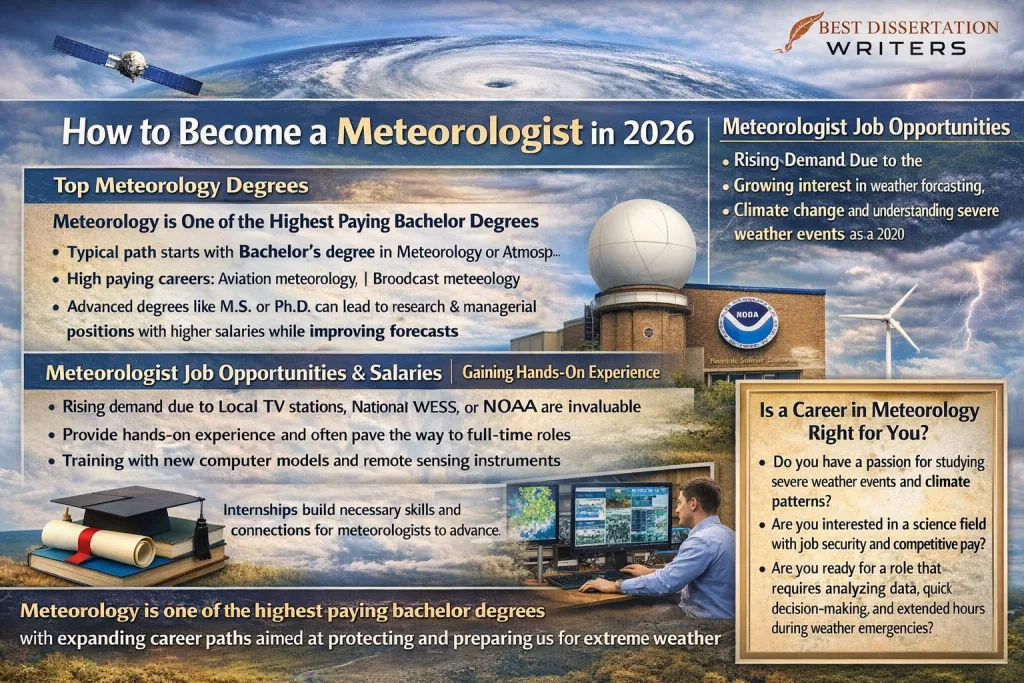
Hands-On Experience: Internships and Training Opportunities
- Importance of practical experience: Meteorologists need hands-on experience to understand real-world weather patterns and the application of theoretical knowledge gained through formal education.
- Internships at weather stations: As a budding meteorologist, securing an internship at a weather station or government agency such as the National Oceanic and Atmospheric Administration (NOAA) will provide valuable exposure to the work of meteorologists.
- Weather data analysis: Internships allow aspiring meteorologists to gain practical experience by analyzing weather data, preparing weather forecasts, and assisting in weather information dissemination.
- Opportunities with private companies: Private companies, such as those involved in aviation meteorology, often offer internships to study meteorology in specific contexts, such as forecasting for airports, air traffic control, or logistics companies that rely on weather information.
- Local TV stations: Working with local TV stations provides a great opportunity for weather broadcasters to develop their communication skills, writing and speaking clearly to audiences while sharing complex weather patterns.
- Training in specialized fields: As meteorology evolves, new types of computer models have vastly improved the accuracy of forecasts. Interns and students will often receive training in these new computer models to better predict weather events and tailor forecasts to specific purposes.
Advancing Your Meteorology Career with Further Study and Credentials
- Importance of Higher Education: While meteorologists typically need a bachelor’s degree in meteorology, atmospheric science, or a related field, pursuing advanced degrees like a master’s degree or Ph.D. can significantly enhance career prospects. These higher education options provide the opportunity for specialization in fields such as climate change, aviation meteorology, or severe weather forecasting, which can lead to more specialized and higher-paying positions.
- For example, those who pursue a Ph.D. may move into roles as researchers, conducting critical studies on weather patterns or the impact of climate change. Additionally, advanced degrees enable meteorologists to take on managerial positions, such as lead meteorologist or meteorology director, which often come with higher salaries and more leadership responsibilities.
- Certified Broadcast Meteorologist (CBM): For meteorologists interested in broadcast meteorology, obtaining certifications like the Certified Broadcast Meteorologist (CBM) designation from the American Meteorological Society (AMS) is an excellent way to advance a career. The CBM certification demonstrates a meteorologist’s ability to present weather data accurately and communicate complex weather concepts in an engaging way for the general public.
- This is particularly important for weather broadcasters, who need to be skilled not only in understanding meteorological data but also in speaking clearly and presenting it in a manner that is both informative and accessible. Earning the CBM is highly respected in the industry and can make a meteorologist a more competitive candidate for broadcast meteorologist roles in top media outlets.
- Specialized Meteorology Fields: Meteorologists have a wide range of specialized fields they can pursue to enhance their credentials and career growth. These fields include aviation meteorology, environmental meteorology, and climate change studies, among others. Gaining additional certifications in these areas can open doors to advanced career opportunities. For instance, aviation meteorologists work to ensure safe flight conditions by providing weather forecasts tailored to the specific needs of airlines and airports, while environmental meteorologists study the relationship between weather and the environment, advising on topics like pollution control and disaster management.
- Climate change specialists, on the other hand, play a critical role in understanding long-term weather patterns and how global warming impacts weather systems. Specializing in these areas often comes with higher salaries and more leadership opportunities in both the private and public sectors, where the demand for such expertise is growing as weather and climate issues become more pressing globally.
Work Environments and Job Settings for Meteorologists
- Weather stations: Meteorologists often work indoors in weather stations, where they analyze weather data collected from satellites, weather balloons, radar systems, and other remote sensing technologies. They prepare both short-term and long-term weather forecasts.
- Broadcast meteorology: Many meteorologists become weather forecasters for local or national TV stations, where they present weather information to the public and issue warnings during extreme weather events. Broadcast meteorologists play a critical role in keeping the public informed about weather conditions.
- National Weather Service (NWS) & NOAA: Some meteorologists work for NOAA or the National Weather Service (NWS), providing weather forecasts and warning systems for severe weather, which may include issuing warnings to protect life and property during hurricanes, tornadoes, and other hazardous conditions.
- Private industry and research: Meteorologists with an interest in research or applying weather forecasting to specific industries (such as aviation meteorology) may find work with private companies that specialize in providing weather information to sectors like agriculture, logistics, and energy.
- Extended hours and weather emergencies: Meteorologists working with the National Weather Service, NOAA, or TV stations often work extended hours during weather emergencies to provide continuous forecasts and ensure the public remains informed about developing weather conditions.
Challenges You’ll Face in the Meteorology Field
- Unpredictable nature of weather: One of the biggest challenges for meteorologists is the unpredictability of weather and climate patterns. Even with computer models and sophisticated technology, meteorologists must be able to deal with weather events that are difficult to forecast accurately.
- Stressful work during severe weather: Meteorologists working in severe weather forecasting often experience high-stress environments, particularly during emergencies like hurricanes or tornadoes, when lives and property are threatened. They must make timely decisions and issue alerts or warnings for weather events.
- Long hours: Meteorologists often work extended hours when storms or severe weather events are approaching. This can mean working overnight shifts, weekends, and holidays, especially during weather emergencies.
- Balancing accuracy with communication: Weather forecasters must strike a balance between providing accurate forecasts and ensuring that the information is clearly communicated to the public. Miscommunication, especially during severe weather, can lead to confusion and panic.
Need Help With Your Dissertation?
Get professional academic support from Best Dissertation Writers . Our expert team is ready to help you with high-quality dissertation writing services tailored to your academic goals.
Get Dissertation HelpTips to Thrive as an Emerging Meteorologist
- Embrace continuous learning: Meteorology is a field that constantly evolves with the introduction of new technologies and scientific discoveries. Meteorologists must stay up to date on the latest developments in forecasting methods, computer models, and climate research to remain relevant.
- Seek practical experience early on: Gaining hands-on experience through internships, part-time jobs, or research projects will set you apart from other candidates and help you build valuable skills that are essential for a successful career.
- Develop communication skills: Whether you’re presenting weather data on TV or working with government agencies, weather forecasters need to write and speak clearly to ensure the public understands weather warnings and information. Strong writing and speaking abilities are crucial in broadcast meteorology.
- Build a professional network: Networking with professionals in the field, attending conferences, and joining organizations like the American Meteorological Society can open doors to career opportunities and provide valuable resources for emerging meteorologists.
- Get certified: While not mandatory, becoming certified by organizations like the American Meteorological Society can improve your credibility and increase job prospects in competitive fields like broadcast meteorology.
Is Becoming a Meteorologist Right for You? Personal Checklist
- Do you have a passion for the weather? If you’re someone who enjoys studying weather patterns, tracking storms, and understanding weather and climate changes, meteorology might be the perfect career for you.
- Do you enjoy problem-solving and science? Meteorology requires a deep understanding of science, as well as the ability to think critically and solve complex problems, particularly when it comes to forecasting.
- Are you comfortable working under pressure? Weather events, especially severe ones, require quick decision-making. Meteorologists often work under pressure, issuing warnings that could save lives and protect property.
- Are you interested in technology? Meteorologists often use advanced technologies such as computer models and remote sensing tools to help forecast weather conditions. If you enjoy working with cutting-edge tech, meteorology offers a great career path.
Conclusion: Next Steps in Your Meteorology Journey
- Research degree programs: If you’re interested in meteorology, the first step is to pursue a degree program in meteorology or atmospheric science. Ensure the program provides hands-on experience through internships, which is vital for building practical skills.
- Gain experience: Start applying for internships or volunteer work in weather stations, TV stations, or other related fields. Hands-on experience will help you apply the theoretical knowledge from your degree in atmospheric science to real-world scenarios.
- Consider further education and certification: Once you have your degree, consider pursuing certifications or advanced degrees in specialized fields like aviation meteorology or climate change to open up more career opportunities and increase your earning potential.
- Pursue job opportunities: With a degree, certifications, and hands-on experience, you’ll be ready to apply for meteorology jobs in public, private, or broadcast sectors. Start with entry-level positions to gain experience and work your way up to senior roles in meteorology.
In 2026, meteorology careers are flourishing, and becoming a meteorologist provides a rewarding, challenging, and lucrative career path. By acquiring the right education, skills, and experience, you can build a successful career forecasting the weather and climate and contributing to vital weather information that helps safeguard life and property.
References
- Should I be a meteorologist? https://learn.rumie.org/jR/bytes/should-i-be-a-meteorologist/
- How to Become a Weather Analyst: Career Path & Guide | Himalayas https://himalayas.app/career-guides/weather-analyst
- Meteorology Internships https://meteorology.rutgers.edu/internships.shtml
- The Challenges and Complexities of Weather Forecasting, by Mark Bloomer https://www.weather.gov/car/weatherforecasting
- Ascending the meteorology career ladder: How to become a meteorologist https://www.cmich.edu/blog/all-things-higher-ed/how-to-become-a-meteorologist
- Meteorologist | Explore Careers | National Careers Service https://nationalcareers.service.gov.uk/job-profiles/meteorologist