

Salary for Radiology Techs in 2026 – Key Takeaways
Radiologic technologists (radiology techs) use medical imaging equipment to assist in diagnosing patient conditions. They play a vital role in healthcare by producing X‑rays, MRIs, CT scans, and other diagnostic images. With growing demand for imaging services, career prospects and compensation remain strong. Below is a clear overview of salary trends, job factors, and growth for radiology techs:
- What Radiology Techs Do:
- Operate imaging equipment such as X‑ray machines, CT scanners, and MRI systems.
- Prepare patients for imaging procedures and ensure safety and image quality.
- Work in hospitals, clinics, imaging centers, and diagnostic laboratories.
- Average Salary Overview:
- The typical annual salary for radiology techs ranges widely based on location, experience, and specialization.
- Median salaries often fall between $55,000 and $75,000 per year.
- Specialized modalities (e.g., MRI or CT) can yield higher compensation due to technical expertise.
- Factors Affecting Salary:
- Experience & Education: More experienced techs and those with advanced credentials tend to earn more.
- Location: Salaries vary by state, region, and cost of living. Urban centers usually pay higher wages.
- Work Setting: Hospitals and specialty clinics often offer higher pay than small outpatient facilities.
- Career Growth & Job Outlook:
- The need for imaging services is growing with an aging population and expanded healthcare access.
- Job growth for radiologic technologists is projected to remain strong, with demand particularly high for techs trained in multiple modalities.
- Specializations That Boost Earnings:
- Computed Tomography (CT) and Magnetic Resonance Imaging (MRI) certifications often lead to higher pay.
- Additional credentials like Sonography or Interventional Radiography can further enhance salary potential.
- Education & Certification Requirements:
- Radiology techs typically complete an accredited program (associate or bachelor’s degree) in radiologic technology.
- Licensure and certification through bodies like the American Registry of Radiologic Technologists (ARRT) are essential for employment and advancement.
Radiology techs are essential in diagnostic healthcare. With the growing demand for imaging services and a need for specialized skills, the career outlook for radiologic technologists is strong, with competitive salaries that vary depending on location, experience, and specialization.
Salary for Radiology Techs and Radiologic Technologists
Who Are Radiology Techs and Radiologic Technologists and How to Become One?
- Definition and Role
- Radiology techs, also known as radiologic technologists, are healthcare professionals trained to perform diagnostic imaging examinations such as X-ray, CT scans, MRI scans, and mammography.
- They play a critical role in patient care, providing essential imaging for diagnosis and treatment planning.
- Technologists typically work in hospitals, outpatient centers, diagnostic clinics, and specialty imaging facilities.
- Education Requirements
- Most entry-level positions require an associate degree in radiology or medical imaging, often completed over 2–3 years.
- Coursework includes anatomy, patient care, radiographic procedures, and safety practices.
- Certification and Licensure
- Professional certification is offered through organizations such as the American Registry of Radiologic Technologists (ARRT).
- Licensure is mandatory in many states, ensuring technologists meet standardized professional competencies.
- Additional certifications in specialties like MRI, CT, or mammography can lead to higher salaries and better job opportunities.
- Employment Outlook
- According to the Bureau of Labor Statistics (BLS), employment of radiologic technologists is projected to grow faster than the average due to the expanding need for diagnostic imaging services.
- Job growth is especially strong for specialized fields such as nuclear medicine technologists, cardiovascular technologists and technicians, and diagnostic medical sonographers.
Radiology Tech Salary Overview
- General Salary Expectations
- Salary for radiology techs varies depending on experience, location, facility type, and specialization.
- Radiology tech salary can range from entry-level figures to substantially higher salaries for experienced, certified technologists.
- The BLS reports that technologists earn a median annual salary that reflects the midpoint of the pay range, providing a reliable benchmark.
- Factors That Affect Salary
- Geographic location: High-demand areas or states with higher cost of living tend to pay more.
- Type of facility: Hospitals often offer higher pay than outpatient or community clinics.
- Specialty skills and certifications: Technologists trained in CT scans, MRI, mammography, or nuclear medicine typically earn higher salaries.
- Experience and tenure: Technologists with years of practice or supervisory roles see higher earning potential.
How Much Does a Radiology Technologist Earn?
Median and Average Salary
- Radiology techs can earn varying salaries depending on role and specialization
- Technologists performing standard X-ray imaging generally earn near the median, while those trained in advanced procedures like CT scans, MRI scans, mammography, or nuclear medicine often command higher salaries.
- Factors that affect salary for radiology techs include facility type, geographic location, level of experience, and certifications.
- According to the Bureau of Labor Statistics (BLS)
- The median annual wage for radiologic technologists provides a reliable benchmark for what most professionals earn.
- Median wages are competitive with other medical imaging professions, such as diagnostic medical sonographers or cardiovascular technologists and technicians.
- Average Salary Considerations
- Average salary figures may be higher than the median because they account for top earners who perform specialized imaging procedures or work in high-paying regions.
- Radiology techs with multiple certifications or experience in outpatient centers, hospitals, or specialty clinics can earn well above the average.
Comparisons With Related Professions
- Diagnostic medical sonographers often have comparable or slightly higher salaries than general radiologic technologists due to specialized ultrasound training.
- Cardiovascular technologists and technicians can earn more if performing invasive cardiac procedures or advanced diagnostic testing.
- Nuclear medicine technologists are another high-earning specialty, with salaries higher than the median because of additional certification and patient care responsibilities.
Need Help With Your Dissertation?
Get professional academic support from Best Dissertation Writers . Our expert team is ready to help you with high-quality dissertation writing services tailored to your academic goals.
Get Dissertation Help2026 Median Radiologic Technologist Salary
Projections
- The 2026 median radiologic technologist salary is expected to reflect steady growth as healthcare facilities expand imaging services and adopt new technologies.
- BLS employment projections indicate that the demand for radiologic technologists is growing faster than the average for all occupations.
- Hospitals and outpatient imaging centers may offer higher salaries to retain qualified technologists as job growth increases competition for skilled personnel.
Expected Salary Range for Radiology Technologists
- Entry‑Level Radiology Tech Salary:
- Entry‑level radiology techs typically start near the lower end of the pay scale, reflecting initial training and experience.
- According to the Bureau of Labor Statistics (BLS), the lowest‑paid 10% of radiologic technologists earn around $50,020 per year, and those in the 25th percentile earn about $60,690 annually.
- Most new technologists with an associate degree in radiology and certification can expect to earn roughly $50,000–$62,000 per year, depending on location, facility type (hospital vs outpatient), and demand.
- Median Salary for Radiology Techs Benchmark:
- The median annual wage—the midpoint where half earn more and half earn less—is approximately $77,660 according to latest BLS data, providing a realistic mid‑career earnings figure.
- Salary for Radiology Techs who are Experienced
- Technologists with significant experience, advanced training, and additional certifications (e.g., MRI scans, CT scans, mammography, nuclear medicine) can command higher salaries than the median.
- At the 75th percentile, wages reach about $84,670, and top earners (90th percentile) can earn $102,380 or more annually.
- Bottom Line:
- Entry‑level radiology techs start around $50K–$62K, median earners are near $77K–$78K, and experienced specialists can exceed $85K–$102K+.
| Experience Level | Annual Salary Range | Notes |
|---|---|---|
| Entry-Level | $50,000 – $62,000 | New radiology techs with an associate degree and certification; varies by location and facility type (hospital vs outpatient). |
| Median (Mid-Career) | $77,660 | Typical median annual wage according to BLS; most practicing technologists earn near this midpoint. |
| Experienced / Specialized | $84,670 – $102,380+ | Technologists with advanced skills, certifications (MRI, CT, mammography, nuclear medicine), or supervisory roles; top earners exceed $100K. |
Salary by State for Radiology Techs
State‑by‑State Variation
- Radiology tech salary varies across the U.S. due to local healthcare infrastructure, demand for medical imaging services, and cost of living. States with many large hospitals, outpatient imaging centers, and busy patient populations often offer more competitive compensation.
- In many high‑paying regions, radiology techs can earn salaries significantly above the national average, while lower‑cost states may pay less but still offer solid purchasing power relative to living expenses.
- According to recent industry compensation data, the highest average annual salaries for radiologic technologists are often found in places like District of Columbia (~$77,755), California (~$77,460), Massachusetts (~$76,428), and Washington (~$76,147) on one set of estimates.
- Other analyses using broader wage data show that states like California (~$99,680), Hawaii (~$88,440), and Massachusetts (~$85,800) rank among the top for average radiology tech earnings.
- Conversely, lower‑paying states such as Alabama (~$53,020), Mississippi (~$51,240), and Arkansas (~$55,180) report average annual salaries below national averages, reflecting differences in local demand and cost of living.
- These state figures represent typical compensation for radiologic technologists who perform diagnostic imaging examinations such as X‑rays, CT scans, and MRI scans and support patient care at hospitals, clinics, and outpatient centers.
Examples of Salary for Radiology Techs Variation
- California: Radiology technologist salaries in California are among the highest nationally, with some estimates placing the average near $77,460–$99,680 annually depending on data source, job market, and facility type.
- High cost of living and dense populations with advanced healthcare systems contribute to these elevated earnings.
- Radiology techs with advanced certifications often command even higher salaries here.
- Massachusetts & Washington: Both states consistently appear near the top of state pay lists, with technologists earning $76,000+ on average.
- These states have strong healthcare systems and many outpatient imaging centers and hospitals.
- Demand for specialized imaging roles can translate into premium wages, especially for techs with MRI, CT, or mammography expertise.
- New York & New Jersey: These Northeast states also pay above average, with average radiology tech salaries often reported in the $74,000+ range.
- Dense urban populations and extensive healthcare networks contribute to strong job markets.
- Lower‑Cost States: States such as Alabama (~$53,020), Mississippi (~$51,240), and South Carolina (~$59,610) tend to offer salaries below the national average, but lower cost of living can make compensation relatively competitive locally.
Salary and Job Outlook Correlation
- States with more hospitals, outpatient centers, and specialty imaging clinics often see technologists earn higher salaries because employers compete for qualified professionals with experience and additional certifications.
- Nationwide employment of radiologic technologists is projected to grow, with demand expected to rise as the population ages and the need for diagnostic imaging increases. The BLS projects employment growth for radiologic and MRI technologists around 5% from 2024 to 2034, faster than the average for all occupations.
- As demand grows, technologists with advanced skills, specialty training, and years of experience are most likely to benefit from stable job opportunities and continued salary growth, especially in states with robust healthcare systems.
| State | Average Salary | Median Salary | 25th Percentile | 75th Percentile | Cost of Living Index |
|---|
Career Guide and Job Outlook for Radiology Technologists
Growing Need for Healthcare Services
- The demand for healthcare services is increasing due to:
- Aging populations requiring more diagnostic imaging.
- Higher prevalence of chronic illnesses such as heart disease, cancer, and diabetes.
- Expanded access to healthcare through outpatient imaging centers and community clinics.
- Hospitals, outpatient centers, and specialty clinics are increasingly relying on diagnostic imaging to support accurate treatment decisions.
- As a result, salary for radiology techs has become more competitive in high-demand regions.
- Technologists must stay updated on the latest imaging technologies and techniques to meet workforce needs as facilities need to replace workers retiring, transferring, or leaving the profession.
Employment Projections
- According to the Bureau of Labor Statistics, employment of radiologic technologists is projected to grow around 5% from 2024 to 2034, which is faster than the average for all occupations.
- This growth is driven by greater demand for advanced imaging procedures such as CT scans, MRI, and mammography.
- Suburban and metropolitan regions with higher patient volumes show particularly strong growth, as hospitals and outpatient centers compete to recruit skilled technologists.
- The growth of outpatient centers, specialty clinics, and mobile imaging services is creating new career opportunities, especially for technologists with multiple certifications.
Regional Variation
- Technologist in California and other large states such as New York, Massachusetts, and Washington experience higher demand, which drives radiology tech salary above the national median.
- Salaries vary by state depending on:
- Cost of living
- Number of hospitals, outpatient centers, and specialty clinics
- Local demand for healthcare services
- Technologists in high-demand metropolitan areas may also receive additional benefits, sign-on bonuses, or higher hourly rates due to workforce competition.
- Rural and lower-cost states may offer salaries slightly below the national median, but these positions often provide stable employment and manageable workloads.
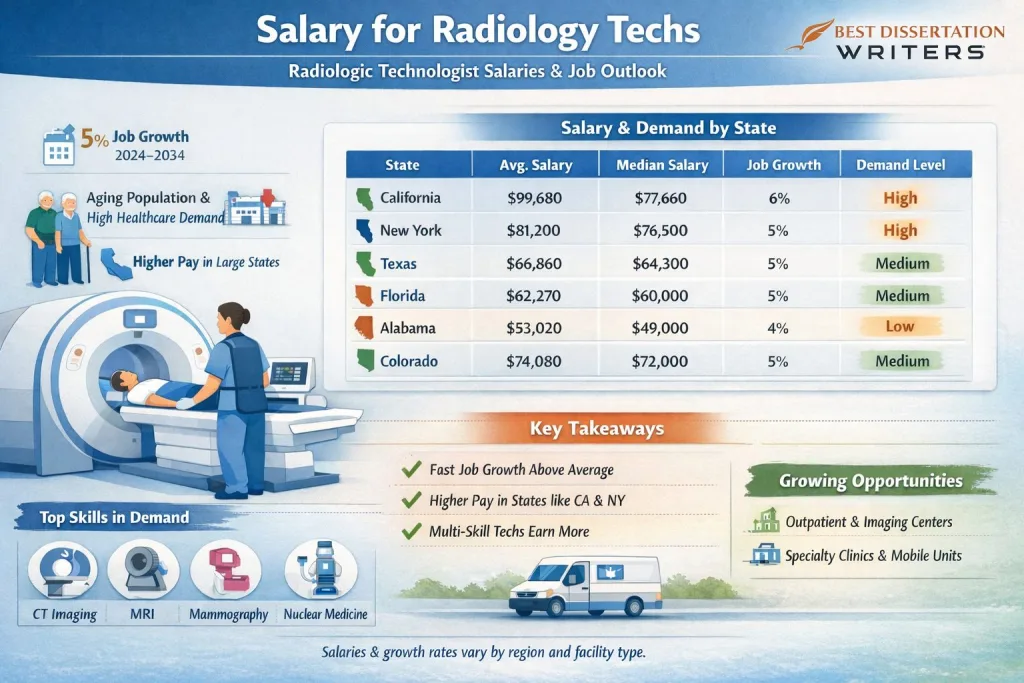
| State | Average Annual Salary | Median Salary | Projected Job Growth (2024–2034) | Demand Level |
|---|---|---|---|---|
| California | $99,680 | $77,660 | 6% | High |
| New York | $81,200 | $76,500 | 5% | High |
| Massachusetts | $85,800 | $77,700 | 5% | High |
| Washington | $82,740 | $77,000 | 5% | High |
| Texas | $66,860 | $64,300 | 5% | Medium |
| Florida | $62,270 | $60,000 | 5% | Medium |
| Alabama | $53,020 | $49,000 | 4% | Low |
| Mississippi | $51,240 | $49,000 | 4% | Low |
| Colorado | $74,080 | $72,000 | 5% | Medium |
| Pennsylvania | $64,550 | $62,000 | 5% | Medium |
Note: Salaries and projected job growth vary across regions. States with large healthcare systems, high patient populations, and strong outpatient networks tend to offer higher pay and more opportunities.
Key Takeaways:
– The demand for radiology technologists is expected to grow faster than average, creating strong job security and opportunities for advancement.
– Salary for radiology techs is influenced by location, specialization, and certifications, with higher pay in states like California and New York.
– Technologists who can operate multiple imaging modalities (CT, MRI, mammography, nuclear medicine) are in greater demand and often command higher salaries.
– Growth in outpatient centers and specialty imaging clinics is expanding employment opportunities beyond traditional hospital settings, allowing technologists to work in different environments.
Work Environment and Daily Occupation Overview
Common Work Settings
- Radiology techs work in hospitals, outpatient imaging centers, specialty clinics, diagnostic labs, and private practices, reflecting the growing demand for healthcare services nationwide.
- Some technologists choose to work in different settings, including mobile imaging services or self-employment, providing flexibility and exposure to diverse patient populations.
- Larger hospitals and specialty centers may employ technologists in advanced imaging departments, such as CT, MRI, mammography, or nuclear medicine, offering opportunities for higher responsibility and career growth.
Typical Work Hours
- Most radiologic technologists work full-time, typically 40 hours per week, though schedules may include nights, weekends, or holidays, especially in hospitals and emergency imaging centers.
- The number of hours worked often depends on patient volume and facility size. In high-demand areas, technologists may work overtime, contributing to additional pay.
Daily Responsibilities
- Technologists must operate imaging equipment safely, including CT scanners, MRI machines, X-ray devices, and mammography units, while ensuring patient safety and accurate documentation.
- Daily tasks include preparing patients, positioning them correctly, monitoring vital signs, and maintaining records.
- Radiology techs who can work in different modalities increase their versatility, techs earn higher salaries, and they gain experience in specialized procedures, supporting career advancement.
- For those becoming a radiology technologist, this variety ensures exposure to multiple imaging techniques, aligning with average growth in the profession driven by rising healthcare needs.
Required Work Experience and Education
Education Programs
- Associate Degree in Radiology or Related Field
- Most candidates start with an associate degree in radiologic technology, radiography, or medical imaging.
- Programs typically take 2–3 years to complete and provide foundational knowledge in anatomy, physiology, radiation safety, and patient care.
- Graduates are prepared to perform diagnostic imaging examinations in hospitals, outpatient clinics, and specialty centers.
- Advanced Degrees for Specialized Roles
- Some technologists pursue a bachelor’s or master’s degree to access leadership, research, or educational roles.
- Advanced degrees allow technologists to supervise imaging departments, coordinate clinical operations, or teach in accredited programs.
- Accredited Education Programs
- Accredited programs combine classroom instruction with clinical rotations, ensuring hands-on experience in CT imaging, MRI, X-ray, and mammography.
- Students learn to handle imaging equipment safely, position patients accurately, and interpret basic diagnostic images under supervision.
- Clinical rotations expose students to different patient populations and medical settings, preparing them for the real-world work environment.
Need Help With Your Dissertation?
Get professional academic support from Best Dissertation Writers . Our expert team is ready to help you with high-quality dissertation writing services tailored to your academic goals.
Get Dissertation HelpCertifications and Licensure
- Licensure Requirements
- Licensure is mandatory in most states, confirming that technologists meet standardized professional and safety competencies.
- Candidates must pass a national exam (often through the American Registry of Radiologic Technologists, ARRT) to obtain licensure.
- Specialty Certifications
- Technologists can pursue additional certifications in MRI, CT imaging, nuclear medicine, or mammography.
- Specialty certifications increase employability, enable technologists to perform advanced imaging procedures, and give access to highest-paying roles.
- Maintaining certification often requires continuing education credits, ensuring technologists stay updated with evolving technology and safety standards.
Work Experience Requirements
- Entry-Level Technologists
- Gain initial experience through clinical rotations during education programs.
- Supervised work allows entry-level technologists to develop technical proficiency, patient care skills, and familiarity with imaging protocols.
- Early experience emphasizes radiation safety, patient positioning, and accurate documentation.
- On-the-Job Experience
- Practical experience is essential for handling complex imaging procedures, such as CT scans, MRI scans, or mammography.
- Technologists refine their skills in patient interaction, emergency protocols, and quality control.
- Experienced technologists may cross-train in multiple modalities, which increases flexibility, career opportunities, and radiology tech salary potential.
- Advancement Through Experience
- Accumulating work experience allows technologists to qualify for supervisory, specialty, or educational roles.
- Experienced technologists are often preferred for high-demand areas, leadership positions, and facilities that require multi-modality expertise.
Related Careers and Similar Professions
Alternative Career Paths
- Diagnostic Medical Sonography
- Radiology techs can transition to sonography, performing ultrasound examinations to evaluate organs, tissues, and blood flow.
- This career often offers higher flexibility and competitive salaries, especially for technologists with prior imaging experience.
- Sonographers may specialize in areas like obstetrics, cardiology, or abdominal imaging, which can further increase earning potential.
- Nuclear Medicine Technology
- Technologists may move into nuclear medicine, using radioactive materials to perform diagnostic and therapeutic procedures.
- This field typically requires additional certification and training but provides access to specialized imaging modalities and higher-paying positions.
- Nuclear medicine technologists often work closely with physicians to evaluate organ function and assist in treatment planning.
- Cardiovascular Imaging Technology
- Radiology techs may pursue a career in cardiovascular imaging, conducting echocardiograms, vascular studies, and cardiac catheterization imaging.
- This specialty is in high demand, offering opportunities to work in hospitals, outpatient centers, and research facilities.
- Cardiovascular imaging provides hands-on patient care and a path to advanced certification, which can increase radiology tech salary.
- Administrative and Leadership Roles
- Technologists with advanced degrees (bachelor’s or master’s) can move into administrative roles, such as department manager or imaging supervisor.
- These positions focus on staff management, workflow optimization, and compliance, rather than direct imaging, and offer higher salaries and leadership experience.
- Research and Education
- Some radiology technologists pursue careers in academic research or teaching, training new technologists or conducting studies on imaging techniques.
- These roles often require advanced degrees or specialty certifications and allow professionals to contribute to advancements in medical imaging.
MRI and Specialty Technologist Opportunities
- Specialty Certifications
- Obtaining certifications in MRI, CT imaging, mammography, or nuclear medicine positions technologists for highest-paying opportunities.
- Specialty technologists are especially in demand in California, New York, and Massachusetts, where healthcare infrastructure is dense and advanced.
- Compensation Benefits
- Specialty certifications and cross-training often allow techs to earn significantly above the 2024 median salary.
- Facilities frequently offer incentives for technologists who can perform multiple imaging modalities or take on leadership roles.
- Career Advancement
- Advanced certifications and experience can lead to lead technologist, department manager, or educator positions.
- Radiology tech salary in specialized or high-demand roles often exceeds the median, reflecting greater demand and required expertise.
- Technologists may also become consultants or self-employed, providing flexible work arrangements while earning competitive salaries.