

Types of Doctorate Degrees: Doctorate vs Doctoral Degree Basics
- Doctoral studies represent the highest level of study in most education systems and typically follow graduate education.
- A doctorate is an academic degree awarded after advanced training that builds deep expertise in a specific field.
- A doctorate is also an advanced degree because it goes beyond standard graduate credentials and expects independent thinking and specialized mastery.
- In many disciplines, the doctorate functions as a terminal degree, meaning it is the top credential normally available in that chosen field.
- In practical terms, a doctorate is the most advanced credential many people will pursue, because it requires sustained, high-level work and specialized outcomes.
- Many employers and institutions describe the doctorate as the credential where the degree is the highest in a formal academic hierarchy.
- In research-intensive fields, the doctorate often represents the highest academic degree, because it signals the ability to generate, evaluate, and apply new knowledge at an expert level.
- Because of the training, scope, and expectations, a doctorate is widely viewed as the highest level of academic achievement, especially when the program requires original scholarly contribution or advanced professional leadership.
What Is a Doctorate Degree Vs. a Doctoral Degree?
- The words “doctorate degree” and “doctoral degree” usually refer to the same credential in everyday use. People often use both terms interchangeably in graduate education.
- Both terms sit within graduate education, which includes master’s and doctoral training after undergraduate study.
- Most applicants enter doctoral studies after earning a master’s degree, but many programs allow entry with a bachelor’s or master’s degree, depending on the field and program design.
- The level of study differs mainly by program purpose and outcomes. Some doctoral tracks emphasize original scholarship, while others emphasize advanced practice and leadership.
- People earn a doctorate when they complete a doctoral program’s required coursework, evaluations, and final capstone requirements.
- You typically earn your doctorate degree after meeting academic milestones such as comprehensive examinations, supervised research or applied projects, and a final defense or assessment.
- A doctorate may take different forms across fields, so the label matters less than what the program trains you to do and what career outcomes it supports.
Major Types of Doctorate Degrees by Field and Career Goals
- Most doctorate options fall into two main categories that align with purpose and outcomes.
- The first category is academic and professional research preparation, which supports knowledge creation, scholarship, and roles that involve research leadership.
- The second category is academic and professional applied preparation, which supports advanced practice, leadership, and high-level decision-making in real-world settings.
- Your target career paths should guide the choice because different doctorates prepare you for different roles, even when they sit at the same academic level.
- The best fit depends on your chosen field, because norms differ across education, healthcare, engineering, business, and the social sciences.
- A strong program match also depends on a specific field focus, such as public health leadership, education systems, clinical practice, or organizational strategy.
- Many applicants select a doctorate tied to a professional field when they want advanced credentials that improve practice authority, leadership, and specialized performance.
- Each doctorate type exists because the degree prepares graduates for distinct outcomes, such as producing original scholarship, implementing evidence-based practice, leading complex organizations, or shaping policy and systems.
Major Types of Doctoral Degrees by Field and Career Goals
- Many fields now offer both research and professional pathways, which is why discussions often compare doctorates and professional options side by side.
- You will also see comparisons of doctorates and professional doctorates, since both are doctoral-level credentials but differ in training emphasis and outputs.
- A helpful way to decide is to compare research doctorates and professional doctorates based on what you want to do after graduation.
- A professional degree at the doctoral level usually prioritizes advanced practice, leadership, and real-world application over producing new theory.
- In contrast, research degrees prioritize building the ability to design studies, analyze evidence, and contribute to scholarship in the discipline.
- Research-focused doctoral training is often described as research-oriented, because it develops the skills needed for academic research roles and research-intensive careers.
- Programs are also described as research-focused when they require original inquiry and advanced scholarly methods throughout the degree.
- The best-known example is the research-focused PhD, which is designed to prepare graduates for scholarship, research leadership, and academic roles in many disciplines.
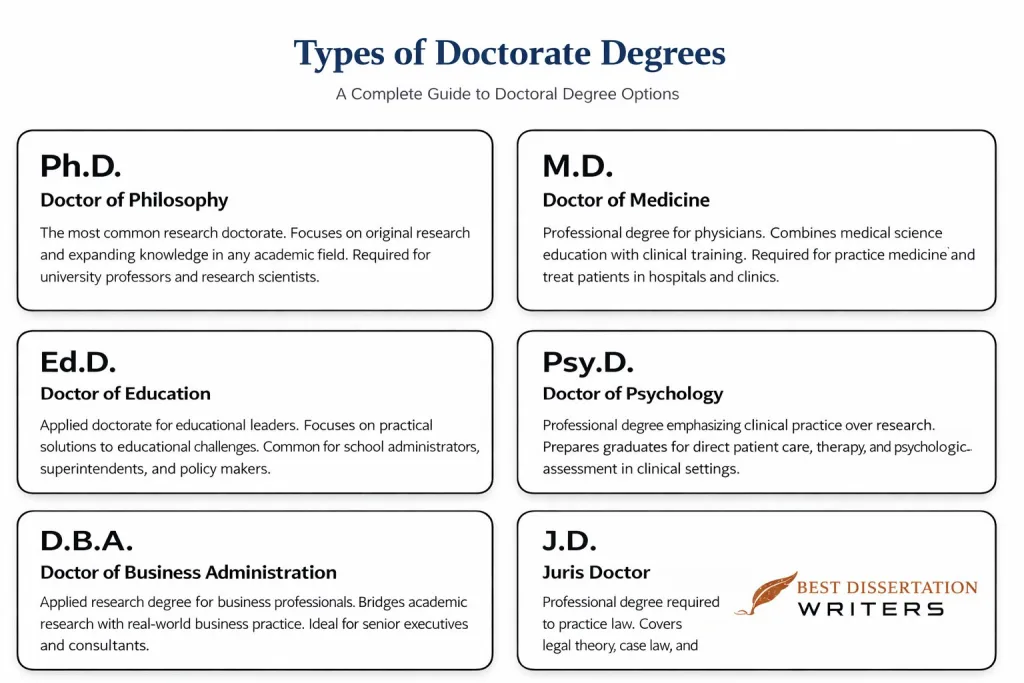
Research Doctorate: Research Doctorate Degrees and the PhD Degree
- PhD programs sit inside the broader category of research degrees and train learners to create new knowledge in a discipline.
- Research doctorate degrees emphasize advanced theory, strong research methods, and the ability to design and complete original research that matters to a field.
- The central outcome of many research-focused doctorates is a major, independent project that contributes something new to the literature.
- Most research doctorates require a dissertation, which is a long-form scholarly work that documents the research problem, methods, findings, and implications.
- Research doctorates align strongly with academia because universities need scholars who can publish, teach, win grants, and mentor future researchers.
- A research doctorate is also research-oriented because it trains you to think like a researcher across contexts, not just to complete one project.
- Even outside academia, a research doctorate can support roles in research and development, policy analysis, evaluation, and advanced analytics because the training centers on evidence and rigor.
Doctor of Philosophy and the PhD Degree Explained
- A Doctor of Philosophy degree is often called the research-focused PhD because it prioritizes discovery, theory-building, and scholarly contribution.
- In many disciplines, the PhD is treated as the highest academic degree because it signals readiness to independently generate and evaluate knowledge.
- Doctoral students in a PhD track typically move from structured learning into increasing independence as they refine a research agenda and develop expertise.
- PhD graduates become doctorate recipients when they complete required milestones, successfully defend the dissertation, and meet program standards.
- In the U.S., institutions often design PhD pathways that combine coursework, examinations, and research training before the dissertation stage begins.
- Many discussions of doctoral education also reference doctorate recipients from U.S. universities because the U.S. has a large doctoral education system across many fields.
- The PhD label can appear similar across fields, but the training and outcomes still depend heavily on discipline norms, research expectations, and professional standards.
Doctor of Philosophy Degree Program Structure
- Many PhD tracks build toward a dissertation as the capstone demonstration of scholarly independence and contribution.
- The dissertation is grounded in original research, meaning the learner collects and analyzes evidence, develops an argument, or produces a novel scholarly product.
- Years to complete vary widely, and timelines depend on research design, access to data or participants, funding, and the pace of writing and revision.
- Programs vary by institution and discipline, so some emphasize intensive coursework first while others move students into lab or field research earlier.
- Fields like science and engineering often include structured lab rotations, team-based research environments, and a heavy emphasis on technical research skills.
- In contrast, other fields may emphasize independent archival work, qualitative methods, theory-building, or advanced modeling depending on the chosen field.
- Across disciplines, the most common milestones include coursework, research methods training, comprehensive or qualifying examinations, proposal development, data collection, analysis, dissertation writing, and a final defense.
Professional Doctorate vs Research Doctorate
- Doctoral education often splits into two main categories, with one category centered on research production and the other centered on advanced practice leadership.
- Research doctorates are typically research-focused because they prioritize scholarly contribution and the production of new knowledge through rigorous inquiry.
- Professional doctorates prioritize professional practice, meaning they prepare learners to solve complex problems in real-world settings using advanced expertise.
- Comparing research doctorates and professional doctorates helps clarify the difference between producing research as the primary outcome versus applying evidence as the primary outcome.
- Many learners also compare doctorates and professional doctorates because both sit at the doctoral level but differ in how they measure mastery and impact.
- Professional doctorate holders often pursue leadership roles, advanced clinical or administrative roles, and high-level decision-making positions that require applied expertise.
- The choice often comes down to whether your long-term goals require intensive research training for academic and research careers, or advanced applied leadership for professional systems.
Professional Doctorate Degree Programs Overview
- A doctorate program in a professional track typically includes advanced coursework, applied projects, and practice-based assessment tied to workforce needs.
- These degrees exist because many professional fields require doctoral-level preparation for leadership, advanced authority, or specialized credentialing.
- A professional doctorate like a Doctor of Nursing Practice, a Doctor of Education, or a Doctor of Business Administration often emphasizes application over theory creation.
- Professional doctorates are designed for a professional field where outcomes matter in organizations, communities, and systems, not only in journals.
- The degree focuses on translating evidence into action, improving outcomes, leading change, and applying advanced frameworks to real problems.
- Programs often highlight knowledge and skills such as leadership, systems thinking, quality improvement, program evaluation, policy implementation, strategic planning, and advanced communication.
- Many learners choose professional doctorates for personal and professional reasons, such as advancing credibility, gaining authority in practice, expanding career options, and making impact at scale.
- While professional doctorates may include research literacy and applied inquiry, they usually measure success through practice change, organizational outcomes, and leadership-level competence rather than a traditional dissertation model.
Doctor of Business Administration (DBA) and Business Administration Doctoral Program
- A Doctor of Business Administration is a program in business designed for advanced leadership and applied problem-solving in organizations.
- The DBA fits a professional field because it emphasizes using evidence to improve performance, strategy, and decision-making in real workplaces.
- DBA doctoral studies often target high-level roles where leaders must manage complexity, uncertainty, and competing stakeholder interests.
- The DBA degree prepares graduates to translate research into action, not just to produce research for publication.
- Common DBA career paths include executive leadership, strategic consulting, business analytics leadership, organizational development, policy roles in industry, and teaching in practice-focused settings.
- DBA curricula often center on strategy, leadership, operations, organizational behavior, innovation, finance, and data-driven decision-making, with an applied research component tied to business challenges.
Understanding the Differences Between DBA vs PhD Degree in Business Administration
- The DBA is typically positioned as a professional degree at the doctoral level, while the PhD is commonly positioned as a research doctorate.
- A DBA can be research-oriented, but its research usually aims to solve applied business problems and improve outcomes in organizations.
- A PhD is more consistently research-focused because it trains scholars to develop theory, publish research, and contribute to academic knowledge.
- Many PhD programs in business administration prioritize advanced research methods, theoretical frameworks, and academic publishing as core outcomes.
- DBA research may still involve original research, but it often emphasizes applied inquiry such as organizational case studies, program evaluation, implementation research, or practice-based analytics.
- DBA study aligns closely with professional practice because learners typically research real industry problems, often connected to their workplace or sector.
- A useful way to decide is to focus on your long-term goals. The PhD commonly supports research-intensive academic roles. The DBA commonly supports executive leadership, consulting, and applied research roles in industry.
Doctor of Business Administration Degree Program Outcomes
- DBA outcomes typically center on stronger professional practice, especially in strategy execution, organizational change, and evidence-based decision-making.
- Graduates develop advanced knowledge and skills in leadership, systems thinking, applied research, analytics, stakeholder management, and strategic communication.
- The DBA degree prepares learners to diagnose organizational problems, design interventions, measure impact, and scale improvements across teams and systems.
- DBA career paths often include chief executive officer roles, chief operating officer roles, strategy director roles, senior consultant roles, analytics leader roles, and entrepreneurship leadership.
- The credential supports high-level credibility because it signals advanced expertise in applying research and strategy to complex business problems.
- Many professional doctorate holders use the DBA to strengthen authority in executive decision-making, improve promotion readiness, and expand influence in competitive industries.
- Capstone expectations differ by university, but many DBA pathways include an applied dissertation or doctoral project that demonstrates practical impact and rigorous analysis.
Doctor of Education: EdD Doctoral Degree Programs
- The Doctor of Education is designed for leaders in education who want to improve systems, organizations, and learner outcomes at scale.
- The EdD emphasizes professional practice, especially leadership, policy implementation, program improvement, and organizational change in education settings.
- The EdD fits a professional field because it prepares practitioners for leadership roles in schools, districts, higher education, training organizations, and public agencies.
- An EdD doctorate program often includes leadership theory, improvement science, evaluation methods, equity-centered practice, curriculum leadership, and systems leadership.
- The EdD degree focuses on applying research to solve practice-based problems, often through a doctoral capstone, applied dissertation, or improvement project.
- Many EdD pathways balance academic and professional expectations by building research literacy while prioritizing leadership outcomes that matter in real education environments.
EdD vs PhD Degree for Education Leaders
- Both degrees can support leaders in education, but they typically differ in purpose, training, and outcomes.
- The PhD aligns more closely with academia because it emphasizes theory-building, advanced research methods, and preparing scholars for faculty and research roles.
- EdD training is often more research-oriented toward applied improvement, meaning it uses research to strengthen leadership decisions and system change.
- The EdD emphasizes professional practice by focusing on leadership implementation, policy, improvement cycles, and measurable outcomes in real settings.
- Many PhD programs in education prepare researchers to publish in peer-reviewed journals and build research careers in universities or research institutes.
- The PhD is typically more research-focused because the dissertation usually aims to create generalizable knowledge, rather than solve a local practice problem.
- A practical decision rule is this. Choose an EdD if you want leadership impact in education systems. Choose a PhD if you want research-intensive academic or research institute work.
Dissertation Writing Help You Can Trust
Get expert, research-driven dissertation support from Best Dissertation Writers . We help you strengthen your topic, refine your proposal, structure chapters, and polish your final draft to meet graduate-level standards.
Get Dissertation Help NowDoctor of Education Doctoral Program Requirements
- Years to complete vary, and the timeline depends on enrollment intensity, dissertation or capstone design, and institutional structure.
- Programs vary widely across universities, so learners should compare curriculum focus, dissertation or capstone expectations, residency requirements, and field experiences.
- The EdD is a high level of study and typically expects strong writing, leadership experience, and comfort with data and evidence.
- Admission may require a bachelor’s or master’s degree, but many EdD programs prefer or require a master’s degree plus professional experience.
- Many EdD cohorts include working professionals, so structures often support part-time study while maintaining academic rigor.
- Doctoral students typically complete coursework first, then move into applied research design, proposal development, project implementation, and final defense.
Doctor of Nursing Practice: Professional Doctorate Degree in Nursing
- The Doctor of Nursing Practice (DNP) is a practice-focused doctorate designed to improve patient and population outcomes through advanced nursing leadership.
- The DNP strengthens advanced clinical skills and systems leadership skills for nurses working at complex levels of care and decision-making.
- The DNP emphasizes professional practice through evidence-based care, quality improvement, leadership, and systems-level change.
- It is often described as a professional degree because it prepares nurses for advanced practice authority and leadership roles rather than research-only careers.
- A professional doctorate like the DNP focuses on applying evidence in practice settings and improving outcomes rather than producing theory-first scholarship.
- The DNP degree prepares graduates for roles such as nurse practitioner leadership, clinical leadership, quality and safety leadership, health systems leadership, and population health leadership.
Doctor of Nursing Practice vs Research Doctorate Degrees
- Comparing research doctorates and professional doctorates is especially important in nursing because nursing offers both pathways at the doctoral level.
- The DNP sits within doctorates and professional doctorates because it emphasizes practice outcomes, leadership, and implementation of evidence.
- A nursing PhD is typically more research-focused because it prepares scholars to produce original nursing science and lead research programs.
- The DNP emphasizes professional practice, including implementing evidence-based protocols, leading quality improvement, and redesigning care systems.
- Nursing research doctorates often require original research that contributes new findings to nursing science and healthcare knowledge.
- Research doctorates usually culminate in a dissertation, while many DNP programs culminate in a practice-focused scholarly project tied to measurable improvement.
Doctor of Nursing Practice Doctoral Degree Programs
- A DNP doctorate program usually combines advanced clinical education, systems leadership, and applied scholarship that connects directly to healthcare outcomes.
- DNP doctoral studies often include advanced practice content, evidence-based practice, epidemiology, informatics, health policy, leadership, and quality improvement.
- Years to complete depend on entry route, such as post-bachelor or post-master pathways, and whether learners study full time or part time.
- Because programs vary, learners should compare clinical hour requirements, specialty tracks, capstone expectations, and accreditation expectations.
- Graduates build knowledge and skills in clinical decision-making, implementation science, evaluation, patient safety, and leading interprofessional teams.
- The DNP fits a professional field because it is designed to strengthen nursing leadership and patient care systems within real clinical environments.
Choosing the Right Doctorate Degree
- The right doctorate degree matches what you want to do after graduation, not just what sounds prestigious.
- Use future outcomes as the anchor because the doctorate you choose shapes training, networks, and credibility.
- Your chosen field determines what doctoral credentials are valued and what “success” looks like.
- For example, education leadership often values practice-focused doctorates, while research careers often value research doctorates.
- Define your specific field focus early.
- A clear focus helps you evaluate program curricula, faculty expertise, and dissertation or project fit.
- Make the decision based on personal and professional realities.
- Consider time, family responsibilities, finances, learning style, and career urgency.
- Map the doctorate to your target career paths.
- Some doctorates primarily support academia, while others support executive leadership, clinical leadership, or applied consulting.
- Ask what the degree prepares you to do.
- Look for the exact competencies the program develops, such as research design, leadership, clinical decision-making, or systems improvement.
How to Pick the Right Doctorate Degree for Your Goals
- Step 1: Identify your end goal and job market fit for the right doctorate degree.
- Decide whether you want a role in academia, industry leadership, clinical leadership, or policy work.
- Match your goal to program outcomes, not program titles.
- Step 2: Clarify your field of study and specialization.
- Define your field of study and narrow it into a track that fits your interests and future work.
- Compare programs by faculty strengths, research labs, centers, and practical partnerships.
- Step 3: Decide whether you need a professional field doctorate or a research doctorate.
- A doctorate in a professional field often emphasizes application, leadership, and systems impact.
- A research doctorate often emphasizes methods, theory, and independent scholarship.
- Step 4: Confirm whether the doctorate is a terminal degree in your area.
- In many disciplines, the doctorate functions as the terminal degree, which can be important for senior roles or academic credibility.
- Check whether your field treats a professional doctorate, a research doctorate, or both as the standard highest credential.
- Step 5: Evaluate how “high-level” your target roles are and what they demand.
- Many high-level roles require evidence of leadership, specialized expertise, and an ability to solve complex problems.
- Choose a doctorate that develops those competencies and provides opportunities to demonstrate them in projects, publications, or applied outcomes.
Questions to Ask Before Pursuing a Doctorate Degree
- Ask what it will take to earn a doctorate in your field.
- Identify required milestones such as coursework, comprehensive examinations, research projects, clinical hours, or capstone assessments.
- Ask what it will take to earn your doctorate degree at the specific institution.
- Review grading standards, progression policies, and final defense requirements.
- Ask how many years to complete the program realistically.
- Consider your work schedule, family obligations, and funding plan because these factors influence completion speed.
- Ask how programs vary within the same degree title.
- Compare dissertation versus applied project requirements, residency expectations, and faculty supervision models.
- Ask how the doctorate will affect your personal and professional life.
- Consider burnout risk, support systems, and whether the program structure fits your responsibilities.
- Ask what the level of study demands day-to-day.
- Expect heavy reading, advanced writing, research or practice evaluation, and sustained independent work.
Doctoral Program Formats and Degree Program Delivery
- A doctorate program can be structured differently depending on discipline and institution.
- Some programs are cohort-based, while others are individualized from the start.
- Doctoral studies often combine structured learning and independent work.
- Coursework builds foundations, while research or practice projects build mastery.
- The level of study is advanced and typically requires self-direction.
- Programs expect learners to manage time, meet deadlines, and communicate professionally with faculty and peers.
- Because programs vary, delivery formats can change the experience.
- Options may include campus-based, hybrid, low-residency, or fully online models.
- Years to complete depend on format, discipline norms, and capstone requirements.
- Research-heavy pathways often take longer than practice-focused pathways, but outcomes differ.
- Doctorates exist across a range of disciplines, so delivery and requirements differ.
- A laboratory-based doctorate will not feel the same as a policy doctorate or an education leadership doctorate.
Full-Time vs Part-Time Doctoral Program Options
- Full-time study can reduce years to complete, but it often requires stable funding and flexibility.
- Full-time pathways may include assistantships, research roles, or structured milestones with tighter timelines.
- Part-time study can extend years to complete, but it often supports working professionals.
- Part-time structures may reduce weekly intensity and allow continued income.
- Because programs vary, part-time policies differ.
- Some programs limit part-time options, and others design the program specifically for working professionals.
- Doctoral students should assess time demands honestly.
- Consider reading loads, writing expectations, and weekly project work.
- Doctoral education is typically a graduate commitment with expectations beyond master’s-level work.
- The level of study often requires consistent engagement, not occasional effort.
- Both options represent an advanced degree workload.
- The best choice is the one you can sustain without sacrificing quality or well-being.
Degree Online Doctoral Degree Programs
- An online doctorate program can improve access, especially for working professionals or those far from research universities.
- Online delivery can reduce relocation costs and increase scheduling flexibility.
- Online doctoral studies still require intensive reading, writing, and faculty engagement.
- Expect structured deadlines, virtual seminars, and frequent feedback cycles.
- Strong programs show how the degree prepares graduates for leadership or research outcomes.
- Look for applied projects, supervised practice, or research milestones that prove competence.
- Online programs should develop measurable knowledge and skills.
- These may include research methods, leadership, evaluation, systems improvement, and professional communication.
- Because programs vary, quality varies.
- Compare accreditation, faculty credentials, residency requirements, student support, and completion outcomes.
- Online doctorates often fit a professional field focus.
- Many are designed for leadership in education, business, healthcare, and public service.
Pursuing a Doctorate: Application and Planning
- Pursuing a doctorate requires planning beyond submitting an application.
- You need a timeline, a funding plan, and a clear match between your goals and program outcomes.
- You earn a doctorate by completing milestones over multiple years, so planning protects momentum.
- Define what “progress” looks like each semester.
- Doctoral students succeed when they align the program with real-life constraints.
- Consider work responsibilities, family support, and bandwidth for writing and research.
- Doctoral education is a graduate commitment and requires sustained performance.
- Plan weekly routines for reading, writing, and project development.
- Stay anchored to your chosen field and your long-term role goals.
- This alignment helps you pick courses, projects, and mentors strategically.
- Keep your specific field focus visible in your application materials.
- A clear focus strengthens your personal statement and improves faculty fit.
Steps for Pursuing a Doctorate
- Step 1: Confirm entry requirements and readiness.
- Many programs accept applicants with a bachelor’s or master’s degree, while others prefer a master’s degree plus experience.
- Review prerequisite coursework, professional licensure needs, and writing expectations.
- Step 2: Select programs that match your doctoral studies goals.
- Compare research focus, applied focus, faculty expertise, and career outcomes.
- Confirm whether the program uses a dissertation, capstone, or applied doctoral project.
- Step 3: Build a clear research or practice agenda.
- If the program requires a dissertation, identify a problem you can investigate deeply over time.
- Frame a topic that can support original research or measurable applied improvement.
- Step 4: Prepare application materials that show fit and capability.
- Present a coherent story that connects your background to the program and your future goals.
- Highlight writing ability, leadership experience, and evidence of commitment to sustained work.
- Step 5: Plan your first-year execution strategy to earn your doctorate degree.
- Create routines for coursework, reading, writing, and relationship-building with faculty.
- Track milestones so you stay on pace to earn your doctorate degree without avoidable delays.
Funding and Timeline for Pursuing a Doctorate Degree
- Plan for years to complete from the start because doctoral progress depends on time and money.
- Build a realistic schedule that includes writing time, revision time, and life disruptions.
- Because programs vary, funding models vary.
- Some programs offer assistantships and stipends, while others require employer support or personal financing.
- Use national data sources to understand trends in doctoral completion and funding in the U.S.
- The Survey of Earned Doctorates and the annual census of research doctorates provide context on doctoral education patterns.
- The National Science Foundation is commonly associated with U.S. reporting on research doctorates and related trends.
- Use these data points to set expectations for timelines and outcomes in research-focused pathways.
- Build a funding plan that supports steady progress.
- Include tuition, fees, books, research costs, travel, software, and time away from work if needed.
- Revisit your timeline every semester.
- Adjust course loads, research scope, and support resources to protect completion goals.