

Stroke Survivors’ and Professionals’ Experiences of Goal Setting and Self-Management in Stroke Rehabilitation: A Literature Review
 By Dr. Robertson Prime, Research Fellow
This dissertation is a worked example that shows the structure and standard of a 5,000-word literature-based Independent Project. It is provided for learning and is not to be submitted as a student’s own work.
Abstract
Background: Stroke rehabilitation aims to help survivors regain function and adapt to life after stroke. Goal setting and self-management support are expected in national guidance, but evidence of benefit is uncertain, and less is known about how survivors and professionals experience them.
Aim: To critically review UK evidence on the experiences of stroke survivors and professionals of goal setting and self-management support in stroke rehabilitation.
Methods: A structured literature review using the Population, Exposure and Outcome framework. OpenAlex was searched twice on 9 November 2026, because CINAHL could not be accessed and a planned MEDLINE search was not completed. The first 40 records of each search were screened: 80 records were identified, 78 screened after duplicates were removed and 6 UK studies included. Quality was considered using Critical Appraisal Skills Programme questions, and findings were combined by thematic synthesis.
Findings: The included studies (n = 6) comprised interview, mixed-methods, documentary and Q methodology research with between 13 and 55 participants per group. Survivors were often unfamiliar with the term self-management but valued encouraging professionals. In five inpatient units, therapists set 60% of goals and 48% were never reviewed. Structured frameworks and a nurse-led intervention were feasible and acceptable but depended on leadership, training and fit. Relationships, partnership and meaningful goals mattered in all four viewpoints in one study.
Conclusions and implications for practice: Experiences of stroke rehabilitation depend on partnership and organisation as much as on technique. Nurses can explain self-management in plain language, involve survivors and families directly in goals, record goals so that progress can be judged and plan how new approaches are embedded. The evidence is limited by the restricted search, single-reviewer screening and reliance on abstracts.
Keywords: stroke rehabilitation; goal setting; self-management; adult nursing; literature review.
Brief at a glance
- Framework
- PEO
- Design
- Literature review (PEO)
- Studies included
- 6
- Field
- Adult Nursing
Introduction
Stroke can leave survivors with lasting physical, cognitive, communication and emotional difficulties, and rehabilitation is central to helping them regain function and adapt to life afterwards. In the UK, the National Clinical Guideline for Stroke covers every adult who has a stroke in England, Wales and Northern Ireland (Intercollegiate Stroke Working Party, 2023). The NICE stroke rehabilitation guideline addresses assessment, planning that includes goal setting, and self-care with long-term support, in hospital and in the community (NICE, 2023). Rehabilitation is therefore not only a set of therapies but a process in which survivors and professionals agree what matters and work towards it together, and its quality depends on the quality of that partnership, which nurses help to shape every day. Goal setting and self-management support are the focus of this dissertation, because both depend on how survivors and professionals understand and experience them.
Nurses contribute to both. Registered nurses are expected to assess needs, plan care, provide and evaluate care and coordinate it across settings (NMC, 2018), and on stroke units and in community teams they work alongside therapists to support survivors’ goals. Evidence on goal setting in rehabilitation is encouraging but uncertain, since a Cochrane review judged the evidence of benefit to be of very low quality (Levack et al., 2015). Supporting people to manage their own condition is also a theme across adult nursing, as in hypertension self-monitoring, and it raises similar questions about who sets goals, who carries them out and who checks progress. This dissertation reviews UK evidence on the experiences of stroke survivors and professionals of goal setting and self-management support in stroke rehabilitation, appraises its quality and considers what it means for nursing practice in stroke care.
Background and Justification
Stroke is a sudden loss of brain function caused by a disturbance in the blood supply to the brain. The National Clinical Guideline for Stroke covers every adult who has a stroke in England, Wales and Northern Ireland, and its 2023 edition is a limited update of the fifth edition published in 2016 (Intercollegiate Stroke Working Party, 2023). Because the effects of stroke are varied and often long lasting, rehabilitation is part of care from the early days in hospital to life at home, and it involves many professions working together over months or years. NICE guidance on rehabilitation after stroke applies to people aged 16 and over and covers how rehabilitation is organised and delivered in hospital and in the community (NICE, 2023).
NICE guideline NG236 replaces the earlier guideline CG162 and addresses assessment for common stroke-related problems, the planning of rehabilitation, including goal setting, and self-care with long-term health and social support (NICE, 2023). Goal setting and self-management are therefore both part of national expectations for rehabilitation after stroke. Registered nurses are expected to assess needs and plan care, to provide and evaluate care, and to coordinate care across settings, as set out in the Nursing and Midwifery Council standards of proficiency (NMC, 2018). Nurses on stroke units and in community teams are therefore well placed to influence how both are experienced. They are present across the pathway, from assessment on the ward to review at home, which gives them regular opportunities to discuss goals with survivors and families and to notice when goals no longer fit (NICE, 2023).
Evidence on goal setting has been summarised in a Cochrane review of 39 studies with 2,846 adults with acquired disability (Levack et al., 2015). Compared with no goal setting, health-related quality of life or emotional status improved with a standardised mean difference of 0.53 in eight studies, and self-efficacy with a difference of 1.07 in three studies of 108 participants. Evidence was inconclusive for social participation, activity levels and engagement in rehabilitation. The authors judged the evidence to be of very low quality and noted that the best evidence favoured psychosocial outcomes over physical ones, with considerable uncertainty (Levack et al., 2015). Goal setting is therefore widely accepted and expected in guidance (NICE, 2023), but its effects are still uncertain, and the review does not describe how survivors and professionals experience the process.
Self-management programmes after stroke have also been reviewed. A Cochrane review of 14 randomised trials with 1,863 community-dwelling adults found that self-management programmes improved quality of life, with a standardised mean difference of 0.34 in six studies, and self-efficacy, with a difference of 0.33 (Fryer et al., 2016). Programmes typically combine stroke-specific education with skills such as problem solving, goal setting and decision making, and they can be delivered in many ways and tailored to different groups. The reviewers called for research to identify the key features of effective programmes (Fryer et al., 2016). These reviews show that goal setting and self-management are linked, and that both depend on what is delivered and how. Self-care with long-term support is also a stated element of national guidance on stroke rehabilitation (NICE, 2023).
Trials and reviews cannot show how survivors and professionals understand and experience these activities. Many survivors also live with other long-term conditions, a challenge examined in work on multimorbidity management, which makes the practicalities of self-management more complex. The reviews above report effects but say little about what the processes mean to the people involved (Levack et al., 2015; Fryer et al., 2016). A structured review of qualitative and mixed-methods research can address that gap by drawing together what survivors and professionals say about goal setting and self-management in stroke rehabilitation, and by judging the quality of the evidence behind those accounts (Aveyard, 2023). Such a review also makes explicit where evidence is thin, which is useful for nurses who must decide how far to rely on it.
This review therefore examines UK primary research on experiences of goal setting and self-management support in stroke rehabilitation, using a framework that separates the population, the exposure and the outcomes (Aveyard, 2023). It focuses on the UK so that its conclusions can be related to NHS practice and to national guidance (NICE, 2023), and so that they speak to the responsibilities of registered nurses (NMC, 2018). The review question concerns survivors and professionals together, because rehabilitation is delivered in partnership, and a view from only one side would give an incomplete picture of how goals are agreed and how self-management is supported. The conclusions are then related to the practice of registered nurses in stroke units and in the community.
Title, Aim and Objectives
What are the experiences of stroke survivors and professionals of goal setting and self-management support in stroke rehabilitation?
Title explained
The title names the population of survivors and professionals, the focus on goal setting and self-management, the setting of stroke rehabilitation, and the literature review design that structures the whole work.
Aim
To critically review UK evidence on experiences of goal setting and self-management support in stroke rehabilitation.
Objectives
- To identify and appraise UK research on goal setting and self-management after stroke.
- To synthesise stroke survivor and professional perspectives.
- To make recommendations for nursing practice in stroke care.
Methodology
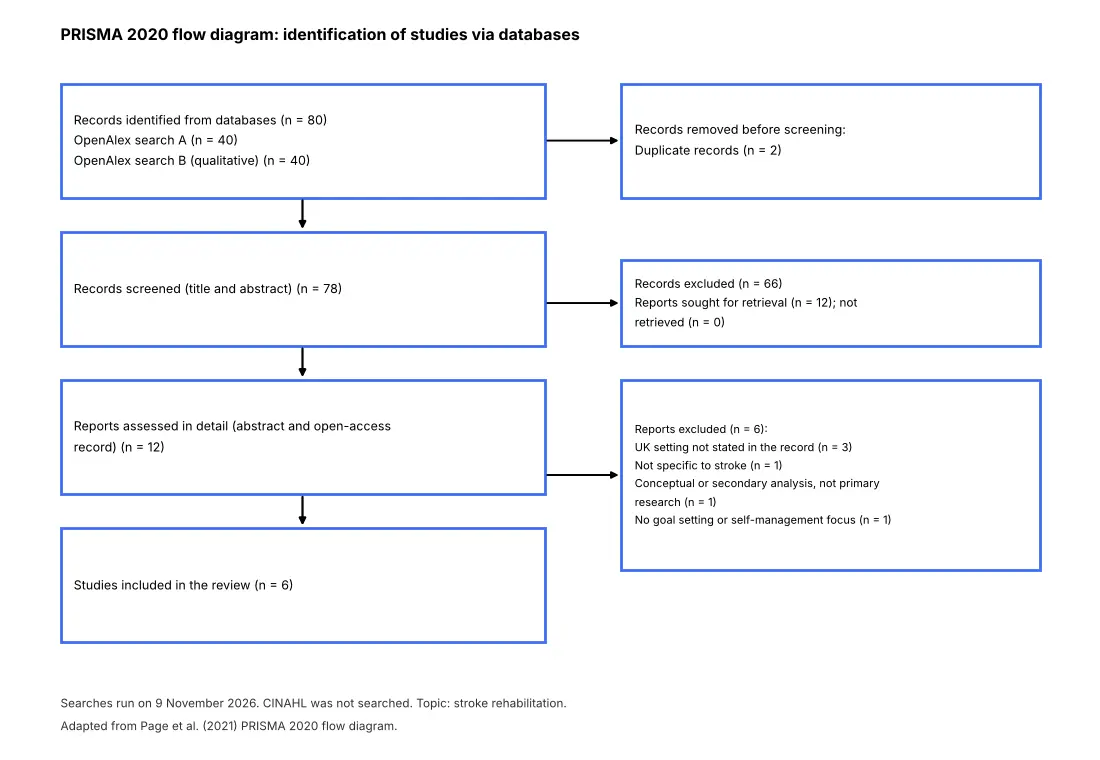
This literature-based dissertation is a structured review of published primary research on stroke rehabilitation. It aims to be transparent and reproducible, but it is smaller in scope than a full systematic review, which would normally involve several reviewers, many more databases and exhaustive searching (Aveyard, 2023). The review is reported with reference to the PRISMA 2020 statement, which lists the items that should be described and recommends a flow diagram showing how records move through identification, screening and inclusion (Page et al., 2021). Appendix D presents that flow diagram, Appendix A records each search string, Appendix B tabulates the included studies and Appendix C gives a worked critical appraisal. Together, the appendices allow another reader to check each decision and to repeat the process.
The review question was framed using the Population, Exposure and Outcome (PEO) structure, which suits questions about experiences and influencing factors rather than the effects of a treatment. The population was adults who have had a stroke, together with the professionals who deliver their rehabilitation. The exposure was goal setting and self-management support in rehabilitation, and the outcomes were experiences, engagement and perceived outcomes. Structured frameworks help to translate a broad topic into searchable concepts, although the choice of framework affects how sensitive a search is (Methley et al., 2014; Aveyard, 2023). Because the question concerned experiences, qualitative, mixed-methods and other primary research were all eligible for inclusion.
Two searches were run on 9 November 2026 in OpenAlex, an open index of scholarly works that covers a large and growing proportion of the published literature (Priem et al., 2022). The first search combined the phrases stroke rehabilitation and goal setting. The second combined stroke, the phrase self-management and the word qualitative, to capture studies of experience. Both searches were limited to open-access records published between 2015 and 2026 with at least one author affiliated to a UK institution. Both searches were restricted to journal articles. Combining more than one source is advised because a single database misses relevant studies (Bramer et al., 2017). The exact strings and settings are given in Appendix A.
CINAHL, the main nursing database, could not be accessed, and a planned search of MEDLINE through Europe PMC was not completed because the service refused repeated requests on the day of searching. The second OpenAlex search was therefore used in its place. These gaps mean that some relevant nursing studies may not have been found, a risk that is well recognised when the combination of databases is restricted (Bramer et al., 2017). OpenAlex matches terms anywhere in the text, so many records were not relevant. It also ranks records by relevance, and the two searches matched 385 and 2,275 records. Only the first 40 records of the first search and the first 40 of the second, 80 in total, were screened, so the review should be read as a structured sample of the literature and not as a complete search (Aveyard, 2023).
Studies were eligible if they involved adults after stroke, family carers or rehabilitation professionals, examined goal setting or self-management support in inpatient or community rehabilitation, and reported experiences, engagement or perceived outcomes. Reports had to be peer-reviewed, written in English, open access and published from 2015 onwards. UK origin was judged from the stated setting and, where the abstract did not name one, from author affiliations. Protocols, reviews, conceptual papers, studies outside the UK and studies that did not concern goal setting or self-management were excluded. Clear criteria applied consistently reduce selection bias and allow the decisions to be audited. The extraction table is presented in Appendix B so that readers can compare studies at a glance (Page et al., 2021; Aveyard, 2023).
All 80 records were exported into a screening log, and 2 duplicates were removed, leaving 78 titles to screen. Titles that clearly concerned another condition, physical activity, technology development, protocols or trials were excluded at this stage. That left 12 reports for closer assessment against the criteria. The abstract and open-access record of each of these reports were read, and the reason for every exclusion was recorded. The log lists every record by its identifier, the search in which it appeared and the decision reached, so that each exclusion can be traced. Six studies met the criteria, and the numbers at each stage reconcile in the flow diagram (Page et al., 2021). Screening was carried out by one reviewer, which is a recognised limitation of student reviews because a second reviewer would normally check each decision (Aveyard, 2023).
Quality was considered using the Critical Appraisal Skills Programme checklists, which ask structured questions about the aims, design, conduct, results and value of a study (CASP, 2024). The qualitative checklist was completed in full for one study, as a worked example in Appendix C, and indicative quality notes for every study are recorded in Appendix B. Those notes are based on the abstract and, for one study, the open full text, so they are judgements of reporting and not a full audit of how the research was conducted. No study was excluded on quality alone, since appraisal was used to weigh the strength of the findings, which is a common approach in nursing reviews (Aveyard, 2023).
Data were extracted into a standard table covering aims, design, sample, setting, methods, findings and limitations. Numerical results were copied as reported and were not recalculated, and extraction was rechecked once against the source records, a step that reduces transcription errors but does not replace independent checking. Findings were grouped into themes by thematic synthesis, with numerical results reported alongside qualitative themes because the review combined interview, survey and documentary evidence (Thomas and Harden, 2008; Braun and Clarke, 2006). The review used published data only and involved no participants, so ethical approval was not required, although the findings of the included studies are reported accurately and with full attribution (Aveyard, 2023).
Findings
Six UK studies met the inclusion criteria, published between 2015 and 2023. One interviewed 13 stroke survivors admitted to a London stroke unit and 13 physiotherapists, 8 from an inpatient unit and 5 from community services (Sadler et al., 2017). One combined an electronic questionnaire for multidisciplinary teams with an analysis of goal-setting documentation from five inpatient stroke units, recruiting 13 therapists and 49 patients and examining 351 goals (Plant and Tyson, 2018). These two studies describe how professionals understand and practise goal setting, and the third used focus groups, a training questionnaire and case note review with 55 staff in three Scottish community rehabilitation teams (Scobbie et al., 2020).
Three further studies explored views of rehabilitation and self-management, two in Scotland and one based around Glasgow. A Q methodology study asked 20 stroke survivors, 20 community-based stroke clinicians and 8 team managers across four health boards to rank 32 statements about supported self-management (Duncan Millar et al., 2023). A qualitative study nested in a feasibility trial interviewed 17 stroke survivors and five carers about augmented arm rehabilitation that included supported self-management (Schnabel et al., 2021). A mixed-methods study developed and evaluated a nurse-led, tailored self-management intervention with 26 stroke survivors and 16 stroke nurses from three NHS Boards (Kidd et al., 2015).
Meanings of self-management in stroke rehabilitation
Understandings of self-management differed between survivors and professionals. Stroke survivors in London were unfamiliar with the term, although they could describe it as looking after oneself and doing things for themselves. They did not see self-management as part of their care, but they valued therapists as encouraging experts in their recovery. Physiotherapists described a process in which survivors take an active role in rehabilitation and in managing their recovery and health, and their views varied with the context in which they worked (Sadler et al., 2017). The Q methodology study likewise found that views on what matters in supporting self-management differed between participants (Duncan Millar et al., 2023).
Both groups in the London study identified individual, social and organisational factors that enable or hinder self-management, and individual and organisational barriers were most evident in the early stages after stroke (Sadler et al., 2017). In the Q study, four shared viewpoints emerged: a person-centred approach that builds self-confidence and self-worth, feeling heard, understood and supported by everyone, preparing appropriate resources, and having the right support in the right place at the right time. Across all four, a trusting and supportive relationship, working in partnership, focusing on meaningful goals and building self-confidence were consistently important (Duncan Millar et al., 2023).
Goal setting in stroke rehabilitation practice
Goal setting in five inpatient units was led by therapists. Of 351 documented goals, therapists set 60%, and 72% were patient-focused, although patients and families were rarely directly involved. Basic mobility goals made up about 50% of goals and activities of daily living about 25%. Only 41% of documented goals met SMART criteria, and 48% were never reviewed; among those reviewed, 24% were marked as ongoing with no date or completion plan. New goals were often documented without a link to previous goals (Plant and Tyson, 2018). This weak review contrasts with the structured approach later tested in community teams (Scobbie et al., 2020).
The Goal setting and action planning framework, which includes staff training and a stroke survivor-held record, was delivered for six months by three Scottish community teams after training. Of 55 staff, 93% (51) attended the training, 80% (41) of those completed the questionnaire and 92% (37) of those rated the training good or very good. The framework was implemented broadly as intended in two teams, where staff said it made sense, was used repeatedly, could be delivered flexibly and had a positive effect. In the third team it did not gain traction, because of delays between training and implementation, limited leadership engagement, poor fit with the team’s structure and the use of other goal-setting methods (Scobbie et al., 2020). The less structured recording of goals in the inpatient units suggests why a shared framework may be attractive to teams (Plant and Tyson, 2018).
Person-centred goal setting was a point of agreement. In the Q study, focusing on meaningful goals was important in all four viewpoints (Duncan Millar et al., 2023). In the nurse-led intervention, goal setting and motivational interviewing were combined with a tailored self-management action plan and an individual assessment of readiness to self-manage, using the Patient Activation Measure (Kidd et al., 2015). Many components were judged feasible and acceptable by both stroke survivors and stroke nurses, and the authors described the work as the first UK study to use patient activation as the theoretical basis for stroke self-management research (Kidd et al., 2015).
Supported self-management in stroke rehabilitation
The nurse-led intervention was developed in two phases, using the Medical Research Council guidance for complex interventions and patient activation theory, with interviews and focus groups in both phases. The participants were 26 stroke survivors, between 3 and 12 months after stroke, and 16 stroke nurses from three NHS Boards (Kidd et al., 2015). Survivors and nurses helped to design a tailored, person-centred intervention for people living at home in the first year after stroke. The authors concluded that further work was needed to refine it and to establish how to embed it in the routine practice of nurses (Kidd et al., 2015). The emphasis on nurses echoes the finding that survivors valued professionals as encouraging experts (Sadler et al., 2017).
Survivors and carers also described supported self-management within an arm rehabilitation programme that provided 27 additional hours over six weeks, including therapist-led sessions and supported self-management. Three themes emerged: acceptability of the intervention, supported self-management and coping with the intervention. All survivors coped well with the intensity of the programme, and most engaged in supported self-management and built the activities into their daily routines. Some survivors, who were male and over 70 years old, found self-management difficult and needed more support (Schnabel et al., 2021). This agrees with the tailoring to readiness to self-manage in the nurse-led intervention (Kidd et al., 2015).
Barriers operated at several levels. Survivors and physiotherapists identified individual and organisational barriers, which were most evident early after stroke (Sadler et al., 2017). Staff in one community team described limited leadership engagement and poor fit with the organisational structure as barriers to implementing a goal-setting framework (Scobbie et al., 2020), and the older men in the arm rehabilitation study needed more support to self-manage (Schnabel et al., 2021). These accounts suggest that difficulty with self-management reflects the setting and timing of support as well as the individual survivor, so support needs to be planned as part of the rehabilitation pathway. Timing matters in particular, because the barriers were reported most clearly in the early weeks.
Patterns across stroke rehabilitation studies
Three patterns ran through the studies. First, relationships mattered, and a trusting, supportive partnership was important in all four viewpoints in the Q study (Duncan Millar et al., 2023). Second, goals were often set by professionals, with limited direct involvement of patients and families and weak review (Plant and Tyson, 2018). Third, structured frameworks were feasible and acceptable to many staff but depended on how well they were implemented locally (Scobbie et al., 2020). Together, these patterns suggest that the quality of goal setting and self-management support depends as much on relationships and organisation as on the techniques used in stroke rehabilitation.
The studies heard some voices more than others. The London interview study excluded survivors with severe communication or cognitive impairment, and the survivors interviewed were mostly well recovered (Sadler et al., 2017). In the goal documentation study, patients and families were rarely directly involved in setting goals (Plant and Tyson, 2018). The arm rehabilitation study interviewed survivors and carers who had completed the programme, so the views of people who did not complete it are unknown (Schnabel et al., 2021). It is therefore not possible to judge from this evidence how survivors with severe impairment experience goal setting and self-management.
The qualitative studies were modest in size. The London study included 13 survivors and 13 physiotherapists from one stroke unit and two community services, and its authors acknowledged a small sample, a mostly well-recovered group of survivors and the possibility of recall bias (Sadler et al., 2017). The nested qualitative study drew on participants in a feasibility trial (Schnabel et al., 2021), and the nurse-led intervention was developed in one country with a small group of nurses (Kidd et al., 2015). Findings from these studies should therefore be transferred to other settings with caution, and they describe what participants said more than what they did.
The remaining studies had different limits. The goal documentation analysis described practice in five units, and its abstract did not report how survivors felt about their goals (Plant and Tyson, 2018). The implementation study covered three teams, one of which did not adopt the framework (Scobbie et al., 2020). The Q methodology study identified shared viewpoints but drew its sample from four health boards in Scotland (Duncan Millar et al., 2023). The findings should therefore be read as a consistent pattern across several UK settings and not as definitive evidence, and none of the studies could be judged free of limitation. Appendix B records the indicative quality notes for each one.
Wider Discussion
The findings show that goal setting and self-management are understood differently by survivors and professionals, and that this shapes how stroke rehabilitation is experienced. Survivors were unfamiliar with the term self-management and did not see it as part of their care, although they valued encouraging therapists (Sadler et al., 2017). This matters because national guidance expects goal setting and self-care to be planned within rehabilitation (NICE, 2023). Where goals were set by therapists and rarely reviewed (Plant and Tyson, 2018), survivors may have little chance to link them to their own priorities. Goal setting that is shared, reviewed and meaningful to the survivor is therefore more likely to support engagement in rehabilitation, although the studies did not test this directly.
The experiential evidence sits alongside trial evidence of uncertain strength. A Cochrane review of goal setting in adults with acquired disability judged the evidence of benefit to be of very low quality (Levack et al., 2015), whereas a review of self-management programmes after stroke, including 14 trials with 1,863 participants, found improved quality of life and self-efficacy (Fryer et al., 2016). The qualitative findings help to explain why programmes may work, since a tailored, nurse-led intervention was acceptable to survivors and nurses (Kidd et al., 2015). They also show that benefit is unlikely to follow unless survivors understand what self-management means, which is a practical message for every member of the team and one that nurses are well placed to deliver.
For nursing practice, the review suggests three priorities. The first is to explain self-management in plain language and to ask survivors what it means to them, because understanding differed between groups (Sadler et al., 2017). The second is to involve survivors and families directly in setting and reviewing goals, and to record goals so that they meet SMART criteria and link to action plans (Plant and Tyson, 2018). The third is to plan how new approaches will be embedded, including training, leadership support and local tailoring (Scobbie et al., 2020). Each priority fits within the planning, delivery and evaluation of care that registered nurses already undertake, and similar principles apply in motor neurone disease care, where goals and self-management also change over time.
Several limitations qualify these conclusions. Only one database, OpenAlex, was searched, in two searches, and CINAHL was not accessible, so relevant studies may have been missed. Eighty records were identified, 78 were screened after duplicates were removed and only the first 40 of each search could be screened. Eligibility was judged by a single reviewer and most appraisal relied on abstracts, which is reported in line with PRISMA (Page et al., 2021). Most studies were set in Scotland or London, so experiences elsewhere in the UK are not captured, and future research on stroke rehabilitation should include survivors with communication or cognitive impairment (Sadler et al., 2017) and should test whether nurse-led approaches improve outcomes for survivors and carers. Larger studies of experience across several regions of the UK would also help to show whether these patterns hold more widely.
Reflection
Writing this review changed my view of what self-management means in stroke care. At the start I assumed that it described something survivors do for themselves once professionals step back. The evidence showed that survivors were often unfamiliar with the term, that they valued encouraging professionals, and that the support offered depended heavily on the organisation and the timing. That moved my attention from the survivor’s responsibility to the relationship around them. As a student nurse I have often written goals on a care plan without asking whether the patient recognised them as their own, and I now see that this question may matter as much as the goal itself. I also realise that I rarely explained what self-management meant, and that I assumed patients knew.
The search taught me how many decisions sit behind a list of included studies. Two searches returned 80 records, and many of them concerned technology, physical activity or other conditions, so I had to read titles and abstracts carefully to find the few that fitted my question. Three studies that seemed promising came from Austria and Sweden, and I excluded them because the UK setting was not stated, even though I would have liked to include them. That was frustrating, but it showed me that clear criteria protect a review from my own preferences, and that every exclusion needs a recorded reason. I also learned to keep a log of every record so that my decisions could be checked.
Appraisal was the most demanding stage. Completing the CASP checklist in full for one qualitative study showed me how much a paper can leave unsaid. The study described its ethics approval and sampling carefully, yet it said nothing about the researcher’s influence, and I could not tell how many physiotherapists had been approached. I also noticed that I was inclined to trust a study more when it matched my own expectations. This has made me more careful to describe my appraisal as indicative when I could read only an abstract, and to look for evidence that a finding was challenged, not only confirmed. Reading the full text of one study also showed me how much detail an abstract leaves out.
Looking ahead, I will bring three things to practice. I will ask survivors what self-management means to them before I explain it, I will involve survivors and families directly when goals are set and reviewed, and I will check whether goals are written so that progress can be judged. I also need to strengthen my skills in synthesising different kinds of evidence, because combining interview themes with audit figures was harder than I expected. I can review these goals with my practice supervisor and academic tutor, and I intend to return to them as my experience grows. I also want to keep asking survivors what they make of the goals set with them.
Conclusion
This dissertation set out to review UK evidence on the experiences of stroke survivors and professionals of goal setting and self-management support in stroke rehabilitation. Six UK studies, comprising interview, mixed-methods, documentary and Q methodology research, showed that survivors and professionals understand self-management differently, that goals are often set by professionals and rarely reviewed, and that relationships and organisation shape how support is experienced. The review therefore answers the question by showing that the experience of rehabilitation depends on partnership as much as on technique, and it identifies where nurses can act. The evidence is consistent although modest in size.
Survivors were often unfamiliar with the term self-management but valued encouraging professionals. Goal setting was therapist-led in inpatient units, with limited direct involvement of survivors and families and incomplete review. Structured frameworks and a nurse-led, tailored intervention were feasible and acceptable to many staff and survivors, although they depended on leadership, training and local fit, which suggests that implementation needs as much attention as design. Barriers were most evident early after stroke, and some older men needed extra support to self-manage. These findings were consistent across studies of different design.
For nursing practice, the review supports explaining self-management in plain language, involving survivors and families directly in goals, recording goals so that progress can be judged, and planning how new approaches are embedded. The strength of this evidence is limited by the restricted search, single-reviewer screening and reliance on abstracts, so the conclusions are best treated as a well-evidenced starting point for local audit. Future research should include survivors with communication or cognitive impairment and settings across the UK, and should test nurse-led approaches in practice.
Reference List
Aveyard, H. (2023) Doing a literature review in health and social care: a practical guide. 5th edn. Open University Press.
Bramer, W.M. et al. (2017) ‘Optimal database combinations for literature searches in systematic reviews: a prospective exploratory study’, Systematic Reviews, 6, article 245. doi:10.1186/s13643-017-0644-y.
Braun, V. and Clarke, V. (2006) ‘Using thematic analysis in psychology’, Qualitative Research in Psychology, 3(2), pp. 77-101. doi:10.1191/1478088706qp063oa.
CASP (2024) CASP checklists. Oxford: Critical Appraisal Skills Programme. Available at: https://casp-uk.net/casp-checklists/ (Accessed: 9 November 2026).
Duncan Millar, J. et al. (2023) ‘What is important in supporting self-management in community stroke rehabilitation? A Q methodology study’, Disability and Rehabilitation, 45(14), pp. 2307-2315. doi:10.1080/09638288.2022.2087766.
Fryer, C.E. et al. (2016) ‘Self management programmes for quality of life in people with stroke’, Cochrane Database of Systematic Reviews, article CD010442. doi:10.1002/14651858.CD010442.pub2.
Intercollegiate Stroke Working Party (2023) National clinical guideline for stroke. Available at: https://www.strokeguideline.org/ (Accessed: 9 November 2026).
Kidd, L. et al. (2015) ‘Development and evaluation of a nurse-led, tailored stroke self-management intervention’, BMC Health Services Research, 15, article 359. doi:10.1186/s12913-015-1021-y.
Levack, W.M.M. et al. (2015) ‘Goal setting and strategies to enhance goal pursuit for adults with acquired disability participating in rehabilitation’, Cochrane Database of Systematic Reviews, 2015(7), article CD009727. doi:10.1002/14651858.CD009727.pub2.
Methley, A.M. et al. (2014) ‘PICO, PICOS and SPIDER: a comparison study of specificity and sensitivity in three search tools for qualitative systematic reviews’, BMC Health Services Research, 14, article 579. doi:10.1186/s12913-014-0579-0.
National Institute for Health and Care Excellence (NICE) (2023) Stroke rehabilitation in adults (NICE guideline NG236). London: NICE. Available at: https://www.nice.org.uk/guidance/ng236 (Accessed: 9 November 2026).
Nursing and Midwifery Council (NMC) (2018) Future nurse: standards of proficiency for registered nurses. London: NMC.
Page, M.J. et al. (2021) ‘The PRISMA 2020 statement: an updated guideline for reporting systematic reviews’, BMJ, 372, article n71. doi:10.1136/bmj.n71.
Plant, S. and Tyson, S.F. (2018) ‘A multicentre study of how goal-setting is practised during inpatient stroke rehabilitation’, Clinical Rehabilitation, 32(2), pp. 263-272. doi:10.1177/0269215517719485.
Priem, J., Piwowar, H. and Orr, R. (2022) ‘OpenAlex: a fully-open index of scholarly works, authors, venues, institutions, and concepts’, arXiv, 2205.01833. doi:10.48550/arXiv.2205.01833.
Sadler, E. et al. (2017) ‘Exploring stroke survivors’ and physiotherapists’ views of self-management after stroke: a qualitative study in the UK’, BMJ Open, 7(3), article e011631. doi:10.1136/bmjopen-2016-011631.
Schnabel, S. et al. (2021) ‘Experiences of augmented arm rehabilitation including supported self-management after stroke: a qualitative investigation’, Clinical Rehabilitation, 35(2), pp. 288-301. doi:10.1177/0269215520956388.
Scobbie, L. et al. (2020) ‘Facilitators and “deal breakers”: a mixed methods study investigating implementation of the Goal setting and action planning (G-AP) framework in community rehabilitation teams’, BMC Health Services Research, 20, article 791. doi:10.1186/s12913-020-05651-2.
Thomas, J. and Harden, A. (2008) ‘Methods for the thematic synthesis of qualitative research in systematic reviews’, BMC Medical Research Methodology, 8, article 45. doi:10.1186/1471-2288-8-45.
Appendix A: Search strategy
This appendix records the searches run for the stroke rehabilitation review so that the process can be repeated and checked.
Two searches on stroke rehabilitation were run on 9 November 2026 using the OpenAlex works API. The first 40 records of the first search and the first 40 of the second, ranked by relevance, were retrieved and screened by title and abstract.
| Database | Platform | Date run | Search string | Limiters | Hits |
|---|---|---|---|---|---|
| OpenAlex search A | OpenAlex API | 9 November 2026 | search=”stroke rehabilitation” AND “goal setting” | Filter: authorships.countries:GB; is_oa:true; publication_year:2015-2026; type:article. 385 matches in total; the first 40 by relevance were screened. | 40 |
| OpenAlex search B (qualitative) | OpenAlex API | 9 November 2026 | search=stroke AND “self-management” AND qualitative | Filter: authorships.countries:GB; is_oa:true; publication_year:2015-2026; type:article. 2,275 matches in total; the first 40 by relevance were screened. | 40 |
CINAHL could not be accessed and was not searched, so no CINAHL results are reported. A planned MEDLINE search through Europe PMC was attempted on the same day but the service refused repeated requests, so it was not completed for stroke rehabilitation; search B, which targeted qualitative studies of self-management, was used instead.
OpenAlex matches search terms in the title, abstract or full text, and the country filter matches any record with at least one author affiliated to a UK institution. UK setting and relevance were therefore checked for each study at the assessment stage. Records identified: 80 (40 + 40); duplicates removed: 2; records screened: 78.
Appendix B: Data extraction table
The table summarises each study included in this stroke rehabilitation review: its aim, design, sample, methods, key findings, limitations and relevance to stroke rehabilitation.
| Author / year / country | Aim | Design | Sample and setting | Methods | Key findings | Limitations / quality | Relevance to stroke rehabilitation |
|---|---|---|---|---|---|---|---|
| Sadler et al. (2017), UK (London) | To explore how stroke survivors and physiotherapists understand self-management after stroke, and what enables or hinders it in stroke rehabilitation. | Qualitative study: semi-structured interviews with thematic analysis. | 13 stroke survivors (8 men, 5 women, aged 53 to 89) admitted to a London stroke unit, and 13 physiotherapists (8 inpatient, 5 community). | Interviews on stroke rehabilitation of 30 to 90 minutes, audio-recorded; purposive sampling; coding in NVivo. | Survivors were unfamiliar with the term, defined it as doing things for yourself, did not see it as part of their care and valued therapists as encouraging experts. Physiotherapists saw an active role for survivors. Individual, social and organisational factors enabled or hindered self-management, with individual and organisational barriers most evident early after stroke. | CASP qualitative appraisal in Appendix C (open full text). Small sample; mostly well-recovered survivors; one professional group; severe communication or cognitive impairment excluded. | Meanings of self-management in stroke rehabilitation for survivors and professionals. |
| Plant and Tyson (2018), UK (setting not named; Manchester authors) | To describe how goal setting is practised during inpatient stroke rehabilitation. | Two-stage study: an electronic questionnaire for multidisciplinary teams and an analysis of patients’ goal-setting documentation. | Five inpatient stroke units; 13 therapists and 49 patients recruited; 351 documented goals examined. | Questionnaire and documentary analysis of stroke rehabilitation goals, including SMART criteria, review and links to treatment. | In stroke rehabilitation, goal setting was therapist-led (60% of goals set by therapists); 72% of goals were patient-focused but patients and families were rarely directly involved; 41% met SMART criteria; 48% were never reviewed; links between goals, treatment and action plans were patchy. | Indicative (abstract only): UK setting inferred from affiliations; five units; documentation may not reflect conversations in stroke rehabilitation. | How goal setting works in practice in stroke rehabilitation. |
| Scobbie et al. (2020), UK (Scotland) | To investigate implementation of the Goal setting and action planning framework in diverse community stroke rehabilitation teams. | Mixed-methods study: focus groups, a training questionnaire and case note review, using the Framework approach and Normalisation Process Theory. | Three community rehabilitation teams with 55 staff; 51 (93%) attended training; 41 (80%) completed the questionnaire. | Framework delivered in stroke rehabilitation for six months after training; fidelity and staff experience assessed. | In stroke rehabilitation teams, 92% (37 of 41) rated training good or very good. Implemented as intended in two teams (it made sense, repeated use, flexible delivery); no traction in a third (delays, limited leadership engagement, poor fit, other goal-setting methods). Staff wanted implementation planning, tailoring and aphasia-friendly electronic records. | Indicative (abstract only): three teams; staff views rather than survivors’ views; implementation study of one framework in stroke rehabilitation. | Staff experiences of goal setting in community stroke rehabilitation. |
| Duncan Millar et al. (2023), UK (Scotland) | To identify what is most important in supporting self-management in community stroke rehabilitation. | Q methodology study with factor analysis of ranked statements. | 20 stroke survivors, 20 community-based stroke clinicians and 8 team managers across four health boards. | Participants ranked 32 statements about stroke rehabilitation by importance; factor analysis identified shared viewpoints. | Four stroke rehabilitation viewpoints: person-centred approach building self-confidence and self-worth; feeling heard, understood and supported; preparing resources; right support in the right place at the right time. In all, a trusting relationship, partnership, meaningful goals and self-confidence were important. | Indicative (abstract only): sample from four Scottish health boards; viewpoints on stroke rehabilitation not generalisable to other settings. | Shared priorities for self-management support in stroke rehabilitation. |
| Schnabel et al. (2021), UK (Glasgow) | To explore survivors’ and carers’ experiences of augmented arm rehabilitation with supported self-management as part of stroke rehabilitation. | Qualitative study nested in a multi-centre randomised feasibility trial, using Normalization Process Theory and framework analysis. | 17 stroke survivors and five carers interviewed after completing the programme. | Semi-structured interviews about stroke rehabilitation at home, at Glasgow Caledonian University and in hospital. | Three stroke rehabilitation themes: acceptability, supported self-management, coping. All survivors coped well; most built activities into daily routines; some men over 70 years found self-management difficult and needed more support. | Indicative (abstract only): interviewed completers only; nested in a trial of stroke rehabilitation; country not named in the abstract, Glasgow setting. | Experience of supported self-management within stroke rehabilitation. |
| Kidd et al. (2015), UK (Scotland) | To develop and evaluate a stroke self-management intervention, for use in stroke rehabilitation, tailored to survivors’ needs, goals and activation levels. | Mixed-methods development and evaluation guided by Medical Research Council complex intervention guidance and patient activation theory. | 26 stroke survivors (3 to 12 months post-stroke) and 16 stroke nurses from three NHS Boards. | Interviews and focus groups on stroke rehabilitation in two phases. | The nurse-led intervention (tailored action plan, Patient Activation Measure, goal setting, motivational interviewing) had many components judged feasible and acceptable by survivors and nurses; further work was needed to embed it in nurses’ routine practice. | Indicative (abstract only): early development study for stroke rehabilitation; small samples; effectiveness not tested. | Nurse-led support for self-management in stroke rehabilitation. |
Appendix C: Critical appraisal checklist
CASP qualitative studies checklist (CASP, 2024), completed for Sadler et al. (2017), a study included in this stroke rehabilitation review. Answers: Yes, No or Can’t tell, each with a short justification.
| # | Question | Answer | Justification |
|---|---|---|---|
| Section A: Are the results valid? | |||
| 1 | Was there a clear statement of the aims of the research? | Yes | The aim is stated clearly: to explore stroke survivors’ and physiotherapists’ views of self-management after stroke, including what it means and what enables or hinders it in stroke rehabilitation. |
| 2 | Is a qualitative methodology appropriate? | Yes | Qualitative methods suit a question about meaning, and the authors justify them by limited earlier work on how survivors and professionals understand self-management, although no epistemological stance is stated. |
| 3 | Was the research design appropriate to address the aims of the research? | Can’t tell | Semi-structured interviews with thematic analysis suit the aims, but it is not stated whether coding was inductive or deductive, and the topic guide’s piloting is not reported. |
| 4 | Was the recruitment strategy appropriate to the aims of the research? | Can’t tell | Survivors were purposively sampled for gender, ethnicity, age and function through a senior physiotherapist, which may act as gatekeeping; 13 of 17 invited consented, and the number of physiotherapists approached is not reported. |
| 5 | Was the data collected in a way that addressed the research issue? | Yes | Stroke rehabilitation interviews of 30 to 90 minutes were held at home or at the workplace, audio-recorded, with a topic guide for each group and field notes; saturation was judged by the first author. |
| 6 | Has the relationship between researcher and participants been adequately considered? | Can’t tell | The first author’s background in physiotherapy and social science is stated, but there is no discussion of how this or earlier observation of participants shaped the interviews on stroke rehabilitation. |
| Section B: What are the results? | |||
| 7 | Have ethical issues been taken into consideration? | Yes | For this stroke rehabilitation study, ethics approval from a London research ethics committee is reported, with written informed consent after an in-person explanation. |
| 8 | Was the data analysis sufficiently rigorous? | Can’t tell | In the stroke rehabilitation data, thematic analysis in NVivo with a coding tree refined by two authors is described, but contradictory cases and respondent validation are not reported. |
| 9 | Is there a clear statement of findings? | Yes | Two groups of stroke rehabilitation themes are presented with labelled quotations and occasional counts, and group differences are discussed. |
| Section C: Will the results help locally? | |||
| 10 | How valuable is the research? | Yes | The study is the first to compare survivors’ and physiotherapists’ views in one study, and the authors give implications for language, strategies and timing in stroke rehabilitation, with limitations stated. |
Appendix D: PRISMA flow diagram
This dissertation is a worked example that shows the structure and standard of a 5,000-word literature-based Independent Project. It is provided for learning and is not to be submitted as a student’s own work.