

Delivering Compassionate Nursing Care in NHS Settings: Patient and Nurse Perspectives and Interventions
 By Dr. Robertson Prime, Research Fellow
This dissertation is a worked example that shows the structure and standard of a 5,000-word literature-based Independent Project. It is provided for learning and is not to be submitted as a student’s own work.
Abstract
Background: Compassion is described as a hallmark of quality care, and compassionate nursing care became a policy priority in the UK after the Mid Staffordshire inquiry. Less is known about how it is delivered, hindered and strengthened in everyday NHS practice from the viewpoint of patients and nurses.
Aim: To critically review UK evidence on the factors that support or hinder compassionate nursing care in NHS settings.
Methods: A structured literature review using the Population, Exposure and Outcome framework. OpenAlex was searched twice on 9 November 2026, because CINAHL could not be accessed and a planned MEDLINE search was not completed. The first 40 records of each search were screened: 80 records were identified, 79 screened after the removal of a duplicate and 10 UK studies included. Quality was considered using Critical Appraisal Skills Programme questions, and findings were combined by thematic synthesis.
Findings: The included studies of compassionate nursing care (n = 10) comprised a pilot trial and its process evaluation, an evaluation of intentional rounding, qualitative studies of staff, leaders and patients, and a mixed-methods study of compassion fatigue. Patients valued small acts of attention, the capacity of nurses to be compassionate depended on organisational conditions and support, and interventions that changed team behaviour without changing wider systems had limited reach.
Conclusions and implications for practice: For compassionate nursing care, nurses can protect time to talk and to meet fundamental needs, teams can support nurses’ wellbeing, and services can judge compassion by observing interactions and listening to patients. The evidence is limited by the restricted search, single-reviewer screening, reliance on abstracts and the small number of intervention studies.
Keywords: compassionate nursing care; patient experience; nurse wellbeing; adult nursing; literature review.
Brief at a glance
- Framework
- PEO
- Design
- Literature review (PEO)
- Studies included
- 10
- Field
- Adult Nursing
Introduction
Compassion is widely regarded as a core value of nursing, yet it is also one of the least well understood elements of quality care. Patients, providers, administrators and policy makers all describe compassion as a hallmark of good care, but its meaning has rarely been examined from the viewpoint of the people who receive it (Sinclair et al., 2016). In the UK, public attention turned to the subject after the public inquiry into Mid Staffordshire NHS Foundation Trust, which found that many patients had suffered severely between 2005 and 2009 and that a negative culture had tolerated poor standards (Francis, 2013). Compassionate nursing care has since become a policy priority, but how it is delivered, hindered and strengthened in everyday NHS practice remains open. Understanding what supports compassion in practice, and what undermines it, is therefore a priority for adult nursing and for the services in which nurses work.
Nurses are at the centre of this question. The Nursing and Midwifery Council expects nurses to treat people with kindness, respect and compassion and to make sure that the fundamentals of care are delivered effectively (NMC, 2018), and national strategy has asked nursing, midwifery and care staff to describe their values in terms of care, compassion, competence, communication, courage and commitment (Cummings and Bennett, 2012). This dissertation reviews UK research on the factors that support or hinder compassionate nursing care in NHS settings, and on interventions designed to strengthen it. It follows a structured process so that each decision can be checked. Another review examines urinary catheter care, an intimate area of practice in which kindness and respect matter especially. The review is limited to the UK so that its conclusions fit NHS services.
Background and Justification
Compassion has been defined in several ways, and one of the clearest empirical accounts comes from patients. In a grounded theory study of 53 patients with advanced cancer who were recruited from a specialist palliative care setting in Canada, the researchers developed what they described as the first empirically based clinical model of compassion. It defines compassion as a virtuous response that seeks to address the suffering and needs of a person through relational understanding and action (Sinclair et al., 2016). That definition places action alongside understanding. It also fits the professional expectation, set out in the Code of the Nursing and Midwifery Council, that nurses will treat people with kindness, respect and compassion (NMC, 2018).
Concern about compassion in the NHS was sharpened by the Mid Staffordshire inquiry. The inquiry, led by Robert Francis QC and published in 2013, examined the period from 2005 to 2009, when many patients suffered severely. It attributed the failures mainly to the trust board’s failure to act on patient concerns and to a negative culture that tolerated poor standards, in which pressure to meet national targets, balance the budget and gain foundation trust status took priority over the quality of care (Francis, 2013). Compassion is frequently named as a hallmark of quality care, even though an empirical understanding of it has been lacking (Sinclair et al., 2016). The inquiry found systemic failures at every level and did not blame individuals alone.
The report made 290 recommendations, grouped into five categories. Several concerned nursing directly: applicants for nursing posts should be assessed for aptitude and commitment to patient welfare, training standards should cover compassionate care, nurses should have a stronger voice in leadership, and healthcare support workers should be registered (Francis, 2013). Others addressed fundamental standards, openness and candour, and leadership. The recommendations placed duties on organisations as well as on individuals, which matters for this review because compassion is shaped by the conditions in which nurses work. National strategy had already set out its own vision for nursing, midwifery and care staff (Cummings and Bennett, 2012).
Compassion in Practice, launched by England’s Chief Nursing Officer, Jane Cummings, and the Department of Health’s Director of Nursing, Viv Bennett, was a three-year strategy for nursing, midwifery and care staff that followed an eight-week consultation with more than 9,000 nurses, midwives, care staff and patients. It set out six areas of action, including building and strengthening leadership and supporting staff experience, and it packaged long-standing ideas as the 6Cs of care, compassion, competence, communication, courage and commitment (Cummings and Bennett, 2012). The 6Cs give staff a shared language for their values and tell patients what to expect, and they sit alongside the professional standard that nurses prioritise people (NMC, 2018).
The conditions of work matter because compassion cannot be delivered without time and staff. The strategy recommended that trust boards publish evidence-based staffing levels at least every six months and included an area of action on getting the right staff with the right skills into the right roles (Cummings and Bennett, 2012). The inquiry found that cost-cutting year after year had weakened the trust’s ability to provide safe care, and that a review of the shortage of skilled nurses progressed slowly because financial goals came first (Francis, 2013). The Code asks nurses to prioritise people, practise effectively, preserve safety and promote professionalism and trust, so these duties depend partly on the conditions in which nurses work (NMC, 2018).
Policy and professional standards say what compassionate nursing care should look like, but they say less about how it is experienced and delivered on wards and in the community. Patients’ own perspectives were described as lacking when the model of compassion was developed (Sinclair et al., 2016), so a review has to draw together research that has asked patients, family carers, nurses and managers directly. Such evidence is varied, because compassion has been studied through interviews, focus groups, observation and trials. A literature review can bring that evidence together, provided that it follows a transparent method and states its limits clearly (Aveyard, 2023).
This review was framed using a structure that separates the population, the exposure and the outcome (Methley et al., 2014). It concentrates on research from the UK so that its conclusions fit the NHS, the setting to which the policy documents and professional standards apply. Restricting the review in this way narrows the range of evidence, but it allows the findings to be read against a single policy and professional context (Aveyard, 2023). Pressures on the capacity of nurses to be compassionate are also examined in nurses during covid-19, which looks at frontline experience during the pandemic. That topic is related to this one, because the conditions of work shape what nurses are able to give.
Title, Aim and Objectives
What do UK studies show about the factors that support or hinder compassionate nursing care in NHS settings, and about interventions to strengthen it?
Title explained
The title names the focus on compassionate nursing care, the NHS setting, the patient and nurse perspectives that are reviewed, the interventions that are examined, and the literature review design that structures the whole work.
Aim
To critically review UK evidence on the factors that support or hinder compassionate nursing care in NHS settings.
Objectives
- To identify and appraise UK research on compassionate nursing care.
- To synthesise patient, nurse and organisational perspectives and interventions.
- To make recommendations for nursing practice.
Methodology
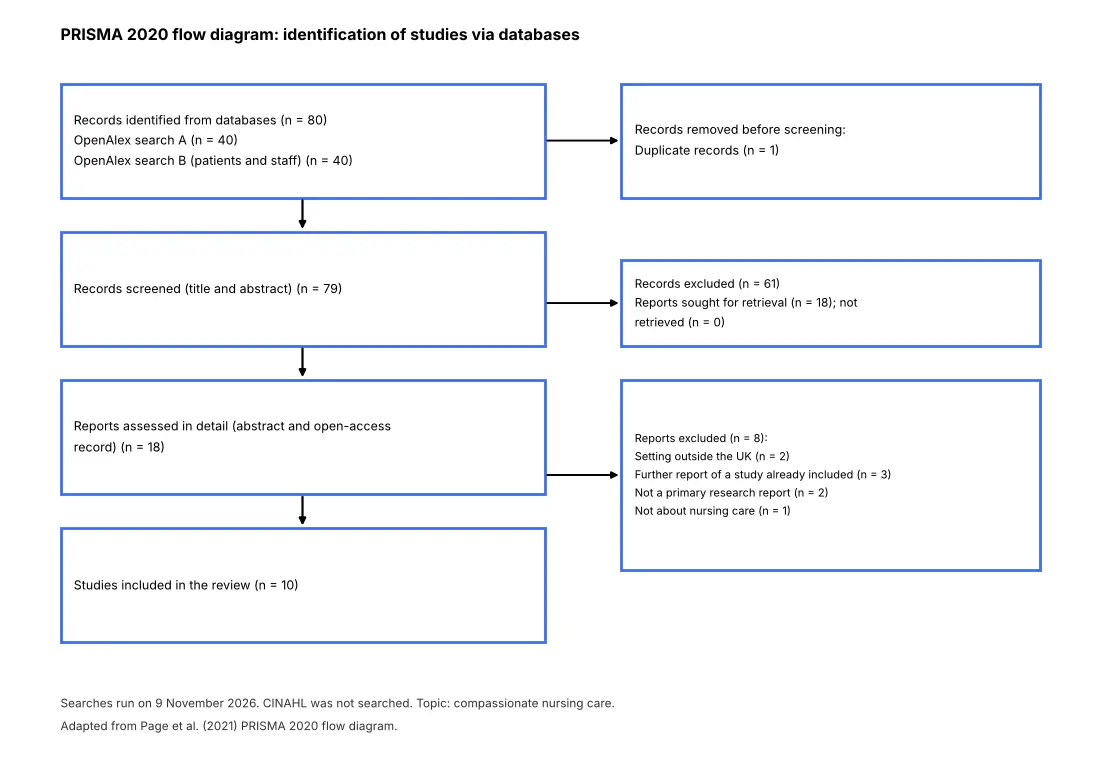
This literature-based dissertation is a structured review of published primary research on compassionate nursing care. It aims to be transparent and reproducible, but it is smaller in scope than a full systematic review, which would normally involve several reviewers, many more databases and exhaustive searching (Aveyard, 2023). The review is reported with reference to the PRISMA 2020 statement, which lists the items that should be described and recommends a flow diagram showing how records move through identification, screening and inclusion (Page et al., 2021). Appendix D presents that flow diagram, Appendix A records each search string, Appendix B tabulates the included studies and Appendix C gives a worked critical appraisal. Together, the appendices allow another reader to check each decision and to repeat the process.
The review question was framed using the Population, Exposure and Outcome (PEO) structure, which suits questions about experiences and influencing factors rather than the effects of a treatment. The population was patients and family carers in NHS settings, together with the nurses and other staff who care for them. The exposures were the personal, team and organisational factors and interventions that shape care, and the outcomes were the delivery and experience of compassion. Structured frameworks help to translate a broad topic into searchable concepts, although the choice of framework affects how sensitive a search is (Methley et al., 2014; Aveyard, 2023). Because the evidence included interviews, focus groups, observation and a trial, qualitative, quantitative and mixed-methods research was eligible for inclusion.
Two searches were run on 9 November 2026 in OpenAlex, an open index of scholarly works that covers a large and growing proportion of the published literature (Priem et al., 2022). The first search used the words compassionate nursing care. The second combined the words compassion, patients, experiences, hospital and qualitative, to capture patient and staff views. Both searches were limited to open-access records published between 2015 and 2026 with at least one author affiliated to a UK institution. Both searches were restricted to journal articles. Combining more than one source is advised because a single database misses relevant studies (Bramer et al., 2017). The exact strings and settings are given in Appendix A.
CINAHL, the main nursing database, could not be accessed, and a planned search of MEDLINE through Europe PMC was not completed because the service refused repeated requests on the day of searching. The second OpenAlex search was therefore used in its place. These gaps mean that some relevant nursing studies may not have been found, a risk that is well recognised when the combination of databases is restricted (Bramer et al., 2017). OpenAlex matches terms anywhere in the text, so many records were not relevant. It also ranks records by relevance, and the two searches matched 4,095 and 4,059 records. Only the first 40 records of the first search and the first 40 of the second, 80 in total, were screened, so the review should be read as a structured sample of the literature and not as a complete search (Aveyard, 2023).
Studies were eligible if they involved patients, carers, or nurses and other staff working with them in UK NHS settings and examined factors that support or hinder compassionate nursing care, or interventions to strengthen it. Reports had to be peer-reviewed, written in English, open access and published from 2015 onwards. UK origin was judged from the stated setting and, where the abstract did not name one, from author affiliations. Reviews, protocols, commentaries, policy analyses, education studies, studies of students and further reports of a study already included were excluded. Clear criteria applied consistently reduce selection bias and allow the decisions to be audited. The extraction table is presented in Appendix B so that readers can compare studies at a glance (Page et al., 2021; Aveyard, 2023).
All 80 records were exported into a screening log, and 1 duplicate was removed, leaving 79 titles to screen. Titles that clearly described education, students, scale development, leadership surveys across countries, non-UK settings or other topics were excluded at this stage. That left 18 reports for closer assessment against the criteria. The abstract and open-access record of each of these reports were read, and the reason for every exclusion was recorded. The log lists every record by its identifier, the search in which it appeared and the decision reached, so that each exclusion can be traced. Ten studies met the criteria, and the numbers at each stage reconcile in the flow diagram (Page et al., 2021). Screening was carried out by one reviewer, which is a recognised limitation of student reviews because a second reviewer would normally check each decision (Aveyard, 2023).
Quality was considered using the Critical Appraisal Skills Programme checklists, which ask structured questions about the aims, design, conduct, results and value of a study (CASP, 2024). The qualitative checklist was completed in full for one study, as a worked example in Appendix C, and indicative quality notes for every study are recorded in Appendix B. Those notes are based on the abstract and, for one study, the open full text, so they are judgements of reporting and not a full audit of how the research was conducted. No study was excluded on quality alone, since appraisal was used to weigh the strength of the findings, which is a common approach in nursing reviews (Aveyard, 2023).
Data were extracted into a standard table covering aims, design, sample, setting, methods, findings and limitations. Numerical results were copied as reported and were not recalculated, and extraction was rechecked once against the source records, a step that reduces transcription errors but does not replace independent checking. Findings were grouped into themes by thematic synthesis, with the trial results reported alongside the qualitative themes because the review combined interview, observation and trial evidence (Thomas and Harden, 2008; Braun and Clarke, 2006). The review used published data only and involved no participants, so ethical approval was not required, although the findings of the included studies are reported accurately and with full attribution (Aveyard, 2023).
Findings
Ten UK studies met the inclusion criteria, published between 2016 and 2024. Three explored staff and stakeholder perspectives through interviews and focus groups. Focus groups with 45 academic staff, clinicians and service users asked participants to define compassion in health care (Kneafsey et al., 2016), a grounded theory study with 36 healthcare professionals caring for people with type 2 diabetes built a model of how compassionate care is enabled (Tierney et al., 2017), and interviews with 50 NHS nurses were collected between 2020 and 2022 (Abrams et al., 2024). The three studies differ in setting, but each treats compassion as shaped by the context in which care is given.
Three studies evaluated interventions or policies intended to improve compassionate care. A pilot cluster randomised trial of the Creating Learning Environments for Compassionate Care programme (CLECC) enrolled six ward nursing teams in two English NHS hospitals, with 627 patients and 178 staff providing data (Gould et al., 2018). A process evaluation of CLECC in four ward teams used 47 staff interviews and seven observations over 26 hours (Bridges et al., 2017), and a realist evaluation of intentional rounding interviewed 33 nursing staff, 17 senior nurse managers, 34 patients and 28 family carers in three hospitals (Sims et al., 2020). The first two studies concern the same programme, so they are not independent.
The remaining studies took the perspective of patients or of nurses. Twenty patients with palliative care needs were interviewed after discharge from one acute hospital trust in north-west England (Black et al., 2018), and a secondary analysis examined patients’ stories held in a digital archive at the University of Oxford (Dillane et al., 2018). A mixed-methods study surveyed and interviewed acute medical care hospital nurses about compassion fatigue and self-compassion (Upton, 2018). A tenth study, of nursing leaders in one community NHS trust, is described below. Together the studies cover wards, community services and patients who had left hospital. All of them were published in peer-reviewed journals.
What compassionate nursing care means to patients and staff
Stakeholders in the focus groups described four overarching themes: definitions of compassion, compassionate behaviours, barriers and threats to compassionate practice, and ways of supporting compassion in practice. Participants felt that staff should be consistently compassionate and that compassion should not be replaced by care delivered without engagement (Kneafsey et al., 2016). Professionals in the grounded theory study took a similar view but added that wanting to give compassionate care was not enough on its own, since they also needed a supportive work setting. The authors described a flow of compassionate care that was boosted by defenders, such as supportive colleagues, and depleted by drainers, such as competing demands on time and resources (Tierney et al., 2017).
Patients valued the small acts of nursing care. In the hospital study of patients with palliative care needs, all of whom had cancer and were aged between 43 and 87, the inpatient experience was viewed positively overall, with compassionate and responsive care centred on the patient, and acts such as time to talk and comfort measures were especially valued (Black et al., 2018). Patients in the archive stories described positive experiences of continuity of care, attentiveness and the fundamentals of care, and negative experiences of poor-quality care, of their own and their families’ needs being ignored, and of staff not being available when needed (Dillane et al., 2018).
Factors that help or hinder compassionate care
Organisational conditions featured strongly in nurses’ accounts. Fifty NHS nurses described three themes: learning and practising self-compassion, the presence and absence of interpersonal compassion, and organisational acts of compassion or the lack of them. Self-compassion required permission and discipline and was often unfamiliar, support between colleagues was often missing, and experiences of organisational compassion were limited, with nurses often feeling undervalued, unsupported and replaceable (Abrams et al., 2024). In acute medical care, compassion fatigue was prevalent, self-compassion moderated and predicted it, and threat cultures, weak leadership and an emphasis on task over process were named as damaging features of the environment (Upton, 2018).
Leadership and time were also described. Eleven nursing leaders from one community NHS trust said that leading and caring with compassion mattered especially in the community, and that compassionate leadership involved modelling behaviour, person-centred care and showing compassion to staff as well as to patients. The authors described a concept they called gritty compassion, which could lead to a loss of compassion (Ali and Terry, 2017). Competing demands on time and resources were the drainers of compassionate care that professionals described in the diabetes study (Tierney et al., 2017). Together these accounts suggest that leaders and the wider system either protect or deplete the capacity of nurses to be compassionate.
Interventions to strengthen compassionate nursing care
The pilot trial tested CLECC, a workplace educational intervention focused on sustainable leadership and team practices, against control wards with no planned team-based education. Recruitment to the observation measure was 93%, and 25% of the patients observed were cognitively impaired. On intervention wards there were more positive ratings of staff-patient interactions (78% against 74%) and fewer negative ratings (8% against 11%), but none of the differences was statistically significant, and nursing empathy did not differ (Gould et al., 2018). Frontline staff were keen to take part and valued the benefits for their wellbeing and patient care (Bridges et al., 2017).
However, the process evaluation found that factors outside the teams’ direct influence limited the impact and sustainability of the programme. An organisational culture focused on tasks and targets limited opportunities for mutual support and learning, and the authors concluded that relational caregiving depends on individual agency, which in turn depends on resources, norms and relationships in the wider system. They suggested that active participation by senior nurse managers was likely to improve impact (Bridges et al., 2017). The trial authors judged that the methods were feasible and that structured observation of staff-patient interaction was a promising outcome measure because it includes patients who are often excluded from research (Gould et al., 2018).
Intentional rounding, in which nurses check every patient at one- or two-hourly intervals using a standard protocol, was introduced in the UK after the public inquiry into Mid Staffordshire. The realist evaluation found little evidence that it ensures patients’ comfort, safety or dignity or increases the delivery of compassionate care. Its systematic approach emphasised transactional care and tick boxes more than relational, individualised care, and nursing staff valued the documentation mainly as written proof of care delivered (Sims et al., 2020). This echoes the process evaluation’s finding that a culture of tasks and targets limits compassionate practice (Bridges et al., 2017).
Patterns across the studies
Three patterns ran through the studies. First, patients judged compassionate nursing care by small acts of attention, such as time to talk and availability when needed (Black et al., 2018). Second, the capacity of nurses to be compassionate depended on organisational conditions and on support from colleagues and leaders (Abrams et al., 2024). Third, interventions that changed ward team behaviour without changing wider systems had limited impact, and a tick-box approach did not increase compassion (Sims et al., 2020). Together, these patterns suggest that compassion is shaped by systems as well as by individual character, although the evidence is mostly qualitative. These patterns recur in studies that used different designs and samples, which strengthens confidence in them.
Quality and limits of the evidence
Several limits qualify these findings. Only one of the ten studies tested an intervention against control wards, and it was a pilot with only six ward teams, so there is no firm evidence that any approach increases compassion (Gould et al., 2018). The two evaluations of CLECC concern the same programme, so their agreement is not independent (Bridges et al., 2017). The appraisal in Appendix B is based on abstracts for nine studies, so it is indicative and not a full audit, and several abstracts did not report sample sizes. Qualitative studies were more numerous than quantitative ones, so the evidence describes experience better than it measures effect.
The qualitative studies drew on small or specific groups. The study of patients with palliative care needs included only people with cancer, who were mostly of one ethnicity, and 17 of the 20 participants had died by the end of data collection, as the worked appraisal in Appendix C shows (Black et al., 2018). The grounded theory study centred on professionals caring for people with type 2 diabetes (Tierney et al., 2017), and the study of nursing leaders involved 11 leaders from one trust (Ali and Terry, 2017). Each of these therefore speaks for a narrow group, and their findings may not apply to other settings.
The remaining studies had further limits. The study of compassion fatigue did not report sample sizes in the abstract and was a single-author project (Upton, 2018). The archive analysis used a purposive sample of transcripts to develop teaching material and was not designed to describe all patients (Dillane et al., 2018). The nurse interviews on acute stress were collected during the pandemic and may reflect those unusual pressures (Abrams et al., 2024). These limits do not make the evidence unusable, but no single result should carry too much weight, and no design gives a complete picture of compassionate nursing care.
Wider Discussion
The findings suggest that compassionate nursing care depends on the system as well as on the individual nurse. The process evaluation of CLECC found that a culture of tasks and targets limited mutual support (Bridges et al., 2017), and intentional rounding emphasised tick boxes over relational care (Sims et al., 2020). This is consistent with the conclusion of the Mid Staffordshire inquiry that the failures were systemic and not the fault of individuals alone (Francis, 2013). It suggests that interventions aimed only at ward teams will have limited reach unless senior leaders and organisations also change, and that measures of compassion should look beyond documentation. Such findings do not make individual nurses unimportant, but they show that individual effort depends on the setting.
Patients’ accounts show what compassion looks like at the bedside. Time to talk, comfort, continuity and availability were valued (Black et al., 2018), which fits the definition of compassion as a response to suffering through relational understanding and action (Sinclair et al., 2016). These are acts that every nurse can perform, but they require nurses to have the time and the support to give them. The professionals caring for people with type 2 diabetes in one study described competing demands on time and resources as a drainer of compassion (Tierney et al., 2017), a pressure that is also relevant to long-term conditions and to complex wound care such as diabetic foot ulcers.
For nursing practice, three priorities follow. First, nurses can protect time to talk and to meet fundamental needs, since these small acts were what patients valued (Black et al., 2018). Second, teams and managers can support nurses’ wellbeing through peer support and a culture in which self-compassion is allowed, because many nurses felt undervalued and unsupported (Abrams et al., 2024). Third, services can judge compassion by observing interactions and by listening to patients, and not by documentation alone (Sims et al., 2020). None of these priorities needs new evidence, but each needs managers who protect the conditions in which nurses work.
Several limitations qualify these conclusions. Only OpenAlex was searched, in two searches, CINAHL was not accessible and a planned search of MEDLINE through Europe PMC was not completed, so relevant studies may have been missed (Bramer et al., 2017). Only the first 40 records of each search were screened, and one reviewer made all decisions, which is a recognised limitation of student reviews (Aveyard, 2023). Most appraisal relied on abstracts, only one study tested an intervention against a control, and studies of students and of other countries were excluded, so the conclusions are offered as a structured sample of the evidence and not as a complete account. The findings should be applied with care in services unlike those studied.
Reflection
I began this review thinking of compassion as a personal quality that some nurses have and others lack. The studies pushed against that view. Patients described compassion in small, practical terms, such as someone taking time to talk, while nurses described a work setting in which they felt undervalued and unsupported. By the end I saw compassionate nursing care as something that organisations either make possible or make difficult, and I became less willing to explain poor care by pointing to an individual nurse. That change was uncomfortable, because it meant that responsibility could not be placed on individuals alone. It also made me more hopeful, since conditions can be changed.
The search made me think carefully about what counts as relevant. Several widely read papers on compassion came from other countries or from nursing education, and I had to leave them out, including a study from New Zealand and one from Iran. I also excluded three further reports of studies that were already in the review, because including them would have counted the same participants more than once. Writing those decisions into the screening log made me realise that choosing what to leave out shapes a review as much as what it includes. I decided to keep the rules simple and to apply them in the same way to every record, which made the log easier to defend.
Appraising the study of patients with palliative care needs was instructive. The authors were open about their small, homogeneous sample and about the fact that most participants had died by the end of the study, yet the paper did not report an ethics committee reference or discuss saturation. It reminded me that a moving, well-written account is not the same as a well-conducted study, and that I trust a story more readily than a table of numbers. I now try to ask of every paper what was done before I ask what was found. Next time I will agree my appraisal approach in advance and test it on one study before using it on the rest. I also learned to note why I made each decision at the time, because memory is a poor record.
In practice, I will make time to talk to patients, even briefly, and I will notice when the routines of a ward have turned into a checklist. I also want to ask colleagues how supported they feel, since the studies suggest that compassion for patients and for staff are connected. I need to improve my reading of trials, because I found it hard to judge a pilot study that reported differences that were not statistically significant, and I want to learn to search more than one database. These are modest goals, but they are the ones that patients value and that nurses need to be able to give.
Conclusion
This dissertation set out to review UK evidence on the factors that support or hinder compassionate nursing care in NHS settings, and on interventions to strengthen it. Ten UK studies, comprising a pilot trial and its process evaluation, an evaluation of intentional rounding, qualitative studies of staff, leaders and patients, and a mixed-methods study of compassion fatigue, showed that patients valued small acts of attention, that the capacity of nurses to be compassionate depended on organisational conditions and support, and that interventions had limited reach when they changed team behaviour without changing the wider system.
Intentional rounding did not increase compassionate care, a programme for ward teams showed encouraging but statistically non-significant differences, and nurses reported limited organisational compassion and prevalent compassion fatigue. These results come from small, local and mostly qualitative studies and do not prove cause, but they agree with one another in pointing to the conditions in which nurses work. Taken together, the studies show that compassion is shaped by systems as well as by individual character, and by the information and support that nurses and patients receive. Their value lies in showing what is feasible in routine nursing, and not in proving that one model is best.
For nursing practice, the review supports protecting time to talk and to meet fundamental needs, supporting the wellbeing of nurses and judging compassion by observing interactions and listening to patients. The strength of this evidence is limited by the restricted search, single-reviewer screening and reliance on abstracts, so the conclusions are best treated as a well-founded starting point and not as a final answer. Further research using controlled designs would show which of these approaches increases compassion most. These recommendations are within the reach of individual nurses and ward teams, although they need support from managers.
Reference List
Abrams, R. et al. (2024) ‘Self, interpersonal and organisational acts of compassion amongst nurses during times of acute stress: a qualitative analysis’, SSM – Qualitative Research in Health, 5, article 100437. doi:10.1016/j.ssmqr.2024.100437.
Ali, S. and Terry, L.M. (2017) ‘Exploring senior nurses’ understanding of compassionate leadership in the community’, British Journal of Community Nursing, 22(2), pp. 77-87. doi:10.12968/bjcn.2017.22.2.77.
Aveyard, H. (2023) Doing a literature review in health and social care: a practical guide. 5th edn. Open University Press.
Black, A. et al. (2018) ‘The “lived experience” of palliative care patients in one acute hospital setting: a qualitative study’, BMC Palliative Care, 17, article 91. doi:10.1186/s12904-018-0345-x.
Bramer, W.M. et al. (2017) ‘Optimal database combinations for literature searches in systematic reviews: a prospective exploratory study’, Systematic Reviews, 6, article 245. doi:10.1186/s13643-017-0644-y.
Braun, V. and Clarke, V. (2006) ‘Using thematic analysis in psychology’, Qualitative Research in Psychology, 3(2), pp. 77-101. doi:10.1191/1478088706qp063oa.
Bridges, J. et al. (2017) ‘Optimising impact and sustainability: a qualitative process evaluation of a complex intervention targeted at compassionate care’, BMJ Quality and Safety, 26(12), pp. 970-977. doi:10.1136/bmjqs-2017-006702.
CASP (2024) CASP checklists. Oxford: Critical Appraisal Skills Programme. Available at: https://casp-uk.net/casp-checklists/ (Accessed: 9 November 2026).
Cummings, J. and Bennett, V. (2012) Compassion in practice: nursing, midwifery and care staff: our vision and strategy. Leeds: NHS Commissioning Board. Available at: https://www.england.nhs.uk/2012/12/compassionate-care/ (Accessed: 9 November 2026).
Dillane, B. et al. (2018) ‘Cameos of compassion: exploring compassionate care using secondary analysis of digital patients’ stories’, Innovations in Global Health Professions Education. doi:10.20421/ighpe2018.03.
Francis, R. (2013) Report of the Mid Staffordshire NHS Foundation Trust Public Inquiry. London: The Stationery Office.
Gould, L. et al. (2018) ‘Compassionate care intervention for hospital nursing teams caring for older people: a pilot cluster randomised controlled trial’, BMJ Open, 8(2), article e018563. doi:10.1136/bmjopen-2017-018563.
Kneafsey, R. et al. (2016) ‘A qualitative study of key stakeholders’ perspectives on compassion in healthcare and the development of a framework for compassionate interpersonal relations’, Journal of Clinical Nursing, 25(1-2), pp. 70-79. doi:10.1111/jocn.12964.
Methley, A.M. et al. (2014) ‘PICO, PICOS and SPIDER: a comparison study of specificity and sensitivity in three search tools for qualitative systematic reviews’, BMC Health Services Research, 14, article 579. doi:10.1186/s12913-014-0579-0.
Nursing and Midwifery Council (NMC) (2018) The Code: professional standards of practice and behaviour for nurses, midwives and nursing associates. London: NMC. Available at: https://www.nmc.org.uk/standards/code/ (Accessed: 9 November 2026).
Page, M.J. et al. (2021) ‘The PRISMA 2020 statement: an updated guideline for reporting systematic reviews’, BMJ, 372, article n71. doi:10.1136/bmj.n71.
Priem, J., Piwowar, H. and Orr, R. (2022) ‘OpenAlex: a fully-open index of scholarly works, authors, venues, institutions, and concepts’, arXiv, 2205.01833. doi:10.48550/arXiv.2205.01833.
Sims, S. et al. (2020) ‘The delivery of compassionate nursing care in a tick-box culture: qualitative perspectives from a realist evaluation of intentional rounding’, International Journal of Nursing Studies, 107, article 103580. doi:10.1016/j.ijnurstu.2020.103580.
Sinclair, S. et al. (2016) ‘Compassion in health care: an empirical model’, Journal of Pain and Symptom Management, 51(2), pp. 193-203. doi:10.1016/j.jpainsymman.2015.10.009.
Thomas, J. and Harden, A. (2008) ‘Methods for the thematic synthesis of qualitative research in systematic reviews’, BMC Medical Research Methodology, 8, article 45. doi:10.1186/1471-2288-8-45.
Tierney, S. et al. (2017) ‘Enabling the flow of compassionate care: a grounded theory study’, BMC Health Services Research, 17, article 174. doi:10.1186/s12913-017-2120-8.
Upton, K.V. (2018) ‘An investigation into compassion fatigue and self-compassion in acute medical care hospital nurses: a mixed methods study’, Journal of Compassionate Health Care, 5(1). doi:10.1186/s40639-018-0050-x.
Appendix A: Search strategy
This appendix records the searches run for the compassionate nursing care review so that the process can be repeated and checked.
Two searches on compassionate nursing care were run on 9 November 2026 using the OpenAlex works API. The first 40 records of the first search and the first 40 of the second, ranked by relevance, were retrieved and screened by title and abstract.
| Database | Platform | Date run | Search string | Limiters | Hits |
|---|---|---|---|---|---|
| OpenAlex search A | OpenAlex API | 9 November 2026 | search=compassionate nursing care | Filter: authorships.countries:GB; is_oa:true; publication_year:2015-2026; type:article. 4,095 matches in total; the first 40 by relevance were screened. | 40 |
| OpenAlex search B (patients and staff) | OpenAlex API | 9 November 2026 | search=compassion patients experiences hospital qualitative | Filter: authorships.countries:GB; is_oa:true; publication_year:2015-2026; type:article. 4,059 matches in total; the first 40 by relevance were screened. | 40 |
CINAHL could not be accessed and was not searched, so no CINAHL results are reported. A planned MEDLINE search through Europe PMC was attempted on the same day but the service refused repeated requests, so it was not completed for compassionate nursing care; search B, which targeted patient and staff experiences, was used instead.
OpenAlex matches search terms in the title, abstract or full text, and the country filter matches any record with at least one author affiliated to a UK institution. UK setting and relevance were therefore checked for each study at the assessment stage. Records identified: 80 (40 + 40); duplicates removed: 1; records screened: 79.
Appendix B: Data extraction table
The table summarises each study included in this compassionate nursing care review: its aim, design, sample, methods, key findings, limitations and relevance to compassionate nursing care.
| Author / year / country | Aim | Design | Sample and setting | Methods | Key findings | Limitations / quality | Relevance to compassionate nursing care |
|---|---|---|---|---|---|---|---|
| Kneafsey et al. (2016), UK (Coventry) | To explore key stakeholders’ views of compassion in health care, including compassionate nursing care, and to present a framework for compassionate interpersonal relations. | Exploratory qualitative study with thematic analysis. | 45 academic staff, clinicians and service users in nine focus groups. | Focus groups asking participants to define compassion in health care and compassionate nursing care. | Four themes: definitions of compassion, compassionate behaviours, barriers and threats to compassionate practice, and ways to support it; staff should be consistently compassionate, not offer care without engagement. | Indicative (abstract only): stakeholders from several professions, not only nurses; opinions about compassionate nursing care, not observed practice. | Stakeholder definitions of compassionate nursing care. |
| Ali and Terry (2017), UK (one Community NHS Trust) | To explore senior nurses’ understanding of compassionate leadership as it relates to compassionate nursing care in the community. | Qualitative study with interpretative phenomenological analysis. | 11 nursing leaders from one Community NHS Trust. | Semi-structured, audio-recorded interviews about compassionate nursing care and leadership. | Leading and caring with compassion mattered especially in the community; compassionate leadership involved modelling behaviour, person-centred care and showing compassion to staff as well as patients; gritty compassion could lead to a loss of compassion. | Indicative (abstract only): one trust; leaders only; small sample; views of compassionate nursing care, not observed practice. | Leadership and compassionate nursing care in community services. |
| Bridges et al. (2017), UK (England) | To explain the extent of implementation of the CLECC intervention for compassionate nursing care in four ward nursing teams and how it could be optimised. | Qualitative process evaluation guided by normalisation process theory. | 47 staff interviews, 7 observations (26 hours), ward manager questionnaires and staffing data. | Process evaluation of a compassionate nursing care intervention. | Staff were keen and implemented many activities; an organisational culture of tasks and targets limited mutual support and learning; senior nurse manager participation was likely to improve impact. | Indicative (abstract only): same programme as the pilot trial, so not independent; four teams; compassionate nursing care intervention only. | Why a compassionate nursing care intervention had limited reach. |
| Tierney et al. (2017), UK (England) | To explore how compassionate care is enacted in practice and what it means to healthcare professionals. | Constructivist grounded theory study. | 36 healthcare professionals in varied roles caring for people with type 2 diabetes (May to October 2015). | Semi-structured interviews and focus groups; open and focused coding, memos and constant comparison on compassionate nursing care. | Wanting to give compassionate care was not enough; a supportive work setting was needed; a flow of compassionate care was boosted by defenders (supportive colleagues) and depleted by drainers (competing demands on time and resources). | Indicative (abstract only): professionals in diabetes care, not only nurses; small sample; model not tested in compassionate nursing care practice. | A model of what enables compassionate nursing care. |
| Gould et al. (2018), UK (two English NHS hospitals) | To evaluate the feasibility and potential effect of the CLECC intervention on compassionate nursing care for older people. | Pilot cluster randomised controlled trial. | Six ward nursing teams (4 intervention, 2 control); data from 627 patients and 178 staff. | Structured observation (Quality of Interaction Schedule), patient-reported emotional care and nurse empathy scales. | Recruitment 93%; positive ratings 78% against 74% and negative 8% against 11%; 63% against 79% gave the lowest connection scores; no statistically significant differences or change in nursing empathy. | Indicative (abstract only): pilot with six clusters; not powered; possible contamination; compassionate nursing care outcomes not significant. | First trial evidence on an intervention for compassionate nursing care. |
| Upton (2018), UK (Aston University) | To explore factors affecting compassionate nursing care through compassion fatigue in acute medical care hospital nurses and whether self-compassion helps them cope. | Mixed-methods study (survey and interviews). | Acute medical care hospital nurses; numbers not stated in the abstract. | Demographic questionnaire, Secondary Traumatic Stress Scale, Self-Compassion Scale, written responses and semi-structured interviews on compassionate nursing care. | Compassion fatigue was prevalent; self-compassion moderated and predicted it; threat cultures, weak leadership and a focus on task over process were damaging. | Indicative (abstract only): sample size not stated; single author; self-reported compassionate nursing care measures. | Nurse wellbeing and the capacity for compassionate nursing care. |
| Black et al. (2018), UK (north-west England) | To explore the lived experience of compassionate nursing care among patients with palliative care needs who had recently been inpatients at one acute hospital trust. | Qualitative study using narrative interviews and thematic analysis. | 20 patients (all with cancer, ages 43 to 87), interviewed at home October 2015 to September 2016. | Narrative interviews with an opening question and topic guide; 15 to 90 minutes. | Overall positive experience, with compassionate and responsive care; time to talk and comfort measures valued; overstretched staff and communication problems affected experience. | CASP qualitative appraisal in Appendix C (open full text). One hospital; all cancer patients of one ethnicity; 17 of 20 died by the end of data collection; no ethics committee reference reported. | Patient views of compassionate nursing care in an acute hospital. |
| Dillane et al. (2018), UK (Oxford archive) | To explore compassionate nursing care by secondary analysis of digital patient stories as a way of teaching compassion to nursing students. | Secondary qualitative analysis of narrative interviews. | Purposive sample of transcripts from the Healthtalk archive. | Analysis of patients’ experiences of illness and healthcare for compassionate nursing care themes. | Positive themes: continuity of care, attentiveness and the fundamentals of care; negative themes: poor-quality care, ignoring patient and family needs, and unavailability. | Indicative (abstract only): number of transcripts not stated; archive not built to study compassionate nursing care; no volume or pages. | Patients’ accounts of compassionate nursing care. |
| Sims et al. (2020), UK (three English hospitals) | To examine the role of intentional rounding in the delivery of compassionate nursing care in England from multiple perspectives. | Qualitative phase of a mixed-methods realist evaluation. | 33 nursing staff, 17 senior nurse managers, 34 patients and 28 family carers. | Individual semi-structured interviews on contexts, mechanisms and outcomes of intentional rounding and compassionate nursing care. | Little evidence that intentional rounding ensures comfort, safety or dignity or increases compassionate care; it emphasised transactional, tick-box care; documentation valued as proof of care. | Indicative (abstract only): three hospitals; views about intentional rounding, not observed compassionate nursing care. | Tests a national policy aimed at compassionate nursing care. |
| Abrams et al. (2024), UK (NHS) | To explore how nurses experience compassionate nursing care, or its absence, during acute stress, and at which level it occurs. | Qualitative longitudinal interview study. | 50 UK NHS nurses, interviewed between March 2020 and September 2022. | Semi-structured interviews about compassionate nursing care and its absence. | Three themes: learning and practising self-compassion; presence and absence of interpersonal compassion; organisational acts of compassion or their absence; nurses felt undervalued, unsupported and replaceable. | Indicative (abstract only): collected during the pandemic; nurses’ views, not patients’; compassionate nursing care measured by self-report. | Organisational conditions for compassionate nursing care. |
Appendix C: Critical appraisal checklist
CASP qualitative studies checklist (CASP, 2024), completed for Black et al. (2018), a study included in this compassionate nursing care review. Answers: Yes, No or Can’t tell, each with a short justification.
| # | Question | Answer | Justification |
|---|---|---|---|
| Section A: Are the results valid? | |||
| 1 | Was there a clear statement of the aims of the research? | Yes | The aim is stated clearly: to explore the lived experience of patients with palliative care needs who had recently been inpatients, which bears on compassionate nursing care in an acute hospital. |
| 2 | Is a qualitative methodology appropriate? | Yes | A qualitative approach suits a question about patient experience, and the authors argue that satisfaction questionnaires alone cannot capture its complex, multifaceted nature. |
| 3 | Was the research design appropriate to address the aims of the research? | Yes | Narrative interviews in patients’ homes, with an opening question and topic guide, let patients direct the conversation, although no piloting of the guide is reported. |
| 4 | Was the recruitment strategy appropriate to the aims of the research? | Can’t tell | A consecutive sample was sought from 560 referrals, but 296 were excluded as too ill, 81 were approached, 26 declined and 20 were interviewed, and family gatekeeping blocked 10 patients, so those least able to take part are under-represented. |
| 5 | Was the data collected in a way that addressed the research issue? | Yes | All interviews were held at home within 10 days of discharge by the main researcher, lasted 15 to 90 minutes (median 41), and were recorded and transcribed verbatim, although saturation is not discussed. |
| 6 | Has the relationship between researcher and participants been adequately considered? | Can’t tell | The researcher was a clinical nurse specialist seconded to the palliative care team, and the authors discuss power balance, a field diary and a distress protocol, but not how her role may have shaped patients’ accounts of compassionate nursing care. |
| Section B: What are the results? | |||
| 7 | Have ethical issues been taken into consideration? | Can’t tell | Written consent followed an information sheet and a check of agreement, but no ethics committee name or reference number is reported. |
| 8 | Was the data analysis sufficiently rigorous? | Yes | Thematic analysis was cyclical, the researcher coded all transcripts, two colleagues independently analysed five (20%) and themes were discussed, although there was no member checking and no software is reported. |
| 9 | Is there a clear statement of findings? | Yes | Four themes about compassionate nursing care are presented with pseudonymised quotations, and variation is reported, such as care being positive for most patients but inconsistent across staff. |
| Section C: Will the results help locally? | |||
| 10 | How valuable is the research? | Yes | The study offers a rare view of what matters to patients with life-limiting illness, states limits such as one hospital, one ethnicity and 17 of 20 deaths, and calls for work on why experience varies. |
Appendix D: PRISMA flow diagram
This dissertation is a worked example that shows the structure and standard of a 5,000-word literature-based Independent Project. It is provided for learning and is not to be submitted as a student’s own work.