

Preventing and Managing Diabetic Foot Ulcers: The Nursing Role in Community and Hospital Care
 By Dr. Robertson Prime, Research Fellow
This dissertation is a worked example that shows the structure and standard of a 5,000-word literature-based Independent Project. It is provided for learning and is not to be submitted as a student’s own work.
Abstract
Background: Diabetic foot ulcers are the most common lower-extremity complication of diabetes, and nurses in hospitals and the community play a central part in their prevention and care. Less is known about which services, nursing roles and patient factors influence healing, recurrence and amputation in UK practice.
Aim: To critically review UK evidence on the services, nursing roles and patient factors that influence the prevention, healing and recurrence of diabetic foot ulcers.
Methods: A structured literature review using the Population, Exposure and Outcome framework. OpenAlex was searched twice on 9 November 2026, because CINAHL could not be accessed and a planned MEDLINE search was not completed. The first 40 records of each search were screened: 80 records were identified, 78 screened after the removal of two duplicates and 9 UK studies included. Quality was considered using Critical Appraisal Skills Programme questions, and findings were combined by thematic synthesis.
Findings: The included studies of diabetic foot ulcers (n = 9) comprised three cohort studies, four service-level studies, a proof-of-concept trial of a smart insole and a qualitative study. Amputation was lower where foot services were stronger, outcomes in routine care were often poor, and patient factors from illness beliefs to life circumstances shaped survival and recurrence.
Conclusions and implications for practice: For diabetic foot ulcers, nurses can recognise and refer new ulcers promptly, assess cardiovascular risk and illness beliefs alongside the wound, and offer education that fits each person. The evidence is limited by the restricted search, single-reviewer screening, reliance on abstracts and the small number of trials.
Keywords: diabetic foot ulcers; foot care; community nursing; adult nursing; literature review.
Brief at a glance
- Framework
- PEO
- Design
- Literature review (PEO)
- Studies included
- 9
- Field
- Adult Nursing
Introduction
Diabetic foot ulcers are open wounds on the feet of people with diabetes, and foot ulceration is the most common lower-extremity complication of the condition (Armstrong et al., 2017). In the UK, an estimated 3.6 million people have diabetes, and diabetes-related foot disease has been described as the single most common cause of morbidity among them (Lim et al., 2017). Loss of sensation and poor circulation can make ulcers painless, so they are often found late, once they have failed to heal. Understanding what supports healing and prevents amputation is therefore a priority. For this reason the wounds matter greatly to adult nursing. Nurses in hospitals, general practice and the community inspect feet, dress wounds, teach self-care and refer people for specialist help, and the way these tasks are organised may shape whether an ulcer heals or leads to amputation.
National guidance from the National Institute for Health and Care Excellence (NICE) covers the prevention and management of foot problems in children, young people and adults with diabetes, including ulcers, infection and Charcot arthropathy (NICE, 2015). These sources set the standard against which practice is judged. The Nursing and Midwifery Council expects nurses to prioritise people, practise effectively, preserve safety and promote professionalism and trust (NMC, 2018). This dissertation reviews UK research on the services, nursing roles and patient factors that influence the prevention, healing and recurrence of diabetic foot ulcers. It follows a structured process so that each decision can be checked. The workforce that delivers this care is also changing, and the experiences of nurses recruited from abroad are reviewed in overseas nurses in the NHS. The review is limited to the UK so that its conclusions fit NHS services.
Background and Justification
Diabetes-related foot disease is common and costly. Foot ulceration is the most common lower-extremity complication in people with diabetes, and international reviews have set out its causes, its treatment and the prevention of recurrence (Armstrong et al., 2017). In the UK, an estimated 3.6 million people have diabetes, which creates a major public health and socioeconomic burden for the NHS, and foot disease is the single most common cause of morbidity among them (Lim et al., 2017). Diabetic foot ulcers therefore sit at the point where long-term condition management, wound care and specialist services meet, which makes them a suitable subject for a nursing review of UK practice.
Several pathologies combine to produce an ulcer. Peripheral vascular disease often makes foot ulcers painless, so they are frequently detected late, once non-healing is evident (Lim et al., 2017). The International Working Group on the Diabetic Foot (IWGDF) groups the factors that affect the outcome of an active ulcer as patient-related, limb-related and ulcer-related, which is a useful way of thinking about why two people with similar wounds can do very differently (Monteiro-Soares et al., 2020). These ideas matter for this review because the included studies examine factors in each group, from the beliefs of patients to the structure of local foot services. A nurse who understands them can judge more accurately when a wound needs urgent expert help.
Classification gives clinicians a shared language. The IWGDF has issued evidence-based guidelines on diabetic foot prevention and management since 1999, and its guideline on classification recommends the SINBAD system for communication among professionals and for audit, the IDSA/IWGDF classification when infection is assessed, and the WIfI system for perfusion and decisions about revascularisation (Monteiro-Soares et al., 2020). Lim et al. (2017) also summarise tools for risk stratification and classification as part of the case for early identification of high-risk patients. Both sources suggest that consistent description of ulcers is a precondition for audit and for comparison of services, which matters when the evidence is as varied as it is in this review.
In England, the main national guideline is NICE guideline NG19 on the prevention and management of foot problems in children, young people and adults with diabetes. It updates and replaces earlier NICE guidance from 2004 and 2011 and addresses diabetic foot ulcers, diabetic foot infection and Charcot arthropathy (NICE, 2015). A review of the guideline in 2023 found no need to change the risk assessment tools or the frequency of diabetic foot reviews (NICE, 2015). Preventive strategies identified in the wider literature include annual foot screening, multidisciplinary team care and early identification of high-risk patients (Lim et al., 2017). How well these strategies work in everyday practice is a question that audit data and research on services can begin to answer.
National audit shows how well services perform. The National Diabetes Foot Care Audit for England and Wales covers the years from 2018 to 2023, and its report, published in 2024, found that the proportion of people with a new ulcer who were alive and ulcer free at 12 weeks fell from 45.7% to 42.2% when unknown outcomes were included, and from 51.0% to 49.0% when they were excluded (NHS England Digital, 2024). Outcomes were better when expert assessment came sooner: 56.1% of self-referrals and 51.0% of people assessed within two days were alive and ulcer free, compared with 36.3% of those assessed after more than two months (NHS England Digital, 2024). Earlier audit had also reported variability and deficiencies in foot care across England and Wales (Lim et al., 2017).
Nurses are central to this work. The Code of the Nursing and Midwifery Council requires nurses to practise effectively and to preserve safety (NMC, 2018), and the national audit recommends that every integrated care board should arrange early expert assessment of all new foot ulcers, with more than 70% assessed within 13 days of referral by 2026 (NHS England Digital, 2024). Living with a chronic wound is also demanding for patients, and the relational side of nursing is considered in compassionate nursing care. Nursing practice for these wounds therefore has to combine technical skill with an understanding of the person and of the system in which care is given.
Guidelines and audits say what should happen, but they say less about what UK research shows works. Evidence on this topic is spread across clinical, service and patient-experience studies, and much of it concerns podiatry and medicine more than nursing. A literature review can bring this evidence together if it follows a transparent method and states its limits clearly (Aveyard, 2023). This review therefore used a structure that separates the population, the exposure and the outcome, because the exposures of interest were services, nursing roles and patient factors and not a single treatment (Methley et al., 2014). Restricting the review to UK studies allows the findings to be read against one policy and professional context (Aveyard, 2023).
Title, Aim and Objectives
What do UK studies show about the services, nursing roles and patient factors that influence the prevention, healing and recurrence of diabetic foot ulcers?
Title explained
The title names the focus on diabetic foot ulcers, the nursing role, the community and hospital settings in which care is given, and the literature review design that structures the whole work.
Aim
To critically review UK evidence on the services, nursing roles and patient factors that influence the prevention, healing and recurrence of diabetic foot ulcers.
Objectives
- To identify and appraise UK research on diabetic foot ulcers.
- To synthesise findings on services, nursing care and patient factors.
- To make recommendations for nursing practice.
Methodology
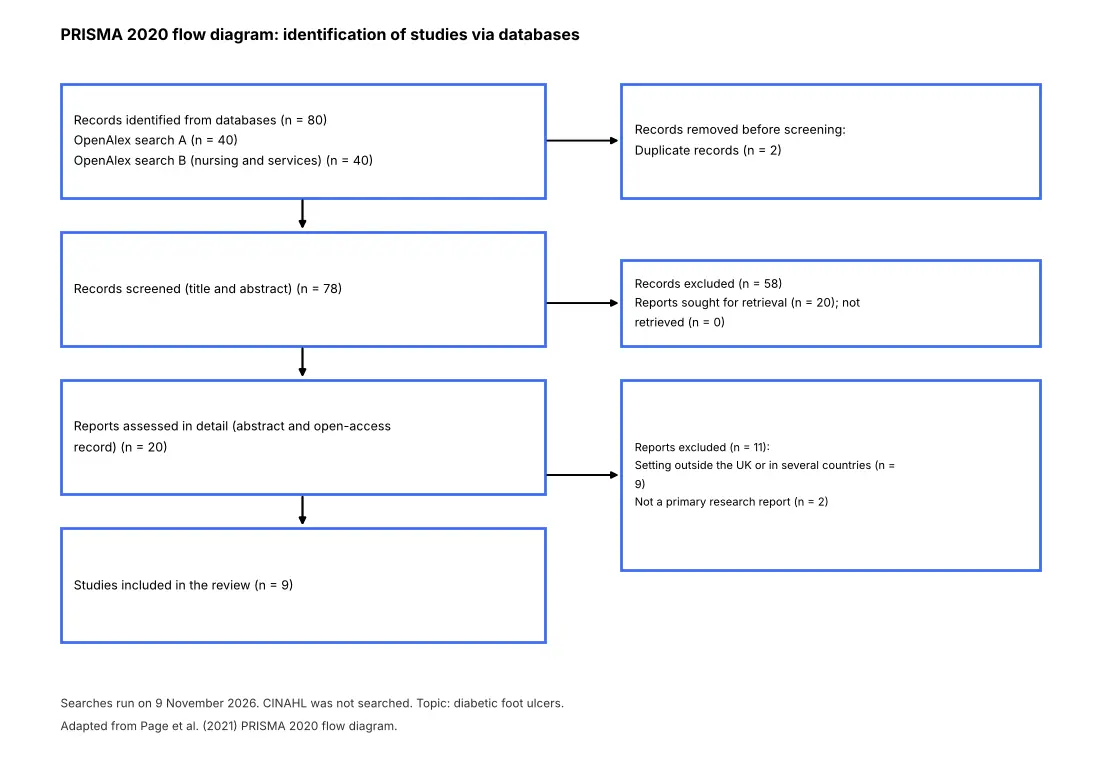
This literature-based dissertation is a structured review of published primary research on diabetic foot ulcers. It aims to be transparent and reproducible, but it is smaller in scope than a full systematic review, which would normally involve several reviewers, many more databases and exhaustive searching (Aveyard, 2023). The review is reported with reference to the PRISMA 2020 statement, which lists the items that should be described and recommends a flow diagram showing how records move through identification, screening and inclusion (Page et al., 2021). Appendix D presents that flow diagram, Appendix A records each search string, Appendix B tabulates the included studies and Appendix C gives a worked critical appraisal. Together, the appendices allow another reader to check each decision and to repeat the process.
The review question was framed using the Population, Exposure and Outcome (PEO) structure, which suits questions about experiences and influencing factors rather than the effects of a treatment. The population was adults with diabetic foot ulcers, together with the nurses and other clinicians who care for them. The exposures were the services, nursing roles and patient factors that influence care, and the outcomes were the prevention, healing and recurrence of ulcers, amputation and survival. Structured frameworks help to translate a broad topic into searchable concepts, although the choice of framework affects how sensitive a search is (Methley et al., 2014; Aveyard, 2023). Because the evidence included cohort studies, service evaluations, a trial and interviews, quantitative, qualitative and mixed-methods research was eligible for inclusion.
Two searches were run on 9 November 2026 in OpenAlex, an open index of scholarly works that covers a large and growing proportion of the published literature (Priem et al., 2022). The first search used the words diabetic foot ulcer. The second combined the words diabetic, foot, care, nurses, education and community, to capture nursing and service evidence. Both searches were limited to open-access records published between 2015 and 2026 with at least one author affiliated to a UK institution. Both searches were restricted to journal articles. Combining more than one source is advised because a single database misses relevant studies (Bramer et al., 2017). The exact strings and settings are given in Appendix A.
CINAHL, the main nursing database, could not be accessed, and a planned search of MEDLINE through Europe PMC was not completed because the service refused repeated requests on the day of searching. The second OpenAlex search was therefore used in its place. These gaps mean that some relevant nursing studies may not have been found, a risk that is well recognised when the combination of databases is restricted (Bramer et al., 2017). OpenAlex matches terms anywhere in the text, so many records were not relevant. It also ranks records by relevance, and the two searches matched 2,405 and 526 records. Only the first 40 records of the first search and the first 40 of the second, 80 in total, were screened, so the review should be read as a structured sample of the literature and not as a complete search (Aveyard, 2023).
Studies were eligible if they involved adults with diabetic foot ulcers, or the nurses and other clinicians and services that care for them, in UK settings and examined factors that influence the prevention, healing or recurrence of ulcers, or the care provided. Reports had to be peer-reviewed, written in English, open access and published from 2015 onwards. UK origin was judged from the stated setting and, where the abstract did not name one, from author affiliations. Reviews, guidelines, protocols, commentaries, imaging and laboratory studies, device-development studies and studies set outside the UK or in several countries were excluded. Clear criteria applied consistently reduce selection bias and allow the decisions to be audited. The extraction table is presented in Appendix B so that readers can compare studies at a glance (Page et al., 2021; Aveyard, 2023).
All 80 records were exported into a screening log, and 2 duplicates were removed, leaving 78 titles to screen. Titles that clearly described image analysis and deep learning, laboratory or genetic work, microbiology, guidelines, reviews, non-UK settings or other topics were excluded at this stage. That left 20 reports for closer assessment against the criteria. The abstract and open-access record of each of these reports were read, and the reason for every exclusion was recorded. The log lists every record by its identifier, the search in which it appeared and the decision reached, so that each exclusion can be traced. Nine studies met the criteria, and the numbers at each stage reconcile in the flow diagram (Page et al., 2021). Screening was carried out by one reviewer, which is a recognised limitation of student reviews because a second reviewer would normally check each decision (Aveyard, 2023).
Quality was considered using the Critical Appraisal Skills Programme checklists, which ask structured questions about the aims, design, conduct, results and value of a study (CASP, 2024). The cohort checklist was completed in full for one study, as a worked example in Appendix C, and indicative quality notes for every study are recorded in Appendix B. Those notes are based on the abstract and, for one study, the open full text, so they are judgements of reporting and not a full audit of how the research was conducted. No study was excluded on quality alone, since appraisal was used to weigh the strength of the findings, which is a common approach in nursing reviews (Aveyard, 2023).
Data were extracted into a standard table covering aims, design, sample, setting, methods, findings and limitations. Numerical results were copied as reported and were not recalculated, and extraction was rechecked once against the source records, a step that reduces transcription errors but does not replace independent checking. Findings were grouped into themes by thematic synthesis, with the cohort, service-level and trial results reported alongside the qualitative themes because the review combined studies of different designs (Thomas and Harden, 2008; Braun and Clarke, 2006). The review used published data only and involved no participants, so ethical approval was not required, although the findings of the included studies are reported accurately and with full attribution (Aveyard, 2023).
Findings
Nine UK studies met the inclusion criteria, published between 2016 and 2025. Three were cohort studies of people with ulcers, which followed patients to death or to a clinical outcome. They recruited patients from outpatient podiatry clinics in secondary care between 2002 and 2007, followed 299 people with infected ulcers for 12 months, and traced deaths among people who had attended a London foot clinic (Vedhara et al., 2016; Ndosi et al., 2018; Chammas et al., 2016). Four were service-level studies, one was a randomised trial of a smart insole and one was a qualitative study of lived experience. Each is described below.
Services and the prevention of diabetic foot ulcers
Two studies linked foot service provision to amputation. A peer review of diabetic foot services in South-West England defined ten elements of service provision and found that major lower limb amputation incidence was inversely correlated with service provision (P = 0.0024, R² = 0.51 in 2013), and that incidence fell as services were enhanced (Paisey et al., 2018). In a semirural, low-income UK health district, 185 service users were engaged through meetings, questionnaires and focus groups to design a partially virtual diabetes service. Over the period in which virtual multidisciplinary reviews were introduced, major amputations fell from 13 to 3 procedures per 10,000 per year and minor amputations from 26 to 18 (Watt et al., 2021).
In one NHS health service area, people who were newly ulcerated or at high risk had been referred to community podiatry since 1998, and ulcer presentations fell from 11.1 to 6.1 per 1000 persons between 2003 and 2017 (P < 0.0001). However, recurrent ulceration remained stable and the prevalence of chronic combined ulceration rose from 20.7 to 33.1 per 1000 persons, so the authors concluded that integrated care was associated with fewer presentations but did not reduce recurrence (Paisey et al., 2019). In the redesigned district service, engagement rose from 5% to 71%, and 175 cases were reviewed virtually, which avoided the hospital diabetic clinic (Watt et al., 2021).
Nursing care and outcomes in routine practice
An analysis of primary care records of 130 patients with newly diagnosed diabetic foot ulcers showed who delivered care in routine practice. Most patients were managed mainly by community nurses, with little involvement from specialist physicians, only 5% saw a podiatrist and 5% received a pressure-offloading device. Within 12 months, 35% of ulcers had healed, 17% of patients had at least one amputation and the mean time to healing was 4.4 months (Guest et al., 2018). In a separate cohort of 299 people with an infected ulcer that needed antibiotics, 45.5% healed within 12 months and 17.4% had an amputation on the same side (Ndosi et al., 2018).
Routine care was also costly. Mean total NHS cost was £7,800 per patient, ranging from £2,140 for a healed ulcer to £8,800 for an unhealed ulcer and £16,900 for an amputated wound (Guest et al., 2018). In the infected-ulcer cohort, an ulcer present for about two months or more (HR 0.55, 95% CI 0.39 to 0.77) and reduced perfusion (PEDIS grade 2 or higher; HR 0.37, 95% CI 0.25 to 0.55) predicted lower healing, whereas a single ulcer healed more often than multiple ulcers (HR 1.90, 95% CI 1.18 to 3.06). In the first year, 45 of the 299 people (15.1%) died (Ndosi et al., 2018).
Patient factors, mortality and lived experience
A cohort of 169 patients with neuropathic or neuroischaemic ulcers was recruited from outpatient podiatry clinics in UK secondary care, and survival data were available for 160. Ischaemia, identity beliefs (HR 1.245, p = 0.036) and coherence beliefs (HR 0.775, p = 0.036) independently predicted time to death, depression did not, and median survival was 6.4 years, which links what patients believed about their ulcer to how long they lived (Vedhara et al., 2016). A longer-term service cohort found that ten-year survival was 85% for people aged under 65 at presentation, 50% for those aged 65 to 74 and 25% for those aged 75 to 81 (Paisey et al., 2019).
At the foot clinic of a London teaching hospital, an 11-year retrospective study of 243 deaths found that ischaemic heart disease was the major cause of death, at 62.5% on postmortem examination against 45.7% on death certificates. People with ulcers died about five years younger from ischaemic heart disease than matched controls without ulcers (68.2 ± 8.7 against 73.1 ± 8.0 years, P = 0.015), and neuropathic ulcers were associated with death from ischaemic heart disease (OR 3.064, 95% CI 1.003 to 9.366) (Chammas et al., 2016). Five-year survival was 35% for people with peripheral vascular disease (Paisey et al., 2019).
The qualitative study took a contextual lens, because earlier research had concentrated on intrinsic factors such as knowledge, physical capability and personal choice. It identified three themes: the spectrum of embodied experiences of diabetic foot ulcers, the intersection of ulcers with wider ill-health, and the framing of ulcers through broader life circumstances. Broader life circumstances shaped how people lived with, managed and prevented recurrence of ulcers in markedly different ways, and the authors argued that these experiences are more nuanced and contextually mediated than previously reported (Hart et al., 2025). Illness beliefs also predicted survival in the cohort described above, which suggests that how people understand an ulcer matters (Vedhara et al., 2016).
Technology to prevent recurrence
A proof-of-concept randomised trial in two UK multidisciplinary foot clinics tested a smart insole that measured plantar pressure during daily life. Of 90 people randomised, 58 completed the study. In the intervention group, smartwatch alerts and offloading instructions were given when abnormal pressure was detected. Ulcer incidence over 18 months was 71% lower (incidence rate ratio 0.29, 95% CI 0.09 to 0.93; p = 0.037), with ten ulcers over 8,638 person-days in controls and four over 11,835 person-days in the intervention group. However, the proportion of patients who ulcerated did not differ significantly (6 of 26 against 4 of 32; p = 0.29) (Abbott et al., 2019). Recurrence was the weak point of the service studies, where recurrent ulceration had stayed stable (Paisey et al., 2019).
Patterns across the studies
Three patterns ran through the studies. First, services mattered: amputation incidence was lower where foot services were stronger or had been enhanced (Paisey et al., 2018). Second, outcomes remained poor in routine care, with only 35% of ulcers healed within a year in primary care records (Guest et al., 2018). Third, patient factors, from illness beliefs to life circumstances and cardiovascular risk, shaped outcomes (Hart et al., 2025). Together, these patterns suggest that the course of these ulcers is shaped by the organisation of care as well as by the wound itself, although the evidence is mostly observational. They recur in studies of different designs, which strengthens confidence in them.
Quality and limits of the evidence
Several limits qualify these findings. Only one of the nine studies was a randomised trial, and it was a proof-of-concept study in which 58 of 90 randomised patients completed follow-up and which was co-funded by a device manufacturer (Abbott et al., 2019). The remaining studies were observational, so they show associations between services, patient factors and outcomes but cannot prove cause. The service studies describe changes over time in single areas, where other developments may also have contributed, such as the introduction of a web-based education programme (Watt et al., 2021). Their results should therefore be treated as suggestive and not as proof.
The appraisal in Appendix B is based on abstracts for eight studies, so it is indicative and not a full audit, and it was used to weigh the findings and not to exclude studies. The worked appraisal in Appendix C shows that even a well-reported cohort had incomplete follow-up: nine of 169 patients had no survival data, 24 deaths had no recorded date, and only 79 of 160 patients had no missing values. Recruitment ran from 2002 to 2007, so care may have changed since (Vedhara et al., 2016). The London foot clinic study was retrospective, drew on one clinic and relied on death certificates and postmortem examinations (Chammas et al., 2016).
The remaining reports had further limits. The two reports by Paisey and colleagues and the redesigned district service share an author, so they may describe overlapping services and their agreement is not necessarily independent (Paisey et al., 2019; Watt et al., 2021). The abstract of the qualitative study did not report the number of participants or the setting, so its sample could not be judged (Hart et al., 2025). Each therefore speaks for a narrow group, and the findings may not apply to other settings. These limits do not make the evidence unusable, but no single result should carry too much weight, and no design gives a complete picture of diabetic foot ulcers.
Wider Discussion
The findings suggest that services matter. Amputation incidence was inversely correlated with the level of foot service provision in South-West England (Paisey et al., 2018), and major amputations fell in a district that redesigned its diabetes service around the needs of service users and community clinicians (Watt et al., 2021). The national audit adds that earlier expert assessment is associated with better outcomes at 12 weeks (NHS England Digital, 2024). None of these sources proves that services cause the differences, but their agreement across designs and areas supports investment in early, coordinated care for people with diabetic foot ulcers. Such findings do not make individual nurses unimportant, but they show that individual effort depends on the setting.
For nursing, the routine-practice data are the most telling. In primary care records, community nurses managed most new ulcers while only 5% of patients saw a podiatrist and 5% received an offloading device (Guest et al., 2018), and the national audit recommends that over 70% of new ulcers should be assessed by experts within 13 days of referral (NHS England Digital, 2024). Nurses cannot close this gap alone, but they can recognise a new ulcer, escalate promptly and record it so that audit is accurate. Such small actions cost little but can change the timing of expert care. Community nurses who manage wounds also meet people with chronic oedema, a related field of nurse-led care reviewed in lymphoedema management.
Patient factors and life circumstances also deserve attention. Illness beliefs and ischaemia predicted survival (Vedhara et al., 2016), cardiovascular disease was the main cause of death in people with ulcers (Chammas et al., 2016), and broader life circumstances shaped how people lived with and prevented recurrence of their ulcers (Hart et al., 2025). Three priorities follow for practice. First, nurses can assess cardiovascular risk and beliefs about the ulcer as well as the wound. Second, teams can ask about housing, work and wider ill-health when planning care. Third, services can offer education that fits the person. None of these needs new evidence, but each needs time. This is a practical agenda for any ward or community team.
Several limitations qualify these conclusions. Only OpenAlex was searched, in two searches, CINAHL was not accessible and a planned search of MEDLINE through Europe PMC was not completed, so relevant nursing studies may have been missed (Bramer et al., 2017). Only the first 40 records of each search were screened, and one reviewer made all decisions, which is a recognised limitation of student reviews (Aveyard, 2023). Most appraisal relied on abstracts, only one study was a trial, and studies from other countries were excluded, so the conclusions are offered as a structured sample of the evidence and not as a complete account. The findings should be applied with care in services unlike those studied.
Reflection
I began this review expecting to find a body of nursing research on this condition, and I was surprised by how little there was. Most UK studies came from podiatry, diabetology and health services research, and the nurse appears in them mainly as the person who dresses the wound. My first plan was to ask whether one intervention worked, using a framework built around comparison. When I saw how few trials existed, I changed to a framework built around exposures and outcomes. That decision made the review broader, and it taught me that a question has to fit the evidence that exists and not only the question I would like to ask.
The search results taught me how much of the literature on this topic lies outside nursing. Many of the first records were studies of image analysis, laboratory work and genetics, and I had to leave them out. Several promising nursing and service studies were set in Singapore, India, Saudi Arabia and Nigeria, including a nurse-led education study with a UK university partner that was carried out in Saudi Arabia, so I excluded them under the UK rule. Writing each decision into the log was tedious, but it kept me honest, and it showed me that what I leave out shapes a review as much as what I include. Next time I will test my criteria on a small set of records first.
Appraising the survival cohort was the most instructive part of the work. The authors were open about the observational design, the modest sample and the single-item measures, yet 24 of the deaths had no recorded date and the paper gave no ethics reference number. I had assumed that a published cohort would be tidy. Instead I saw how much depends on how missing data are handled, and I realised that I trust a hazard ratio more readily than I trust a theme, even though both can be weak. I now try to ask what was done before I ask what was found, and next time I will agree my appraisal approach in advance.
In practice, I will look at the feet of anyone with diabetes whom I care for, ask when a new ulcer was first seen, and make sure that referral to the multidisciplinary foot service is made promptly and recorded. I will also ask what is happening in the person’s life, because the qualitative study showed how housing, work and other illness shape what people can do. I need to improve my skill in searching more than one database and in reading trials, since I found the mixed results of the insole trial hard to judge. These goals are modest and I expect to revisit them as my practice develops, but they are within the reach of a nurse working on any ward or in any community team.
Conclusion
This dissertation set out to review UK evidence on the services, nursing roles and patient factors that influence the prevention, healing and recurrence of diabetic foot ulcers. Nine UK studies, comprising three cohort studies, four service-level studies, a proof-of-concept trial of a smart insole and a qualitative study of lived experience, showed that amputation was lower where foot services were stronger, that outcomes in routine care were often poor, and that patient factors from illness beliefs to life circumstances shaped survival and recurrence.
Fewer ulcer presentations were reported after integrated community care, but recurrence did not fall. Community nurses managed most new ulcers in primary care records, yet few patients saw a podiatrist or received an offloading device, and cardiovascular disease was the main cause of death in people with ulcers. These results come from observational and local studies and do not prove cause, but they agree in pointing to the organisation of care and to the circumstances of the person. Their value lies in showing where nursing action is possible, and not in proving that one model is best. Nurses are well placed to act on the findings because they see the feet of people with diabetes in every setting.
For nursing practice, the review supports prompt recognition and referral of new ulcers, assessment of cardiovascular risk and illness beliefs alongside the wound, and education and support that fit each person’s life. The strength of this evidence is limited by the restricted search, single-reviewer screening and reliance on abstracts, so the conclusions are best treated as a well-founded starting point and not as a final answer. Further research using controlled designs and nurse-led interventions would show which approaches reduce recurrence most, and larger qualitative studies would show how patients experience nursing care. These recommendations are within the reach of nurses and teams, although they need support from managers.
Reference List
Abbott, C.A. et al. (2019) ‘Innovative intelligent insole system reduces diabetic foot ulcer recurrence at plantar sites: a prospective, randomised, proof-of-concept study’, The Lancet Digital Health, 1(6), pp. e308-e318. doi:10.1016/S2589-7500(19)30128-1.
Armstrong, D.G., Boulton, A.J.M. and Bus, S.A. (2017) ‘Diabetic foot ulcers and their recurrence’, New England Journal of Medicine, 376(24), pp. 2367-2375. doi:10.1056/NEJMra1615439.
Aveyard, H. (2023) Doing a literature review in health and social care: a practical guide. 5th edn. Open University Press.
Bramer, W.M. et al. (2017) ‘Optimal database combinations for literature searches in systematic reviews: a prospective exploratory study’, Systematic Reviews, 6, article 245. doi:10.1186/s13643-017-0644-y.
Braun, V. and Clarke, V. (2006) ‘Using thematic analysis in psychology’, Qualitative Research in Psychology, 3(2), pp. 77-101. doi:10.1191/1478088706qp063oa.
CASP (2024) CASP checklists. Oxford: Critical Appraisal Skills Programme. Available at: https://casp-uk.net/casp-checklists/ (Accessed: 9 November 2026).
Chammas, N.K., Hill, R.L.R. and Edmonds, M.E. (2016) ‘Increased mortality in diabetic foot ulcer patients: the significance of ulcer type’, Journal of Diabetes Research, article 2879809. doi:10.1155/2016/2879809.
Guest, J.F., Fuller, G.W. and Vowden, P. (2018) ‘Diabetic foot ulcer management in clinical practice in the UK: costs and outcomes’, International Wound Journal, 15(1), pp. 43-52. doi:10.1111/iwj.12816.
Hart, R.I. et al. (2025) ‘Experiences of living with, managing, and preventing reoccurrence of diabetic foot ulcers: restoring context and complexity to health and illness research’, Health, 30(4), pp. 558-577. doi:10.1177/13634593251387548.
Lim, J.Z.M., Ng, N.S.L. and Thomas, C. (2017) ‘Prevention and treatment of diabetic foot ulcers’, Journal of the Royal Society of Medicine, 110(3), pp. 104-109. doi:10.1177/0141076816688346.
Methley, A.M. et al. (2014) ‘PICO, PICOS and SPIDER: a comparison study of specificity and sensitivity in three search tools for qualitative systematic reviews’, BMC Health Services Research, 14, article 579. doi:10.1186/s12913-014-0579-0.
Monteiro-Soares, M. et al. (2020) ‘Guidelines on the classification of diabetic foot ulcers (IWGDF 2019)’, Diabetes/Metabolism Research and Reviews, 36(S1), article e3273. doi:10.1002/dmrr.3273.
National Institute for Health and Care Excellence (NICE) (2015) Diabetic foot problems: prevention and management (NG19). London: NICE. Available at: https://www.nice.org.uk/guidance/ng19 (Accessed: 9 November 2026).
Ndosi, M. et al. (2018) ‘Prognosis of the infected diabetic foot ulcer: a 12-month prospective observational study’, Diabetic Medicine, 35(1), pp. 78-88. doi:10.1111/dme.13537.
NHS England Digital (2024) National Diabetes Foot Care Audit 2018 to 2023. Leeds: NHS England Digital. Available at: https://digital.nhs.uk/data-and-information/publications/statistical/national-diabetes-footcare-audit (Accessed: 9 November 2026).
Nursing and Midwifery Council (NMC) (2018) The Code: professional standards of practice and behaviour for nurses, midwives and nursing associates. London: NMC. Available at: https://www.nmc.org.uk/standards/code/ (Accessed: 9 November 2026).
Page, M.J. et al. (2021) ‘The PRISMA 2020 statement: an updated guideline for reporting systematic reviews’, BMJ, 372, article n71. doi:10.1136/bmj.n71.
Paisey, R.B. et al. (2018) ‘Diabetes-related major lower limb amputation incidence is strongly related to diabetic foot service provision and improves with enhancement of services: peer review of the South-West of England’, Diabetic Medicine, 35(1), pp. 53-62. doi:10.1111/dme.13512.
Paisey, R.B. et al. (2019) ‘Diabetic foot ulcer incidence and survival with improved diabetic foot services: an 18-year study’, Diabetic Medicine, 36(11), pp. 1424-1430. doi:10.1111/dme.14045.
Priem, J., Piwowar, H. and Orr, R. (2022) ‘OpenAlex: a fully-open index of scholarly works, authors, venues, institutions, and concepts’, arXiv, 2205.01833. doi:10.48550/arXiv.2205.01833.
Thomas, J. and Harden, A. (2008) ‘Methods for the thematic synthesis of qualitative research in systematic reviews’, BMC Medical Research Methodology, 8, article 45. doi:10.1186/1471-2288-8-45.
Vedhara, K. et al. (2016) ‘Illness beliefs predict mortality in patients with diabetic foot ulcers’, PLOS ONE, 11(4), article e0153315. doi:10.1371/journal.pone.0153315.
Watt, A. et al. (2021) ‘Service user and community clinician design of a partially virtual diabetic service improves access to care and education and reduces amputation incidence’, BMJ Open Diabetes Research and Care, 9(1), article e001657. doi:10.1136/bmjdrc-2020-001657.
Appendix A: Search strategy
This appendix records the searches run for the diabetic foot ulcers review so that the process can be repeated and checked.
Two searches on diabetic foot ulcers were run on 9 November 2026 using the OpenAlex works API. The first 40 records of the first search and the first 40 of the second, ranked by relevance, were retrieved and screened by title and abstract.
| Database | Platform | Date run | Search string | Limiters | Hits |
|---|---|---|---|---|---|
| OpenAlex search A | OpenAlex API | 9 November 2026 | search=diabetic foot ulcer | Filter: authorships.countries:GB; is_oa:true; publication_year:2015-2026; type:article. 2,405 matches in total; the first 40 by relevance were screened. | 40 |
| OpenAlex search B (nursing and services) | OpenAlex API | 9 November 2026 | search=diabetic foot care nurses education community | Filter: authorships.countries:GB; is_oa:true; publication_year:2015-2026; type:article. 526 matches in total; the first 40 by relevance were screened. | 40 |
CINAHL could not be accessed and was not searched, so no CINAHL results are reported. A planned MEDLINE search through Europe PMC was attempted on the same day but the service refused repeated requests, so it was not completed for diabetic foot ulcers; search B, which targeted nursing and service evidence, was used instead.
OpenAlex matches search terms in the title, abstract or full text, and the country filter matches any record with at least one author affiliated to a UK institution. UK setting and relevance were therefore checked for each study at the assessment stage. Records identified: 80 (40 + 40); duplicates removed: 2; records screened: 78.
Appendix B: Data extraction table
The table summarises each study included in this diabetic foot ulcers review: its aim, design, sample, methods, key findings, limitations and relevance to diabetic foot ulcers.
| Author / year / country | Aim | Design | Sample and setting | Methods | Key findings | Limitations / quality | Relevance to diabetic foot ulcers |
|---|---|---|---|---|---|---|---|
| Vedhara et al. (2016), UK (outpatient podiatry clinics) | To test whether illness beliefs independently predicted survival in patients with diabetic foot ulcers. | Prospective cohort study with Cox regression. | 169 patients with diabetic foot ulcers recruited 2002 to 2007; survival data for 160. | Brief Illness Perception Questionnaire at baseline, depression scale, and survival from GP records at a census point in 2011. | Ischaemia, identity beliefs (HR 1.245) and coherence beliefs (HR 0.775) predicted time to death in patients with diabetic foot ulcers; depression did not; median survival 6.4 years. | CASP cohort appraisal in Appendix C (open full text). Convenience sample; 9 patients lost; 24 deaths undated; single-item beliefs in diabetic foot ulcers; no confidence intervals in the text. | Patient factors and survival in diabetic foot ulcers. |
| Chammas et al. (2016), UK (London foot clinic) | To identify the causes of death and the significance of ulcer type in patients with diabetic foot ulcers. | Retrospective study with matched controls. | 243 deaths over 11 years among clinic patients with diabetic foot ulcers, with matched controls without ulcers. | Review of death certificates and postmortem examinations for diabetic foot ulcers patients and controls. | Ischaemic heart disease caused most deaths (62.5% on postmortem against 45.7% on certificates); patients with diabetic foot ulcers died about five years younger; neuropathic ulcers linked to ischaemic heart disease death. | Indicative (abstract only): one clinic; retrospective; only patients who died; cause of death in diabetic foot ulcers drawn from certificates. | Cardiovascular risk in people with diabetic foot ulcers. |
| Guest et al. (2018), UK (primary care records) | To estimate patterns of care, resource use and costs of managing diabetic foot ulcers in NHS practice. | Retrospective cohort analysis of primary care records. | 130 patients with newly diagnosed diabetic foot ulcers. | Analysis of records from The Health Improvement Network database, with costs at 2015 to 2016 prices. | Most patients with diabetic foot ulcers were managed mainly by community nurses; 5% saw a podiatrist and 5% had an offloading device; 35% healed in 12 months; 17% had an amputation; mean cost £7,800. | Indicative (abstract only): routine records, not designed for research; small sample of diabetic foot ulcers; associations not causes. | Who delivers care for diabetic foot ulcers and what it costs. |
| Ndosi et al. (2018), UK (multicentre) | To describe the prognosis of the infected diabetic foot ulcer over 12 months. | Prospective observational study with competing risk analysis. | 299 people with a culture-positive infected diabetic foot ulcer needing antibiotics. | 12-month follow-up with outcomes taken from clinical notes. | In diabetic foot ulcers, 45.5% healed, 17.4% had an amputation and 15.1% died; longer duration, reduced perfusion and multiple ulcers predicted poorer healing. | Indicative (abstract only): infected diabetic foot ulcers only; outcomes from notes; country inferred from author affiliations. | Prognosis and predictors in diabetic foot ulcers. |
| Paisey et al. (2018), UK (South-West England) | To relate major amputation incidence to diabetic foot service provision across a region. | Regional peer review of services. | Diabetic foot services across the South-West of England, assessed on ten elements of provision. | Peer review of the provision of diabetic foot ulcers services compared with amputation incidence. | Amputation incidence was inversely correlated with service provision (P = 0.0024, R² = 0.51 in 2013) and fell as services were enhanced. | Indicative (abstract only): ecological design; association not cause; authors overlap with the other Paisey and Watt reports on diabetic foot ulcers services. | Links the organisation of diabetic foot ulcers services to amputation. |
| Abbott et al. (2019), UK (two outpatient clinics) | To test a smart insole system for reducing recurrence in people with a history of plantar diabetic foot ulcers. | Prospective randomised proof-of-concept trial. | 90 people randomised; 58 completed the study. | Insole with continuous plantar pressure monitoring; the intervention group also received smartwatch alerts and offloading advice. | Ulcer incidence was 71% lower (IRR 0.29, 95% CI 0.09 to 0.93), but the proportion who ulcerated did not differ (6 of 26 against 4 of 32). | Indicative (abstract only): proof-of-concept; 32 of 90 did not complete; industry co-funding; recurrence of diabetic foot ulcers measured in a small sample. | Technology to prevent recurrence of diabetic foot ulcers. |
| Paisey et al. (2019), UK (one NHS service area) | To assess how improved diabetic foot services affected ulcer incidence and survival. | Long-term service cohort with Cox survival analysis. | People newly ulcerated or at high risk referred to community podiatry from 1998. | Central database of diabetic foot ulcers presentations from 2003 to 2017. | Presentations fell from 11.1 to 6.1 per 1000; recurrence stable; chronic ulceration prevalence rose from 20.7 to 33.1 per 1000; ten-year survival 85%, 50% and 25% by age band. | Indicative (abstract only): one service area; no comparison area; overlapping authors with other service reports on diabetic foot ulcers. | Long-run effect of integrated care on diabetic foot ulcers. |
| Watt et al. (2021), UK (semirural, low-income health district) | To describe the co-design of an integrated, partially virtual diabetes service and its effect on access to foot care and amputation. | Service user and clinician co-design with before-and-after outcomes. | 185 service users engaged through meetings, questionnaires and focus groups, plus general practice staff. | Public meetings, questionnaires and workshops, then virtual multidisciplinary reviews, helplines and web-based education. | Engagement rose from 5% to 71%; 175 cases reviewed virtually; major amputations fell from 13 to 3 per 10,000 per year and minor from 26 to 18, with diabetic foot ulcers care among the improved outcomes. | Indicative (abstract only): single district; no control group; other changes occurred over the period; country inferred from author affiliations. | Service redesign and amputation in diabetic foot ulcers care. |
| Hart et al. (2025), UK (author affiliations) | To explore experiences of living with, managing and preventing recurrence of diabetic foot ulcers, using a contextual lens. | Qualitative study. | Not stated in the abstract. | Qualitative analysis of lived experience of diabetic foot ulcers; data collection methods not stated in the abstract. | Three themes: embodied experiences of diabetic foot ulcers, intersection with wider ill-health, and broader life circumstances, which shaped how people lived with and prevented recurrence. | Indicative (abstract only): sample size, setting and methods not stated; UK origin judged from author affiliations; online year 2025. | Patient experience and context in diabetic foot ulcers. |
Appendix C: Critical appraisal checklist
CASP cohort study checklist (CASP, 2024), completed for Vedhara et al. (2016), a study included in this diabetic foot ulcers review. Answers: Yes, No or Can’t tell, each with a short justification.
| # | Question | Answer | Justification |
|---|---|---|---|
| Section A: Are the results of the study valid? | |||
| 1 | Did the study address a clearly focused issue? | Yes | The aim is stated clearly: to test whether illness beliefs independently predict survival in patients with diabetic foot ulcers. |
| 2 | Was the cohort recruited in an acceptable way? | Can’t tell | A convenience sample was recruited from outpatient podiatry clinics in UK secondary care between 2002 and 2007, 169 patients were recruited and the number approached is not reported; exclusions such as severe ischaemia limit who the diabetic foot ulcers sample represents. |
| 3 | Was the exposure accurately measured to minimise bias? | Can’t tell | Beliefs were measured with the Brief Illness Perception Questionnaire, single items scored 0 to 10, which the authors accept lack precision in diabetic foot ulcers. |
| 4 | Was the outcome accurately measured to minimise bias? | Can’t tell | Death status came from general practitioners at a census point in 2011, but 24 of the 160 deaths had no date and survival time was estimated by imputation. |
| 5 | Have the authors identified all important confounding factors? | Yes | Age, sex, HbA1c, previous ulcers, infection, diabetes type, neuropathy, ischaemia, ulcer size and depression were collected as possible confounders. |
| 6 | Have they taken account of the confounding factors in the design and/or analysis? | Yes | A two-stage Cox analysis screened covariates first and then added the belief measures, with imputation of missing data, although some analyses were not reported with confidence intervals. |
| 7 | Was the follow up of subjects complete enough? | Can’t tell | Survival data were available for 160 of 169 patients, nine were lost, 24 deaths had no date and only 79 of 160 patients had complete data. |
| 8 | Was the follow up of subjects long enough? | Yes | The census in 2011 gave roughly five to ten years of follow-up after recruitment, and median survival was 6.4 years in this diabetic foot ulcers cohort. |
| Section B: What are the results? | |||
| 9 | What are the results of this study? | Yes | Ischaemia (HR 0.976, p < 0.0001), coherence (HR 0.775, p = 0.036) and identity (HR 1.245, p = 0.036) beliefs were significant, and treatment control was not (HR 0.735, p = 0.086). |
| 10 | How precise are the results? | Can’t tell | Confidence intervals are not reported in the text, so the precision of the estimates for diabetic foot ulcers survival cannot be judged. |
| 11 | Do you believe the results? | Can’t tell | Ischaemia and identity beliefs stayed significant across five imputation methods, but the identity finding is counterintuitive and unexplained, and the study is observational. |
| Section C: Will the results help locally? | |||
| 12 | Can the results be applied to the local population? | Can’t tell | The clinics were in UK secondary care, but patients had neuropathic or neuroischaemic ulcers, those with severe ischaemia were excluded and recruitment ended in 2007, so the fit with current diabetic foot ulcers services is uncertain. |
| 13 | Do the results of this study fit with other available evidence? | Yes | The authors relate the findings to research on diabetes outcomes and on renal and cardiac illness beliefs, and note that earlier renal studies found treatment control beliefs instead. |
| 14 | What are the implications of this study for practice? | Yes | The authors suggest that illness beliefs could be added to mortality risk models and to interventions for people with diabetic foot ulcers. |
Appendix D: PRISMA flow diagram
This dissertation is a worked example that shows the structure and standard of a 5,000-word literature-based Independent Project. It is provided for learning and is not to be submitted as a student’s own work.