

Living with Motor Neurone Disease: Patient and Family Experiences of Nursing and Supportive Care
 By Dr. Robertson Prime, Research Fellow
This dissertation is a worked example that shows the structure and standard of a 5,000-word literature-based Independent Project. It is provided for learning and is not to be submitted as a student’s own work.
Abstract
Background: Motor neurone disease is a rapidly progressive and incurable condition, and motor neurone disease care, including nursing and supportive care, is central to how people and families live with it. Less is known about how UK studies describe their experiences, the decisions they face and the support they receive.
Aim: To critically review UK evidence on the experiences of people with motor neurone disease and their families of nursing and supportive care.
Methods: A structured literature review using the Population, Exposure and Outcome framework. OpenAlex was searched twice on 9 November 2026, because CINAHL could not be accessed and a planned MEDLINE search was not completed. The first 40 records of each search were screened: 80 records were identified, 69 screened after the removal of duplicates and 10 UK studies included. Quality was considered using Critical Appraisal Skills Programme questions, and findings were combined by thematic synthesis.
Findings: The included studies of motor neurone disease care (n = 10) comprised interviews with people with the disease, young people and bereaved carers, studies of professionals’ decisions about feeding, ventilation and bad news, surveys and a pilot trial of telehealth. Uncertainty shaped experience, discussions about future care often came late, and carers had limited preparation for death.
Conclusions and implications for practice: For motor neurone disease care, teams can raise future care early and revisit it, use structured tools to identify the needs of carers, and give staff training and time. The evidence is limited by the restricted search, single-reviewer screening, reliance on abstracts and the lack of studies that tested supports for carers.
Keywords: motor neurone disease care; palliative care; carer support; adult nursing; literature review.
Brief at a glance
- Framework
- PEO
- Design
- Literature review (PEO)
- Studies included
- 10
- Field
- Adult Nursing
Introduction
Motor neurone disease is a rapidly progressive and incurable condition. More than 5,000 adults in the UK are living with it at any one time, six people are diagnosed each day, and the disease kills a third of people within a year and more than half within two years (MND Association, 2025). Nursing is central to motor neurone disease care because people need symptom control, help with communication, breathing and nutrition, and support at the end of life, often over a short time, and national guidance asks for care from a specialist team (NICE, 2016). Families share much of this work, often for months or years before death, and they need information and practical help as well as emotional support. How nurses and their teams support people and carers is therefore a question of quality for adult nursing, and it is the focus of this dissertation.
National guidance asks for care from a specialist multidisciplinary team, with a single point of contact, early discussion of future decisions and support for carers (NICE, 2016). The Nursing and Midwifery Council expects nurses to prioritise people and to practise effectively (NMC, 2018), which applies to a disease in which needs change quickly. Hygiene and safety also matter for people who are dependent on others for personal care, as discussed in hand hygiene compliance. This dissertation reviews UK research on the experiences of people with the disease, their families and professionals. It follows a structured process so that each decision can be checked, and it asks what the evidence implies for nursing practice and for the support given to families. The review is limited to the UK so that its conclusions fit the health system in which most readers will work, and it includes qualitative, quantitative and mixed-methods studies.
Background and Justification
Motor neurone disease is a progressive neurological condition that damages the nerves controlling movement, speech, swallowing and breathing. More than 5,000 adults in the UK are living with it at any one time, and about six people are diagnosed every day. The disease is fatal, killing a third of people within a year of diagnosis and more than half within two years (MND Association, 2025). Because decline is fast and the course differs between individuals, motor neurone disease care must be planned early and revised often. The national guideline on assessment and management, first published in 2016 and later updated, replaced an earlier guideline and remains the main reference for services in England (NICE, 2016). For nurses, knowledge of the guidance and of the likely course of the disease helps to avoid delay in referral and review.
The guideline recommends that people are cared for by a specialist multidisciplinary team for motor neurone disease, whose core members include a specialist nurse. It advises regular reviews, usually every two to three months, a single point of contact for the person and their family, and face-to-face follow-up within four weeks of diagnosis, with the general practitioner kept informed (NICE, 2016). These recommendations place the specialist nurse at the centre of coordination. The Code of the Nursing and Midwifery Council asks nurses to prioritise people and to practise effectively, so nurses in these teams are expected to listen, to respond to need and to work with colleagues (NMC, 2018). Coordination matters because people may see many professionals, including neurologists, therapists, dietitians and community staff, and a named contact reduces the risk that information is lost between them.
Communication and daily function are a second area of need. The guideline asks that information is tailored to the person, and it recommends speech and language therapy and augmentative and alternative communication for those whose speech is failing (NICE, 2016). It also advises that non-invasive ventilation is offered when breathing weakens, that nutrition is assessed and that gastrostomy is discussed early. Early discussion matters because the disease progresses quickly, and the national association describes a median survival of only a few years for many people (MND Association, 2025). Nurses help to explain these options, to monitor weight and breathing and to support decisions. Each of these decisions is personal, and some people choose not to accept an intervention, so the nurse also needs to respect that choice and to keep offering support whatever the person decides.
Planning for the end of life is part of care from an early stage. The guideline recommends that conversations about future care are held at trigger points rather than only at the end, covering advance care planning, advance decisions to refuse treatment, do not attempt cardiopulmonary resuscitation decisions and lasting power of attorney. It recommends referral to specialist palliative care and offers bereavement support for families (NICE, 2016). The Code requires nurses to respect people’s choices and to act in their interests, which is demanding when the person may lose speech and mobility (NMC, 2018). This is why communication and decision making are central themes of the review. Families are usually present in these conversations, and they may be asked to take part in decisions on behalf of the person if speech or capacity is lost.
Families and carers are also in scope. The guideline asks teams to discuss the impact of the disease on carers at multidisciplinary assessments, to offer respite and a carer assessment and to arrange extra nursing care near the end of life (NICE, 2016). Carers often provide physical, emotional and organisational support for long periods, and the association stresses how quickly the illness advances (MND Association, 2025). Other neurological conditions, such as the effects of stroke described in stroke rehabilitation, also need coordinated nursing and family involvement, but motor neurone disease care is distinct because the outlook is short and the decisions are difficult. Carers may therefore be bereaved within a year or two of diagnosis, which is why bereavement support is part of the guidance.
Guidance and statistics describe what care should be, but they say less about what people and families experience and what professionals find difficult. Evidence is spread across qualitative, survey and trial reports. A literature review can bring it together if it follows a transparent method and states its limits (Aveyard, 2023). This review used a structure that separates the population, the exposure and the outcome, because the exposure of interest was care delivered in many ways and not a single intervention (Methley et al., 2014). Restricting the review to UK studies allows the findings to be read against one health system and one set of guidance (NICE, 2016). The research question was framed so that it covers people, families and professionals, because all three groups shape how care is delivered.
Title, Aim and Objectives
What do UK studies show about the experiences of people with motor neurone disease, their families and the professionals who deliver motor neurone disease care?
Title explained
The title names the focus on people living with motor neurone disease and their families, the nursing and supportive care that they receive, which this work calls motor neurone disease care, and the literature review design.
Aim
To critically review UK evidence on the experiences of people with motor neurone disease and their families of nursing and supportive care.
Objectives
- To identify and appraise UK research on motor neurone disease care.
- To synthesise findings on experiences, decisions and support.
- To make recommendations for nursing practice.
Methodology
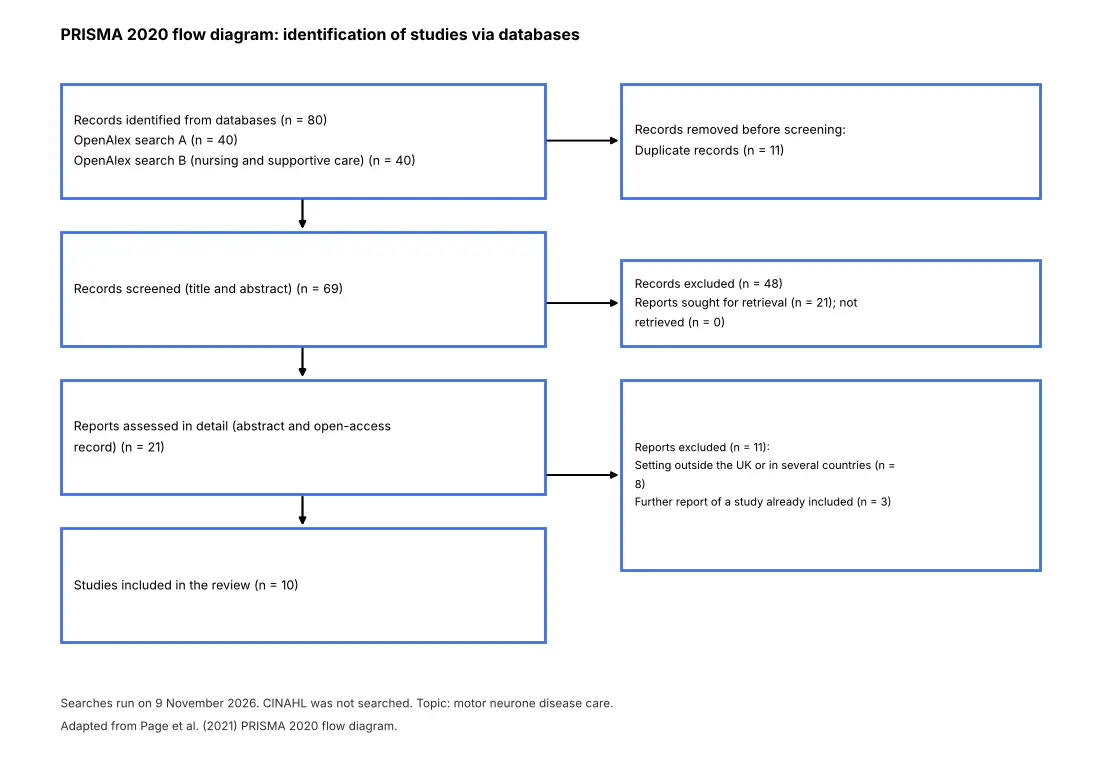
This literature-based dissertation is a structured review of published primary research on motor neurone disease care. It aims to be transparent and reproducible, but it is smaller in scope than a full systematic review, which would normally involve several reviewers, many more databases and exhaustive searching (Aveyard, 2023). The review is reported with reference to the PRISMA 2020 statement, which lists the items that should be described and recommends a flow diagram showing how records move through identification, screening and inclusion (Page et al., 2021). Appendix D presents that flow diagram, Appendix A records each search string, Appendix B tabulates the included studies and Appendix C gives a worked critical appraisal. Together, the appendices allow another reader to check each decision and to repeat the process.
The review question was framed using the Population, Exposure and Outcome (PEO) structure, which suits questions about experiences and influencing factors rather than the effects of a treatment. The population was people with motor neurone disease, their families and the professionals who care for them in the UK. The exposures were nursing and supportive care, including specialist services, communication, decision making and support for carers, and the outcomes were their experiences, needs, decisions and the delivery of care. Structured frameworks help to translate a broad topic into searchable concepts, although the choice of framework affects how sensitive a search is (Methley et al., 2014; Aveyard, 2023). Because the evidence included interviews, surveys and a pilot trial, qualitative, quantitative and mixed-methods research was eligible for inclusion.
Two searches were run on 9 November 2026 in OpenAlex, an open index of scholarly works that covers a large and growing proportion of the published literature (Priem et al., 2022). The first search used the words motor neurone disease care. The second combined the words motor neurone disease, nurses, supportive care and experiences, to capture nursing and supportive care more directly. Both searches were limited to open-access records published between 2015 and 2026 with at least one author affiliated to a UK institution. Both searches were restricted to journal articles. Combining more than one source is advised because a single database misses relevant studies (Bramer et al., 2017). The exact strings and settings are given in Appendix A.
CINAHL, the main nursing database, could not be accessed, and a planned search of MEDLINE through Europe PMC was not completed because the service refused repeated requests on the day of searching. The second OpenAlex search was therefore used in its place. These gaps mean that some relevant nursing studies may not have been found, a risk that is well recognised when the combination of databases is restricted (Bramer et al., 2017). OpenAlex matches terms anywhere in the text, so many records were not relevant. It also ranks records by relevance, and the two searches matched 1,665 and 170 records. Only the first 40 records of the first search and the first 40 of the second, 80 in total, were screened, so the review should be read as a structured sample of the literature and not as a complete search (Aveyard, 2023).
Studies were eligible if they involved people with motor neurone disease, their families or the professionals who care for them in the UK, and examined nursing, supportive or specialist care, decisions, communication or carer support. Reports had to be peer-reviewed, written in English, open access and published from 2015 onwards. UK origin was judged from the stated setting and, where the abstract did not name one, from author affiliations. Reviews, protocols, clinical case reports, studies of epidemiology or diagnosis, studies set outside the UK and further reports of studies already included were excluded. Clear criteria applied consistently reduce selection bias and allow the decisions to be audited. The extraction table is presented in Appendix B so that readers can compare studies at a glance (Page et al., 2021; Aveyard, 2023).
All 80 records were exported into a screening log, and 11 duplicates were removed, leaving 69 titles to screen. Titles on clinical, diagnostic, epidemiological, grief-only or other-condition topics were excluded; where more than ten studies were eligible, those most about nursing or supportive care were preferred. That left 21 reports for closer assessment against the criteria. The abstract and open-access record of each of these reports were read, and the reason for every exclusion was recorded. The log lists every record by its identifier, the search in which it appeared and the decision reached, so that each exclusion can be traced. Ten studies met the criteria, and the numbers at each stage reconcile in the flow diagram (Page et al., 2021). Screening was carried out by one reviewer, which is a recognised limitation of student reviews because a second reviewer would normally check each decision (Aveyard, 2023).
Quality was considered using the Critical Appraisal Skills Programme checklists, which ask structured questions about the aims, design, conduct, results and value of a study (CASP, 2024). The qualitative checklist was completed in full for one interview study, as a worked example in Appendix C, and indicative quality notes for every study are recorded in Appendix B. Those notes are based on the abstract and, for one study, the open full text, so they are judgements of reporting and not a full audit of how the research was conducted. No study was excluded on quality alone, since appraisal was used to weigh the strength of the findings, which is a common approach in nursing reviews (Aveyard, 2023).
Data were extracted into a standard table covering aims, design, sample, setting, methods, findings and limitations. Numerical results were copied as reported and were not recalculated, and extraction was rechecked once against the source records, a step that reduces transcription errors but does not replace independent checking. Findings were grouped into themes by thematic synthesis, with the survey and pilot trial results reported alongside the qualitative themes because the review combined studies of different designs (Thomas and Harden, 2008; Braun and Clarke, 2006). The review used published data only and involved no participants, so ethical approval was not required, although the findings of the included studies are reported accurately and with full attribution (Aveyard, 2023).
Findings
Ten UK studies met the inclusion criteria, published between 2015 and 2024. Five used interviews or other qualitative methods with people with the disease, carers or bereaved relatives, two used qualitative methods with health professionals, one was a survey of professionals, one a survey of services and carers’ views on grief support, and one was a pilot trial of a telehealth service. Studies of bereaved carers (McVeigh et al., 2019), of professionals deciding about gastrostomy (White et al., 2024) and of young people (Clabburn and O’Brien, 2015) are described below, and the section ends with the quality and limits of the evidence. Each study is reported as its authors described it, and the numbers come from abstracts or open full text.
Living with the disease and its uncertainty
Four people with the disease took part in life-story interviews in a hermeneutic phenomenological study. Their accounts described three phases: a body failing prematurely, a search for answers, and nearing the end of life with a need to talk. Participants wanted contact with palliative care professionals, and the authors concluded that holistic care is needed and that the phases could help nurses to understand and respond to what people are going through (Harris et al., 2018). Young people were also affected. Seven who were caring for or bereaved by a parent with the disease described changes in family roles, effects on education and social life, and some positive outcomes (Clabburn and O’Brien, 2015).
Bereaved carers in Northern Ireland described similar needs. In 13 interviews, they spoke of holistic care, of the biopsychosocial impact of the illness and of a lack of preparation for death. Only 5 of the 13 had received specialist palliative care, 5 had an advance decision to refuse treatment, and 7 deaths took place in hospital, while 5 took place at home and 1 in a hospice (McVeigh et al., 2019). A UK-wide interview study of 16 people with the disease, 10 family members and 36 bereaved relatives described selective decision making: advance care planning and treatment withdrawal gave a sense of control, but many did not understand the dying process (Wilson et al., 2024).
Specialist motor neurone disease care and decisions
Decisions about feeding were shaped by timing. In an online survey of 139 UK health professionals, 36 of 101 (36%) said they began discussing gastrostomy later than ideal, and the mean weight loss at discussion was 8.1%. Some 45% favoured placement before respiratory symptoms, and half thought gastrostomy was placed too late. Nurses and dietitians covered the broadest range of information, whereas doctors covered mortality risk and prognosis (White et al., 2024). These patterns fit the carers’ accounts of poor preparation, because late discussion leaves less time for the person to understand the options and to decide (McVeigh et al., 2019).
Staff also found some decisions hard. In a study of eight multidisciplinary team members, three doctors, four nurses and one allied health professional, elective withdrawal of non-invasive ventilation was supported by fulfilling the person’s wishes, teamwork, an experienced clinician and awareness of the 2015 guidance, but it was made difficult by unpredictability, moral and ethical uncertainty, lack of time, mismatched expectations, poor communication and emotional intensity (Cox et al., 2024). Nineteen professionals who gave bad news to people with motor neurodegenerative conditions, including motor neurone disease, described it as a balancing act and asked for more support and training (Anestis et al., 2021). The two studies therefore agree that staff carry an emotional load, and that organisations can lighten it through training and teamwork.
A pilot trial tested whether a telehealth service could widen access to specialist care. The 18-month single-centre mixed-methods trial compared telehealth plus usual care with usual care alone in 40 patients and 37 carers. Some 80% of patients and 82% of carers completed the measures at 6 months, and the authors estimated that 131 participants per arm would be needed for a definitive trial, concluding that the approach was feasible but challenging (Hobson et al., 2019). The study shows that new models of motor neurone disease care can be tested, although its single-centre pilot design limits what can be said about effect. Access to an experienced clinician was also named as an enabler by staff in another study (Cox et al., 2024), which suggests why remote specialist advice might be valued.
Carers and support
Carers’ needs were examined in two studies. A survey of 56 people involved in motor neurone disease care in England found that more than two-thirds could not predict which carers would develop prolonged grief disorder, and respondents wanted an alert tool to identify those at risk (O’Brien et al., 2016). The survey therefore pointed to a gap in identifying risk, while the qualitative study pointed to a tool that could help meet need. A qualitative study across three specialist UK centres, with 33 carers (19 current and 14 bereaved) and 19 carer advisors, found that the Carer Support Needs Assessment Tool covered most needs, although one new domain was needed (Ewing et al., 2020).
Taken together, these studies suggest that carers are exposed to need over a long period and that services do not always identify it. The young people described adjusting to new roles in the home (Clabburn and O’Brien, 2015), bereaved carers reported little preparation for death (McVeigh et al., 2019), and family members were closely involved in decisions about ventilation and withdrawal (Wilson et al., 2024). The tools in the carer studies are practical, but none of the studies tested whether using them improved outcomes for carers. Carers were also affected beyond the person’s death, which is why bereavement support matters. Taken together, the carer studies describe needs that begin at diagnosis and continue after death, and they show that nurses and teams can reach families only if they ask early and repeatedly.
Patterns across the studies
Three patterns ran through the studies. First, uncertainty and unpredictability shaped both lived experience and professional decisions, from the search for answers (Harris et al., 2018) to the unpredictable course of withdrawal. Second, communication and timing mattered, because gastrostomy discussion often began late (White et al., 2024). Third, families needed support before and after death, yet preparation was limited, with only 5 of 13 bereaved carers having received specialist palliative care (McVeigh et al., 2019). These patterns suggest that motor neurone disease care depends on early, honest and repeated conversations that involve the whole family, although the evidence is mostly qualitative and descriptive.
Differences in focus also ran through the evidence. Some studies centred on the person with the disease (Harris et al., 2018), others on bereaved relatives (Wilson et al., 2024), and others on staff (Cox et al., 2024). Although these views agreed on the importance of planning, they differed in emphasis: families described a lack of understanding of dying, whereas professionals described moral uncertainty and time pressure. The contrast suggests that the same decision can look different from each side, and it is a reason why the studies were reported side by side and not combined into a single estimate. It also suggests that services need to ask each group what it needs.
Quality and limits of the evidence
Several limits qualify these findings. Many studies were small and qualitative, so they describe experience in depth but cannot show how common it is. The study of life stories involved four people (Harris et al., 2018), and the study of young people involved seven (Clabburn and O’Brien, 2015). Samples were often selected, and several studies heard only from carers or only from staff. The telehealth trial was a single-centre pilot, so its results show feasibility and not effectiveness (Hobson et al., 2019). The numbers reported, such as completion rates and the estimated sample size, come from the abstract of that trial and were not recalculated, and the other studies gave few figures that could be compared directly, which is why the findings are reported in words.
The appraisal in Appendix B is based on abstracts for nine studies, so it is indicative and not a full audit. The worked appraisal in Appendix C of the study of bereaved carers in Northern Ireland found a clear aim, appropriate methods, ethical approval and a clear presentation of themes, but only 13 of 20 invited carers took part, no formal reflexivity statement was given, and the sample included carers only, with no health professionals (McVeigh et al., 2019). The funder was the regional motor neurone disease association, which does not suggest bias but should be noted, and the abstract of the pilot trial did not say who funded it (Hobson et al., 2019).
The studies may also overlap. Several came from groups that have published more than one report from the same programmes, and further reports from the same programmes were excluded to avoid counting them twice, although overlap among the included studies cannot be ruled out. The survey of gastrostomy practice did not report how respondents were identified in the abstract (White et al., 2024). The studies were published between 2015 and 2024, so practice may have changed since the earliest were done (Clabburn and O’Brien, 2015). No design here gives a complete picture of motor neurone disease care, and the evidence on young people rests on seven participants (Clabburn and O’Brien, 2015). Findings should therefore be read as indicative of what UK services have reported rather than as measures of how often each experience occurs.
Wider Discussion
The findings suggest that motor neurone disease care depends on timely conversation as much as on clinical skill. Carers reported little preparation for death (McVeigh et al., 2019), and professionals admitted starting gastrostomy discussions later than ideal (White et al., 2024). This fits the national guidance, which asks for discussions at trigger points and early discussion of nutrition and ventilation (NICE, 2016). None of these sources proves that earlier discussion improves outcomes, but together they support planned and repeated conversations led by the specialist team, in which the nurse often has a central role. Nurses are well placed to do this because they see families often and can notice when a person is ready to talk.
Staff need support as well. Professionals described emotional intensity, moral uncertainty and a lack of time when withdrawing ventilation (Cox et al., 2024), and they asked for training in giving bad news (Anestis et al., 2021). The Code of the Nursing and Midwifery Council expects nurses to practise effectively and to work within their competence (NMC, 2018), and this implies that organisations should provide the training and reflection time that make such practice possible. Without this support, the emotional intensity that staff described may lead to distress and to avoidance of difficult conversations. The same workforce questions affect all specialist services, including those that depend on internationally educated staff, as described in overseas nurses in the NHS.
Three priorities follow for practice. First, teams can raise future care early and return to it often, since many families felt unprepared. Second, services can use structured tools to identify carers’ needs, because the Carer Support Needs Assessment Tool covered most needs (Ewing et al., 2020) and clinicians wanted a way to identify carers at risk of prolonged grief (O’Brien et al., 2016). Third, organisations can test new models, such as telehealth, in larger trials (Hobson et al., 2019). Each priority needs protected time and cooperation between services, and each is within the reach of local teams. None needs new legislation, but each needs managers who protect the time to do it.
Several limitations qualify these conclusions. Only OpenAlex was searched, in two searches, CINAHL was not accessible and a planned search of MEDLINE through Europe PMC was not completed, so relevant nursing studies may have been missed (Bramer et al., 2017). Only the first 40 records of each search were screened, one reviewer made all decisions, and where more than ten eligible studies existed those most about nursing and supportive care were preferred, which is a recognised limitation of student reviews (Aveyard, 2023). Most appraisal relied on abstracts and several Australian studies were excluded under the UK rule, so the conclusions are offered as a structured sample of the evidence and not as a complete account. They should be applied with care in services unlike those studied.
Reflection
I began this review thinking that motor neurone disease care would be mostly about managing physical symptoms such as breathing and swallowing. The studies showed otherwise, and that was an uncomfortable realisation. People and families described uncertainty, a search for answers and little preparation for dying, and these were matters of conversation and timing more than of equipment. That changed how I think about my own practice, because on a ward or in the community I am likely to meet someone with a progressive illness whose family has not been told what to expect. I became more aware that I have rarely asked what people understand, and that silence from a patient can mean fear and not agreement.
The search was harder than I expected. Several relevant studies were set in Australia or in several countries, and I had to exclude them under the UK rule even though their findings were interesting. Other reports came from the same programmes as studies already included, and I excluded them so that the same participants were not counted twice. Because more than ten studies were eligible, I also had to decide which to keep, and I chose those most about nursing and supportive care. Writing down each decision was slow, but it showed me how much a review depends on its rules, and next time I will agree them in advance. It also taught me to be honest about what I had left out.
Appraising the study of bereaved carers was the most instructive part of the work. The interviews were rich and well presented, which I found moving, yet only 13 of 20 invited carers took part and no health professionals were included. I had assumed that a persuasive account would also be a complete one. Instead I saw that a study can be good and still tell only part of the story, and I realised that I am drawn to personal accounts more than to numbers. This made me more careful about asking whose voice is missing. I now try to ask who is absent before I ask what was found, and I hope that habit will help me in clinical work too.
In practice, I will ask people and families what they understand about the illness and what they would like to talk about, and I will not wait for them to raise the end of life. I will also pay attention to carers, because several studies suggested that their needs were not always noticed. I need to improve my skills in finding full texts and in reading survey tables, since I found some of the statistics hard to interpret. I also want to learn more about communication aids, because speech loss changes how a conversation can happen. These goals are modest, but they are within the reach of any nurse, and I can review them at the end of each placement with my practice supervisor.
Conclusion
This dissertation set out to review UK evidence on the experiences of people with motor neurone disease and their families of nursing and supportive care. Ten UK studies, comprising interviews with people with the disease, young people and bereaved carers, studies of professionals’ decisions about feeding, ventilation and bad news, surveys and a pilot trial of telehealth, showed that uncertainty shaped experience, that discussions about future care often came late, and that carers received limited preparation for death. Professionals, for their part, found some decisions emotionally and morally difficult.
Staff described moral uncertainty and emotional strain, and carer tools covered most needs but were not shown to improve outcomes. These results come from small qualitative samples, surveys and one pilot trial and do not prove cause, but they agree in pointing to early, repeated and honest conversation. Taken together, the studies show that motor neurone disease care depends on the specialist team and on the organisation as well as on individual nurses. Their value lies in showing where services can act, and not in proving that one model is best.
For nursing practice, the review supports raising future care early and revisiting it, using structured tools to identify the needs of carers, and giving staff the training and time they need. The strength of this evidence is limited by the restricted search, single-reviewer screening and reliance on abstracts, so the conclusions are best treated as a well-founded starting point and not as a final answer. Further research that follows families over time and tests supports in larger trials would show which approaches work best. Teams that act on these points may also improve motor neurone disease care for the people they look after.
Reference List
Anestis, E. et al. (2021) ‘Healthcare professionals’ involvement in breaking bad news to newly diagnosed patients with motor neurodegenerative conditions: a qualitative study’, Disability and Rehabilitation, 44(25), pp. 7877-7890. doi:10.1080/09638288.2021.2002436.
Aveyard, H. (2023) Doing a literature review in health and social care: a practical guide. 5th edn. Open University Press.
Bramer, W.M. et al. (2017) ‘Optimal database combinations for literature searches in systematic reviews: a prospective exploratory study’, Systematic Reviews, 6, article 245. doi:10.1186/s13643-017-0644-y.
Braun, V. and Clarke, V. (2006) ‘Using thematic analysis in psychology’, Qualitative Research in Psychology, 3(2), pp. 77-101. doi:10.1191/1478088706qp063oa.
CASP (2024) CASP checklists. Oxford: Critical Appraisal Skills Programme. Available at: https://casp-uk.net/casp-checklists/ (Accessed: 9 November 2026).
Clabburn, O. and O’Brien, M.R. (2015) ‘Exploring the impact on young people who are caring and grieving for a parent with motor neurone disease’, British Journal of Neuroscience Nursing, 11(5), pp. 243-248. doi:10.12968/bjnn.2015.11.5.243.
Cox, G., Davis, C. and Woodley, J. (2024) ‘A qualitative exploratory study into medical, nursing and allied health professional experiences of elective withdrawal of non-invasive ventilation in a motor neurone disease cohort’, Journal of Evaluation in Clinical Practice, 31(3), article e14166. doi:10.1111/jep.14166.
Ewing, G. et al. (2020) ‘Suitability and acceptability of the Carer Support Needs Assessment Tool (CSNAT) for the assessment of carers of people with MND: a qualitative study’, BMJ Open, 10(12), article e039031. doi:10.1136/bmjopen-2020-039031.
Harris, D., Jack, K. and Wibberley, C. (2018) ‘The meaning of living with uncertainty for people with motor neurone disease’, Journal of Clinical Nursing, 27(9-10), pp. 2062-2071. doi:10.1111/jocn.14350.
Hobson, E. et al. (2019) ‘Using telehealth in motor neuron disease to increase access to specialist multidisciplinary care: a UK-based pilot and feasibility study’, BMJ Open, 9(10), article e028525. doi:10.1136/bmjopen-2018-028525.
McVeigh, C. et al. (2019) ‘Palliative care for patients with motor neurone disease and their bereaved carers: a qualitative study’, BMC Palliative Care, 18, article 39. doi:10.1186/s12904-019-0423-8.
Methley, A.M. et al. (2014) ‘PICO, PICOS and SPIDER: a comparison study of specificity and sensitivity in three search tools for qualitative systematic reviews’, BMC Health Services Research, 14, article 579. doi:10.1186/s12913-014-0579-0.
Motor Neurone Disease Association (MND Association) (2025) Key messages and core information. Northampton: MND Association. Available at: https://www.mndassociation.org/sites/default/files/public/2025-11/MND%20Association%20Key%20Messages%20updated%20May%202025.pdf (Accessed: 9 November 2026).
National Institute for Health and Care Excellence (NICE) (2016) Motor neurone disease: assessment and management (NG42). London: NICE. Available at: https://www.nice.org.uk/guidance/ng42 (Accessed: 9 November 2026).
Nursing and Midwifery Council (NMC) (2018) The Code: professional standards of practice and behaviour for nurses, midwives and nursing associates. London: NMC. Available at: https://www.nmc.org.uk/standards/code/ (Accessed: 9 November 2026).
O’Brien, M.R. et al. (2016) ‘Bereavement support and prolonged grief disorder among carers of people with motor neurone disease’, British Journal of Neuroscience Nursing, 12(6), pp. 268-276. doi:10.12968/bjnn.2016.12.6.268.
Page, M.J. et al. (2021) ‘The PRISMA 2020 statement: an updated guideline for reporting systematic reviews’, BMJ, 372, article n71. doi:10.1136/bmj.n71.
Priem, J., Piwowar, H. and Orr, R. (2022) ‘OpenAlex: a fully-open index of scholarly works, authors, venues, institutions, and concepts’, arXiv, 2205.01833. doi:10.48550/arXiv.2205.01833.
Thomas, J. and Harden, A. (2008) ‘Methods for the thematic synthesis of qualitative research in systematic reviews’, BMC Medical Research Methodology, 8, article 45. doi:10.1186/1471-2288-8-45.
White, S. et al. (2024) ‘Supporting people with Motor Neuron Disease (MND) to make decisions about gastrostomy feeding tube placement: a survey of UK healthcare professionals’ practice and beliefs’, Amyotrophic Lateral Sclerosis and Frontotemporal Degeneration, 25(3-4), pp. 290-298. doi:10.1080/21678421.2024.2314061.
Wilson, E. et al. (2024) ‘End of life decision making when home mechanical ventilation is used to sustain breathing in Motor Neurone Disease: patient and family perspectives’, BMC Palliative Care, 23, article 115. doi:10.1186/s12904-024-01443-1.
Appendix A: Search strategy
This appendix records the searches run for the motor neurone disease care review so that the process can be repeated and checked.
Two searches on motor neurone disease care were run on 9 November 2026 using the OpenAlex works API. The first 40 records of the first search and the first 40 of the second, ranked by relevance, were retrieved and screened by title and abstract.
| Database | Platform | Date run | Search string | Limiters | Hits |
|---|---|---|---|---|---|
| OpenAlex search A | OpenAlex API | 9 November 2026 | search=motor neurone disease care | Filter: authorships.countries:GB; is_oa:true; publication_year:2015-2026; type:article. 1,665 matches in total; the first 40 by relevance were screened. | 40 |
| OpenAlex search B (nursing and supportive care) | OpenAlex API | 9 November 2026 | search=motor neurone disease nurses supportive care experiences | Filter: authorships.countries:GB; is_oa:true; publication_year:2015-2026; type:article. 170 matches in total; the first 40 by relevance were screened. | 40 |
CINAHL could not be accessed and was not searched, so no CINAHL results are reported. A planned MEDLINE search through Europe PMC was attempted on the same day but the service refused repeated requests, so it was not completed for motor neurone disease care; search B, which targeted nursing and supportive care, was used instead.
OpenAlex matches search terms in the title, abstract or full text, and the country filter matches any record with at least one author affiliated to a UK institution. UK setting and relevance were therefore checked for each study at the assessment stage. Records identified: 80 (40 + 40); duplicates removed: 11; records screened: 69.
Appendix B: Data extraction table
The table summarises each study included in this motor neurone disease care review: its aim, design, sample, methods, key findings, limitations and relevance to motor neurone disease care.
| Author / year / country | Aim | Design | Sample and setting | Methods | Key findings | Limitations / quality | Relevance to motor neurone disease care |
|---|---|---|---|---|---|---|---|
| Clabburn and O’Brien (2015), UK (England) | To explore the impact on young people who are caring for, or bereaved by, a parent with motor neurone disease. | Qualitative interview study. | Seven young people caring for or bereaved by a parent with motor neurone disease care needs. | Informal semi-structured interviews. | Themes in motor neurone disease care for families were diagnosis, changing family roles, education, social life and positive outcomes. | Indicative (abstract only): seven participants; young people only; UK origin judged from author affiliations; limited relevance to nursing delivery of motor neurone disease care. | Family experience of motor neurone disease care. |
| O’Brien et al. (2016), UK (England) | To explore bereavement support and the identification of prolonged grief disorder among carers in motor neurone disease care. | Survey. | 56 people involved in motor neurone disease care in England. | Survey of staff and others involved in motor neurone disease care. | In motor neurone disease care, more than two-thirds could not predict which carers would develop prolonged grief disorder; respondents wanted an alert tool. | Indicative (abstract only): small survey; response rate not stated in the abstract; self-reported views on motor neurone disease care. | Carer support in motor neurone disease care. |
| Harris et al. (2018), UK (England) | To understand the meaning of living with uncertainty for people with motor neurone disease. | Hermeneutic phenomenology. | Four people with motor neurone disease receiving motor neurone disease care. | Life-story interviews. | Three phases: a body failing prematurely, a search for answers, and nearing the end of life with a need to talk; participants wanted palliative care professionals and holistic care. | Indicative (abstract only): four participants; UK origin judged from author affiliations; findings may not transfer to other motor neurone disease care settings. | Lived experience and holistic motor neurone disease care. |
| McVeigh et al. (2019), UK (Northern Ireland) | To explore palliative care in motor neurone disease care from the perspective of bereaved carers. | Qualitative interpretivist interview study. | 13 of 20 invited bereaved carers recruited through the Northern Ireland register, 2015. | Semi-structured home interviews of 60 to 90 minutes, analysed with the approach of King and Horrocks. | Themes of holistic care, biopsychosocial impact and lack of preparation for death; 5 of 13 received specialist palliative care and 7 deaths were in hospital. | CASP qualitative appraisal in Appendix C (open full text). Carers only; no health professionals; 13 of 20 invited took part; no formal reflexivity statement; motor neurone disease care in one region. | Palliative aspects of motor neurone disease care. |
| Hobson et al. (2019), UK (England) | To test the feasibility of a telehealth service to increase access to specialist motor neurone disease care. | Single-centre mixed-methods pilot randomised controlled trial. | 40 patients and 37 carers over 18 months. | Telehealth plus usual care compared with usual care alone, with outcome measures and qualitative data. | 80% of patients and 82% of carers completed measures at 6 months; 131 participants per arm were estimated for a definitive trial; feasible but challenging. | Indicative (abstract only): single centre; pilot size; funding not stated in the abstract; tests one model of motor neurone disease care. | Service models for motor neurone disease care. |
| Ewing et al. (2020), UK (three specialist centres) | To assess the suitability and acceptability of the Carer Support Needs Assessment Tool for carers in motor neurone disease care. | Two-stage qualitative study. | 33 carers (19 current, 14 bereaved) and 19 carer advisors at three UK specialist centres. | Qualitative interviews and consultation about the tool in motor neurone disease care. | The tool domains covered most needs in motor neurone disease care; one new domain was needed. | Indicative (abstract only): tool tested for acceptability, not for outcomes; three specialist centres; methods only briefly described. | Carer assessment in motor neurone disease care. |
| Anestis et al. (2021), UK | To explore how professionals take part in breaking bad news to newly diagnosed patients with motor neurodegenerative conditions, including motor neurone disease care. | Qualitative study. | 19 healthcare professionals working in motor neurone disease care, multiple sclerosis, Parkinson’s disease and Huntington’s disease. | Qualitative interviews with professionals; analysis gave four themes. | Giving bad news in motor neurone disease care was a balancing act; professionals asked for support and training. | Indicative (abstract only): mixed conditions, not only motor neurone disease care; online year 2021 used (print 2022). | Communication within motor neurone disease care. |
| Cox et al. (2024), UK (NHS) | To explore professionals’ experiences of elective withdrawal of non-invasive ventilation in motor neurone disease care. | Qualitative exploratory study. | Eight multidisciplinary team members (three doctors, four nurses, one allied health professional). | Qualitative interviews analysed thematically; four themes. | Enablers were fulfilling wishes, teamwork, an experienced clinician and awareness of 2015 guidance; barriers were unpredictability, moral and ethical uncertainty, time, mismatched expectations, poor communication and emotional intensity. | Indicative (abstract only): eight participants; one service; online year 2024 used (volume 31). | End-of-life decisions in motor neurone disease care. |
| White et al. (2024), UK | To describe how UK professionals support decisions about gastrostomy in motor neurone disease care. | Online cross-sectional survey. | 139 UK healthcare professionals in motor neurone disease care. | Online survey of practice and beliefs. | 36 of 101 (36%) began discussions later than ideal; mean weight loss 8.1%; 45% favoured placement before respiratory symptoms; nurses and dietitians covered the broadest information. | Indicative (abstract only): self-reported survey; selection of respondents not described in the abstract; professionals’ views, not patients’ views of motor neurone disease care. | Nutrition decisions in motor neurone disease care. |
| Wilson et al. (2024), UK | To explore end-of-life decision making when home mechanical ventilation is used in motor neurone disease care. | Qualitative study using flexible interviews. | 16 people with motor neurone disease, 10 family members and 36 bereaved family members. | Flexible qualitative interviews across the UK. | Selective decision making; advance care planning and treatment withdrawal gave a sense of control; many lacked understanding of the dying process. | Indicative (abstract only): ventilation users only; self-selected participants; may overlap with other reports on motor neurone disease care from the same programme. | Decision making in motor neurone disease care. |
Appendix C: Critical appraisal checklist
CASP qualitative studies checklist (CASP, 2024), completed for McVeigh et al. (2019), a study included in this motor neurone disease care review. Answers: Yes, No or Can’t tell, each with a short justification.
| # | Question | Answer | Justification |
|---|---|---|---|
| Section A: Are the results valid? | |||
| 1 | Was there a clear statement of the aims of the research? | Yes | The aim is stated clearly: to explore palliative care in motor neurone disease care in Northern Ireland from the perspective of bereaved carers. |
| 2 | Is a qualitative methodology appropriate? | Yes | A qualitative method suits a question about experiences of motor neurone disease care and the needs of bereaved carers. |
| 3 | Was the research design appropriate to address the aims of the research? | Yes | An interpretivist qualitative design using semi-structured interviews suits the aim of exploring carers’ accounts of motor neurone disease care. |
| 4 | Was the recruitment strategy appropriate to the aims of the research? | Yes | Carers of people receiving motor neurone disease care were recruited through the Northern Ireland register: 20 were invited and 13 took part, although sampling was by convenience and no professionals were included. |
| 5 | Was the data collected in a way that addressed the research issue? | Yes | Interviews were held at home, lasted 60 to 90 minutes, were recorded and transcribed verbatim, and were conducted by a research nurse. |
| 6 | Has the relationship between researcher and participants been adequately considered? | Can’t tell | No formal reflexivity statement is given, although reflective questioning and feedback were used while collecting data on motor neurone disease care. |
| Section B: What are the results? | |||
| 7 | Have ethical issues been taken into consideration? | Yes | The study had approval from the Office for Research Ethics Committees Northern Ireland (reference 14/NI/1034) and written consent was obtained. |
| 8 | Was the data analysis sufficiently rigorous? | Yes | The approach of King and Horrocks was used and the analysis was reviewed by several team members, although no software is named. |
| 9 | Is there a clear statement of findings? | Yes | Findings are stated clearly with participants’ quotations and relate to motor neurone disease care at home, in hospices and in hospital. |
| Section C: Will the results help locally? | |||
| 10 | How valuable is the research? | Yes | The study adds to knowledge of motor neurone disease care and states its limits, in particular that only carers were interviewed. |
Appendix D: PRISMA flow diagram
This dissertation is a worked example that shows the structure and standard of a 5,000-word literature-based Independent Project. It is provided for learning and is not to be submitted as a student’s own work.