

Dignity in the Care of Older People in Hospitals and Care Homes: Patient, Family and Nurse Perspectives
 By Dr. Robertson Prime, Research Fellow
This dissertation is a worked example that shows the structure and standard of a 5,000-word literature-based Independent Project. It is provided for learning and is not to be submitted as a student’s own work.
Abstract
Background: Dignity is a regulatory standard and a professional duty, and older people in hospitals and care homes may depend on others for personal care. Less is known about how UK studies describe the experiences of older people, families and nurses of dignity in care and what supports it.
Aim: To critically review UK evidence on how older people, their families and nurses experience dignity in care in hospitals and care homes.
Methods: A structured literature review using the Population, Exposure and Outcome framework. OpenAlex was searched twice on 15 November 2026, because CINAHL could not be accessed and a planned MEDLINE search was not completed. The first 40 records of each search were screened: 80 records were identified, 72 screened after the removal of duplicates and 10 UK studies included. Quality was considered using Critical Appraisal Skills Programme questions, and findings were combined by thematic synthesis.
Findings: The included studies of dignity in care (n = 10) comprised interviews with patients, staff and residents, ward measures of dignity, a pilot of a dignity question, action research in care homes, studies of nursing students, an ethnography of district nursing and an analysis of national survey data. Dignity depended on small everyday actions, time and staffing, and education and culture shaped what staff could do.
Conclusions and implications for practice: For dignity in care, teams can use simple tools to learn how care is experienced, involve residents and staff in shaping practice, protect time for personal care and attend to inequalities for the oldest and disabled. The evidence is limited by the restricted search, single-reviewer screening, reliance on abstracts and the scarcity of family perspectives.
Keywords: dignity in care; dignified care; older people; adult nursing; literature review.
Brief at a glance
- Framework
- PEO
- Design
- Literature review (PEO)
- Studies included
- 10
- Field
- Adult Nursing
Introduction
Dignity is at the centre of what people expect from nursing. The Social Care Institute for Excellence describes dignified care as care that supports the self-respect of the person and recognises their abilities and aspirations without weakening them (SCIE, 2026). The Care Quality Commission requires that people receiving care and treatment are treated with respect and dignity at all times (CQC, 2026), and the Code of the Nursing and Midwifery Council begins with the duty to treat people as individuals and uphold their dignity (NMC, 2018). Older people are among the most frequent users of hospitals and care homes, and they may depend on others for personal care. Dignity in care is therefore a core question for adult nursing. Because the question concerns experience, equal weight is given to the views of older people and of the staff who care for them.
Dignity may be easy to endorse but hard to deliver. Compassion and dignity are closely linked, as discussed in compassionate nursing care, yet national guidance expects dignity to be protected in everyday matters such as privacy, communication and choice (CQC, 2026). This dissertation reviews UK research on how older people, their families and nurses experience dignity in care in hospitals and care homes. It follows a structured process so that each decision can be checked. The review is limited to the UK so that its conclusions fit NHS and social care services, and it includes qualitative, quantitative and mixed-methods studies. It also asks what the evidence implies for nursing practice and education. The Social Care Institute for Excellence stresses that dignity depends on the whole experience of care, including communication, choice and privacy (SCIE, 2026), so the review looks beyond individual acts of kindness.
Background and Justification
Dignity has no single definition, but national guidance describes it in practical terms. The Social Care Institute for Excellence presents dignity as care that supports the self-respect of the person, recognises their abilities and aspirations and does not weaken them (SCIE, 2026). Its guide is written for care providers, managers and staff who work with adults, especially older adults, and it covers the views of people receiving care, their carers, families and friends. Its chapters include recognising the individual, information and communication, freedom to choose, privacy, involvement and inclusion, and warmth and kindness (SCIE, 2026). Its guide also links dignity to the regulations of the Care Quality Commission, which gives providers a shared language for inspection (SCIE, 2026; CQC, 2026). Dignity is therefore relational and concerns the whole experience of being cared for.
Dignity is also a regulatory standard. The Care Quality Commission states that people receiving care and treatment should be treated with respect and dignity at all times, which includes having privacy when they want it, being treated as equals and getting the support they need to be autonomous and independent (CQC, 2026). Staff must treat people with dignity and respect in a caring and compassionate way, communicate respectfully, respect personal preferences and lifestyle, address people in their preferred way and not neglect people or leave them in undignified situations (CQC, 2026). These requirements apply to hospitals and care homes alike and give inspectors a basis for judging whether dignity is upheld. They sit alongside the professional duty of nurses to uphold dignity (NMC, 2018).
The regulation also lists specific examples. Privacy must be maintained at all times, including when people are asleep, unconscious or lack capacity, and sensitive discussions should not be overheard. People should be supported in washing, bathing and toileting, and provided with support that matches their needs while respecting their wish to act independently. Providers must not discriminate on grounds that include age or disability (CQC, 2026). The Commission cannot prosecute for a breach of this regulation, but it can take regulatory action and must refuse registration if a provider cannot show that it will comply (CQC, 2026). The Code makes the same point for nurses, who must protect human rights as well as deliver basic care (NMC, 2018). Dignity is therefore a legal expectation as well as a professional ideal.
Professional standards give nurses a clear role. The Code of the Nursing and Midwifery Council places dignity in its first section, which asks nurses to show kindness, respect and compassion to everyone receiving care, to deliver the basic elements of care well, to avoid assumptions and respect individual choices, to provide care promptly and to protect human rights (NMC, 2018). The guide of the Social Care Institute for Excellence also includes a chapter on a dignified life and a dignified death (SCIE, 2026), which links this topic to the care of people nearing the end of life, as described in motor neurone disease care.
Dignity depends on conditions as well as on attitudes. Privacy needs to be identified, recorded and met, communication has to be suited to the person, and staff need time to give attention to the individual (CQC, 2026). The guide of the Social Care Institute for Excellence stresses information and communication, involvement and inclusion, and warmth and kindness as parts of dignity (SCIE, 2026). The Code asks nurses to deliver the basic elements of care well and to provide care without unnecessary waiting, which assumes that workload and staffing allow it (NMC, 2018). It therefore ties dignity to everyday standards of care and not to a single task. A review of dignity therefore has to look at the environment and the organisation as well as at the individual nurse.
Guidance describes what dignity requires, but it says less about how older people and staff experience it and what helps. Evidence is spread across interviews, surveys, observation, action research and national data. A literature review can bring it together if it follows a transparent method and states its limits (Aveyard, 2023). This review used a structure that separates the population, the exposure and the outcome, because the exposures of interest were practices and conditions and not a single intervention (Methley et al., 2014). Restricting the review to UK studies allows the findings to be read against one professional code (NMC, 2018).
Title, Aim and Objectives
What do UK studies show about how older people, their families and nurses experience dignity in care in hospitals, care homes and the community?
Title explained
The title names the focus on dignity in care, the older people who receive it in hospitals and care homes, the perspectives of patients, families and nurses that are reviewed, and the literature review design that structures the whole work.
Aim
To critically review UK evidence on how older people, their families and nurses experience dignity in care in hospitals and care homes.
Objectives
- To identify and appraise UK research on dignity in care.
- To synthesise findings on experiences, measurement and education.
- To make recommendations for nursing practice.
Methodology
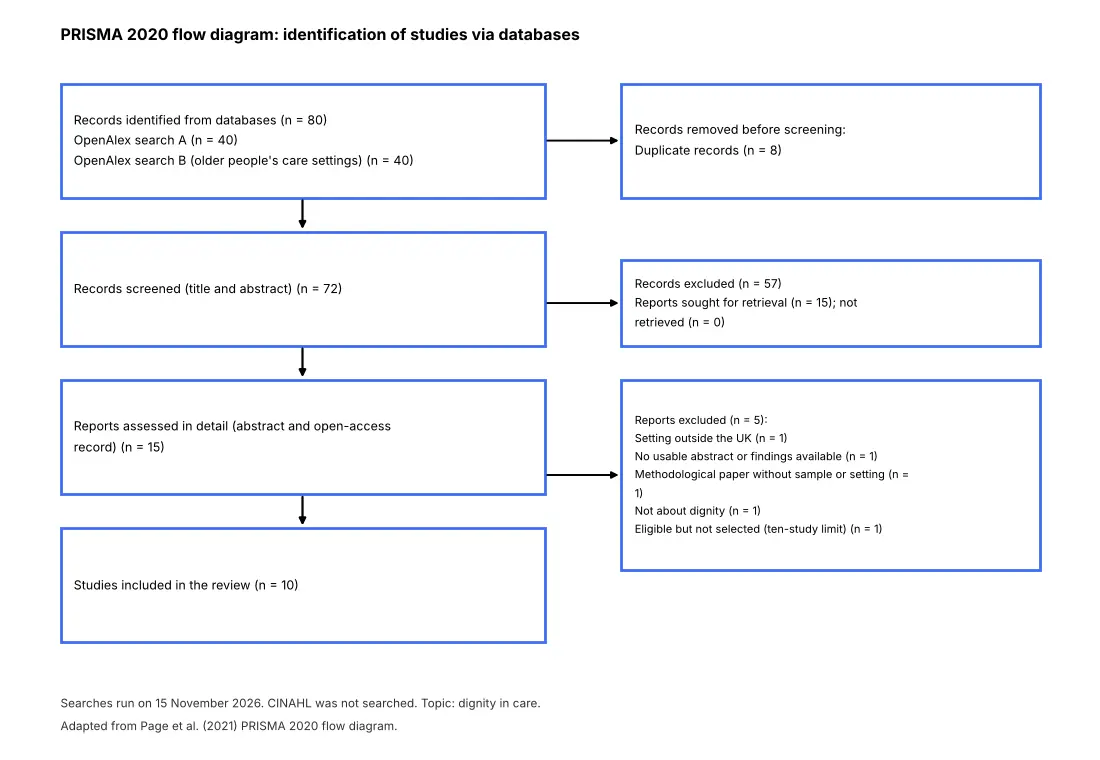
This literature-based dissertation is a structured review of published primary research on dignity in care. It aims to be transparent and reproducible, but it is smaller in scope than a full systematic review, which would normally involve several reviewers, many more databases and exhaustive searching (Aveyard, 2023). The review is reported with reference to the PRISMA 2020 statement, which lists the items that should be described and recommends a flow diagram showing how records move through identification, screening and inclusion (Page et al., 2021). Appendix D presents that flow diagram, Appendix A records each search string, Appendix B tabulates the included studies and Appendix C gives a worked critical appraisal. Together, the appendices allow another reader to check each decision and to repeat the process.
The review question was framed using the Population, Exposure and Outcome (PEO) structure, which suits questions about experiences and influencing factors rather than the effects of a treatment. The population was older people receiving care in UK hospitals, care homes and their own homes, together with their families and the nurses and other staff who care for them. The exposures were the practices, interventions, education and organisational conditions that might uphold or breach dignity, and the outcomes were experiences, measured dignity and the views of staff. Structured frameworks help to translate a broad topic into searchable concepts, although the choice of framework affects how sensitive a search is (Methley et al., 2014; Aveyard, 2023). Because the evidence included interviews, surveys, observation, action research and national survey data, qualitative, quantitative and mixed-methods research was eligible for inclusion.
Two searches were run on 15 November 2026 in OpenAlex, an open index of scholarly works that covers a large and growing proportion of the published literature (Priem et al., 2022). The first search used the words dignity in care. The second combined the words dignity, older people, hospital, care home, nurses and experiences, to bring studies of older people’s care settings higher in the results. Both searches were limited to open-access records published between 2015 and 2026 with at least one author affiliated to a UK institution. Both searches were restricted to journal articles. Combining more than one source is advised because a single database misses relevant studies (Bramer et al., 2017). The exact strings and settings are given in Appendix A.
CINAHL, the main nursing database, could not be accessed, and a planned search of MEDLINE through Europe PMC was not completed because the service refused repeated requests on the day of searching. The second OpenAlex search was therefore used in its place. These gaps mean that some relevant nursing studies may not have been found, a risk that is well recognised when the combination of databases is restricted (Bramer et al., 2017). OpenAlex matches terms anywhere in the text, so many records were not relevant. It also ranks records by relevance, and the two searches matched 16,705 and 1,804 records. Only the first 40 records of the first search and the first 40 of the second, 80 in total, were screened, so the review should be read as a structured sample of the literature and not as a complete search (Aveyard, 2023).
Studies were eligible if they involved older people, their families, nurses or other care staff, or nursing students in UK hospital, care home or community settings, and examined dignity, dignified care, its measurement or interventions to uphold it. Reports had to be peer-reviewed, written in English, open access and published from 2015 onwards. UK origin was judged from the stated setting and, where the abstract did not name one, from author affiliations. Reviews, protocols, commentaries, methodological papers, studies not about dignity, studies set outside the UK and reports without a usable abstract were excluded. Clear criteria applied consistently reduce selection bias and allow the decisions to be audited. The extraction table is presented in Appendix B so that readers can compare studies at a glance (Page et al., 2021; Aveyard, 2023).
All 80 records were exported into a screening log, and 8 duplicates were removed, leaving 72 titles to screen. Titles about other countries, dignity therapy, theology, housing or technology were excluded here, and where more than ten eligible studies existed, those most about older people were preferred. That left 15 reports for closer assessment against the criteria. The abstract and open-access record of each of these reports were read, and the reason for every exclusion was recorded. The log lists every record by its identifier, the search in which it appeared and the decision reached, so that each exclusion can be traced. Ten studies met the criteria, and the numbers at each stage reconcile in the flow diagram (Page et al., 2021). Screening was carried out by one reviewer, which is a recognised limitation of student reviews because a second reviewer would normally check each decision (Aveyard, 2023).
Quality was considered using the Critical Appraisal Skills Programme checklists, which ask structured questions about the aims, design, conduct, results and value of a study (CASP, 2024). The qualitative checklist was completed in full for one interview study, as a worked example in Appendix C, and indicative quality notes for every study are recorded in Appendix B. Those notes are based on the abstract and, for one study, the open full text, so they are judgements of reporting and not a full audit of how the research was conducted. No study was excluded on quality alone, since appraisal was used to weigh the strength of the findings, which is a common approach in nursing reviews (Aveyard, 2023).
Data were extracted into a standard table covering aims, design, sample, setting, methods, findings and limitations. Numerical results were copied as reported and were not recalculated, and extraction was rechecked once against the source records, a step that reduces transcription errors but does not replace independent checking. Findings were grouped into themes by thematic synthesis, with the survey, observation and national data results reported alongside the qualitative themes because the review combined studies of different designs (Thomas and Harden, 2008; Braun and Clarke, 2006). The review used published data only and involved no participants, so ethical approval was not required, although the findings of the included studies are reported accurately and with full attribution (Aveyard, 2023).
Findings
Ten UK studies met the inclusion criteria, published between 2015 and 2023. Four were set in acute hospitals, two in care homes, one in the community, one drew on national survey data for English hospitals and two involved nursing students. Seven used interviews, focus groups or action research, one used observation and surveys, one used a national survey and one was a mixed-methods pilot. Each is described below, and the section ends with the quality and limits of the evidence. Two of the reports came from the same research programme (Tauber-Gilmore et al., 2018a; Tauber-Gilmore et al., 2018b), so they are not necessarily independent.
Views and experiences of dignity in care
In one metropolitan hospital, 13 older patients and 38 healthcare professionals were interviewed about what dignity means and what supports or breaches it. Patients and staff broadly agreed on its meaning, and three themes emerged: the meaning of dignity, staffing levels and their impact, and organisational culture. Registered staff from all disciplines and student nurses reported receiving very little training on dignity or on the care of older people. The authors concluded that dignified care was applied inconsistently and that clinical nurses play a major role in ensuring it (Tauber-Gilmore et al., 2018a). Staff in four NHS trusts described the same pattern of small actions mattering most (Williams et al., 2016).
Staff views were also studied across four NHS trusts. In interviews with 48 healthcare professionals in 2012, two main themes emerged: small everyday actions matter to both patients and professionals, and improving care is closely linked to making poor care visible. The authors described the small actions as supporting both caring for patients and caring about them, and they suggested that a non-threatening approach could help professionals deliver dignified care (Williams et al., 2016). This fits the view that staff behaviour in the hospital study, and not only policy, shaped what patients experienced (Tauber-Gilmore et al., 2018a). Both findings point to day-to-day behaviour as the place where dignity is won or lost.
In care homes, residents described dignity in terms of identity. Interviews with 26 residents of five homes in Wales, supported by four staff interviews, found that moving into care was associated with a loss of identity, that teeth or dentures were part of identity, pride and independence, and that residents prioritised privacy, pride and independence above effective oral hygiene. Carers adapted care to balance time with privacy and dignity, and two residents said they did not want to die without their dentures (Johnson et al., 2023). The study shows how an everyday task can carry a great deal of meaning for dignity. Care home staff in action research similarly valued time to discuss dignity (Gallagher et al., 2016).
Measuring and promoting dignity in care
A second report from the hospital programme developed tools to measure dignity on 17 wards where at least half of patients were aged 65 or over. In 5,693 electronic surveys the mean dignity score rose from 22.00 before an intervention to 23.03 afterwards on a scale of 6 to 24 (p < 0.001). Observation of 581 staff and patient interactions found that 41% were positive, 39% neutral and 20% negative, with the positive share ranging from 17% to 59% across wards. Allied health professionals had the highest share of positive interactions (76%) and domestic staff the lowest (22%), and longer encounters were more often positive (Tauber-Gilmore et al., 2018b). Hospital staff in the same programme had described dignified care as applied inconsistently (Tauber-Gilmore et al., 2018a).
A mixed-methods pilot tested the Patient Dignity Question, which asks what the professional needs to know about the person in order to give the best care. Among 30 patients, 17 professionals and 4 family members in an acute hospital, higher scores for a person-centred climate were positively correlated with higher scores for empathy, and the question prompted disclosure of information that staff had not known. Patients valued staff attributes, wished to be known as a person and wanted staff to take time to talk (Johnston et al., 2015). Taken with the ward measures, this suggests that a simple question can support dignity without a large change in routine (Tauber-Gilmore et al., 2018b).
Action research gave care home staff a role in change. In four care homes in south England, groups of staff, residents and relatives discussed dignity principles and experiences over six cycles in six months and helped to develop a toolkit, which was produced in hard copy and online versions tailored to each home. Caregivers said that the process made time for discussing dignity and that they felt empowered, and the authors argued that a collaborative, bottom-up approach could help registered nurses to provide ethical leadership (Gallagher et al., 2016). Residents interviewed in Wales likewise valued privacy, pride and independence (Johnson et al., 2023).
Education, staffing and organisation
Two studies examined what nursing students understand by dignity. In one university, students linked dignity to listening, involving patients in decisions and protecting privacy, felt confident about what it looked like in practice and were less sure about theory, and identified organisational, environmental, professional and personal barriers (Macaden et al., 2017). In another Scottish programme, 31 students used photographs and a nominal group technique to describe dignity in terms of relationships and feelings, in 10 categories of meaning (Mullen et al., 2019). Both studies suggest that dignity education should be more prominent in pre-registration programmes. Neither followed students into practice, so the effect of this learning on care is unknown.
National data pointed to staffing and inequalities. Analysis of the Adult Inpatient Survey for England found that poor and inconsistent experiences of respect, dignity and eating support affected a large share of older inpatients in most acute trusts, with little change over time and modest improvement after the Francis Inquiry. They were more common among people over 80, people with long-standing illness or disability and women, and the highest rates were among disabled women over 80. Perceived inadequate nursing numbers and quality, and limited food choice, were strongly associated with poor eating support (Vizard and Burchardt, 2023). Staffing was also a theme in interviews (Tauber-Gilmore et al., 2018a).
Dignity in care was also studied in people’s own homes. An ethnography of district nursing in England included 62 observations of care, interviews with 11 staff and interviews with 11 older adults. Time and space were the key ways in which dignity appeared in practice, and their absence created openings for abuse and neglect. Nurses were not formally allocated time for dignity-focused care, and dignity could be marginalised although it was treated as a core part of caregiving. The authors argued that abuse is less likely when clinicians maintain dignity (Stevens et al., 2022). The concern about time echoes the care home findings (Johnson et al., 2023).
Patterns across the studies
Three patterns ran through the studies. First, dignity was shaped by small, everyday actions such as listening, privacy and taking time (Williams et al., 2016). Second, time and staffing were repeatedly named as conditions that made dignity possible or impossible (Stevens et al., 2022). Third, education and culture mattered, because staff and students reported little training and identified organisational barriers (Macaden et al., 2017). Together, these patterns suggest that dignity depends on the organisation and its resources as well as on the attitudes of individual nurses, although most of the evidence is qualitative and local. These patterns were visible in hospitals, care homes and the community alike.
Differences in perspective are also informative. Patients and staff broadly agreed about what dignity means (Tauber-Gilmore et al., 2018a), yet residents prioritised privacy and pride over the clinical goal of oral hygiene (Johnson et al., 2023), whereas national survey data showed that experiences of dignity were unevenly distributed across groups (Vizard and Burchardt, 2023). These contrasts suggest that dignity cannot be judged from average scores or from staff views alone, and they are a reason why the studies were reported side by side and not combined into a single estimate. They also show why a review of dignity needs both numbers and accounts of experience.
Quality and limits of the evidence
Several limits qualify these findings. Most studies were small, qualitative and set in one or a few places, so they describe experience in depth but cannot show how common it is. The hospital interview study took place in one metropolitan hospital (Tauber-Gilmore et al., 2018a), the care home action research in four homes in south England (Gallagher et al., 2016) and the oral care study in homes in one Welsh city (Johnson et al., 2023). The number of students who took part was not reported for one study of student nurses. Few studies heard from families or followed older people.
The appraisal in Appendix B is based on abstracts for nine studies, so it is indicative and not a full audit. The worked appraisal in Appendix C of the Welsh care home study found a clear aim, appropriate methods, two researchers at most interviews, independent reading of transcripts and clear themes, but it gave no limitations section and no ethics reference, did not report how many residents were approached, excluded residents with very limited capacity and was funded by a company with an interest in oral care (Johnson et al., 2023). These points do not make the findings unusable, but they show why single studies need cautious reading. The hospital interview study, by contrast, could be judged only from its abstract (Tauber-Gilmore et al., 2018a).
The studies also overlap. The two hospital reports came from one programme and one hospital, so their agreement is not necessarily independent (Tauber-Gilmore et al., 2018a; Tauber-Gilmore et al., 2018b). The setting of the palliative pilot was an acute hospital with UK origin judged from author affiliations (Johnston et al., 2015). The national survey analysis did not report its sample size in the abstract. Readers should keep these gaps in mind and read with care. Five further reports were assessed in detail and excluded, including one set in Ireland and one without a usable abstract, so relevant evidence may have been lost.
Wider Discussion
The findings suggest that dignity in care depends as much on time, staffing and culture as on good intentions. Patients and staff in hospital agreed on what dignity means, yet staff reported little training and breaches of dignity occurred when staffing was low (Tauber-Gilmore et al., 2018a). District nurses were not allocated time for dignity, and the lack of time created openings for neglect (Stevens et al., 2022). This fits the national standard, which expects staff to meet privacy and communication needs at all times (CQC, 2026). None of these sources proves that more staff would improve dignity, but together they support attention to workload when dignity is reviewed. Managers can therefore review workload alongside training.
Education and everyday practice both need attention. Students linked dignity to listening, involvement and privacy but were less sure of the theory (Macaden et al., 2017), and professionals described small actions as central to dignified care (Williams et al., 2016). The Code of the Nursing and Midwifery Council asks nurses to show kindness, respect and compassion and to recognise diversity and individual choice (NMC, 2018), and this implies that education should connect those values to concrete actions. Unregistered staff also provide much personal care and need support, as discussed in healthcare support workers, because domestic staff had the lowest share of positive interactions in the hospital observations.
Three priorities follow for practice. First, teams can use simple tools such as the Patient Dignity Question and short surveys or observation to learn how care is experienced (Tauber-Gilmore et al., 2018b). Local teams can start with this first priority at little cost. Second, services can involve residents and staff in shaping dignity practice, since action research gave caregivers time to discuss it and a sense of empowerment (Gallagher et al., 2016). Third, managers can look at inequalities and eating support for the oldest and disabled patients, because national data showed poorer experiences for these groups (Vizard and Burchardt, 2023). Each priority needs protected time and cooperation between services, and each is within the reach of local teams.
Several limitations qualify these conclusions. Only OpenAlex was searched, in two searches, CINAHL was not accessible and a planned search of MEDLINE through Europe PMC was not completed, so relevant nursing studies may have been missed (Bramer et al., 2017). Only the first 40 records of each search were screened, one reviewer made all decisions, and where more than ten eligible studies existed those most about older people and nursing were preferred, which is a recognised limitation of student reviews (Aveyard, 2023). Most appraisal relied on abstracts and few studies heard from families, so the conclusions are offered as a structured sample of the evidence and not as a complete account.
Reflection
I began this review thinking that dignity in care was mostly about manners, such as knocking before entering a room and using a person’s preferred name. The studies showed otherwise, and that was an uncomfortable realisation. Older people and staff described dignity in terms of time, staffing, privacy and being known as a person, and the national data showed that experiences differed by age, disability and sex. That changed how I think about my own practice, because I know I have sometimes rushed a wash or a meal when a ward was busy. I became more aware that a hurried act can feel undignified even when it is kind.
The search was harder than I expected. One relevant study of student nurses had no abstract in the records I could reach, so I could not judge it, and I excluded it for that reason. A study of community nurses was set in Ireland and a methodological paper gave no sample, so both were left out under the criteria. Because more than ten studies were eligible, I also had to decide which to keep, and I chose those most about older people and nursing. Writing down each decision was slow, but it showed me how much a review depends on its rules, and next time I will agree them in advance.
Appraising the care home study was the most instructive part of the work. The residents’ accounts were vivid and moving, especially the wish not to die without dentures, yet the paper had no limitations section, gave no ethics reference and mentioned funding from a company. I had assumed that a published study would state its own weaknesses. Instead I saw that I had to find them myself, and I realised that I am drawn to stories more than to methods. This made me more careful about checking what is missing. I now try to ask what a paper leaves out before I ask what it found, and next time I will make that my first question.
In practice, I will tell people what I am about to do before I do it, and I will ask what name they prefer. I will also pay attention to privacy during personal care and to how a busy shift changes my pace, because several studies linked dignity to time. I need to improve my skills in reading regression results and in finding full texts, since I found the national survey analysis hard to follow. I also want to learn more about how families can be involved, because few of the studies heard from them. These goals are modest, but they are within the reach of any nurse, and I can review them at the end of each placement.
Conclusion
This dissertation set out to review UK evidence on how older people, their families and nurses experience dignity in care in hospitals and care homes. Ten UK studies, comprising interviews with patients, staff and residents, ward measures of dignity, a pilot of a dignity question, action research in care homes, studies of nursing students, an ethnography of district nursing and an analysis of national survey data, showed that dignity depended on small everyday actions, time and staffing, and that education and culture shaped what staff could do.
Experiences were unevenly distributed, with poorer dignity and eating support reported by the oldest and disabled patients, and caregivers who helped to design a toolkit described feeling empowered. These results come from small local studies, surveys and one national data set and do not prove cause, but they agree in pointing to time, training and culture. Taken together, the studies show that dignity depends on the organisation and its resources as well as on individual nurses. Their value lies in showing where services can act, and not in proving that one approach is best.
For nursing practice, the review supports using simple tools to learn how care is experienced, involving residents and staff in shaping dignity practice, protecting time for personal care and attending to inequalities for the oldest and disabled. The strength of this evidence is limited by the restricted search, single-reviewer screening and reliance on abstracts, so the conclusions are best treated as a well-founded starting point and not as a final answer. Further research that hears from families and follows older people over time would show which approaches work best. Teams that act on these points may also strengthen dignity in care on their own wards.
Reference List
Aveyard, H. (2023) Doing a literature review in health and social care: a practical guide. 5th edn. Open University Press.
Bramer, W.M. et al. (2017) ‘Optimal database combinations for literature searches in systematic reviews: a prospective exploratory study’, Systematic Reviews, 6, article 245. doi:10.1186/s13643-017-0644-y.
Braun, V. and Clarke, V. (2006) ‘Using thematic analysis in psychology’, Qualitative Research in Psychology, 3(2), pp. 77-101. doi:10.1191/1478088706qp063oa.
Care Quality Commission (CQC) (2026) Regulation 10: Dignity and respect. London: CQC. Available at: https://www.cqc.org.uk/guidance-providers/regulations-enforcement/regulation-10-dignity-respect (Accessed: 15 November 2026).
CASP (2024) CASP checklists. Oxford: Critical Appraisal Skills Programme. Available at: https://casp-uk.net/casp-checklists/ (Accessed: 9 November 2026).
Gallagher, A., Curtis, K., Dunn, M. and Baillie, L. (2016) ‘Realising dignity in care home practice: an action research project’, International Journal of Older People Nursing, 12(2), article e12128. doi:10.1111/opn.12128.
Johnson, I.G., Morgan, M.Z. and Jones, R.J. (2023) ‘Oral care, loss of personal identity and dignity in residential care homes’, Gerodontology, 40(2), pp. 200-206. doi:10.1111/ger.12633.
Johnston, B.M. et al. (2015) ‘The dignified approach to care: a pilot study using the patient dignity question as an intervention to enhance dignity and person-centred care for people with palliative care needs in the acute hospital setting’, BMC Palliative Care, 14, article 9. doi:10.1186/s12904-015-0013-3.
Macaden, L. et al. (2017) ‘Student nurses’ perceptions of dignity in the care of older people’, British Journal of Nursing, 26(5), pp. 274-280. doi:10.12968/bjon.2017.26.5.274.
Methley, A.M. et al. (2014) ‘PICO, PICOS and SPIDER: a comparison study of specificity and sensitivity in three search tools for qualitative systematic reviews’, BMC Health Services Research, 14, article 579. doi:10.1186/s12913-014-0579-0.
Mullen, R. et al. (2019) ‘Dignity in nursing care: what does it mean to nursing students?’, Nursing Ethics, 26(2), pp. 390-404. doi:10.1177/0969733017720825.
Nursing and Midwifery Council (NMC) (2018) The Code: professional standards of practice and behaviour for nurses, midwives and nursing associates. London: NMC. Available at: https://www.nmc.org.uk/standards/code/ (Accessed: 15 November 2026).
Page, M.J. et al. (2021) ‘The PRISMA 2020 statement: an updated guideline for reporting systematic reviews’, BMJ, 372, article n71. doi:10.1136/bmj.n71.
Priem, J., Piwowar, H. and Orr, R. (2022) ‘OpenAlex: a fully-open index of scholarly works, authors, venues, institutions, and concepts’, arXiv, 2205.01833. doi:10.48550/arXiv.2205.01833.
Social Care Institute for Excellence (SCIE) (2026) Dignity in care. London: SCIE. Available at: https://www.scie.org.uk/person-centred-care/dignity/ (Accessed: 15 November 2026).
Stevens, E., Price, L. and Walker, L. (2022) ”Just because people are old, just because they’re ill…’ dignity matters in district nursing’, The Journal of Adult Protection, 24(1), pp. 3-14. doi:10.1108/jap-07-2021-0024.
Tauber-Gilmore, M. et al. (2018a) ‘The views of older people and health professionals about dignity in acute hospital care’, Journal of Clinical Nursing, 27(1-2), pp. 223-234. doi:10.1111/jocn.13877.
Tauber-Gilmore, M. et al. (2018b) ‘Development of tools to measure dignity for older people in acute hospitals’, Journal of Clinical Nursing, 27(19-20), pp. 3706-3718. doi:10.1111/jocn.14490.
Thomas, J. and Harden, A. (2008) ‘Methods for the thematic synthesis of qualitative research in systematic reviews’, BMC Medical Research Methodology, 8, article 45. doi:10.1186/1471-2288-8-45.
Vizard, P. and Burchardt, T. (2023) ‘Older people’s experiences of dignity and support with eating during hospital stays: analytical framework, policies and outcomes’, Ageing and Society, 43(7), pp. 1661-1695. doi:10.1017/s0144686x21000568.
Williams, V., Kinnear, D. and Victor, C. (2016) ”It’s the little things that count’: healthcare professionals’ views on delivering dignified care: a qualitative study’, Journal of Advanced Nursing, 72(4), pp. 782-790. doi:10.1111/jan.12878.
Appendix A: Search strategy
This appendix records the searches run for the dignity in care review so that the process can be repeated and checked.
Two searches on dignity in care were run on 15 November 2026 using the OpenAlex works API. The first 40 records of the first search and the first 40 of the second, ranked by relevance, were retrieved and screened by title and abstract.
| Database | Platform | Date run | Search string | Limiters | Hits |
|---|---|---|---|---|---|
| OpenAlex search A | OpenAlex API | 15 November 2026 | search=dignity in care | Filter: authorships.countries:GB; is_oa:true; publication_year:2015-2026; type:article. 16,705 matches in total; the first 40 by relevance were screened. | 40 |
| OpenAlex search B (older people’s care settings) | OpenAlex API | 15 November 2026 | search=dignity older people hospital care home nurses experiences | Filter: authorships.countries:GB; is_oa:true; publication_year:2015-2026; type:article. 1,804 matches in total; the first 40 by relevance were screened. | 40 |
CINAHL could not be accessed and was not searched, so no CINAHL results are reported. A planned MEDLINE search through Europe PMC was attempted on the same day but the service refused repeated requests, so it was not completed for dignity in care; search B, which targeted older people’s care settings, was used instead.
OpenAlex matches search terms in the title, abstract or full text, and the country filter matches any record with at least one author affiliated to a UK institution. UK setting and relevance were therefore checked for each study at the assessment stage. Records identified: 80 (40 + 40); duplicates removed: 8; records screened: 72.
Appendix B: Data extraction table
The table summarises each study included in this dignity in care review: its aim, design, sample, methods, key findings, limitations and relevance to dignity in care.
| Author / year / country | Aim | Design | Sample and setting | Methods | Key findings | Limitations / quality | Relevance to dignity in care |
|---|---|---|---|---|---|---|---|
| Johnston et al. (2015), UK (acute hospital; affiliations) | To test whether the Patient Dignity Question can improve a person-centred climate and acceptability of dignity in care for people with palliative care needs in an acute hospital. | Mixed-methods pilot study. | 30 patients, 17 healthcare professionals and 4 family members. | Before and after measures (Person-Centred Climate Questionnaire and CARE measure), feedback questionnaires and qualitative interviews on dignity in care. | Higher person-centred climate scores correlated with higher empathy scores; the question prompted disclosure of information staff had not known; themes of being known as a person and staff taking time. | Indicative (abstract only): small pilot; palliative rather than older people specifically; hospital not named; UK judged from affiliations; no control group for dignity in care. | A simple dignity in care intervention in hospital. |
| Gallagher et al. (2016), UK (south England) | To explore how to turn dignity in care into everyday practice in care homes and how registered nurses can provide ethical leadership. | Action research. | Four care homes; staff (registered and non-registered), residents and relatives. | Group discussions over six cycles in six months to develop a toolkit, with interviews before and after, focused on dignity in care. | Hard copy and online toolkits tailored to each home; caregivers made time to discuss dignity and felt empowered; opportunities for wider use identified. | Indicative (abstract only): four homes in one region; numbers of participants not stated; outcomes were reports of empowerment, not measured dignity in care. | Care home practice and nurse leadership for dignity in care. |
| Williams et al. (2016), UK (four NHS trusts) | To examine healthcare professionals’ views on, and experiences of, delivering dignified care. | Qualitative interview study. | 48 healthcare professionals in four NHS trusts. | In-depth interviews from June to November 2012, audio-recorded, transcribed and analysed thematically; focus on dignity in care. | Small everyday actions matter to patients and professionals; improving care and making poor care visible are closely linked; a non-threatening approach could help. | Indicative (abstract only): data from 2012; older people not specified in the abstract; staff views only on dignity in care. | Professionals’ views on dignity in care. |
| Macaden et al. (2017), UK (one university) | To examine how student nurses understand dignity in care for older people and the barriers they identify. | Mixed-methods survey and focus groups. | Students in a three-year undergraduate programme; number of participants not reported in the abstract. | Online questionnaire and focus groups about dignity in care. | Dignity was linked to listening, involving patients and privacy; students were less sure of theory; four barriers (organisational, environmental, professional, personal). | Indicative (abstract only): one university; participant number not reported; students’ views, not patients’ views of dignity in care. | Education for dignity in care. |
| Tauber-Gilmore et al. (2018a), UK (one metropolitan hospital) | To explore what dignity in care means to older patients and staff and what supports or breaches it in acute hospital care. | Qualitative interview study. | 13 patients and 38 healthcare professionals, purposively sampled. | Semi-structured interviews, transcribed verbatim and analysed thematically; part of a larger project on dignity in care. | Patients and staff broadly agreed on meaning; themes were meaning, staffing levels and organisational culture; very little training; dignified care applied inconsistently. | Indicative (abstract only): one hospital; same programme as the 2018b report; print year 2018 (online 2017); dignity in care views only. | Hospital views of dignity in care. |
| Tauber-Gilmore et al. (2018b), UK (one large acute hospital) | To develop tools to measure dignity for older people in acute hospitals. | Survey and non-participant observation before and after an intervention. | 17 wards where at least 50% of patients were aged 65 or over; 5,693 surveys; 581 observed interactions. | Electronic patient survey scored 6 to 24 and observation of staff and patient interactions on dignity in care. | Mean score rose from 22.00 to 23.03; 41% of interactions positive, 39% neutral, 20% negative; allied health professionals 76% positive and domestic staff 22%; longer encounters more positive. | Indicative (abstract only): one hospital; same programme as the 2018a report; interviews reported elsewhere; before and after design for dignity in care. | Measuring dignity in care on wards. |
| Mullen et al. (2019), UK (Scotland) | To explore what dignity in care means to nursing students. | Photo-elicitation with Nominal Group Technique. | 31 students from every year of a three-year adult nursing programme. | Qualitative and quantitative content analysis of responses about dignity in care. | Dignity was described in terms of relationships and feelings, in 10 categories of meaning; the nurse and patient interaction preserves dignity. | Indicative (abstract only): one programme; students’ views; print year 2019 (online 2017); not older people specifically. | Students’ meanings of dignity in care. |
| Stevens et al. (2022), UK (England) | To examine how dignity in care is understood and practised, and how older adults and district nursing staff experience it. | Ethnography. | 62 observations of care, 11 staff interviews and 11 interviews with older adults. | Observation and semi-structured interviews in district nursing about dignity in care. | Time and space were key; absence of time created openings for abuse and neglect; dignity marginalised though core to caregiving; abuse less likely when dignity is kept. | Indicative (abstract only): one district nursing service not named; print year 2022 (online 2021); community rather than hospital or care home dignity in care. | Dignity in care at home. |
| Vizard and Burchardt (2023), UK (England) | To build national evidence on older patients’ experiences of dignity in care and support with eating during hospital stays. | Secondary analysis of a national survey. | Adult Inpatient Survey for England, patients aged 65 and over; sample size not stated in the abstract. | Descriptive analysis and logistic regression of experiences of dignity in care and eating support. | Poor and inconsistent dignity and eating support in most acute trusts; more common over 80, with long-standing illness or disability, and in women; inadequate nursing and limited food choice were correlates. | Indicative (abstract only): sample size not stated; self-reported survey; print year 2023 (online 2021); associations not causes for dignity in care. | Inequalities in dignity in care in hospitals. |
| Johnson et al. (2023), UK (Wales) | To explore care home residents’ views of oral care and what matters to them, in relation to dignity in care. | Qualitative interview study. | 26 residents from five care homes and four managers or oral health leads. | Semi-structured interviews analysed thematically in NVivo 10; saturation reached. | Going into care was linked to loss of identity; teeth were part of identity; privacy, pride and independence outweighed oral hygiene; carers balanced time with dignity in care. | CASP qualitative appraisal in Appendix C (open full text). No limitations section; no ethics reference; residents approached not reported; funded by GSK; single Welsh city. | Care home residents’ views of dignity in care. |
Appendix C: Critical appraisal checklist
CASP qualitative studies checklist (CASP, 2024), completed for Johnson et al. (2023), a study included in this dignity in care review. Answers: Yes, No or Can’t tell, each with a short justification.
| # | Question | Answer | Justification |
|---|---|---|---|
| Section A: Are the results valid? | |||
| 1 | Was there a clear statement of the aims of the research? | Yes | The aim is stated clearly: to explore care home residents’ views and perspectives of oral care, in a paper that treats oral care as part of dignity in care. |
| 2 | Is a qualitative methodology appropriate? | Yes | A qualitative method suits a question about residents’ views and the meaning of oral health, although the paper gives no explicit reason for choosing it beyond the aim. |
| 3 | Was the research design appropriate to address the aims of the research? | Yes | Semi-structured one-to-one interviews with inductive thematic analysis suit the aim of exploring dignity in care from residents’ points of view. |
| 4 | Was the recruitment strategy appropriate to the aims of the research? | Yes | Five care homes were purposively selected from inspection reports for one Welsh city, and 26 residents with capacity took part, although the number of residents approached is not reported. |
| 5 | Was the data collected in a way that addressed the research issue? | Can’t tell | Interviews took place in residents’ rooms or quiet areas, were audio-recorded and transcribed, and two researchers were present, but the interview duration and topic guide are not reported. |
| 6 | Has the relationship between researcher and participants been adequately considered? | Can’t tell | Reflective notes and weekly team meetings considered bias, but no formal statement of researcher position is given in the work on dignity in care. |
| Section B: What are the results? | |||
| 7 | Have ethical issues been taken into consideration? | Yes | The School of Dentistry research ethics committee approved the study and verbal consent was reassessed before each interview, although no reference number is given. |
| 8 | Was the data analysis sufficiently rigorous? | Yes | All researchers read all transcripts independently, coding used NVivo and saturation is stated, although formal member checking of findings is not described. |
| 9 | Is there a clear statement of findings? | Yes | Four themes are presented with pseudonymised quotations from residents and staff, and they address dignity in care. |
| Section C: Will the results help locally? | |||
| 10 | How valuable is the research? | Can’t tell | The study adds to knowledge of how residents see dignity in care, but it has no limitations section, a single region and a mostly female sample, and it was funded by a company with an interest in oral care. |
Appendix D: PRISMA flow diagram
This dissertation is a worked example that shows the structure and standard of a 5,000-word literature-based Independent Project. It is provided for learning and is not to be submitted as a student’s own work.