

Role, Training and Experiences of Healthcare Support Workers in the NHS: A Literature Review
 By Dr. Robertson Prime, Research Fellow
This dissertation is a worked example that shows the structure and standard of a 5,000-word literature-based Independent Project. It is provided for learning and is not to be submitted as a student’s own work.
Abstract
Background: Healthcare support workers give much of the direct care in the NHS but are unregistered and have been trained unevenly, and registered nurses are accountable for delegating to them. Less is known about how UK studies describe their role, training and experiences.
Aim: To critically review UK evidence on the role, training and experiences of healthcare support workers in the NHS.
Methods: A structured literature review using the Population, Exposure and Outcome framework. OpenAlex was searched twice on 15 November 2026, because CINAHL could not be accessed and a planned MEDLINE search was not completed. The first 40 records of each search were screened: 80 records were identified, 72 screened after the removal of duplicates and 10 UK studies included. Quality was considered using Critical Appraisal Skills Programme questions, and findings were combined by thematic synthesis.
Findings: The included studies of healthcare support workers (n = 10) comprised interviews, case studies, surveys, a mixed-methods study, an action research project, a national staffing analysis and a secondary analysis of a trial. Induction and ongoing training were often inconsistent, boundaries between registered and unregistered work were negotiated in practice, and many support workers brought ambition and skill that were not always recognised.
Conclusions and implications for practice: For healthcare support workers, services can protect time for supervision and learning, agree delegated tasks clearly, check competence and recognise ambition. The evidence is limited by the restricted search, single-reviewer screening, reliance on abstracts and the lack of studies that follow workers over time.
Keywords: healthcare support workers; healthcare assistants; nursing workforce; adult nursing; literature review.
Brief at a glance
- Framework
- PEO
- Design
- Literature review (PEO)
- Studies included
- 10
- Field
- Adult Nursing
Introduction
Healthcare support workers deliver a large share of the hands-on care that patients receive in the NHS, yet they sit outside professional regulation and have often been trained unevenly. The Cavendish Review was commissioned after the Francis Inquiry to ask how unregistered staff in the NHS and social care could be helped to treat people with care and compassion (Cavendish, 2013). Registered nurses supervise much of this work, and the Code of the Nursing and Midwifery Council makes them accountable for their decisions to delegate tasks and duties (NMC, 2018). The role of unregistered staff is therefore a matter for nursing practice, education and workforce planning, and it connects with compassion in care, as discussed in dignity in care. Understanding how support workers are trained and used is therefore important for anyone who will lead or work alongside them as a registered nurse.
This dissertation reviews UK research on the role, training and experiences of healthcare support workers in the NHS. A literature review suits the question because the evidence is scattered across interviews, surveys, case studies and national data, and a structured process makes each choice visible and open to challenge (Aveyard, 2023). The concern of the Cavendish Review with training and recognition frames the questions asked (Cavendish, 2013). The review is limited to the UK so that its conclusions can be read against one set of national policies and one professional code, and it includes qualitative, quantitative and mixed-methods studies. It asks what the evidence shows about training and competence, about roles and boundaries between registered and unregistered staff, and about the working lives of support workers, so that the answer is useful to student nurses who will supervise support workers in practice.
Background and Justification
Support workers form a large part of the care workforce, and the size of the workforce makes these questions pressing. The Cavendish Review used the terms healthcare assistants and support workers for unregistered staff who give direct care in NHS and social care settings, and it argued that the NHS should see healthcare assistants as a critical and strategic resource (Cavendish, 2013). It found that many of them felt undervalued and overlooked. It also noted that social care support workers were taking on more challenging tasks, including the care of more frail elderly people, while their training varied widely (Cavendish, 2013). This review uses the term healthcare support workers for unregistered staff who give direct care under the direction of registered nurses, in line with the delegation duties set out in the Code (NMC, 2018).
The Review reported that healthcare assistants had no compulsory or consistent training and carried a wide range of job titles, which confused patients and sometimes nurses. Some performed tasks that had once been the work of nurses, yet they were paid less than newly qualified nurses (Cavendish, 2013). The Code of the Nursing and Midwifery Council expects nurses to delegate only tasks that are within the other person’s competence and to make sure that the person fully understands their instructions (NMC, 2018). When training is inconsistent, the duty of the nurse to judge competence becomes harder to meet, because the same job title may hide very different preparation. Role clarity and training are therefore linked professional concerns and not separate administrative matters.
The central proposal of the Review was a Certificate of Fundamental Care, written in plain language and shared across health and social care, which workers would need before working unsupervised and which would connect the training of support workers with the training of nurses (Cavendish, 2013). It also proposed a higher certificate so that experienced workers could progress into nursing (Cavendish, 2013). The Review set out 18 recommendations and did not recommend statutory registration. The certificate that followed was the Care Certificate, which was launched in 2015 and developed as part of the response to the Review (NHS Employers, 2026). Support workers in general practice and other community settings also work alongside nurses, as described in practice nurses, so the same questions about preparation and supervision arise outside hospitals.
The Care Certificate was developed by Skills for Health, Skills for Care and NHS England. It aims to equip healthcare assistants, assistant practitioners and trainee nursing associates with the knowledge and skills they need to provide safe and compassionate care (NHS Employers, 2026). The Care Quality Commission describes it as setting standards for the induction of support workers, to form the foundation for ongoing learning and development (NHS Employers, 2026). A certificate of induction is not the same as competence in practice, and the Code makes registered nurses responsible for ensuring that anyone they delegate to is adequately supervised and supported so that they can give safe and compassionate care (NMC, 2018).
Delegation is a defining feature of the relationship between nurses and support workers. Under the Code, nurses must confirm that the outcome of any delegated task meets the required standard, as well as checking competence and giving support (NMC, 2018). The Code also asks nurses to deliver the basic elements of care well and to respect individual choice, and these are the tasks that support workers often carry out (NMC, 2018). Where tasks have moved from nurses to assistants, as the Review observed (Cavendish, 2013), these duties raise practical questions about supervision time, role boundaries and training that a review of the evidence can usefully examine. Clear delegation may also protect patients and workers alike, because ambiguity about who is responsible for a task can lead to errors and to missed care.
Policy and guidance describe what should happen, but they say less about how it is experienced or whether it works. Evidence is spread across interviews, surveys, case studies and national data sets, so a structured literature review can bring it together if it states its method and limits (Aveyard, 2023). This review used a framework that separates the population, the exposure and the outcome, because the questions concerned a workforce group and its working conditions and not a single intervention (Methley et al., 2014). Restricting the search to UK studies allows the findings to be read against the recommendations of the Cavendish Review (Cavendish, 2013) and against the standards that guide practice in the four UK nations.
Title, Aim and Objectives
What do UK studies show about the training, roles and experiences of healthcare support workers in NHS hospitals and community settings?
Title explained
The title names the focus on healthcare support workers, the three aspects of their work that are reviewed (role, training and experiences), the NHS setting that bounds the evidence and the literature review design that structures the whole work.
Aim
To critically review UK evidence on the role, training and experiences of healthcare support workers in the NHS.
Objectives
- To identify and appraise UK research on support workers in NHS care.
- To synthesise findings on training, roles and experiences.
- To make recommendations for nursing practice.
Methodology
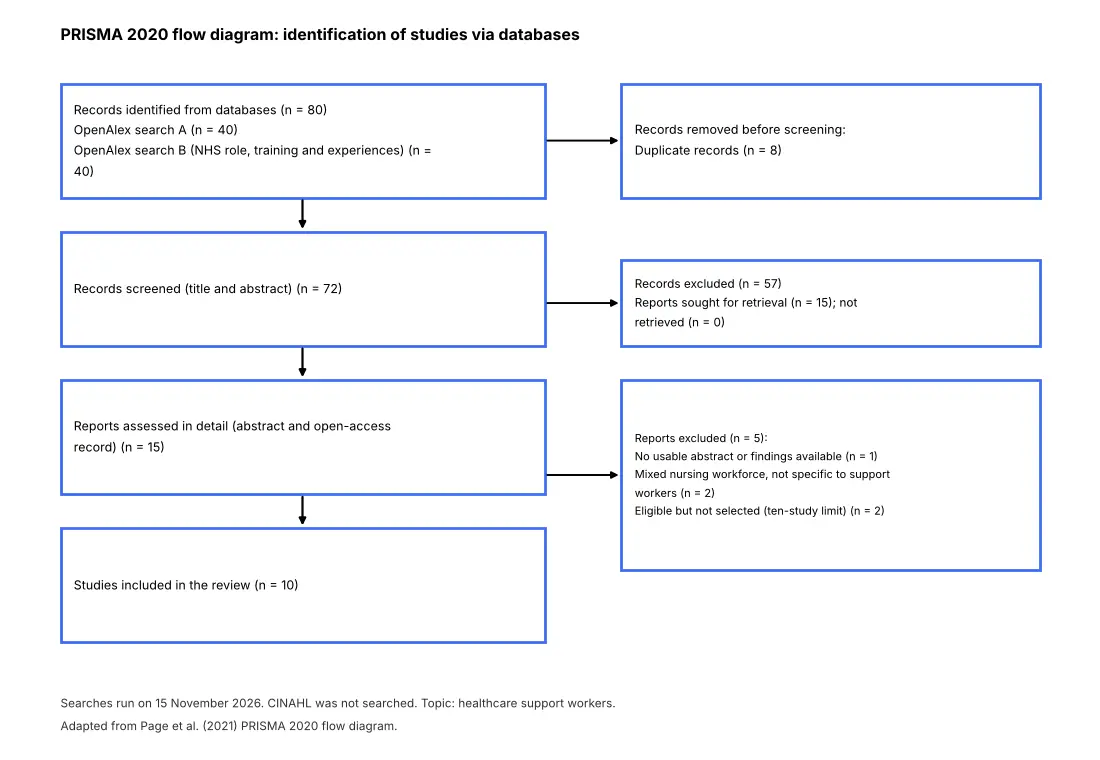
This literature-based dissertation is a structured review of published primary research on healthcare support workers. It aims to be transparent and reproducible, but it is smaller in scope than a full systematic review, which would normally involve several reviewers, many more databases and exhaustive searching (Aveyard, 2023). The review is reported with reference to the PRISMA 2020 statement, which lists the items that should be described and recommends a flow diagram showing how records move through identification, screening and inclusion (Page et al., 2021). Appendix D presents that flow diagram, Appendix A records each search string, Appendix B tabulates the included studies and Appendix C gives a worked critical appraisal. Together, the appendices allow another reader to check each decision and to repeat the process.
The review question was framed using the Population, Exposure and Outcome (PEO) structure, which suits questions about experiences and influencing factors rather than the effects of a treatment. The population was healthcare support workers, also called healthcare assistants, working in NHS hospital, community, mental health and primary care settings in the UK, together with the registered nurses and managers who work alongside them. The exposures were the training, supervision, delegation and organisational arrangements that shape their work, and the outcomes were their knowledge, roles, experiences and the effects of their staffing. Structured frameworks help to translate a broad topic into searchable concepts, although the choice of framework affects how sensitive a search is (Methley et al., 2014; Aveyard, 2023). Because the evidence included interviews, case studies, surveys, action research and national staffing data, qualitative, quantitative and mixed-methods research was eligible for inclusion.
Two searches were run on 15 November 2026 in OpenAlex, an open index of scholarly works that covers a large and growing proportion of the published literature (Priem et al., 2022). The first search used the words healthcare support workers. The second combined the words healthcare support workers, NHS, role, training and experiences, to bring studies of the NHS workforce higher in the results. Both searches were limited to open-access records published between 2015 and 2026 with at least one author affiliated to a UK institution. Both searches were restricted to journal articles. Combining more than one source is advised because a single database misses relevant studies (Bramer et al., 2017). The exact strings and settings are given in Appendix A.
CINAHL, the main nursing database, could not be accessed, and a planned search of MEDLINE through Europe PMC was not completed because the service refused repeated requests on the day of searching. The second OpenAlex search was therefore used in its place. These gaps mean that some relevant nursing studies may not have been found, a risk that is well recognised when the combination of databases is restricted (Bramer et al., 2017). OpenAlex matches terms anywhere in the text, so many records were not relevant. It also ranks records by relevance, and the two searches matched 62,246 and 11,094 records. Only the first 40 records of the first search and the first 40 of the second, 80 in total, were screened, so the review should be read as a structured sample of the literature and not as a complete search (Aveyard, 2023).
Studies were eligible if they involved healthcare support workers or healthcare assistants in UK health care settings, or the staff who train, supervise or work with them, and examined their roles, training, delegated work, experiences or effects. Reports had to be peer-reviewed, written in English, open access and published from 2015 onwards. UK origin was judged from the stated setting and, where the abstract did not name one, from author affiliations. Reviews, protocols, commentaries, studies of mixed nursing workforces, studies set outside the UK and reports without a usable abstract were excluded. Clear criteria applied consistently reduce selection bias and allow the decisions to be audited. The extraction table is presented in Appendix B so that readers can compare studies at a glance (Page et al., 2021; Aveyard, 2023).
All 80 records were exported into a screening log, and 8 duplicates were removed, leaving 72 titles to screen. Titles about other countries, general healthcare workers, wellbeing programmes or laboratory studies were excluded here, and where more than ten eligible studies existed, those most about support workers were preferred. That left 15 reports for closer assessment against the criteria. The abstract and open-access record of each of these reports were read, and the reason for every exclusion was recorded. The log lists every record by its identifier, the search in which it appeared and the decision reached, so that each exclusion can be traced. Ten studies met the criteria, and the numbers at each stage reconcile in the flow diagram (Page et al., 2021). Screening was carried out by one reviewer, which is a recognised limitation of student reviews because a second reviewer would normally check each decision (Aveyard, 2023).
Quality was considered using the Critical Appraisal Skills Programme checklists, which ask structured questions about the aims, design, conduct, results and value of a study (CASP, 2024). The qualitative checklist was completed in full for one interview study, as a worked example in Appendix C, and indicative quality notes for every study are recorded in Appendix B. Those notes are based on the abstract and, for one study, the open full text, so they are judgements of reporting and not a full audit of how the research was conducted. No study was excluded on quality alone, since appraisal was used to weigh the strength of the findings, which is a common approach in nursing reviews (Aveyard, 2023).
Data were extracted into a standard table covering aims, design, sample, setting, methods, findings and limitations. Numerical results were copied as reported and were not recalculated, and extraction was rechecked once against the source records, a step that reduces transcription errors but does not replace independent checking. Findings were grouped into themes by thematic synthesis, with the survey, staffing and trial results reported alongside the qualitative themes because the review combined studies of different designs (Thomas and Harden, 2008; Braun and Clarke, 2006). The review used published data only and involved no participants, so ethical approval was not required, although the findings of the included studies are reported accurately and with full attribution (Aveyard, 2023).
Findings
Ten UK studies met the inclusion criteria, published between 2015 and 2025. Four were set in hospitals, one in community mental health teams for older people, one on mental health wards, one in community nursing teams and one in primary care, while two surveyed support workers across several settings. The designs were five qualitative interview or action research studies, one set of case studies, one mixed-methods study, two cross-sectional studies and one secondary analysis of a trial. Each is described below, and the section ends with the quality and limits of the evidence. Because the studies differ in design, their results are reported side by side and not combined into one estimate (Sarre et al., 2018; Griffiths et al., 2016).
Training, support and competence
In three English acute hospitals, 58 interviews were carried out in 2014 with 30 support workers working with older people, other ward staff and training leads. Induction training was valued but did not fully prepare support workers for the realities of the ward. Supervision and assessment of competence varied within and between hospitals and depended on the time of the staff available. Access to ongoing training was limited by lack of time, infrequent provision, the attitudes of ward managers and a default reliance on e-learning, and staff identified gaps in training on cognitive impairment, managing emotions and difficult conversations (Sarre et al., 2018). Barriers to training and further qualification were also reported in community mental health teams (Wilberforce et al., 2017).
A survey of 164 UK healthcare support workers, carried out between the end of 2020 and the middle of 2021, tested their knowledge and attitudes about pressure ulcer prevention. Knowledge scores were low although attitudes were positive, and the weakest areas were the causes of pressure ulcers, risk assessment and interventions to reduce pressure for people at risk. Scores were higher in acute hospital wards and nursing homes than in other settings, and the authors called for continuing structured education (Liu et al., 2023). This agrees with the interview evidence that induction did not fully prepare support workers for ward practice, and that ongoing learning was hard to reach (Sarre et al., 2018).
Roles, boundaries and delegation
Role boundaries were a concern in both hospital and community studies. In 2011, 42 members of nine community mental health teams for older people were interviewed about the functions of support workers. Support workers undertook diverse roles, and boundaries were described as negotiated, with examples of those boundaries being breached. Lines of authority were complex, although support workers were supported through open communication with the wider team (Wilberforce et al., 2017). In an NHS hospital trust, a study that used interviews, questionnaires and observation found that healthcare assistants bore informal losses as nurses shifted duties on to them during modernisation, and that they responded in a variety of ways (Clark and Thompson, 2015).
Delegation of clinical tasks was examined in two studies. Stakeholders in community nursing teams saw benefits in delegating insulin administration to non-registered workers, such as flexibility and continuity of care, but raised concerns about pay and missed care, and the study concluded that delegation can be acceptable when it is well managed (Stenner et al., 2023). In a trial of smoking cessation support in primary care, 602 participants were advised by either healthcare assistants or nurses. Abstinence at eight weeks did not differ significantly between the two groups, nor did it at four and six months, and healthcare assistants gave longer consultations on average, at 23.6 compared with 20.8 minutes (Faulkner et al., 2016).
National staffing data raised a caution. Using administrative data from 137 NHS acute hospital trusts and a survey of 2,917 registered nurses in 31 trusts, one study found that ward-based registered nurse staffing was significantly associated with lower mortality for medical patients, while there was little evidence of beneficial associations with support worker staffing (Griffiths et al., 2016). This design cannot show cause, and it does not say that support workers are ineffective, because it measured staffing levels and not the tasks that they carry out. A trial that gave a defined task to healthcare assistants found no difference in outcomes from nurses (Faulkner et al., 2016).
Careers, experiences and ways of working
Career aspiration was studied in four NHS hospital trust case studies in England. The authors challenged the view that low-paid and low-status workers have limited aspirations as a rational response to constraints, and showed that support workers could override those constraints and develop strong ambitions to become nurses, driven by values and norms as well as by calculation (Kessler et al., 2019). This is relevant to training, because barriers to further qualification were also reported in community mental health teams (Wilberforce et al., 2017). Together the studies suggest that support workers are not a fixed group, and that some look for a route into registered nursing.
The experiences of support workers during the COVID-19 pandemic were explored in 15 interviews analysed with interpretative phenomenological analysis, carried out while restrictions were still in place. Five themes were identified: challenging experiences, coping mechanisms, emotions and behaviours, external interest in the health of workers, and a take-home message about good organisational practice (Kasdovasilis et al., 2023). The pressure ulcer survey was carried out over the same period, so its knowledge scores were recorded during the pandemic (Liu et al., 2023). Neither study compared the pandemic with earlier practice, so what is attributable to the pandemic remains unclear. A small sample also limits what can be said.
On mental health wards, a participatory action research study across three wards at two sites examined how support workers care for older people with dementia, using care aesthetics as its framework. Collaborative learning groups and constant comparative analysis produced a practice model of sensory, embodied and relational care, in which workers tune in to the person, to colleagues, to themselves and to visitors (Kindell et al., 2025). The model gives a language for skills that are rarely written down. It also fits the hospital study in which support workers wanted more training on cognitive impairment, managing emotions and difficult conversations (Sarre et al., 2018).
Patterns across the studies
Three patterns appeared across the studies. First, training was inconsistent and often too brief or too theoretical, whether it concerned induction on hospital wards (Sarre et al., 2018) or a clinical topic. Second, the boundary between registered and unregistered work was negotiated in practice and not fixed, for example in community teams (Wilberforce et al., 2017). Third, support workers brought values and ambition to their work that organisations did not always recognise (Kessler et al., 2019). Most of the evidence on these patterns is qualitative and local, and it describes experience in depth without showing how common it is. These patterns were seen in hospitals and in community teams.
Differences between the studies are also informative. National staffing data found little evidence that more support workers reduced mortality (Griffiths et al., 2016), whereas a trial of a defined task found that healthcare assistants were as effective as nurses (Faulkner et al., 2016), and qualitative studies described support workers as skilled and ambitious people working in roles with unclear boundaries (Kessler et al., 2019). These findings do not conflict. They suggest that the value of a support worker depends on the task, the training and the supervision, and that staffing numbers alone are a poor guide to the contribution of the role.
Quality and limits of the evidence
Several limits qualify these findings. Most studies were small, qualitative and set in one region or one type of service, so they describe experience in depth but cannot show how common it is. The hospital interviews took place in 2014, before the national Care Certificate was implemented (Sarre et al., 2018), and the community interviews were carried out in 2011 (Wilberforce et al., 2017). Policy has changed since then, so the findings may describe practice that has already been altered. Few studies followed support workers over time, and only one study asked directly about the effect of training on care.
The full-text appraisal in Appendix C of the hospital training study found a clear aim, an appropriate qualitative design, ethical approval from a university committee, written consent, recording and verbatim transcription, analysis in NVivo with two researchers coding, peer debriefing and an audit trail (Sarre et al., 2018). Its weaknesses were that response rates were not reported, reflexivity was described only briefly, saturation was not discussed and the breakdown of other staff in the abstract did not match the main text. The other nine studies were appraised from abstracts only, so their quality notes in Appendix B are indicative (Wilberforce et al., 2017).
Design limits matter too. The national analysis used administrative staffing data and could not show cause (Griffiths et al., 2016). The pressure ulcer survey was cross-sectional, so it cannot show change over time (Liu et al., 2023), and the pandemic interviews came from 15 workers at one point in time (Kasdovasilis et al., 2023). The studies did not share samples, but five further reports were assessed in detail and excluded, including one without a usable abstract and two that mixed support workers with nurses and midwives, so relevant evidence may have been lost. Readers should keep these gaps in mind when using the results.
Wider Discussion
The findings suggest that the value of healthcare support workers depends on how the role is defined, trained and supervised, and not on numbers alone. Staff reported induction that did not prepare them for the realities of the ward and supervision that depended on available time (Sarre et al., 2018), and knowledge of pressure ulcer prevention was low across settings (Liu et al., 2023). This echoes the Cavendish Review, which found that training was inconsistent (Cavendish, 2013). None of these sources shows that better training improves patient outcomes, but together they support a consistent and protected programme of learning after induction. Such a programme would need to be set locally, because the studies describe very different wards and services.
Delegation is where nursing practice and the support worker role meet. Boundaries were negotiated in community teams (Wilberforce et al., 2017), and stakeholders accepted delegation of insulin injections when it was well managed, with concerns about pay and missed care (Stenner et al., 2023). The Code asks nurses to delegate only within a person’s competence and to confirm that delegated tasks meet the required standard (NMC, 2018). In practice, this means that nurses need clear local agreements, competence checks and time to supervise, and that extended tasks should be agreed and recorded and not left to custom. These steps protect patients as well as support workers.
Three priorities follow for practice. First, services can protect time for supervision and ongoing learning, since lack of time and reliance on e-learning limited training (Sarre et al., 2018). Second, nurses can agree and record the boundaries of delegated tasks with their teams, so that negotiated boundaries are not left to chance (Wilberforce et al., 2017). Third, organisations can recognise ambition, since support workers developed strong aims to become nurses (Kessler et al., 2019), by offering routes into registered roles. Each priority is within the reach of local teams, although managers must also protect time because none of these steps is possible without it, and the pressures of a crisis are discussed in nurses during covid-19.
Several limitations qualify these conclusions. Only OpenAlex was searched, in two searches, CINAHL was not accessible and a planned search of MEDLINE through Europe PMC was not completed, so relevant nursing studies may have been missed (Bramer et al., 2017). Only the first 40 records of each search were screened, one reviewer made all decisions, and where more than ten eligible studies existed those most about support workers were preferred, which is a recognised limitation of student reviews (Aveyard, 2023). Appraisal relied on abstracts for nine studies, and the evidence is mostly qualitative and local, so the conclusions are offered as a structured sample of the evidence and not as a complete account. A larger review with a second reviewer would reduce these risks.
Reflection
I began this review thinking that support workers were mainly a way of filling gaps in staffing, with nurses delegating whatever could be spared. The studies changed that view. Support workers described training that did not match the ward, boundaries that were negotiated every day, and ambitions to become nurses, and I realised how little I had considered their point of view. On my own placements I have worked beside support workers who taught me how to move patients safely and how to settle an anxious person, and I did not always acknowledge it. That was an uncomfortable thing to realise. I became more aware that delegation is a relationship and not only a task.
The search was harder than I expected. Several relevant UK papers had no abstract in the records I could reach, and one study with an empty abstract was excluded for that reason. Two further studies mixed nurses, midwives and support workers, so they could not answer my question, and that was a disappointment because their titles suggested a close match. Because more than ten studies were eligible, I also had to decide which to keep, and I chose those that gave the clearest picture of training, roles and experiences. Writing down each decision was slow, but it showed me how much a review depends on its rules, and next time I will agree them in advance.
Appraising the hospital training study was the most instructive part of the work. It had a clear aim, ethical approval and careful analysis, yet it did not report how many staff were approached, and its abstract gave a different number of other staff from the main text. I had assumed that a respected journal would have checked such details. I realised that I tend to trust a paper that sounds convincing, and that is a habit I need to change. I now try to ask what a paper leaves out before I ask what it found, and next time I will make that my first question. It taught me to read the methods section first.
In practice, I will ask support workers what they have been trained to do before I delegate, I will check competence and not assume it, and I will make time to give feedback on the task afterwards. I need to improve my skills in reading survey and regression results, since the national staffing study was hard to follow, and I want to learn more about how roles are designed. These goals are modest, but they are within the reach of any student nurse, and I will review them at the end of each placement with my practice supervisor. I will also ask how our ward agrees tasks with its support workers.
Conclusion
This dissertation set out to review UK evidence on the role, training and experiences of healthcare support workers in the NHS. Ten UK studies, comprising interviews, case studies, surveys, a mixed-methods study, an action research project, a national staffing analysis and a secondary analysis of a trial, showed that induction and ongoing training were often inconsistent, that boundaries between registered and unregistered work were negotiated in practice, and that many support workers brought ambition and skill that organisations did not always recognise.
These results come from small local studies and a few national data sets and do not prove cause, but they agree in pointing to training, supervision and role clarity. They also show that staffing numbers alone say little about the contribution of the role, since a defined task was delivered as effectively by healthcare support workers as by nurses in one trial, while national data found little evidence of benefit from higher support worker staffing. Even so, the pattern is consistent across settings. Their value lies in showing where services can act and not in proving that one approach is best.
For nursing practice, the review supports protecting time for supervision and learning, agreeing delegated tasks clearly, checking competence and recognising ambition. The strength of this evidence is limited by the restricted search, single-reviewer screening and reliance on abstracts, so the conclusions are best treated as a well-founded starting point and not as a final answer. Further research that follows support workers over time and measures patient outcomes would show which approaches work best, and services that act on these points may strengthen their workforce. Teams can begin with training and supervision, which the studies most often named.
Reference List
Aveyard, H. (2023) Doing a literature review in health and social care: a practical guide. 5th edn. Open University Press.
Bramer, W.M. et al. (2017) ‘Optimal database combinations for literature searches in systematic reviews: a prospective exploratory study’, Systematic Reviews, 6, article 245. doi:10.1186/s13643-017-0644-y.
Braun, V. and Clarke, V. (2006) ‘Using thematic analysis in psychology’, Qualitative Research in Psychology, 3(2), pp. 77-101. doi:10.1191/1478088706qp063oa.
CASP (2024) CASP checklists. Oxford: Critical Appraisal Skills Programme. Available at: https://casp-uk.net/casp-checklists/ (Accessed: 9 November 2026).
Cavendish, C. (2013) The Cavendish Review: an independent review into healthcare assistants and support workers in the NHS and social care settings. London: Department of Health. Available at: https://www.gov.uk/government/publications/review-of-healthcare-assistants-and-support-workers-in-nhs-and-social-care (Accessed: 15 November 2026).
Clark, I. and Thompson, A. (2015) ‘Healthcare assistants: distributional losses as a consequence of NHS modernisation?’, New Technology, Work and Employment, 30(3), pp. 209-221. doi:10.1111/ntwe.12053.
Faulkner, K. et al. (2016) ‘Are nurses and auxiliary healthcare workers equally effective in delivering smoking cessation support in primary care?’, Nicotine and Tobacco Research, 18(5), pp. 1054-1060. doi:10.1093/ntr/ntv206.
Griffiths, P. et al. (2016) ‘Registered nurse, healthcare support worker, medical staffing levels and mortality in English hospital trusts: a cross-sectional study’, BMJ Open, 6(2), article e008751. doi:10.1136/bmjopen-2015-008751.
Kasdovasilis, P., Cook, N. and Montasem, A. (2023) ‘UK healthcare support workers and the COVID-19 pandemic: an explorative analysis of lived experiences during the COVID-19 pandemic’, Home Health Care Services Quarterly, 42(1), pp. 14-39. doi:10.1080/01621424.2022.2123757.
Kessler, I., Bach, S. and Nath, V. (2019) ‘The construction of career aspirations amongst healthcare support workers: beyond the rational and the mundane?’, Industrial Relations Journal, 50(2), pp. 150-167. doi:10.1111/irj.12245.
Kindell, J. et al. (2025) ‘Healthcare support workers working with people with dementia on mental health wards: a practice model informed by care aesthetics’, Qualitative Health Research, article 10497323251393890. doi:10.1177/10497323251393890.
Liu, L.Q. et al. (2023) ‘The knowledge and attitudes regarding pressure ulcer prevention among healthcare support workers in the UK: a cross-sectional study’, Journal of Tissue Viability, 32(1), pp. 130-135. doi:10.1016/j.jtv.2022.11.004.
Methley, A.M. et al. (2014) ‘PICO, PICOS and SPIDER: a comparison study of specificity and sensitivity in three search tools for qualitative systematic reviews’, BMC Health Services Research, 14, article 579. doi:10.1186/s12913-014-0579-0.
NHS Employers (2026) Care certificate. Leeds: NHS Employers. Available at: https://www.nhsemployers.org/articles/care-certificate (Accessed: 15 November 2026).
Nursing and Midwifery Council (NMC) (2018) The Code: professional standards of practice and behaviour for nurses, midwives and nursing associates. London: NMC. Available at: https://www.nmc.org.uk/standards/code/ (Accessed: 15 November 2026).
Page, M.J. et al. (2021) ‘The PRISMA 2020 statement: an updated guideline for reporting systematic reviews’, BMJ, 372, article n71. doi:10.1136/bmj.n71.
Priem, J., Piwowar, H. and Orr, R. (2022) ‘OpenAlex: a fully-open index of scholarly works, authors, venues, institutions, and concepts’, arXiv, 2205.01833. doi:10.48550/arXiv.2205.01833.
Sarre, S. et al. (2018) ‘The challenges of training, support and assessment of healthcare support workers: a qualitative study of experiences in three English acute hospitals’, International Journal of Nursing Studies, 79, pp. 145-153. doi:10.1016/j.ijnurstu.2017.11.010.
Stenner, K.L. et al. (2023) ‘Delegation of insulin administration to non-registered healthcare workers in community nursing teams: a qualitative study’, Journal of Advanced Nursing, 79(9), pp. 3382-3396. doi:10.1111/jan.15662.
Thomas, J. and Harden, A. (2008) ‘Methods for the thematic synthesis of qualitative research in systematic reviews’, BMC Medical Research Methodology, 8, article 45. doi:10.1186/1471-2288-8-45.
Wilberforce, M. et al. (2017) ‘Support workers in community mental health teams for older people: roles, boundaries, supervision and training’, Journal of Advanced Nursing, 73(7), pp. 1657-1666. doi:10.1111/jan.13264.
Appendix A: Search strategy
This appendix records the searches run for the healthcare support workers review so that the process can be repeated and checked.
Two searches on healthcare support workers were run on 15 November 2026 using the OpenAlex works API. The first 40 records of the first search and the first 40 of the second, ranked by relevance, were retrieved and screened by title and abstract.
| Database | Platform | Date run | Search string | Limiters | Hits |
|---|---|---|---|---|---|
| OpenAlex search A | OpenAlex API | 15 November 2026 | search=healthcare support workers | Filter: authorships.countries:GB; is_oa:true; publication_year:2015-2026; type:article. 62,246 matches in total; the first 40 by relevance were screened. | 40 |
| OpenAlex search B (NHS role, training and experiences) | OpenAlex API | 15 November 2026 | search=healthcare support workers NHS role training experiences | Filter: authorships.countries:GB; is_oa:true; publication_year:2015-2026; type:article. 11,094 matches in total; the first 40 by relevance were screened. | 40 |
CINAHL could not be accessed and was not searched, so no CINAHL results are reported. A planned MEDLINE search through Europe PMC was attempted on the same day but the service refused repeated requests, so it was not completed for healthcare support workers; search B, which targeted the NHS role, training and experiences of support workers, was used instead.
OpenAlex matches search terms in the title, abstract or full text, and the country filter matches any record with at least one author affiliated to a UK institution. UK setting and relevance were therefore checked for each study at the assessment stage. Records identified: 80 (40 + 40); duplicates removed: 8; records screened: 72.
Appendix B: Data extraction table
The table summarises each study included in this healthcare support workers review: its aim, design, sample, methods, key findings, limitations and relevance to healthcare support workers.
| Author / year / country | Aim | Design | Sample and setting | Methods | Key findings | Limitations / quality | Relevance to healthcare support workers |
|---|---|---|---|---|---|---|---|
| Clark and Thompson (2015), UK (NHS hospital trust; affiliations) | To examine the labour process of healthcare assistants (healthcare support workers) in an NHS hospital trust during modernisation and how they responded. | Mixed-methods case study. | Healthcare assistants at one NHS hospital trust; numbers not reported in the abstract. | Interviews, questionnaires and observation about the work of healthcare support workers. | Healthcare assistants bore informal losses as nurses shifted duties on to them, and they responded in a range of ways. | Indicative (abstract only): one trust; sample size not stated; UK judged from the NHS setting and affiliations; role of healthcare support workers only. | Role change for healthcare support workers. |
| Griffiths et al. (2016), UK (England) | To examine associations between mortality and registered nurse staffing in English hospital trusts, taking account of medical and healthcare support worker staffing. | Cross-sectional study of administrative data and a nurse survey. | 137 NHS acute hospital trusts and 2,917 registered nurses in 31 trusts. | Risk-adjusted adult mortality related to staffing, measured as beds per staff member and patients per ward nurse. | Ward-based registered nurse staffing was associated with lower mortality for medical patients; little evidence of beneficial associations with staffing by healthcare support workers. | Indicative (abstract only): associations not causes; staffing data are posts to beds, not tasks; healthcare support workers measured only by numbers. | Staffing evidence on healthcare support workers. |
| Sarre et al. (2018), UK (three English acute hospitals) | To examine access to training, support and assessment for healthcare support workers, perceived gaps and barriers to policy implementation. | Qualitative interview study. | 58 interviews: 30 support workers, other ward staff and 4 training leads. | One-to-one semi-structured interviews in 2014, analysed by thematic description. | Induction valued but did not fully prepare healthcare support workers for the ward; supervision and assessment varied; ongoing training limited by time and reliance on e-learning. | CASP qualitative appraisal in Appendix C (open full text). Response rates not reported; reflexivity brief; saturation not discussed; print year 2018 (online 2017). | Training of healthcare support workers. |
| Wilberforce et al. (2017), UK (affiliations; community mental health teams) | To explore the functions of healthcare support workers in community mental health teams for older adults in relation to roles, boundaries, supervision and training. | Qualitative interview study. | 42 members of nine community mental health teams. | Semi-structured face-to-face interviews in 2011 about support workers and registered practitioners. | Diverse roles; negotiated boundaries and examples of breaches; complex lines of authority; open communication supportive; barriers to training and qualification. | Indicative (abstract and open record): interviews date from 2011; UK judged from affiliations; one service type; support workers’ views alongside registered staff. | Roles of healthcare support workers in community teams. |
| Kessler et al. (2019), UK (four NHS hospital trusts in England) | To examine how career aspirations are constructed among healthcare support workers. | Case studies. | Four NHS hospital trusts; number of participants not reported in the abstract. | Case study research on the aspirations of healthcare support workers. | Support workers could override structural constraints and develop strong ambitions to become nurses, driven by values and norms. | Indicative (abstract only): sample not stated; employment relations journal rather than nursing; print year 2019 (online 2019); healthcare support workers only. | Careers of healthcare support workers. |
| Liu et al. (2023), UK | To assess the knowledge and attitudes of healthcare support workers regarding pressure ulcer prevention. | Cross-sectional survey. | 164 UK healthcare support workers. | Survey with the Knowledge Attitudes toward Ulcer Prevention Assessment Tool, December 2020 to June 2021. | Low knowledge but positive attitudes; weakest on causes, risk assessment and pressure-reducing interventions; higher scores in acute wards and nursing homes. | Indicative (abstract only): cross-sectional; recruitment method not stated in the abstract; print year 2023 (online 2022); healthcare support workers only. | Knowledge of healthcare support workers. |
| Kasdovasilis et al. (2023), UK | To explore the lived experiences of UK healthcare support workers during the COVID-19 pandemic. | Qualitative interview study (interpretative phenomenological analysis). | 15 healthcare support workers. | Interviews while restrictions were in place, analysed phenomenologically. | Five themes: challenging experiences, coping mechanisms, emotions and behaviours, external interest in workers’ health, and good organisational practice. | Indicative (abstract only): small sample; one time point; print year 2023 (online 2022); healthcare support workers’ views only. | Pandemic experiences of healthcare support workers. |
| Stenner et al. (2023), UK (affiliations; community nursing) | To explore stakeholder views on delegating insulin administration to non-registered healthcare workers in community nursing teams. | Qualitative interview study. | Stakeholders in community nursing; numbers not reported in the abstract. | Qualitative study of perceived benefits and concerns about delegation. | Benefits included flexibility and continuity of care; concerns included pay and missed care; delegation can be acceptable when well managed. | Indicative (abstract only): sample size not stated; UK judged from affiliations and an NHS trust; delegation to healthcare support workers on one task only. | Delegation to healthcare support workers. |
| Kindell et al. (2025), UK (affiliations; NHS mental health trusts) | To develop a practice model of how healthcare support workers care for older people with dementia on mental health wards. | Participatory action research. | Three wards at two sites; numbers not reported in the abstract. | Collaborative learning groups and constant comparative analysis, using care aesthetics as the framework. | A practice model of healthcare support workers’ sensory, embodied and relational care in which workers tune in to the person, colleagues, themselves and visitors. | Indicative (abstract only): small number of wards; UK judged from affiliations; online 2025 with no volume; healthcare support workers on mental health wards only. | Practice of healthcare support workers with dementia. |
| Faulkner et al. (2016), UK (affiliations; primary care) | To compare the effectiveness of healthcare assistants and nurses in delivering smoking cessation support in primary care. | Secondary analysis of a randomised controlled trial (iQuit Practice). | 602 trial participants. | Comparison of abstinence and of contact patterns between advisors who were healthcare assistants and nurses. | No significant difference in abstinence at 8 weeks, 4 and 6 months; healthcare assistants gave longer consultations (23.6 versus 20.8 minutes) and more interim contacts. | Indicative (abstract only): secondary analysis; one task; UK judged from affiliations; print year 2016 (online 2015); healthcare support workers as advisors. | Effectiveness of healthcare support workers in a defined task. |
Appendix C: Critical appraisal checklist
CASP qualitative studies checklist (CASP, 2024), completed for Sarre et al. (2018), a study included in this healthcare support workers review. Answers: Yes, No or Can’t tell, each with a short justification.
| # | Question | Answer | Justification |
|---|---|---|---|
| Section A: Are the results valid? | |||
| 1 | Was there a clear statement of the aims of the research? | Yes | The aim is stated clearly: to examine access to training, support and assessment for healthcare support workers, gaps in training and barriers to policy implementation on older people’s wards. |
| 2 | Is a qualitative methodology appropriate? | Yes | A qualitative method suits a question about the experiences and views of healthcare support workers and those who work with them, which were not well documented. |
| 3 | Was the research design appropriate to address the aims of the research? | Yes | One-to-one semi-structured interviews with thematic description suit the aim, and the work was part of a larger NIHR-funded development and feasibility study. |
| 4 | Was the recruitment strategy appropriate to the aims of the research? | Can’t tell | Three teaching hospitals were chosen for diversity and staff were recruited through handovers and ward visits, but the number of staff approached and the number who declined are not reported. |
| 5 | Was the data collected in a way that addressed the research issue? | Yes | Interviews used a topic guide in private rooms in work time, were audio-recorded and transcribed verbatim, and lasted about 33 minutes on average; fieldnotes captured interruptions and time pressure. |
| 6 | Has the relationship between researcher and participants been adequately considered? | Can’t tell | The researchers stated that they were not NHS staff and used fieldnotes, but no detailed statement of how their position might shape the work with healthcare support workers is given. |
| Section B: What are the results? | |||
| 7 | Have ethical issues been taken into consideration? | Yes | The University of East Anglia ethics committee approved the study (reference 2013/2014-19) and each hospital gave research approval; written consent was taken, with recorded verbal consent by telephone, and pseudonyms were used. |
| 8 | Was the data analysis sufficiently rigorous? | Yes | An a priori framework was followed by inductive analysis with constant comparison in NVivo, two researchers coded initially, five team members held peer debriefing and an audit trail was kept, although saturation is not discussed. |
| 9 | Is there a clear statement of findings? | Yes | Five themes are presented with illustrative quotations from healthcare support workers, and the discussion links them to the aim. |
| Section C: Will the results help locally? | |||
| 10 | How valuable is the research? | Yes | The study adds to knowledge of the training of healthcare support workers and states its limits (one country, a period of policy change, older people’s wards); it was funded by the NIHR, and the breakdown of other staff differs between abstract and text. |
Appendix D: PRISMA flow diagram
This dissertation is a worked example that shows the structure and standard of a 5,000-word literature-based Independent Project. It is provided for learning and is not to be submitted as a student’s own work.