

Living with Chronic Breathlessness: Patient Experiences and Nurse-Led Supportive Interventions
 By Dr. Robertson Prime, Research Fellow
This dissertation is a worked example that shows the structure and standard of a 5,000-word literature-based Independent Project. It is provided for learning and is not to be submitted as a student’s own work.
Abstract
Background: Chronic breathlessness is a common and distressing symptom of long-term conditions, and national guidance emphasises information, self-management, rehabilitation and palliative care. Less is known about how UK studies describe the experience of chronic breathlessness and the supportive interventions in which nurses play a part.
Aim: To critically review UK evidence on chronic breathlessness, with a focus on patient experiences and supportive interventions in which nurses play a part.
Methods: A structured literature review using the Population, Exposure and Outcome framework. OpenAlex was searched twice on 15 November 2026, because CINAHL could not be accessed and a planned MEDLINE search was not completed. The first 40 records of each search were screened: 80 records were identified, 79 screened after the removal of duplicates and 10 UK studies included. Quality was considered using Critical Appraisal Skills Programme questions, and findings were combined by thematic synthesis.
Findings: The included studies of chronic breathlessness (n = 10) comprised interviews, a survey, an observational analysis and feasibility trials. Breathlessness restricted daily life and relationships, people and carers valued education and personalised care, and supportive interventions were mostly small feasibility studies, with only one clearly nurse-led.
Conclusions and implications for practice: For nursing practice, nurses can ask about the effects of breathlessness on daily life, involve carers and offer simple self-help where it suits the person. The evidence is limited by the restricted search, single-reviewer screening, reliance on abstracts and the scarcity of studies that test nurse-led support.
Keywords: chronic breathlessness; breathlessness self-management; supportive interventions; adult nursing; literature review.
Brief at a glance
- Framework
- PEO
- Design
- Literature review (PEO)
- Studies included
- 10
- Field
- Adult Nursing
Introduction
Chronic breathlessness is breathlessness that persists in people with long-term conditions such as chronic obstructive pulmonary disease, lung cancer and interstitial lung disease, and nurses meet it in hospitals, clinics and homes. National guidance for chronic obstructive pulmonary disease advises that people receive written information, a personalised self-management plan and pulmonary rehabilitation where it is suitable, and that those with end-stage disease have access to palliative care (NICE, 2018). Guidance on end of life care adds that people approaching the end of life should be able to reach highly skilled practitioners when needed (NICE, 2019). Nurses also support breathlessness in progressive neurological disease, as in motor neurone disease care, and the Code of the Nursing and Midwifery Council applies wherever they work (NMC, 2018). Their care often depends on whether the symptom is recognised and explained early, and on whether patients and carers can reach support when it worsens.
This dissertation reviews UK research on chronic breathlessness, with a focus on the experiences of patients and carers and on supportive interventions in which nurses play a part. A literature review suits the question because the evidence is scattered across interviews, surveys and small feasibility trials, and a structured process makes each choice visible and open to challenge (Aveyard, 2023). The review is limited to the UK so that its conclusions can be read against national guidance and one professional code (NICE, 2018). It asks how people describe living with the symptom, what the studies show about supportive interventions and services, and what is known about who delivers them. It then considers what this means for nursing practice and education. The answer matters for any nurse who supports people with breathlessness, whatever the setting, and it shapes what a student can reasonably propose.
Background and Justification
The guideline of the National Institute for Health and Care Excellence on chronic obstructive pulmonary disease gives a central place to information and self-management. It advises that people are offered written information and the chance to talk with an experienced clinician at diagnosis and at each review, that family or carers are included, and that information is matched to the person’s stage of disease. Managing breathlessness is among the topics to be covered, and where breathlessness is frightening the guideline advises considering a cognitive behavioural component in self-management (NICE, 2018). These recommendations sit alongside the Code, which asks nurses to treat people as individuals and to respect their dignity (NMC, 2018). The guideline concerns one condition, so it does not cover breathlessness from cancer or heart failure.
Pulmonary rehabilitation is the main structured programme named in the guideline for people limited by breathlessness. It is advised for everyone who views themselves as functionally disabled by the disease, usually at grade 3 or above on the Medical Research Council breathlessness scale, and it is not suitable for people who cannot walk, who have unstable angina or who have had a recent heart attack (NICE, 2018). A person whose breathlessness is severe enough to prevent walking, or whose heart condition makes exercise unsafe, may therefore fall outside the programme and need other forms of support. National guidance on end of life care recommends that adults approaching the end of life can reach highly skilled practitioners when needed (NICE, 2019).
For people with end-stage disease, the guideline says that opioids may be used for breathlessness that does not respond to other treatment, and that benzodiazepines, tricyclic antidepressants, major tranquillisers and oxygen are also options in the same situation. It adds that people with end-stage disease, and their families or carers, should have access to the full range of multidisciplinary palliative care services, including hospices (NICE, 2018). The later guideline on end of life care noted that people with progressive non-cancer disease are typically referred late to specialist palliative care, if at all, and proposed research on earlier review and referral (NICE, 2019). Drug treatment and palliative referral therefore sit at the end of a pathway that begins with information and self-management.
The guideline on end of life care for adults also sets out how services should be organised. It recommends that adults approaching the end of life, their carers and other people important to them have access to highly skilled practitioners when needed and to out-of-hours care, including a pharmacy service with medicines for symptom management (NICE, 2019). These arrangements depend on nurses who recognise breathlessness as a symptom that needs a plan and who know when to involve a specialist service. The Code requires nurses to recognise and work within the limits of their competence, which includes knowing what they can offer and when others should be involved (NMC, 2018). Neither guideline describes a nurse-led breathlessness service, so the role of the nurse has to be inferred from the wider duties that they set out.
Self-management is central to many long-term conditions, not only those of the lung. In lymphoedema management, for example, people are also asked to act on information in daily life, and the same questions arise about preparation and access to specialists. Evidence on these questions is spread across interviews, surveys and small trials, so a structured literature review can bring it together if it states its method and limits (Aveyard, 2023). Questions about people, their exposures and their outcomes fit a framework that separates the population, the exposure and the outcome better than one built around a single treatment (Methley et al., 2014). Studies of different designs are read side by side and are not combined into one estimate.
This review therefore examines UK research on chronic breathlessness against the guidance described above. It is limited to UK studies so that the findings can be read against national guidance and the Code of the Nursing and Midwifery Council (NICE, 2018; NMC, 2018). It looks at three linked questions: how people describe living with the symptom, what the studies show about services and supportive interventions, and who delivers them. The guidance names information, self-management and rehabilitation, and the studies are read for how people receive these (NICE, 2018). It does not assess the effectiveness of particular drugs, which would need different evidence and is the subject of larger trials. The focus is therefore on how people live with the symptom and on the support that nurses and others can offer.
Title, Aim and Objectives
What do UK studies show about the experiences of people living with chronic breathlessness and about supportive interventions in which nurses play a part?
Title explained
The title names the population of people living with chronic breathlessness, the two aspects reviewed (their experiences and nurse-led supportive interventions), the UK boundary of the evidence and the literature review design that structures the whole work.
Aim
To critically review UK evidence on chronic breathlessness, with a focus on patient experiences and supportive interventions in which nurses play a part.
Objectives
- To identify and appraise UK research on people living with breathlessness.
- To synthesise findings on experiences, services and supportive interventions.
- To make recommendations for nursing practice.
Methodology
This literature-based dissertation is a structured review of published primary research on chronic breathlessness. It aims to be transparent and reproducible, but it is smaller in scope than a full systematic review, which would normally involve several reviewers, many more databases and exhaustive searching (Aveyard, 2023). The review is reported with reference to the PRISMA 2020 statement, which lists the items that should be described and recommends a flow diagram showing how records move through identification, screening and inclusion (Page et al., 2021). Appendix D presents that flow diagram, Appendix A records each search string, Appendix B tabulates the included studies and Appendix C gives a worked critical appraisal. Together, the appendices allow another reader to check each decision and to repeat the process.
The review question was framed using the Population, Exposure and Outcome (PEO) structure, which suits questions about experiences and influencing factors rather than the effects of a treatment. The population was adults living with chronic breathlessness caused by long-term conditions in the UK, together with their carers. The exposures were services, self-management and supportive interventions, including those delivered or supported by nurses, and the outcomes were experiences, feasibility, acceptability and self-management. Structured frameworks help to translate a broad topic into searchable concepts, although the choice of framework affects how sensitive a search is (Methley et al., 2014; Aveyard, 2023). Because the evidence included interviews, surveys, feasibility trials and an observational analysis, qualitative, quantitative and mixed-methods research was eligible for inclusion.
Two searches were run on 15 November 2026 in OpenAlex, an open index of scholarly works that covers a large and growing proportion of the published literature (Priem et al., 2022). The first search used the words chronic breathlessness. The second combined the words chronic breathlessness, nurse-led, supportive intervention and experiences, to bring studies of people and services higher in the results. Both searches were limited to open-access records published between 2015 and 2026 with at least one author affiliated to a UK institution. Both searches were restricted to journal articles. Combining more than one source is advised because a single database misses relevant studies (Bramer et al., 2017). The exact strings and settings are given in Appendix A.
CINAHL, the main nursing database, could not be accessed, and a planned search of MEDLINE through Europe PMC was not completed because the service refused repeated requests on the day of searching. The second OpenAlex search was therefore used in its place. These gaps mean that some relevant nursing studies may not have been found, a risk that is well recognised when the combination of databases is restricted (Bramer et al., 2017). OpenAlex matches terms anywhere in the text, so many records were not relevant. It also ranks records by relevance, and the two searches matched 5,009 and 294 records. Only the first 40 records of the first search and the first 40 of the second, 80 in total, were screened, so the review should be read as a structured sample of the literature and not as a complete search (Aveyard, 2023).
Studies were eligible if they involved adults with breathlessness caused by long-term conditions in the UK, or their carers or clinicians, and examined experiences, services, self-management or supportive interventions. Reports had to be peer-reviewed, written in English, open access and published from 2015 onwards. UK origin was judged from the stated setting and, where the abstract did not name one, from author affiliations. Reviews, protocols, descriptive or opinion articles without methods, studies set outside the UK or in several countries and reports without a usable abstract were excluded. Clear criteria applied consistently reduce selection bias and allow the decisions to be audited. The extraction table is presented in Appendix B so that readers can compare studies at a glance (Page et al., 2021; Aveyard, 2023).
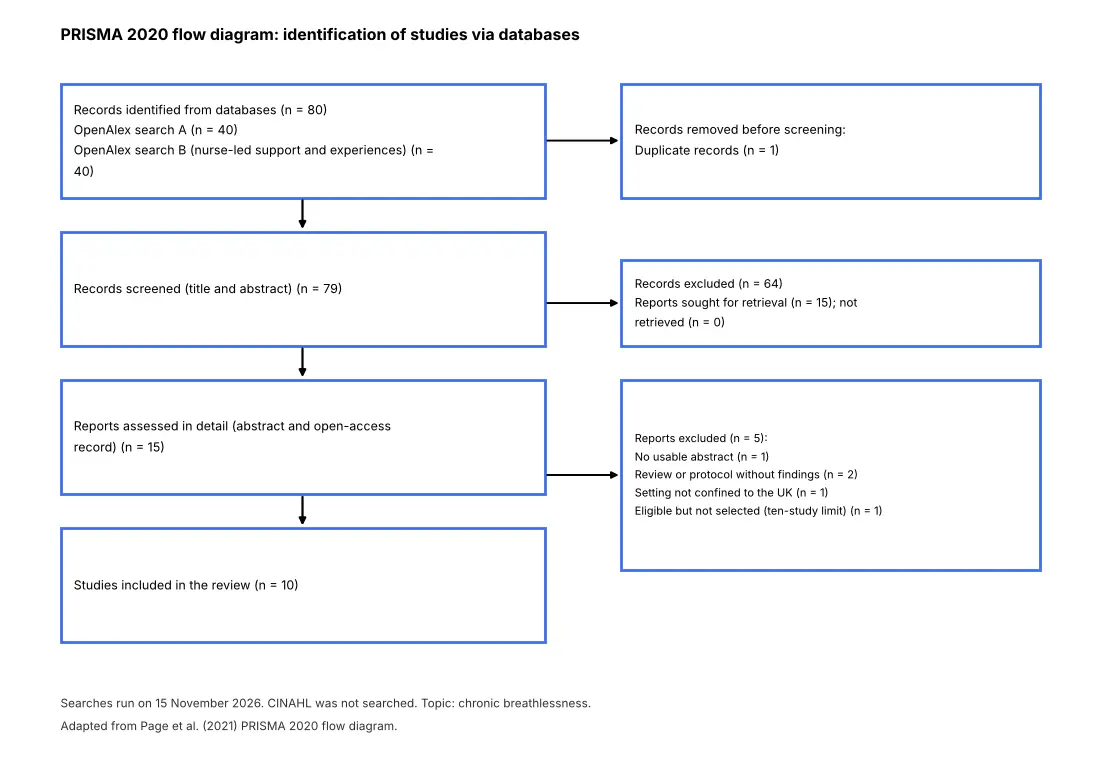
All 80 records were exported into a screening log, and 1 duplicate was removed, leaving 79 titles to screen. Titles about drug treatments, other countries, children or other conditions were excluded here, and where more than ten eligible studies existed, those most about experience and supportive interventions were preferred. That left 15 reports for closer assessment against the criteria. The abstract and open-access record of each of these reports were read, and the reason for every exclusion was recorded. The log lists every record by its identifier, the search in which it appeared and the decision reached, so that each exclusion can be traced. Ten studies met the criteria, and the numbers at each stage reconcile in the flow diagram (Page et al., 2021). Screening was carried out by one reviewer, which is a recognised limitation of student reviews because a second reviewer would normally check each decision (Aveyard, 2023).
Quality was considered using the Critical Appraisal Skills Programme checklists, which ask structured questions about the aims, design, conduct, results and value of a study (CASP, 2024). The qualitative checklist was completed in full for one interview study, as a worked example in Appendix C, and indicative quality notes for every study are recorded in Appendix B. Those notes are based on the abstract and, for one study, the open full text, so they are judgements of reporting and not a full audit of how the research was conducted. No study was excluded on quality alone, since appraisal was used to weigh the strength of the findings, which is a common approach in nursing reviews (Aveyard, 2023).
Data were extracted into a standard table covering aims, design, sample, setting, methods, findings and limitations. Numerical results were copied as reported and were not recalculated, and extraction was rechecked once against the source records, a step that reduces transcription errors but does not replace independent checking. Findings were grouped into themes by thematic synthesis, with the numerical results reported alongside the qualitative themes because the review combined studies of different designs (Thomas and Harden, 2008; Braun and Clarke, 2006). The review used published data only and involved no participants, so ethical approval was not required, although the findings of the included studies are reported accurately and with full attribution (Aveyard, 2023).
Findings
Ten UK studies met the inclusion criteria, published between 2015 and 2026. Three were qualitative interview studies, three were feasibility or pilot randomised trials, two were a survey and a cross-sectional analysis, and two were exploratory evaluations of a hand-held fan and of a dance programme. Four concerned services or interventions delivered by health professionals, three explored experience, and others described self-help or online support. Each is described below by theme, and the section ends with the quality and limits of the evidence. Because the designs differ, results are reported side by side and are not combined (Crooks et al., 2025; Barnes-Harris et al., 2019).
Living with chronic breathlessness
In telephone interviews with 25 adults with advanced respiratory disease, four themes described chronic breathlessness. It limited daily activities and increased dependence on others, it affected social interactions and relationships and led to isolation, living with several long-term conditions and environmental factors made it worse, and cognitive, affective and behavioural responses further restricted activity. The authors called for a public health approach that includes housing and environmental agencies (Reilly et al., 2026). The interviewees had COPD (13), lung cancer (8), interstitial lung disease (3) or bronchiectasis (1), and the interviews took place in 2020, during pandemic restrictions. A related observational study is described next (Reilly et al., 2024).
A cross-sectional analysis of data from a feasibility trial examined illness perceptions and responses. Several dimensions of illness perception, including consequences, identity, concern and emotional response, were associated with greater breathlessness severity and distress, poorer self-management and lower quality of life, and symptom-focusing and embarrassment-avoidance responses were important correlates. The authors concluded that interventions targeting these perceptions and responses might reduce symptom burden (Reilly et al., 2024). The analysis could not show cause and effect, and the abstract did not state the sample size, so the strength of each association cannot be judged from the record. The responses that restricted activity in the interviews fit these correlates (Reilly et al., 2026).
Carers and clinicians
Interviews with 25 patient-carer pairs, half of whom had cancer and half chronic obstructive pulmonary disease, asked carers what they wanted to learn about breathlessness. Carers strongly wanted to learn, and six topics emerged: understanding breathlessness, managing anxiety and panic, infections, keeping active, living positively and knowing what to expect in future. A tension in the caring relationship, arising from mismatched expectations, ran through the accounts, and needs differed by diagnosis (Farquhar et al., 2017). The study was designed to inform an educational intervention and did not test one. Carers are therefore part of care for breathlessness and not only observers of it, which fits the dependence on others described by patients (Reilly et al., 2026).
Clinicians were interviewed about the hand-held fan. Twelve clinicians, four doctors, four nurses and four allied health professionals, described three themes: their knowledge and skills for using the fan, environmental constraints and their beliefs about its consequences. Clinicians believed the fan relieved breathlessness, and a clear rationale helped implementation, but infection-control restrictions during the pandemic and a lack of funding to supply fans were barriers, and scepticism from patients and colleagues was common (Brown et al., 2023). The study did not report separate findings for nurses. It shows that a simple self-help tool still depends on staff knowledge and local resources (Barnes-Harris et al., 2019).
Services and nurse-led support
A postal survey evaluated a new integrated breathlessness support service that combined palliative care, respiratory medicine and physiotherapy over six weeks. Of 70 surveys sent, 25 were returned (36%), and 13 of 21 respondents said that the service had definitely helped. Four themes were personalised care, caring staff, education for empowerment and context-specific interventions. The authors concluded that empowerment, education and personalised, caring delivery should be central to future services (Reilly et al., 2016). The response rate was low and the service was multi-professional, so the survey cannot show what nurses contributed within it. Its emphasis on education and personalised care is echoed by the pilot trial described next (Buckingham et al., 2015).
The clearest example of nurse-led support was a pilot trial in Scotland of home visits by a specialist respiratory nurse for older people with very severe chronic obstructive pulmonary disease after discharge. Thirty-two people were randomised and 19 completed the study. Nurses recorded a mean of 1.6 actions per assessment, mostly information and self-help, and only five referrals were made. Patients valued the chance to discuss concerns and coping, although questionnaires were burdensome, and professionals saw holistic needs as important but found that the timing overlapped with discharge planning (Buckingham et al., 2015). Its emphasis on information and self-help matches the value placed on education in the postal survey (Reilly et al., 2016).
Self-help, exercise and online support
Two exploratory studies examined self-help for breathlessness. In 41 participants who received activity advice alone or with a calming-hand technique, a fan or both, 35 (85%) said the fan helped their breathing and 22 (54%) said it increased their activity, although associations with diagnosis were not statistically significant (Barnes-Harris et al., 2019). A 10-week dance programme for members of community groups in north-east England and London found improvements in all outcome measures except interoceptive awareness, and participants spent on average 43.5 minutes of a class at moderate or higher intensity, but only seven completed the programme (Harrison et al., 2020). Neither study was nurse-led.
The SELF-BREATHE feasibility trial tested an online, self-guided programme in a south-east London NHS trust. Of 110 eligible patients, 52 were randomised, 19 of 26 in the intervention arm logged on, and 36 of 52 (70%) returned postal questionnaires. Interviews showed that users valued the programme for managing breathlessness in daily life and during crises, and the authors concluded that the data supported a fully powered trial with changes to reduce missing data (Reilly et al., 2023). The data came from one centre and a small sample. The cross-sectional analysis described earlier used the same trial, so the two reports are not independent (Reilly et al., 2024).
A multicentre wait-list trial in idiopathic pulmonary fibrosis tested a complex breathlessness intervention of two face-to-face sessions and one telephone session covering breathing control, fan use, pacing and anxiety management. Forty-seven patients were randomised, recruitment ran at about 2.5 participants per month, and at four weeks distress caused by breathlessness was lower in the fast-track group, with an adjusted difference of -1.84 (95% confidence interval -3.29 to -0.39). The qualitative substudy supported acceptability, and the authors judged the intervention feasible, with preliminary support for effectiveness (Crooks et al., 2025). The abstract did not state which professionals delivered the sessions, and the sample was small, as it was in the online trial (Reilly et al., 2023).
Patterns across the studies
Three patterns appeared across the studies. First, breathlessness restricted daily life and relationships, and people’s responses to it could restrict them further (Reilly et al., 2026). Second, people and carers valued education, personalised care and the chance to talk, in services and in trials (Reilly et al., 2016). Third, the studies of supportive interventions were mostly feasibility studies with small samples (Reilly et al., 2023). Each pattern appeared in more than one report in this review, although several reports came from one research group, which strengthens the case that they are real features of the problem but not that they are independent.
Differences between designs are also informative. The interview studies describe isolation, fear and dependence, whereas the trials measured feasibility and symptoms such as distress and did not report effects on isolation or dependence (Crooks et al., 2025). Few studies stated who delivered the intervention, and only one was clearly nurse-led (Buckingham et al., 2015). Nurses featured more often as clinicians interviewed than as intervention deliverers. This gap between what people describe and what has been trialled, and between the title’s focus on nurses and the evidence found, is an important finding in itself, and it should shape the questions asked by future studies.
Quality and limits of the evidence
Several limits qualify these findings. Samples were small, with 12 to 52 people in most studies, so they describe experience in depth but cannot show how common it is. The survey of the support service had a response of 36% (Reilly et al., 2016), the dance programme was completed by seven people (Harrison et al., 2020), and the pilot nurse-led trial lost 13 of 32 participants (Buckingham et al., 2015). Several reports came from one group in London, and three concerned the same trial or the same interviews, so their agreement is not necessarily independent. Studies of this kind are useful for generating ideas but cannot estimate effects.
The full-text appraisal in Appendix C of the interview study by Reilly et al. (2026) found a clear aim, a suitable qualitative design, ethical approval, audio-recorded interviews with a topic guide and a four-theme content analysis supported by quotations. Its weaknesses were that recruitment and consent were not described in the main text, reflexivity was limited, the analysis was a secondary analysis of earlier interviews with a second researcher only reviewing the coding, and some participant numbers differed between text and table. The other nine studies were appraised from abstracts only, so their quality notes in Appendix B are indicative and should not be read as full audits (Farquhar et al., 2017).
Design limits matter too. The fan and dance studies were exploratory and did not clearly state randomisation (Barnes-Harris et al., 2019), the clinician study did not state its country in the abstract (Brown et al., 2023), and the trials were feasibility studies and not tests of effectiveness (Crooks et al., 2025). Five further reports were assessed in detail and excluded, including one protocol, one review, one study set in Australia, one interview study with no usable abstract and one eligible study not selected under the ten-study limit, so relevant evidence may have been lost. The excluded Australian study would have added a different health system and is not comparable.
Wider Discussion
The findings suggest that how people think and feel about chronic breathlessness is as important as the symptom itself. Illness perceptions and responses such as symptom-focusing and embarrassment-avoidance were associated with greater distress and poorer self-management (Reilly et al., 2024), and interviewees described fear, isolation and dependence (Reilly et al., 2026). National guidance already advises considering a cognitive behavioural component where breathlessness is frightening (NICE, 2018). The studies reviewed here do not show whether this is done in practice, but they support asking people how they interpret their breathlessness, and they suggest that a nurse who asks about fear and avoidance addresses part of the problem that a drug or exercise programme may not reach.
The evidence on nurse-led support for chronic breathlessness is thinner than the title suggests. Only one study clearly tested nurse-led home visits, and it was a small pilot with high attrition (Buckingham et al., 2015). Nurses appeared more often as clinicians describing the hand-held fan (Brown et al., 2023), and the integrated service that patients praised was multi-professional (Reilly et al., 2016). The studies therefore support the value of education, personalisation and the chance to talk, which nurses are well placed to offer, but they do not show that nurse-led delivery is better than other models. A fully powered comparison would be needed, and it would need to record who delivers each element. This gap is the most useful finding for students who wish to research the topic.
Three priorities follow for practice. First, nurses can ask about the effects of breathlessness on daily life and relationships, and about fear and avoidance, because these were central in the interviews (Reilly et al., 2026). Second, nurses can include carers in education and plans, since carers wanted to learn and described tension in caring (Farquhar et al., 2017). Third, nurses can offer simple self-help such as a fan where it suits the person, while recognising that the evidence is exploratory (Barnes-Harris et al., 2019). The interviews were held during pandemic restrictions, as discussed in nurses during covid-19, so the isolation described may have been affected by that context.
Several limitations qualify these conclusions. Only OpenAlex was searched, in two searches, CINAHL was not accessible and a planned search of MEDLINE through Europe PMC was not completed, so relevant nursing studies may have been missed (Bramer et al., 2017). Only the first 40 records of each search were screened, one reviewer made all decisions, and where more than ten eligible studies existed those most about experience and supportive interventions were preferred, which is a recognised limitation of student reviews (Aveyard, 2023). Appraisal relied on abstracts for nine studies, and the evidence is small and mostly exploratory, so the conclusions are offered as a structured sample of the evidence and not as a complete account.
Reflection
I began this review thinking that chronic breathlessness was mostly a matter of inhalers, oxygen and exercise. The studies changed that view. People described fear, isolation and dependence on others, and the evidence suggested that how they thought about the symptom shaped how much it disabled them. I realised that on placement I had focused on saturations and treatment, and I had rarely asked a breathless person what it was like to go out or to be seen struggling. I became more aware that a clinical sign can look controlled from the nurse’s side while it dominates daily life for the person living with it. I had not expected to feel so unsure about something that appears on almost every medical ward.
The search was harder than I expected. The topic produced thousands of records, many of them about morphine trials and population surveys, and I had to decide quickly which were about experience and nursing support. One protocol and one review fitted my topic but gave no findings that I could appraise, and a study set in Australia could not be included under my own rules. I also noticed that the title I had been given promised nurse-led interventions, yet I found only one clearly nurse-led study. That was uncomfortable, because I had to report a gap and not the answer I had expected, and I had to check that I was not stretching the evidence to fit the title.
Appraising the interview study was the most instructive part of the work. It had a clear aim, ethical approval and four well-supported themes, yet it was a secondary analysis, recruitment and consent were not described in the main text and participant numbers did not match between text and table. I had assumed that a paper in a respected journal would be consistent, and I was surprised that it was not. I realised that I tend to trust a paper that sounds thorough, and that is a habit I need to change. I now try to ask what a paper leaves out before I ask what it found.
In practice, I will ask people with breathlessness how it affects their days and their relationships, and what they do when it frightens them, before I assume that medicines and exercise are the whole answer. I need to improve my skills in reading feasibility trials, since the studies of fans, dance and online support were hard to compare, and I want to learn more about how breathlessness services are organised. These goals are modest, but they are within the reach of any student nurse, and I will review them at the end of each placement with my practice supervisor. I will also ask how carers are being supported when I meet a family on a ward or in a clinic.
Conclusion
This dissertation set out to review UK evidence on chronic breathlessness, with a focus on patient experiences and supportive interventions in which nurses play a part. Ten UK studies, comprising interviews, a survey, an observational analysis and feasibility trials, showed that breathlessness restricted daily life and relationships, that people and carers valued education and personalised care, and that supportive interventions were mostly small feasibility studies. Together these findings describe a symptom that is hard to live with and for which the evidence on nurse-led care is limited, although nurses are well placed to offer education and listening.
These results come from small studies and do not prove cause, but they agree in pointing to the importance of fear, isolation and education. They also show that only one included study was clearly nurse-led, so the evidence does not yet say whether nurses deliver supportive interventions better than other professionals. This matters because students are often asked to propose nurse-led models. Their value lies in showing where nurses and services can act and not in proving that one approach is best. Local audit of how breathlessness is assessed and who offers support would be a practical first step.
For nursing practice, the review supports asking about the effects of breathlessness on daily life, involving carers and offering simple self-help where it suits the person. The strength of this evidence is limited by the restricted search, single-reviewer screening and reliance on abstracts, so the conclusions are best treated as a well-founded starting point and not as a final answer. Further research that tests nurse-led support against other models, and follows people over time, would show which approaches work best, and services that act on these points may improve the care of people living with breathlessness.
Reference List
Aveyard, H. (2023) Doing a literature review in health and social care: a practical guide. 5th edn. Open University Press.
Barnes-Harris, M. et al. (2019) ‘Battery operated fan and chronic breathlessness: does it help?’, BMJ Supportive & Palliative Care, 9(4), pp. 478-481. doi:10.1136/bmjspcare-2018-001749.
Bramer, W.M. et al. (2017) ‘Optimal database combinations for literature searches in systematic reviews: a prospective exploratory study’, Systematic Reviews, 6, article 245. doi:10.1186/s13643-017-0644-y.
Braun, V. and Clarke, V. (2006) ‘Using thematic analysis in psychology’, Qualitative Research in Psychology, 3(2), pp. 77-101. doi:10.1191/1478088706qp063oa.
Brown, J. et al. (2023) ‘The handheld fan for chronic breathlessness: clinicians’ experiences and views of implementation in clinical practice’, PLOS ONE, 18(11), article e0294748. doi:10.1371/journal.pone.0294748.
Buckingham, S.C. et al. (2015) ‘HELPing older people with very severe chronic obstructive pulmonary disease (HELP-COPD): mixed-method feasibility pilot randomised controlled trial of a novel intervention’, npj Primary Care Respiratory Medicine, 25, article 15020. doi:10.1038/npjpcrm.2015.20.
CASP (2024) CASP checklists. Oxford: Critical Appraisal Skills Programme. Available at: https://casp-uk.net/casp-checklists/ (Accessed: 9 November 2026).
Crooks, M.G. et al. (2025) ‘Complex breathlessness intervention in idiopathic pulmonary fibrosis (BREEZE-IPF): a feasibility, wait-list design randomised controlled trial’, BMJ Open Respiratory Research, 12(1), article e002327. doi:10.1136/bmjresp-2024-002327.
Farquhar, M.C. et al. (2017) ‘Six key topics informal carers of patients with breathlessness in advanced disease want to learn about and why: MRC phase I study to inform an educational intervention’, PLOS ONE, 12(5), article e0177081. doi:10.1371/journal.pone.0177081.
Harrison, S.L. et al. (2020) ‘Dance for people with chronic breathlessness: a transdisciplinary approach to intervention development’, BMJ Open Respiratory Research, 7(1), article e000696. doi:10.1136/bmjresp-2020-000696.
Methley, A.M. et al. (2014) ‘PICO, PICOS and SPIDER: a comparison study of specificity and sensitivity in three search tools for qualitative systematic reviews’, BMC Health Services Research, 14, article 579. doi:10.1186/s12913-014-0579-0.
National Institute for Health and Care Excellence (NICE) (2018) Chronic obstructive pulmonary disease in over 16s: diagnosis and management (NG115). London: NICE. Available at: https://nice.org.uk/guidance/ng115/chapter/Recommendations (Accessed: 15 November 2026).
National Institute for Health and Care Excellence (NICE) (2019) End of life care for adults: service delivery (NG142). London: NICE. Available at: https://www.nice.org.uk/guidance/ng142/chapter/recommendations-for-research (Accessed: 15 November 2026).
Nursing and Midwifery Council (NMC) (2018) The Code: professional standards of practice and behaviour for nurses, midwives and nursing associates. London: NMC. Available at: https://www.nmc.org.uk/standards/code/ (Accessed: 15 November 2026).
Page, M.J. et al. (2021) ‘The PRISMA 2020 statement: an updated guideline for reporting systematic reviews’, BMJ, 372, article n71. doi:10.1136/bmj.n71.
Priem, J., Piwowar, H. and Orr, R. (2022) ‘OpenAlex: a fully-open index of scholarly works, authors, venues, institutions, and concepts’, arXiv, 2205.01833. doi:10.48550/arXiv.2205.01833.
Reilly, C.C. et al. (2016) ‘Patients’ experiences of a new integrated breathlessness support service for patients with refractory breathlessness: results of a postal survey’, Palliative Medicine, 30(3), pp. 313-322. doi:10.1177/0269216315600103.
Reilly, C.C. et al. (2023) ‘A randomised, controlled, feasibility trial of an online, self-guided breathlessness supportive intervention (SELF-BREATHE) for individuals with chronic breathlessness due to advanced disease’, ERJ Open Research, 9(2), article 00508-2022. doi:10.1183/23120541.00508-2022.
Reilly, C.C. et al. (2026) ”Breathlessness stops me doing everything’: exploring the impact of chronic breathlessness due to advanced respiratory disease and exacerbating factors: a qualitative study’, ERJ Open Research, 12(2), article 00660-2025. doi:10.1183/23120541.00660-2025.
Reilly, C.C., Higginson, I.J. and Chalder, T. (2024) ‘Illness perceptions, cognitive and behavioural responses to chronic breathlessness in individuals living with advanced respiratory disease: an observational study’, ERJ Open Research, 10(2), article 00874-2023. doi:10.1183/23120541.00874-2023.
Thomas, J. and Harden, A. (2008) ‘Methods for the thematic synthesis of qualitative research in systematic reviews’, BMC Medical Research Methodology, 8, article 45. doi:10.1186/1471-2288-8-45.
Appendix A: Search strategy
This appendix records the searches run for the chronic breathlessness review so that the process can be repeated and checked.
Two searches on chronic breathlessness were run on 15 November 2026 using the OpenAlex works API. The first 40 records of the first search and the first 40 of the second, ranked by relevance, were retrieved and screened by title and abstract.
| Database | Platform | Date run | Search string | Limiters | Hits |
|---|---|---|---|---|---|
| OpenAlex search A | OpenAlex API | 15 November 2026 | search=chronic breathlessness | Filter: authorships.countries:GB; is_oa:true; publication_year:2015-2026; type:article. 5,009 matches in total; the first 40 by relevance were screened. | 40 |
| OpenAlex search B (nurse-led support and experiences) | OpenAlex API | 15 November 2026 | search=chronic breathlessness nurse-led supportive intervention experiences | Filter: authorships.countries:GB; is_oa:true; publication_year:2015-2026; type:article. 294 matches in total; the first 40 by relevance were screened. | 40 |
CINAHL could not be accessed and was not searched, so no CINAHL results are reported. A planned MEDLINE search through Europe PMC was attempted on the same day but the service refused repeated requests, so it was not completed for chronic breathlessness; search B, which targeted nurse-led support and experiences, was used instead.
OpenAlex matches search terms in the title, abstract or full text, and the country filter matches any record with at least one author affiliated to a UK institution. UK setting and relevance were therefore checked for each study at the assessment stage. Records identified: 80 (40 + 40); duplicates removed: 1; records screened: 79.
Appendix B: Data extraction table
The table summarises each study included in this chronic breathlessness review: its aim, design, sample, methods, key findings, limitations and relevance to chronic breathlessness.
| Author / year / country | Aim | Design | Sample and setting | Methods | Key findings | Limitations / quality | Relevance to chronic breathlessness |
|---|---|---|---|---|---|---|---|
| Reilly et al. (2016), UK (King’s College London service) | To describe patients’ experiences of a new integrated breathlessness support service for refractory chronic breathlessness. | Postal survey with descriptive statistics and thematic analysis of free-text comments on chronic breathlessness support. | 70 surveys sent to people who completed the six-week service; 25 returned (36%); 21 respondents answered the helpfulness question. | Self-completed questionnaire on experience, composition and effectiveness of the service. | 13 of 21 respondents said the service had definitely helped; four themes: personalised care, caring staff, education for empowerment and context-specific interventions in chronic breathlessness. | Indicative (abstract only): 36% return; one service; multi-professional so nurse contribution unclear; print year 2016 (online 2015); chronic breathlessness services. | Services and experience in chronic breathlessness. |
| Buckingham et al. (2015), UK (Scotland) | To test the feasibility of home visits for older people with very severe chronic obstructive pulmonary disease. | Mixed-method feasibility pilot randomised controlled trial (3:1) with qualitative interviews on breathlessness support. | 32 randomised (24 to the intervention); 19 completed; interviews with patients, carers and professionals (numbers not stated). | Home visits by a specialist respiratory nurse after discharge; questionnaires, records and interviews analysed with Normalisation Process Theory. | Mean 1.6 actions per assessment, mostly information and self-help; five referrals; patients valued discussion of concerns and coping with chronic breathlessness. | Indicative (abstract only): small pilot; 13 of 32 lost; no limitations stated; nurse-led support for chronic breathlessness in COPD. | Nurse-led support in chronic breathlessness. |
| Farquhar et al. (2017), UK (Cambridge area) | To identify what informal carers of people with breathlessness in advanced disease want to learn about, to inform an educational intervention. | Qualitative interview study (MRC phase I) of carers of people with chronic breathlessness. | 25 purposively sampled patient-carer pairs; half cancer, half COPD. | Interviews exploring what carers wanted to learn and why. | Six topics: understanding breathlessness, managing anxiety and panic, infections, keeping active, living positively and knowing what to expect; tension in the caring relationship. | Indicative (abstract only): one area; cancer and COPD only; no limitations stated; carers in chronic breathlessness care. | Carers and education in chronic breathlessness. |
| Barnes-Harris et al. (2019), UK (Hull York Medical School; affiliations) | To explore whether a battery operated fan helps people with chronic breathlessness. | Exploratory allocation study of fan, calming-hand technique and activity advice in chronic breathlessness. | 41 participants; median age 73; 59% male; COPD (20), heart failure (3), cancer (3). | Allocation to activity advice alone or with calming hand, fan or both; descriptive statistics and regression. | 35 (85%) said the fan helped breathing and 22 (54%) said it increased activity; associations not statistically significant. | Indicative (abstract only): small sample; allocation method unclear; setting not stated; Australian co-author; self-help for chronic breathlessness. | Self-help in chronic breathlessness. |
| Harrison et al. (2020), UK (Darlington and London) | To develop and evaluate a dance programme for people with chronic breathlessness. | Transdisciplinary intervention development with pre and post evaluation in chronic breathlessness. | Members of community groups; seven completed the 10-week programme; total enrolled not stated. | 10-week programme of 60 to 90 minute classes; outcomes at baseline and after; heart-rate monitoring in one class. | Improvements in all outcomes except interoceptive awareness; mean 43.5 minutes at moderate or higher intensity in a class. | Indicative (abstract only): seven completers; no control group; no limitations stated; delivered by an instructor, not nurses; chronic breathlessness exercise. | Exercise in chronic breathlessness. |
| Reilly et al. (2023), UK (south-east London) | To test the feasibility of an online, self-guided supportive intervention (SELF-BREATHE) for chronic breathlessness due to advanced disease. | Single-centre randomised mixed-methods feasibility trial for chronic breathlessness. | 110 eligible; 52 randomised 1:1 (26 per arm). | SELF-BREATHE plus usual care or usual care alone for six weeks; progression criteria and interviews. | 19 of 26 used the intervention; 36 of 52 (70%) returned questionnaires; users valued it in daily life and crises. | Indicative (abstract only): single centre; small sample; missing data; same trial as the 2024 analysis; online support for chronic breathlessness. | Online support in chronic breathlessness. |
| Brown et al. (2023), UK (Hull; affiliations) | To explore clinicians’ experiences and views of implementing the handheld fan for chronic breathlessness. | Qualitative interview study of clinicians using the fan in chronic breathlessness. | 12 clinicians: four doctors, four nurses, four allied health professionals. | Semi-structured interviews informed by the Theoretical Domains Framework. | Three themes: knowledge and skills, environmental constraints and beliefs about consequences; barriers were pandemic restrictions and lack of funding. | Indicative (abstract only): 12 clinicians; country not stated; Australian co-author; no limitations stated; clinicians in chronic breathlessness care. | Clinicians and implementation in chronic breathlessness. |
| Reilly et al. (2024), UK (King’s College London) | To explore illness perceptions and cognitive and behavioural responses to chronic breathlessness in advanced respiratory disease. | Cross-sectional secondary analysis of a feasibility trial of chronic breathlessness. | Adults with chronic breathlessness due to advanced disease; sample size not stated in the abstract. | Questionnaires on breathlessness, self-efficacy, quality of life, illness perception and responses; Spearman correlations. | Illness perceptions were associated with greater severity and distress, poorer self-management and lower quality of life; symptom-focusing and embarrassment-avoidance were important. | Indicative (abstract only): cross-sectional; sample not stated; same trial as the 2023 report; chronic breathlessness responses. | Illness perceptions in chronic breathlessness. |
| Crooks et al. (2025), UK (Hull and three sites) | To test the feasibility of a complex breathlessness intervention in idiopathic pulmonary fibrosis (BREEZE-IPF). | Multicentre wait-list randomised feasibility trial with qualitative substudy for chronic breathlessness. | 47 patients with idiopathic pulmonary fibrosis or other fibrotic interstitial lung disease. | Two face-to-face sessions and one telephone session covering breathing control, fan, pacing and anxiety management. | Recruitment about 2.5 per month; distress difference -1.84 (95% CI -3.29 to -0.39); acceptable to patients. | Indicative (abstract only): small sample; short follow-up; deliverers not stated; wait-list design; chronic breathlessness in lung fibrosis. | Complex intervention in chronic breathlessness. |
| Reilly et al. (2026), UK (King’s College London; telephone interviews) | To explore the lived experience of chronic breathlessness due to advanced respiratory disease and the factors that make it worse. | Qualitative telephone interview study (secondary analysis) of chronic breathlessness. | 25 adults: COPD (13), lung cancer (8), interstitial lung disease (3), bronchiectasis (1); median age 70. | Semi-structured telephone interviews in 2020; conventional content analysis. | Four themes: activity and dependence, social and relational impact, multimorbidity and environment, and cognitive, affective and behavioural responses to chronic breathlessness. | CASP qualitative appraisal in Appendix C (open full text). Secondary analysis; recruitment and consent not described in main text; limited reflexivity; one region; chronic breathlessness. | Lived experience of chronic breathlessness. |
Appendix C: Critical appraisal checklist
CASP qualitative studies checklist (CASP, 2024), completed for Reilly et al. (2026), a study included in this chronic breathlessness review. Answers: Yes, No or Can’t tell, each with a short justification.
| # | Question | Answer | Justification |
|---|---|---|---|
| Section A: Are the results valid? | |||
| 1 | Was there a clear statement of the aims of the research? | Yes | The aim is stated clearly: to explore the lived experience of chronic breathlessness in advanced respiratory disease, focusing on its impact and on the factors that make it worse. |
| 2 | Is a qualitative methodology appropriate? | Yes | A qualitative method suits a question about lived experience and potentially modifiable factors, and the authors state a pragmatist paradigm and explain why interviews were needed. |
| 3 | Was the research design appropriate to address the aims of the research? | Yes | Semi-structured telephone interviews with content analysis suit the aim, although the paper is a secondary analysis of interviews collected for an earlier study of chronic breathlessness. |
| 4 | Was the recruitment strategy appropriate to the aims of the research? | Can’t tell | Participants came from the SELF-BREATHE study and 25 adults with four diagnoses took part, with a pragmatic judgement of saturation, but recruitment is described only in an online supplement and the text does not say whether sampling was purposive. |
| 5 | Was the data collected in a way that addressed the research issue? | Yes | Interviews took place in 2020 during pandemic restrictions, used a topic guide, were audio-recorded and transcribed verbatim, and were held by two researchers who did not know the participants, although the effect of the telephone is not discussed. |
| 6 | Has the relationship between researcher and participants been adequately considered? | Can’t tell | A reflexive diary was kept and the interviewers had no earlier relationship with participants, but their clinical background and possible influence on what people said are not described. |
| Section B: What are the results? | |||
| 7 | Have ethical issues been taken into consideration? | Can’t tell | Ethical and governance approval and trial registration are reported, but the consent process is not described in the main text. |
| 8 | Was the data analysis sufficiently rigorous? | Can’t tell | An inductive conventional content analysis was used with coding by one researcher and review by a second, but there was no independent double coding or audit trail and a pragmatist approach is not shown to shape the analysis. |
| 9 | Is there a clear statement of findings? | Yes | Four themes are presented with a table of quotations attributed by diagnosis, sex, age band and breathlessness score, although the number of male participants differs between the text and the table. |
| Section C: Will the results help locally? | |||
| 10 | How valuable is the research? | Yes | The study adds to knowledge of chronic breathlessness by linking it to housing and environmental factors, and it states that it is a secondary analysis from one UK region with COVID-19 not explored; funders had no stated role. |
Appendix D: PRISMA flow diagram
This dissertation is a worked example that shows the structure and standard of a 5,000-word literature-based Independent Project. It is provided for learning and is not to be submitted as a student’s own work.