

How Industry Certifications Align with Job Roles in 2026 – Key Takeaways
The industry certifications have become a major factor in the modern job market because they help professionals prove their skills, match employer expectations, and improve their chances of getting hired or promoted. It presents certifications as practical credentials that connect training directly to real job roles in fields such as healthcare, IT, project management, and other technical professions.
- Why Industry Certifications Matter:
- Certifications help professionals validate their expertise and show employers they have job-ready skills.
- In a competitive market, these credentials help candidates stand out from others who may not have formal proof of their abilities.
- The article also links certifications to higher salaries, promotions, and long-term career growth.
- What Makes a Credential Industry-Recognized:
- An industry-recognized credential is usually issued by a trusted accrediting body or professional organization.
- It is developed with input from industry experts, employers, and professional groups.
- The article says strong credentials are also tested against real-world job roles and supported by continuing education so they stay relevant.
- How Certifications Support Career Growth:
- Certifications align employees’ skills with changing workforce demands.
- They can open the door to specialized roles, better pay, and faster advancement.
- Examples in the article include PMP certification in project management and healthcare credentials that improve both salary and job security.
- Why Employers and Recruiters Value Them:
- Employers see certifications as proof that a person already has the technical knowledge and competencies needed for the role.
- Recruiters increasingly use certifications to identify qualified candidates and reduce training time.
- Many job postings now list certifications as a preferred or required qualification.
- LinkedIn and Professional Visibility:
- The article highlights LinkedIn as an important place to display certifications.
- Adding credentials to a profile can increase credibility, discoverability, and recruiter interest.
- It recommends listing the certification name, issuing body, and completion details clearly.
- Long-Term Value of Certification:
- Certifications are presented as a path to career resilience and ongoing professional development.
- The article encourages professionals to align certifications with their career goals and keep updating their skills as industries evolve.
- Overall, strategically chosen certifications help people stay competitive in a changing job market.
Industry certifications can play a major role in helping professionals connect their skills to real job opportunities. When chosen strategically, they enhance credibility, improve visibility to employers, and support long-term career advancement in a rapidly changing workforce.
Introduction: The Power of Industry Certifications in the Modern Job Market
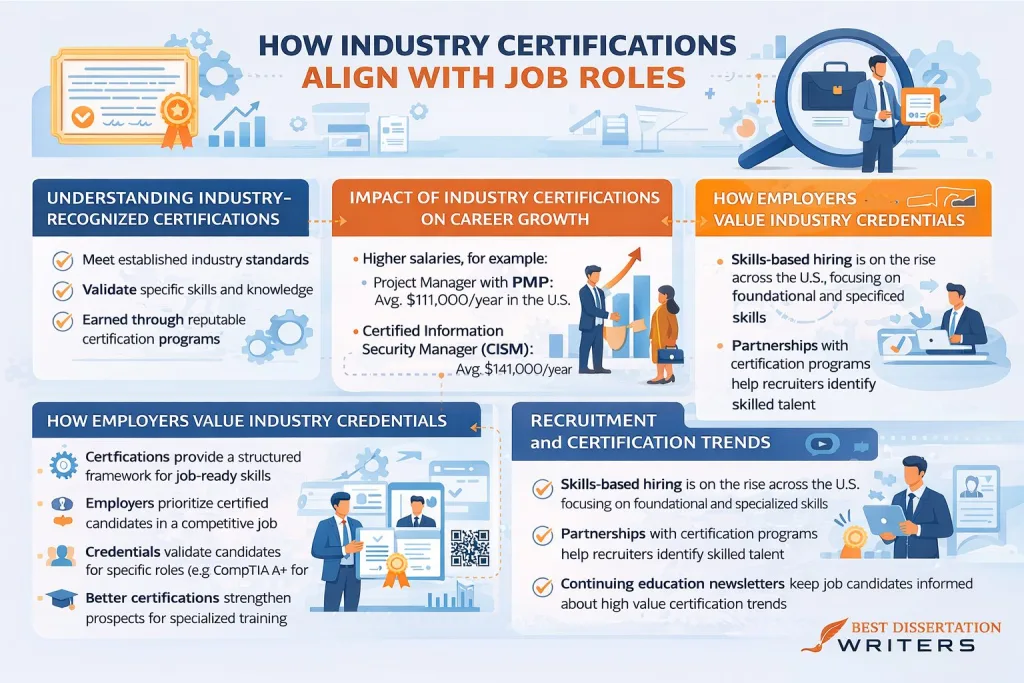
- Industry certifications play an increasingly pivotal role in today’s job market, helping professionals to validate their expertise and align their skills with employer expectations.
- In a competitive job market, industry certifications serve as a clear signal to employers that candidates have the technical skills required to excel in their roles.
- Earning a certification demonstrates a commitment to professional development and provides an edge over other candidates who may not possess industry-recognized credentials.
- Industry certifications offer a structured pathway for employees to gain job-ready skills and improve their readiness for career advancement opportunities.
- According to the U.S. Bureau of Labor Statistics (BLS), individuals with certifications, especially in fields like project management, healthcare, and technical roles, are more likely to earn higher salaries and secure promotions.
- Certificates also help professionals differentiate themselves in a crowded job market, signaling to employers that they are prepared for the challenges of today’s labor market.
- As industries evolve, continuing education and certification programs have become essential for professionals to stay up to date with industry standards and to remain competitive in their fields.
Understanding Certification: What Makes a Credential Industry-Recognized?
- An industry-recognized credential is a certification that is widely accepted within a specific field or profession and often accredited by a reputable certification body or industry organization.
- These certifications are based on industry standards and developed in collaboration with employers to ensure that they align with the skills and competencies required in the workplace.
- Certification programs are typically developed through rigorous frameworks that focus on equipping professionals with the necessary job skills that meet current and future needs of the workforce.
- To be industry-recognized, a credential must be:
- Issued by a recognized accrediting organization.
- Developed with input from industry experts, employers, and professional bodies.
- Tested and validated against real-world scenarios and job roles.
- Supported by a robust continuing education component, ensuring that certifications remain relevant and up-to-date with industry developments.
- When employers hire or prioritize candidates, they are more likely to choose those with industry-recognized credentials, as these certifications demonstrate a level of proficiency and dedication to career advancement.
- Industry certifications in professions such as healthcare, project management, and technical fields serve as a pathway to specialized roles and higher-paying opportunities.
- For instance, project management certifications like the Project Management Professional (PMP) are recognized worldwide, signaling proficiency in managing projects efficiently across industries.
Need Help With Your Dissertation?
Get professional academic support from Best Dissertation Writers . Our expert team is ready to help you with high-quality dissertation writing services tailored to your academic goals.
Get Dissertation HelpHow Industry Certifications Impact Workforce Development and Career Growth
- Industry certifications have a direct influence on workforce development, helping professionals to align their skills with the evolving demands of the job market.
- With industry-recognized credentials, employees can open the door to new career opportunities and improve their earning potential.
- Research indicates that professionals with certifications earn higher salaries compared to their non-certified peers. For example, the average salary of a Project Manager with a PMP certification can reach approximately $115,000 annually in the U.S., compared to around $92,000 for those without it.
- Earning a certification also enables professionals to advance more quickly in their careers. A certified healthcare professional or project manager is more likely to receive promotions and salary increases.
- A well-established credential in a competitive job market can significantly enhance career trajectory. As industries continue to grow and demand for skilled labor increases, certifications in fields such as technical skills, healthcare, and project management will continue to be valued highly by employers.
- Workforce development programs that incorporate certifications ensure that employees remain aligned with the industry standards and job skills required to meet changing demands.
- In healthcare, for example, certified nursing assistants (CNAs) and medical assistants (MAs) earn significantly higher salaries and enjoy better job security due to the certification programs that validate their competencies.
Easy Certifications That Pay Well in 2026
1. CompTIA A+ (IT Support Specialist)
- Description: This entry-level certification is perfect for those wanting to start a career in IT support, focusing on the fundamentals of computer hardware, software, and networking. It’s a widely recognized certification across the tech industry and provides foundational knowledge for further specialization in IT.
- Requirements: No prior experience is necessary. The certification is beginner-friendly and ideal for individuals looking to switch careers or enter the IT field.
- Salary: The average salary for an IT support specialist with a CompTIA A+ certification is $50,000 per year.
- Job Roles: IT Support Specialist, Help Desk Technician, IT Technician, Network Technician.
2. Certified Nursing Assistant (CNA)
- Description: This healthcare certification equips individuals with the necessary skills to assist in the daily care of patients, especially in long-term care settings like nursing homes and hospitals. The training focuses on direct patient care, safety, and basic medical procedures.
- Requirements: Completing a short training program (usually between 6-12 weeks), followed by passing a state exam to become certified.
- Salary: The average salary for a Certified Nursing Assistant is around $34,000 per year. CNAs can often work in various healthcare settings such as hospitals, home healthcare agencies, and private clinics.
- Job Roles: Nursing Assistant, Patient Care Assistant, Home Health Aide, Geriatric Aide.
3. Google IT Support Professional Certificate
- Description: Offered by Google through Coursera, this certification provides essential skills needed for IT support roles, covering troubleshooting, customer service, networking, and security. It’s an excellent option for people looking to break into the IT industry without prior technical experience.
- Requirements: This certification can be completed in approximately six months with a commitment of around 5-10 hours per week. No prior IT experience is needed.
- Salary: The average salary for IT support professionals who have completed the Google IT Support certification is $53,000 per year.
- Job Roles: IT Support Specialist, Help Desk Support, Desktop Support Technician, Network Support Technician.
4. Project Management Professional (PMP) – Entry Level (CAPM)
- Description: While the PMP certification is typically aimed at more experienced professionals, the Certified Associate in Project Management (CAPM) is an entry-level certification that provides the foundational knowledge necessary to manage and lead projects.
- Requirements: Requires a minimum of 23 hours of project management education, which can be completed online in a short amount of time. It’s ideal for individuals who want to build a career in project management or enhance their organizational skills.
- Salary: The average salary for project managers with the CAPM certification is $75,000 per year. This figure can increase substantially with further experience and certification progression.
- Job Roles: Assistant Project Manager, Junior Project Manager, Project Coordinator, Project Administrator.
5. Certified Ethical Hacker (CEH)
- Description: CEH certification is aimed at those interested in cybersecurity. It teaches ethical hacking techniques to identify and fix vulnerabilities in computer systems, helping organizations defend against malicious attacks.
- Requirements: Typically requires basic knowledge of networking and security. However, training programs can prepare individuals to sit for the exam even without hands-on experience.
- Salary: Certified Ethical Hackers earn an average of $85,000 per year, depending on experience and the level of expertise.
- Job Roles: Ethical Hacker, Penetration Tester, Cybersecurity Analyst, Information Security Specialist.
6. Certified Medical Assistant (CMA)
- Description: The CMA certification helps individuals gain skills in both administrative and clinical tasks, such as taking medical histories, scheduling appointments, and assisting with patient examinations. It’s ideal for those looking for a versatile role in the healthcare sector.
- Requirements: To become certified, candidates must complete an accredited medical assistant program and pass a certification exam. The training typically lasts 9-12 months.
- Salary: The average salary for Certified Medical Assistants (CMA) is $36,000 per year, though this can vary depending on location and experience.
- Job Roles: Medical Assistant, Clinical Assistant, Healthcare Office Administrator, Medical Office Specialist.
7. Salesforce Administrator Certification
- Description: Salesforce is one of the leading CRM platforms, and the Salesforce Administrator certification focuses on managing and customizing the Salesforce environment. It’s an ideal certification for individuals looking to work in sales or customer relationship management.
- Requirements: Basic knowledge of Salesforce tools is helpful, but the certification process is manageable for individuals with some tech-savvy background.
- Salary: The average salary for Salesforce administrators is $70,000 per year.
- Job Roles: Salesforce Administrator, CRM Consultant, Business Analyst, Salesforce Developer.
8. Salesforce Marketing Cloud Email Specialist
- Description: This Salesforce certification focuses specifically on email marketing within the Salesforce Marketing Cloud platform. It’s perfect for those who want to specialize in digital marketing, especially email campaigns.
- Requirements: Prior experience in digital marketing is helpful, but Salesforce training courses can help individuals learn the platform’s basics and prepare for the certification exam.
- Salary: The average salary for a Salesforce Marketing Cloud Email Specialist is around $75,000 per year.
- Job Roles: Email Marketing Specialist, Marketing Cloud Specialist, Digital Marketing Manager.
9. Forklift Certification
- Description: Forklift operators are crucial to warehouse, construction, and logistics operations. This certification ensures that individuals understand how to operate forklifts safely and efficiently.
- Requirements: Forklift training programs are relatively quick, typically lasting a few days. Certification is valid for a set period, after which a renewal is required.
- Salary: The average salary for forklift operators is $39,000 per year.
- Job Roles: Forklift Operator, Warehouse Worker, Logistics Associate, Material Handler.
10. AWS Certified Cloud Practitioner
- Description: AWS (Amazon Web Services) is one of the leading cloud service providers, and this entry-level certification focuses on the basics of cloud computing and AWS services.
- Requirements: Basic understanding of IT and cloud services is recommended, but no prior experience is needed.
- Salary: The average salary for an AWS Certified Cloud Practitioner is $72,000 per year.
- Job Roles: Cloud Practitioner, Cloud Support Associate, AWS Cloud Consultant, IT Infrastructure Specialist.
Certificates and Job Readiness: How Employers Value Industry Credentials
- Certificates provide job-ready skills that are immediately applicable in the workplace, making certified individuals more appealing to employers.
- Employers increasingly seek professionals who possess industry-recognized credentials, as they validate that the employee has the knowledge and technical skills required to contribute to the organization’s goals right away.
- In today’s labor market, many job descriptions list certifications as a prerequisite, signaling that they are a crucial part of the hiring process.
- Certification programs are designed to help individuals gain practical knowledge and skills that are directly applicable to their job roles. As a result, certified professionals are seen as more prepared for the responsibilities they will face, making them highly sought after by employers.
- For instance, a Certified Information Systems Security Professional (CISSP) certification can increase a cybersecurity professional’s earning potential to over $120,000 annually, highlighting the immense value employers place on certifications that reflect industry standards.
- According to a survey by the Association for Talent Development (ATD), employers in the U.S. are prioritizing certifications for various roles, from project management to healthcare, due to the readiness they signify in candidates.
- When employers hire, they often look for a certificate to confirm that the candidate has a proven set of competencies, which saves both time and money spent on training.
Leveraging LinkedIn to Showcase Industry-Recognized Certifications
- LinkedIn is one of the most powerful tools for professionals looking to embed their industry-recognized credentials into their online profiles and demonstrate their expertise to potential employers.
- Adding certifications to your LinkedIn profile helps establish credibility and improves your chances of being discovered by recruiters.
- LinkedIn allows users to add certifications to their profile under the “Licenses & Certifications” section, which can be linked directly to the official certificate or certifying body, adding an extra layer of verification.
- When showcasing certifications on LinkedIn, be sure to include:
- The name of the certification.
- The certifying organization or body.
- The date of completion and any continuing education requirements to maintain the certification.
- Having these industry-recognized credentials prominently displayed helps ensure that you are found by employers who are seeking candidates with specific job skills.
- In a competitive job market, LinkedIn allows professionals to leverage their certifications to differentiate themselves from other candidates.
- By consistently updating your LinkedIn profile with new certifications, you show your commitment to professional development and career advancement.
The Role of Recruitment in Recognizing and Valuing Certifications
- Recruiters across various industries increasingly recognize the importance of industry certifications in shaping job candidates’ qualifications.
- In today’s competitive job market, certifications are an essential factor that recruiters rely on to evaluate potential hires. They help distinguish candidates with verified expertise in specific fields.
- Recruiters often use certifications as a key indicator of a candidate’s job readiness and proficiency in specific skills required for the role.
- As skills-based hiring becomes more prevalent, certifications help employers make informed decisions by aligning industry-recognized credentials with the qualifications needed for the job.
- Recruitment processes in sectors like healthcare, project management, and technology often prioritize candidates with industry-recognized credentials because these certifications signal a commitment to professional development and competence in specialized training.
- Job postings regularly highlight certifications as a requirement, signaling their increasing importance in hiring decisions. For example, PMP (Project Management Professional) certifications are often a prerequisite for project management positions across the U.S., with salaries averaging $115,000 annually for certified professionals.
- With certifications becoming a standard for evaluating candidates, recruiters are empowered to streamline the hiring process, ensuring they recruit only the most qualified professionals.
Industry-Recognized Credentials: A Catalyst for Career Advancement
- Industry certifications act as a catalyst for career advancement by providing professionals with specific skills that align directly with their career goals.
- Certifications provide a structured pathway for individuals to enhance their expertise in their current profession or transition into a new career.
- Earning a high-value credential can increase a professional’s marketability by showcasing their ability to meet industry standards and specialized training needs.
- Certifications serve as a tool to sharpen skills, making individuals more attractive to employers looking for skilled professionals who are adaptable and agile in the face of industry changes.
- As industries evolve, certifications help professionals stay relevant by updating their knowledge base, ensuring they stay current with emerging trends and technologies.
- For example, certified IT professionals in roles such as network administrators or cybersecurity specialists in the U.S. can see salary increases ranging from 10% to 30% compared to their non-certified counterparts.
- Additionally, earning industry-recognized credentials opens up access to additional certifications, creating a stack of qualifications that bolster career growth.
- Many certifications require periodic renewal or continuing education, ensuring that professionals are committed to student success and continual improvement.
- Ultimately, industry-recognized credentials serve as a foundation for long-term career resilience and advancement.
Staying Updated: How Newsletters Keep You Informed on Certification Trends
- Newsletters are an invaluable resource for staying updated on industry certifications and the latest trends in the job market.
- Subscribing to newsletters from recognized certification bodies or industry associations provides professionals with a constant flow of information on new certifications and updates to existing ones.
- These newsletters often highlight emerging trends, such as specialized certifications in agile methodologies, data science, or cloud computing, enabling professionals to stay ahead of the curve and meet the growing demands of their respective industries.
- Many newsletters also provide insight into job postings and how the role of certifications is evolving in the recruitment process. They can inform job seekers about in-demand certifications that employers are seeking, thus enhancing their ability to target the right qualifications.
- These resources often include updates on certification pathways and details about the process of earning and maintaining specific certifications, giving professionals the tools they need to make informed decisions about their career development.
- Regular updates on high-quality certification programs can help individuals identify the most relevant certifications that will strengthen their qualifications and improve their standing in the competitive job market.
Building a Professional Profile with Industry-Recognized Credentials
- Industry-recognized credentials are crucial in building a professional profile that aligns with current industry expectations.
- Having certifications listed on professional platforms like LinkedIn allows candidates to showcase their skills and knowledge, making them visible to potential employers.
- LinkedIn profiles with certifications are more likely to catch the eye of recruiters, especially if the credentials are from well-known and respected certification bodies.
- In addition to certifications, professionals should also highlight their soft skills and foundational knowledge, as these qualities complement the technical competencies validated by the credentials.
- Certification pathways often include entry-level certifications, which are ideal for individuals just starting their careers, and more advanced certifications for those looking to specialize further or assume leadership roles in their profession.
- Building a professional profile with industry-recognized credentials boosts employability, demonstrating a proactive commitment to career development.
- These certifications allow professionals to move beyond basic qualifications and set themselves apart by sharpening their expertise in areas that directly impact job performance and success.
Need Help With Your Dissertation?
Get professional academic support from Best Dissertation Writers . Our expert team is ready to help you with high-quality dissertation writing services tailored to your academic goals.
Get Dissertation HelpConclusion: Aligning Your Certifications with Career Goals in the Job Market
- Aligning certifications with career goals is key to achieving long-term success in today’s dynamic job market.
- Industry certifications help professionals validate their skills and make their profiles more attractive to recruiters, aligning their qualifications with the specific needs of employers.
- By choosing certifications that match their career goals and desired job roles, individuals can improve their chances of securing job postings that match their skills and aspirations.
- In underserved sectors like healthcare, IT, and project management, industry-recognized credentials are especially important as they help individuals break into highly specialized and high-paying roles.
- The ongoing trend of skills-based hiring further highlights the significance of industry-recognized certifications, as these credentials align directly with the competencies employers need to drive their businesses forward.
- Whether an individual is seeking entry-level roles or aiming for higher positions, certifications provide a structured pathway for career growth, while also improving student success and job-ready skills.
- To stay competitive, professionals should consistently evaluate and strengthen their skill sets by earning additional certifications, ensuring they meet the evolving needs of the job market and continue advancing their careers effectively.
By strategically aligning industry certifications with job roles, professionals can differentiate themselves, gain access to better opportunities, and ensure they remain competitive in a constantly evolving job market.
References
- How Industry Certifications Align with Job Roles – https://www.shrm.org/resourcesandtools/hr-topics/organizational-and-employee-development/pages/how-industry-certifications-align-with-job-roles.aspx
- Understanding Industry Certifications: Benefits and Opportunities – https://www.careeraddict.com/industry-certifications-benefits
- Certifications in the Workplace: How They Relate to Job Performance – https://www.forbes.com/sites/forbeshumanresourcescouncil/2020/11/23/certifications-in-the-workplace-how-they-relate-to-job-performance/
- The Role of Industry Certifications in Career Development – https://www.thebalancecareers.com/industry-certifications-2061869