

Frontline Nurses’ Experiences of Working in UK Healthcare during the COVID-19 Pandemic
 By Dr. Robertson Prime, Research Fellow
This dissertation is a worked example that shows the structure and standard of a 5,000-word literature-based Independent Project. It is provided for learning and is not to be submitted as a student’s own work.
Abstract
Background: Nurses were central to the health service response to COVID-19, and the national inquiry found that healthcare systems coped only just. Less is known about how UK studies describe the experiences, wellbeing and working conditions of nurses during COVID-19.
Aim: To critically review UK evidence on the experiences, wellbeing and working conditions of nurses during COVID-19.
Methods: A structured literature review using the Population, Exposure and Outcome framework. OpenAlex was searched twice on 15 November 2026, because CINAHL could not be accessed and a planned MEDLINE search was not completed. The first 40 records of each search were screened: 80 records were identified, 77 screened after the removal of duplicates and 10 UK studies included. Quality was considered using Critical Appraisal Skills Programme questions, and findings were combined by thematic synthesis.
Findings: The included studies of nurses during COVID-19 (n = 10) comprised interviews, focus groups and two surveys. Nurses described distress, exhaustion and thoughts of leaving, shortages of staff and equipment and diluted skill mix shaped wellbeing and perceptions of safety, and support and voice were inconsistent.
Conclusions and implications for practice: For nursing practice, services can plan redeployment with training and supervision, offer quick and consistent support and respond visibly when nurses speak up. The evidence is limited by the restricted search, single-reviewer screening, reliance on abstracts and the scarcity of studies that follow nurses over time.
Keywords: nurses during covid-19; nurse wellbeing; nurse resilience; adult nursing; literature review.
Brief at a glance
- Framework
- PEO
- Design
- Literature review (PEO)
- Studies included
- 10
- Field
- Adult Nursing
Introduction
Nurses were at the centre of the health service response to COVID-19, and their experiences of working in UK healthcare during the pandemic have been described in interviews, focus groups and surveys. The UK Covid-19 Inquiry concluded in its report on healthcare systems that they coped only just, and that they were already overstretched and understaffed when the pandemic arrived (UK Covid-19 Inquiry, 2026). Nurses worked alongside colleagues in other roles, as explored in healthcare support workers, and the Code of the Nursing and Midwifery Council applied to all of them throughout (NMC, 2018). What nurses during COVID-19 reported is therefore a matter for workforce planning as well as for individual wellbeing, and it shapes how the next emergency is prepared for. The experiences of those who worked through it are evidence that planners can use.
This dissertation reviews UK research on the experiences of nurses during COVID-19, with a focus on their wellbeing, working conditions and support. A literature review suits the question because the evidence is scattered across interviews, focus groups and surveys, and a structured process makes each choice visible and open to challenge (Aveyard, 2023). The review is limited to the UK so that its conclusions can be read against the findings of the national inquiry and one professional code (UK Covid-19 Inquiry, 2026). It asks how nurses describe working during the pandemic, what the studies show about staffing, protective equipment and redeployment, and what support nurses said they needed. It then considers what this means for nursing practice and education. Each of these questions is addressed using studies that report the views of nurses themselves, so that their own words and numbers are the evidence.
Background and Justification
The UK Covid-19 Inquiry published its report on the impact of the pandemic on healthcare systems in 2026. The Chair summarised the impact as follows: the systems coped, but only just, and came close to collapse. Healthcare workers carried the burden of caring for the sick and dying, at great cost to themselves and their families (UK Covid-19 Inquiry, 2026). The Chair also noted that the systems were already overstretched and understaffed when the pandemic arrived, which made them fragile. The government response, presented to Parliament later in 2026, recognised the extraordinary efforts of frontline staff and the pressures under which they worked (DHSC, 2026). These two documents set the national context for the studies of nurses during COVID-19 reviewed here, although neither was written to describe the experience of any one profession.
Staffing was one of the first pressures. Absences from illness and self-isolation, together with the existing shortage, meant that staff were redeployed from other areas to the front line, which put other care at risk, while recruitment drives were launched and retired staff were encouraged to return where it was safe. Early in the pandemic, ratios in intensive care were reduced so that one nurse could care for up to four critically ill patients, instead of one (UK Covid-19 Inquiry, 2026). One of the ten recommendations of the Inquiry concerns redeploying staff to expand hospital capacity with appropriate training, supervision and governance, and the government accepted the need for planning (DHSC, 2026). Redeployment of this kind is a recurring theme in the studies that follow.
Protective equipment and infection control were a second pressure. The Inquiry found that shortages and poor-quality equipment caused immense anxiety among healthcare workers and put their own and their families’ health at risk, and it also found fundamental flaws in the guidance on infection prevention and control (UK Covid-19 Inquiry, 2026). Infection prevention is a theme for all clinical staff, as shown in hand hygiene compliance. The government response states that it is improving governance of infection prevention and control, strengthening visiting rights and modernising health data systems (DHSC, 2026). These measures concern systems and not nurses directly, although nurses carry out much of the day-to-day practice, so equipment and guidance were part of their daily working conditions.
The Inquiry also described the personal cost to staff. Many healthcare workers died, particularly those from ethnic minority backgrounds, and professionals reported declining mental health after prolonged pressure, with some diagnosed with post-traumatic stress disorder and some choosing to leave their roles (UK Covid-19 Inquiry, 2026). One recommendation calls for psychological and emotional support to be provided at scale from the start of a pandemic. The government response notes that 40 staff mental health hubs were set up during the acute phase, with targeted programmes for staff from minority ethnic backgrounds and those in lower-banded roles, but it does not single out nurses (DHSC, 2026). The experience of nurses therefore has to be sought in research, and the studies reviewed here supply it.
The Code of the Nursing and Midwifery Council applied throughout the pandemic. It requires nurses to treat people as individuals and to respect their dignity, and to recognise and work within the limits of their competence, which is a particular challenge when nurses are redeployed to unfamiliar areas (NMC, 2018). Research on these experiences is spread across interviews, focus groups and surveys, so a structured literature review can bring it together if it states its method and limits (Aveyard, 2023). Studies of people, their exposures and their outcomes fit a framework that separates the population, the exposure and the outcome (Methley et al., 2014). Studies of different designs are read side by side and are not combined into one estimate.
This review therefore examines UK research on nurses during COVID-19 against the national context described above. It is limited to UK studies so that the findings can be read against the report of the Inquiry and the Code of the Nursing and Midwifery Council (UK Covid-19 Inquiry, 2026; NMC, 2018). It looks at three linked questions: how nurses describe their distress, resilience and identity, what the studies show about conditions such as staffing, protective equipment and redeployment, and what happened when nurses tried to speak up or sought support. It does not assess the effectiveness of particular support programmes, which would need different evidence (DHSC, 2026).
Title, Aim and Objectives
What do UK studies show about the experiences, wellbeing and working conditions of nurses during COVID-19?
Title explained
The title names the population of frontline nurses, the focus on their experiences of work, the UK boundary of the evidence, the pandemic period under review and the literature review design that structures the whole work.
Aim
To critically review UK evidence on the experiences, wellbeing and working conditions of nurses during COVID-19.
Objectives
- To identify and appraise UK research on nurses working during the pandemic.
- To synthesise findings on experiences, wellbeing, working conditions and support.
- To make recommendations for nursing practice.
Methodology
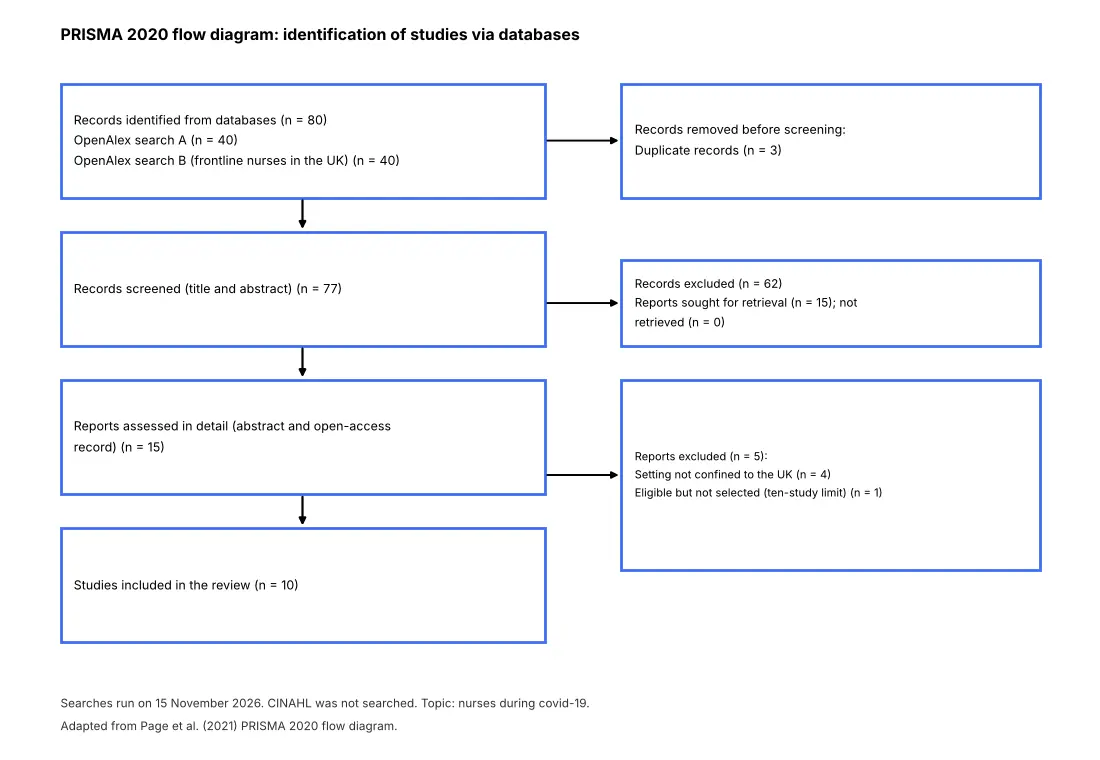
This literature-based dissertation is a structured review of published primary research on nurses during covid-19. It aims to be transparent and reproducible, but it is smaller in scope than a full systematic review, which would normally involve several reviewers, many more databases and exhaustive searching (Aveyard, 2023). The review is reported with reference to the PRISMA 2020 statement, which lists the items that should be described and recommends a flow diagram showing how records move through identification, screening and inclusion (Page et al., 2021). Appendix D presents that flow diagram, Appendix A records each search string, Appendix B tabulates the included studies and Appendix C gives a worked critical appraisal. Together, the appendices allow another reader to check each decision and to repeat the process.
The review question was framed using the Population, Exposure and Outcome (PEO) structure, which suits questions about experiences and influencing factors rather than the effects of a treatment. The population was registered nurses working in UK health services during the pandemic, including advanced practice nurses, nurse managers and nurse leaders. The exposures were the working conditions of the pandemic, including redeployment, protective equipment, staffing and support, and the outcomes were their experiences, wellbeing, resilience, perceptions of safety and intentions to leave. Structured frameworks help to translate a broad topic into searchable concepts, although the choice of framework affects how sensitive a search is (Methley et al., 2014; Aveyard, 2023). Because the evidence included interviews, focus groups and surveys, qualitative, quantitative and mixed-methods research was eligible for inclusion.
Two searches were run on 15 November 2026 in OpenAlex, an open index of scholarly works that covers a large and growing proportion of the published literature (Priem et al., 2022). The first search used the words nurses during covid-19. The second combined the words frontline nurses, experiences, covid-19 pandemic and UK, to bring studies of UK nurses higher in the results. Both searches were limited to open-access records published between 2015 and 2026 with at least one author affiliated to a UK institution. Both searches were restricted to journal articles. Combining more than one source is advised because a single database misses relevant studies (Bramer et al., 2017). The exact strings and settings are given in Appendix A.
CINAHL, the main nursing database, could not be accessed, and a planned search of MEDLINE through Europe PMC was not completed because the service refused repeated requests on the day of searching. The second OpenAlex search was therefore used in its place. These gaps mean that some relevant nursing studies may not have been found, a risk that is well recognised when the combination of databases is restricted (Bramer et al., 2017). OpenAlex matches terms anywhere in the text, so many records were not relevant. It also ranks records by relevance, and the two searches matched 26,733 and 2,855 records. Only the first 40 records of the first search and the first 40 of the second, 80 in total, were screened, so the review should be read as a structured sample of the literature and not as a complete search (Aveyard, 2023).
Studies were eligible if they involved registered nurses, or nurse managers and leaders, working in UK health services during the pandemic and examined their experiences, wellbeing, working conditions, resilience or support. Reports had to be peer-reviewed, written in English, open access and published from 2015 onwards. UK origin was judged from the stated setting and, where the abstract did not name one, from author affiliations. Reviews, protocols, descriptive or opinion articles without methods, studies of mixed professional groups, studies set outside the UK or in several countries and reports without a usable abstract were excluded. Clear criteria applied consistently reduce selection bias and allow the decisions to be audited. The extraction table is presented in Appendix B so that readers can compare studies at a glance (Page et al., 2021; Aveyard, 2023).
All 80 records were exported into a screening log, and 3 duplicates were removed, leaving 77 titles to screen. Titles about other countries, other professions, students were excluded here, and where more than ten eligible studies existed, those most about the experiences of nurses were preferred. That left 15 reports for closer assessment against the criteria. The abstract and open-access record of each of these reports were read, and the reason for every exclusion was recorded. The log lists every record by its identifier, the search in which it appeared and the decision reached, so that each exclusion can be traced. Ten studies met the criteria, and the numbers at each stage reconcile in the flow diagram (Page et al., 2021). Screening was carried out by one reviewer, which is a recognised limitation of student reviews because a second reviewer would normally check each decision (Aveyard, 2023).
Quality was considered using the Critical Appraisal Skills Programme checklists, which ask structured questions about the aims, design, conduct, results and value of a study (CASP, 2024). The qualitative checklist was completed in full for one focus group study, as a worked example in Appendix C, and indicative quality notes for every study are recorded in Appendix B. Those notes are based on the abstract and, for one study, the open full text, so they are judgements of reporting and not a full audit of how the research was conducted. No study was excluded on quality alone, since appraisal was used to weigh the strength of the findings, which is a common approach in nursing reviews (Aveyard, 2023).
Data were extracted into a standard table covering aims, design, sample, setting, methods, findings and limitations. Numerical results were copied as reported and were not recalculated, and extraction was rechecked once against the source records, a step that reduces transcription errors but does not replace independent checking. Findings were grouped into themes by thematic synthesis, with the survey results reported alongside the qualitative themes because the review combined studies of different designs (Thomas and Harden, 2008; Braun and Clarke, 2006). The review used published data only and involved no participants, so ethical approval was not required, although the findings of the included studies are reported accurately and with full attribution (Aveyard, 2023).
Findings
Ten UK studies of nurses during COVID-19 met the inclusion criteria, published between 2021 and 2025. Eight were qualitative, using interviews or focus groups, and two were surveys, one of which combined closed and open questions. They covered nurses across settings, advanced practice nurses, nurses in respiratory areas and intensive care, Filipino nurses, nurse managers and executive nurse directors. Each is described below by theme, and the section ends with the quality and limits of the evidence. Because the designs differ, results are reported side by side and are not simply combined (Wood et al., 2021; Maben et al., 2022).
Distress, wellbeing and resilience
In longitudinal interviews with 27 nurses after the first wave and 25 at the start of the second, moral distress, compassion fatigue, burnout and post-traumatic stress were the states most often described, and many considered leaving the profession. Four themes were deathscapes and impoverished care, systemic challenges, emotional exhaustion and self-preservation, and support that was helpful or unhelpful (Maben et al., 2022). A UK survey of advanced practice nurses reported that 47% had considered leaving their job during the first three months of the outbreak, and examples of good practice and innovation were also given (Wood et al., 2021). Both studies point to leaving as a real risk, although neither measured who actually left.
Resilience was treated critically in two studies. Narrative interviews with 27 nurses showed resilience to be a contested concept, often framed as a set of coping tools, and the authors argued that nurses should not be blamed for struggling when their reactions were normal responses to extreme circumstances (Conolly et al., 2022). In five online focus groups with 22 nurses at one NHS Trust, nurses described losses and positive changes, and four themes covered rapid change, loss and disruption, opportunities for positive transformation and a reinforced professional identity (Davey et al., 2022). Nurses during COVID-19 therefore described both harm and strengthened identity.
Working conditions, protective equipment and patient safety
A survey of advanced practice nurses was sent to an existing UK-wide cohort, and 124 responded (51%). Respondents reported shortages of staff (51%) and of protective equipment (68%) across primary and secondary care in all UK regions, and they raised concerns about morale and about patients not receiving routine care. Some reported positive changes that enhanced care (Wood et al., 2021). The abstract gave no data collection dates and did not describe the analysis in detail, so the response cannot be judged for bias. The shortages reported here match the equipment concerns found in nurses working in respiratory areas, described next (Roberts et al., 2021).
An online survey of nurses caring for respiratory patients ran for three weeks in 2020 and was shared through social media and professional societies. Concerns centred on the working environment, the supply and availability of protective equipment, the quality of care and the ability to deliver it. Many nurses worried about bringing the virus home and about their own mental health, and support was available but inconsistent, which showed the role of nursing leadership in fair access to services (Roberts et al., 2021). The abstract did not state the number of respondents, so the weight of each concern cannot be judged. The role of leaders is explored in a later study (James et al., 2025).
Nurses in intensive care were interviewed about patient safety. Nineteen registered nurses described a situation of being on a war footing and of doing the best they could. They reported increased patient safety risks, which they linked to diluted skill mix and fragmented care, and specialist nurses working alongside colleagues without critical care experience was seen as leading to reduced quality, more adverse events and harm that was not consistently reported (Stayt et al., 2022). Interviews took place in 2021, after the first waves. The account agrees with the account of reduced staff ratios in the national inquiry, and with the deathscapes described by Maben et al. (2022).
Speaking up, redeployment and leadership
Longitudinal interviews on speaking up found three themes: being under threat, risk tolerance and avoidance, and deafness and hostility. Concerns focused on protective equipment, patient safety and redeployment, opportunities to raise concerns were often thwarted even when Trusts introduced response policies, and nurses reported feeling futile and silenced (Abrams et al., 2023). The authors noted missed chances to learn from frontline staff. These data came from the same research programme as the study of distress, so the two reports are not independent (Maben et al., 2022). The abstract did not give the number of nurses interviewed, and the interviews ran over almost two years, so the views may have changed over time.
The management of redeployment was studied in three NHS Trusts in England, with interviews of 32 nurse managers and four human resources advisors and later focus groups. Nurses and managers held mismatched views of who was responsible for decisions, approaches were inconsistent, and managers felt caught in the middle between staff and organisational demands. The authors concluded that the approach prioritised staffing numbers over staff wellbeing and recommended a planned, scalable approach with operational guidance, which would apply to any future emergency (Hartley et al., 2024). Redeployment was also a concern for the nurses who spoke up about it (Abrams et al., 2023).
Twenty-one executive nurse directors in England and Wales described six themes, including tensions, adaptive responses and personal leadership styles, uncertainty and support at board level, responding to national political decisions, emotional impact and the voice and public profile of nursing. Enablers included multidisciplinary working and stronger bonds with colleagues, and barriers included limited knowledge of the virus and a lack of national guidance (James et al., 2025). The directors also asked for recognition of the emotional impact and protection from burnout. This view from leaders complements the experiences of frontline nurses in the study of redeployment (Hartley et al., 2024).
Experiences of Filipino nurses
Six Filipino nurses in the UK were interviewed using interpretative phenomenological analysis. They experienced the pandemic as all-consuming, perceived their work as a threat and felt placed at disproportionate risk, which they linked to racial, systemic and political factors. They felt that they had no choice but to battle through, and they coped in culturally specific ways, although the abstract did not give the dates of the interviews (Borbolla and Nkansa-Dwamena, 2025). This small study adds a perspective on inequality that the larger studies did not report in their abstracts, and it was the only included study of a specific ethnic group of nurses (Maben et al., 2022).
Patterns across the studies
Three patterns appeared across the studies. First, nurses described distress, exhaustion and thoughts of leaving, and linked them to conditions as well as to individual coping (Maben et al., 2022). Second, shortages of staff and protective equipment, and diluted skill mix, shaped both wellbeing and perceptions of safety (Wood et al., 2021). Third, support and voice were inconsistent, and nurses who tried to speak up felt silenced (Abrams et al., 2023). Each pattern appeared in more than one report, although several reports came from one research programme, which strengthens the case that they are real features of the period but not that they are independent.
Differences in perspective are also informative. Frontline nurses reported silencing and distress (Abrams et al., 2023), whereas executive nurse directors described tension, uncertainty and emotional impact at board level, and managers described being caught in the middle (James et al., 2025; Hartley et al., 2024). These views do not conflict. They suggest that the strain of the period was felt at every level, but that nurses in different roles had different degrees of control over decisions, and that support was needed for managers and leaders as well as for staff delivering care. The studies did not compare these groups directly, so the contrast is an interpretation and not a finding.
Quality and limits of the evidence
Several limits qualify these findings. Most studies were qualitative with small samples recruited by opportunity or through networks, so they describe experience in depth but cannot show how common it is. The focus group study recruited opportunistically at one Trust (Davey et al., 2022), the survey of advanced practice nurses had a 51% response (Wood et al., 2021), and the Filipino nurses study had six participants (Borbolla and Nkansa-Dwamena, 2025). Three reports used interviews from one research programme, and two came from one survey group, so their agreement is not necessarily independent. Studies of this kind are useful for describing experience but cannot estimate its extent.
The full-text appraisal in Appendix C of the focus group study by Davey et al. (2022) found a clear aim, a suitable qualitative design, ethical approval from a university, the Health Research Authority and the Trust, written consent, recorded and transcribed groups and a Framework Method analysis with quotations. Its weaknesses were that the number of nurses invited was not reported, the researchers’ backgrounds and reflexivity were not described, one team member coded all transcripts and there was no second coder, saturation or member checking. The other nine studies were appraised from abstracts only, so their quality notes in Appendix B are indicative and should not be read as full audits (Wood et al., 2021).
Design limits matter too. The survey of respiratory nurses did not report its sample size in the abstract (Roberts et al., 2021), the speaking up study did not report the number of interviewees (Abrams et al., 2023), and none of the studies followed nurses beyond 2022. Five further reports were assessed in detail and excluded, including four set outside the UK or in several countries and one eligible survey not selected under the ten-study limit because it was from the same group as an included survey, so relevant evidence may have been lost. All of the included studies were published after 2020, so the evidence reflects the early and middle period of the pandemic.
Wider Discussion
The findings suggest that the distress reported by nurses during COVID-19 was linked to conditions as much as to individual resilience. Nurses described moral distress, exhaustion and thoughts of leaving (Maben et al., 2022), and the authors of the resilience study warned against blaming nurses for struggling when their reactions were normal responses to extreme circumstances (Conolly et al., 2022). Intensive care nurses linked patient safety risks to diluted skill mix (Stayt et al., 2022). None of these studies shows that better conditions would have prevented distress, but together they support looking at staffing and support before attributing difficulty to the resilience of individuals. This is consistent with the national inquiry, which also described understaffing before the pandemic began.
Voice and leadership were also central. Nurses who raised concerns about equipment, safety and redeployment felt silenced (Abrams et al., 2023), managers felt caught between staff and organisational demands (Hartley et al., 2024), and executive directors described tensions and limited national guidance (James et al., 2025). The evidence reviewed here suggests that speaking up needs a response that nurses can see, and that managers and leaders need support to provide it. The studies do not show which response policies work. Nurses during COVID-19 said that having a policy was not the same as being heard, which is a useful distinction for practice, because a policy that is not seen to work may add to the sense of futility that nurses described.
Three priorities follow for practice. First, services can plan redeployment with training, supervision and clear decision-making, because nurses and managers held mismatched views of responsibility (Hartley et al., 2024). Second, employers can offer support that is quick and consistent, since support was available but inconsistent (Roberts et al., 2021). Third, organisations can respond visibly when nurses speak up (Abrams et al., 2023). Nurses in other settings, such as practice nurses, also worked through the pandemic, although none of the included studies was set in general practice. Each priority is within the reach of local teams and managers, and none depends on new national policy.
Several limitations qualify these conclusions. Only OpenAlex was searched, in two searches, CINAHL was not accessible and a planned search of MEDLINE through Europe PMC was not completed, so relevant nursing studies may have been missed (Bramer et al., 2017). Only the first 40 records of each search were screened, one reviewer made all decisions, and where more than ten eligible studies existed those most about the experiences of nurses during COVID-19 were preferred, which is a recognised limitation of student reviews (Aveyard, 2023). Appraisal relied on abstracts for nine studies, and the evidence is mostly qualitative and local, so the conclusions are offered as a structured sample of the evidence and not as a complete account.
Reflection
I began this review thinking that the experience of nurses during COVID-19 was mainly a story of exhaustion and courage. The studies changed that view. Nurses described moral distress, silence and a sense that their concerns were not heard, and the studies of managers and leaders showed that the strain reached every level. I realised that I had thought of resilience as a personal quality that some nurses have and others lack, and the authors who warned against blaming nurses for struggling made me rethink that. I became more aware that support is a matter for employers and systems as well as for individuals, and that my own placements during that period may have shaped what I noticed.
The search was harder than I expected. The topic produced thousands of records from many countries, and I had to decide quickly which were about UK nurses. Several relevant papers were set in other countries or in several countries, and one concerned a mixed group of staff, so I excluded them under my own rules. One survey of respiratory nurses fitted the criteria but came from the same group as another survey that I kept, so I left it out under the ten-study limit. That was uncomfortable, because each excluded paper had something to teach, and I had to check that I was not choosing studies that confirmed my expectations. Writing down each decision was slow, but it showed me how much a review depends on its rules.
Appraising the focus group study was the most instructive part of the work. It had a clear aim, approvals from three bodies and four well-supported themes, yet it did not report how many nurses were invited, and the researchers did not describe their own backgrounds. I had assumed that a study approved by the Health Research Authority would be fully reported, and I was surprised that it was not. I realised that I tend to trust a paper that sounds thorough, and that is a habit I need to change. I now try to ask what a paper leaves out before I ask what it found.
In practice, I will ask colleagues who have been redeployed what training and supervision they were given, and I will raise concerns early and in writing when care is unsafe. I need to improve my skills in reading surveys, since the two surveys here were hard to compare with the interviews, and I want to learn more about how organisations respond when staff speak up. These goals are modest, but they are within the reach of any student nurse, and I will review them at the end of each placement with my practice supervisor. I will also ask how newly redeployed colleagues are welcomed onto a ward, because that was a recurring concern.
Conclusion
This dissertation set out to review UK evidence on the experiences, wellbeing and working conditions of nurses during COVID-19. Ten UK studies, comprising interviews, focus groups and two surveys, showed that nurses described distress, exhaustion and thoughts of leaving, that shortages of staff and equipment and diluted skill mix shaped both wellbeing and perceptions of safety, and that support and voice were inconsistent. Together these findings describe a workforce that carried a heavy load under conditions that were not of its own making, and whose voice was not always heard.
These results come from small, local studies and do not prove cause, but they agree in pointing to staffing, protective equipment, support and voice. They also show that distress was linked to conditions and not only to individual resilience, which matters because support programmes can otherwise place the burden back on nurses. Their value lies in showing where employers and policy makers can act and not in proving that one approach is best. Local review of how nurses during COVID-19 were redeployed and supported would be a practical first step, and it would be low in cost.
For nursing practice, the review supports planned redeployment with training and supervision, quick and consistent support and a visible response when nurses speak up. The strength of this evidence is limited by the restricted search, single-reviewer screening and reliance on abstracts, so the conclusions are best treated as a well-founded starting point and not as a final answer. Further research that follows nurses over time and tests support programmes would show which approaches work best, and services that act on these points may be better prepared for the next emergency.
Reference List
Abrams, R. et al. (2023) ‘Speaking up during the COVID-19 pandemic: nurses’ experiences of organizational disregard and silence’, Journal of Advanced Nursing, 79(6), pp. 2189-2199. doi:10.1111/jan.15526.
Aveyard, H. (2023) Doing a literature review in health and social care: a practical guide. 5th edn. Open University Press.
Borbolla, D. and Nkansa-Dwamena, O. (2025) ”It’s sink or swim for us’: the lived experiences of Filipino nurses in the UK during the COVID-19 pandemic’, Qualitative Research in Medicine & Healthcare, 9(1), article 100002. doi:10.1016/j.qrmh.2025.100002.
Bramer, W.M. et al. (2017) ‘Optimal database combinations for literature searches in systematic reviews: a prospective exploratory study’, Systematic Reviews, 6, article 245. doi:10.1186/s13643-017-0644-y.
Braun, V. and Clarke, V. (2006) ‘Using thematic analysis in psychology’, Qualitative Research in Psychology, 3(2), pp. 77-101. doi:10.1191/1478088706qp063oa.
CASP (2024) CASP checklists. Oxford: Critical Appraisal Skills Programme. Available at: https://casp-uk.net/casp-checklists/ (Accessed: 9 November 2026).
Conolly, A. et al. (2022) ”What is the matter with me?’ or a ‘badge of honor’: nurses’ constructions of resilience during Covid-19′, Global Qualitative Nursing Research, 9, article 23333936221094862. doi:10.1177/23333936221094862.
Davey, Z., Srikesavan, C., Cipriani, A. and Henshall, C. (2022) ”It’s what we do’: experiences of UK nurses working during the COVID-19 pandemic: impact on practice, identity and resilience’, Healthcare, 10(9), article 1674. doi:10.3390/healthcare10091674.
Department of Health and Social Care (DHSC) (2026) UK government response to the Covid-19 Inquiry Module 3 report (CP 1664). London: DHSC. Available at: https://assets.publishing.service.gov.uk/media/6aa7fc596d3764db16904608/uk-government-response-covid-19-inquiry-module-3-report-print-ready.pdf (Accessed: 15 November 2026).
Hartley, H. et al. (2024) ‘Managing nurse redeployment during the Covid-19 pandemic, lessons for future redeployment: a qualitative study’, International Journal of Nursing Studies, 157, article 104828. doi:10.1016/j.ijnurstu.2024.104828.
James, A.H. et al. (2025) ‘Leading through the COVID-19 pandemic: experiences of UK Executive Nurse Directors’, Journal of Advanced Nursing, 81(3), pp. 1463-1475. doi:10.1111/jan.16329.
Maben, J. et al. (2022) ”You can’t walk through water without getting wet’: UK nurses’ distress and psychological health needs during the Covid-19 pandemic: a longitudinal interview study’, International Journal of Nursing Studies, 131, article 104242. doi:10.1016/j.ijnurstu.2022.104242.
Methley, A.M. et al. (2014) ‘PICO, PICOS and SPIDER: a comparison study of specificity and sensitivity in three search tools for qualitative systematic reviews’, BMC Health Services Research, 14, article 579. doi:10.1186/s12913-014-0579-0.
Nursing and Midwifery Council (NMC) (2018) The Code: professional standards of practice and behaviour for nurses, midwives and nursing associates. London: NMC. Available at: https://www.nmc.org.uk/standards/code/ (Accessed: 15 November 2026).
Page, M.J. et al. (2021) ‘The PRISMA 2020 statement: an updated guideline for reporting systematic reviews’, BMJ, 372, article n71. doi:10.1136/bmj.n71.
Priem, J., Piwowar, H. and Orr, R. (2022) ‘OpenAlex: a fully-open index of scholarly works, authors, venues, institutions, and concepts’, arXiv, 2205.01833. doi:10.48550/arXiv.2205.01833.
Roberts, N.J. et al. (2021) ‘Experiences of nurses caring for respiratory patients during the first wave of the COVID-19 pandemic: an online survey study’, BMJ Open Respiratory Research, 8(1), article e000987. doi:10.1136/bmjresp-2021-000987.
Stayt, L.C. et al. (2022) ”Doing the best we can’: registered nurses’ experiences and perceptions of patient safety in intensive care during COVID-19′, Journal of Advanced Nursing, 78(10), pp. 3371-3384. doi:10.1111/jan.15419.
Thomas, J. and Harden, A. (2008) ‘Methods for the thematic synthesis of qualitative research in systematic reviews’, BMC Medical Research Methodology, 8, article 45. doi:10.1186/1471-2288-8-45.
UK Covid-19 Inquiry (2026) Module 3 report: Chair’s statement. London: UK Covid-19 Inquiry. Available at: https://covid19.public-inquiry.uk/chair-statements/module-3-report-chairs-statement/ (Accessed: 15 November 2026).
Wood, E. et al. (2021) ‘UK advanced practice nurses’ experiences of the COVID-19 pandemic: a mixed-methods cross-sectional study’, BMJ Open, 11(3), article e044139. doi:10.1136/bmjopen-2020-044139.
Appendix A: Search strategy
This appendix records the searches run for the nurses during covid-19 review so that the process can be repeated and checked.
Two searches on nurses during covid-19 were run on 15 November 2026 using the OpenAlex works API. The first 40 records of the first search and the first 40 of the second, ranked by relevance, were retrieved and screened by title and abstract.
| Database | Platform | Date run | Search string | Limiters | Hits |
|---|---|---|---|---|---|
| OpenAlex search A | OpenAlex API | 15 November 2026 | search=nurses during covid-19 | Filter: authorships.countries:GB; is_oa:true; publication_year:2015-2026; type:article. 26,733 matches in total; the first 40 by relevance were screened. | 40 |
| OpenAlex search B (frontline nurses in the UK) | OpenAlex API | 15 November 2026 | search=frontline nurses experiences covid-19 pandemic UK | Filter: authorships.countries:GB; is_oa:true; publication_year:2015-2026; type:article. 2,855 matches in total; the first 40 by relevance were screened. | 40 |
CINAHL could not be accessed and was not searched, so no CINAHL results are reported. A planned MEDLINE search through Europe PMC was attempted on the same day but the service refused repeated requests, so it was not completed for nurses during covid-19; search B, which targeted frontline nurses in the UK, was used instead.
OpenAlex matches search terms in the title, abstract or full text, and the country filter matches any record with at least one author affiliated to a UK institution. UK setting and relevance were therefore checked for each study at the assessment stage. Records identified: 80 (40 + 40); duplicates removed: 3; records screened: 77.
Appendix B: Data extraction table
The table summarises each study included in this nurses during covid-19 review: its aim, design, sample, methods, key findings, limitations and relevance to nurses during covid-19.
| Author / year / country | Aim | Design | Sample and setting | Methods | Key findings | Limitations / quality | Relevance to nurses during covid-19 |
|---|---|---|---|---|---|---|---|
| Wood et al. (2021), UK (UK-wide cohort of advanced practice nurses) | To describe the experiences of UK advanced practice nurses during the first months of the COVID-19 outbreak. | Cross-sectional mixed-methods survey of nurses during COVID-19. | 124 responses from an existing UK-wide cohort (51%). | Survey of advanced practice nurses during COVID-19 with closed and open questions; analysis not described in the abstract. | Shortages of staff (51%) and equipment (68%); 47% had considered leaving; some positive changes and good practice; concerns about morale and routine care for nurses during COVID-19. | Indicative (abstract only): one cohort; self-reported; dates not stated; no limitations stated; advanced practice nurses only. | Working conditions of nurses during COVID-19. |
| Roberts et al. (2021), UK (respiratory nurses; affiliations) | To describe the experiences of nurses during COVID-19 caring for respiratory patients in the first wave. | Cross-sectional online survey of nurses during COVID-19 with closed and free-text questions. | Number of respondents (nurses during COVID-19) not stated in the abstract; survey open for three weeks in 2020. | Survey of nurses during COVID-19 of about 90 questions shared through social media and professional societies. | Concerns about the working environment, protective equipment, quality of care and bringing the virus home; support available but inconsistent; leadership role. | Indicative (abstract only): sample size not stated; self-selected; no limitations stated; respiratory nurses during COVID-19; same group as an excluded survey. | Equipment and support for nurses during COVID-19. |
| Davey et al. (2022), UK (one NHS Trust in the South of England) | To explore the experiences of nurses working during the pandemic and the impact on psychological health, wellbeing and resilience. | Qualitative focus group study of nurses during COVID-19. | 22 nurses during COVID-19 in five online focus groups. | Online focus groups of nurses during COVID-19 analysed with the Framework Method. | Four themes: rapid change in fluid contexts, loss and disruption, opportunities for positive transformation, and reinforced professional identity among nurses during COVID-19. | CASP qualitative appraisal in Appendix C (open full text). Invitations not reported; no reflexivity; single coder; one Trust; nurses during COVID-19. | Resilience and identity of nurses during COVID-19. |
| Maben et al. (2022), UK (nurses across settings) | To explore the distress and psychological health needs of UK nurses during COVID-19 over time. | Longitudinal qualitative interview study of nurses during COVID-19. | 27 nurses during COVID-19 at the first interview and 25 at the second; purposively sampled from survey respondents. | Narrative interviews after the first wave and at the start of the second, analysed within and across waves. | Moral distress, compassion fatigue, burnout and post-traumatic stress; many considered leaving; four themes including deathscapes and exhaustion. | Indicative (abstract only): sampled from survey respondents; no limitations stated; same programme as two other reports; nurses during COVID-19. | Distress and wellbeing of nurses during COVID-19. |
| Conolly et al. (2022), UK (affiliations; ICON programme) | To explore how nurses constructed resilience during the pandemic. | Qualitative narrative interview study of nurses during COVID-19. | 27 nurses during COVID-19; country not stated in the abstract. | Narrative interviews from the same programme as the longitudinal study. | Resilience was a contested concept framed as coping tools; nurses should not be blamed for struggling when reactions were normal responses to extreme circumstances. | Indicative (abstract only): UK judged from affiliations; same programme and likely same nurses as Maben et al. (2022); nurses during COVID-19. | Resilience of nurses during COVID-19. |
| Stayt et al. (2022), UK (intensive care; affiliations) | To explore registered nurses’ experiences and perceptions of patient safety in intensive care. | Qualitative interview study informed by constructivism, of nurses during COVID-19. | 19 registered nurses during COVID-19 who worked in intensive care. | Semi-structured interviews in 2021 analysed thematically with a framework approach. | Themes of being on a war footing and doing the best we can; increased patient safety risks linked to diluted skill mix and fragmented care. | Indicative (abstract only): 19 nurses; country not stated in the abstract (UK from affiliations); no limitations stated; intensive care nurses during COVID-19. | Patient safety for nurses during COVID-19. |
| Abrams et al. (2023), UK (affiliations; ICON programme) | To explore the experiences of nurses during COVID-19 of speaking up. | Longitudinal qualitative interview study of nurses during COVID-19. | Purposively sampled nurses during COVID-19; number not stated in the abstract. | Remote semi-structured interviews from 2020 to 2022 with inductive analysis. | Three themes: being under threat, risk tolerance and avoidance, and deafness and hostility; concerns were often thwarted and nurses felt silenced. | Indicative (abstract only): sample not stated; country from affiliations; same programme as other reports; speaking up by nurses during COVID-19. | Voice of nurses during COVID-19. |
| Hartley et al. (2024), UK (three NHS Trusts in England) | To explore how redeployment of nurses during COVID-19 was managed. | Qualitative interview and focus group study of nurse managers during COVID-19. | 32 nurse managers and four human resources advisors for nurses during COVID-19. | Interviews and virtual focus groups in 2021 with reflexive thematic analysis; Singapore co-author. | Four themes across phases of redeployment; mismatched views of decision-making; managers caught in the middle; staffing numbers prioritised over wellbeing. | Indicative (abstract only): three Trusts; managers rather than frontline nurses; no limitations stated; redeployment of nurses during COVID-19. | Redeployment of nurses during COVID-19. |
| James et al. (2025), UK (England and Wales) | To explore the experiences of UK Executive Nurse Directors leading nurses during COVID-19. | Qualitative interview study of nurse leaders during COVID-19. | 21 Executive Nurse Directors of nurses during COVID-19, purposively sampled through Chief Nursing Officers’ networks. | Online semi-structured interviews with reflexive thematic analysis. | Six themes including tensions, personal leadership styles, uncertainty and support at board level, emotional impact and the voice of nursing. | Indicative (abstract only): leaders, not frontline nurses; dates not stated; print year 2025 (online 2024); leadership of nurses during COVID-19. | Leadership of nurses during COVID-19. |
| Borbolla and Nkansa-Dwamena (2025), UK (Filipino nurses) | To explore the lived experiences of Filipino nurses in the UK during COVID-19. | Qualitative interpretative phenomenological study of nurses during COVID-19. | Six Filipino nurses during COVID-19 recruited by purposive and snowball sampling. | Semi-structured interviews transcribed verbatim and analysed with interpretative phenomenological analysis. | The pandemic was all-consuming; work seen as a threat with disproportionate risk linked to racial, systemic and political factors; coping in culturally specific ways. | Indicative (abstract only): six nurses; dates not stated; no limitations stated; Filipino nurses during COVID-19. | Inequality among nurses during COVID-19. |
Appendix C: Critical appraisal checklist
CASP qualitative studies checklist (CASP, 2024), completed for Davey et al. (2022), a study included in this nurses during covid-19 review. Answers: Yes, No or Can’t tell, each with a short justification.
| # | Question | Answer | Justification |
|---|---|---|---|
| Section A: Are the results valid? | |||
| 1 | Was there a clear statement of the aims of the research? | Yes | The aim is stated clearly: to explore the experiences of nurses working during the pandemic and the impact on their psychological health, wellbeing and resilience, as part of a wider project to develop an online resilience programme. |
| 2 | Is a qualitative methodology appropriate? | Yes | A qualitative method suits a question about experience, and the authors explain that focus groups were chosen to generate rich accounts and to use group discussion, and that they suited a geographically spread, time-poor workforce. |
| 3 | Was the research design appropriate to address the aims of the research? | Yes | Online focus groups analysed with the Framework Method suit the aim, although the topic guide is described in the text and not appended. |
| 4 | Was the recruitment strategy appropriate to the aims of the research? | Can’t tell | Nurses were recruited opportunistically through Trust communications, newsletters, posters and social media, aiming for variety in field, setting and band, and 22 took part in five groups, but the number invited is not reported and the sample was mostly women aged 40 to 59. |
| 5 | Was the data collected in a way that addressed the research issue? | Yes | Five focus groups were held online in 2021, each lasting about an hour, with two experienced facilitators, a topic guide on resilience, wellbeing, patient care, colleagues and support, and recording with professional transcription. |
| 6 | Has the relationship between researcher and participants been adequately considered? | No | The paper notes that facilitators were experienced with healthcare professionals, but it does not describe their backgrounds or relationship to the nurses, or reflect on how their position might shape the groups. |
| Section B: What are the results? | |||
| 7 | Have ethical issues been taken into consideration? | Yes | The study was approved by a university ethics committee, the Health Research Authority and the Trust, and written consent was taken through an online information sheet and consent form before the groups began. |
| 8 | Was the data analysis sufficiently rigorous? | Can’t tell | The Framework Method was used to chart data, one team member coded all transcripts and themes were agreed at team meetings, but no second coder, saturation or member checking is described. |
| 9 | Is there a clear statement of findings? | Yes | Four themes are presented with illustrative quotations attributed by group, band and field, and the findings are discussed against earlier literature. |
| Section C: Will the results help locally? | |||
| 10 | How valuable is the research? | Yes | The study adds to knowledge of nurses during COVID-19 and states its limits (one Trust in the South of England, a sample narrow in ethnicity); it was funded by a charitable trust for nursing and declares no conflicts of interest. |
Appendix D: PRISMA flow diagram
This dissertation is a worked example that shows the structure and standard of a 5,000-word literature-based Independent Project. It is provided for learning and is not to be submitted as a student’s own work.