

What Is a Convergent Parallel Design in Mixed Methods Research?
- A convergent parallel design is a major mixed methods research design where researchers collect quantitative and qualitative data during the same phase of a study, analyse the two sets of data separately, and then compare or combine the findings.
- In simple terms, convergent parallel design means that the researcher studies the same research problem from two sides at the same time:
- Quantitative data helps measure patterns, numbers, trends, and relationships.
- Qualitative research helps explain experiences, meanings, views, and reasons behind those patterns.
- This research design is called “convergent” because the two types of data are brought together at the interpretation stage. It is called “parallel” because the qualitative and quantitative parts are conducted at the same time, rather than one after the other.
- In a typical convergent parallel design, a researcher may collect survey responses from a large group of participants while also conducting qualitative interview sessions or focus groups with selected participants.
- For example, in health research, a researcher may use a survey to measure patient satisfaction scores and also conduct interviews to understand why patients feel satisfied or dissatisfied. The quantitative findings may show that satisfaction is low, while the qualitative results may explain that long waiting times and poor communication are the main causes.
- This type of mixed methods study is useful when one form of data alone is not enough. Numbers may show what is happening, but interviews may explain why it is happening.
- A convergent parallel design is one of the basic mixed methods approaches often discussed by scholars such as Creswell and Plano Clark. It is also commonly presented in research texts from SAGE and SAGE Publications.
- Compared with explanatory sequential design and exploratory sequential design, the convergent parallel design does not collect one type of data first and then use it to guide the next phase. Instead, it involves the simultaneous collection of both data types.
- This means the researcher does not wait for quantitative results before starting qualitative data collection and analysis. The researcher also does not use initial qualitative findings to inform the design of a later survey.
- The main goal of the convergent parallel design is triangulation. This means checking whether different but complementary data sources support, expand, or challenge one another.
- In mixed methods research, this design is especially useful when the research question requires a fuller understanding of a problem, event, programme, or human experience.
- Overall, convergent parallel design is a strong research approach because it allows researchers to integrate qualitative and quantitative evidence and produce a richer, more balanced conclusion.
Need Help With Your Dissertation?
Get professional academic support from Best Dissertation Writers . Our expert team is ready to help you with high-quality dissertation writing services tailored to your academic goals.
Get Dissertation HelpPhilosophical Assumptions of the Convergent Parallel Design in Mixed Methods Research
- The convergent parallel design is based on the belief that social reality can be understood better when researchers use more than one research method.
- This design accepts that both numbers and personal experiences are valuable. In other words, qualitative and quantitative research are not seen as competing approaches. Instead, they are viewed as different but complementary ways of understanding the same issue.
- Many researchers link convergent parallel design with pragmatism. Pragmatism focuses on what works best for answering the research question. The researcher chooses methods based on the needs of the study, not because one method is always better than the other.
- In this view, mixed methods research offers powerful ways to study complex problems because real-world issues are rarely simple. A problem in social science, education, business, or healthcare may have both measurable patterns and personal meanings.
- For example, a researcher studying student performance may need test scores, attendance records, and descriptive statistics. However, the same researcher may also need qualitative responses from students and teachers to understand motivation, family pressure, or classroom challenges.
- Another key assumption is that each type of data has its own strengths and limits:
- Quantitative data collection is useful for measuring how common something is.
- Qualitative interviews to investigate lived experiences are useful for understanding depth and context.
- Combining both improves the quality of interpretation.
- The convergent design also assumes that data collected from different sources can be compared meaningfully. This is why careful design and analysis are important.
- Researchers using convergent parallel design usually believe that the strongest conclusion comes from the analysis of both quantitative and qualitative findings together.
- This design also assumes that disagreement between findings is not a failure. If quantitative results and qualitative results do not match, the researcher should explore the reason. This can reveal important factors influencing the research problem.
- For example, a survey may show that employees report high job satisfaction, but interviews may reveal fear of speaking honestly. This conflict gives the research team a deeper insight into the organisation.
- Philosophically, convergent parallel design supports balance. It does not allow the researcher to rely only on numbers or only on stories.
- It also requires strong research ethics. Participants should understand the purpose of the study, the types of data being collected, and how their responses will be used.
- Institutions such as the National Institutes of Health often support mixed methods because methods research offers powerful tools for solving complex health and social problems.
- Overall, the philosophical foundation of convergent parallel design is simple: a complex research problem should be studied with a flexible, practical, and integrated mixed methods approach.
How To Conduct a Convergent Parallel Mixed Methods Research Design in 6 Easy Steps
Step 1: Define the Research Problem and Research Question Clearly
- The first step in conducting a convergent parallel design is to identify the problem that needs both numerical and detailed personal evidence.
- A good research question should show why both qualitative and quantitative approaches are needed.
- For example:
- “What is the level of patient satisfaction in a hospital, and how do patients explain their experiences?”
- “How effective is an online learning platform, and what challenges do students describe when using it?”
- “What factors influence employee engagement, and how do workers explain those factors?”
- These questions work well because they require both measurement and explanation.
- In this step, the researcher should decide whether a convergent parallel design is better than other mixed methods designs, such as explanatory sequential or exploratory sequential designs.
- In an explanatory sequential design, the researcher first collects quantitative data and then uses qualitative data to explain the results.
- In an exploratory sequential design, the researcher first collects qualitative data and then uses it to develop a later quantitative phase.
- However, in convergent parallel design, both strands happen together. This makes it suitable when time is limited or when the researcher wants equal attention to both forms of evidence.
- The research process should begin with a clear purpose statement. This helps the researcher decide the participants, tools, timeline, and data collection methods.
- The researcher should also identify whether the study is a qualitative study, quantitative study, or a true mixed-methods study. For convergent parallel design, it must clearly use both.
Step 2: Plan the Study Design and Select Participants
- After defining the problem, the researcher should plan the full study design.
- This includes deciding:
- Who will participate in the study.
- What types of data will be collected.
- Which tools will be used.
- How the two data strands will be compared.
- How integrating data in mixed methods will happen.
- In convergent parallel design, the same participants may provide both qualitative and quantitative data, or different groups may provide each type.
- For example, in education research:
- Students may complete a survey.
- Teachers may participate in focus groups.
- School administrators may take part in interviews.
- The sample size for the survey is usually larger because quantitative data often needs enough responses for statistical analysis.
- The sample size for interviews or focus groups is usually smaller because qualitative work focuses on depth.
- The researcher should also prepare a clear plan for qualitative and quantitative data collection.
- For example:
- Quantitative strand: online survey, test scores, rating scales, attendance records.
- Qualitative strand: interviews, focus groups, open-ended questions, observation notes.
- The research team should also agree on responsibilities. One team member may handle the survey, while another may conduct interviews.
- Good planning supports effective communication and collaboration, especially when different people are collecting and analysing different data.
- This stage also requires attention to research ethics. Participants should give informed consent, and their data should be protected.
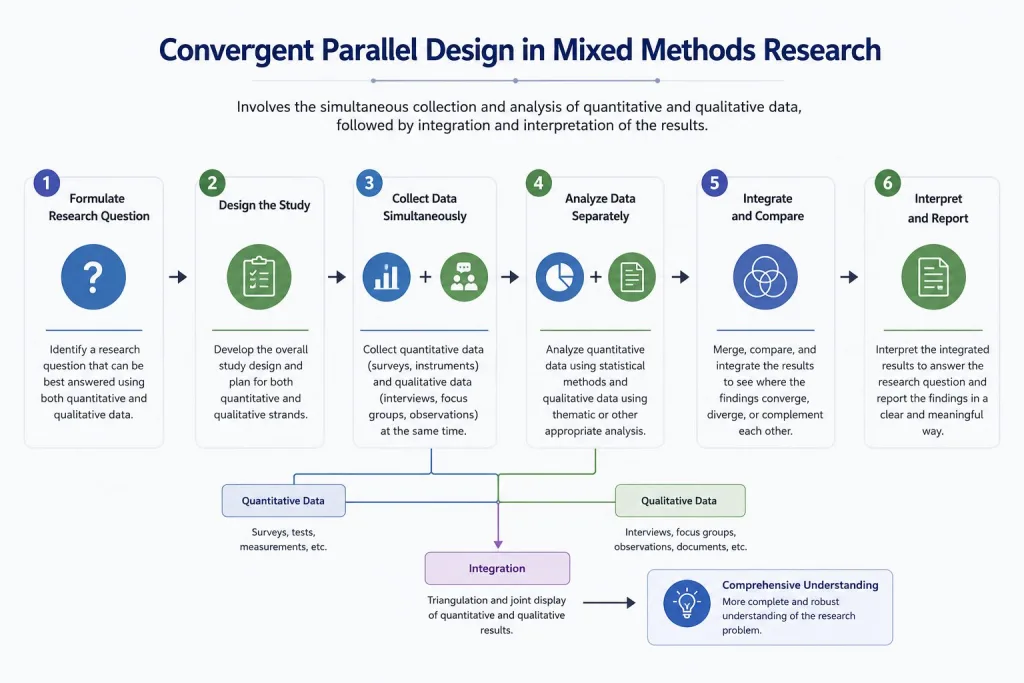
Step 3: Collect Quantitative and Qualitative Data at the Same Time
- The third step is data collection.
- In convergent parallel design, qualitative data are collected during the same general period as quantitative data.
- This is one of the most important features of this type of design.
- For example:
- A researcher may send a survey to 300 participants.
- At the same time, the researcher may conduct 20 interviews.
- The survey may collect numerical ratings.
- The interviews may collect personal explanations.
- The quantitative strand may include:
- Survey responses.
- Scores.
- Frequencies.
- Percentages.
- Statistical measures.
- Closed-ended questionnaire items.
- The qualitative strand may include:
- Interview transcripts.
- Focus group discussions.
- Open-ended survey answers.
- Field notes.
- Participant reflections.
- The researcher should ensure that the tools connect to the same main problem.
- For example, if the survey asks about patient satisfaction, the interview questions should also explore patient satisfaction.
- This makes it easier to compare the quantitative findings and qualitative results later.
- In mixed methods research, poor alignment between tools can weaken the final interpretation.
- The researcher should also keep records of how the data were collected. This improves transparency and strengthens the credibility of the mixed methods study.
- A clear data collection plan also helps when writing the methodology section of research studies.
Step 4: Analyse the Two Data Sets Separately
- After data collection, the researcher should analyse the two data sets separately.
- This means that quantitative data should be analysed using quantitative techniques, while qualitative data should be analysed using qualitative techniques.
- For quantitative data, the researcher may use:
- Descriptive statistics.
- Percentages.
- Mean scores.
- Standard deviation.
- Correlation.
- Regression.
- Group comparison.
- For qualitative data, the researcher may use:
- Coding.
- Thematic analysis.
- Content analysis.
- Narrative analysis.
- Pattern identification.
- This separate analysis is important because each form of data has its own logic.
- In convergent parallel design, data are often analyzed separately before being compared.
- For example:
- Survey results may show that 70% of participants are satisfied.
- Interview data may show that participants value fast service, respectful staff, and clear communication.
- At this stage, the researcher should not force the findings together too early.
- The quantitative side should produce clear quantitative results.
- The qualitative side should produce clear themes, patterns, and qualitative responses.
- This step is also called data collection and analysis, because each strand follows its own procedure before integration.
- Good qualitative analysis should include direct attention to participant meaning.
- Good quantitative analysis should clearly explain what the numbers show.
- This step helps the researcher prepare for the most important part of convergent parallel design: integration.
Step 5: Compare, Merge, and Integrate the Findings
- The fifth step is where the two strands come together.
- This is the heart of convergent parallel design.
- The researcher now compares the quantitative data with the qualitative themes.
- This process is often called integration, merging, or triangulation.
- Common techniques for integrating data include:
- Side-by-side comparison.
- Joint display tables.
- Merged discussion.
- Theme-by-statistic comparison.
- Explaining agreement and disagreement.
- For example, a joint display may compare survey findings with interview themes:
- Survey finding: 80% of patients rated communication as poor.
- Interview theme: Patients felt doctors used medical language that was hard to understand.
- Integrated meaning: Communication problems are both measurable and strongly experienced by patients.
- In integrating data in mixed methods, the researcher should look for three possible outcomes:
- Agreement: both data types show the same conclusion.
- Expansion: one data type adds more detail to the other.
- Conflict: the two findings disagree and need further explanation.
- This step helps the researcher integrate qualitative and quantitative evidence into one strong interpretation.
- It also shows the strengths of mixed methods because the final answer becomes more complete than either method alone.
- For example, the numbers may show that a training programme improved employee confidence. Interviews may explain that confidence improved because the training used practical demonstrations.
- In some cases, the two findings may conflict. This does not mean the convergent parallel design failed. It may mean the issue is more complex than expected.
- Strong integration is what makes the study a true mixed methods approach, not just two separate studies placed together.
Step 6: Interpret the Results and Present the Final Conclusion
- The final step is to interpret the merged findings and present the conclusion clearly.
- In this stage, the researcher explains what the combined evidence means.
- A good conclusion in convergent parallel design should answer the original research question using both qualitative and quantitative evidence.
- The researcher should explain:
- What the quantitative findings showed.
- What the qualitative results revealed.
- Where the findings agreed.
- Where they differed.
- What the combined interpretation means.
- What the study recommends.
- For example:
- Quantitative finding: Most students reported low engagement in online classes.
- Qualitative finding: Students said online classes felt isolating and lacked interaction.
- Integrated conclusion: Low engagement is linked not only to technology access but also to limited social connection.
- This kind of conclusion is stronger than only reporting survey scores or only presenting interview quotes.
- The researcher should also discuss the limitations of the study.
- For example:
- The survey sample may be small.
- The interviews may not represent all participants.
- Time limits may affect depth.
- Some participants may give socially desirable answers.
- The researcher should also explain the value of the mixed methods research design.
- This is where the researcher can show that mixed methods research offers powerful insights because it brings together measurement and meaning.
- In the final report, the researcher may include examples of mixed methods, tables, charts, participant quotes, and visual models.
- The conclusion should be written in a way that shows how both data strands worked together.
- A strong convergent parallel design report should not treat the qualitative and quantitative parts as separate chapters with no connection. Instead, the final interpretation should clearly show how the two strands support a complete understanding.
- In summary, convergent parallel design is one of the three basic mixed method designs—exploratory sequential, explanatory sequential, and convergent parallel. Among the basic mixed method designs—exploratory sequential, explanatory sequential, and convergent parallel, this approach is especially useful when researchers want to collect, analyse, and compare both forms of data during the same phase.
- When properly planned, convergent parallel design strengthens the design and implementation of a study and helps researchers produce findings that are practical, credible, and easy to apply.
What Are the Advantages and Disadvantages of Convergent Parallel Design?
- Convergent parallel design is one of the most useful mixed methods designs because it allows researchers to study a problem using both numbers and detailed human experiences.
- In mixed methods research, this research design is valuable because it collects quantitative and qualitative data during the same phase of the study. This helps the researcher understand both the size of a problem and the meaning behind it.
Advantages of Convergent Parallel Design
- It gives a fuller understanding of the research problem
- One major advantage of convergent parallel design is that it brings together qualitative and quantitative data.
- Quantitative data may show patterns, percentages, or relationships, while qualitative research explains the reasons behind those patterns.
- For example, a survey may show that 65% of students are dissatisfied with online learning. However, interviews or focus groups may explain that students feel isolated, lack feedback, or struggle with internet access.
- It supports triangulation
- Triangulation means using different types of data to check whether findings support each other.
- In convergent parallel design, the researcher compares quantitative findings with qualitative results.
- If both findings point to the same conclusion, the study becomes stronger and more credible.
- If the findings differ, the researcher can explore why the results do not match.
- It saves time compared to sequential designs
- In an explanatory sequential design, the researcher collects quantitative data first and qualitative data later.
- In an exploratory sequential design, the researcher collects qualitative data first and then develops the quantitative phase.
- However, convergent parallel design involves collecting both forms of data at the same time.
- This makes it useful when the research team has limited time but still wants a strong mixed methods research design.
- It gives equal value to qualitative and quantitative approaches
- A strong convergent parallel design does not treat one method as more important than the other.
- The researcher gives attention to both quantitative data collection and qualitative data collection and analysis.
- This balance is useful when the research question requires both measurement and explanation.
- It improves the quality of interpretation
- By integrating data in mixed methods, researchers can produce findings that are more practical and detailed.
- This is one reason scholars such as Creswell and Plano Clark often discuss convergent design as one of the basic mixed methods approaches.
- Texts from SAGE also present this design as a helpful option for researchers who want to compare different but related findings.
Disadvantages of Convergent Parallel Design
- It can be difficult to manage
- Convergent parallel design requires careful planning because two forms of data collection happen at the same time.
- The researcher must manage surveys, interviews, focus groups, data storage, and participant communication.
- If the research team is not organised, the study can become confusing.
- It requires strong skills in both methods
- The researcher must understand both statistical analysis and qualitative analysis.
- This can be challenging for researchers who are more comfortable with only one research method.
- A weak analysis of either strand can reduce the quality of the whole mixed methods study.
- Integration can be difficult
- One of the hardest parts of convergent parallel design is the need to integrate qualitative and quantitative findings.
- The researcher must compare the two sets of results clearly.
- If the findings conflict, the researcher must explain the disagreement instead of ignoring it.
- It may require more resources
- This study design may need more time, money, software, and trained researchers than a single-method study.
- For example, the researcher may need tools for survey analysis and separate tools for interview coding.
- Findings may not always match
- In convergent parallel design, the quantitative results and qualitative results may support each other, but they may also differ.
- This is not always a weakness, but it can make the final interpretation more complex.
- The researcher must explain these differences carefully to avoid confusing readers.
Examples of Convergent Parallel Design in Mixed Methods Research
Example 1: Patient Satisfaction in Health Research
- A common example of convergent parallel design can be found in health research, especially when researchers want to understand patient satisfaction.
- The research question may be:
- “How satisfied are patients with outpatient services, and how do they describe their care experiences?”
- In this mixed methods study, the researcher may collect quantitative data through a patient satisfaction survey.
- The survey may ask patients to rate:
- Waiting time.
- Staff communication.
- Cleanliness.
- Cost of services.
- Overall satisfaction.
- Likelihood of recommending the facility.
- At the same time, the researcher may collect qualitative data through:
- Focus groups with patients.
- Short interviews after appointments.
- Open-ended questions on the survey.
- Written patient comments.
- This is a clear convergent parallel design because both forms of data are collected during the same period.
- The quantitative findings may show that 72% of patients are satisfied with the service.
- However, the qualitative results may show that many patients still feel the waiting area is overcrowded and that communication from nurses is sometimes rushed.
- When the researcher compares the findings, the results may show that patients are generally satisfied, but there are specific service areas that need improvement.
- This example shows how convergent parallel design supports triangulation. The survey provides measurable evidence, while the interviews explain patient experiences in detail.
- This approach is stronger than using only a survey because the researcher can understand both the rating scores and the reasons behind the scores.
Need Help With Your Dissertation?
Get professional academic support from Best Dissertation Writers . Our expert team is ready to help you with high-quality dissertation writing services tailored to your academic goals.
Get Dissertation HelpExample 2: Online Learning Experiences in Education
- Another strong example of convergent parallel design is a study on online learning.
- The research question may be:
- “What is the level of student engagement in online learning, and how do students describe their learning experiences?”
- In this mixed methods research design, the researcher may collect quantitative and qualitative data from students during the same semester.
- The quantitative strand may include:
- A student engagement survey.
- Attendance records.
- Assignment submission rates.
- Online platform login data.
- Quiz scores.
- The qualitative strand may include:
- Student interviews.
- Teacher interviews.
- Open-ended survey responses.
- Focus groups with learners.
- The researcher may analyse the survey data using descriptive statistics to identify engagement levels.
- At the same time, the researcher may conduct qualitative data collection and analysis to identify themes such as motivation, internet challenges, lack of feedback, and difficulty concentrating at home.
- The quantitative results may show that students log in regularly, but assignment completion rates are low.
- The qualitative results may explain that students attend online classes but struggle to complete assignments because of poor internet access or family responsibilities.
- This makes convergent parallel design very useful because the numbers alone may suggest that students are engaged, while interviews reveal deeper struggles.
- This example also shows the value of data in mixed methods studies. Each type of evidence adds something important to the final interpretation.
Example 3: Employee Engagement in an Organisation
- Convergent parallel design can also be used in business and organisational research.
- A possible research question may be:
- “What is the level of employee engagement in the organisation, and what workplace factors influence employee motivation?”
- The researcher may collect quantitative data through:
- Employee engagement surveys.
- Performance indicators.
- Absenteeism records.
- Staff turnover data.
- Satisfaction ratings.
- At the same time, the researcher may collect qualitative data through:
- Employee interviews.
- Focus groups.
- Manager interviews.
- Open-ended comments.
- This is a good example of convergent parallel design because the researcher collects both forms of evidence during the same research phase.
- The quantitative findings may show that employee engagement is moderate.
- The qualitative findings may reveal that employees value teamwork but feel frustrated by unclear promotion procedures.
- The researcher can then compare the two strands to produce a deeper conclusion.
- For example:
- Survey result: 58% of employees report moderate engagement.
- Interview theme: Employees feel committed to their teams but not fully valued by senior management.
- Integrated finding: Engagement is present at the team level, but organisational trust needs improvement.
- This example shows how researchers can use mixed methods to move beyond simple employee scores and understand the human reasons behind workplace attitudes.
Example 4: Community Health Awareness Campaign
- Another example of convergent parallel design is a study evaluating a community health campaign.
- The research question may be:
- “How effective was the health awareness campaign, and how did community members experience the campaign messages?”
- The quantitative strand may include:
- Pre-campaign and post-campaign survey responses.
- Attendance numbers.
- Number of people reached.
- Knowledge test scores.
- Clinic visit records.
- The qualitative strand may include:
- Focus groups with community members.
- Interviews with health workers.
- Open-ended survey questions.
- Observations during campaign events.
- The researcher may collect both forms of data during the campaign period.
- This makes the study a convergent parallel design rather than an explanatory sequential or exploratory sequential approach.
- The quantitative results may show that health knowledge improved after the campaign.
- The qualitative results may explain that people understood the message better when local leaders used familiar language and real-life examples.
- By integrating data in mixed methods, the researcher can conclude not only that the campaign worked, but also why it worked.
- This is helpful for future campaign planning because it shows which communication strategies were most effective.
Example 5: Customer Experience in a Digital Business
- Businesses can also use convergent parallel design to study customer experience on websites, mobile apps, or online platforms.
- The research question may be:
- “How do customers rate the digital service, and what challenges do they experience when using the platform?”
- The quantitative strand may include:
- Customer satisfaction surveys.
- Website analytics.
- Conversion rates.
- Bounce rates.
- Checkout completion rates.
- Support ticket numbers.
- The qualitative strand may include:
- Customer interviews.
- Open-ended feedback forms.
- Usability testing notes.
- Focus groups with frequent users.
- The researcher may collect qualitative and quantitative data during the same testing period.
- The quantitative findings may show that many users leave the checkout page before completing payment.
- The qualitative results may explain that users find the payment instructions unclear or do not trust the security information on the page.
- In this case, convergent parallel design helps the business understand both what is happening and why it is happening.
- This example shows why mixed methods research is useful in digital product improvement.
Example 6: Public Policy and Social Science Research
- In social science, researchers often use convergent parallel design to study public policy issues.
- A possible research question may be:
- “How effective is a youth employment programme, and how do participants describe its impact on their lives?”
- The quantitative strand may include:
- Employment rates.
- Income changes.
- Training completion rates.
- Survey responses from participants.
- Programme attendance records.
- The qualitative strand may include:
- Interviews with young people.
- Focus groups with trainers.
- Case studies.
- Open-ended participant reflections.
- The researcher may find that quantitative data shows a rise in employment after the programme.
- However, qualitative data may reveal that some participants still struggle with transport costs, confidence, or access to job networks.
- By comparing the two strands, the researcher can develop a balanced conclusion.
- This is the strength of convergent parallel design. It helps researchers avoid shallow conclusions based only on numbers.
- It also helps policymakers understand what should be improved in the design and implementation of future programmes.
Mixed Methods Research Design Guides
Structured guides to key mixed methods research designs including sequential, convergent, embedded, multiphase approaches, and dissertation methodology foundations.
Research Methodology in Dissertation
Core foundations of research design, structure, and methodology in dissertations. Read full guide →
Mixed Methods Overview
Foundations of qualitative and quantitative integration. Explore article →
Explanatory Sequential
Quantitative results followed by qualitative explanation. Read more →
Exploratory Sequential
Qualitative insights shaping quantitative instruments. Read more →
Convergent Parallel
Concurrent qualitative and quantitative analysis. Read more →
Embedded Design
One method embedded within another dominant design. Read more →
Transformative Design
Research focused on change and social impact. Read more →
Multiphase Design
Multiple linked phases across one research program. Read more →
Final Note on Examples
- These examples of mixed methods show that convergent parallel design can be used in many fields, including education, healthcare, business, digital platforms, and public policy.
- The key feature remains the same: the researcher collects quantitative and qualitative data during the same phase, analyses the data separately, and then brings the findings together.
- Compared with explanatory sequential design and exploratory sequential design, convergent parallel design is best when the researcher wants both forms of data at the same time.
- When planned well, convergent parallel design helps researchers produce findings that are detailed, balanced, credible, and useful for real-world decisions.
References
- Mixed Methods Designs – Georgia State University Library Research Guides – https://research.library.gsu.edu/c.php?g=1050115&p=7622501
- Qualitative Research: Mixed Methods Research – Gonzaga University Library – https://researchguides.gonzaga.edu/qualitative/mixed-methods
- Mixed Methods Analysis – Georgetown University Library – https://guides.library.georgetown.edu/c.php?g=1311988&p=9670809