

What Is a Transformative Mixed Methods Research Design?
A transformative mixed methods research design is a type of mixed methods research that combines qualitative and quantitative methods while being guided by a social justice purpose. It is not only concerned with collecting data or answering a research question. It also aims to challenge unfair systems, support excluded voices, and produce findings that can lead to real change.
- A transformative mixed methods research design is built on the idea that research should do more than describe a problem.
- It should help explain why the problem exists.
- It should show how people are affected by the problem.
- It should provide evidence that can support action, reform, or advocacy.
- This research design is strongly connected to the transformative paradigm.
- The transformative paradigm is a worldview that focuses on power, inequality, oppression, and social change.
- It asks researchers to think carefully about who benefits from research and who may be harmed or ignored.
- Scholars such as Mertens are often linked with this approach because of their work on research, ethics, inclusion, and social justice.
- In a transformative mixed methods research design, the researcher uses both quantitative and qualitative data.
- Quantitative data may show patterns, gaps, statistics, or differences between groups.
- Qualitative insights may explain people’s lived experiences, feelings, barriers, and needs.
- Together, the two forms of evidence help the researcher understand both the size of a problem and the human meaning behind it.
- For example, a researcher may study healthcare access among a marginalized community.
- The quantitative phase may use surveys to measure how many people lack access to care.
- The qualitative phase may use semi-structured interviews to understand why people struggle to receive care.
- The findings may then be used to recommend changes in social policy.
- A transformative mixed methods research design is often used in topics connected to:
- Racial inequality
- Gender discrimination
- Disability rights
- Poverty
- Education gaps
- Healthcare inequity
- Community development
- Public health issues such as the COVID-19 pandemic
- This design is different from a basic mixed method study because it has a clear action purpose.
- A normal mixed methods study may focus mainly on explanation.
- A transformative mixed methods research design focuses on explanation, empowerment, and social impact.
- The design may also draw from participatory research and action research.
- In these approaches, participants are not treated only as sources of data.
- They may be involved as partners, advisors, or co-researchers.
- This helps make the research more respectful, relevant, and useful to the studied population.
Overall, a transformative mixed methods research design is a powerful mixed methods design for researchers who want their work to support fairness, inclusion, and practical change.
Need Help With Your Dissertation?
Get professional academic support from Best Dissertation Writers . Our expert team is ready to help you with high-quality dissertation writing services tailored to your academic goals.
Get Dissertation HelpPhilosophical Assumptions of The Transformative Mixed Methods Research Design
The philosophical assumptions of a transformative mixed methods research design explain how researchers understand reality, knowledge, values, and ethics. These assumptions shape the whole research process, from the first research question to final recommendations.
- The first assumption is that reality is shaped by social and political conditions.
- People do not experience the world in the same way.
- Their experiences may be shaped by race, class, gender, disability, culture, age, or immigration status.
- A transformative mixed methods research design pays attention to these differences instead of pretending that all participants have equal power.
- The second assumption is that knowledge should support change.
- In this design, research is not neutral in the simple sense.
- The researcher openly acknowledges that the study aims to improve social justice.
- This does not mean the researcher ignores evidence.
- It means the researcher uses strong methodological procedures while also focusing on justice and practical usefulness.
- The third assumption is that power matters.
- A transformative mixed methods research design examines power dynamics between institutions, researchers, and communities.
- It asks who has authority, who is excluded, and whose voice is missing.
- This is important when studying inequity or addressing social justice issues.
- The fourth assumption is that ethics must guide the whole study.
- Research ethics are not only about consent forms.
- They also include respect, cultural sensitivity, confidentiality, fairness, and benefit to participants.
- The researcher should avoid using communities only for data collection without giving anything useful back.
- The fifth assumption is that participants can help shape the research.
- In some studies, community members may help design the research question.
- They may also advise on data collection, interpretation, and recommendations.
- This is common in participatory research, action research, and other action-oriented mixed methods approaches.
- The sixth assumption is that reflexivity is necessary.
- Reflexivity means the researcher reflects on their own position, beliefs, assumptions, and influence.
- For example, a researcher studying a disadvantaged group should ask how their own background may affect trust, interpretation, and communication.
- This improves transparency and strengthens the study.
- The seventh assumption is that integration is central.
- The researcher must integrate qualitative and quantitative evidence in a meaningful way.
- This is known as integration in mixed methods research.
- Strong integration helps researchers connect numbers with lived experience.
- It also supports achieving integration in mixed methods, which is an important issue discussed in qualitative and mixed methods scholarship.
- The transformative paradigm may also be combined with theories such as critical race theory, feminist theory, disability theory, or human rights frameworks.
- These frameworks help researchers move from theory to practice.
- They also support the integration of transformative values across the full study.
Scholars such as Creswell, Plano Clark, Tashakkori, Teddlie, Sweetman, Badiee, and Camacho have contributed to discussions about mixed methods research, legitimation, design quality, and social justice. Journals such as the Journal of Mixed Methods Research and publishers such as SAGE and SAGE Publications have also helped develop the field.
How To Conduct a Transformative Mixed Methods Research Design In 6 Easy Steps?
Conducting a transformative mixed methods research design requires planning, ethical care, and strong integration. The following six steps provide a practical guide to mixed methods for researchers who want to connect research with social change.
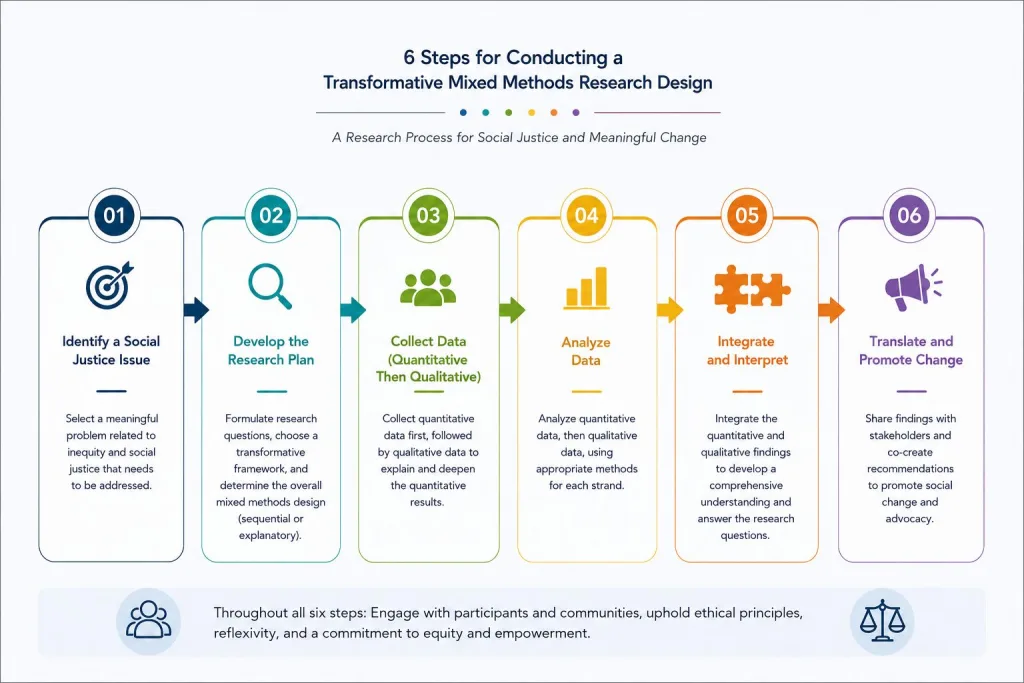
Step 1: Identify a Social Justice Problem and Write a Clear Research Question
The first step is to identify a real problem connected to inequality, exclusion, or unfair treatment.
- Start by choosing a topic that has clear social importance.
- This may include education inequality, healthcare access, housing discrimination, disability rights, gender-based violence, racial injustice, or poverty.
- The topic should matter to the community being studied.
- It should also have potential for practical action.
- Study the background of the problem.
- Review academic sources, reports, policy documents, and community discussions.
- Look for evidence of inequity across different sub-groups.
- For example, a study may compare access to online learning among rural students, low-income students, and students with disabilities.
- Develop a strong research question.
- The question should allow both quantitative methods and qualitative inquiry.
- It should also connect clearly to social justice.
- For example: “How do low-income students experience digital learning barriers, and what institutional changes could improve access?”
- Make sure the research question fits a transformative mixed methods research design.
- It should not only ask what is happening.
- It should also help explain why it is happening and what can be done.
Step 2: Choose a Transformative Framework
The second step is to choose a guiding framework.
- A framework helps shape the purpose and direction of the study.
- It explains the lens through which the researcher views the problem.
- It helps connect the study to the transformative paradigm.
- It also guides decisions about sampling, data collection, analysis, and recommendations.
- Common frameworks include:
- Critical race theory for studies about race, racism, and institutional inequality.
- Feminist theory for studies about gender and power.
- Disability theory for studies about access, inclusion, and ableism.
- Human rights frameworks for studies about dignity, justice, and equal protection.
- Community-based frameworks for studies involving local participation.
- The framework should be used throughout the research process.
- It should not appear only in the introduction.
- It should guide the research question, methods, interpretation, and final action steps.
- This creates stronger alignment in the transformative mixed methods design.
- This step is also where researchers think about methodological considerations.
- Who should be included?
- Which voices are often missing?
- What risks could participants face?
- How can the study avoid reinforcing harm?
Step 3: Select the Best Mixed Methods Study Design
The third step is choosing the most suitable study design.
- A transformative mixed methods research design can use different forms of mixed methods approaches.
- The choice depends on the research question, timing, resources, and purpose.
- The researcher must decide whether data will be collected in one phase or several phases.
- One option is a sequential design.
- In a sequential design, one type of data is collected first, followed by another type.
- This can be useful when the researcher wants one phase to inform the next.
- A common option is the explanatory sequential design.
- This is also called a sequential explanatory design.
- The researcher first collects and analyzes quantitative data.
- Then the researcher collects qualitative data to explain the numbers in more depth.
- For example, survey results may show that minority students report lower belonging in school.
- Interviews can then explain the individual experiences behind those results.
- Another option is an exploratory sequential design.
- The researcher begins with qualitative data.
- Then quantitative data is collected to test or expand what was learned.
- This may work well when little is known about the issue.
- A concurrent design may also be used.
- Qualitative and quantitative data are collected during the same period.
- The researcher then compares and integrates the findings.
- The chosen mixed methods design should support the social justice aim.
- The design should help produce findings that are useful, credible, and action-oriented.
- This is what makes the transformative mixed methods approach different from a general mixed methods study.
Step 4: Plan Ethical and Inclusive Data Collection
The fourth step is planning data collection carefully.
- In a transformative mixed methods research design, data collection must be ethical, respectful, and inclusive.
- The researcher should think about participant safety.
- They should consider language, culture, accessibility, and trust.
- They should avoid creating situations where participants feel exposed or powerless.
- Quantitative data collection may include:
- Surveys
- Questionnaires
- Standardized scales
- Service records
- Public datasets
- Institutional data
- Quantitative data can help show:
- Patterns
- Gaps
- Differences between groups
- Relationships between variables
- The scale of a problem
- Qualitative data collection may include:
- Semi-structured interviews
- Focus groups
- Open-ended survey responses
- Observations
- Community meetings
- Document review
- Qualitative data helps explain:
- Personal meaning
- Barriers
- Emotions
- Cultural context
- Individual experiences
- Community priorities
- Sampling is very important.
- A transformative study should not only include people who are easy to reach.
- It should intentionally include the voices of a marginalized community and relevant sub-groups.
- For example, in a healthcare study, the researcher may include rural patients, older adults, disabled participants, and low-income families.
- Some studies may include participants as co-researchers.
- They may help create interview questions.
- They may help interpret findings.
- They may help decide which recommendations are most useful.
Step 5: Analyze the Data and Integrate the Findings
The fifth step is data analysis and integration.
- In the quantitative phase, the researcher may analyze:
- Frequencies
- Percentages
- Mean scores
- Correlations
- Group differences
- Trends across sub-groups
- This analysis helps show what is happening.
- For example, the data may show that one group has less access to services than another group.
- It may also show that certain policies affect groups differently.
- In the qualitative phase, the researcher may use thematic analysis.
- This involves reading interview transcripts carefully.
- The researcher identifies codes, categories, and themes.
- These themes explain how participants experience the problem.
- Qualitative analysis helps show why the issue matters.
- It gives depth to the numbers.
- It captures voices that may not appear in statistics.
- It supports a stronger understanding of the studied population.
- The most important part is integration.
- A transformative mixed methods research design must bring the two forms of data together.
- This is called integration across methods.
- It may happen during design, data collection, analysis, or interpretation.
- Researchers can integrate findings by:
- Comparing survey results with interview themes.
- Using qualitative findings to explain quantitative patterns.
- Creating joint displays.
- Connecting statistical findings with participant quotes.
- Identifying where results agree or disagree.
- This process supports achieving integration in mixed methods.
- It also improves legitimation, which means strengthening the credibility and quality of the study.
- Scholars such as Tashakkori and Teddlie have written about quality and legitimation in mixed methods research.
Step 6: Turn Findings Into Action-Oriented Recommendations
The final step is turning results into practical action.
- A transformative mixed methods research design should not end with data presentation only.
- The findings should lead to clear recommendations.
- These recommendations should connect to the social justice problem identified at the beginning.
- Recommendations may focus on:
- Policy change
- Better services
- Community programmes
- Institutional reform
- Training
- Funding priorities
- Public awareness
- Future research
- For example, an impact study on school exclusion may show that students from certain backgrounds are punished more often.
- Quantitative data may show the pattern.
- Qualitative interviews may explain how students experience discipline.
- The final recommendations may call for teacher training, restorative practices, and fairer disciplinary policies.
- The findings should be shared with the people affected by the problem.
- This may include community members, leaders, policymakers, schools, healthcare providers, or advocacy groups.
- The goal is to ensure the research creates social impact.
- This is where the design moves from theory to practice.
- The researcher uses evidence to support change.
- The study becomes part of wider transformative research.
- It may also contribute to social science, policy development, and future qualitative and quantitative research.
- A strong conclusion should show how the study helps addressing social justice issues.
- It should explain what was learned.
- It should identify who benefits from the findings.
- It should show how the research can support change.
A transformative mixed methods research design is more than a technical method. It is a complete worldview, a methodological approach, and a practical strategy for producing research that matters. By combining qualitative and quantitative methods, using a strong framework, practicing reflexivity, and focusing on action, researchers can create studies that explain complex problems and help build fairer systems.
Need Help With Your Dissertation?
Get professional academic support from Best Dissertation Writers . Our expert team is ready to help you with high-quality dissertation writing services tailored to your academic goals.
Get Dissertation HelpWhat are the Advantages and Disadvantages of Transformative Mixed Methods Research Design?
A transformative mixed methods research design has many strengths, especially when a researcher wants to study complex social problems and support practical change. However, it also has some challenges because it requires strong planning, ethical care, and good integration of data.
Advantages of Transformative Mixed Methods Research Design
- It supports social justice-focused research
- One major advantage of a transformative mixed methods research design is that it places social justice at the centre of the study.
- The researcher does not only collect information for academic purposes.
- The study also aims to identify unfair conditions, explain inequality, and suggest ways to reduce harm.
- This makes the design useful for topics involving poverty, racism, disability, gender inequality, healthcare gaps, education exclusion, and other forms of inequity.
- It combines qualitative and quantitative evidence
- A transformative mixed methods research design uses both qualitative and quantitative data.
- The quantitative part can show the size, pattern, or frequency of a problem.
- The qualitative part can explain people’s lived experiences, feelings, and barriers.
- This combination makes the findings more complete than using only one method.
- It gives voice to marginalised groups
- This research design is useful because it allows people affected by injustice to share their experiences.
- Through qualitative inquiry, interviews, focus groups, and community discussions, participants can explain issues in their own words.
- This is important because statistics alone may not show pain, exclusion, fear, or frustration.
- A transformative mixed methods research design helps make these voices visible.
- It encourages action-oriented outcomes
- The goal of this design is not only to understand a problem.
- It also aims to produce practical recommendations.
- This makes the study action-oriented and useful for policy, practice, advocacy, and community improvement.
- In this way, transformative mixed methods research connects research findings with real-world change.
- It strengthens the research process
- Because the design uses both quantitative methods and qualitative methods, the researcher can compare and connect findings.
- This can improve the quality of the mixed methods study.
- For example, survey results may identify a problem, while interviews explain why the problem exists.
- This type of integration can make the final interpretation stronger.
- It works well with participatory research
- A transformative mixed methods design can include participants as partners.
- In participatory research or action research, community members may help shape the research question, data collection tools, interpretation, or recommendations.
- This can make the study more respectful and relevant to the people it is meant to serve.
- It supports deeper data analysis
- A transformative mixed methods research design allows the researcher to analyse both numbers and meanings.
- Quantitative data can reveal trends across groups.
- Qualitative data can explain why those trends matter.
- This gives the researcher a more detailed understanding of the problem.
- It provides a strong framework for complex social issues
- The transformative paradigm gives researchers a clear framework for studying power, exclusion, and fairness.
- This is helpful in social science research, where problems are often connected to history, institutions, policy, and culture.
- Scholars such as Mertens, Creswell, and others have shown how mixed methods can support stronger and more meaningful inquiry.
Disadvantages of Transformative Mixed Methods Research Design
- It can be time-consuming
- A transformative mixed methods research design often requires more time than a single-method study.
- The researcher may need to collect both qualitative and quantitative data.
- They may also need to work with community partners, conduct interviews, analyse surveys, and integrate findings.
- This can make the research process longer and more demanding.
- It requires strong methodological skill
- The researcher must understand mixed methods research, qualitative research, quantitative research, and the transformative paradigm.
- They must also know how to design a strong mixed methods design.
- Poor planning can lead to weak integration, unclear findings, or confusing conclusions.
- This is why methodological guidance from sources such as SAGE, SAGE Publications, the Journal of Mixed Methods Research, and authors like Creswell can be useful.
- Integration can be difficult
- One of the biggest challenges is learning how to integrate findings properly.
- Integration in mixed methods research means bringing qualitative and quantitative findings together in a meaningful way.
- If the researcher only reports the two sets of findings separately, the study may not fully work as a mixed methods project.
- Achieving integration in mixed methods requires careful planning from the beginning.
- It may create ethical challenges
- Since this design often involves vulnerable or marginalised groups, research ethics are very important.
- The researcher must protect participants from harm.
- They must avoid using participants only as sources of data.
- They should also consider whether the research will actually benefit the people involved.
- It can be affected by researcher bias
- Because the study is guided by social justice goals, some critics may argue that the researcher is not neutral.
- However, the purpose of a transformative mixed methods research design is not to hide values.
- Instead, it requires honesty, reflexivity, transparency, and strong evidence.
- The researcher must clearly explain their position and use reliable methods.
- It may need more resources
- This type of mixed method study may require more funding, more time, more participants, and more research support.
- It may also require translators, community advisors, software, travel, or additional training.
- These needs can make the design difficult for small projects.
- It may be hard to balance advocacy and evidence
- A transformative mixed methods approach aims to support change, but it must still be evidence-based.
- The researcher should not force the findings to match a preferred conclusion.
- Strong data analysis and transparent reporting are necessary to protect the quality of the study.
Overall, the transformative mixed methods research design is powerful, but it must be used carefully. It works best when the researcher has a clear purpose, a strong framework, ethical awareness, and a serious plan for integration.
Mixed Methods Research Design Guides
Structured guides to key mixed methods research designs including sequential, convergent, embedded, multiphase approaches, and dissertation methodology foundations.
Research Methodology in Dissertation
Core foundations of research design, structure, and methodology in dissertations. Read full guide →
Mixed Methods Overview
Foundations of qualitative and quantitative integration. Explore article →
Explanatory Sequential
Quantitative results followed by qualitative explanation. Read more →
Exploratory Sequential
Qualitative insights shaping quantitative instruments. Read more →
Convergent Parallel
Concurrent qualitative and quantitative analysis. Read more →
Embedded Design
One method embedded within another dominant design. Read more →
Transformative Design
Research focused on change and social impact. Read more →
Multiphase Design
Multiple linked phases across one research program. Read more →
Examples of Transformative Mixed Methods Research Design
The following examples show how a transformative mixed methods research design can be used in real research situations. Each example combines qualitative and quantitative evidence and uses the findings to support social change.
Example 1: Studying Healthcare Access in a Marginalised Community
- A researcher may use a transformative mixed methods research design to study healthcare access among low-income families in a rural area.
- The problem may be that many families cannot access hospitals, specialists, or affordable medicine.
- This issue connects directly to social justice because healthcare access should not depend only on income or location.
- The researcher may begin with a quantitative survey.
- The survey may ask families about distance to clinics, waiting time, cost of treatment, insurance status, and missed appointments.
- This quantitative data can show how widespread the problem is.
- The researcher may then use semi-structured interviews.
- These interviews allow participants to explain their personal experiences.
- They may describe transport problems, fear of medical bills, language barriers, or poor treatment by health workers.
- This qualitative part provides deeper human meaning.
- This example could use an explanatory sequential approach.
- First, the researcher collects survey data.
- Second, the researcher uses interviews to explain the survey results.
- This is also known as a sequential explanatory design.
- The final recommendations may include:
- Mobile clinics
- Transport support
- Community health workers
- Affordable medicine programmes
- Better language support
- This shows how a transformative mixed methods research design can move from data to action.
Example 2: Investigating Racial Inequality in School Discipline
- A school researcher may use a transformative mixed methods design to study whether students from certain racial groups are suspended more often than others.
- The research question may ask: “How do school discipline practices affect students from different racial backgrounds?”
- The researcher may use school records as the quantitative phase.
- These records may show suspension rates, detention rates, repeat offences, and differences between student sub-groups.
- The researcher may compare patterns across race, gender, disability, and year level.
- The qualitative phase may include interviews with students, parents, and teachers.
- Students may explain how discipline policies make them feel targeted or misunderstood.
- Parents may discuss communication problems with the school.
- Teachers may describe training needs or policy confusion.
- The study may use critical race theory as the guiding framework.
- This framework helps the researcher examine power, racism, policy, and institutional practices.
- It also supports the integration of transformative thinking into the study.
- The findings may lead to:
- Restorative justice practices
- Anti-bias teacher training
- Clearer discipline policies
- Student voice forums
- Better parent-school communication
- This example shows how transformative mixed methods research can support school reform.
Example 3: Exploring Digital Inequality During the COVID-19 Pandemic
- A transformative mixed methods research design can also be used to study digital inequality during the COVID-19 pandemic.
- Many students struggled with online learning because they lacked internet access, devices, quiet study spaces, or digital skills.
- This issue reflects educational inequity.
- The researcher may begin with a survey.
- Students may answer questions about internet access, device ownership, attendance, assignment completion, and learning confidence.
- This gives measurable quantitative data.
- The researcher may then conduct focus groups or interviews.
- Students may explain how poor internet affected their motivation.
- Parents may describe the pressure of sharing one phone among several children.
- Teachers may explain the difficulty of supporting students remotely.
- This mixed methods study may use a sequential design.
- The quantitative phase identifies the groups most affected.
- The qualitative phase explains the reasons behind the numbers.
- The results may support:
- Free internet programmes
- Device-lending schemes
- Digital skills training
- Flexible assignment deadlines
- Community learning centres
- This example shows how a transformative mixed methods research design can help turn crisis-based research into practical social support.
Example 4: Examining Disability Inclusion in Public Transport
- Another example of a transformative mixed methods research design is a study on public transport access for people with disabilities.
- The issue may involve inaccessible buses, unsafe stops, poor signage, or limited staff support.
- This is a social justice issue because transport affects work, education, healthcare, and independence.
- The quantitative phase may include:
- Accessibility audits
- Passenger surveys
- Complaint records
- Travel time comparisons
- Service availability data
- The qualitative phase may include:
- Interviews with disabled passengers
- Observations at bus stops
- Discussions with transport workers
- Stories about daily travel barriers
- The researcher may use a transformative design based on disability rights.
- This framework helps keep dignity, access, and inclusion at the centre.
- Participants may also act as advisors or co-researchers.
- The findings may lead to:
- Better ramps
- Audio announcements
- Staff training
- Clearer signage
- Safer waiting areas
- Stronger accessibility policies
- This example shows how transformative mixed methods approaches can support practical improvements in public services.
Example 5: Studying Gender Inequality in Workplace Promotion
- A researcher may use a transformative mixed methods research design to examine gender inequality in workplace promotion.
- The study may ask why women or other underrepresented groups are promoted less often than men.
- Quantitative data may include:
- Promotion rates
- Salary data
- Performance scores
- Years of experience
- Training access
- Leadership appointments
- Qualitative data may include:
- Interviews with employees
- Focus groups with managers
- Open-ended survey responses
- Review of workplace policies
- The study may reveal that promotion gaps are not only about qualifications.
- They may also involve informal networks, bias, family-care assumptions, lack of mentoring, or unclear promotion criteria.
- The findings may support:
- Transparent promotion systems
- Mentorship programmes
- Bias training
- Flexible leadership pathways
- Equal pay reviews
- This example shows how the transformative mixed methods research design can connect workplace data with lived experience and practical reform.
Example 6: Evaluating an Action Research Community Programme
- A community organisation may use a transformative mixed methods research design to evaluate a youth employment programme.
- The goal may be to help unemployed young people gain skills, confidence, and job opportunities.
- The quantitative phase may measure:
- Number of participants trained
- Job placement rates
- Attendance
- Income changes
- Skills scores before and after the programme
- The qualitative phase may explore:
- Participant confidence
- Barriers to employment
- Experiences with training
- Views of employers
- Suggestions for improvement
- Because this is connected to action research, the findings may be used immediately to improve the programme.
- Participants may help review the findings.
- Community leaders may help shape the final recommendations.
- The final report may recommend:
- More practical training
- Employer partnerships
- Transport support
- Mentoring
- Follow-up support after job placement
- This example shows how a transformative mixed methods research design can produce both evidence and action.
In all these examples, the transformative mixed methods research design combines numbers with stories, evidence with ethics, and research with change. It is one of the most useful mixed methods approaches for researchers who want their work to explain problems, support communities, and contribute to a fairer society.
References
- Mixed Methods Designs – Georgia State University Library Research Guides – https://research.library.gsu.edu/c.php?g=1050115&p=7622501
- Qualitative Research: Mixed Methods Research – Gonzaga University Library – https://researchguides.gonzaga.edu/qualitative/mixed-methods
- Mixed Methods Analysis – Georgetown University Library – https://guides.library.georgetown.edu/c.php?g=1311988&p=9670809