

What Is a Mixed Methods Research?
- Mixed methods research is a research method that combines quantitative and qualitative research in one study.
It helps researchers collect both numerical information and detailed personal views. This means the researcher can measure a problem and also understand the reasons behind it. - In simple terms, mixed methods research brings numbers and meanings together.
Quantitative methods focus on measurable results, such as scores, percentages, statistics, and patterns. Qualitative methods focus on people’s experiences, opinions, feelings, and explanations. - A mixed method is useful when one type of data cannot fully answer the research question.
For example, quantitative data may show that students are performing poorly in online learning. However, qualitative research can explain why this is happening through interviews, observations, or focus groups. - The main goal of mixed methods research is to integrate quantitative and qualitative data.
Researchers do not just collect two separate types of information. They connect the findings so that the final results are clearer, stronger, and more useful. - Mixed methods research is often used in education, business, psychology, social science, and research in health.
These fields often deal with complex human behaviour. That is why researchers use mixed methods when they need both measurement and explanation.
Types of Mixed Methods Research Designs
- A mixed methods design explains how a researcher will combine qualitative and quantitative data in a study.
It shows the order of data collection, the role of each method, and how the findings will be connected during data collection and analysis. - The best mixed methods design depends on the research question.
Some studies need quantitative methods first. Others need qualitative research first. Some mixed methods studies collect both types of data at the same time. The chosen research design should match the purpose of the study.
1. Convergent Parallel Mixed Methods Design
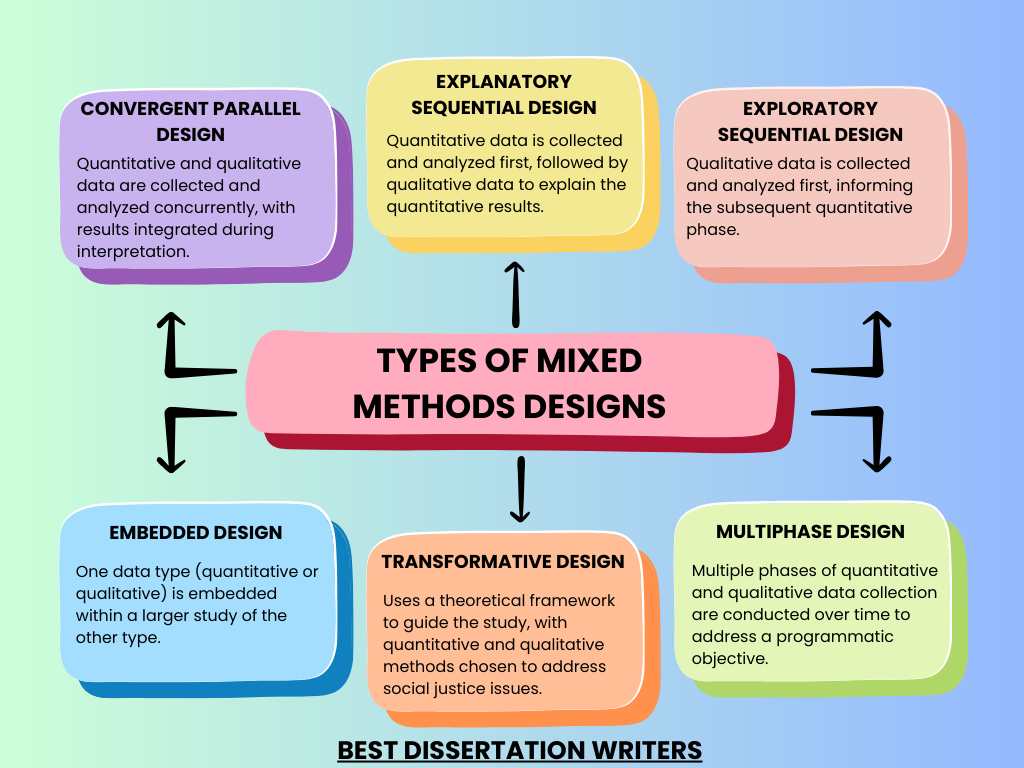
- Convergent parallel design collects quantitative and qualitative data at the same time.
In this type of mixed methods research, the researcher collects both sets of data during the same stage of the study. After that, the researcher compares or combines the findings. - This design is useful when the researcher wants a balanced view of the same problem.
Quantitative data may show the size of the issue, while qualitative methods explain people’s experiences in more detail. This makes the mixed methods approach useful for topics that need both facts and explanations. - The researcher gives equal importance to both types of data.
For example, a school may use a survey to measure student satisfaction. At the same time, the school may conduct focus groups to understand student concerns. The survey gives numbers, while the focus groups provide deeper explanations. - Example:
A hospital wants to study patient satisfaction. The researcher gives patients questionnaires to collect quantitative data. The researcher also interviews patients to collect qualitative and quantitative insights about their experiences. When the results are compared, the hospital can see both the satisfaction level and the reasons behind it. - Why this design is important:
This type of mixed methods research is helpful when the researcher wants to confirm whether both data sources support each other. If the survey results and interview findings agree, the study becomes stronger. If they differ, the researcher can explore the reason for the difference.
Need Help With Your Dissertation?
Get professional academic support from Best Dissertation Writers . Our expert team is ready to help you with high-quality dissertation writing services tailored to your academic goals.
Get Dissertation Help2. Explanatory Sequential Mixed Methods Design
- Explanatory sequential design starts with quantitative methods, then follows with qualitative research.
The researcher first collects and analyses numerical data. After that, the researcher uses qualitative methods to explain the results in more detail. - This type of mixed methods research is useful when numbers show what happened, but not why it happened.
For example, a survey may show that many employees are unhappy at work. However, the survey may not fully explain the reasons. Interviews can help explain whether the issue is low pay, poor leadership, workload, or lack of communication. - The first stage focuses on measurement.
The researcher may use questionnaires, tests, statistical records, or performance scores. This stage provides quantitative data that identifies patterns or relationships. - The second stage focuses on explanation.
The researcher may use interviews, focus groups, or open-ended questions. This stage helps explain the meaning behind the numbers. This is why explanatory sequential design is common in mixed methods studies. - Example:
A university wants to understand why students are failing an online course. First, the researcher analyses exam results and attendance records. The quantitative data shows that many students with low attendance also have low grades. The researcher then interviews students. The qualitative studies reveal that poor internet access, unclear instructions, and limited lecturer feedback are major challenges. - Why this design is important:
This mixed methods design is strong because it moves from general results to deeper explanation. It helps researchers avoid guessing the reasons behind numerical findings. Instead, mixed methods research allows the participants to explain the results in their own words.
3. Exploratory Sequential Mixed Methods Design
- Exploratory sequential design begins with qualitative research and then follows with quantitative methods.
The researcher first explores the topic through interviews, observations, focus groups, or open-ended responses. The findings are then used to create a survey, tool, or measurement for a larger group. - This type of mixed methods research is useful when the topic is new or not well understood.
Sometimes researchers do not know the main issues affecting participants. In such cases, qualitative methods help identify themes before quantitative data is collected. - The first stage allows participants to guide the study.
The researcher listens to people’s experiences and identifies common ideas. This makes the study more natural and realistic because it begins with real voices. - The second stage measures how common those ideas are.
After identifying key themes, the researcher may create a questionnaire and send it to a larger population. This helps confirm whether the themes found in the first stage apply to many people. - Example:
A researcher wants to study why new nurses leave their jobs within the first year. First, the researcher interviews nurses who recently resigned. The interviews show themes such as stress, poor supervision, emotional exhaustion, and lack of support. The researcher then develops a survey to measure how common these problems are among many nurses. - Why this design is important:
This mixed methods approach is useful because it builds measurement tools from real experiences. It is especially helpful when existing surveys or theories do not fully explain the problem. Mixed methods research gives the researcher a stronger foundation before measuring the issue on a larger scale.
4. Embedded Mixed Methods Design
- Embedded design places one research method inside a larger study.
In this design, one method is the main method, while the other plays a supporting role. For example, a mainly quantitative study may include a small qualitative section to provide extra explanation. - This type of mixed methods research is useful when one method is dominant.
A researcher may mainly want to measure outcomes using quantitative methods but still need participant views to explain the findings. In this case, qualitative research supports the main study. - Embedded design is common in experiments, clinical trials, education studies, and programme evaluations.
For example, a researcher may test whether a new teaching strategy improves exam scores. The exam results provide quantitative data. Student interviews explain how learners experienced the new teaching strategy. - Example:
A company introduces a new employee training programme. The main study measures employee productivity before and after training. This provides quantitative and qualitative evidence when interviews are also included. Employees may explain whether the training was easy to understand, practical, or useful in daily work. - Why this design is important:
Embedded mixed methods research helps researchers add context to a main study. Numbers may show whether a programme worked, but participant explanations show how and why it worked. This makes the findings more complete and practical.
5. Transformative Mixed Methods Design
- Transformative design is guided by a specific research paradigm focused on change, fairness, or social justice.
This design is often used when the researcher wants to understand problems affecting vulnerable, marginalised, or underrepresented groups. - This type of mixed methods research connects evidence with action.
The researcher does not only study a problem. The aim is often to support change, improve access, reduce inequality, or give voice to people who are often ignored. - Transformative design uses both qualitative and quantitative data to understand the size and meaning of a problem.
Quantitative data may show how many people are affected. Qualitative research can explain how the problem affects people’s daily lives. - Example:
A researcher studies access to maternal healthcare in rural communities. Survey data may show how many women miss appointments. Interviews may reveal transport problems, cost barriers, cultural concerns, or poor treatment by healthcare workers. - Why this design is important:
This mixed methods design is powerful because it connects research with real-life improvement. Mixed methods research gives both evidence and human stories. This can help policymakers, health workers, educators, and community leaders make better decisions.
6. Multiphase Mixed Methods Design
- Multiphase design uses several connected stages over time.
It is often used in large projects, long-term studies, policy research, and programme development. Each stage builds on the previous stage. - This type of mixed methods research is useful when a study cannot be completed in one step.
The researcher may begin with qualitative studies, then develop a survey, then test an intervention, and later evaluate the results. - Multiphase design is flexible and detailed.
It allows researchers to use mixed methods across different stages of a project. This makes it useful for complex research questions that need repeated data collection and analysis. - Example:
A public health team wants to improve diabetes education. First, they conduct focus groups with patients to understand their learning needs. Next, they create a survey based on the focus group findings. Then, they design an education programme. After the programme, they collect quantitative data to measure improvement. Finally, they interview patients again to understand their experience. - Why this design is important:
Multiphase mixed methods research is useful for large studies because it allows researchers to improve the project as they move forward. Each phase gives new evidence that supports the next phase.
Mixed Methods Research Designs: Definitions, Strengths, Weaknesses, and Examples
The table below compares the main mixed methods research designs, showing how each design works, when to use it, and how it can be applied in real research studies.
| Mixed Methods Design | Definition | Strengths | Weaknesses | When to Use It | Example |
|---|---|---|---|---|---|
| Convergent Parallel Design | Quantitative and qualitative data are collected at the same time, analysed separately, and then compared or combined. | Gives a balanced view and compares numerical findings with participant experiences. | Findings can be difficult to merge, especially when results conflict. | Use when studying the same question with numbers and personal views. | A hospital surveys patients and interviews them about care experiences. |
| Explanatory Sequential Design | Quantitative data is collected first, followed by qualitative data to explain the numerical results. | Explains the reasons behind statistics, trends, and unexpected patterns. | Takes more time because the second phase depends on the first. | Use when quantitative findings need deeper explanation. | A school reviews exam scores, then interviews students about learning challenges. |
| Exploratory Sequential Design | Qualitative data is collected first, then used to guide quantitative data collection. | Useful for new topics and for building surveys from real experiences. | Can be slow because tools are developed after the qualitative phase. | Use when exploring experiences before measuring them in a larger group. | A researcher interviews nurses, then creates a survey on job stress. |
| Embedded Design | One method is placed inside a larger study that mainly uses another method. | Adds useful context without changing the main study design. | The supporting method may receive less attention or weak integration. | Use when one main method needs extra explanation or support. | Productivity scores test training, while interviews explain employee views. |
| Transformative Design | A design guided by social change, fairness, justice, access, or vulnerable groups. | Gives voice to underrepresented groups and supports practical improvement. | Requires careful ethical planning and clear control of researcher bias. | Use when the research aims to address inequality or improve access. | A study measures rural maternal care access and interviews women about barriers. |
| Multiphase Design | Several connected phases of quantitative and qualitative research are used over time. | Flexible and suitable for large projects where each phase builds on another. | Can be complex, costly, time-consuming, and difficult to manage. | Use for projects with exploration, development, intervention, and evaluation stages. | A health team interviews patients, develops a programme, measures impact, and follows up. |
How to Choose the Right Mixed Methods Research Design
- Start with the research question.
A strong research question helps the researcher decide which mixed methods design is best. If the researcher needs to explain numerical results, explanatory sequential design may be suitable. If the researcher needs to explore a topic first, exploratory sequential design may be better. - Decide the order of data collection.
Some studies collect quantitative and qualitative data at the same time. Others collect one type of data first. The timing should match the purpose of the study. - Decide which method has more weight.
Some mixed methods studies give equal importance to quantitative and qualitative research. Others give more attention to one method. For example, a clinical trial may focus mainly on quantitative methods, while interviews support the findings. - Plan how to integrate the findings.
The researcher must explain how the two data types will be connected. The findings may be compared, merged, explained, expanded, or used to build the next stage of the study. - Use mixed methods when the topic needs both measurement and meaning.
Mixed methods research is best when numbers alone are not enough and personal explanations alone are also not enough. It allows the researcher to understand a problem from different angles. - Overall, mixed methods research gives a fuller understanding of complex topics.
It brings together the strength of quantitative methods and the depth of qualitative methods. When planned well, mixed methods research produces findings that are clear, balanced, and useful for real-world decisions.
How To Conduct a Mixed Methods Research In 4 Easy Steps?
- Mixed methods research becomes easier when the researcher follows a clear research process.
Since this type of research uses both quantitative and qualitative methods, it needs careful planning from the beginning. The researcher must know what data to collect, why the data is needed, and how the findings will be combined. A strong mixed methods design makes the study more organised, practical, and easier to explain to readers.
1. Start With a Clear Research Problem and Research Goals
- The first step in mixed methods research is to identify the research problem clearly.
A research problem is the main issue the researcher wants to investigate. It may be a problem in education, business, health research, nursing research, social science, or health services research. For example, a hospital may want to understand why patient satisfaction scores are low. - The research problem should show why one method alone is not enough.
Some problems cannot be fully answered using either quantitative or qualitative research only. Quantitative research may show that patient satisfaction is low, but qualitative findings may explain that patients feel ignored, rushed, or poorly informed. This is where mixed methods research becomes useful. - The researcher should then create clear research aims.
Research aims explain what the study wants to achieve. For example, the aim may be to measure patient satisfaction levels and explore patient experiences. This aim naturally supports a mixed methods approach because it requires both numerical data and detailed personal explanations. - A good study may also be guided by a single research question.
For example: “What factors influence patient satisfaction in outpatient clinics, and how do patients describe their care experiences?” This single research question clearly requires qualitative and quantitative research because it asks for both measurement and explanation. - This step also helps the researcher decide whether the study needs quantitative or qualitative emphasis.
Some mixed studies give more importance to numbers. Others give more attention to interviews, observations, or stories. The choice depends on the research goals and the nature of the topic.
2. Choose the Best Mixed Methods Study Design
- The second step is to select the right study design.
A study design explains how the research project will be organised. In mixed methods research, the design shows whether the researcher will collect qualitative and quantitative data at the same time or in different stages. - There are different types of mixed methods designs.
The researcher can choose a convergent parallel design, exploratory sequential design, explanatory sequential design, embedded design, transformative design, or multiphase design. Each design works differently depending on the research aims. - A convergent parallel design collects both types of data at the same time.
For example, a researcher may give patients a survey while also conducting interviews. The quantitative findings from the survey are then compared with the qualitative findings from the interviews. This design is useful when the researcher wants a complete view of the same issue within the same period. - An exploratory sequential design begins with qualitative data collection.
The researcher first explores people’s experiences through interviews, focus groups, or observations. After that, the researcher uses the findings to create a survey or measurement tool. This design is useful when little is known about the topic. - An explanatory sequential design begins with quantitative data collection and analysis.
The researcher first collects numerical data, then follows up with qualitative data collection and analysis to explain the results. This is useful when statistics show a pattern, but the researcher needs to understand why that pattern exists. - The choice of design should match the research methodology.
Creswell is often linked with the introduction to mixed methods research because his work explains how design choice, timing, priority, and integration shape mixed methods research. Researchers can also learn from published studies in the Journal of Mixed Methods Research when choosing a suitable design.
Need Help With Your Dissertation?
Get professional academic support from Best Dissertation Writers . Our expert team is ready to help you with high-quality dissertation writing services tailored to your academic goals.
Get Dissertation Help3. Plan Data Collection and Analysis Methods
- The third step is to plan the data collection and analysis methods carefully.
Mixed methods research uses quantitative and qualitative data, so the researcher must decide what information will be collected and how it will be analysed. This step is important because poor planning can make the study confusing. - Quantitative data collection and analysis may include surveys, tests, scores, statistics, or records.
This helps the researcher measure patterns, percentages, relationships, and outcomes. For example, in research in health, a nurse researcher may collect data on patient waiting times, readmission rates, or satisfaction scores. - Qualitative data collection may include interviews, focus groups, open-ended questions, observations, or case notes.
These methods help the researcher understand feelings, attitudes, experiences, and personal meanings. In mixed methods research in nursing, interviews can help explain why patients respond well or poorly to a care programme. - The researcher should understand the different types of data being collected.
Quantitative data is numerical, while qualitative data is descriptive. Both are valuable, but they answer different parts of the research question. This is why combining qualitative and quantitative methods gives a stronger understanding than using one method alone. - The researcher must also decide whether the two methods will be equal or unequal.
In some studies, quantitative and qualitative research methods are equally important. In other studies, one method may support the other. For example, a clinical study may mainly use quantitative research but include interviews to support the interpretation of results. - Research training is important before conducting research using different methods.
Researchers must know how to design survey questions, conduct interviews, analyse statistics, code qualitative responses, and protect participant privacy. Good research training improves the quality of the whole research process.
4. Integrate the Findings and Present the Results Clearly
- The final step is integrating quantitative and qualitative data.
This is one of the most important parts of mixed methods research. The researcher should not present the two sets of results as completely separate studies. Instead, the findings should be connected to answer the research question more fully. - Integration can happen throughout the research process.
It can happen during study design, data collection, data analysis, interpretation, or reporting. For example, qualitative findings may help create a survey. Quantitative findings may help select participants for interviews. Both results may also be compared in the discussion section. - The researcher should explain how the two methods worked together.
The findings may confirm each other, expand each other, or show differences. For example, quantitative findings may show that many patients are dissatisfied with waiting times. Qualitative findings may explain that poor communication during waiting is the bigger concern. - An example of a mixed methods study can be seen in health services research.
A clinic may use a mixed methods research design to study appointment delays. The quantitative data may show the average waiting time. The qualitative data may show how patients feel about the delay and how staff explain the causes. - The final report should be written in a way readers can follow easily.
The researcher should explain the research approach, study design, data collection process, data analysis, findings, and conclusion. This gives readers a clear overview of mixed methods and shows the importance of mixed methods research in answering complex questions.
Mixed Methods Research Design Guides
Structured guides to key mixed methods research designs including sequential, convergent, embedded, multiphase approaches, and dissertation methodology foundations.
Research Methodology in Dissertation
Core foundations of research design, structure, and methodology in dissertations. Read full guide →
Mixed Methods Overview
Foundations of qualitative and quantitative integration. Explore article →
Explanatory Sequential
Quantitative results followed by qualitative explanation. Read more →
Exploratory Sequential
Qualitative insights shaping quantitative instruments. Read more →
Convergent Parallel
Concurrent qualitative and quantitative analysis. Read more →
Embedded Design
One method embedded within another dominant design. Read more →
Transformative Design
Research focused on change and social impact. Read more →
Multiphase Design
Multiple linked phases across one research program. Read more →
What Are the Advantages and Disadvantages of Mixed Methods Research?
Advantages of Mixed Methods Research
- Provides an in-depth understanding of the research problem.
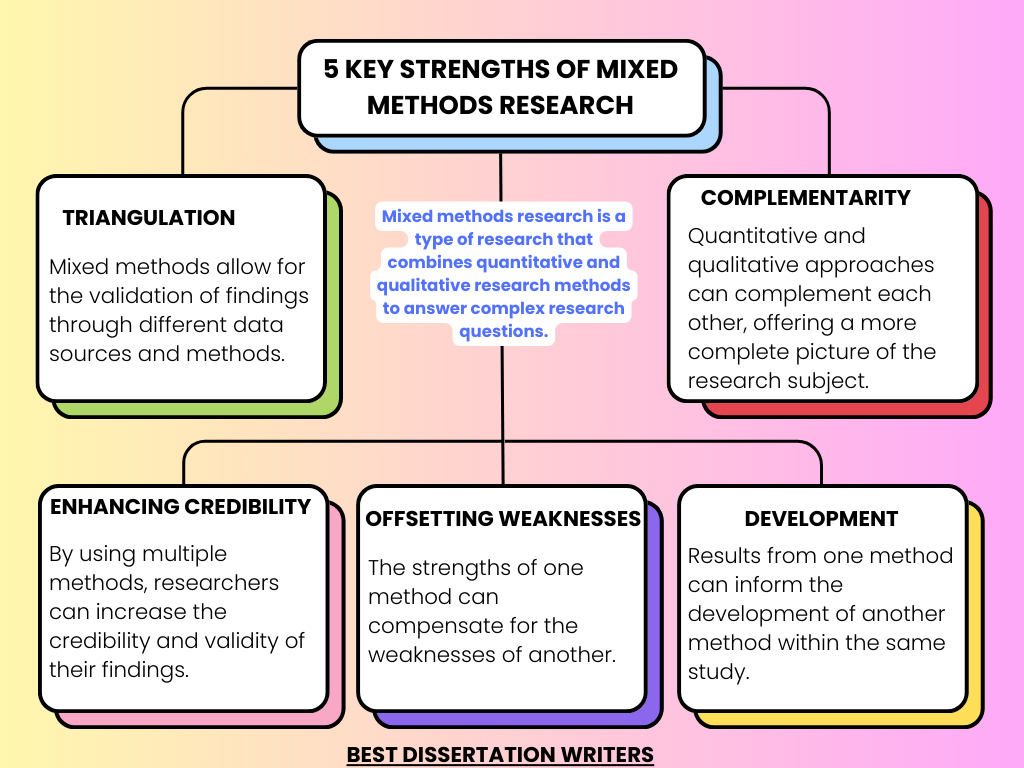
Numbers can show what is happening, while words can explain why it is happening. This makes mixed methods research useful when studying complex human, social, educational, or health-related issues. - Mixed methods research combines the strengths of qualitative and quantitative methods.
Quantitative research is useful for measuring trends, testing relationships, and identifying patterns. Qualitative research is useful for understanding meanings, experiences, and behaviours. When both are used together, the findings become richer and more balanced. - The advantages of mixed methods research include stronger evidence.
If the quantitative findings and qualitative findings support each other, the conclusion becomes more convincing. This can help researchers, managers, nurses, teachers, and policymakers make better decisions. - Mixed methods research helps explain unexpected results.
A survey may show a surprising result, but interviews can help explain it. For example, quantitative data may show that patients are satisfied with treatment but dissatisfied with communication. Interviews can explain what kind of communication was missing. - The mixed methods approach is useful for practical decision-making.
In nursing research, education, business, and health research, leaders often need both statistics and personal experiences. Mixed methods research provides both, making the results more useful in real-world settings. - Mixed methods research supports better instrument development.
In exploratory sequential design, qualitative data can help researchers create better survey questions. This is useful when existing tools do not fully match the research problem or population. - Another advantage of mixed methods is flexibility.
Researchers can use a mixed methods design in many ways. Methods may be used at the same time, one after another, or with one method embedded inside another. This flexibility makes mixed methods research suitable for many research fields.
Disadvantages of Mixed Methods Research
- Mixed methods research can be time-consuming.
Since it uses two methods, the researcher often needs more time for planning, data collection, analysis, and reporting. Collecting both qualitative and quantitative data can take longer than using only one method. - Mixed methods research can also be more expensive.
A research project may require survey tools, interview time, transcription, statistical software, and trained researchers. This can make the research process more costly than a purely quantitative or qualitative study. - It may require advanced research skills.
The researcher needs to understand quantitative or qualitative research, but also how to combine the two. This can be difficult for beginners who are new to research methodology. - Integrating findings can be challenging.
One of the hardest parts of mixed methods research is bringing the findings together clearly. Sometimes quantitative findings and qualitative findings do not agree. The researcher must then explain the difference carefully instead of ignoring it. - The study can become too broad if it is not well planned.
Because mixed methods research uses different methods, researchers may collect too much data. This can make the study confusing and difficult to manage. A clear research question and study design help prevent this problem. - Some readers may prefer either quantitative or qualitative evidence.
Certain audiences may trust numbers more, while others may value personal stories more. The researcher must explain why combining qualitative and quantitative evidence gives a stronger answer. - Despite these challenges, mixed methods research remains a powerful research approach.
When it is well planned, it helps researchers answer complex questions more clearly. It uses quantitative and qualitative data collection, connects different types of evidence, and produces findings that are practical, detailed, and useful.
References
- Mixed Methods Designs – Georgia State University Library Research Guides – https://research.library.gsu.edu/c.php?g=1050115&p=7622501
- Qualitative Research: Mixed Methods Research – Gonzaga University Library – https://researchguides.gonzaga.edu/qualitative/mixed-methods
- Mixed Methods Analysis – Georgetown University Library – https://guides.library.georgetown.edu/c.php?g=1311988&p=9670809