

What Is an Embedded Design in Mixed Methods Research?
- Embedded design is a type of mixed method research where one form of data is placed inside a larger research design.
- In simple terms, embedded design means that a researcher mainly uses one research method, either quantitative or qualitative, but adds another type of data to support, explain, or enrich the main study.
- For example, a researcher may conduct a mainly quantitative study using surveys, test scores, or numerical results. Within that same study, the researcher may also collect qualitative data through interviews, open-ended questions, observations, or written reflections.
- In another case, a researcher may conduct a mainly qualitative study, such as interviews or case studies, and then add quantitative data such as rating scales, attendance records, or demographic statistics.
- This makes embedded design useful because it allows the researcher to answer a main research question while also exploring smaller but important aspects of the research problem.
- Embedded design is part of the mixed methods approach.
- A mixed methods approach combines qualitative and quantitative data within a single study.
- In mixed method research, the goal is not only to collect different types of data. The goal is also to integrate the data in a meaningful way.
- Embedded design is different from some other mixed methods research design options because one data set is usually more important than the other.
- The main data set guides the research process, while the secondary data set is embedded within the study to provide extra understanding.
- The main idea behind embedded design is support.
- The secondary type of data supports the main research design.
- For example, if the main study is quantitative, qualitative data may help explain why participants answered in a certain way.
- If the main study is qualitative, quantitative data may help show patterns, frequencies, or background information.
- This is why embedded design is often used when one research method alone cannot fully answer the research question.
- Embedded design can be used in different types of mixed methods studies.
- It can be used in experimental research.
- It can be used in intervention studies.
- It can be used in programme evaluation.
- It can be used in educational research.
- It can be used in healthcare research.
- It can be used in business research.
- It can also be used in social science research.
- In all these areas, embedded design helps the researcher understand both measurable outcomes and human experiences.
- Embedded design is useful when the researcher has one clear main method but still needs another type of data.
- For example, a school may want to test whether a new reading programme improves student scores.
- The main part of the study may be quantitative because the researcher compares test scores before and after the programme.
- However, the researcher may also interview students and teachers to understand their experience with the programme.
- In this case, the interviews are embedded within the larger quantitative research design.
- The qualitative data does not replace the test scores. Instead, it helps explain the meaning behind the numbers.
- Embedded design can also work the other way around.
- A researcher may conduct a qualitative study about how nurses experience stress in hospitals.
- The main data may come from interviews.
- However, the researcher may also include a short quantitative stress scale.
- The scale gives numerical support to the interview findings.
- In this case, the quantitative data is embedded within a qualitative design.
- Embedded design is flexible.
- The embedded data can be collected before, during, or after the main data collection.
- If the researcher collects the supporting data during the main study, the design may be called a concurrent embedded design.
- If the researcher collects one type of data after another, the design may become a sequential embedded design.
- A sequential embedded design can be useful when the second phase helps explain or expand the first phase.
- For example, a researcher may collect survey data first and then conduct interviews with selected participants afterward.
- Embedded design can connect with explanatory and exploratory models.
- In an explanatory design, the researcher may begin with quantitative data and then use qualitative data to explain the results.
- This is similar to an explanatory sequential model, but in embedded design, the second data set is usually smaller and placed inside the larger study.
- In an exploratory sequential model, the researcher may start with qualitative data and then use quantitative data to test or measure patterns found in the first phase.
- Embedded design can borrow from these ideas, but its key feature is that one method remains primary and the other is supportive.
- Embedded design is especially useful when the research problem is complex.
- Some research problems cannot be understood through numbers alone.
- Other research problems cannot be understood through personal experiences alone.
- Embedded design allows the researcher to study both outcomes and context.
- This makes the research stronger, more balanced, and more useful for real-world decision-making.
- A simple example of embedded design in mixed method research is a healthcare study.
- A hospital may test whether a new patient appointment system reduces waiting time.
- The quantitative data may include waiting time records before and after the system is introduced.
- The qualitative data collection may include patient interviews about satisfaction, comfort, and communication.
- The main study may focus on waiting time numbers.
- However, the embedded qualitative data may show whether patients actually feel the service has improved.
- Another example of embedded design is an education study.
- A researcher may examine whether online learning improves student performance.
- The quantitative data may include grades, attendance, and completion rates.
- The qualitative data may include student reflections and teacher interviews.
- The embedded approach helps the researcher understand both academic performance and student experience.
- Embedded design is not just about adding extra data.
- The researcher must have a clear reason for including the second type of data.
- The secondary data should answer a specific part of the research question.
- It should also strengthen the main findings.
- If the extra data does not support the purpose of the study, the embedded research design may become confusing.
Need Help With Your Dissertation?
Get professional academic support from Best Dissertation Writers . Our expert team is ready to help you with high-quality dissertation writing services tailored to your academic goals.
Get Dissertation HelpPhilosophical Assumptions of The Embedded Mixed Methods Design
- Embedded design is based on the belief that research problems can be understood from more than one viewpoint.
- In mixed method research, the researcher accepts that both numbers and human experiences can provide valuable knowledge.
- Quantitative data may show patterns, relationships, changes, and measurable outcomes.
- Qualitative data may explain meanings, feelings, reasons, and personal experiences.
- Embedded design brings these two forms of knowledge together within a single study.
- One important philosophical assumption is pragmatism.
- Pragmatism focuses on what works best for answering the research question.
- In an embedded design, the researcher does not choose qualitative or quantitative methods because one is always better.
- Instead, the researcher chooses the method that best fits the research problem.
- If numbers are needed, the researcher uses quantitative methods.
- If deeper explanations are needed, the researcher uses qualitative research methods.
- If both are needed, the researcher combines them through a mixed methods approach.
- Pragmatism supports flexibility in research design.
- Embedded design is flexible because the researcher can decide which type of data should be primary and which should be secondary.
- For example, a researcher may decide that a quantitative experiment is the main study.
- At the same time, qualitative data may be embedded within the experiment to understand participant reactions.
- This flexibility helps the researcher design a study that is practical, focused, and useful.
- Another assumption is that reality can be both measurable and interpreted.
- Quantitative research often assumes that reality can be measured through numbers, variables, and statistics.
- Qualitative research often assumes that reality is shaped by people’s meanings, experiences, and social contexts.
- Embedded design accepts both views.
- It allows the researcher to measure what is happening and also understand why it may be happening.
- Embedded design also assumes that one method may not be enough.
- Some research questions are too broad or complex for only one research method.
- For example, a researcher may know that a training programme improved employee performance.
- However, the researcher may not know why it worked, how employees experienced it, or what challenges they faced.
- By using embedded mixed methods, the researcher can study both results and experiences.
- The design also assumes that qualitative and quantitative data can complement each other.
- Quantitative and qualitative data do not have to compete.
- They can work together.
- In embedded design, one type of data may explain, support, expand, or clarify the other.
- For example, survey results may show that students are dissatisfied with online classes.
- Interview responses may explain that the dissatisfaction comes from poor internet access, lack of feedback, or limited interaction.
- The embedded qualitative data gives meaning to the quantitative results.
- Embedded design assumes that integration is important.
- The researcher should not collect qualitative and quantitative data separately and leave them disconnected.
- The collection and analysis should be planned so that the two data sets speak to each other.
- Integration may happen during the design stage, data collection stage, analysis stage, or interpretation stage.
- The researcher must clearly explain how the embedded data supports the main data.
- Another philosophical assumption is that research should be useful in real life.
- Embedded design is often used in applied research because it helps solve practical problems.
- In education, it may help improve teaching strategies.
- In healthcare, it may help improve patient care.
- In business, it may help improve customer experience.
- In social research, it may help understand community needs.
- This practical focus makes embedded design suitable for researchers who want findings that can guide action.
- Embedded design also respects the complexity of human behaviour.
- Human behaviour is not always easy to measure.
- A quantitative study may show what changed, but it may not explain people’s feelings, choices, or challenges.
- A qualitative study may explain experiences, but it may not show the size or strength of a pattern.
- Embedded design allows the researcher to study both sides.
- The work of mixed methods scholars such as Creswell and Plano Clark supports this approach.
- Plano Clark and other mixed methods scholars explain that different types of mixed methods designs can be chosen depending on the research purpose.
- Embedded design is one of these designs because it allows a secondary method to be placed inside a larger study design.
- This makes it useful when the researcher wants a main method but still needs another form of evidence.
- The philosophical position of embedded design also depends on the study design.
- If the main study is quantitative, the design may lean more toward a post-positivist view.
- This means the researcher may focus on measurement, testing, and evidence.
- If the main study is qualitative, the design may lean more toward a constructivist view.
- This means the researcher may focus on meaning, context, and participant experience.
- However, because embedded design is a mixed methods research design, it often combines these assumptions in a practical way.
- In simple terms, the philosophy of embedded design is balanced and practical.
- It accepts that numbers matter.
- It accepts that stories and experiences matter.
- It accepts that research should answer real questions.
- It accepts that one method can be stronger when supported by another method.
- This is why embedded design is valuable for designing and conducting mixed methods studies.
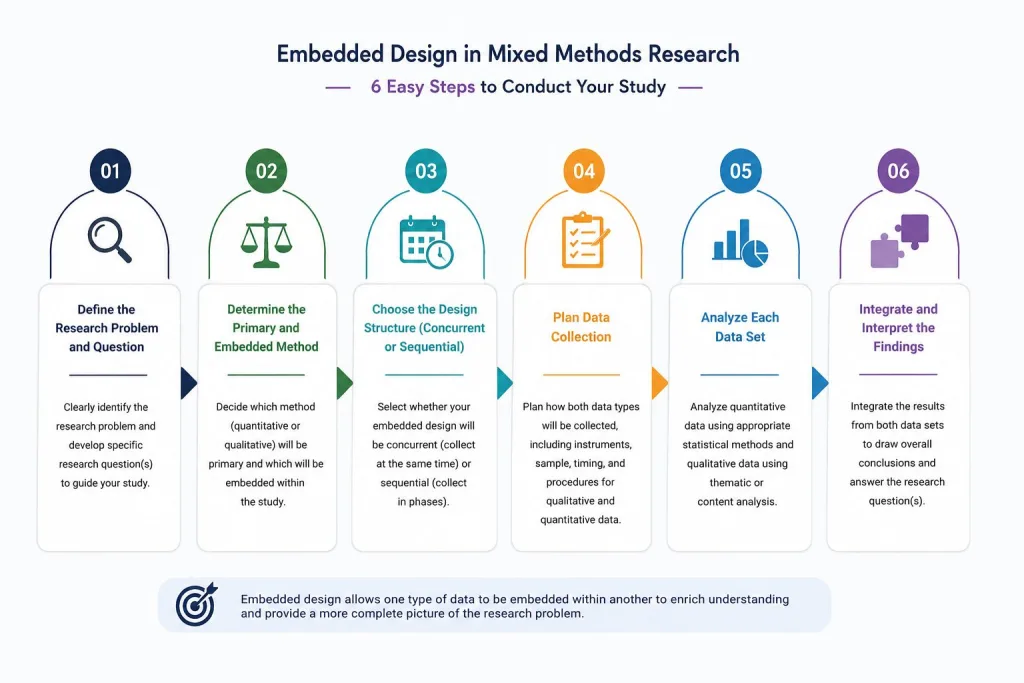
How To Conduct an Embedded Mixed Methods Design In 6 Easy Steps?
- Step 1: Start with a clear research problem and research question.
- Every embedded design begins with a research problem.
- The researcher must first understand what issue needs to be studied.
- A good research problem should be specific, focused, and meaningful.
- For example, the research problem may be low student engagement in online learning.
- The researcher may then ask: “How does online learning affect student engagement, and how do students describe their learning experience?”
- This research question shows the need for both quantitative and qualitative data.
- The quantitative part may measure engagement levels.
- The qualitative part may explore student opinions and experiences.
- At this stage, the researcher should decide whether the study mainly needs a quantitative or qualitative approach.
- Step 2: Decide which method is primary and which method is embedded.
- In embedded design, one method is usually dominant.
- The researcher must decide whether the main study will be quantitative or qualitative.
- If the main aim is to measure outcomes, compare groups, or test an intervention, the primary method may be quantitative.
- If the main aim is to explore experiences, meanings, or social processes, the primary method may be qualitative.
- The secondary method is then embedded within the main research design.
- For example, in a mainly quantitative study, interviews may be added to explain survey results.
- In a mainly qualitative study, a short questionnaire may be added to describe participant characteristics or measure selected patterns.
- This step is important because it prevents confusion during the research process.
- Step 3: Choose the best embedded mixed methods structure.
- The researcher should decide how the qualitative and quantitative data will be collected.
- There are several ways to structure an embedded design.
- A concurrent embedded design collects both types of data during the same general period.
- For example, a researcher may collect survey responses and interview comments during the same programme evaluation.
- A sequential embedded design collects one type of data before or after the other.
- For example, a researcher may collect test scores first and then conduct interviews to explain the results.
- An explanatory sequential structure starts with quantitative data and then uses qualitative data to explain the findings.
- An exploratory sequential structure starts with qualitative data and then uses quantitative data to measure or test what was discovered.
- The researcher should choose the structure that best matches the research question.
- Step 4: Plan the data collection carefully.
- Data collection must be planned before the study begins.
- The researcher should decide what type of data will be collected, from whom, when, and how.
- For quantitative data, this may include surveys, tests, scores, records, or rating scales.
- For qualitative data collection, this may include interviews, focus groups, open-ended survey questions, field notes, or observations.
- The researcher should also decide how many participants will be involved.
- The embedded data set may be smaller than the main data set because it has a supporting role.
- For example, a study may survey 200 students but interview only 15 of them.
- This is acceptable in embedded design as long as the smaller data set helps answer part of the research question.
- Step 5: Analyse each data set using the correct method.
- After data collection, the researcher should analyse the quantitative and qualitative data using suitable methods.
- Quantitative data may be analysed using descriptive statistics, percentages, averages, correlations, or comparison tests.
- Qualitative data may be analysed using coding, themes, categories, patterns, or narrative interpretation.
- The researcher should not force one type of data to behave like the other.
- Each data set should be respected for what it can show.
- For example, test scores may show whether performance improved.
- Interview themes may show why participants felt the programme helped or did not help.
- This separate analysis prepares the researcher for integration.
- Step 6: Integrate the findings and explain the full meaning.
- Integration is one of the most important parts of embedded design.
- The researcher must bring the quantitative and qualitative findings together.
- This does not mean mixing everything randomly.
- It means explaining how the embedded data supports, expands, confirms, or challenges the main findings.
- For example, if survey results show that employees liked a new training programme, interview data may explain that they liked it because it was practical and easy to apply.
- If test scores improved but interviews showed that students felt stressed, the researcher should report both findings honestly.
- Good integration helps readers understand the full story.
- A strong embedded design should show the role of each data set clearly.
- The researcher should explain which data set is primary.
- The researcher should explain which data set is secondary.
- The researcher should explain why the secondary data was embedded within the study.
- The researcher should explain how the findings were integrated.
- This makes the embedded research design easier to understand and more credible.
- When conducting mixed methods research, the researcher should also consider ethics.
- Participants should know what kind of data is being collected.
- They should understand whether they are completing surveys, interviews, observations, or other activities.
- The researcher should protect participant privacy.
- The researcher should store quantitative and qualitative data safely.
- Ethical planning is important in all mixed methods studies.
- The researcher should also avoid common mistakes in embedded design.
- One common mistake is adding qualitative or quantitative data without a clear purpose.
- Another mistake is failing to integrate the findings.
- Another mistake is treating the embedded data as unimportant.
- The supporting data may be smaller, but it still needs careful collection and analysis.
- A good embedded approach gives value to both data sets.
- A simple model for conducting embedded mixed methods can be remembered like this.
- Identify the research problem.
- Choose the main research method.
- Decide what supporting data is needed.
- Plan the timing of data collection.
- Analyse each data set properly.
- Integrate the findings into one clear explanation.
Need Help With Your Dissertation?
Get professional academic support from Best Dissertation Writers . Our expert team is ready to help you with high-quality dissertation writing services tailored to your academic goals.
Get Dissertation HelpWhat are the Advantages and Disadvantages of Embedded Design in Mixed Method Research?
Advantages of Embedded Design
- Embedded design gives a deeper understanding of the research problem.
- The main strength of embedded design is that it allows the researcher to study a topic from more than one angle.
- Instead of depending on only one type of data, the researcher can use quantitative and qualitative data within the same study.
- For example, a survey may show what is happening, while a qualitative interview may explain why it is happening.
- This makes embedded design useful in complex research where one research method may not fully answer the research question.
- Embedded design supports the main research approach.
- In this type of design, one data set is usually primary, while the second data set is embedded within the primary data.
- This means the secondary data supports the overall research instead of competing with it.
- For example, qualitative data is embedded within a mainly quantitative study to explain participant experiences.
- In another case, quantitative data may be placed inside a qualitative framework to support qualitative results.
- Embedded design is flexible for different research aims.
- Embedded design can fit different types of mixed methods studies.
- It can be used in action research, programme evaluation, healthcare studies, education research, and business research.
- The researcher can decide whether the main study design should be quantitative or qualitative.
- This makes embedded design a practical mixed methods research design for various research settings.
- Embedded design helps address different research questions within one study.
- Some studies have one main research question and smaller research questions within the same project.
- Embedded design allows the researcher to answer these different research questions without creating separate studies.
- For example, a researcher may ask whether a training programme improves staff performance.
- The researcher may also ask how staff experienced the training.
- The quantitative part answers the performance question, while the qualitative data collection answers the experience question.
- Embedded design improves data collection and analysis.
- Mixed methods research integrates qualitative and quantitative methods to create a fuller picture.
- Through embedded design, the researcher collects and analyzes quantitative and qualitative data in a planned way.
- The design helps the researcher connect different types of data during data collection and analysis.
- This can lead to valuable insights that may not appear when using only one research method.
- Embedded design works well with sequential models.
- Embedded design can be used in an explanatory sequential model, where quantitative data is collected first and followed by qualitative data.
- It can also be used in an exploratory sequential model, where qualitative research is conducted first and then supported by quantitative data.
- A sequential embedded design is useful when one type of data needs to explain or build on the other.
- This makes embedded design useful for designing and conducting mixed methods research in stages.
- Embedded design is useful when one method must remain dominant.
- In some studies, the researcher must follow a specific research framework.
- For example, an experiment may need to remain mainly quantitative.
- However, qualitative data may be embedded within the experiment to explain participant views.
- This allows the study to keep its main structure while still gaining extra insight from another data type.
Disadvantages of Embedded Design
- Embedded design can be difficult to plan.
- Although embedded design is flexible, it requires careful planning.
- The researcher must decide which method is primary and which method is secondary.
- The researcher must also explain why one data type is embedded within the other.
- If this is not clear, the embedded research design may appear weak or confusing.
- Embedded design can make the research process longer.
- Conducting mixed methods research often takes more time than using only one method.
- The researcher may need to plan both qualitative and quantitative data collection.
- The researcher may also need to complete separate analysis for each data set.
- This can increase the time, effort, and resources needed for the study.
- Embedded design requires skill in qualitative and quantitative research methods.
- The researcher should understand both qualitative and quantitative methods.
- If the researcher is strong in only one area, the weaker part of the study may not be done well.
- For example, weak qualitative interview questions may produce poor qualitative data.
- Poor statistical analysis may also weaken the quantitative part of the study.
- Embedded design can create integration challenges.
- Mixed methods research integrates qualitative and quantitative data, but this is not always easy.
- The researcher must show how the embedded data connects with the primary data.
- If the findings are simply reported separately, the study may not fully achieve the purpose of embedded design.
- Strong integration is needed to make the results meaningful.
- Embedded design may give less attention to the secondary data set.
- Since one data set is primary, the embedded data may be treated as less important.
- This can weaken the study if the secondary data is not collected or analysed carefully.
- For example, qualitative data may be too brief to explain the quantitative results properly.
- The researcher should still give enough attention to the embedded part of the study.
- Embedded design may confuse readers if the structure is not explained clearly.
- Readers need to understand the type of research being used.
- They also need to know how the qualitative or quantitative data was embedded within the single study.
- If the researcher does not explain the design variants, timing, and purpose, readers may struggle to follow the study.
- Clear explanation is important when presenting embedded mixed methods research.
Mixed Methods Research Design Guides
Structured guides to key mixed methods research designs including sequential, convergent, embedded, multiphase approaches, and dissertation methodology foundations.
Research Methodology in Dissertation
Core foundations of research design, structure, and methodology in dissertations. Read full guide →
Mixed Methods Overview
Foundations of qualitative and quantitative integration. Explore article →
Explanatory Sequential
Quantitative results followed by qualitative explanation. Read more →
Exploratory Sequential
Qualitative insights shaping quantitative instruments. Read more →
Convergent Parallel
Concurrent qualitative and quantitative analysis. Read more →
Embedded Design
One method embedded within another dominant design. Read more →
Transformative Design
Research focused on change and social impact. Read more →
Multiphase Design
Multiple linked phases across one research program. Read more →
Examples of Embedded Mixed Methods Design
- Example 1: Embedded design in education research
- A researcher wants to study whether a new reading programme improves student performance.
- The main research approach is quantitative because the researcher compares test scores before and after the programme.
- However, qualitative data may be collected through student interviews to understand how learners experienced the reading activities.
- In this case, the qualitative data is embedded within the primary quantitative study.
- This embedded design helps the researcher understand both the scores and the student experience.
- Example 2: Embedded design in healthcare research
- A hospital may test whether a new appointment system reduces patient waiting time.
- The primary data may be quantitative, such as average waiting time, number of patients served, and appointment completion rates.
- The secondary data may come from qualitative interview responses from patients and nurses.
- The qualitative data may explain whether patients felt the system was easier, faster, or more respectful.
- This embedded approach gives a better understanding of the research problem than numbers alone.
- Example 3: Embedded design in business research
- A company may want to know whether customer service training improves customer satisfaction.
- The researcher may collects and analyzes quantitative survey ratings before and after the training.
- A smaller qualitative study may be embedded within the project through staff interviews.
- The interviews may explain which parts of the training were most useful.
- This embedded design helps connect customer satisfaction scores with employee experience.
- Example 4: Embedded design in action research
- A teacher may use action research to improve classroom participation.
- The main qualitative design may involve classroom observation, teacher reflection, and student comments.
- Quantitative data may be embedded within the study through participation counts or short rating scales.
- This allows the teacher to understand both behaviour patterns and student views.
- Embedded design is helpful here because action research often focuses on practical change within a real setting.
- Example 5: Embedded design in an explanatory sequential study
- A researcher may first collect quantitative data through a student motivation survey.
- The data is collected first to identify patterns in motivation levels.
- This may be followed by qualitative data from interviews with selected students.
- The qualitative data may explain why some students reported high motivation while others reported low motivation.
- This sequential embedded design is useful because the second phase explains the first phase.
- Example 6: Embedded design in an exploratory design
- A researcher may begin with qualitative research to explore how employees describe workplace stress.
- After analysing the interview themes, the researcher may create a short questionnaire to measure how common those stress factors are.
- In this case, qualitative research guides the study, while quantitative data is added to support the findings.
- This shows how embedded design can work in an exploratory sequential structure.
- It is useful when the researcher wants to move from detailed experiences to wider patterns.
- Example 7: Embedded design in programme evaluation
- A nonprofit organisation may evaluate whether a youth mentoring programme improves confidence.
- Quantitative data may include confidence scale scores before and after the programme.
- Qualitative data may include mentor notes, youth reflections, and focus group responses.
- The qualitative or quantitative data can be embedded within the main programme evaluation, depending on the research aims.
- This embedded mixed methods design gives valuable insights into both outcomes and personal experiences.
- Example 8: Embedded design based on Plano Clark’s mixed methods ideas
- Mixed methods scholars such as Plano Clark explain that different types of mixed methods can be used depending on the purpose of the study.
- Embedded design is one of the design variants that allows one method to sit inside a larger research framework.
- This means the researcher can keep a main quantitative or qualitative study design while adding another method within it.
- The design aims to strengthen the overall research by using different types of data in a single study.
- This makes embedded design useful when one type of data alone cannot fully explain the research problem.
References
- Mixed Methods Designs – Georgia State University Library Research Guides – https://research.library.gsu.edu/c.php?g=1050115&p=7622501
- Qualitative Research: Mixed Methods Research – Gonzaga University Library – https://researchguides.gonzaga.edu/qualitative/mixed-methods
- Mixed Methods Analysis – Georgetown University Library – https://guides.library.georgetown.edu/c.php?g=1311988&p=9670809