

What Is an Exploratory Sequential Design in Mixed Methods Research?
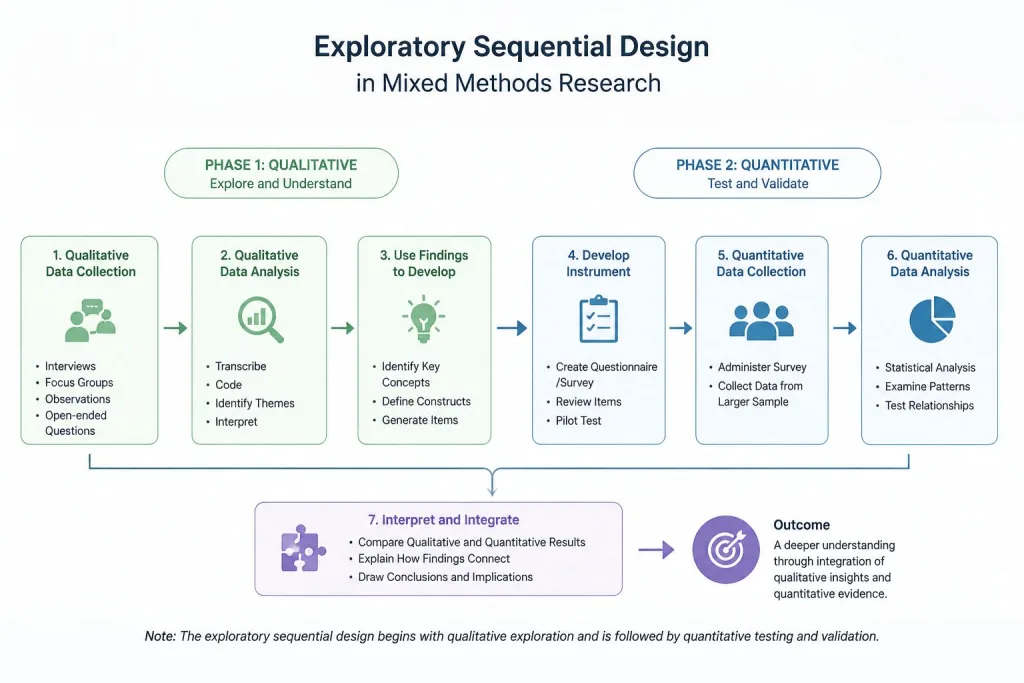
- Exploratory sequential design is a type of mixed methods research design where the researcher begins with a qualitative phase and then follows it with a quantitative phase.
- In simple terms, the researcher first explores a topic through qualitative research, such as interviews, focus groups, observations, or open-ended responses.
- After this initial exploration, the researcher uses the qualitative findings to build or improve a quantitative tool, such as a questionnaire, rating scale, checklist, or structured survey.
- This makes the design useful when little is known about a problem, when existing tools are weak, or when the researcher wants to understand people’s experiences before measuring them.
- Exploratory sequential design is called “sequential” because the research happens in order.
- The first phase is usually the qualitative strand, where qualitative data is collected and analysed.
- The second phase is the quantitative strand, where quantitative data collection and analysis are used to test, measure, or validate what was learned earlier.
- This differs from a convergent or convergent parallel design, where quantitative and qualitative data are collected during the same general period and then compared.
- In mixed methods research, this design is often written as QUAL → QUAN.
- “QUAL” means the initial qualitative phase is given strong attention.
- “QUAN” means the subsequent quantitative stage is used to examine the patterns from the qualitative stage more broadly.
- This makes exploratory sequential design especially helpful when the researcher needs to move from deep understanding to wider measurement.
- A common example of using an exploratory sequential approach is developing a new survey.
- A researcher may begin with qualitative interviews to understand how students experience online learning.
- The researcher may then identify qualitative themes, such as motivation, technology access, instructor feedback, and isolation.
- These themes are then used to develop a new instrument, such as a student experience questionnaire.
- The quantitative survey is then given to a larger group of students, and the researcher may use descriptive statistics or other forms of quantitative analysis to evaluate the results.
- Exploratory sequential design is different from explanatory sequential design.
- In explanatory sequential design, the researcher starts with quantitative data and then uses qualitative methods to explain the quantitative results.
- In exploratory sequential design, the researcher starts with qualitative data and then uses quantitative research to test, measure, or expand the qualitative results.
- This difference is important because each sequential design answers a different kind of research question.
- Overall, exploratory sequential design is a strong mixed methods approach for complex research situations.
- It allows the researcher to discover meanings first, then measure them clearly.
- It combines qualitative and quantitative methods in a structured way.
- It is useful in education, healthcare, business, psychology, social sciences, and many other fields where researchers need both depth and measurement.
Need Help With Your Dissertation?
Get professional academic support from Best Dissertation Writers . Our expert team is ready to help you with high-quality dissertation writing services tailored to your academic goals.
Get Dissertation HelpPhilosophical Assumptions of the Exploratory Sequential Design in Mixed Methods Research
- Exploratory sequential design is usually connected to a pragmatic way of thinking.
- Pragmatism focuses on what works best for answering the research question.
- Instead of treating qualitative and quantitative approaches as separate or competing traditions, pragmatism allows both to work together in methods in a single study.
- This means the researcher can use qualitative data to explore meaning and quantitative data to examine patterns, relationships, or frequencies.
- One key assumption is that reality can be understood from more than one angle.
- The qualitative approach helps the researcher understand people’s experiences, beliefs, words, and social meanings.
- The quantitative approach helps the researcher measure how common, strong, or widespread those experiences are.
- In this way, exploratory sequential design accepts that both personal meaning and measurable evidence are important.
- Another assumption is that research should move from discovery to testing.
- In the qualitative phase, the researcher does not begin with fixed categories.
- Instead, the researcher allows themes, concepts, and explanations to emerge from participants.
- In the quantitative phase, those findings are turned into measurable variables, survey items, scales, or categories.
- This is why exploratory sequential mixed methods are often used in design and testing, especially when developing a new instrument.
- This design also assumes that one type of data can strengthen the other.
- Qualitative data collection and analysis can reveal rich details that a closed-ended survey may miss.
- Quantitative data collection can then show whether the discovered themes apply to a larger group.
- When the two phases are connected carefully, the researcher can improve validity and reliability.
- For example, a survey that is based on qualitative themes may be more meaningful than one created without listening to participants first.
- Scholars such as Creswell often explain mixed methods research as a way to integrate qualitative and quantitative data in one study.
- Many books from SAGE and SAGE Publications also discuss different design types, including exploratory sequential, explanatory sequential, convergent design, parallel design, convergent parallel, embedded design, and other forms of quantitative and mixed methods research.
- In an applied guide to research designs, exploratory sequential design is usually presented as one of the most practical designs for building tools, exploring unknown issues, and testing findings across wider populations.
- Ethical assumptions are also important in exploratory sequential design.
- Because the first stage often involves qualitative interviews, focus groups, or personal stories, researchers must protect participants’ privacy and dignity.
- In many institutions, approval from an institutional review board is needed before data collection begins.
- Organisations such as the National Institutes of Health also emphasise careful ethical review, especially when human participants are involved.
- This matters because mixed methods research involves collecting different types of data, sometimes from the same people, across more than one stage.
- In short, the philosophical foundation of exploratory sequential design supports flexibility, integration, and practical problem-solving.
- It values the human depth of qualitative research.
- It also values the measurement strength of quantitative research.
- Together, the qualitative and quantitative phases help the researcher move from exploration to evidence-based conclusions.
How To Conduct an Exploratory Sequential Mixed Methods Research Design in 6 Easy Steps
Step 1: Start with a clear research problem and research question
- The first step in exploratory sequential design is to define the problem clearly.
- The researcher should identify what is not yet understood.
- This design is best when the topic is new, complex, poorly measured, or not fully explained by existing quantitative studies.
- For example, a researcher may want to understand why first-year university students feel disconnected from online learning.
- The research question should match the purpose of the design.
- A strong question may ask what people experience, how they describe a problem, or what themes explain a situation.
- For example: “What challenges do first-year students experience in online learning, and how can these challenges be measured through a survey?”
- This type of question fits exploratory sequential design because it begins with exploration and then moves into measurement.
- At this stage, the researcher should also define the research objectives.
- One objective may focus on exploring participants’ experiences.
- Another objective may focus on using those experiences to create a data collection tool.
- A third objective may focus on testing that tool with a larger sample.
- These objectives help keep the full study design organised.
Step 2: Conduct the initial qualitative phase
- The initial qualitative phase is the foundation of exploratory sequential design.
- This is where the researcher collects qualitative data to understand the topic deeply.
- Common methods include qualitative interviews, focus groups, open-ended questionnaires, field notes, or document analysis.
- The goal is not to measure numbers yet. The goal is to discover ideas, meanings, and patterns.
- In this phase, the researcher should choose participants who can give rich information.
- For example, if the study is about student stress, the researcher may interview students from different years, programmes, or learning backgrounds.
- If the study is about patient satisfaction, the researcher may interview patients who received different services.
- The sample is usually smaller than in the quantitative phase, but the information should be detailed.
- Qualitative data collection and analysis should be systematic.
- The researcher may record interviews, transcribe them, and code the responses.
- Software such as ATLAS.ti can help organise codes, quotations, and qualitative themes.
- However, the software does not replace the researcher’s thinking. The researcher still needs to interpret what the data means.
- The researcher should look for clear patterns in the qualitative results.
- These may include repeated concerns, shared experiences, new concepts, or unexpected findings.
- For example, students may say that online learning is difficult because of poor internet, unclear instructions, lack of interaction, and low motivation.
- These qualitative findings become the basis for the next stage of the exploratory sequential mixed methods design.
Step 3: Analyse the qualitative findings and prepare for integration
- After qualitative data is collected, the researcher must analyse it carefully.
- This stage connects the qualitative phase to the quantitative phase.
- The researcher should identify the most important themes, categories, and explanations.
- These findings should directly guide what happens in the second phase.
- In exploratory sequential design, integration does not happen only at the end.
- Integration begins when the researcher decides how the qualitative findings will shape the quantitative stage.
- For example, if interview participants identify five major barriers to healthcare access, those five barriers can become sections in a survey.
- This is what makes the design truly exploratory sequential, not just two separate studies placed together.
- The researcher should decide what needs to be measured.
- Some themes may become survey questions.
- Some themes may become response options.
- Some themes may become variables for quantitative analysis.
- For example, the theme “lack of feedback” may become questionnaire items asking how often students receive comments, grades, or guidance from instructors.
- This step also helps the researcher check whether the findings are strong enough for the next phase.
- If the themes are unclear, the researcher may need more interviews.
- If the themes are strong and repeated, the researcher can move toward quantitative data collection.
- This careful transition improves the quality of the full mixed methods study.
Step 4: Develop the quantitative instrument or data collection tool
- One of the most common uses of exploratory sequential design is creating a new instrument.
- This may be a questionnaire, survey, checklist, rating scale, interview schedule, or structured observation form.
- The instrument is usually based on qualitative findings from the first stage.
- This makes the instrument more connected to real participant experiences.
- For example, a researcher may use interview findings to develop a quantitative survey.
- If students describe “unclear instructions” as a major problem, the survey may include an item such as: “Course instructions are clear and easy to follow.”
- If patients describe “long waiting times,” the survey may ask them to rate waiting time satisfaction.
- In this way, the qualitative themes are transformed into measurable items.
- The researcher should also think about validity and reliability.
- Validity asks whether the tool measures what it is supposed to measure.
- Reliability asks whether the tool gives consistent results.
- Because the tool is developed from real qualitative data, it may have stronger content validity.
- However, it still needs to be reviewed, piloted, and refined.
- Expert review can also improve the tool.
- Researchers may ask supervisors, subject experts, or methodologists to evaluate the questionnaire items.
- They may check whether the items are clear, relevant, and suitable for the study population.
- This is especially important in mixed methods research because weak measurement in the second stage can reduce the value of the whole design.
- A pilot test is also useful before full quantitative data collection.
- A small group of participants can complete the survey and give feedback.
- The researcher can then adjust confusing questions, remove repeated items, or improve response options.
- This step prepares the design for stronger quantitative data collection and analysis.
Step 5: Conduct the quantitative phase
- The quantitative phase is the second major stage of exploratory sequential design.
- Here, the researcher collects quantitative data from a larger sample.
- This stage may involve a survey, questionnaire, experiment, test, or structured measurement tool.
- The purpose is to examine whether the earlier qualitative findings apply more widely.
- This stage is often followed by a survey because surveys are practical for reaching many participants.
- For example, after interviewing 20 students, a researcher may survey 300 students.
- The survey may measure how common each challenge is, which challenges are most serious, and whether different groups report different experiences.
- This helps the researcher move from individual stories to broader patterns.
- The researcher should collect and manage data carefully.
- The sample size should match the study purpose and available resources.
- The data should be cleaned before analysis.
- Missing responses, unclear answers, or incomplete questionnaires should be handled consistently.
- Strong data management supports better quantitative results.
- Quantitative analysis depends on the research objectives.
- The researcher may use descriptive statistics to summarise frequencies, percentages, means, and standard deviations.
- They may also compare groups or examine relationships between variables.
- For example, the researcher may compare stress levels between online students and blended-learning students.
- In exploratory sequential design, the quantitative stage should always remain connected to the qualitative stage.
- The researcher should not introduce unrelated survey items that do not connect to the earlier findings.
- The strength of this mixed methods design comes from the clear link between the two phases.
- When the phases are connected well, the researcher can evaluate both meaning and measurement in the same study.
Step 6: Integrate, interpret, and report the qualitative and quantitative results
- The final step is to bring the qualitative and quantitative results together.
- The researcher should explain how the quantitative results support, expand, or challenge the earlier qualitative results.
- This is where the full value of exploratory sequential design becomes clear.
- The researcher is not simply reporting two separate studies. They are showing how one phase informed the other.
- Integration may happen in several ways.
- The researcher may compare the qualitative themes with the survey findings.
- They may show which interview themes were most common in the larger sample.
- They may explain why some themes appeared strongly in interviews but weakly in the survey.
- They may also use tables to connect each qualitative theme with related quantitative findings.
- For example, interviews may show that students feel isolated in online learning.
- The later survey may show that 72% of students agree that limited peer interaction affects their motivation.
- This means the qualitative theme was supported by the quantitative data.
- If only 15% of students agree, the researcher may need to explain why the theme was strong in interviews but less common in the larger sample.
- The researcher should also discuss the contribution of the design.
- Exploratory sequential design is useful because it can create better tools, improve understanding, and produce findings that are both deep and measurable.
- It is especially strong when no suitable questionnaire already exists.
- It also works well when the researcher wants to design a survey that reflects real participant language and experience.
- The report should clearly describe the full process.
- It should explain the qualitative data collection and analysis.
- It should explain how the data collection tool was developed.
- It should describe the quantitative data collection and analysis.
- It should show how the two phases were integrated.
- This helps readers understand the logic of the exploratory sequential mixed methods process.
- The researcher should also acknowledge limitations.
- The qualitative sample may be small.
- The survey may not represent every population.
- The new instrument may need more testing in future research.
- The study may require more time than a simple qualitative study or simple quantitative study because data are collected in two connected stages.
- Finally, the researcher should explain why exploratory sequential design was better than other options.
- A convergent parallel design may not be suitable if the researcher first needs to discover themes before measuring them.
- An explanatory sequential design may not be suitable if there are no earlier quantitative findings to explain.
- An embedded design may not be suitable if both phases need clear, separate attention.
- Therefore, exploratory sequential design is the best choice when the study needs to begin with exploration and then move into structured measurement.
- In practical terms, exploratory sequential design helps researchers build knowledge step by step.
- It begins with people’s experiences.
- It turns those experiences into measurable ideas.
- It tests those ideas with a larger group.
- It then combines the two sets of findings to give a stronger answer to the research problem.
- For this reason, exploratory sequential design remains one of the most useful research methods for a mixed method or mixed methods approach where both discovery and measurement are needed.
What Are the Advantages and Disadvantages of Exploratory Sequential Design in Mixed Methods Research?
- Exploratory sequential design is a mixed methods research design that begins with an initial qualitative phase followed by a quantitative phase.
- This sequential structure allows researchers to explore a phenomenon in depth before measuring it on a larger scale.
- It is particularly useful when existing research instruments are weak, unavailable, or the research problem is not well understood.
Advantages of Exploratory Sequential Design
- Deep exploration before measurement
- Using a qualitative approach in the first phase allows researchers to discover qualitative themes and concepts directly from participants’ experiences.
- These qualitative findings form the basis for developing quantitative instruments such as questionnaires or structured surveys.
- This approach ensures that the later quantitative phase measures relevant and meaningful constructs.
- Enhanced validity and reliability
- Because quantitative data collection is guided by qualitative themes, the resulting mixed methods study has stronger content validity.
- The sequential design allows researchers to refine measurement tools based on qualitative data, improving reliability in the quantitative analysis.
- Integration of qualitative and quantitative data
- Exploratory sequential mixed methods design provides a systematic way to combine qualitative and quantitative approaches.
- The researcher can use qualitative data to inform the quantitative strand, then analyze quantitative results in light of earlier qualitative findings.
- This mixed methods approach ensures that data collection and analysis reflect both depth and breadth.
- Flexibility for complex research problems
- Exploratory sequential design works well for complex research situations where little prior knowledge exists.
- Researchers can explore unknown dimensions before committing to large-scale quantitative data collection.
- It supports both descriptive and explanatory goals in a single mixed methods study.
- Development of new instruments
- Using qualitative data to inform quantitative research allows the creation of new instruments tailored to participants’ experiences.
- For example, qualitative interviews may reveal themes that can be transformed into survey items or scales for quantitative analysis.
- This is particularly valuable when standard tools are inadequate.
- Supports actionable research
- Findings from exploratory sequential mixed methods research can guide policy, educational interventions, or program design.
- Because the design includes both qualitative and quantitative phases, stakeholders can see not only what participants experience but also how widespread those experiences are.
Mixed Methods Research Design Guides
Structured guides to key mixed methods research designs including sequential, convergent, embedded, multiphase approaches, and dissertation methodology foundations.
Research Methodology in Dissertation
Core foundations of research design, structure, and methodology in dissertations. Read full guide →
Mixed Methods Overview
Foundations of qualitative and quantitative integration. Explore article →
Explanatory Sequential
Quantitative results followed by qualitative explanation. Read more →
Exploratory Sequential
Qualitative insights shaping quantitative instruments. Read more →
Convergent Parallel
Concurrent qualitative and quantitative analysis. Read more →
Embedded Design
One method embedded within another dominant design. Read more →
Transformative Design
Research focused on change and social impact. Read more →
Multiphase Design
Multiple linked phases across one research program. Read more →
Disadvantages of Exploratory Sequential Design
- Time-intensive
- Conducting two distinct qualitative and quantitative phases requires more time than a single-method study.
- Researchers must complete data collection and analysis for the first phase before starting the second phase, which can delay results.
- Resource-heavy
- The sequential nature of the design often demands more resources, including personnel, participant recruitment, and data management.
- Using tools such as ATLAS.ti or SPSS may be necessary for qualitative and quantitative analysis, adding to complexity.
- Risk of weak integration
- The strength of exploratory sequential design depends on how well the qualitative and quantitative phases are connected.
- Poorly linked phases can lead to disconnected findings, reducing the value of the mixed methods study.
- Sample considerations
- Qualitative samples are typically small, which may not represent the population accurately.
- If quantitative data collection is not properly designed, the generalizability of results may be limited.
- Potential for complexity in reporting
- Reporting results from two distinct phases can be challenging.
- Researchers must clearly explain data collection and analysis methods, the development of quantitative instruments, and the integration of qualitative and quantitative results.
- Journals or stakeholders unfamiliar with mixed methods research design may struggle to interpret the findings.
- Ethical considerations
- Because the qualitative phase often involves interviews or personal experiences, ethical approval and careful data handling are crucial.
- Researchers need to ensure participant confidentiality across both phases, particularly when data are collected sequentially.
- Not suitable for all research questions
- Exploratory sequential design works best for discovery and measurement.
- If the research question requires testing an existing hypothesis from the start, an explanatory sequential design or convergent parallel design may be more appropriate.
Examples of Exploratory Sequential Design in Mixed Methods Research
- Exploratory sequential design is widely used in mixed methods research across education, healthcare, psychology, social sciences, and business studies.
- The key is that qualitative and quantitative phases work together to explore and then measure phenomena.
Example 1: Developing a Student Well-Being Questionnaire
- Context: University students’ mental health and academic stress.
- Qualitative phase:
- Conducted qualitative interviews with 25 students across multiple faculties.
- Explored themes like academic pressure, social isolation, financial stress, and online learning challenges.
- Identified qualitative themes relevant to overall student well-being.
- Quantitative phase:
- Developed a questionnaire based on the qualitative findings.
- Administered the quantitative survey to 400 students.
- Quantitative data collection and analysis examined how widespread each stressor was.
- Descriptive statistics highlighted the most common stress factors, while inferential statistics explored relationships between demographics and stress levels.
- Result:
- Qualitative and quantitative results were integrated to create a validated tool for future research on student well-being.
- The study illustrates the exploratory sequential mixed methods design by using qualitative data to develop quantitative instruments.
Example 2: Healthcare Patient Satisfaction Instrument
- Context: Improving hospital patient experience.
- Qualitative phase:
- Conducted focus groups and qualitative interviews with 30 patients from multiple departments.
- Explored themes such as communication with staff, waiting times, care quality, and discharge procedures.
- Identified qualitative findings to inform measurement.
- Quantitative phase:
- Developed a quantitative survey based on the qualitative themes.
- Administered to 500 patients using a structured questionnaire.
- Analyzed quantitative data using descriptive and inferential statistics.
- Integration:
- The study validated the patient satisfaction survey, ensuring it captured the concerns identified in interviews.
- Demonstrates how exploratory sequential design strengthens both validity and reliability.
Need Help With Your Dissertation?
Get professional academic support from Best Dissertation Writers . Our expert team is ready to help you with high-quality dissertation writing services tailored to your academic goals.
Get Dissertation HelpExample 3: Workplace Diversity and Inclusion Study
- Context: Employee perceptions of organizational inclusion.
- Qualitative phase:
- Conducted 20 qualitative interviews across different departments.
- Explored qualitative themes: fairness, opportunity, bias, mentorship, and communication.
- Quantitative phase:
- Designed a questionnaire measuring each identified theme.
- Administered to 300 employees.
- Conducted quantitative analysis to assess which inclusion factors were most significant across departments.
- Result:
- Integration of qualitative and quantitative results allowed HR to develop targeted interventions.
- Using exploratory sequential design, researchers could use qualitative data to inform measurable organizational strategies.
Example 4: Consumer Behavior and Product Development
- Context: Understanding user preferences for a new tech product.
- Qualitative phase:
- Conducted qualitative interviews with early adopters to explore product needs and pain points.
- Themes included usability, aesthetics, cost, and customer support.
- Quantitative phase:
- Developed a survey instrument to test these preferences among a larger sample (n=500).
- Applied quantitative data collection and analysis to rank consumer priorities.
- Result:
- Insights guided product design decisions.
- Demonstrates the exploratory sequential mixed methods approach in a market research context.
Example 5: Educational Intervention Evaluation
- Context: Assessing effectiveness of a literacy program.
- Qualitative phase:
- Conducted qualitative interviews with teachers and students to explore teaching methods, learning difficulties, and engagement.
- Generated qualitative findings highlighting areas of challenge.
- Quantitative phase:
- Created questionnaires and assessments to measure literacy improvement.
- Collected quantitative data from 200 students.
- Integration:
- Merged qualitative and quantitative results to evaluate the program’s success.
- This mixed methods study illustrates the applied guide to research designs approach using exploratory sequential design.
Example 6: Public Health Survey on Vaccination Attitudes
- Context: Understanding community attitudes towards vaccination campaigns.
- Qualitative phase:
- Conducted 30 qualitative interviews to explore fears, misconceptions, and motivators for vaccination.
- Identified qualitative themes such as trust in healthcare, misinformation, and access barriers.
- Quantitative phase:
- Developed a questionnaire reflecting the identified themes.
- Administered to 1000 community members.
- Quantitative analysis evaluated patterns across age, education, and socio-economic status.
- Result:
- Provided both qualitative and quantitative data to inform targeted public health messaging.
- Illustrates the exploratory sequential mixed methods design in applied public health research.
Example 7: Social Media Impact on Youth Behavior
- Context: Exploring how social media affects teen mental health.
- Qualitative phase:
- Conducted 25 qualitative interviews with adolescents and parents.
- Explored themes such as anxiety, self-esteem, peer influence, and screen time.
- Quantitative phase:
- Developed a questionnaire measuring these themes across a larger group (n=400).
- Applied quantitative research methods to assess frequency and intensity.
- Integration:
- Results validated qualitative findings and provided generalizable insights for educators and policymakers.
- Confirms how exploratory sequential design supports comprehensive understanding in social research.
- Across these examples, exploratory sequential design demonstrates:
- How qualitative and quantitative approaches are combined.
- How qualitative data informs quantitative data collection.
- How mixed methods research design enables both discovery and measurement.
- How researchers can validate, refine, and implement findings in real-world contexts.
References
- Mixed Methods Designs – Georgia State University Library Research Guides – https://research.library.gsu.edu/c.php?g=1050115&p=7622501
- Qualitative Research: Mixed Methods Research – Gonzaga University Library – https://researchguides.gonzaga.edu/qualitative/mixed-methods
- Mixed Methods Analysis – Georgetown University Library – https://guides.library.georgetown.edu/c.php?g=1311988&p=9670809