

Is Political Science a Good Major? – Key Takeaways
Political science is a strong major for students interested in government, law, public policy, international relations, public service, and political systems. It focuses on power, institutions, citizenship, leadership, and decision-making, while helping students connect classroom learning to real-world issues such as elections, laws, governance, and public affairs. Its biggest strength is flexibility: rather than preparing students for only one job, it builds broad skills that support many career paths.
- What a Political Science Major Covers:
- It studies government systems, institutions, constitutions, public policy, political behavior, and international relations.
- Students learn to analyze how societies are organized and how public decisions affect everyday life.
- Common areas include political theory, comparative politics, public policy, political behavior, and law-related topics.
- Why It Can Be a Good Major:
- It is valuable for students who enjoy reading, writing, debate, research, and critical thinking.
- The degree develops transferable skills instead of locking students into one narrow profession.
- It can support careers in law, journalism, advocacy, consulting, public administration, government, and communications.
- What the Degree Program Looks Like:
- Programs may be offered as a Bachelor of Arts or Bachelor of Science, depending on the school.
- Coursework usually combines theory with application and may include internships, research, methods classes, constitutional law, policy analysis, and public opinion.
- Many students strengthen the major with electives or minors in economics, sociology, business, journalism, or history.
- How It Helps with Law School:
- Political science is often a strong preparation for law school because it develops argumentation, research, writing, and logical reasoning.
- Courses in constitutional law, political theory, and policy analysis are especially useful.
- Activities such as internships, debate, and mock trials can also support legal preparation.
- Career Paths and Salary Potential:
- Common paths include lawyer, policy analyst, campaign manager, public relations specialist, diplomat, foreign service officer, political scientist, journalist, and nonprofit manager.
- Salary varies by role, education, experience, and industry.
- Graduate education can improve specialization and earning potential.
- Main Pros and Cons:
- Pros: versatility, strong analytical and writing skills, broad career options, and graduate school potential.
- Cons: some paths require further education, and competitive fields often demand internships, networking, and extra experience.
- It is a strong major for motivated students who are ready to use the degree actively and strategically.
Political science is a versatile and valuable major that opens doors to various career opportunities, especially in law, government, and public service. With transferable skills in analysis, communication, and policy evaluation, graduates are well-equipped to pursue a wide range of roles across both public and private sectors.
Introduction: Is Political Science a Good Major?
- Many students ask, is political science a good major, because they want a degree that is interesting, practical, and useful in different industries. It is a common question for students who care about society, leadership, law, government, and how decisions shape everyday life.
- A political science major is often appealing because it connects classroom learning to the real-world. Instead of studying ideas in isolation, students explore elections, institutions, conflict, leadership, justice, and the way public policies affect communities, nations, and global affairs.
- At its core, political science is the study of power, governance, citizenship, institutions, and public decision-making. It helps students understand how leaders govern, how people vote, how laws are made, and how government systems and political systems influence daily life.
- For students wondering is political science a good major, the answer often depends on goals rather than on the degree alone. It can be an excellent choice for students who enjoy debate, reading, writing, research, and asking why societies function the way they do.
- This field belongs to the social sciences, so it combines theory with observation and analysis. Students learn to evaluate arguments, interpret data, compare countries, and understand public opinion, institutions, and political behavior in a thoughtful and structured way.
- A political science degree does not train students for only one job title. Instead, it builds a strong foundation of transferable skills that can support more than one career path, including law, policy, journalism, advocacy, public administration, consulting, education, public relations, and government work.
- That is why many students and parents ask not only is political science a good major, but also whether it leads to stable opportunities. The good news is that the degree offers flexibility, and that flexibility is often one of its biggest strengths.
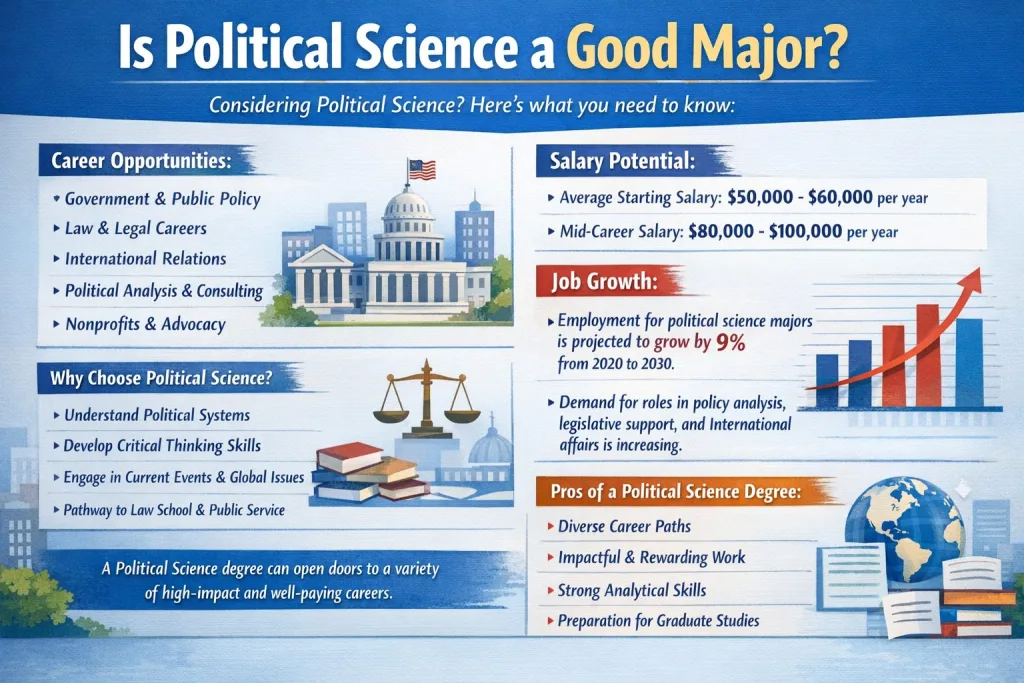
What is a Political Science Major?
- A political science major is an academic field focused on power, governance, institutions, citizenship, and decision-making. Students do not simply memorize leaders or events; they study systems, patterns, and ideas that explain how societies are organized.
- In simple terms, a degree in political science teaches students how governments work, how citizens participate, how laws and constitutions shape authority, and how countries interact with one another. It gives students a structured way of understanding political systems at local, national, and global levels.
- Students in this major usually explore topics such as political theory, comparative politics, American politics, public policy, and international relations. These areas are closely related, and together they help students understand both domestic and global political life.
- A political science degree program also trains students to look beyond headlines. They learn how to examine evidence, question assumptions, and separate opinion from fact when studying political systems and public decision-making.
- Because political science majors study institutions, law, constitutions, elections, and citizens, they often become skilled at seeing the bigger picture. They can connect policy debates to economics, ethics, history, and culture in a way that is both broad and analytical.
- This major is especially valuable for students who enjoy reading, structured argument, and evidence-based discussion. A poli sci degree helps students develop critical thinking, strong writing skills, and advanced research skills, all of which are useful in both academic and professional settings.
- Some students choose this field because they want to become a political scientist, while others want careers in government, nonprofits, or communication. In that sense, political science as a major is flexible enough to support students with academic goals and those focused on employment.
Struggling with Your Political Science Research or Thesis?
Get expert assistance with your political science research, thesis, or dissertation from Best Dissertation Writers . Our team specializes in crafting well-researched, professionally written papers tailored to your political science topics. Visit our site for more information and start your journey towards academic success.
Get Professional HelpIs Political Science a Good Major for an Easy Path to Success?
- When students ask, is political science a good major for an easy path to success, it is important to answer honestly. It can be a good major, but it is not usually an “easy” one in the sense of effortless rewards.
- The major requires serious reading, discussion, interpretation, and writing. Students are often expected to build arguments, analyze evidence, and understand complicated ideas about law, justice, states, and institutions. That means success depends on commitment and curiosity.
- Still, is political science a good major for long-term growth? Yes, especially for students who want a degree that builds flexible skills rather than training for only one narrow role. The strength of the field is that it teaches students how to think, write, research, and argue effectively.
- A political science degree can lead to many directions. Graduates may work as an analyst, legislative assistant, campaign staff member, nonprofit coordinator, researcher, policy aide, public relations specialist, communications officer, or public affairs professional.
- For students planning for law school, this major is often a strong choice. The emphasis on argument, logic, institutions, reading, and writing can help students apply to law school, prepare for applying to law, and build confidence before entering law school.
- It is also useful for students interested in diplomacy and global issues. A graduate may pursue work in foreign service, become a foreign service officer, or move into roles connected to international development, diplomacy, or global advocacy.
- Students who enjoy campaigns and elections may also find a rewarding science career path in political consulting, polling, voter outreach, or campaign strategy. They may support a political campaign, work for a political candidate, or help organizations understand voters and civic engagement.
- In terms of salary, this is not a one-number field. Pay depends on industry, location, role, and education level. Entry-level roles may begin modestly, but experience, specialization, and graduate education can improve salary potential over time.
- Many students also use the major as preparation for advanced education. They may pursue a law degree, master’s programs in policy or public affairs, or advanced studies in law and governance. Because of that, degree can also be seen as a launchpad rather than a final destination.
- So, is political science a good major? It is a very strong option for students who are motivated, curious, and ready to use the degree actively through networking, internships, and skill-building.
Political Science Degree Program: Overview and Structure
- A typical political science degree program is designed to introduce students to institutions, theories, systems, and public life in a structured way. Most universities offer political science through both broad introductory classes and more specialized upper-level study.
- Students may be able to earn a degree through either a bachelor of arts or a bachelor of science, depending on the university. The bachelor of arts often emphasizes theory, history, language, and broader humanities connections, while the bachelor of science may place more emphasis on methods, statistics, and empirical analysis.
- Most degree programs begin with an undergraduate degree structure that includes general education requirements and core major classes. This allows students to build a broad academic base while also progressing through the political science program.
- The political science program also often includes elective pathways, so students can focus on comparative politics, policy, law, political communication, global affairs, or public institutions. This makes the degree flexible for different interests and goals.
- A well-designed political science degree program usually balances theory and application. Students study ideas in class, but they also connect them to public debates, elections, constitutions, and current events.
- Many programs also include opportunities for an internship, which can be one of the most valuable parts of the degree. An internship helps students test a possible career path, build professional confidence, and gain experience in offices, advocacy groups, media organizations, or government agencies.
- Some students pair the major with minors or electives in economics, sociology, history, business, journalism, or communication. These combinations strengthen the degree and make graduates more competitive in different fields.
- For prospective political science students, the key thing to understand is that the major rewards active participation. Students benefit most when they engage in research, campus leadership, debate, community service, and professional exploration.
- In that way, political science can open doors not only because of the content, but because of the habits it develops: careful reading, public communication, evidence-based reasoning, and strategic thinking.
Key Coursework in a Political Science Degree Program
- The coursework in a political science major is usually built around several core areas that help students understand power and governance from different angles. This mix of theory and practice is what gives the major depth.
- Introductory courses explain the basics of political institutions, civic life, constitutions, and the role of citizens. These classes help students begin understanding political systems before moving into more advanced topics.
- Classes in political theory explore major thinkers and ideas about justice, freedom, rights, democracy, and authority. This part of the coursework teaches students how political ideas developed and why they still shape modern debate.
- Comparative politics courses examine how different countries organize leadership, elections, and institutions. Students compare government systems, constitutions, and parties while learning how culture and history shape public life.
- Courses in international relations focus on diplomacy, war, trade, alliances, global institutions, and conflict. These classes are useful for students interested in diplomacy, security, development, and the foreign service.
- Public policy and policy analysis courses examine how governments identify problems, design responses, and evaluate outcomes. Students learn how public policies are formed, challenged, and revised in response to social needs.
- Courses on political behavior and public opinion help students understand why people vote, how beliefs are formed, and how communication influences participation. This is especially useful for students interested in campaigns, polling, or media strategy.
- Legal and institutional courses may include constitutional law, civil liberties, and the courts. These classes are especially valuable for students considering law school or a future connected to legal institutions.
- Research and methods classes teach students how to gather evidence, interpret findings, and communicate results clearly. This is where political science majors develop the analytical and research skills that employers and graduate schools value.
- Writing-intensive assignments are common across the major, so students leave with stronger writing skills, better argumentation, and a clearer professional voice. Those skills are useful whether a graduate enters government, media, consulting, or public service.
- Overall, the political science program gives students a broad but useful education. Many political science graduates succeed not because the degree guarantees one job, but because the political science degree can lead to multiple opportunities built on strong, transferable skills.
How a Political Science Degree Helps You Prepare for Law School
- A political science major provides an excellent foundation for students who are considering law school as a future career. One of the main reasons why political science is a good major for law school is that it develops the critical thinking skills required to succeed in legal studies. Through analyzing complex issues, forming arguments, and understanding the intricacies of law and governance, students learn the essential tools needed in law.
- Political science majors often study constitutional law, policy analysis, and political theory—all of which are highly relevant to law school. These courses introduce students to the way legal systems function, how policies are shaped, and the role of law in society.
- In addition to this academic foundation, a political science degree sharpens students’ research and writing skills. Law schools require extensive writing, research, and case study analysis, which political science majors are well-equipped to handle.
- Political science students are accustomed to researching complex topics, organizing arguments, and writing persuasive papers. These are all skills that directly transfer to law school, where students must write legal briefs, memorize statutes, and analyze case law.
- Many political science majors also have the chance to participate in internships, mock trials, and debate teams, all of which simulate real-life legal experiences. These activities further prepare students for the demands of law school, providing practical experience that will be valuable once they begin their legal education.
- For students who are unsure whether to apply for law school, political science provides clarity. A poli sci degree acts as a strong preparation for the LSAT, a crucial part of the law school application process, as it helps students develop logical reasoning skills.
- Overall, a political science degree program offers students the tools, knowledge, and experience to succeed in law school and beyond. It provides a comprehensive understanding of how laws affect individuals, governments, and societies—something that is crucial for a future career in law.
Career Paths with a Political Science Degree: Opportunities and Salaries
- Political science is a good major for those interested in a wide range of career paths. Graduates of political science degree programs often find positions in both public and private sectors. The versatility of a political science degree allows students to tailor their career paths according to their interests, be it in government, nonprofit organizations, or even the private sector.
- Here are several key career paths that a political science degree opens up:
- Lawyer: Many political science graduates pursue careers in law. With a strong foundation in understanding political systems, government structures, and legal theory, these graduates are well-prepared to attend law school and become attorneys.
- Public Policy Analyst: These professionals analyze government policies and their impact on various sectors, offering recommendations for improvement. This role requires critical thinking, research, and writing—skills well-developed in a political science major.
- Political Campaign Manager: Students interested in jobs in politics may choose to work as campaign managers, helping political candidates run for office. This role involves organizing events, creating advertising strategies, and managing a candidate’s public image.
- Public Relations Specialist: A political science major provides a strong foundation for students interested in public relations and communications. Graduates can work for political candidates, advocacy groups, or government organizations to manage their public image and communications.
- Diplomat or Foreign Service Officer: For those passionate about international relations, a career as a diplomat or foreign service officer is a rewarding path. Graduates with a master’s degree in political science or an interest in international relations can work for their home country’s embassy or consulate.
- Political Scientist: Political science majors who are interested in research can become political scientists, studying the behaviors, policies, and systems that shape government. Political scientists often work for universities, think tanks, or government agencies.
- Journalism and Media: Political science graduates with strong writing skills often pursue journalism and media careers, focusing on political reporting, public policy analysis, and election coverage.
- Nonprofit Management: For those passionate about social change, political science graduates can work in nonprofit organizations, focusing on advocacy, community outreach, and program management.
- Salaries in these fields vary based on location, experience, and job function. For example, a public relations specialist can expect a median annual salary of around $62,000, while a lawyer in the U.S. can make over $120,000 annually. Many political science graduates who work in government or international relations also have opportunities for high-paying roles.
- Graduate programs in political science, law, or international relations often provide additional career opportunities and higher salaries. Students who earn a master’s degree or law degree can advance to senior positions in their fields, with salaries to match.
The Importance of Analytical Skills in a Political Science Major
- One of the key components of a political science degree is the development of strong analytical skills. Whether analyzing policy issues, examining political behavior, or evaluating government effectiveness, analytical skills are vital for success in this field.
- Critical thinking skills are honed as political science students are taught to evaluate multiple viewpoints, question assumptions, and synthesize data from various sources. Political science majors engage in in-depth analysis of political systems, public opinion, voting behavior, and institutional design. This requires an ability to assess complex situations and reach logical conclusions.
- Analytical skills are not only essential for academic success but also crucial in professional environments. For example, a policy analyst must sift through large amounts of data, identify trends, and make sense of complicated reports to offer recommendations to government agencies or private clients.
- Additionally, research and writing are significant components of the political science major. Students must present their findings in a structured, coherent manner. This ability to convey analytical thought in writing will benefit political science graduates throughout their careers, particularly in roles that require policy analysis, legal research, or campaign strategy.
- Many graduates of political science programs enter roles where they need to evaluate public policies, government performance, and political events. Having well-developed analytical skills makes it easier to identify key issues, understand their implications, and make well-reasoned decisions.
Struggling with Your Political Science Research or Thesis?
Get expert assistance with your political science research, thesis, or dissertation from Best Dissertation Writers . Our team specializes in crafting well-researched, professionally written papers tailored to your political science topics. Visit our site for more information and start your journey towards academic success.
Get Professional HelpWhy a Degree in Political Science is a Good Fit for Careers in Public Service
- Public service is one of the most common career paths for political science graduates. Whether working in government, nonprofit organizations, or international agencies, a degree in political science prepares students for roles that directly impact society.
- The study of governments and political systems gives graduates an understanding of how laws are created, how power is distributed, and how citizens can engage in the political process. These insights are crucial for those working in public administration, public policy, or as government employees.
- A political science degree provides the research skills, critical thinking, and writing skills needed to excel in public service roles. Public service employees often work on policy analysis, report writing, and public relations—areas in which political science majors are well-trained.
- Graduates who work in public service may find opportunities to work in government agencies at the local, state, or federal levels. Some may work for advocacy groups that focus on issues such as human rights, healthcare, or environmental protection. Others may take roles in international organizations, managing global policy issues or humanitarian efforts.
- For students passionate about making a difference in their communities, a political science degree offers a clear pathway to meaningful careers in public service.
Is a Poli Sci Degree Right for You? Pros and Cons
Pros:
- Versatility: A political science major can open doors to a variety of fields, including law, journalism, government, international relations, and more. It is an excellent option for students who want flexibility in their career path.
- Critical Skills: The degree helps students develop critical thinking, writing, and research skills, all of which are highly valued in the workforce.
- Potential for Growth: Graduates can pursue further education, such as a master’s degree in political science or a law degree, which can lead to more specialized roles and higher salaries.
Cons:
- Requires Graduate Studies for Certain Careers: While a political science degree opens many doors, some roles, especially in law and advanced research, require further education, such as a master’s degree or law degree.
- Competitive: Fields like law and government can be competitive, requiring internships, networking, and extra experience to stand out.
- Political science offers insights into how political systems shape society. To get started, it’s essential to understand what political science is and how it impacts governance and policy-making across the world.
- If you are interested in diving deeper into political ideas, political theory is a great place to begin, where you can explore the major thinkers and ideologies that have influenced modern political thought.
- The choice of university can play a key role in your academic journey. Learn about the top political science schools that offer robust programs and a strong academic community.
- There are many myths about political science careers that can mislead students. Our article on political science rumors debunks these misconceptions and provides accurate insights into the field.
- If you’re looking for inspiration for your next academic project, check out our list of research topics in political science, which can spark new ideas for your thesis or dissertation.
- Staying informed about the latest developments in the field is essential. Explore the top political science journals where the most influential and groundbreaking research is published.
- Once you earn your degree in political science, there are many career opportunities waiting for you. Our guide on career options will help you explore different job paths available to political science graduates.
Conclusion: Why a Political Science Degree is a Good Major for Your Future Career
- Overall, is political science a good major? Absolutely. This major provides a strong foundation for a wide range of careers, from law to government to public service, and develops essential skills such as critical thinking, analysis, and communication.
- Whether you’re interested in jobs in politics, public policy, international relations, or journalism, a political science degree equips you with the tools to succeed. With strong research and writing abilities, critical thinking skills, and a deep understanding of political systems, you’ll be well-prepared to embark on a rewarding career.
- The flexibility and opportunities provided by a political science degree program make it a good major for students looking to build a fulfilling and dynamic career.
References
- What Is Political Science? – University of Washington Department of Political Science – https://www.polisci.washington.edu/what-political-science
- Political Science Department – University of Utah – https://poli-sci.utah.edu/
- What Is Political Science? – Southern New Hampshire University – https://www.snhu.edu/about-us/newsroom/social-sciences/what-is-political-science