

Political Theory and Political Philosophy – Key Takeaways
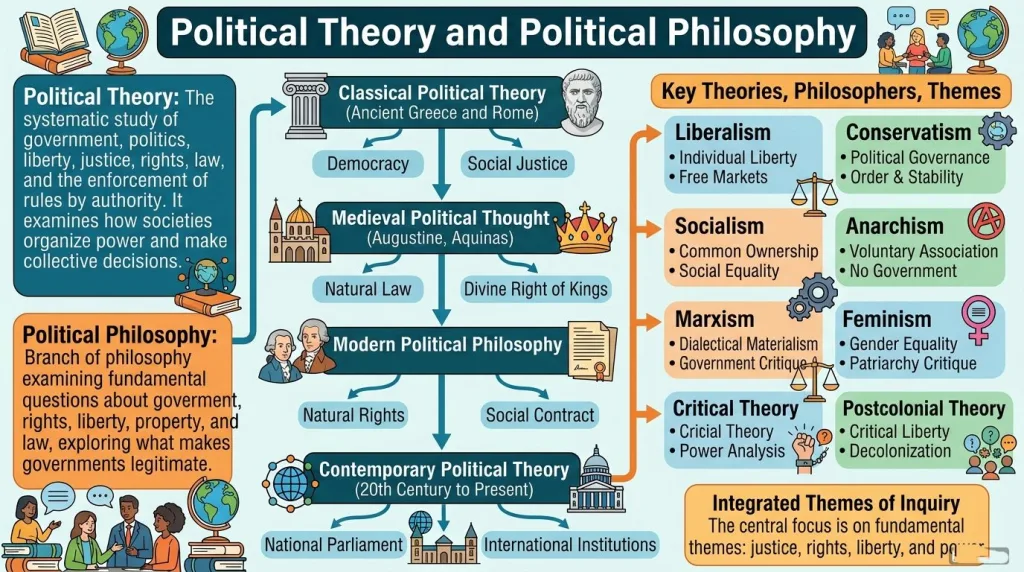
Political theory and political philosophy explore the big questions of public life: power, justice, freedom, authority, rights, equality, law, and the best way to organize society. They do not only ask how governments work, but also how they should work. This makes the field central to understanding democracy, citizenship, institutions, and the moral foundations of political life.
- What Political Theory and Political Philosophy Study:
- They examine the meaning of justice, political power, rights, democracy, law, and the common good.
- Political theory gives a framework for understanding political ideas, while political philosophy evaluates those ideas ethically.
- The field connects abstract thought to real institutions, laws, and public debates.
- Historical Foundations of the Field:
- The subject developed through long debates about who should rule, what makes government legitimate, and how power should be limited.
- Major traditions include classical virtue politics, natural law, social contract theory, liberalism, Marxism, anarchism, and modern justice theory.
- Many current debates about liberty, welfare, equality, and state authority are updated versions of older arguments.
- Major Thinkers and Their Contributions:
- Plato focused on justice, education, and the ideal state ruled by philosopher-kings.
- Aristotle studied constitutions and argued for balanced constitutional government and civic virtue.
- Marx linked politics to class, labor, and economic inequality.
- Other important figures mentioned include Confucius, Machiavelli, Rousseau, Kant, Bentham, Hegel, and Arendt.
- Major Ideological Traditions:
- Liberalism emphasizes rights, limited government, consent, constitutionalism, and individual freedom.
- Marxism focuses on class struggle, capitalism, and material inequality.
- Anarchism challenges centralized state authority and favors voluntary cooperation and decentralization.
- The field also includes conservatism, republicanism, feminism, communitarianism, and libertarianism.
- Democracy in Political Theory:
- Democratic thought has moved from ancient Athens to modern debates over participatory, representative, and deliberative democracy.
- Liberal democratic ideas were shaped by thinkers like Locke and Kant, while Marxism offered a major critique of liberal democracy.
- Current debates ask how democracy should balance freedom, equality, participation, and state authority.
- Contemporary Relevance:
- Modern political theory addresses issues such as identity politics, inequality, rights, recognition, globalization, authoritarian threats, and the future of democracy.
- It helps people think critically about public life instead of accepting institutions as fixed or natural.
- The field remains essential for understanding both enduring political ideas and fast-changing global challenges.
Political theory and philosophy remain foundational in understanding political life, governance, and the ethical underpinnings of society. These disciplines help shape public debates, democracy, and the global landscape while offering critical tools for students to engage with contemporary issues.
Introduction to Political Theory and Political Philosophy
- Political theory is the branch of political science and political philosophy that explores the big questions about power, justice, freedom, authority, rights, and the best way to organize society.
- At its heart, political theory asks not only how governments work, but also how they should work. That is why it is deeply connected to normative questions, meaning questions about values, morality, and what is right or wrong in public life.
- Unlike some areas of social science that focus mainly on data and observation, political theory also examines ideals, principles, and the meaning behind institutions. It helps us understand why laws exist, what makes a government legitimate, and how citizens should relate to the state.
- A theorist in this field studies the ideas of past and present societies and examines how those ideas shape real political systems. For this reason, political theory is often seen as central to political theory as a discipline because it links abstract principles with public life.
- Political philosophers and political theorists examine issues such as:
- the meaning of justice
- the limits of political power
- the value of democracy
- the role of law and the rule of law
- the balance between freedom and equality
- the pursuit of the common good
- In simple terms, political theory gives readers a framework for understanding political ideas, while political philosophy gives them the tools to judge those ideas ethically.
- This is why the field remains essential in the modern political world. Whether people are debating rights, inequality, citizenship, or global conflict, they are often relying on arguments that began in the long history of political thought.
- For students looking for a guide political learning path, this subject offers a foundation for understanding both older traditions and contemporary political debates.
The Historical Foundations of Political Theory
- The study of political theory has deep roots in the history of political thought, stretching across centuries of debate about justice, authority, and human nature.
- The earliest political thinkers tried to answer practical questions that still matter today:
- Who should rule?
- What makes a government just?
- What is the best form of community?
- How should power be limited?
- These questions produced different political theories, each shaped by the time and society in which it emerged. Some defended kingship or aristocracy, while others favored republicanism, democracy, or radical equality.
- The historical development of political theory can be understood as a conversation between generations of major thinkers. Each thinker responds to earlier arguments, revises them, and applies them to new problems.
- Over time, several major traditions emerged within the schools of political thought:
- classical virtue-based politics
- natural law traditions
- social contract theory
- liberalism
- marxism
- anarchism
- modern justice theory and political ethics
- The historical foundations of political theory matter because they show how ideas evolve. What begins as a debate about the city-state in ancient Greece later becomes a debate about the nation-state, capitalism, rights, and even international relations.
- Studying these foundations also helps readers see that today’s political arguments are rarely new. Many current debates over liberty, equality, welfare, and state authority are updated versions of older arguments in western political thought.
Crash Course in Political Theory
- A simple crash course political theory overview begins with one basic idea: this field is about understanding how people live together under authority and how they ought to do so.
- In a short crash course political theory structure, the field can be divided into a few key themes:
- Power and authority – who has the right to rule, and why
- Justice and equality – what societies owe their members
- Freedom and rights – how much autonomy individuals should have
- Law and order – why the rule of law matters
- Citizenship and participation – what role people should play in democracy
- Another useful way to understand political theory is through its two major approaches:
- Normative theory, which asks what ought to be
- empirical or descriptive approaches, which ask what actually happens in politics
- Because of this, political theory stands between philosophy and political science. It is theoretical, but it also affects constitutions, institutions, policy, and the everyday design of forms of government.
- A beginner should also know that political theory is not limited to one ideology. It includes arguments from liberalism, conservatism, republicanism, anarchism, feminism, and marxism, among others.
- In short, political theory teaches readers how to think critically about public life rather than simply accept existing institutions as natural or permanent.
Ancient Roots: Plato, Aristotle, and Early Political Thought
- The ancient roots of political theory begin most famously with plato and aristotle, two of the most influential political philosophers in history.
- Plato examined justice, leadership, and the ideal state. In The Republic, plato argued that society should be ruled by wise philosopher-kings who understand truth and the good. His work remains central to political theory because it asks whether knowledge, virtue, or consent should guide government.
- Aristotle, a student of plato, took a more practical approach. He studied real constitutions and compared different political systems. Aristotle argued that human beings are political by nature and that the purpose of the state is to promote the good life.
- Early political thought focused heavily on virtue, citizenship, and the common good. Rather than starting with individual rights, ancient writers often asked what kind of character citizens needed for a healthy community.
- These ancient debates shaped later political theorists in lasting ways:
- the importance of civic life
- the relationship between ethics and politics
- the dangers of corruption
- the strengths and weaknesses of monarchy, aristocracy, and democracy
- The ancient world did not settle these debates, but it gave later generations the language and concepts that still define political theory today.
Struggling with Your Political Science Research or Thesis?
Get expert assistance with your political science research, thesis, or dissertation from Best Dissertation Writers . Our team specializes in crafting well-researched, professionally written papers tailored to your political science topics. Visit our site for more information and start your journey towards academic success.
Get Professional HelpThe Rise of Liberalism
- The rise of liberalism marked one of the biggest turning points in political theory.
- Early modern thinkers began shifting attention away from virtue-centered politics and toward rights, liberty, consent, and the protection of the individual. This change reflected new social conditions, religious conflict, market growth, and changing views of authority.
- Liberalism is built on several core ideas:
- individual rights
- limited government
- consent of the governed
- tolerance and pluralism
- constitutionalism and the rule of law
- The social contract became especially important during this period. Contract thinkers argued that political authority is legitimate only if it can be justified to free and equal individuals.
- This tradition also encouraged individualism, the belief that persons have moral worth independent of the state or social class.
- In the modern political world, liberalism strongly shaped constitutional democracy, civil liberties, and debates in international relations.
- Later figures such as Rawls renewed liberal thought by asking what a just society would look like if people designed it fairly from an equal starting point.
Marx and the Birth of Socialist Thought
- Marx transformed political theory by arguing that politics cannot be fully understood without economics, class, and material conditions.
- Karl Marx challenged liberal assumptions by claiming that formal freedom means little when deep inequality shapes real life. His work connected economic theory with power, labor, and exploitation.
- Marxism teaches that political institutions often reflect class interests rather than universal justice. From this view, the state is not neutral; it is tied to economic structures and struggles over production.
- Karl Marx also changed the study of political thought by focusing attention on class conflict, capitalism, and historical change.
- The birth of socialist thought introduced major questions that still shape contemporary political debate:
- Who controls wealth and labor?
- Can equality exist under capitalism?
- Is the state a tool of justice or domination?
- Even those who reject marxism continue to engage with marx because his critique of inequality remains one of the most powerful in the history of political thought.
Key Thinkers in Political Philosophy
- Political theory is a key subfield of political science and philosophy that:
- Explores how humans should live together.
- Examines how power should be organized.
- Investigates what makes authority legitimate.
- Studies principles behind laws, leadership, freedom, equality, and justice.
- Looks at how institutions and practices shape everyday life (e.g., voting, education, family relations).
- Foundations in ancient Greek thought:
- Plato and Aristotle systematized questions on citizenship, virtue, law, and the common good.
- Their work influences ongoing debates about democracy, authority, and justice.
- Other influential traditions:
- Confucius emphasized moral order and social harmony.
- Legalism in ancient China focused on discipline and the strength of the centralized state.
- These diverse traditions show the global scope of political theory.
- Later thinkers expanded the conversation:
- Machiavelli: Explored power and statecraft with a mix of realism and idealism.
- Rousseau: Focused on freedom, sovereignty, and inequality.
- Kant: Contributed ideas on moral autonomy and universal law.
- Bentham: Advocated for the principle of utility and happiness.
- Hegel: Examined the ethical life of the state and civil society.
- Arendt: Reflected on freedom, totalitarianism, and the boundary between public and private life.
- Enduring influence of these thinkers:
- Each presented unique views on order, freedom, and moral responsibility.
- Their approaches include rationalism, materialism, and historical or methodological reflection.
- They contributed to philosophy’s goal of not just explaining power, but also judging it.
Plato’s Ideal State and Justice
- Plato is one of the most influential figures in political theory, especially through The Republic, a foundational political treatise. In it, he asks what justice means in the soul and in the city, linking personal morality with social order.
- Plato’s ideal state is built around the idea that a just society functions when each class performs its proper role:
- rulers govern with wisdom,
- guardians defend the city with courage,
- producers supply material needs through labor and trade.
- For Plato, justice is not simple equality. Instead, it is harmony. His answer to the nature of justice is that justice exists when each part of the whole works according to its proper function without interfering with the others.
- This model reflects a strong faith in rationality. Plato believed that political rule should be guided by knowledge rather than appetite, emotion, or wealth. That is why he famously preferred philosopher-kings, whose education would train them in truth, discipline, and moral judgment.
- His account of education is also central to political theory:
- education shapes character,
- character shapes citizenship,
- citizenship shapes the fate of the state.
Plato believed that poor education produces disorder, while disciplined education creates a stable political community.
- At the same time, Plato’s ideal state raises lasting concerns:
- it gives enormous authority to a small ruling class,
- it limits individual freedom,
- it permits censorship and social control in the name of order.
- Because of this, Plato remains important not only as a defender of justice, but also as a warning about the dangers of perfectionist politics. His work forces readers of political theory to ask whether a highly ordered society may drift toward paternalism or even tyranny.
Aristotle: Politics and Constitutional Government
- Aristotle took a more practical approach than Plato. In Politics, another foundational political treatise, he examined constitutions, citizenship, and the real workings of political communities.
- Aristotle argued that human beings are political animals. By this he meant that people achieve their full potential in a community shaped by law, speech, and shared moral purpose. For him, political theory must begin with how people actually live in cities, not only with ideal blueprints.
- He classified governments into good and corrupt forms:
- monarchy can decline into tyranny,
- aristocracy can decline into oligarchy,
- polity can decline into mob rule or distorted democracy.
- His preference for constitutional government came from balance. Aristotle valued mixed systems that restrain extremes, encourage deliberation, and protect the common good. This makes him especially relevant to modern discussions of institutions, moderation, and constitutional design.
- Aristotle also stressed civic virtue. A good constitution does not survive on laws alone; it depends on citizens trained to act responsibly. In this sense, political theory is closely tied to ethics.
- His fear of unstable democracy also connects to later concerns about the tyranny of the majority. If the many govern only for their own advantage, they may ignore justice, property, and minority rights. Aristotle therefore reminds us that democracy needs norms, limits, and habits of self-restraint.
Karl Marx and the Theory of Class Struggle
- Karl Marx transformed political theory by shifting attention from ideals alone to economic structure and historical conflict. With Engels, he argued that political life cannot be understood apart from labor, ownership, and production.
- Marx’s central claim is that history is driven by class struggle. In capitalism, society is divided between:
- the bourgeoisie, who control capital and productive assets,
- the proletariat, who sell their labor to survive.
- This is where materialism becomes crucial. Marx argued that law, culture, morality, and even ideas are shaped by material conditions and by who owns the means of production. Political institutions are therefore linked to deeper economic power.
- Marx believed that many forms of freedom under capitalism are incomplete because they ignore exploitation. He saw class inequality as one of the key social phenomena behind modern politics.
- His work expanded political theory by asking readers to look beyond formal equality and examine actual power in workplaces, property relations, and state structures. It also influenced later debates on revolution, labor, ideology, and global justice.
Anarchism: Rejection of State Authority
- Anarchism is another major current in political theory, defined by its rejection of coercive state authority. Anarchists argue that the state often preserves hierarchy, domination, and violence rather than genuine freedom.
- Unlike simple disorder, anarchism proposes an alternative moral and political vision:
- voluntary cooperation,
- mutual aid,
- decentralized organization,
- community self-management.
- Anarchist thinkers question whether the centralized state is necessary at all. They believe social order can emerge through free association rather than command from above.
- This tradition also challenges the assumption that all rights and obligations must come from official law. Many anarchists believe moral duties arise within communities, workplaces, and shared human relationships, not only through formal government.
- In that way, anarchism forces political theory to reconsider whether authority must always be institutional, and whether freedom is better protected by networks of cooperation than by centralized control.
The Impact of Identity Politics on Political Thought
- Contemporary political theory has been deeply shaped by identity politics, which focuses on how social identity influences power, recognition, exclusion, and justice.
- This approach highlights the fact that race, gender, class, sexuality, religion, and culture affect how people experience laws, representation, and opportunity. It pushes political thought beyond universal claims that sometimes hide inequality.
- Identity-based analysis has changed debates in modern philosophy by asking who is included in the category of “the citizen,” whose voice counts in deliberation, and how institutions can respond to structural injustice.
- It has also created dialogue with traditions such as communitarianism, which emphasizes belonging, shared values, and collective life, while still raising hard questions about pluralism, conflict, and inclusion in civil society.
- The strength of identity politics is that it makes political theory more attentive to lived experience. Its challenge is to balance difference with solidarity, so that democratic thought can address both recognition and common purpose.
Political Theories and Democracy
- Political theory explores how political power is organized and how societies should govern themselves. At the heart of political theory is the question of democracy, a system of governance where citizens have a role in decision-making.
- Over time, thinkers have developed diverse theories about democracy and its role in society, shaping our understanding of politics today. In this section, we will dive into the evolution of democratic ideas, examining key theories and thinkers, from ancient Greece to modern debates.
Democracy in Political Theories: A Historical Overview
- Democracy has its roots in ancient Greece, particularly in the city-state of Athens.
- The Athenian model of democracy involved direct participation where citizens voted on laws and policies.
- Philosophers like Plato and Aristotle explored and critiqued this form of government, raising questions about the nature of justice, virtue, and the role of citizens in politics.
- Plato’s critique of democracy:
- Plato, in The Republic, argued that democracy, though based on equality, leads to mob rule and can eventually degrade into tyranny.
- He believed that democracy’s reliance on the will of the majority neglected the wisdom of philosopher-kings and the importance of rationality.
- Aristotle’s view:
- Aristotle, however, offered a more balanced perspective, suggesting that democracy could work well if combined with other forms of government, such as aristocracy or monarchy.
- He believed democracy should be moderated through laws that promote the common good and limit the power of the majority.
- The historical development of democracy saw it evolving from these early critiques, shaped by thinkers who focused on the balance between individual liberty and collective decision-making.
Liberalism and the Foundation of Democratic Ideals
- Liberalism laid the groundwork for modern democracy by promoting individual rights and freedoms.
- John Locke, one of liberalism’s primary thinkers, argued for a governmental system based on consent of the governed. His ideas about the social contract and natural rights influenced modern democratic systems.
- Locke’s conception of democracy was centered around the protection of private property, freedom of speech, and freedom of religion.
- The Liberal Tradition:
- In liberal democratic systems, individual liberty is balanced with the rule of law.
- Liberals believe that democracy should protect individual freedoms and that political authority is legitimate only if it derives from the consent of the people.
- Over time, liberalism has been central to the development of democratic public policy, with debates focusing on the scope of government intervention, economic inequality, and civil liberties.
- Immanuel Kant:
- Kant’s work further advanced the liberal conception of democracy by emphasizing moral autonomy and the idea of universal law. His theory suggests that a just democracy must be based on moral principles that apply equally to all citizens.
- He also believed that democracy could help promote peace, aligning with his ideas on international relations and the possibility of a universal democratic republic.
- Georg Wilhelm Friedrich Hegel:
- Hegel’s ideas added complexity to liberal democracy, emphasizing the role of the state in promoting ethical life. He believed that freedom is actualized through participation in a rational state that recognizes the rights and responsibilities of individuals and communities.
- Hegel’s work informed later debates on governmental authority, civil society, and democracy’s role in achieving human freedom.
Marxism and Its Critique of Democracy
- Marxism offers a stark critique of democracy, particularly liberal democracy, by focusing on the role of class struggle and economic relations in shaping politics.
- Karl Marx argued that the state, under capitalism, serves the interests of the ruling class (the bourgeoisie) and perpetuates inequality.
- According to Marx, democracy in capitalist societies is a tool that allows the wealthy to maintain control over the means of production and labor.
- Marx’s critique of democracy:
- Marx rejected the idea that democracy could resolve inequality, as he believed the state was inherently biased toward the capitalist class.
- He argued that a true democratic society would emerge only after the working class (the proletariat) overthrows capitalism and establishes a socialist state where the workers control production.
- Engels further developed Marx’s ideas, focusing on the role of class consciousness and revolutionary action to establish a society based on equality and common ownership.
Schools of Thought on Democracy: Participatory vs. Representative Models
- Participatory Democracy:
- Participatory democracy emphasizes direct involvement of citizens in decision-making processes.
- Thinkers like Jean-Jacques Rousseau argued that true democracy requires active participation from citizens, who should directly influence laws and policies.
- Rousseau’s concept of the general will is central to participatory democracy, where the collective good is determined through direct deliberation and consensus.
- Representative Democracy:
- In contrast, representative democracy suggests that citizens elect representatives to make decisions on their behalf.
- This model addresses the challenges of scale in large, complex societies where direct participation is impractical.
- Key thinkers like Niccolò Machiavelli contributed to this model by emphasizing the role of political leaders who can act decisively in the interest of the state.
- Deliberative Democracy:
- In more recent debates, deliberative democracy has gained attention. This school focuses on the role of discussion and argumentation in democratic decision-making.
- The idea is that citizens engage in thoughtful deliberation, considering the fundamental principles of justice, fairness, and the common good.
Struggling with Your Political Science Research or Thesis?
Get expert assistance with your political science research, thesis, or dissertation from Best Dissertation Writers . Our team specializes in crafting well-researched, professionally written papers tailored to your political science topics. Visit our site for more information and start your journey towards academic success.
Get Professional HelpModern Political Philosophy and Contemporary Debates
- Modern political philosophy has witnessed a broadening of the scope of democratic theories, addressing issues of justice, equality, and the rights of marginalized groups.
- Thinkers like Hannah Arendt and John Rawls contributed significantly to the modern understanding of democracy.
- Arendt explored the idea of political action and the role of public and private spheres in democratic life, emphasizing the importance of participation in public life and collective decision-making.
- Rawls, in his book A Theory of Justice, proposed a model of justice as fairness, advocating for a social contract that would be accepted by all under a veil of ignorance, where individuals do not know their social or economic status.
- Contemporary debates focus on issues such as:
- The role of identity politics in modern democracy,
- The tension between individual rights and collective responsibility,
- The relationship between economic inequality and democratic participation.
Current Political Theories: From Liberalism to Anarchism
- Liberalism continues to dominate much of democratic public policy, with debates about how to balance individual freedom with state intervention.
- Issues like healthcare, climate change, and economic reform are central to liberal democratic debates today.
- Anarchism challenges the very existence of the state and its role in democratic societies.
- Anarchists argue for a society organized through voluntary cooperation, rejecting centralized authority.
- Contemporary anarchist movements push for more decentralized and horizontal forms of governance.
- Other contemporary political theories include:
- Communitarianism, which emphasizes the role of community and shared values in shaping democratic life.
- Libertarianism, which advocates for minimal state interference in the lives of individuals.
- Feminist and postcolonial political theories, which critique the structures of power and privilege within democratic systems.
Identity Politics in Modern Political Philosophy
- Identity politics has become a powerful force in contemporary political theory, focusing on the intersection of race, gender, class, and sexuality in shaping political outcomes.
- Identity-based movements have sought to challenge the ways in which traditional political theories have excluded or marginalized certain groups.
- Thinkers like bell hooks, Kimberlé Crenshaw, and Judith Butler have highlighted the ways in which social identity influences political power, arguing for greater recognition and inclusivity in democratic decision-making.
- Identity politics raises important questions about:
- How democracy can accommodate diverse groups,
- The role of social justice in democratic life,
- The impact of historical oppression on current public policy.
- Political science helps us understand how governments work, how power is distributed, and the roles that policies play in society. A great starting point is to understand what political science is and its various branches.
- Political science is a popular major, but is it the right fit for you? If you’re unsure, read more about why political science is a great major and how it can lead to fulfilling career paths.
- Choosing the right academic program is crucial when studying political science. Our article on top political science schools provides insight into the best universities and programs available.
- While political science is full of career opportunities, there are often misconceptions surrounding the field. Our guide on political science rumors debunks common myths and presents the real picture of political science careers.
- If you’re ready to start working on a research project, it’s important to choose a strong topic. Our article on research topics in political science can help inspire ideas for your next thesis or dissertation.
- To stay current with cutting-edge research in political science, it’s essential to read the most reputable journals. Learn more about top political science journals where the latest studies are published.
- Finally, after completing your degree, there are numerous career options in the field. Our article on career options provides an in-depth look at the various professions that political science graduates can pursue.
The Future of Democracy in a Changing World
- As the world faces new challenges, the future of democracy is uncertain.
- Issues like climate change, globalization, and technological advancements require a rethinking of democratic structures.
- Political theory must adapt to address how democracy can function in an increasingly interconnected and complex world.
- Some scholars suggest that:
- Democracy may need to become more participatory and inclusive to respond to global challenges.
- Others warn that democracy is under threat from authoritarian regimes and the erosion of democratic norms.
- Ultimately, political theory will continue to evolve as philosophers and activists work to address the tensions between freedom, equality, and authority in a rapidly changing world.
References
- What Is Political Science? – University of Washington Department of Political Science – https://www.polisci.washington.edu/what-political-science
- Political Science Department – University of Utah – https://poli-sci.utah.edu/
- What Is Political Science? – Southern New Hampshire University – https://www.snhu.edu/about-us/newsroom/social-sciences/what-is-political-science