

What Is Political Science? – Key Takeaways
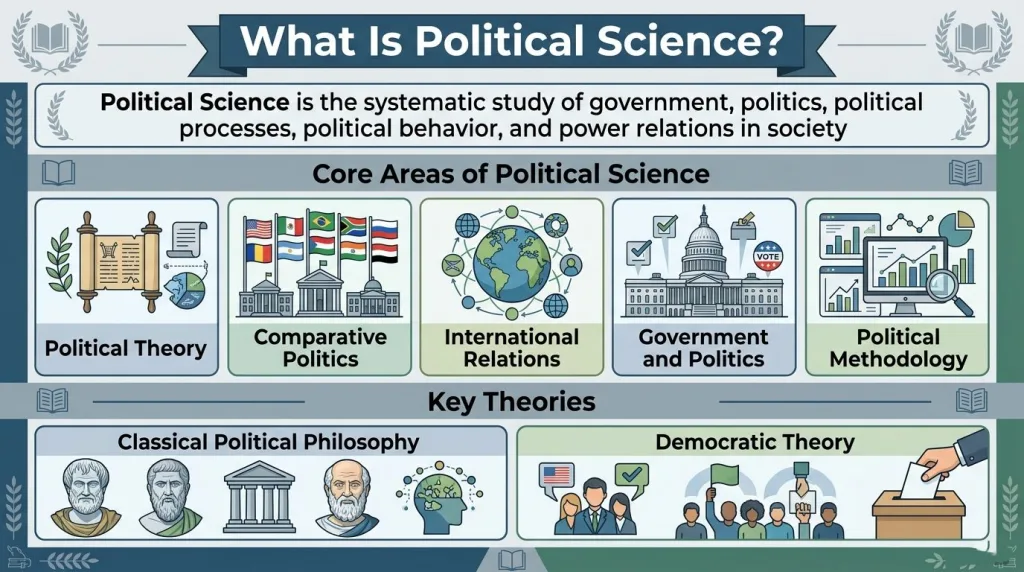
Political science is the systematic study of government, politics, political behavior, and public policy. It is a branch of social science that examines how political systems work, how power is exercised, how decisions are made, and how institutions shape society. It helps students understand both local and global politics and provides tools for analyzing political systems, public issues, and governance.
- What Political Science Means:
- It studies government structures, political processes, institutions, and behavior.
- It explains how policies are made, why conflicts arise, and how political systems function.
- It is relevant to understanding both daily civic life and global affairs.
- Main Areas of Political Science:
- Political theory focuses on ideas such as justice, power, freedom, equality, and authority.
- Comparative politics compares political systems across countries.
- International relations studies how states and global institutions interact.
- Government and politics examines political systems, parties, institutions, and policymaking.
- Political methodology uses research methods and data analysis to study political issues.
- Why It Matters for Students:
- It helps students understand governance, public opinion, political ideologies, and institutions.
- It develops critical thinking, research, analysis, and communication skills.
- It provides a foundation for active citizenship and informed participation in democracy.
- Career Paths with a Political Science Degree:
- Graduates can work in government, public administration, law, policy analysis, diplomacy, advocacy, education, research, public relations, and international organizations.
- Common roles include policy analyst, legislative assistant, diplomat, public administrator, political consultant, lobbyist, and legal analyst.
- The degree is versatile and useful in both the public and private sectors.
- Key Theories and Ideas in the Field:
- Important approaches include classical political philosophy, realism, liberalism, behaviorism, Marxism, and constructivism.
- These theories help explain political behavior, institutions, and international relations.
- They provide different ways of understanding how power, identity, and interests shape politics.
- Why Political Science Remains Important Today:
- It helps explain political change, global interdependence, elections, public policy, and governance challenges.
- It is useful for understanding issues such as democracy, international conflict, law, human rights, and public administration.
- Political science remains important because it connects academic study with real-world decision-making and leadership.
Political science plays a critical role in understanding governance and shaping decisions on local, national, and international levels. It provides essential tools for students interested in making meaningful contributions to society and understanding the forces that govern the world around them.
Introduction: What is Political Science?
- Definition of Political Science:
- Political science is the systematic study of government, politics, and political behavior. It focuses on understanding the structures, processes, and dynamics of political systems, institutions, and individuals involved in governance.
- It is a branch of social science that analyzes political phenomena and aims to explain how political systems function, why political conflicts arise, and how policies are made and implemented.
- Why Study Political Science?
- Political science helps individuals understand the world around them, particularly how government institutions and political ideologies influence daily life.
- By studying political science, individuals gain insights into the dynamics of power, authority, and governance, and how these elements shape public policies and political behavior.
- Key Components of Political Science:
- Political theory: Focuses on fundamental political ideas, ideologies, and philosophies that have shaped political thought through history.
- Comparative politics: Studies different political systems across countries to understand their structures, policies, and outcomes.
- International relations: Investigates the relationships between countries and the factors influencing global politics.
- Political methodology: Involves using scientific methods to analyze and understand political phenomena.
- Political Science in Contemporary Society:
- The study of political science is highly relevant as it helps us comprehend political dynamics of countries, understand political parties, and analyze the effects of public opinion on political systems.
- It enables us to explore political institutions, the interaction between different branches of government, and the decision-making processes involved in policy analysis.
- The Role of Political Scientists:
- Political scientists research, analyze, and interpret political phenomena. They contribute to understanding the political dynamics of different nations and offer insights into public policies and governance.
The Political Science Degree: Is It Worth It?
- Overview of Political Science Degree:
- A degree in political science offers students the tools and skills to analyze the complexities of government and politics.
- It provides knowledge about political systems, political institutions, and the political processes that affect local and global governance.
- Career Opportunities with a Political Science Degree:
- Graduates of political science can pursue a variety of career paths in government, non-profit organizations, think tanks, and the private sector. Possible careers include:
- Political scientists who analyze and interpret data on political issues.
- Policy analysts who work on formulating and assessing public policies.
- Government officials working in administration, public administration, or public opinion research.
- International relations experts involved in diplomacy or working in international organizations.
- Public administration professionals who manage government resources and services.
- Graduates of political science can pursue a variety of career paths in government, non-profit organizations, think tanks, and the private sector. Possible careers include:
- Is the Political Science Degree Worth It?
- A bachelor’s degree in political science is valuable for students who are passionate about understanding the political world and want to influence change through various career paths.
- The degree provides a foundation in political thought, public policy, international political economy, and political philosophy.
- The American Political Science Association reports that political science graduates have high employability and can pursue diverse roles such as political consultants, journalists, and lawyers.
History of Political Science: Tracing the Origins and Development
- Roots in Ancient Thought:
- The history of political science traces back to ancient philosophers like Plato, Aristotle, and Machiavelli, who laid the foundations for the study of governance and political systems.
- Political theory and political philosophy emerged as methods for understanding the ideal forms of government and the dynamics of power.
- Development Through Time:
- Over time, the field of political science expanded, with political theorists analyzing and critiquing various political systems and ideologies.
- The history of political science became more formalized with the establishment of academic departments in universities, starting with the development of the Department of Political Science in the 19th century.
- Modern Political Science:
- In the 20th century, the study of political behavior, political parties, and political ideologies became central to the field. The advent of new research methods and statistical tools transformed political science into a more empirical and analytical discipline.
- Today, political science research is vital for understanding contemporary political issues and policy analysis.
Struggling with Your Political Science Research or Thesis?
Get expert assistance with your political science research, thesis, or dissertation from Best Dissertation Writers . Our team specializes in crafting well-researched, professionally written papers tailored to your political science topics. Visit our site for more information and start your journey towards academic success.
Get Professional HelpCore Areas of Political Science
The study of political science is vast and multidisciplinary, divided into several core areas that explore different facets of politics and governance. Each of these subfields equips students with unique insights into the workings of political systems, ideologies, and the complexities of political behavior. Below are the key areas of study within a political science degree program:
Political Theory
- Overview:
- Political theory is the foundational area of political science that examines the nature and philosophy of politics. It explores the ideas and concepts that have shaped political systems throughout history.
- Key Concepts:
- This area focuses on political thought, considering key concepts such as justice, power, freedom, equality, and authority. Political theorists examine how these ideas relate to the organization of society and government.
- Political theory also involves a deep dive into political ideologies like liberalism, conservatism, socialism, feminism, and more, analyzing their historical development and their impact on contemporary political systems.
- Famous Political Theorists:
- Students learn about the works of classic political philosophers such as Plato, Aristotle, Hobbes, Locke, Marx, and John Stuart Mill, whose ideas laid the groundwork for modern political science.
- Real-world Application:
- Political theory helps students understand the ethical dimensions of governance and the role of the state in regulating individual behavior. It provides the philosophical background for analyzing policies, such as human rights, civil liberties, and political representation.
- Connection to Other Subfields:
- Political theory lays the groundwork for other subfields of political science, influencing how students analyze and critique the foundations of various political systems and political ideologies.
Comparative Politics
- Overview:
- Comparative politics involves comparing political systems, institutions, and processes across different countries and regions. It seeks to understand how different governments operate, how they interact with society, and how they address issues like inequality, security, and economic development.
- Key Concepts:
- This subfield examines the political systems of democratic, authoritarian, and hybrid regimes. It also explores electoral systems, political parties, interest groups, and the relationship between the state and society.
- Comparative politics emphasizes the differences and similarities between political institutions and processes in different parts of the world, providing a rich context for understanding global governance.
- Key Topics Studied:
- The structure and function of political institutions (e.g., parliaments, courts, executives) in different nations.
- Electoral systems and voting behavior.
- The role of political parties in shaping public opinion and policy outcomes.
- Issues such as political corruption, civil liberties, human rights, and democracy promotion.
- Real-world Application:
- Comparative politics allows students to gain insights into how different systems address similar challenges, helping them understand why certain countries are more successful in implementing public policies than others.
- It is essential for policy analysis, international diplomacy, and assessing the effectiveness of governance systems worldwide.
International Relations
- Overview:
- International relations (IR) studies the interactions between countries, as well as the roles of international organizations, global institutions, and actors like multinational corporations. This area of political science is essential for understanding the forces that shape the global political landscape.
- Key Concepts:
- International relations covers topics such as international political economy, global security, trade, diplomacy, and human rights.
- Theories of international relations, including realism, liberalism, and constructivism, help explain how countries behave in the global arena and how conflicts and cooperation unfold between states.
- Key Topics Studied:
- Foreign policy analysis, where students learn how countries make decisions regarding their relationships with others.
- Global governance, including the role of international organizations like the United Nations, World Trade Organization, and International Monetary Fund.
- International political economy, examining how politics and economics interact on a global scale.
- Issues of global security, including military alliances, diplomacy, and conflict resolution.
- Real-world Application:
- International relations provides critical insights for those interested in careers in diplomacy, international business, development agencies, or international law.
- It helps students understand how states and international organizations collaborate to solve global issues, such as climate change, terrorism, and poverty.
Government and Politics
- Overview:
- The study of government and politics focuses on the structure, function, and processes of political systems, primarily at the national level. This area of political science looks at how governments organize, exercise power, and create policies that affect citizens’ lives.
- Key Concepts:
- Students examine the role of the state, government institutions, and political leaders in shaping public policies and implementing laws. They study the nature of political authority, sovereignty, and democracy.
- This subfield also explores political systems (e.g., American politics, parliamentary systems, socialist states) and their comparative effectiveness in achieving political goals.
- Key Topics Studied:
- The study of political parties and their role in policy-making and elections.
- The examination of political campaigns, public opinion, and voting behavior.
- Political institutions such as legislatures, executives, and judicial systems, and how they interact within the broader framework of governance.
- The impact of political ideology on governance and policy analysis.
- Real-world Application:
- Government and politics equips students with the skills to understand the functioning of local, national, and international political systems. It prepares individuals to take roles in public administration, governmental agencies, and policy research.
- Students of political science interested in this field may go on to pursue careers as government officials, legislators, or policy analysts.
Political Methodology
- Overview:
- Political methodology focuses on the research techniques and tools used by political scientists to analyze political phenomena. This subfield provides the quantitative and qualitative methods necessary to study political systems, public opinion, political behavior, and policy outcomes.
- Key Concepts:
- The use of statistical methods, surveys, and experiments to gather data about political systems and behavior.
- Political scientists employ these methods to analyze electoral patterns, political participation, and the effectiveness of public policies.
- Key Topics Studied:
- The study of research designs, data collection techniques, and statistical analysis in the context of political science.
- The use of surveys, experiments, and case studies to analyze political issues, including voting behavior, policy support, and public opinion.
- Techniques for evaluating the effectiveness of political actions, campaigns, and political interventions.
- Real-world Application:
- Political methodology is critical for students interested in pursuing careers in political consulting, opinion polling, and academic research.
- This area of study is essential for those who want to design political science research or engage in policy analysis to inform decision-making in governmental or international organizations.
Political Science Careers: What Can You Do with a Political Science Degree?
Political science is a dynamic and multifaceted field of study that opens up a wide range of career paths for graduates. A degree in political science is highly versatile and can lead to opportunities in various sectors, including government, private industry, nonprofit organizations, and international relations. Below are some of the most common career paths for political science majors:
- Public Sector Careers:
- Political science graduates often find careers in government at local, state, and federal levels. Some of the roles include:
- Policy Analyst: Evaluates public policies and their effects, recommends policy changes, and provides advice to government officials.
- Legislative Assistant: Works directly with elected officials, providing research, drafting speeches, and helping develop legislation.
- Government Official: Works within government agencies, such as the Department of Political Science, helping to implement policies and manage government operations.
- Public Administrator: Manages public sector organizations and ensures they are functioning efficiently and according to law.
- Political science graduates often find careers in government at local, state, and federal levels. Some of the roles include:
- International Relations and Diplomacy:
- Graduates can also enter careers in diplomacy and international relations, roles that require an understanding of global governance, political science theories, and international political systems.
- Diplomat: Represents the government in foreign countries, negotiating treaties and trade agreements, and managing diplomatic relations.
- Foreign Service Officer: Works for the government abroad, dealing with international relations and the political and economic interests of the country.
- International Development Specialist: Works with international organizations to improve the development and infrastructure of developing nations.
- Graduates can also enter careers in diplomacy and international relations, roles that require an understanding of global governance, political science theories, and international political systems.
- Political Science in Private Industry:
- Political Science jobs are not limited to government positions. Graduates often find roles in private companies, especially those working in areas affected by public policies.
- Political Consultant: Provides advice to political candidates and organizations on strategies, messaging, and public opinion.
- Lobbyist: Works on behalf of corporations or interest groups to influence public policy decisions at various government levels.
- Public Relations Specialist: Manages the public image of politicians, organizations, and other entities, shaping public perception through the media.
- Political Science jobs are not limited to government positions. Graduates often find roles in private companies, especially those working in areas affected by public policies.
- Nonprofit and Advocacy Organizations:
- Many political science graduates are drawn to nonprofit organizations that work on issues like human rights, environmental protection, and social justice. These organizations require individuals with strong critical thinking and policy analysis skills.
- Advocacy Director: Leads efforts to influence political decisions on behalf of marginalized or underrepresented groups.
- Community Organizer: Works to mobilize individuals and communities around political or social causes, often focusing on organizing grassroots efforts for political change.
- Many political science graduates are drawn to nonprofit organizations that work on issues like human rights, environmental protection, and social justice. These organizations require individuals with strong critical thinking and policy analysis skills.
- Education and Research:
- Political science graduates can also pursue careers in academia, researching and teaching political science to future students.
- University Professor: Teaches political science courses and conducts research in areas such as political theory, comparative politics, and international relations.
- Research Analyst: Works for think tanks or research organizations to conduct studies on political phenomena, offering insights into the functioning of political systems.
- Political science graduates can also pursue careers in academia, researching and teaching political science to future students.
- Legal Careers:
- The analytical and writing skills developed through a political science degree make graduates strong candidates for legal careers. Many political science majors go on to law school to become lawyers or legal consultants.
- Lawyer: Specializes in different areas of law, including constitutional, criminal, and civil law.
- Legal Analyst: Works within law firms or government agencies, researching legal issues, reviewing documents, and assisting lawyers with case preparation.
- The analytical and writing skills developed through a political science degree make graduates strong candidates for legal careers. Many political science majors go on to law school to become lawyers or legal consultants.
Struggling with Your Political Science Research or Thesis?
Get expert assistance with your political science research, thesis, or dissertation from Best Dissertation Writers . Our team specializes in crafting well-researched, professionally written papers tailored to your political science topics. Visit our site for more information and start your journey towards academic success.
Get Professional HelpBecoming a Political Scientist: Steps and Qualifications
A career as a political scientist requires a strong educational background, analytical skills, and an interest in understanding political systems and political phenomena. Below are the steps to becoming a political scientist:
- Educational Path:
- Bachelor’s Degree in Political Science: The first step is to earn a bachelor’s degree in political science, which provides the foundational knowledge necessary to understand political structures, processes, and systems. This degree typically includes courses in political theory, government, political behavior, international relations, and political methodology.
- Graduate Studies: For those wishing to conduct advanced research or teach at the university level, a master’s degree or Ph.D. in political science is often required. Graduate programs delve deeper into specialized areas, such as comparative politics, international relations, and public administration.
- Skills Development:
- Political scientists need to develop strong research, analytical, and writing skills. It is also beneficial to have expertise in political analysis, statistical methods, and policy evaluation.
- Many political scientists also engage in internships or work experience in government agencies, think tanks, or political organizations to gain practical experience in their field.
- Work Experience:
- While not always required, internships or related work experience provide valuable insight into political processes and help build a professional network.
- Political scientists often engage in research or policy analysis for governmental bodies, NGOs, or political consulting firms.
- Certifications and Continuous Education:
- While there is no formal certification required to become a political scientist, attending conferences, workshops, and obtaining certifications in data analysis or policy analysis can be beneficial.
- Political scientists must stay updated on the latest political events, trends, and methodologies by engaging in continuous education.
Theories of Political Science: Key Theories You Should Know
Political science as a field of study is based on various theories that help us understand political behavior, institutions, and governance. Here are some of the key theories:
- Classical Political Philosophy:
- Classical political philosophy laid the foundation for modern political science. Philosophers like Plato, Aristotle, and Machiavelli discussed the nature of justice, the ideal state, and the role of rulers in society. These early ideas shaped many of the concepts we use in political theory today.
- Realism:
- Realism in international relations is based on the idea that states act in their own self-interest, primarily focused on maintaining power and security. Political scientists examine how countries interact under this framework, often leading to conflict and competition for resources.
- Liberalism:
- Liberalism, on the other hand, argues that individuals and governments can work together to promote cooperation, peace, and prosperity. It focuses on the importance of democracy, human rights, and international institutions in fostering peaceful relations between states.
- Behaviorism:
- Behavioralism is a theory in political science that emphasizes the study of actual political behavior rather than abstract theories or ideologies. It focuses on how individuals and groups interact with political systems and make political decisions.
- Marxism:
- Marxist theory analyzes political and economic systems, focusing on the role of class struggle in shaping political outcomes. Marxism is particularly influential in understanding the dynamics of social movements, economic systems, and the politics of inequality.
- Constructivism:
- In international relations, constructivism argues that political behavior is shaped by social norms, identity, and ideas. This theory emphasizes the importance of how actors in the international system construct their understanding of reality and their political strategies.
American Government and Politics: A Case Study in Political Science
The United States has one of the most well-studied political systems in the world. American politics serves as a critical case study for political scientists. Here’s why it’s significant:
- The Structure of American Government:
- The United States government operates under a federal system, with power divided between the federal government and state governments. This division is a key area of study in political science.
- The U.S. political system is also characterized by the separation of powers between three branches: the executive, the legislative, and the judicial. Political scientists analyze how these branches interact and check each other’s power.
- The Political Parties:
- American politics is heavily influenced by its two-party system, with the Democratic and Republican parties dominating the political landscape. Political scientists examine the roles these parties play in shaping public opinion, policymaking, and elections.
- Electoral System and Voting Behavior:
- The U.S. electoral system, particularly the Electoral College, is a subject of intense debate and analysis. Political scientists study how elections are conducted, how voter behavior is influenced, and the impact of campaign strategies.
- Policy Analysis in American Government:
- U.S. political science is also focused on policy analysis, which involves evaluating the effectiveness of public policies in areas like healthcare, education, and foreign relations. Political scientists use both qualitative and quantitative methods to assess the impact of these policies.
- Political science is a broad field that examines the dynamics of governments, political systems, and how individuals interact within them.
- For a deeper dive, consider exploring a political theory overview, which covers key thinkers and their ideas.
- To understand how research is shaped in political science, take a look at the leading political science journals where groundbreaking studies are published.
- If you’re considering the major, you may ask, “Is political science a good fit for me?” This question is addressed in our career path guide.
- When selecting an academic path, it’s helpful to research the best political science schools that offer strong programs in this field.
- Need research ideas for your thesis or papers? Check out our list of paper topic ideas in political science to inspire your next project.
- Lastly, you may have heard rumors about political science careers—many of them are debunked in our article on common myths about the field.
- Finally, explore the potential careers in political science with our guide on career options available with this degree.
Conclusion: Why Political Science Matters for Students Today
Political science is not just an academic discipline; it is a field of study that has real-world applications. Understanding the political processes, public policies, and the behavior of political actors is critical for informed citizenship and active participation in democracy.
- Political Science is a Social Science:
- Political science is a social science, meaning that it focuses on human behavior, social structures, and systems. This makes it relevant for understanding everything from local governance to global politics.
- Understanding Political Phenomena:
- Political science helps us understand political phenomena such as voting patterns, the rise of political movements, and how governments function. By studying political science, students develop critical thinking skills that are vital for analyzing complex social and political issues.
- Global Significance:
- As global interdependence increases, understanding international relations and political science is more important than ever. Graduates of political science programs contribute to better policy analysis, diplomacy, and governance worldwide.
- Impact on Careers:
- A degree in political science opens doors to careers in government, international relations, advocacy, education, and research. Whether you’re interested in policy analysis, international relations, or becoming a political scientist, a political science degree provides the foundation for a fulfilling career that shapes the future of societies and countries.
References
- What Is Political Science? – University of Washington Department of Political Science – https://www.polisci.washington.edu/what-political-science
- Political Science Department – University of Utah – https://poli-sci.utah.edu/
- What Is Political Science? – Southern New Hampshire University – https://www.snhu.edu/about-us/newsroom/social-sciences/what-is-political-science