

Political Science Research Topics – Key Takeaways
Political science research topics cover a wide range of areas such as governance, public policy, international relations, political theory, political behavior, public law, democratization, media, corruption, and political economy. Choosing the right topic is an important step in writing a strong research paper because it shapes the quality, depth, and relevance of the entire project. A good topic should match the student’s interests, be researchable, stay current, and be narrow enough for focused analysis.
- How to Choose a Strong Political Science Topic:
- Pick a topic that matches your interests and course focus.
- Choose something relevant and current, especially around modern political issues.
- Make sure the topic is neither too broad nor too narrow.
- Use credible academic sources and narrow the subject to a clear angle.
- Good Practices for Writing the Paper:
- Build the paper around a clear research question.
- Use credible and varied sources such as journals and books.
- Stay objective, provide context, and organize the paper well.
- Avoid broad topics, plagiarism, rushed research, outdated sources, and weak conclusions.
- Major Topic Areas in Political Science:
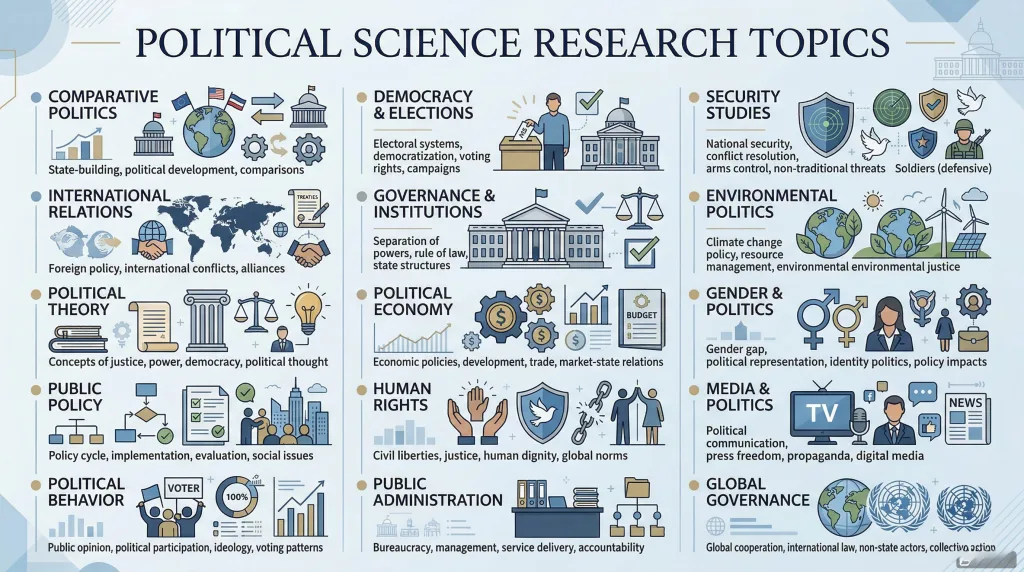
- The post groups topics into areas such as international relations, comparative politics, public administration, political theory, public law, political behavior, civil society, governance, policymaking, democracy, corruption, globalization, conflict resolution, political economy, media, institutions, and methodology.
- These categories help students focus on a specific branch of the discipline.
- Examples of Current and Easy Topics:
- Current topics include issues like social media and elections, political polarization, climate policy, misinformation, democratic backsliding, gender representation, and AI in governance.
- Easier student topics include voting, political parties, constitutions, local government, nationalism, women in politics, and youth participation.
- Advanced and Dissertation-Level Directions:
- More advanced topics focus on electoral reform, democratic transitions, health care reform, globalization, peacekeeping, foreign policy, human rights, bureaucracy, and the relationship between institutions and political outcomes.
- These are suited for deeper comparative or analytical research.
- What Makes a Topic Effective:
- An effective topic is focused, researchable, relevant, and supported by strong sources.
- It should lead to a clear argument, allow critical analysis, and connect to real political questions or debates.
Choosing a strong research topic in political science is essential for producing a meaningful and relevant paper. Whether focusing on current issues or more advanced research, selecting a topic that aligns with your interests and allows for a focused, evidence-based analysis will ensure a more impactful and successful study.
How to Choose the Best Political Science Research Topics
Choosing the right political science research topic is crucial for producing a high-quality research paper. Political science is a diverse field with a wide range of topics that explore governance, policy, international relations, and political theory. Here are some helpful tips for selecting the best political science research topics:
- Align the Topic with Your Interests: Choosing a political science research paper topic that you are passionate about will make the writing process much easier and more enjoyable. Consider your interests in areas like political theory and political philosophy, state power, international agreements, or the study of politics. Research topics that resonate with you will help keep you motivated throughout the project.
- Choose a Relevant and Current Topic: Look for emerging trends or political science research topics that address modern issues, such as political polarization, globalization, or environmental policy. Being timely and relevant will ensure your research is aligned with the current discourse in political science.
- Consider the Scope of the Topic: While it’s important to be specific, your topic should also offer enough depth for in-depth research. A topic that is too narrow might not provide enough material for a thorough analysis, while a very broad topic may lead to a shallow treatment. Strike a balance that allows you to explore political ideas in-depth while staying focused.
- Focus on Areas You Are Comfortable With: If you have taken a political science class, you may already have a good grasp of certain areas of political science. Leverage that knowledge when choosing your topic. This ensures you can provide research paper help by tapping into your existing understanding of certain political systems, governance, or political behavior.
- Explore Diverse Sources: When research topics explore different themes like international relations, political behavior, or comparative politics, ensure you have access to credible sources. Your research should be based on scholarly articles, books, and reliable online resources. Avoid relying on non-academic sources that could weaken your analysis.
- Narrow Down Your Topic: Once you have a list of political topics, narrow it down to a specific angle. For instance, if you’re interested in analyzing governance, focus on a particular country or a comparison among countries. This makes your paper more structured and manageable.
Top 6 Do’s and 6 Don’ts of Political Science Research Papers
Writing a political science research paper can be daunting, but following some essential strategies used by successful writers can guide you to success. Here’s a list of do’s and don’ts to keep in mind:
Do’s:
- Do Focus on a Clear Research Question
- Your political science research paper topics should be based around a specific question. This keeps your research on track and helps you structure your argument effectively.
- Do Use Credible and Varied Sources
- Make sure to reference peer-reviewed journals, books, and reputable online resources. Credible sources are vital for creating a well-supported research paper.
- Do Provide Context for Your Topic
- Topics offer much more value when you provide historical and political context. For example, if you’re writing on international agreements, explain their significance in political history.
- Do Stay Objective
- Avoid letting personal opinions cloud your analysis. In-depth research should be unbiased and based on facts and evidence, especially when examining topics like state power or governance strategies.
- Do Structure Your Paper Well
- A clear structure with a defined introduction, body, and conclusion is essential. This allows you to present your political ideas logically and ensures coherence throughout your paper.
- Do Follow the Formatting Guidelines
- Stick to the formatting rules provided by your instructor or institution. Proper referencing, consistent font size, and line spacing make your paper easier to read.
Don’ts:
- Don’t Choose an Overly Broad Topic
- Choosing political science research topics that are too broad, like “The Study of Politics”, can make your research unfocused. Always narrow down your focus to a specific issue within the topic.
- Don’t Ignore Counterarguments
- Even when you have a strong stance on an issue, it’s important to present and analyze opposing views. This shows critical thinking and a balanced perspective.
- Don’t Plagiarize
- Always cite your sources. Using someone else’s work without proper attribution undermines the integrity of your paper and can lead to academic consequences.
- Don’t Rush the Research
- Take your time to research topics explore deeply and analyze your findings carefully. Cutting corners may lead to a superficial paper with weak arguments.
- Don’t Use Outdated Information
- Be mindful of using up-to-date sources. In political science, issues evolve quickly, and outdated information can make your paper irrelevant.
- Don’t Ignore the Conclusion
- Your conclusion is crucial for summarizing your findings and presenting the implications of your research. Failing to summarize can leave your readers unsure of your arguments.
Struggling with Your Political Science Research or Thesis?
Get expert assistance with your political science research, thesis, or dissertation from Best Dissertation Writers . Our team specializes in crafting well-researched, professionally written papers tailored to your political science topics. Visit our site for more information and start your journey towards academic success.
Get Professional HelpChoosing the Right Topic for Your Political Science Research Paper
Choosing the right topic is a critical part of the research process. Here are some tips on choosing the best political science research topics:
- Match Your Topic to Your Course: If you’re in a political science class, ensure the topic aligns with the course objectives. Whether your focus is on international agreements or state power, make sure your topic is relevant to the subject matter at hand.
- Explore Unanswered Questions: Political science is a diverse field, and there are still many unanswered questions. Focus on research topics that have not been fully explored yet, such as the impact of peaceful strategies in conflict resolution or emerging trends in democratic governance.
- Narrow Focus: Once you have a few topic ideas, narrow them down by focusing on a specific region, policy, or political figure. This makes your research paper more focused and achievable.
- Stay Current: Research emerging trends in politics, such as the role of non-state actors in governance or the influence of digital media on elections. Staying current makes your research more impactful and reflective of contemporary political issues.
Current Political Science Research Topics
- The impact of social media on public opinion during national elections
- How political parties respond to rising populism in modern political systems
- The role of youth activism in shaping contemporary political life
- Democratic backsliding and authoritarian regime change in the 21st century
- The influence of misinformation on voter behavior and political analysis
- Climate change policy as one of today’s most urgent political issues
- Gender representation in parliament and changing political phenomena
- Electoral violence and its effects on democratic legitimacy
- The rise of digital campaigning in a diverse field of global democracies
- Protest movements and state response in contemporary global politics
- Immigration debates and nationalist politics in Western democracies
- The effect of economic inequality on trust in government and public opinion
- Corruption scandals and declining confidence in democratic institutions
- The role of courts in resolving major political issues
- Political polarization and legislative deadlock in presidential systems
- The relationship between identity politics and party competition
- Artificial intelligence, surveillance, and the future of democratic governance
- Media freedom and its importance in understanding modern political topics
- Civil society responses to democratic erosion across countries
- A comparative analytical study of election integrity reforms in emerging democracies
Easy Political Science Research Topics for Students
- The role of voting in democratic political systems
- How political parties influence election outcomes
- The importance of public opinion in government decision-making
- An introduction to major ideas in political philosophy
- The relationship between citizens and government in everyday political life
- Why some students participate more in politics than others
- The impact of campaign promises on voter choices
- The role of the media in shaping simple political analysis
- How protest movements influence government policy
- The difference between democracy and authoritarian regime structures
- Women in politics and barriers to representation
- Local government and public service delivery
- Political leadership styles and their effects on governance
- The role of constitutions in organizing political systems
- Political participation among young voters
- Nationalism as a topic for beginner research in political science
- The influence of education on public opinion
- A simple comparison of presidential and parliamentary systems across countries
- Human rights as one of the most common essay topics in politics
- Easy political research questions about elections, parties, and citizenship
International Relations Political Science Topics
- The role of diplomacy in resolving modern international conflicts
- The influence of non-state actors in contemporary international affairs
- Peacebuilding and mediation in civil wars
- The effectiveness of the United Nations in managing global politics
- Border disputes and regional security cooperation
- The role of international law and the treaty system in conflict prevention
- Economic sanctions as tools of foreign policy
- Refugee crises and state responses in international politics
- Cyber warfare and security threats in modern international affairs
- Great power rivalry and shifting alliances in global governance
- The politics of nuclear deterrence and arms control agreements
- Humanitarian intervention and state sovereignty
- Maritime disputes and their effect on regional stability
- International organizations and peace enforcement across countries
- Climate diplomacy and global environmental agreements
- The role of foreign aid in post-conflict reconstruction
- Terrorism and the changing power of non-state actors
- Trade wars and their influence on political issues in world affairs
- An analytical study of conflict mediation in Africa or the Middle East
- Political science topics for research on war, peace, and diplomacy
Comparative Politics Research Topics in Political Science
- Comparing electoral political systems in presidential and parliamentary democracies
- The development of political parties across countries
- Democratic transition and authoritarian regime survival in comparative perspective
- Comparing constitutional reforms in emerging democracies
- The role of religion in shaping political life in different states
- Electoral systems and representation of women across countries
- A comparative study of populism in Europe and Latin America
- Federal and unitary systems in comparative governance
- Corruption control strategies in different national contexts
- Welfare policy and citizen trust in government
- The relationship between economic development and democracy
- Comparing civil-military relations in developing states
- Political culture and public opinion in democratic societies
- The effect of social movements on policy change in different countries
- Identity politics and ethnic conflict in divided societies
- Judicial independence in different regime types
- A comparative political analysis of party systems in Africa and Asia
- Protest politics and state repression across countries
- Comparative political phenomena in hybrid regimes and full democracies
- Strong topics for political science research on institutional change in a diverse field
Public Administration Topics in Political Science
- Public sector accountability and transparency in government institutions
- Civil service reform and efficiency in public administration
- Leadership and decision-making in public organizations
- Bureaucracy and service delivery in developing states
- The role of public administrators in managing political issues
- Decentralization and local government performance
- Budgeting and resource allocation in the public sector
- Ethics and corruption control in public administration
- Citizen participation and public opinion in policy implementation
- E-government and digital transformation in public services
- Public policy evaluation through analytical frameworks
- Administrative challenges in health care delivery
- Human resource management in the civil service
- Disaster management and crisis response by government agencies
- Public administration reform across countries
- The relationship between bureaucracy and democratic political life
- Intergovernmental relations in federal political systems
- The role of administrative institutions in policy mediation
- Public administration as a manageable area for a political science paper
- Project topics on governance, accountability, and public service performance
Political Theory and Philosophy Topics in Political Science
- The philosophical foundations of democracy in political philosophy
- The role of justice in political systems and societal organization
- The theory of regime types: Comparing authoritarianism and democracy
- The concept of freedom in liberal political thought
- The impact of post-modernism on contemporary political philosophy
- The social contract theory and its application to modern political life
- The intersection of moral values and political governance
- The philosophy of governance in non-democratic regimes
- The role of ideology in shaping political parties and movements
- Marxism and its influence on 21st-century political phenomena
- The idea of the public opinion in representative democracy
- The concept of equality in classical and modern political thought
- The philosophical implications of authoritarian populism
- The role of the state in individual autonomy: A political analysis
- Ethics of political leadership and its moral responsibilities
- The philosophical underpinnings of global governance and diplomacy
- The development of civil rights and liberties in political theory
- Feminism and political theory: Analyzing gender politics
- The relevance of political philosophy in understanding modern politics
- Political ecology: The philosophy of governance in environmental policy
Public Law and Constitutional Politics Research Topics
- The role of constitutional law in shaping modern political systems
- Comparative study of public law in democratic and authoritarian states
- The impact of constitutional reforms on political stability
- Judicial review and its influence on the separation of powers
- The constitutional rights of minority groups in modern democracies
- The effectiveness of human rights protections under national constitutions
- The role of public opinion in constitutional amendments and reforms
- Constitutional protection of political parties and free elections
- Sovereignty versus globalization: Conflicting public law perspectives
- The rise of executive power and the erosion of legislative authority in regimes
- The role of constitutional courts in political mediation
- Comparative analysis of electoral systems and their constitutional basis
- Political activism and constitutional politics in authoritarian regimes
- The legal challenges to civil rights and freedoms under regime control
- The principle of the rule of law in international diplomacy
- The evolution of political rights under modern constitutions
- The impact of digital surveillance on constitutional privacy protections
- The theory of constitutional democracy in comparative political systems
- State of emergency provisions and their constitutional limits
- Constitutional design and governance: A political analysis of state-building
Political Behavior and Voter Politics Topics
- The influence of public opinion on electoral outcomes
- The psychology of voting behavior: Why people vote the way they do
- The role of political campaigns in shaping voter perceptions
- Media influence on voter behavior and political parties
- The impact of political polarization on voting trends
- The rise of political populism and its effect on voter behavior
- Comparative analysis of voter turnout in political systems
- The effect of political trust on voter engagement and participation
- The relationship between socioeconomic status and voting patterns
- Political participation in non-democratic regimes and its implications
- The role of young voters in shaping election results
- Voter suppression tactics and their effects on democracy
- The role of social media in modern political life and voter behavior
- Race, ethnicity, and voting behavior: Examining demographic divides
- The influence of interest groups on voter preferences
- Comparative study of electoral systems and voter behavior across countries
- The psychology of partisan alignment and loyalty
- Campaign finance and its impact on democratic representation
- Political behavior in hybrid democracies and authoritarian regimes
- The effect of digital technology on the future of voting systems
Political Science Topics on Civil Society and Social Movements
- The role of civil society in promoting democracy
- The intersection of social media and grassroots social movements
- The impact of environmental activism on government policy
- The role of non-state actors in advancing human rights
- Social movements and political parties: Allies or adversaries?
- Labor unions and their political influence in modern democracies
- The role of social movements in shaping public policy
- Women’s movements and the fight for gender equality
- Global civil society: How organizations influence international policy
- Political protests and their effectiveness in achieving policy goals
- The politics of migration and its impact on social movements
- Media representation of social movements and their political impact
- Civil disobedience as a form of political action and its ethical considerations
- The rise of populist movements and their challenge to traditional political systems
- The role of civil society organizations in conflict mediation
- Youth activism and its influence on modern political topics
- Civil society and the political analysis of democratic resilience
- The power of grassroots organizations in fighting for political change
- Religious social movements and their influence on public opinion
- The future of social movements in the digital age
Struggling with Your Political Science Research or Thesis?
Get expert assistance with your political science research, thesis, or dissertation from Best Dissertation Writers . Our team specializes in crafting well-researched, professionally written papers tailored to your political science topics. Visit our site for more information and start your journey towards academic success.
Get Professional HelpGovernance and Public Policy Research Topics
- The role of governance in addressing climate change challenges
- Public health policy and its impact on public opinion during pandemics
- The effectiveness of e-governance in improving public service delivery
- Governance structures and their impact on economic development
- The politics of health care reform in different political systems
- The relationship between corruption and governance in authoritarian regimes
- Public-private partnerships in infrastructure governance
- The role of governance in managing urbanization and sustainability
- The impact of international trade agreements on national public policy
- The influence of lobbying on political topics and policy decisions
- Policy-making in times of political crisis: A comparative analytical approach
- Governance and security: The role of state institutions in maintaining peace
- The politics of education reform and the role of public opinion
- The effectiveness of decentralized governance in developing countries
- The role of non-state actors in shaping global politics
- Social policy and its effects on poverty reduction
- Government responses to economic inequality and their political implications
- Public policy evaluation and its impact on governance transparency
- The role of diplomacy in international public policy coordination
- The politics of welfare reform and its implications for governance
Political Science Research Questions on Policymaking
- How do political parties influence the policymaking process in democratic political systems?
- What role does public opinion play in shaping national political life and policymaking?
- How do economic crises influence policy decisions in different regimes?
- The impact of non-state actors in international policymaking: A comparative analysis.
- What factors determine the success or failure of public policy implementation across countries?
- How does the executive-legislative relationship affect the policymaking process in presidential systems?
- The influence of interest groups on shaping political topics and public policy.
- How do political ideologies shape policy choices in different regimes?
- What role does diplomacy play in international policy formulation?
- The role of bureaucracy and civil service in policy decisions.
- How does political corruption affect policymaking and governance?
- What are the implications of public policy on social inequality and class structures?
- The relationship between political stability and the effectiveness of public policy.
- How do party systems influence policy preferences and governance outcomes?
- The impact of social movements on national policymaking and reforms.
- How does political culture influence the adoption of public policies in democratic states?
- What are the barriers to policy reforms in authoritarian regimes?
- How do political leaders navigate global and national interests in policy negotiations?
- What is the role of electoral systems in shaping policy outcomes in comparative political systems?
- How does media influence affect public understanding and acceptance of new policies?
Democracy and Democratization Political Science Topics
- The role of civil society in supporting the democratization process in authoritarian regimes.
- How do different political systems facilitate or hinder the democratization process?
- The impact of external interventions and diplomacy on democratic transitions.
- The role of political parties in the process of democratization in post-conflict societies.
- The challenges of democratization in hybrid regimes and semi-democracies.
- How do economic development and democratization interact in emerging economies?
- The influence of public opinion on the consolidation of democracy in newly democratized states.
- Democracy in the digital age: The effects of social media on political participation and voting behavior.
- The role of elections in fostering democracy and political legitimacy.
- How do global political phenomena affect democratization efforts in developing countries?
- Political reforms and their role in strengthening or weakening democratic structures.
- The relationship between human rights protection and democratization.
- Non-state actors and their involvement in promoting democratic values globally.
- The impact of regimes on democratization: A comparison of authoritarian and semi-authoritarian transitions.
- The relationship between democratization and economic equality.
- The importance of media freedom and its role in the democratization process.
- The rise of populism and its effect on democratic governance.
- The role of education and civic engagement in sustaining democratic norms.
- How do international treaties and organizations influence the democratization of states?
- Comparative analysis of democratic systems and their resilience to political crises.
Political Corruption and Ethics Topics in Political Science
- How does political corruption impact governance and policy reforms in democracies?
- The role of public opinion in combating political corruption in political systems.
- Ethical considerations in political leadership: Balancing power and public trust.
- The relationship between corruption and the stability of regimes in developing nations.
- The effect of corruption scandals on political parties and electoral outcomes.
- The role of international organizations in addressing political corruption globally.
- How does corruption affect the legitimacy of democratic institutions?
- The ethical dilemmas faced by politicians in power: A case study of recent political scandals.
- The role of civil society in monitoring and reducing corruption.
- Can political corruption be eradicated without compromising democratic values?
- The influence of patronage politics on public opinion and voting behavior.
- How do corruption and weak governance interact to shape political life in fragile states?
- The role of transparency and accountability mechanisms in curbing political corruption.
- The impact of ethical leadership on the public opinion and political integrity.
- How does the perception of corruption affect citizens’ trust in the political system?
- The role of international treaties in curbing corruption in public sectors.
- How do political corruption and electoral fraud influence democratic legitimacy?
- Ethics in political campaigning: The moral limits of political advertising.
- How do political parties manage corruption within their ranks?
- An analysis of the ethical challenges in reforming corrupt political systems.
Globalization and Global Governance Research Topics
- The impact of globalization on political systems and sovereignty in developing countries.
- The role of international organizations in shaping global governance structures.
- Global politics and the challenge of balancing state interests with global cooperation.
- How does globalization influence the democratization process and political participation?
- The role of non-governmental organizations (NGOs) in promoting global governance.
- Global trade agreements and their implications for domestic policymaking.
- The effects of globalization on national identity and political culture.
- How does globalization affect international conflicts and diplomacy?
- The role of multilateralism in addressing global political issues.
- The interaction between globalization and national regimes: A comparative analysis.
- The challenge of maintaining democratic accountability in the face of global governance.
- The role of international treaties in managing cross-border political issues.
- The effects of globalization on economic inequality and political stability.
- How do global financial institutions influence domestic public policy?
- The role of non-state actors in global environmental governance.
- Global diplomacy in the 21st century: The future of international relations.
- The impact of the rise of global digital networks on state sovereignty and governance.
- The role of international law in maintaining global peace and order.
- The politics of international migration in a globalized world.
- Global governance and the challenge of balancing human rights with national interests.
Conflict Resolution and Peacebuilding in Political Science
- The role of mediation in resolving international conflicts and promoting peace.
- The effectiveness of peacebuilding efforts in post-conflict societies.
- How do international organizations like the UN promote peacebuilding in war-torn regions?
- The role of non-state actors in mediating peace processes.
- The impact of political corruption on conflict resolution and peacebuilding efforts.
- Post-conflict reconstruction: The challenges of rebuilding political and social systems.
- The role of diplomacy in resolving regional political conflicts.
- The relationship between economic development and long-term peacebuilding.
- Civil society’s role in peace processes and conflict resolution.
- How does the international community engage with peace processes in authoritarian regimes?
- The influence of religion in conflict resolution and peacebuilding efforts.
- An analysis of successful peace treaties and their long-term political implications.
- The role of international law in managing global conflicts and promoting peace.
- The challenge of reconciling political elites and grassroots movements in post-conflict societies.
- Conflict resolution in multi-ethnic societies: The case of the Balkans or the Middle East.
- The role of international mediation in settling territorial disputes.
- The impact of transitional justice mechanisms on peacebuilding in conflict zones.
- Political analysis of peacekeeping missions and their effectiveness.
- The relationship between peace, democracy, and human rights in post-conflict regions.
- Gender and peacebuilding: The role of women in conflict resolution and governance.
Political Economy and Economic Policy Research Topics
- The relationship between political systems and economic inequality in capitalist economies.
- The impact of economic policy on poverty reduction in developing countries.
- How do political parties shape fiscal policy in democratic states?
- The role of public opinion in the formulation of economic policymaking.
- Global trade agreements and their influence on national economic policies.
- The political economy of health care reform in both developing and developed nations.
- The relationship between globalization and domestic economic policies.
- The politics of taxation: How tax policies are shaped by political ideologies.
- The effect of government regulation on market efficiency and competition.
- Political factors influencing public debt and deficit management in political systems.
- Economic sanctions as a tool of foreign policy: Effects on international conflicts and economic stability.
- The role of state-owned enterprises in the political economy of socialist regimes.
- The politics of energy policy in the context of climate change and global economic governance.
- How regimes use economic policy to strengthen political legitimacy.
- Economic crises and their impact on the stability of political institutions.
- Political ideologies and their effect on economic growth and public opinion.
- An analysis of the economic impacts of trade wars on global politics.
- The role of international financial institutions in shaping domestic economic policies.
- Political decisions in response to economic inequalities and the rise of populist movements.
- The politics of monetary policy and its influence on national and global economies.
Political Communication and Media Influence Topics
- The role of media in shaping public opinion during election cycles.
- The influence of political advertising on voting behavior and political parties.
- Social media and its effect on political participation and political life.
- The role of traditional media in framing political discourse and political topics.
- The effect of fake news and misinformation on public opinion and democracy.
- Political polarization and the role of media in reinforcing political divides.
- The relationship between media ownership and political bias in political analysis.
- The influence of media on regime stability and authoritarian control.
- The role of citizen journalism in modern political communication.
- The power of media in shaping international political issues and diplomacy.
- The impact of political debates and media coverage on voter perceptions and election results.
- The role of media in international conflict resolution and peacebuilding efforts.
- The relationship between media censorship and democratic participation in regimes.
- Political communication strategies during crises: The role of government messaging.
- The evolution of media in the digital age and its impact on political behavior.
- The role of media in shaping gender and race politics in democratic societies.
- How do populist leaders use media to influence political topics and public support?
- Media’s role in political socialization and the development of political ideologies.
- The role of media in shaping political narratives during international elections.
- The influence of media on environmental political issues and public policy.
Political Institutions and Bureaucratic Politics Topics
- The role of political institutions in maintaining political stability in regimes.
- How do bureaucratic politics shape the formulation and implementation of public policies?
- The relationship between political institutions and electoral systems in shaping political life.
- The role of parliaments and legislatures in shaping national policymaking.
- How does the bureaucracy influence the efficiency of government in authoritarian states?
- The role of political institutions in responding to social movements and political parties.
- Institutional design and its impact on the distribution of power and resources.
- Bureaucratic politics and its effect on the implementation of environmental policies.
- The relationship between political institutions and public service reforms in political systems.
- The role of executive agencies in the development and enforcement of public policies.
- The role of the judiciary in checking the power of political institutions and ensuring accountability.
- The role of political institutions in shaping responses to international conflicts.
- Political decision-making processes and the influence of political elites in bureaucratic settings.
- Bureaucratic resistance and the challenges of implementing political reforms in transitional regimes.
- The role of political institutions in fostering or hindering democratic consolidation.
- The impact of institutionalized corruption within bureaucratic agencies.
- The evolution of public administration and its impact on governance and policy outcomes.
- How do political institutions in authoritarian regimes maintain control and legitimacy?
- The relationship between public administration reforms and the democratization process.
- Comparative analysis of bureaucratic politics in different political systems.
Political Science Methodology and Research Design Topics
- The role of qualitative versus quantitative methods in political science research.
- Ethical considerations in political science research and data collection.
- The use of case studies in analyzing political regimes and policy outcomes.
- How to design political science research papers that address global political issues.
- The role of public opinion surveys in political science research.
- The influence of sampling techniques on the validity of political research findings.
- How do mixed-method approaches enhance political science research design?
- The use of experiments in studying political behavior and political parties.
- The importance of longitudinal studies in understanding political change and stability.
- Research design for comparative politics: A guide to cross-national research.
- The role of secondary data in political science research and policy analysis.
- How do political scientists conduct analytical research on international conflicts?
- Survey design and its impact on political attitudes and behavior.
- The challenges of conducting field research in authoritarian regimes.
- Ethical dilemmas in studying sensitive political topics in repressive environments.
- The use of social media data in political science research on political behavior.
- The challenges of operationalizing political concepts in research design.
- The relationship between research methodology and political outcomes in democratic and non-democratic states.
- The role of political science research papers in shaping public policy decisions.
- The challenges of studying political institutions in emerging democracies.
- Political science provides essential insights into the functioning of governments and the political dynamics that shape societies. A great place to start is by exploring the core concepts in what political science is and its diverse areas of study.
- If you’re diving deeper into the field, political theory is fundamental. It introduces key concepts and thinkers that have shaped political ideas and movements throughout history.
- For those looking to pursue a degree in political science, it’s crucial to understand its value. Our article on why political science is a good major can help you make an informed decision about your future career path.
- Choosing the right school can significantly impact your political science career. Learn about the best political science schools that offer excellent academic programs and research opportunities.
- Despite the numerous career opportunities in political science, many myths persist. We debunk these myths in our article on common political science rumors to give you a clearer understanding of the field.
- Understanding political science’s broad scope can sometimes be challenging. That’s why our article on top political science journals can help you explore the latest academic research and findings in the field.
- Finally, after earning your degree in political science, many students wonder about potential careers. Our article on career options offers a comprehensive guide to the job opportunities available in politics, government, and law.
Dissertation Level Political Science Research Topics
- Analyzing the role of political parties in shaping the outcomes of democratic transitions.
- The influence of political regimes on economic policy and development.
- The relationship between international treaties and state sovereignty in global governance.
- A comparative study of electoral reforms in political systems: The case of proportional vs. majoritarian representation.
- The role of social movements in shaping national political life in post-conflict societies.
- The political economy of healthcare reform in welfare states: A cross-national analysis.
- Examining the relationship between the judiciary and political institutions in authoritarian regimes.
- The role of media in shaping political discourse and influencing public opinion during elections.
- The effectiveness of international conflict resolution strategies: A case study of peacekeeping missions.
- The role of public opinion in shaping foreign policy decisions during international crises.
- Political corruption and its impact on the development of democratic institutions.
- A comparative analysis of political participation and electoral behavior in authoritarian vs. democratic states.
- The role of non-state actors in influencing international diplomacy and global governance.
- The influence of political elites on the development of economic policies in emerging economies.
- The relationship between political stability and economic growth: A case study of Latin American democracies.
- The impact of globalization on domestic policy decisions in national political systems.
- Political party systems and their impact on democratic consolidation: A comparative study.
- The role of the executive in shaping policy during times of crisis: A study of leadership during pandemics.
- The intersection of social movements and political institutions in shaping human rights policies.
- A study of the influence of public administration reforms on governance and political analysis.
References
- What Is Political Science? – University of Washington Department of Political Science – https://www.polisci.washington.edu/what-political-science
- Political Science Department – University of Utah – https://poli-sci.utah.edu/
- What Is Political Science? – Southern New Hampshire University – https://www.snhu.edu/about-us/newsroom/social-sciences/what-is-political-science