

What Is Multiphase Design in Mixed Methods Research?
- Multiphase design is a mixed methods research design used when one study is not enough to answer a complex research question. Instead of collecting only one round of qualitative data or one round of quantitative data, the researcher plans several connected phases across the overall project. Each phase has a clear purpose, but all phases work together to address one broad research problem.
- In mixed methods research, a multiphase design normally includes more than one qualitative component, more than one quantitative component, or a planned combination of both across several stages. For example, a research team may begin with qualitative interviews, use the results to build a questionnaire, test the questionnaire with a larger sample, and then conduct follow-up qualitative assessments to explain the findings in more depth.
- A multiphase design is different from a simple sequential design because it usually goes beyond two phases. A basic exploratory sequential design may move from QUAL to QUAN, while an explanatory sequential design may move from QUAN to QUAL. However, a multiphase mixed methods design may include exploratory, explanatory, convergent, embedded design, and parallel design elements within one larger research project.
- This type of study design is useful for addressing complex research problems where the researcher needs development, testing, explanation, refinement, and evaluation. For instance, in educational research, a researcher may first explore teacher experiences, then design a survey, then test a programme, and later evaluate how the programme worked across different schools.
- The main strength of multiphase design is that it allows the researcher to build knowledge sequentially and sometimes concurrently. Some phases may happen one after another, while other phases may run concurrently or use concurrent designs. This flexibility makes multiphase design suitable for programme development and evaluation, health research, social science research, and large institutional studies supported by organisations such as the National Institutes of Health.
- In simple terms, multiphase design is a long-form mixed methods approach. It connects different methods, different data sources, and different research objectives into one organised mixed methods research study.
Philosophical Assumptions of the Multiphase Design in Mixed Methods Research
- The philosophical foundation of multiphase design is usually pragmatic. Pragmatism focuses on what works best for answering the research question. Instead of forcing the researcher to choose only qualitative or quantitative approaches, pragmatism allows the use of qualitative and quantitative methods when both are needed.
- In a multiphase mixed methods research design, the researcher accepts that complex research cannot always be understood through one form of evidence. Quantitative approaches may show patterns, relationships, frequencies, and measurable outcomes. Qualitative methods may explain meanings, experiences, motivations, and contextual factors. A multiphase design combines these strengths so the final interpretation is stronger than either method alone.
- Another important assumption is methodological pluralism. This means the researcher accepts that different methods can produce different but valuable forms of knowledge. A qualitative study may reveal how participants understand an issue, while a quantitative phase may test whether that issue appears across a larger population. Together, qualitative and quantitative data create a more complete understanding.
- Multiphase design also assumes that integration is essential. The purpose is not just to place qualitative and quantitative data side by side. The researcher must connect, compare, explain, merge, or build from one phase to another. This integration of qualitative and quantitative evidence is what makes the design truly mixed methods rather than simply multi-method.
- Another philosophical assumption is that knowledge develops over time. In multiphase mixed methods research, each phase informs the next phase. This means the design is often sequentially organised, even when some parts are concurrent. The researcher may begin with exploration, move into measurement, continue into explanation, and finish with evaluation or refinement.
- The design also supports transformative research when the aim is to address social problems, improve services, or support change. In this case, the multiphase design may include participant voices, stakeholder feedback, community priorities, and measurable outcomes. This is useful in educational research, health services, social justice research, and public policy evaluation.
- Finally, multiphase design assumes that research should match the complexity of real-world problems. When the research question involves multiple groups, several settings, different outcomes, and changing conditions, one qualitative or quantitative phase is often too limited. A multiphase mixed methods design gives the research team a structured way to study the issue from several angles.
Need Help With Your Dissertation?
Get professional academic support from Best Dissertation Writers . Our expert team is ready to help you with high-quality dissertation writing services tailored to your academic goals.
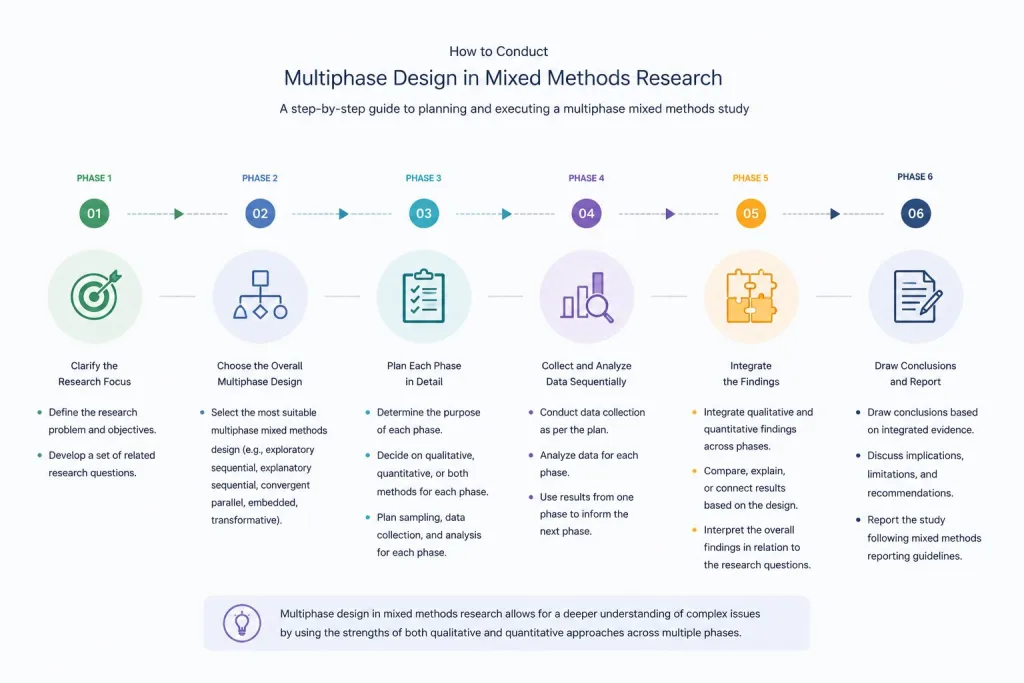
Get Dissertation HelpHow To Conduct Multiphase Design in Mixed Methods Research In 6 Easy Steps
Step 1: Define the overall research problem and the connected research questions
- The first step in multiphase design is to identify the main problem that requires a mixed methods approach. The problem should be complex enough to justify more than one phase. If the issue can be answered with only one survey or only one set of interviews, then multiphase design may not be necessary.
- A strong multiphase research project usually begins with one broad research question and a set of related research questions. These questions should be linked, not separate mini-studies with no connection. For example, the overall question may ask how a new teaching programme improves student engagement. Related questions may explore teacher experiences, student attitudes, measurable outcomes, and implementation challenges.
- At this stage, the researcher should decide why qualitative and quantitative approaches are both needed. The qualitative component may help explore experiences, while the quantitative component may measure outcomes. One qualitative and one quantitative phase may be enough for some studies, but a multiphase design is stronger when the research objectives require several linked phases.
- The researcher should also clarify whether the study is mainly exploratory, explanatory, transformative, or evaluative. This helps guide the structure of the design. For example, an exploratory study may begin with qualitative inquiry, while an explanatory study may begin with statistical results that need deeper explanation.
- A useful planning question is: “What does each phase contribute to the overall project?” Every phase should have a specific role. If a phase does not develop, test, explain, refine, or evaluate something important, it may not belong in the multiphase design.
Step 2: Choose the structure of the multiphase mixed methods design
- The second step is to choose the structure of the multiphase mixed methods design. This means deciding how the qualitative and quantitative strands will be arranged across the project. Some phases may be sequential, meaning one phase comes after another. Other phases may be concurrent, meaning data collection happens at the same time.
- A common structure is exploratory to explanatory. For example, the researcher may start with qualitative interviews, use the findings to create a survey, collect quantitative data, and then return to qualitative methods to explain surprising results. This structure combines exploratory sequential and explanatory sequential logic within one larger multiphase design.
- Another structure is convergent and sequential. In this version, the researcher may collect qualitative and quantitative data concurrently during one phase, compare the results, and then use the findings to design the next phase. This can include elements of convergent parallel design and sequential mixed methods design.
- Some studies use embedded design within a larger multiphase structure. For example, a clinical trial may be mainly quantitative, but include qualitative interviews to understand participant experiences. Later phases may add further qualitative assessments, survey testing, or implementation evaluation.
- The researcher should also decide whether the project needs parallel mixed methods, sequential and concurrent phases, or a combination of design types. This is why multiphase design is often considered one of the more advanced approaches to mixed methods research. It can include several designs inside one larger framework.
- A clear design map is very helpful. The map can show Phase 1, Phase 2, Phase 3, and Phase 4, with arrows explaining how data moves from one phase to the next. This helps the research team, supervisors, funders, and readers understand the logic of the study.
Step 3: Plan data collection and analysis for each phase
- The third step is to plan data collection and analysis in detail. Each phase should have its own method, sample, instrument, data source, and analysis plan. This prevents the multiphase design from becoming disorganised.
- In the first phase, the researcher may collect qualitative data through interviews, focus groups, open-ended questionnaires, observations, or document analysis. Qualitative methods are useful when the researcher wants to understand experiences, language, meanings, or context before designing the next phase.
- In the second phase, the researcher may collect quantitative data using surveys, tests, scales, experiments, or administrative records. Quantitative and qualitative data can then be compared, connected, or used to develop new instruments.
- In later phases, the researcher may conduct more qualitative inquiry, collect more survey data, run an intervention, evaluate outcomes, or refine a programme. For example, in programme development and evaluation, Phase 1 may identify needs, Phase 2 may design the programme, Phase 3 may test the programme, and Phase 4 may evaluate implementation.
- The analysis plan should also be clear. Qualitative data may be analysed through thematic analysis, content analysis, framework analysis, or narrative analysis. Quantitative data may be analysed using descriptive statistics, regression, comparison tests, or predictive models. The most important point is that each analysis should support the purpose of its phase.
- In a strong multiphase design, data collection and analysis are not isolated activities. The results from one phase should shape the next phase. This is what makes the design sequentially connected and methodologically strong.
Step 4: Integrate qualitative and quantitative findings across the phases
- Integration is the centre of multiphase design. Without integration, the study becomes a collection of separate qualitative or quantitative studies. In mixed methods research, integration means bringing findings together so they produce a deeper answer to the research question.
- Integration can happen at several points. It can happen during study design, when the researcher decides how phases connect. It can happen during data collection, when results from one phase are used to create tools for the next phase. It can happen during data analysis, when qualitative and quantitative data are compared. It can also happen during interpretation, when the researcher explains what the combined findings mean.
- One common integration strategy is building. This happens when one phase directly informs the next. For example, qualitative interviews may help create a questionnaire. Another strategy is explaining. This happens when qualitative findings explain quantitative results. A third strategy is merging. This happens when quantitative and qualitative data are brought together to compare similarities and differences.
- A multiphase design may also use joint displays, tables, diagrams, or matrices to show how findings connect. For example, a table may list quantitative survey results in one column and qualitative interview themes in another column. This helps readers see how the two forms of evidence support, expand, or challenge each other.
- The researcher should also look for agreement, disagreement, and expansion. Agreement means the findings support each other. Disagreement means the findings conflict and need explanation. Expansion means one type of data adds new insight that the other type could not provide.
- Strong integration of qualitative and quantitative evidence makes multiphase mixed methods research more valuable. It helps the researcher move beyond simple description and produce a fuller interpretation of the problem.
Step 5: Manage the research team, timeline, and methodological quality
- Multiphase design often requires careful project management because it can be longer and more complex than other mixed methods studies. The research team must manage several phases, different methods, multiple participants, and repeated decision points.
- A clear timeline is important. The researcher should decide when each phase begins and ends, how long data collection will take, when analysis will happen, and how findings will be used to design the next phase. Because phases are connected, delays in one phase can affect the whole research project.
- The research team should also include people with the right skills. Some team members may be stronger in qualitative inquiry, while others may be stronger in statistics, questionnaire design, intervention testing, or programme evaluation. A multiphase mixed methods research project is stronger when the team understands both qualitative and quantitative approaches.
- Quality should be checked in every phase. In qualitative phases, the researcher should consider credibility, dependability, transferability, and reflexivity. In quantitative phases, the researcher should consider validity, reliability, sampling, measurement quality, and statistical accuracy. In mixed methods phases, the researcher should consider integration quality.
- Ethical planning is also important. Because multiphase design may involve repeated contact with participants, the researcher must consider consent, privacy, participant burden, and data protection. Participants should understand how their information will be used across the overall project.
- The researcher should also keep detailed records of decisions. This includes why each phase was included, how participants were selected, how instruments were developed, and how findings were integrated. These records improve transparency and make the final mixed methods research study easier to defend.
Step 6: Present the final findings as one connected mixed methods story
- The final step is to report the findings clearly. A multiphase design should not be written as disconnected chapters or unrelated studies. The final report should show how each phase contributed to the overall project.
- A strong structure is to present the study phase by phase. For each phase, explain the purpose, method, sample, data collection, data analysis, findings, and connection to the next phase. This helps readers follow the logic of the multiphase mixed methods design.
- The final discussion should focus on integration. The researcher should explain what was learned by integrating qualitative and quantitative findings. This is where the value of the multiphase design becomes clear. The report should show how the findings answer the set of related research questions better than a single method could.
- The researcher may also compare the design to other four mixed methods designs, such as convergent parallel, explanatory sequential, exploratory sequential, and embedded design. This helps readers understand why multiphase design was the best choice for the study.
- In fields such as educational research, health research, and programme development and evaluation, the final report should also explain practical implications. For example, the findings may help improve a programme, design a better questionnaire, support policy change, or guide future intervention development.
- The conclusion should return to the main research question and explain how the phases worked together. It should not only summarise each phase separately. Instead, it should show the combined value of qualitative and quantitative methods across the full study.
- A well-written multiphase design report should make the reader feel that every phase was necessary. The qualitative component, quantitative component, sequential design elements, convergent parallel sections, concurrent phases, and explanatory stages should all connect to the same research objectives.
- In simple terms, the final report should tell one complete mixed methods story. It should show how the multiphase design helped the researcher explore the problem, measure key patterns, explain important findings, and produce a stronger conclusion for complex research.
What are the Advantages and Disadvantages of Multiphase Design in Mixed Methods Research?
Advantages of Multiphase Design in Mixed Methods Research
- Multiphase design is useful for addressing complex research problems
- One of the strongest advantages of multiphase design is that it helps researchers study complex research issues that cannot be answered through one qualitative or quantitative phase alone.
- In mixed methods research, some research problems need several connected stages because the research question may develop over time.
- For example, a researcher may begin with qualitative interviews, use the findings to create a questionnaire, test the questionnaire using quantitative approaches, and later return to qualitative inquiry to explain the results.
- This makes multiphase design especially useful in educational research, healthcare research, social science, programme evaluation, and policy studies where human experiences, measurable outcomes, and practical solutions must all be considered.
- Multiphase design allows researchers to answer a set of related research questions
- A single mixed method study may answer one main research question, but multiphase design can answer a set of related research questions across several phases.
- Each phase can focus on a specific part of the overall project.
- For instance, Phase 1 may explore the problem, Phase 2 may measure how common the problem is, and Phase 3 may test an intervention.
- This makes multiphase design stronger than simpler design types when the research objectives are broad, layered, or long-term.
- Multiphase design supports both sequential and concurrent data collection
- In a multiphase mixed methods design, researchers can collect data sequentially, concurrently, or through a combination of both.
- Some phases may follow a sequential design, where one phase informs the next phase.
- Other phases may use concurrent designs, where qualitative and quantitative data are collected at the same time.
- This flexibility allows the research team to choose the best research methods for each stage of the research project.
- For example, one phase may use a convergent parallel design, while another phase may use an explanatory sequential design.
- Multiphase design improves integration of qualitative and quantitative data
- A major goal of any mixed methods research design is the integration of qualitative and quantitative evidence.
- Multiphase design gives researchers several opportunities for integrating qualitative and quantitative findings across the study.
- The researcher can compare results, build one phase from another, explain unexpected findings, or develop a final interpretation based on all phases.
- This is helpful because qualitative data can explain the meaning behind numbers, while quantitative and qualitative data together can provide a fuller understanding of the issue.
- Multiphase design is valuable for programme development and evaluation
- Multiphase design is commonly used in programme development and evaluation because programmes often need to be designed, tested, refined, and evaluated over time.
- For example, a public health team may first use qualitative methods to understand patient needs, then design an intervention, then test it with quantitative approaches, and finally collect qualitative assessments from participants.
- This type of multiphase mixed methods research can help organisations such as universities, hospitals, and even the National Institutes of Health develop evidence-based programmes.
- It is also useful when a study needs to move from exploratory work to practical implementation.
- Multiphase design can combine different mixed methods designs
- Another advantage of multiphase design is that it can include different approaches to mixed methods research within one overall study.
- For example, a researcher may begin with an exploratory sequential phase, continue with a convergent parallel phase, and end with an explanatory sequential phase.
- This means multiphase design is not limited to one mixed methods approach.
- It can include explanatory, exploratory, transformative, embedded design, parallel mixed, and convergent components depending on the purpose of the study.
- This makes it one of the most flexible of the four mixed methods designs often discussed by Creswell and Plano Clark.
Disadvantages of Multiphase Design in Mixed Methods Research
- Multiphase design can be time-consuming
- The biggest disadvantage of multiphase design is that it usually takes longer than a basic qualitative study, quantitative study, or single mixed methods research study.
- Because the study includes several phases, each phase requires planning, data collection, data collection and analysis, interpretation, and reporting.
- If one phase is delayed, the next phase may also be delayed, especially when the design is sequential mixed methods.
- This can make multiphase design difficult for students, small research teams, or organisations working with limited time.
- Multiphase design requires strong methodological planning
- A multiphase mixed methods research project must be carefully planned from the beginning.
- The researcher must decide how each phase connects to the next, whether data will be collected concurrently or sequentially, and how the qualitative and quantitative strands will be integrated.
- Poor planning can make the study feel disconnected.
- For example, if the qualitative component does not clearly inform the questionnaire, or if the quantitative results are not connected back to the qualitative data, the overall project may lose coherence.
- This is why writers such as Creswell, Bazeley and Kemp, and scholars in the Journal of Mixed Methods Research emphasise careful design logic in mixed methods studies.
- Multiphase design can be expensive
- Since multiphase design often involves different methods, several data collection tools, and a longer timeline, it may require more funding.
- A research team may need interviewers, survey tools, statistical software, transcription services, travel support, and participant incentives.
- In some mixed methods studies, researchers also need experts in both qual and quantitative methods.
- This can make multiphase design harder to complete without institutional support.
- Multiphase design can be difficult to manage
- Managing a multiphase mixed methods design can be challenging because each phase may involve different participants, instruments, data types, and research objectives.
- The researcher must keep track of how the findings from one phase influence the next phase.
- For example, an exploratory phase may produce themes, an explanatory phase may test those themes, and a final transformative phase may apply the findings to improve practice.
- Without strong organisation, the study design can become too broad or confusing.
- Multiphase design may produce too much data
- Because multiphase design uses qualitative and quantitative methods across several phases, it can generate a large amount of information.
- The researcher may collect interview transcripts, survey responses, observation notes, documents, statistics, and evaluation feedback.
- This can make data collection and analysis complex, especially when the researcher needs to integrate qualitative and quantitative approaches into one clear conclusion.
- The challenge is not only collecting the data but also deciding which findings are most important for the final interpretation.
- Multiphase design requires advanced mixed methods skills
- A researcher using multiphase design must understand qualitative methods, quantitative approaches, integration strategies, and mixed methods research design principles.
- This can be difficult for beginners because the researcher must know when to use qualitative or quantitative data, how to connect phases, and how to explain the value of the whole mixed methods approach.
- For this reason, multiphase design is often more suitable for experienced researchers, doctoral research, funded projects, and large-scale studies.
Examples of Multiphase Design in Mixed Methods Research
Example 1: Multiphase Design in Educational Research
- Research topic
- A researcher wants to understand why first-year university students struggle with academic writing and how a writing support programme can be improved.
- This is a good example of multiphase design because the research question is too broad for one phase of data collection.
- Phase 1: Exploratory qualitative phase
- The researcher begins with qualitative interviews with students and lecturers.
- The purpose is to explore students’ writing challenges, confidence levels, feedback experiences, and support needs.
- This phase uses qualitative inquiry to understand the problem deeply before creating any measurement tool.
- The qualitative data may show that students struggle with referencing, essay structure, academic language, and understanding lecturer comments.
- Phase 2: Quantitative questionnaire phase
- The researcher then uses the themes from Phase 1 to design a questionnaire.
- This follows an exploratory sequential logic because the qualitative findings help shape the quantitative instrument.
- The questionnaire is given to a larger group of students to measure how common each writing challenge is.
- This phase produces qualitative and quantitative data across the overall project, allowing the researcher to move from rich descriptions to measurable patterns.
- Phase 3: Programme development phase
- Based on the results, the university creates a writing support programme.
- The programme may include workshops, online videos, peer support, and one-to-one writing consultations.
- This shows how multiphase design supports programme development and evaluation because the findings are used to build a practical solution.
- Phase 4: Evaluation phase
- After the programme is introduced, the researcher uses a convergent parallel design to evaluate it.
- Survey results are collected from students, while qualitative assessments are collected through focus groups.
- The researcher analyses the data concurrently and then compares both forms of evidence.
- This example shows how multiphase design can include exploratory sequential, convergent parallel design, and evaluation phases within a mixed methods research study.
Example 2: Multiphase Design in Healthcare Research
- Research topic
- A hospital wants to improve patient satisfaction with outpatient services.
- This is suitable for multiphase design because patient satisfaction involves experiences, waiting times, communication, service quality, and measurable outcomes.
- Phase 1: Qualitative exploration
- The research team begins with qualitative interviews with patients, nurses, doctors, and administrative staff.
- The goal is to understand what patients experience when they visit the outpatient department.
- Patients may describe long waiting times, unclear communication, lack of privacy, or difficulty understanding medical instructions.
- This phase provides the qualitative component of the study.
- Phase 2: Quantitative measurement
- The team then develops a structured patient satisfaction survey.
- The survey measures waiting time, staff communication, appointment systems, cleanliness, privacy, and overall satisfaction.
- This phase uses quantitative approaches to identify the most common issues.
- It also helps the hospital compare satisfaction across departments or patient groups.
- Phase 3: Explanatory follow-up
- If the survey shows that many patients are dissatisfied with communication, the researchers may conduct follow-up interviews.
- This creates an explanatory sequential design because the quantitative findings are explained using qualitative data.
- For example, the numbers may show low satisfaction, while the interviews explain that patients feel rushed during consultations.
- This is one of the strengths of multiphase design because the study does not stop at numbers; it investigates the reasons behind them.
- Phase 4: Intervention and final evaluation
- The hospital may introduce staff communication training, improved signage, and a better appointment system.
- After several months, the researchers collect new survey data and interview patients again.
- This final phase helps determine whether the intervention worked.
- The example shows how multiphase design is useful for addressing complex research problems in real service settings.
Need Help With Your Dissertation?
Get professional academic support from Best Dissertation Writers . Our expert team is ready to help you with high-quality dissertation writing services tailored to your academic goals.
Get Dissertation HelpExample 3: Multiphase Design in Community Development Research
- Research topic
- A local government wants to understand why young people are not participating in community development programmes.
- This topic requires a multiphase mixed methods approach because participation may be affected by attitudes, access, awareness, trust, and social barriers.
- Phase 1: Exploratory interviews
- The researcher begins by interviewing young people, community leaders, parents, and programme officers.
- These interviews help identify barriers such as poor communication, lack of transport, limited internet access, or programmes that do not match young people’s interests.
- This phase uses multiple qualitative methods to build an initial understanding of the problem.
- Phase 2: Survey with a larger population
- The findings from the first phase are used to develop a survey.
- The survey asks young people about awareness, motivation, preferred activities, barriers, and communication channels.
- This phase gives the researcher quantitative and qualitative data that can support planning decisions.
- Phase 3: Concurrent design for solution testing
- The local government tests two new engagement strategies: a social media campaign and youth-led community forums.
- During this phase, the researcher collects attendance numbers and survey responses while also conducting short interviews.
- This is a concurrent mixed methods phase because both types of data are collected concurrently.
- It may also resemble an embedded design because qualitative feedback is embedded within a mainly quantitative evaluation.
- Phase 4: Transformative application
- The final phase uses the findings to redesign youth programmes so they are more inclusive, accessible, and relevant.
- This gives the study a transformative purpose because the findings are used to improve participation and reduce barriers.
- In this example, multiphase design does more than describe a problem; it supports real change.
Example 4: Multiphase Design in Organisational Research
- Research topic
- A company wants to improve employee engagement and reduce staff turnover.
- This is a strong example of multiphase design because employee engagement involves attitudes, workplace culture, leadership, job satisfaction, and measurable performance indicators.
- Phase 1: Qualitative study
- The researcher conducts interviews with employees and managers.
- The aim is to understand why employees feel motivated, unsupported, stressed, or disconnected from leadership.
- The qualitative data may reveal issues such as poor communication, limited career growth, workload pressure, and lack of recognition.
- Phase 2: Quantitative employee survey
- The researcher then creates an employee engagement survey based on the interview themes.
- This survey is sent to all employees.
- The results show which issues are most serious across the organisation.
- This phase demonstrates the value of integrating qualitative and quantitative evidence because the survey is grounded in employee experiences.
- Phase 3: Parallel mixed evaluation
- The company introduces new leadership training, flexible work policies, and recognition programmes.
- The researcher evaluates the changes using a parallel design.
- Quantitative data may include turnover rates, attendance, and engagement scores.
- Qualitative data may include staff interviews and open-ended survey comments.
- The findings are compared to understand whether the intervention improved the workplace.
- Phase 4: Final integration
- In the final phase, the researcher brings together all findings from the study.
- This includes the original qualitative findings, the survey results, the intervention outcomes, and the final employee feedback.
- This final integration helps the company understand what worked, what still needs improvement, and how future policies should be developed.
- This example shows why multiphase design is a strong research design for long-term organisational improvement.
Example 5: Multiphase Design in Public Policy Research
- Research topic
- A public agency wants to evaluate whether a new digital service improves access for citizens.
- A multiphase design is useful because access involves measurable use patterns and personal experiences.
- Phase 1: Document review and qualitative interviews
- The researcher reviews policy documents and interviews service users.
- This helps identify the main access problems, such as digital literacy, language barriers, disability access, and lack of awareness.
- Phase 2: Quantitative service-use analysis
- The researcher analyses usage statistics, completion rates, waiting times, and demographic patterns.
- This phase shows whether the service is reaching different groups fairly.
- Phase 3: Explanatory sequential mixed methods design
- If the quantitative data shows that older adults use the service less often, the researcher conducts follow-up interviews to explain why.
- This phase uses an explanatory sequential approach because qualitative data helps explain the quantitative findings.
- Phase 4: Policy recommendation phase
- The final phase combines all findings into practical recommendations.
- The agency may improve website accessibility, offer community training, provide multilingual support, and maintain face-to-face options.
- This example shows how multiphase design can support evidence-based policy decisions through qualitative and quantitative methods.
Mixed Methods Research Design Guides
Structured guides to key mixed methods research designs including sequential, convergent, embedded, multiphase approaches, and dissertation methodology foundations.
Research Methodology in Dissertation
Core foundations of research design, structure, and methodology in dissertations. Read full guide →
Mixed Methods Overview
Foundations of qualitative and quantitative integration. Explore article →
Explanatory Sequential
Quantitative results followed by qualitative explanation. Read more →
Exploratory Sequential
Qualitative insights shaping quantitative instruments. Read more →
Convergent Parallel
Concurrent qualitative and quantitative analysis. Read more →
Embedded Design
One method embedded within another dominant design. Read more →
Transformative Design
Research focused on change and social impact. Read more →
Multiphase Design
Multiple linked phases across one research program. Read more →
Final Point
- Multiphase design is best used when the research problem is broad, practical, and complex
- Overall, multiphase design is one of the most powerful approaches to mixed methods research because it allows researchers to study a problem step by step.
- It can combine exploratory, explanatory, convergent, concurrent, sequential, embedded, and transformative elements within a mixed methods research design.
- Although it requires time, planning, resources, and methodological skill, multiphase design is especially valuable when researchers need to connect several phases, answer related research questions, and produce practical outcomes from the integration of qualitative and quantitative findings.
References
- Mixed Methods Designs – Georgia State University Library Research Guides – https://research.library.gsu.edu/c.php?g=1050115&p=7622501
- Qualitative Research: Mixed Methods Research – Gonzaga University Library – https://researchguides.gonzaga.edu/qualitative/mixed-methods
- Mixed Methods Analysis – Georgetown University Library – https://guides.library.georgetown.edu/c.php?g=1311988&p=9670809