

Art History Major – Key Takeaways
An art history major explores the development, meaning, and cultural significance of visual art across historical periods, regions, and styles. This academic path blends critical thinking, research, and visual analysis to prepare students for careers in museums, education, cultural institutions, and related fields. Below is a clear breakdown of what the major involves, career outcomes, and key considerations.
- What an Art History Major Is:
- Focuses on the study of art from antiquity to the modern era, including painting, sculpture, architecture, and visual culture.
- Students learn to interpret artistic movements and understand art within its historical, social, and political contexts.
- Coursework often includes art theory, criticism, museum studies, and cultural heritage.
- Core Curriculum & Skills:
- Common classes: Ancient Art, Renaissance Art, Contemporary Art, Art Theory and Criticism, Research Methods.
- Emphasis on visual literacy, writing proficiency, research skills, and critical analysis.
- Students often engage with galleries, museums, and primary source materials.
- Academic Experience:
- Learning combines lecture courses, seminars, and hands‑on analysis of artworks and artifacts.
- Opportunities may include museum internships, study abroad, and archival research.
- Projects and papers sharpen communication, argumentation, and interpretive skills.
- Career Paths & Opportunities:
- Museums and Galleries (curatorial assistant, collections management)
- Education and Academia (teaching, academic research)
- Cultural Institutions and Nonprofits (arts administration, programming)
- Art Market & Publishing (art appraisal, writing, criticism)
- Salary & Job Outlook:
- Salaries vary by career choice and sector; specialized roles (e.g., museum curators, cultural managers) often pay more.
- The field values communication, research, and critical thinking—skills that apply to many professions.
- Why Choose Art History:
- Ideal for students passionate about visual culture, history, and interpretation.
- Builds transferable analytical and writing skills useful in diverse careers.
- Encourages a deeper understanding of how art shapes and reflects societies.
Choosing to major in art history provides students with a strong foundation in critical analysis, research, and communication, all of which are highly valued in various career paths related to art, culture, and education.
What Is an Art History Major?
- Definition of an Art History Major
- An art history major is an academic program focused on the study of art across periods, regions, and media.
- Students explore art movements, artistic production, and the history of art, analyzing works of art to understand their meaning, style, and cultural context.
- The curriculum often includes sculpture, decorative arts, painting, and contemporary art, bridging both theory and practical observation.
- Scope of Study
- Examining art around the world, from Western art traditions like the Renaissance and Baroque to non-Western and contemporary practices.
- Learning about different styles, techniques, and mediums such as oil on canvas, frescoes, and mixed media.
- Studying the timeline of artistic developments, including iconic figures like Michelangelo, Leonardo da Vinci, Giorgio Vasari, and modern artists such as Pollock.
- Analytical Approach
- Students are trained to analyze the iconography, symbolism, and subject matter of works of art.
- Focus on art-historical critique, evaluating aesthetics, provenance, attribution, and historical patronage.
- Emphasis on writing essays that include citation, scholarship, and thorough examination of artworks’ contexts.
- Connection to Human History and Society
- The study of art provides insight into human history, cultural values, religious beliefs, and social dynamics.
- Artworks can evoke emotions, distort or enhance reality, and reflect political, social, and philosophical movements such as Romanticism, Realism, Impressionism, Pop Art, and Feminism in art.
Why Students Choose an Art History Major
- Passion for Art and Culture
- Many students are drawn to an art history major due to a fascination with artistic styles, biographies of painters, and the evolution of art movements.
- Opportunity to study works of artists from the Renaissance to modern artists, including female artists, and to explore the diversity of decorative arts.
- Exploration of Different Styles and Techniques
- Students learn to identify stylistic overlaps and differences among movements such as Baroque, Romanticism, Realism, Impressionism, and Pop Art.
- Hands-on exposure to sculpture, oil on canvas, and other media, understanding how artistic production reflects societal, cultural, and patronage contexts.
- Analytical and Critical Skills
- Studying an art history major enhances the ability to analyze, interpret, and critique artworks with attention to aesthetics, iconography, and symbolism.
- Students learn to distinguish attribution and provenance of artworks, deepening insight into art-historical scholarship.
- Career Preparation and Opportunities
- Graduates pursue careers as art historians, museum curators, gallery directors, or educators, leveraging their knowledge of art around the world.
- Understanding artistic production, styles, and history provides pathways to roles in conservation, art appraisal, feminist art studies, and art criticism.
- For students interested in research, writing essays and publishing in academic journals develops skills essential for scholarship and critical inquiry.
Top Universities Offering Art History Major
Arizona State University
ASU offers online BA degrees in Art History and Museum Studies. Students explore global art movements, develop skills in critical analysis of artworks, and gain insight into museum curation and exhibition planning.
- Online BA in Art History
- Online BA in Museum Studies
Academy of Art University
Offers online programs from BA to MA in Art History. Curriculum emphasizes historical and contemporary art, analytical essay writing, and research methods. Students examine iconic artists, patronage, and stylistic developments across centuries.
- BA in Art History
- BFA in Art History
- MA in Art History
New York University
NYU provides online Art History programs with focus on global art from 16th century to modern era. Students study individual works, art movements, and comparative analysis while gaining expertise in critical writing and proper citation style.
- BA in Art History
- MA in Art History
UCLA
UCLA’s Art History programs provide an overview of Western and global art, emphasizing analysis of two-dimensional and three-dimensional works, use of line, geometric forms, and overall composition. Coursework integrates theory and historical context.
- BA in Art History
- MA in Art History
Pratt Institute
Pratt focuses on hands-on art history education. Students examine chapel art, Renaissance and nineteenth-century styles, and modern era works. The program emphasizes critical writing, comparative analysis, and understanding patronage and artistic production.
- BA in Art History
- BFA in Fine Arts
Columbia University
Columbia offers detailed programs in Art History emphasizing historical context, stylistic development, and critical overview of art movements from the middle ages to contemporary practice. Students learn research, essay writing, and citation style for professional scholarship.
- BA in Art History
- MA in Art History
School of the Art Institute of Chicago
SAIC focuses on modern era and historical art. Students study individual works, depiction techniques, and explore picture plane and negative space. The program prepares students for careers in curation, conservation, and museum studies.
- BA in Art History
- MA in Art History
Boston University
BU’s programs cover Western art, Renaissance to modern era, and introduce comparative analysis across periods. Coursework emphasizes analytical essays, contextual research, and understanding patronage and stylistic evolution.
- BA in Art History
- MA in Art History
MICA
MICA offers a balanced curriculum focusing on individual works, two-dimensional and three-dimensional art, and modern era trends. Students gain skills in art analysis, exhibition planning, and understanding patronage and artistic context.
- BA in Art History
- MA in Art History
University of Pennsylvania
UPenn’s Art History programs cover historical overview, contemporary art, picture plane, and depiction techniques. Emphasis on research, essay writing, and contextual analysis prepares students for museums and academic careers.
- BA in Art History
- MA in Art History
Key Challenges of an Art History Major
- Heavy Reading and Research Requirements
- Students engage with biographies, art-historical scholarship, and dense texts on history of art, often spanning centuries.
- Required to interpret complex works by artists such as Leonardo da Vinci, Michelangelo, and Italian artists, linking subject matter, symbol, and style.
- Analytical and Writing Demands
- Writing essays requires clear arguments, structured reasoning, and citation of primary and secondary sources.
- Students must interpret art-historical evidence, explain stylistic features, and discuss symbolism and aesthetics.
- Critical evaluation includes discussing provenance, attribution, and the overlap between artistic periods or movements.
- Exposure to Diverse Art Forms and Cultures
- Understanding contemporary art, decorative arts, and art around the world may challenge students unfamiliar with non-Western or modern practices.
- Learning to evoke insight from art-historical analysis requires patience and careful observation.
- Time-Intensive Observation
- Students often visit museums, galleries, and historical sites to study works of art firsthand.
- Assignments may include detailed analysis of sculpture, painting, and decorative arts, evaluating artistic production in historical context.
- Balancing Theory and Practical Application
- Integrating stylistic knowledge, biography of artists, and historical patronage into written and verbal presentations.
- Developing an understanding of art-historical attribution, distinguishing between authentic works and copies or misattributed paintings.
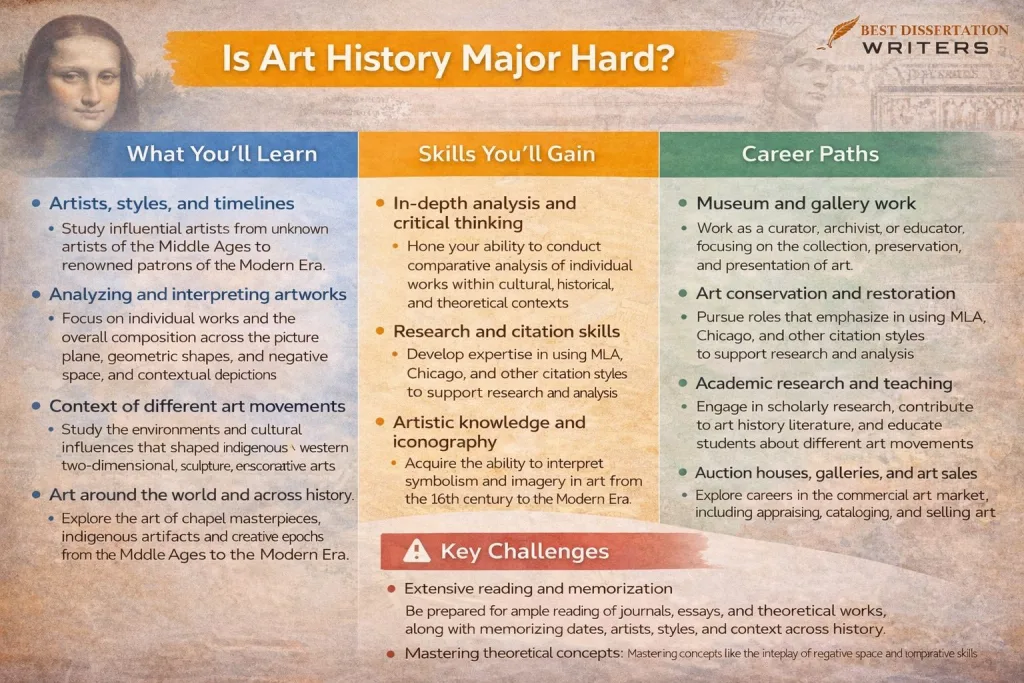
Skills You’ll Gain from an Art History Major
- Critical Thinking and Analysis
- Ability to analyze artworks for style, iconography, and subject matter.
- Evaluate art movements, identify influences, and understand how art reflects human history and societal trends.
- Research and Writing Expertise
- Writing essays that synthesize visual and historical evidence.
- Proper citation and scholarship training to support arguments in academic or museum contexts.
- Developing art-historical critique skills, including interpretation of symbolism, stylistic elements, and artistic production.
- Visual Literacy and Observation
- Recognize different styles across time periods such as Baroque, Renaissance, Realism, Impressionism, and Pop Art.
- Understand aesthetic principles, composition, color use, and techniques like oil on canvas.
- Develop an ability to evoke insights about cultural and artistic significance from works of art.
- Historical and Cultural Knowledge
- Knowledge of key figures, including Leonardo da Vinci, Michelangelo, and Giorgio Vasari, along with female artists and modern artists.
- Study of art around the world, Western art, and contemporary art, understanding overlap between art movements and cultural influence.
- Research and Evaluation Skills
- Assess provenance, attribution, and authenticity of artworks.
- Develop the ability to interpret complex iconography, symbolism, and the subject matter of paintings, sculpture, and decorative arts.
- Communication and Presentation Skills
- Present findings clearly in writing or oral presentations, combining analysis of art-historical evidence, historical timeline, and artistic production.
- Ability to critique and explain artwork to diverse audiences, including academic peers, museum visitors, and the general public.
- Career-Ready Competencies
- Prepare for work as art historians, museum curators, or in arts administration.
- Develop insight into patronage, the art market, and professional scholarship, enhancing employability in art career paths.
- Gain familiarity with professional standards in analyzing Renaissance, Baroque, Romanticism, Realism, Impressionism, and Pop Art artworks.
Who Thrives as an Art History Major
- Analytical Thinkers
- Students who excel as an art history major are often those with strong comparative analysis skills.
- They can examine individual works, compare styles across the middle ages, 16th-century, nineteenth-century, and modern era art, and detect subtle differences in depiction, use of line, geometric shapes, and overall composition.
- Success requires attention to detail in evaluating two-dimensional forms and understanding the picture plane, negative space, and stylistic evolution over time.
- Curious About Cultural Context
- Thriving students are deeply interested in how artistic production relates to social, religious, and political contexts.
- They explore patron influence on art, from chapel commissions in the Renaissance to indigenous artworks of the 1800s and modern era.
- Understanding the contextual significance of art allows students to interpret depiction choices, materials, and stylistic conventions.
- Detail-Oriented Researchers
- An art history major benefits those who enjoy meticulous research, including assessing unknown artists or attributing works to specific creators.
- Students develop proficiency in using proper citation style and credit sources accurately for theoretical or historical analyses.
- Attention to individual works and the ability to connect them to broader art movements enhances insight and scholarship.
- Creative and Critical Thinkers
- Students who can emphasize both the formal qualities of art (composition, line, negative space) and theoretical considerations (symbolism, patronage, cultural context) thrive.
- They enjoy evaluating overall composition, the artist’s intent, and how a work fits into larger narratives of art history, from the 16th century to contemporary practice.
- Lifelong Learners
- Those who thrive are naturally curious about art around the world, narratives of the middle ages, and innovations in the modern era.
- They approach each overview of a period or art movement with excitement and a desire to understand historical trends and depiction techniques.
Need Help With Your Dissertation?
Get professional academic support from Best Dissertation Writers . Our expert team is ready to help you with high-quality dissertation writing services tailored to your academic goals.
Get Dissertation HelpCareer Opportunities for Art History Major Graduates
- Museum and Gallery Careers
- Graduates often work as curators, exhibition coordinators, or registrars, responsible for cataloging individual works, planning displays, and analyzing overall composition for public education.
- Positions may involve working with patron records, commissioning contemporary works, or preserving indigenous and historical collections.
- Art Conservation and Restoration
- Art history majors may specialize in conserving chapel paintings, nineteenth-century canvases, or other artworks where use of line, geometric structure, and picture plane considerations are critical.
- Restorers must understand historical contextual practices and materials to maintain authenticity and credit proper authorship.
- Academic and Research Roles
- Graduates can become art historians or scholars, conducting research on unknown artists, comparative studies, or theoretical approaches to two-dimensional and three-dimensional art forms.
- Responsibilities often include publishing articles with citation style compliance, teaching overview courses, or analyzing depiction techniques in the middle ages, 16th century, and beyond.
- Art Criticism and Journalism
- Positions as art critics, editors, or writers for magazines and online platforms allow art history majors to emphasize trends in modern era art or discuss overall composition, negative space, and geometric experimentation in works of emerging artists.
- Coverage may include exhibitions, retrospectives of nineteenth-century painters, or analysis of indigenous art traditions.
- Auction Houses and Art Market
- Careers in art valuation, provenance research, and credit attribution often require graduates to handle individual works, assess depiction, and identify unknown artists.
- They must understand historical patronage, market trends, and overview of art movements, from chapel frescoes to modern era pieces.
- Cultural Heritage and Nonprofit Roles
- Working with cultural institutions, universities, and foundations allows graduates to preserve artistic production from past eras while educating the public.
- Tasks include preparing reports on two-dimensional works, advising on overall composition, and creating educational overview materials highlighting styles like Romanticism, Realism, and modern era experimentation.
Is an Art History Major Right for You? Final Considerations
- Interest in Diverse Art Forms
- Success as an art history major requires genuine curiosity about art around the world, including indigenous art, chapel commissions, and contemporary movements.
- Appreciation for individual works and understanding their depiction, symbolism, and geometric arrangements is essential.
- Willingness to Engage with Historical Context
- Students must enjoy investigating patronage, social history, and the contextual factors that influence artistic production.
- An interest in middle ages, 16th-century, nineteenth-century, and modern era works allows for richer insights into artistic evolution.
- Ability to Conduct In-Depth Analysis
- Must be comfortable performing comparative analysis of two-dimensional and three-dimensional art.
- Evaluating overall composition, use of line, negative space, and stylistic differences across eras is central to the major.
- Commitment to Scholarly Work
- Writing well-researched essays, citing sources properly (citation style), and documenting the overview of movements or unknown artists are core responsibilities.
- Students should be prepared to analyze the depiction choices in paintings, sculpture, or chapel frescoes with accuracy and depth.
- Career and Personal Alignment
- Consider if you enjoy roles that involve teaching, research, museum work, or writing about modern era and historical artworks.
- An art history major is ideal for those who seek intellectual challenges and a lifelong engagement with artistic production across time and cultures.
- Conclusion
- Students who thrive in this field combine curiosity, attention to detail, analytical thinking, and a passion for understanding the overview of human artistic expression.
- Whether analyzing a nineteenth-century painter, a chapel fresco, or indigenous artwork, graduates gain the skills to contribute to scholarship, curation, and public appreciation of art worldwide.