

How to Become a Medical Coder – Key Takeaways
Medical coding and billing are essential parts of the healthcare system. Medical coding turns diagnoses, procedures, and services into standardized codes such as ICD-10-CM, CPT, and HCPCS Level II, while medical billing uses those codes to submit insurance claims and secure payment for healthcare providers. Medical coders help keep patient records accurate, reduce billing errors, and support smooth communication between providers, insurers, and patients.
- What a Medical Coder Does:
- Reviews patient charts and clinical records.
- Assigns the correct diagnosis, procedure, and supply codes.
- Ensures coding supports billing accuracy, insurance claims, and proper documentation.
- Works with providers to clarify diagnoses and procedures when needed.
- How to Become a Medical Coder:
- Start with a certificate program or associate degree in medical billing and coding.
- Learn medical terminology, anatomy, coding systems, insurance processes, and healthcare regulations.
- Gain practical experience through internships or entry-level work.
- Prepare for and pass a professional certification exam.
- Important Certifications:
- Common credentials include Certified Professional Coder (CPC), Certified Coding Associate (CCA), and Certified Billing and Coding Specialist (CBCS).
- Certification improves job prospects, salary potential, and career advancement.
- Continuing education is important for maintaining certification and staying current with code updates.
- Skills Needed for Success:
- Strong knowledge of ICD-10, CPT, and HCPCS.
- Excellent attention to detail to avoid coding errors and claim denials.
- Good understanding of medical terminology, anatomy, and healthcare regulations such as HIPAA.
- Ability to interpret complex clinical documents accurately.
- Career Path and Salary Outlook:
- Entry-level roles usually begin in hospitals, clinics, insurance companies, or private practices.
- With experience, coders can move into specialized or senior roles such as coding manager, compliance officer, or specialty coder.
- Median pay was listed around $44,000, while experienced and certified coders may earn $60,000 or more, depending on specialization and location.
- Why Medical Coding Is a Strong Career Choice:
- Offers job stability, career growth, certification-based advancement, and flexible work options, including remote work.
- Growing healthcare demand, electronic health records, and specialization opportunities continue to increase the need for trained coders.
- It is a practical healthcare career that supports both financial operations and patient care quality.
Medical coding offers job security and numerous opportunities for career growth. As the healthcare industry continues to expand, the demand for skilled coders is expected to rise, making it a promising career for those interested in supporting patient care and healthcare operations.
What Is Medical Coding and Billing?
- Medical Coding is the process of converting healthcare diagnoses, procedures, medical services, and equipment into universal medical codes. These codes are then used for insurance billing, medical records, and communication between healthcare providers and insurers.
- Medical codes are standardized by systems like ICD-10-CM (International Classification of Diseases, 10th edition) for diagnoses, and CPT (Current Procedural Terminology) for procedures.
- The HCPCS Level II codes are also used for billing items and services not included in CPT codes, such as medical supplies and ambulance services.
- Medical Billing is the process of submitting and managing claims to insurance companies for services provided by healthcare providers. This ensures that healthcare providers receive payment for their services.
- It involves creating and managing claims for the various medical services provided to patients using the appropriate codes.
- It is essential to understand medical terminology, insurance policies, and the payment system for proper billing.
- The medical coding and medical billing process ensures that medical records are accurate and properly reflect the care provided to patients, while ensuring that healthcare providers are paid for their services.
What Does a Medical Coder Do?
- A medical coder is responsible for reviewing clinical documents and translating diagnoses and treatments into standardized codes. This is a vital part of the medical billing and coding process.
- Medical Coders ensure that the codes used for billing match the actual services provided by healthcare professionals.
- They work with various coding systems like ICD-10-CM, CPT, and HCPCS Level II to ensure the accuracy of medical records and claims.
- Coders often specialize in a particular area of medicine, such as radiology, cardiology, or oncology, depending on their training.
- Responsibilities:
- Review patient charts and clinical records to identify services provided.
- Apply the correct code for diagnoses (ICD-10-CM), procedures (CPT), and supplies (HCPCS Level II).
- Ensure that the coding is accurate for billing, insurance claims, and patient records.
- Verify that codes comply with healthcare regulations and standards.
- Work with healthcare providers to clarify diagnoses and procedures as needed.
- Key Skills:
- Strong knowledge of medical terminology and anatomy.
- Ability to accurately interpret clinical records and apply appropriate codes.
- Familiarity with healthcare laws and regulations, including those related to insurance billing and medical services provided.
- Attention to detail to avoid coding errors, which could result in claim denials or delayed payments.
Need Help With Your Dissertation?
Get professional academic support from Best Dissertation Writers . Our expert team is ready to help you with high-quality dissertation writing services tailored to your academic goals.
Get Dissertation HelpHow to Become a Medical Coder
Becoming a medical coder involves several key steps, each designed to equip you with the necessary skills and knowledge to excel in this field. In this section, we will outline the essential path to becoming a certified medical coder and provide a detailed understanding of the required skills, career outlook, and more.
The Path to Becoming a Certified Medical Coder
- Education:
- While medical coding can be learned through various routes, the most common path starts with a certificate program or an associate degree in medical billing and coding.
- Many coders choose to pursue an online course or online learning opportunities, which offer flexibility in terms of timing and location.
- Some universities and community colleges offer bachelor’s degree programs in health information management, which include coding principles as part of the curriculum.
- The online course will prepare students with the knowledge of ICD-10, CPT, and HCPCS coding systems, along with other vital aspects of medical billing.
- Complete a Certificate Program or Degree:
- To become a medical coder, you may need to complete a certificate program specifically in medical billing and coding or medical assisting.
- Entry-level positions typically require completion of a certificate program that covers coding systems like ICD-10, CPT, and HCPCS, as well as medical terminology and healthcare common procedure coding system (HCPCS).
- Course fees for certificate programs may vary, but many affordable options are available, including those offered by accredited institutions or online learning platforms.
- Gain Practical Experience:
- Many students also seek internships or entry-level positions to gain practical, hands-on experience, which is essential for mastering coding in real-world environments.
- Coding professionals must be able to apply their knowledge of medical information and coding guidelines in actual healthcare settings to ensure accuracy in medical records and claims.
- Certification:
- To increase career prospects and salary potential, most medical coders obtain certifications such as the Certified Professional Coder (CPC), offered by the American Academy of Professional Coders (AAPC), or Certified Coding Associate (CCA), offered by the American Health Information Management Association (AHIMA).
- The exam offered by the American Academy and exam offered by the American Health are the key certification exams that assess knowledge in medical coding systems and practices.
- Completing a certification can make you more competitive in the job market and help you qualify for higher-paying jobs.
- Register and Enroll in Exams:
- Registration and enrollment for certification exams require meeting certain prerequisites and requirements set by the certifying organizations.
- For instance, some certifications require completion of an accredited certificate program or a certain number of hours of practical experience in coding.
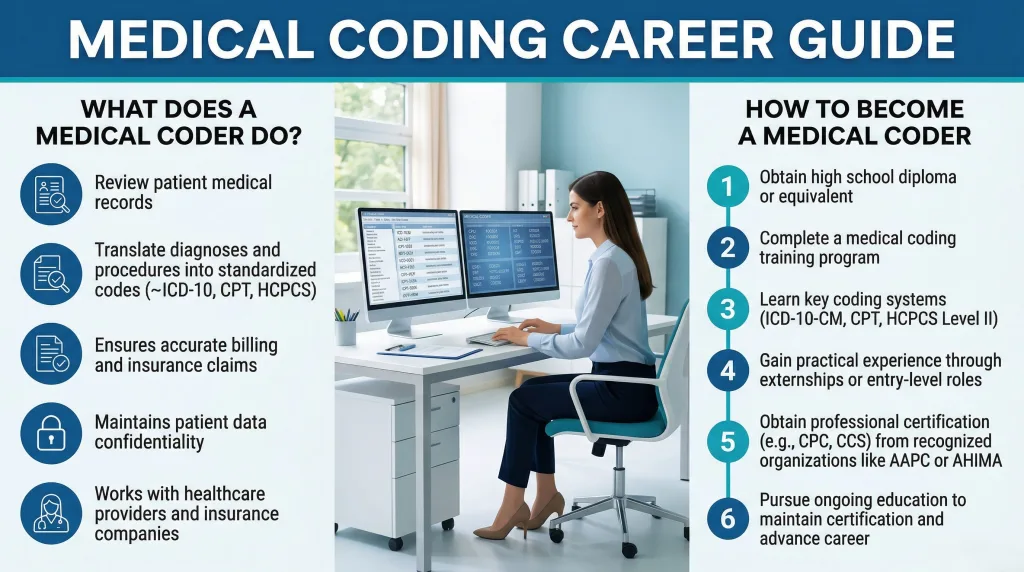
Steps to Certification in Medical Coding
- Step 1: Complete Medical Billing and Coding Education
- Pursue a degree or certificate program, such as a medical billing and coding course, to gain foundational knowledge in medical terminology and coding systems like ICD-10-CM, CPT, and HCPCS Level II.
- Consider enrolling in an online medical billing and coding course for flexible learning options.
- Complete coursework related to health information management, insurance processes, and patient care.
- Step 2: Choose the Right Certification
- Decide between certifications like Certified Professional Coder (CPC), Certified Coding Associate (CCA), or Certified Billing and Coding Specialist.
- Consider your career goals and area of interest (e.g., outpatient, inpatient, or specialty coding) when choosing a certification.
- Step 3: Prepare for the Certification Exam
- Study coding principles, medical terminology, ICD-10-CM, CPT, and other relevant systems. Many online medical courses provide preparation for these exams.
- Review practice exams and study guides to ensure readiness.
- Consider joining study groups or seeking advice from coding professionals to help with exam preparation.
- Step 4: Pass the Certification Exam
- Take the certification exam and pass it to become a certified medical coder.
- Once you pass, you will be qualified to work as a certified professional coder in various healthcare settings, including hospitals, clinics, and private practices.
- Step 5: Maintain Certification
- Stay up-to-date with continuing education and recertification requirements to maintain your certification.
- Participate in webinars, workshops, and other educational activities offered by organizations like AAPC and AHIMA to enhance your skills.
The Role of Certified Medical Billing and Coding Professionals in Patient Care
- Medical Coders and Medical Billers are essential in ensuring that the healthcare system functions smoothly and efficiently.
- Their primary role is to convert medical services provided into accurate codes, which are used for insurance claims and to maintain patient records.
- Accurate coding ensures that healthcare providers are paid correctly and on time, allowing them to continue providing high-quality patient care.
- They play a key role in reducing billing errors and fraud, which can lead to financial loss for healthcare providers and insurers.
- Impact on Patient Care:
- By ensuring accurate coding, certified medical billing and coding specialists help ensure that patient care records are accurate, which is essential for future treatments and continuity of care.
- They help improve communication between healthcare providers, insurers, and patients, ensuring that patients receive the care they need without financial barriers.
- Medical coding professionals are critical in maintaining the integrity of patient records and ensuring that services are appropriately reimbursed.
By becoming a medical coder, you can embark on a rewarding coding career that plays a crucial role in the healthcare system, ensuring accurate billing, proper documentation, and quality patient care.
Key Skills Required for Medical Coding Professionals
To succeed as a medical coder, professionals need a combination of specialized knowledge, technical skills, and the ability to interpret complex medical data accurately. The following are the key skills required for medical coding professionals to perform their job effectively and maintain compliance with industry standards. 1. Knowledge of Coding Systems in Medical Billing
One of the most important skills for a medical coder is an in-depth knowledge of various coding systems. Medical coding involves using standardized codes to classify diseases, medical conditions, treatments, and procedures for insurance billing and record-keeping purposes. The three primary coding systems used are ICD-10, CPT, and HCPCS.
- ICD-10 (International Classification of Diseases, 10th edition) is used for diagnostic coding, enabling coders to classify and report all diseases and health conditions. Coders must understand the structure of ICD-10 codes, which are made up of letters and numbers representing specific diagnoses. For instance, ICD-10-CM codes for heart disease differ significantly from those for respiratory infections, and coders need to recognize these differences.
- CPT (Current Procedural Terminology) codes are used to classify medical procedures and services. Coders must understand which codes apply to a wide range of medical interventions, from minor diagnostic tests to complex surgeries.
- HCPCS (Healthcare Common Procedure Coding System) codes are used to classify services and products that are not included in the CPT system, such as durable medical equipment, ambulance services, and certain medications. Medical coding professionals must understand how to apply these codes based on the specific services provided by healthcare professionals.
Understanding these coding systems is essential for medical coding professionals to accurately report diagnoses and treatments, which directly impacts the efficiency of insurance billing and patient care. 2. Attention to Detail
Attention to detail is a cornerstone of medical coding. Accuracy is crucial, as even minor errors in coding can lead to significant problems. Mistakes can cause denied claims, delayed payments, or, in some cases, even legal issues if incorrect information is submitted for reimbursement.
- Medical coders must carefully review patient charts, medical records, and physicians’ notes to ensure that every diagnosis, procedure, and service is coded accurately. Each CPT, ICD-10, and HCPCS code has specific guidelines, and it is critical that coders apply the correct code to avoid errors that could result in claim denials.
- Coders must also be diligent when reviewing and interpreting complex medical records. Even small discrepancies, such as incorrect modifiers or missing diagnosis codes, can result in the rejection of claims. Inaccurate coding can lead to delays in payment and ultimately affect the financial health of healthcare organizations.
3. Medical Terminology
A medical coder must have a strong foundation in medical terminology to effectively understand the terms used by healthcare providers and translate them into accurate codes. Medical terminology includes the language and terminology used to describe the body, diseases, conditions, and medical procedures.
- Coders must be familiar with anatomical terms, disease classifications, and treatment procedures. For instance, understanding the difference between “myocardial infarction” (heart attack) and “angina” (chest pain) is essential, as these terms have different ICD-10 codes associated with them.
- Having knowledge of medical terminology also helps coders to understand the context and specifics of a patient’s condition, enabling them to select the most appropriate code for the diagnosis and treatment. Coders must also interpret clinical documents, such as doctors’ notes, lab results, and imaging reports, to identify the correct medical procedures and services.
4. Knowledge of Healthcare Regulations
Another essential skill for medical coding professionals is understanding the regulations and guidelines that govern the healthcare industry. Medical coding is closely tied to healthcare laws, and coders must adhere to rules and policies that ensure patient confidentiality, billing accuracy, and compliance with industry standards.
- HIPAA (Health Insurance Portability and Accountability Act) is one of the most important regulations that medical coders must follow. HIPAA governs the privacy and security of patient data, ensuring that sensitive medical information is kept confidential. Medical coders must understand how to handle patient data securely and follow best practices for data protection.
- Additionally, coding guidelines must be followed to ensure that codes are applied correctly and consistently. Coders must stay informed about updates and changes in coding systems, such as changes in the ICD-10 codebook or CPT revisions. This helps maintain the accuracy of medical records and ensures that healthcare providers comply with reimbursement policies set by insurance companies and government programs like Medicare and Medicaid.
- Government regulations also dictate how healthcare providers should bill for services and how insurance claims should be processed. Medical coders must stay informed of updates to these rules and apply them consistently to ensure compliance and minimize the risk of audits, penalties, or claims rejections.
Need Help With Your Dissertation?
Get professional academic support from Best Dissertation Writers . Our expert team is ready to help you with high-quality dissertation writing services tailored to your academic goals.
Get Dissertation HelpMedical Billing and Coding Career Path
The medical billing and coding career path is a promising and dynamic one, offering various opportunities for growth and specialization. It typically begins with obtaining a foundational education and then progresses into more advanced roles with experience and certifications.
- Education and Training:
- The first step to starting a career in medical coding is completing an associate degree program in medical billing and coding. Many community colleges and universities offer degree programs in medical billing that provide comprehensive training in medical terminology, coding systems (such as ICD-10, CPT, and HCPCS), insurance processes, and healthcare regulations.
- Additionally, for those seeking flexibility, self-paced online courses are available. These courses allow students to learn at their own pace while balancing other responsibilities. Online courses may be offered by accredited institutions like the National Healthcareer Association (NHA), which ensures that students receive quality training aligned with industry standards.
- Entry-Level Positions:
- After completing the required course requirements, most medical coding professionals start in entry-level positions. These roles typically involve working as a medical coder or billing specialist in a healthcare facility, where you will be tasked with reviewing medical records, assigning appropriate codes to procedures and diagnoses, and submitting insurance claims for reimbursement.
- These positions provide valuable hands-on experience and allow you to develop a deeper understanding of coding rules and how coding affects the overall workflow in healthcare practices.
- Certification:
- To advance in the coding profession, obtaining certifications is essential. Certifications validate your expertise and can increase your earning potential and job prospects. Two popular certifications are:
- Certified Professional Coder (CPC), offered by the American Academy of Professional Coders (AAPC).
- Certified Billing and Coding Specialist (CBCS), offered by the National Healthcareer Association (NHA).
- These certifications ensure that you are equipped with the knowledge required for accurate coding and billing, which are crucial for insurance purposes and maintaining compliance with healthcare laws.
- To advance in the coding profession, obtaining certifications is essential. Certifications validate your expertise and can increase your earning potential and job prospects. Two popular certifications are:
- Career Advancement:
- With several years of experience, medical coders can move into more advanced roles, such as medical coding manager, compliance officer, or healthcare IT specialist. In addition, many coders choose to specialize in specific areas of medicine, such as cardiology, radiology, or orthopedics, which can lead to higher-paying roles.
- You might also pursue a management program or advanced certifications, such as the Certified Coding Specialist (CCS) or Certified Inpatient Coder (CIC), to further enhance your career opportunities.
- Job Outlook and Salary:
- According to the Bureau of Labor Statistics (BLS), employment of medical records and health information technicians (which includes medical coders and billers) is projected to grow by 8% from 2019 to 2029, which is faster than the average for all occupations. The increasing demand for healthcare services, along with the rise of electronic health records (EHRs), contributes to this strong job outlook.
- In terms of salary, the median annual wage for medical records and health information technicians was approximately $44,000 in May 2020, according to the BLS. However, this can vary based on factors like location, experience, and certification. Certified coders, particularly those with specialized certifications like the CBCS or CPC, tend to earn higher wages.
Medical Coder Salary, Jobs, and Career Outlook
The salary and job outlook for medical coders are very promising, especially for those who achieve certification and gain specialized experience.
- Salary Expectations:
- As mentioned, the BLS reports that the median annual salary for medical records and health information technicians was about $44,000 in 2020. However, medical coders with additional certifications or specialized knowledge can earn significantly more. Coders who hold certifications like the CPC or CBCS can command salaries on the higher end of the spectrum, with experienced professionals earning upwards of $60,000 annually, depending on their role and the region they work in.
- Those working in larger healthcare facilities, insurance companies, or specialized areas such as inpatient coding or compliance can see even greater earning potential. For instance, coding managers or compliance officers can earn significantly more due to their leadership roles and additional responsibilities.
- Job Opportunities:
- The demand for medical coders is high across a variety of healthcare settings. Jobs are available in hospitals, private practices, insurance companies, long-term care facilities, and government healthcare programs like Medicare and Medicaid.
- With the job outlook for medical coders remaining strong due to the continued expansion of healthcare services and the ongoing shift to electronic health records, coders are essential in ensuring proper documentation and billing.
- Working Conditions:
- Many medical coders enjoy flexible work options, including the ability to work from home or remotely. Especially after gaining experience, some coders may choose to work as independent contractors or consultants, offering their services to healthcare facilities, private practices, or insurance companies.
- The job also offers stability, as healthcare is an essential and expanding industry. Coders can work in a variety of settings, from small medical offices to large hospital networks.
Why Medical Coding Is a Growing Profession
- Increased Demand for Healthcare Services:
- The aging population and increasing demand for healthcare services directly contribute to the growth of the medical coding profession. As more people seek medical treatment and services, the need for accurate coding and billing also increases to ensure that insurance claims are processed and reimbursed correctly.
- Technological Advancements:
- The rise of electronic health records (EHRs) and the ongoing digitization of healthcare records further emphasize the need for skilled coding professionals. Medical coders must be familiar with new technologies and coding systems to keep up with evolving healthcare needs.
- Opportunities for Specialization:
- The coding profession offers various opportunities for specialization, which can lead to higher salaries and better job security. Coders can focus on areas like cardiology, radiology, or psychiatry, or they can specialize in inpatient or outpatient coding.
- Specialized certifications, such as the Certified Inpatient Coder (CIC), Certified Coding Specialist (CCS), and certifications from organizations like the National Healthcareer Association (NHA), allow coders to enhance their skills and advance their careers.
- Career Flexibility:
- The flexibility in the coding profession makes it an attractive option for many individuals. Whether you’re looking to work in an office setting, from home, or as part of a healthcare IT team, there are numerous career paths and opportunities available.
- Job Stability:
- As the healthcare industry continues to grow, the job outlook for medical coders remains strong. The increasing use of EHRs, government regulations, and the need for accurate insurance billing all contribute to the ongoing demand for skilled coders.
Conclusion: Why Becoming a Medical Coder Is a Rewarding Career Choice
- Job Security:
- The demand for medical coders continues to rise due to the increasing need for healthcare services, especially with the aging population.
- The job outlook for medical coders is strong, with the profession projected to grow significantly in the coming years, offering long-term job security.
- Competitive Salary:
- Medical coding offers a competitive salary, particularly for certified coders (e.g., CPC, CBCS).
- Certified coders often earn higher wages than non-certified coders, with opportunities for advancement as skills and experience grow.
- Opportunities for Career Growth:
- There are many career advancement opportunities in medical coding. Coders can specialize in different areas of healthcare, such as radiology, cardiology, or inpatient coding, which can lead to higher salaries and more complex roles.
- Additional certifications (e.g., Certified Coding Specialist (CCS), Certified Inpatient Coder (CIC)) open up more career paths and specialization options.
- Flexibility:
- Medical coding provides flexible work options, including remote or telecommute opportunities, especially for experienced coders.
- Coders can work in various settings, including hospitals, private practices, insurance companies, and even as independent contractors.
- Positive Impact on Healthcare:
- Medical coders play a crucial role in ensuring accurate billing and insurance claims. Their work ensures that healthcare providers are reimbursed correctly, which is vital for maintaining the financial health of medical facilities and supporting patient care.
- Work Environment:
- The profession offers a stable work environment, with job opportunities available in virtually every healthcare sector, from hospitals to government programs like Medicare and Medicaid.
Therefore, becoming a medical coder offers job security, competitive salaries, career growth, and the opportunity to make a significant impact on the healthcare system. It’s a rewarding career choice with a stable future and the flexibility to work in various settings.
References
- Medical Billing and Coding Program – Aims Community College – https://www.aims.edu/programs/medical-billing-and-coding
- Online Medical Billing and Coding Certification Prep – University of Denver – https://professional.du.edu/content/online-medical-billing-and-coding-certification-prep