

Career Paths After College – Key Takeaways
A career path is the direction a person’s working life takes over time, from entry-level roles to more advanced positions. It includes the jobs, skills, education, training, and decisions that shape long-term professional growth. After college, understanding career paths helps graduates move beyond simply finding any job and instead build a more focused, stable, and rewarding future.
- What a Career Path Means:
- A career path is more than one job; it includes the steps, growth, and progression across a field.
- It may begin with internships, assistant roles, part-time jobs, or training opportunities.
- Over time, it can lead to specialist, manager, consultant, or leadership positions.
- Why Career Paths Matter After College:
- They help graduates make strategic choices instead of only chasing immediate employment.
- A clear path connects a person’s degree, skills, values, and long-term goals to real job opportunities.
- It also helps avoid wasted time by showing what qualifications, certifications, or experiences are needed.
- How to Explore the Right Career Direction:
- Start with self-assessment: identify your skills, interests, strengths, values, and preferred work environment.
- Research different industries, job titles, salaries, responsibilities, and advancement opportunities.
- Compare options side by side to see which roles best match your goals and personality.
- Five Practical Steps for Choosing a Career Path:
- Assess your skills, interests, and values.
- Research career paths and related job titles.
- Explore college programs, certificates, and technical training.
- Use career search tools and workforce resources for salary and outlook data.
- Start the job search early and build experience through entry-level work, internships, or volunteering.
- Popular and Emerging Career Paths Mentioned:
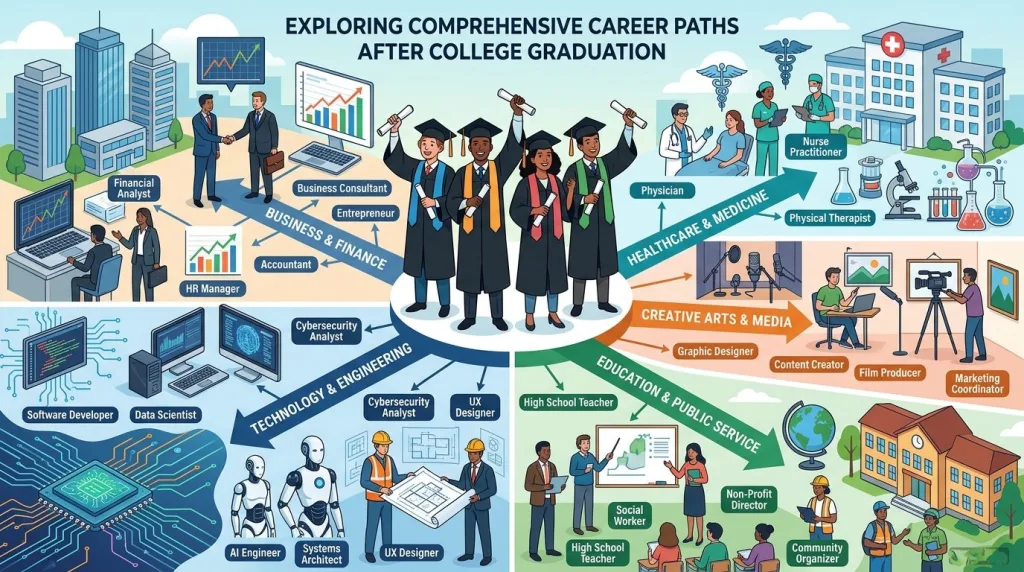
- The post highlights fields such as consumer services, basic industries, finance, energy, oil and gas, REITs, technology, capital goods, public utilities, and health care.
- Each path offers different combinations of salary potential, work environment, specialization, stability, and growth.
- The best option depends on personal fit as well as labor market demand.
- What Makes a Strong Career Decision:
- A strong choice considers more than job title or starting salary.
- It should also reflect long-term interests, qualifications, daily responsibilities, growth potential, and industry demand.
- Using trusted career resources and staying open to experience-based growth can help graduates build a meaningful and successful future after college.
Understanding career paths after college helps graduates make informed decisions that support long-term growth and satisfaction. By matching personal strengths and interests with real opportunities and workforce trends, students can build a career that is both practical and meaningful.
Explore Career Paths After College: Where to Start
What is a Career Path?
- A career path is the direction your working life takes over time, from your first job to more advanced roles in a chosen field. It is not just one position. It includes the steps, choices, and growth that shape your career.
- Career paths often begin with entry-level work, internships, part-time roles, volunteer experience, or training opportunities after college. Over time, these can lead to a more specialized or senior role.
- Every career path has stages. For example:
- You may begin as an assistant, trainee, or junior worker.
- Then move into a coordinator, analyst, or specialist position.
- Later, you may become a manager, consultant, or other professional leader.
- A career path also includes the education and training you complete along the way. This could involve:
- A degree from college
- A short program
- A technical course
- A certificate to help you certify your knowledge
- On-the-job learning in a real work environment
- When people explore career options, they are trying to understand which occupations fit their strengths, personality, and goals. This is why learning about career paths early is so important.
- Put simply, a career path gives structure to your future. It helps you see:
- Where you can start
- What skills you need
- What kinds of job titles exist
- How much you may earn
- What level of responsibility each step involves
Why Career Paths Matter After College?
- After college, many graduates feel pressure to get any job quickly. While that may be necessary at times, understanding career paths helps you make smarter and more strategic choices.
- Career paths matter because they help you move from short-term employment to a more meaningful and rewarding career. Instead of only focusing on the next paycheck, you begin to think about long-term growth.
- Knowing your options can help you:
- Explore industries that match your interest
- Find a role with good salary potential
- Understand what employers want before they hire
- Prepare better application materials
- Build a future with stronger stability and purpose
- Many students leave college with knowledge but not always with a clear plan. That is where career planning becomes valuable. It helps you connect your degree, your skill set, and your personal goals to real opportunities in the workforce.
- Clear career paths also help you avoid wasted time. For example:
- You may discover a role requires extra certification before applying.
- You may realize a certain occupation does not fit your preferred work environment.
- You may find better potential career paths in a related industry than in your original major.
- In today’s competitive labor market, employers often want candidates who understand the description of the role they want and can explain why they are a good fit. When you know your direction, your job search becomes more focused and effective.
- This is especially important in life after high school and after college, because the early choices you make can influence your future career path, income, and growth opportunities.
How To Become a Medical Coder
Explore the medical coder career path, including education, certification, core skills, daily responsibilities, and salary potential. This blog helps readers understand how to enter a growing healthcare support role with confidence.
How To Become a Phlebotomist
Learn about the phlebotomist career path through salary insight, training requirements, key skills, and job demand. This blog is useful for readers exploring an entry-level healthcare role with practical patient-care experience.
How To Become a Neurologist
Discover the neurologist career path from undergraduate study to medical school, residency, and specialization. This blog explains qualifications, responsibilities, subspecialties, and salary expectations for an advanced healthcare profession.
How To Become a Sonographer
Explore the sonographer career path by learning about different specialties, training routes, work settings, and salary potential. This blog helps readers compare options and choose a diagnostic imaging role that suits them.
How To Become a Meteorologist
Understand the meteorologist career path through education requirements, technical skills, internship experience, and career outlook. This blog supports readers interested in weather science, forecasting, and environmental job opportunities.
How To Become a Radiology Technician
Review the radiology technician career path with salary details, education requirements, certifications, and job outlook. This blog helps readers evaluate a technical healthcare role focused on diagnostic imaging and patient support.
Understanding Your Career Path and Long-Term Career Goals
- Before you choose a job, it helps to understand what you want from your long-term career. A good career path should fit not only your education, but also your values, strengths, and lifestyle goals.
- Start by asking yourself a few important questions:
- What kind of work feels interesting and engaging?
- What am I naturally good at?
- What type of work environment suits me best?
- Do I want a high salary, flexibility, creativity, service, or leadership?
- Which work values matter most to me?
- Your long-term goals may include:
- Becoming a manager or specialist
- Entering a respected professional field
- Working in a growing industry
- Starting a business
- Finding a stable role with strong benefits
- Building a rewarding career that aligns with your personal value system
- It is helpful to evaluate both your current position and your future direction. You do not need to know everything right away, but you do need a starting point.
- Think of career planning as a map. It helps you identify:
- Your current skills
- The jobs available to you now
- The education or training needed for future roles
- The steps required to move forward in your chosen career path
- When you understand your goals, it becomes easier to search for jobs with purpose instead of randomly applying. This makes it easier to build a more strategic plan for growth.
How to Explore Career Options Based on Your Interests
- One of the best ways to explore career directions is to start with your interests. Your interests often point to the type of work that will keep you motivated and engaged over time.
- Begin with self-reflection and assessment. Ask:
- What subjects did I enjoy most in college?
- What tasks do I enjoy doing?
- Do I like solving problems, helping people, designing, organizing, teaching, or working with technology?
- Do I prefer independent work or teamwork?
- Once you identify your interests, look at careers connected to them. For example:
- If you enjoy technology, you may pursue a technical role in IT, software, or data support.
- If you enjoy helping others, you may explore healthcare, counseling, education, or social services.
- If you enjoy business, you may look into marketing, finance, operations, or management.
- It is also useful to compare:
- Required education
- Typical salary
- Daily duty and responsibility
- Advancement opportunities
- Job demand in the u.s
- Whether the role allows you to specialize
- Another strong way to learn about careers is through experience:
- Join an internship
- Speak with career services staff
- Attend employer events
- Read job postings carefully
- Review different job titles within the same field
- These steps help you explore career options in a practical way. Instead of guessing, you begin to see what each role actually involves and whether it matches your interests and goals.
Using CareerOneStop as a Career Planning Resource
- CareerOneStop is one of the most useful online tools for students and graduates who want to explore career options. Sponsored in the u.s, it offers trusted information about jobs, training, and employment trends.
- CareerOneStop is helpful because it brings many career planning tools into one place. Through CareerOneStop, you can:
- Take an interest or skills assessment
- Search occupations by keyword or category
- Compare wages and salary data
- Find local training and education options
- Review job outlook information
- Identify certifications and licenses
- Access resource guides for job seekers
- The careeronestop platform is especially useful for students who are unsure where to begin. It can help you match your interests to occupations and show what kind of training is required for different career paths.
- If you want to explore career ideas with structure, this tool can support your career planning and make your search more focused.
How To Become a Veterinarian
Explore the veterinarian career path through DVM education, clinical training, salary expectations, and long-term growth. This blog helps readers understand veterinary medicine as a professional route focused on animal care and practice.
How To Become Industry Certified for Job Roles
Learn how industry certifications support career growth by aligning credentials with job roles, workforce needs, and employer expectations. This blog helps readers understand how certificates can strengthen professional credibility and readiness.
How To Become Skilled Through Trade School
Discover trade school pathways for women through hands-on training, skilled trades programs, and career opportunities. This blog helps readers explore practical routes into trades that offer growth, confidence, and long-term employment.
How To Become a Patient Care Technician or Medical Assistant
Compare the patient care technician and medical assistant career paths through skills, duties, salary, and advancement options. This blog helps readers choose the healthcare support role that best matches their goals.
How To Become Qualified for High-Paying Careers
Explore high-paying bachelor degree paths by reviewing top majors, career options, and salary potential. This blog helps readers connect college study choices with strong long-term professional and financial opportunities.
How To Become Successful with an Art History Major
Learn how an art history major can lead to career opportunities in museums, education, research, and creative industries. This blog helps readers understand the skills, challenges, and value of this academic path.
Assessing Occupational Outlook and Workforce Trends
- To make a smart decision, you should not only choose a career you like. You should also study the larger workforce and labor market.
- Looking at occupational outlook means reviewing future demand for jobs. This helps you understand:
- Which fields are growing
- Which roles may decline
- Where employers are likely to hire
- What skills are becoming more important across industries
- Workforce trends can reveal valuable opportunities in healthcare, technology, business services, trades, and other growing sectors. This makes it easier to identify potential career paths with long-term stability.
- When exploring outlook data, focus on:
- Expected job growth
- Median salary
- Required education and training
- Common entry-level roles
- Advancement paths within the occupation
- By combining personal interest with market data, you can make a more informed choice. That is the best way to build a career that is both personally fulfilling and professionally strong.
- In the end, career paths are not just about finding any job. They are about building a future. When you take time to explore, research, and plan, you give yourself a better chance to create a stable, meaningful, and successful life after college.
How to Choose a Career Path in 5 Easy Steps
Step 1: Assess Your Skills, Values, and Interests
- The first step in choosing among different career paths is to understand yourself before you focus on any specific job. Many students begin by looking at salaries or popular industries, but a better starting point is to ask what you are good at, what matters to you, and what kind of work you genuinely enjoy.
- Start by identifying your skills. These are the abilities you already have or are developing through school, internships, part-time work, volunteering, or everyday life. Your skills may include:
- Communication and writing
- Problem-solving and critical thinking
- Organization and time management
- Leadership and teamwork
- Technical or digital ability
- Research and analysis
- Next, think about your values. Values shape the kind of work that will feel meaningful over time. For example, you may value:
- Stability and long-term security
- High income and growth potential
- Helping people or serving a community
- Creativity and independence
- Flexibility and work-life balance
- Respect, recognition, and advancement
- Your interests are just as important. Interests often point you toward career paths that will keep you motivated. Ask yourself:
- What subjects did I enjoy most in school or college?
- What kind of tasks make me feel engaged?
- What topics do I enjoy reading or learning about?
- Where do I already have curiosity, energy, or passion?
- Be honest during this process. You do not need to choose a perfect path right away, but you do need a clear starting point. When your skills, values, and interests line up, you are more likely to build a satisfying and sustainable future.
- It also helps to list your strengths in one column and your preferences in another. This creates a simple personal profile that can guide your decisions as you compare career paths later.
- This step matters because many people choose work based only on pressure or outside expectations. A better approach is to build from self-awareness. When you understand yourself first, it becomes much easier to choose from the many career paths available after college.
Step 2: Research Career Paths and Job Titles
- Once you understand yourself better, the next step is to research real career paths and the job titles connected to them. This helps you move from general ideas such as “business,” “healthcare,” or “technology” into clearer and more practical options.
- Begin by looking at broad industries that match your interests. Then narrow your focus by exploring different roles within those industries. For example:
- In marketing, roles may include content writer, digital marketer, SEO specialist, or brand coordinator.
- In healthcare, roles may include medical assistant, nurse, therapist, or health administrator.
- In technology, roles may include support technician, data analyst, software tester, or developer.
- Researching career paths means going beyond the title alone. You should also study:
- Daily job responsibilities
- Required education or training
- Entry-level opportunities
- Salary ranges
- Advancement potential
- Whether the role matches your strengths and personality
- As you do your research, pay attention to how one role can lead to another. A strong career path often begins with an entry-level job and then develops through experience, training, and specialization. This helps you see not just where you can start, but where you can grow.
- This is also the stage where you can learn how to become qualified for a role that interests you. For each path, ask:
- What degree, certificate, or experience is expected?
- What qualification do employers usually ask for?
- Do I need a license or exam to qualify?
- What kind of practical experience will help me stand out?
- Make a shortlist of roles that interest you most. Then compare them side by side. A comprehensive comparison helps you avoid making choices based only on job title or salary.
- By researching carefully, you begin to turn a vague career idea into a realistic direction. This is one of the most useful steps for narrowing down career paths and finding options that fit both your goals and your abilities.
Step 3: Explore College Programs, Certificates, and Technical Training
- After researching potential career paths, the next step is to look at the education and training needed to enter them. Not every career requires the same route, and understanding your options can save you time, money, and effort.
- Some roles require a traditional college degree, while others are accessible through:
- Certificate programs
- Short-term technical courses
- Industry certifications
- Apprenticeships
- Vocational training
- This is why it is important to explore several educational paths instead of assuming there is only one route into a profession. In many industries, employers value practical ability just as much as academic knowledge.
- When reviewing programs, ask:
- What does the program teach?
- How long does it take to complete?
- Does it help me qualify for entry-level work?
- Does it include internship placement or practical learning?
- Will the credential transfer if I decide to continue my education later?
- Technical training can be especially valuable for students who want direct entry into the workforce. It often focuses on specific job skills and gives students targeted preparation for real workplace tasks. This makes it a strong option for those interested in hands-on fields.
- Vocational training is also useful for students who prefer practical learning over more theoretical study. It can open doors to steady job opportunities in fields such as healthcare support, skilled trades, information technology, and administrative services.
- As you compare learning options, think about where you want to build your expertise. Some students want broad knowledge, while others want to specialize quickly in a focused area.
- Exploring education this way helps you choose a training route that supports your long-term goals. It also makes your chosen career path feel more achievable because you can clearly see the next step.
- Many successful professionals build strong career paths by combining education with practical experience over time. The key is to choose a path that fits your learning style, goals, and timeline.
Step 4: Use Career Search Tools and Workforce Resources
- Once you know which career paths interest you and what training they require, the next step is to use career search tools and workforce resources. These tools help you make informed choices using real labor market data instead of guesswork.
- Good resources can help you:
- Explore occupations by field
- Compare salaries
- Review qualifications
- Understand hiring demand
- Discover new job opportunities
- Learn how industries are changing
- Look for reliable career websites, job boards, college career centers, and public workforce platforms. These often include tools that explain:
- Required qualification
- Common job responsibilities
- Needed skills and credentials
- Average wages
- Future outlook for different career paths
- It is also helpful to use official workforce information from organizations such as the Department of Labor. These sources can provide trusted insight into employment trends, industry growth, and what employers are looking for in new hires.
- When using workforce tools, focus on both immediate openings and long-term potential. A job may sound appealing today, but a good career path also offers room to grow, build expertise, and move into higher roles later.
- You can make this process easier by creating a simple research table. Include:
- Job title
- Industry
- Education needed
- Salary range
- Outlook
- Skills required
- Growth opportunities
- This creates a more comprehensive view of your options and helps you compare career paths with confidence.
- The more informed your research is, the stronger your career decisions will be. These tools help turn curiosity into strategy and help you move forward with clarity.
Step 5: Start Your Job Search and Build Experience
- The final step is to begin your job search and actively build experience. At this point, you have already assessed yourself, researched career paths, explored training options, and studied workforce data. Now it is time to take action.
- Start by targeting entry-level positions, internships, part-time work, volunteer roles, or training placements connected to your chosen field. These opportunities help you gain exposure and start building credibility.
- Early experience matters because employers often want more than classroom knowledge. They want proof that you can apply what you know in a real setting. This is where hands-on experience becomes especially valuable.
- Even if your first role is not your dream job, it can still support your long-term career path by helping you:
- Build confidence
- Develop workplace habits
- Learn industry expectations
- Improve communication and teamwork
- Understand real job responsibilities
- Discover which different roles suit you best
- As you begin applying, tailor your resume and cover letter to each role. Show clearly how your education, skills, and experiences make you a strong match. Focus on the qualifications employers mention most often.
- Networking is also important. Speak with alumni, teachers, supervisors, classmates, and professionals in your field. Many job opportunities come through conversations, referrals, and connections rather than online applications alone.
- Keep learning as you go. Some students begin in one role and later transfer into another as they gain experience and discover new interests. That is completely normal. Many strong career paths develop step by step, not all at once.
- Most importantly, stay open and consistent. Building a future takes time, but every application, project, internship, and new skill adds value to your journey.
- In the end, choosing among career paths becomes easier when you break it into clear steps. By assessing yourself, researching roles, exploring training, using workforce resources, and gaining experience, you create a practical path toward a strong and meaningful career after college.
Need Help With Your Dissertation?
Get professional academic support from Best Dissertation Writers . Our expert team is ready to help you with high-quality dissertation writing services tailored to your academic goals.
Get Dissertation HelpExamples of Emerging Career Paths After College with Different Job Options
- The best career paths are not always the most obvious ones. Some graduates follow their passion, while others focus on strong job opportunities, salary growth, or stability. In reality, the smartest choice often combines several factors:
- Your interests and natural strengths
- Industry demand and hiring trends
- Required education or qualification
- Long-term growth and promotion options
- Daily job responsibilities
- Whether the field offers room to build expertise
- Below are examples of popular and emerging career paths after college, with a look at whether each one may be a good choice.
Is Consumer Services a Good Career Path?
- Consumer services can be a strong career path for graduates who enjoy working directly with people and solving everyday problems. This field includes jobs related to customer support, hospitality, retail operations, personal services, and client care.
- It is a good option for people who:
- Have strong communication and interpersonal skills
- Enjoy helping others
- Work well in fast-paced environments
- Want to build experience in service-focused industries
- Common different roles in consumer services include:
- Customer service representative
- Client support specialist
- Hospitality coordinator
- Store manager
- Guest relations officer
- The job responsibilities in this area often include answering customer questions, resolving concerns, managing service quality, and creating a positive client experience.
- This can be one of the more accessible career paths because some roles do not require highly specialized education. However, advancement often depends on performance, leadership ability, and hands-on experience.
- It may be a good fit if you want:
- Entry-level job opportunities
- Practical business experience
- A chance to move into management later
- It may not be ideal if you prefer highly technical or independent work.
Is Basic Industries a Good Career Path?
- Basic industries include sectors such as agriculture, mining, steel, chemicals, forestry, and raw material production. These industries form the foundation of many economies because they provide the materials other sectors use.
- This can be one of the most practical career paths for graduates interested in production, operations, logistics, engineering support, or industrial systems.
- It is often a good fit for people who:
- Prefer structured work
- Enjoy physical systems and operations
- Want stable industries with long-term demand
- Are open to technical environments
- Possible roles include:
- Operations analyst
- Production supervisor
- Supply chain coordinator
- Quality control specialist
- Industrial technician
- Some jobs in this field require degrees, while others may accept vocational training, certifications, or technical diplomas. This makes it appealing to graduates who want flexible entry routes.
- A major benefit is that workers can build expertise steadily and often transfer into higher-level operations or management roles over time.
- This path is especially good for graduates who want practical industries with clear responsibilities, although some work settings may be physically demanding or location-dependent.
Is Finance a Good Career Path?
- Finance is one of the most popular career paths after college because it offers strong salary potential, professional growth, and a wide range of job opportunities.
- It is a good option for graduates who enjoy numbers, analysis, planning, and decision-making. People who like business strategy often do well here.
- Common finance roles include:
- Financial analyst
- Accountant
- Credit analyst
- Investment associate
- Risk specialist
- Budget coordinator
- The field includes many different roles, so students can explore corporate finance, banking, insurance, investment services, or financial planning.
- Typical job responsibilities may include:
- Reviewing financial data
- Preparing reports
- Supporting investment decisions
- Managing budgets
- Monitoring risk and compliance
- Finance can be a very rewarding path if you are willing to build technical knowledge and professional credibility. Some positions may require extra certification or licensing to fully qualify.
- This is also a field where students often learn how to become more specialized over time. You may begin in an entry-level analyst role and later move into leadership, advisory, or investment positions.
- Finance is a strong choice for graduates who want structured advancement, strong earning potential, and a professional environment.
Is Energy a Good Career Path?
- Energy is becoming one of the most important career paths for modern graduates because the sector is changing quickly. It includes renewable energy, power systems, sustainability, utilities, and energy management.
- This field is especially attractive to students interested in science, engineering, technology, policy, or environmental planning.
- Roles in energy may include:
- Energy analyst
- Sustainability coordinator
- Renewable systems technician
- Project manager
- Environmental compliance specialist
- One reason this is among the more promising career paths is that global demand for energy solutions continues to grow. There are increasing job opportunities in solar, wind, battery systems, and energy efficiency.
- This field may be ideal for graduates who:
- Want work with long-term relevance
- Care about innovation and sustainability
- Enjoy technical or strategic problem-solving
- Some roles require engineering or science degrees, while others may accept technical training and certifications. In many cases, graduates need a clear qualification path to enter specialized positions.
- Energy is a good path for those who want growth, impact, and evolving career options.
Is Oil & Gas Production a Good Career Path?
- Oil and gas production remains one of the more established career paths, especially for graduates interested in engineering, geology, operations, logistics, and industrial management.
- This field can offer high salaries and strong operational experience, especially in production and field-based positions.
- Examples of roles include:
- Production engineer
- Field operations coordinator
- Safety specialist
- Maintenance planner
- Petroleum analyst
- The appeal of this field often comes from:
- Strong pay in many roles
- Large-scale operations
- Technical skill development
- Opportunities for advancement
- However, this path is not for everyone. Work may involve remote sites, strict safety expectations, and changing market conditions.
- Graduates considering this field should review:
- Industry stability
- Personal comfort with work locations
- Required training and qualification
- Long-term goals compared with renewable energy sectors
- For some students, oil and gas offers excellent early hands-on experience and deep industry exposure. For others, newer energy sectors may align better with their long-term passion.
How To Become a Forensic Scientist
Explore the forensic science career path through degree requirements, lab skills, certifications, salary expectations, and daily responsibilities. This blog helps readers understand whether forensic science is challenging and worth pursuing professionally.
How To Become an ICE Agent
Learn about the ICE agent career path through qualifications, federal hiring requirements, academy training, and law enforcement responsibilities. This blog helps readers understand careers in immigration enforcement and homeland security operations.
How To Become an Oceanographer
Discover the oceanography career path through degree programs, admission requirements, fieldwork, and marine science specialization. This blog helps readers explore careers in ocean research, conservation, and environmental science.
How To Become a Public Health Leader
Explore the Doctor of Public Health career path through leadership training, practicum experience, public health impact, and salary potential. This blog helps readers understand advanced careers in policy, government, and global health.
How To Become a Pharmacist
Understand the pharmacist career path through PharmD education, licensure preparation, experiential learning, and pharmacy career options. This blog helps readers explore professional opportunities in patient care and pharmaceutical practice.
How To Become an Educational Leader
Learn about the Doctor of Education career path through online EdD programs, leadership specializations, admission requirements, and salary outcomes. This blog helps readers explore advanced careers in education and organizational leadership.
Is Real Estate Investment Trusts a Good Career Path?
- Real Estate Investment Trusts, often called REITs, can offer strong career paths for graduates interested in property, finance, investing, asset management, and market analysis.
- A REIT is a company that owns or manages income-producing real estate. Working in this area can combine finance skills with knowledge of property markets.
- Common roles include:
- Investment analyst
- Property operations coordinator
- Asset management assistant
- Leasing analyst
- Portfolio support specialist
- This can be a good path for graduates who enjoy:
- Market research
- Investment strategy
- Real estate trends
- Financial performance tracking
- The job responsibilities in this field can include reviewing property performance, supporting leasing decisions, analyzing return on investment, and preparing reports.
- It is one of the more specialized career paths, but it can be rewarding for those who want to build expertise in both property and finance.
- Graduates may need business, finance, economics, or real estate education to enter the field. Some may later qualify for advanced roles through industry certifications or practical experience.
Is Technology a Good Career Path?
- Technology is widely seen as one of the best career paths after college because it continues to create new roles, strong salaries, and flexible working options.
- This field is broad, which means students can explore different roles based on their strengths. Not every technology job requires advanced coding. There are roles in support, design, data, cybersecurity, testing, analysis, and product operations.
- Possible job titles include:
- Software developer
- IT support specialist
- Data analyst
- Cybersecurity associate
- Product coordinator
- UX designer
- Technology is a strong option for graduates who:
- Enjoy problem-solving
- Want high-demand skills
- Are comfortable learning continuously
- Want access to global job opportunities
- One advantage is that students can learn how to become qualified through multiple routes. Some enter through degrees, while others use boot camps, certificates, technical programs, or self-study combined with projects.
- This path rewards skill-building and real ability. Employers often value portfolios, certifications, and hands-on experience alongside formal education.
- Technology remains one of the fastest-growing career paths and is a strong choice for graduates who enjoy innovation and ongoing learning.
Is Capital Goods a Good Career Path?
- Capital goods refers to industries that produce machinery, equipment, tools, and systems used by other businesses. This includes manufacturing equipment, industrial machines, transportation systems, and production technology.
- It is a good path for graduates who like engineering, manufacturing systems, operations, logistics, and large-scale industrial work.
- Example roles include:
- Manufacturing analyst
- Mechanical design assistant
- Procurement specialist
- Operations coordinator
- Equipment support engineer
- These career paths can be appealing because they offer:
- Stable industrial demand
- Technical development
- Clear advancement routes
- Opportunities to build specialized expertise
- Some roles require engineering or technical backgrounds, while others allow graduates to enter through operations or business support functions and later transfer into more specialized positions.
- This is a good option for students who want structured industries and clearly defined job responsibilities.
Is Public Utilities a Good Career Path?
- Public utilities include water, electricity, gas distribution, sanitation, and related services. These are essential industries, which makes them one of the more stable career paths after college.
- This field is attractive for graduates seeking reliability, public impact, and long-term employment.
- Roles may include:
- Utility analyst
- Operations coordinator
- Environmental compliance officer
- Systems technician
- Project support specialist
- Utility work can combine public service with technical systems. It is often a good path for students interested in infrastructure, sustainability, engineering, or operations.
- Benefits of this path may include:
- Stable demand
- Strong organizational structure
- Opportunities for advancement
- A clear sense of community value
- Public utilities can also provide a more predictable work environment than some private sectors. For graduates who want stable career paths, this may be a very attractive option.
Is Health Care a Good Career Path?
- Health care remains one of the strongest career paths because it offers meaningful work, consistent demand, and a very wide range of job options.
- This field is much broader than many students first realize. It includes clinical care, administration, health technology, records management, therapy support, public health, and research.
- Common roles include:
- Medical assistant
- Health administrator
- Public health coordinator
- Clinical support specialist
- Health information technician
- Patient care associate
- This is one of the best career paths for graduates who want:
- Purpose-driven work
- Strong employment demand
- Opportunities to specialize
- Long-term professional growth
- Health care has many entry routes. Some roles require advanced degrees, while others can begin with certificates, diplomas, or vocational training. This makes the sector accessible to a wide range of learners.
- It is also a field where workers can build deep expertise and later move into leadership, specialized care, education, or management.
- Because of ongoing demand, health care continues to offer strong job opportunities and long-term stability. For graduates who value service, people-centered work, and growth, it is often an excellent choice.
Conclusion: Career Paths After College and Your Next Job Search Steps
- The truth is that there is no single best answer for everyone. The best career paths depend on your strengths, goals, education, and interests. What matters most is choosing a path that gives you room to grow, earn well, and build a future you value.
- As you review these industries, take a comprehensive approach. Do not focus only on job title or starting salary. Also consider:
- Your long-term interests
- Daily job responsibilities
- Required qualification
- Growth potential
- Work environment
- Industry demand
- It can help to create a shortlist of two to four fields that interest you most. For each one, research:
- Entry-level positions
- Needed education or certifications
- Skills employers expect
- Promotion opportunities
- Whether you can qualify quickly or need more training
- Use trusted sources such as college career offices, employer websites, and labor market resources. In the U.S., information from the Department of Labor can help you compare industries, outlook, and training requirements in a more informed way.
References
- Career Success Resources – St. John’s College – https://www.sjc.edu/career-success
- What to Do After Graduating College – MCPHS University – https://www.mcphs.edu/admission-and-aid/blog/what-to-do-after-graduating-college
- Students and Recent Graduates – U.S. Department of Labor – https://www.dol.gov/general/jobs/students-and-recent-grads