
How to Write Research Aims and Objectives, with Examples
 By Dr. Robertson Prime, Research Fellow
Updated October 21, 2026
12 min read
About 2,400 words
A research aim is a single, broad statement of what your study intends to achieve. Your objectives then break that aim into specific, measurable steps, and your research questions say exactly what you will answer. This guide shows you how to formulate a strong research aim and write clear aims and objectives for a thesis or dissertation, or a research proposal.
- The definitions: how a research aim differs from a research objective and a research question.
- The method: a 5-step guide to formulate a research aim, then turn it into objectives.
- The examples: weak vs strong research aims and objectives, full examples and a template.
On this page
Key takeaways
- Write one research aim: a single sentence describing the overall goal of your study.
- Break the aim into three to five specific, measurable objectives.
- Match each objective with one or more research questions.
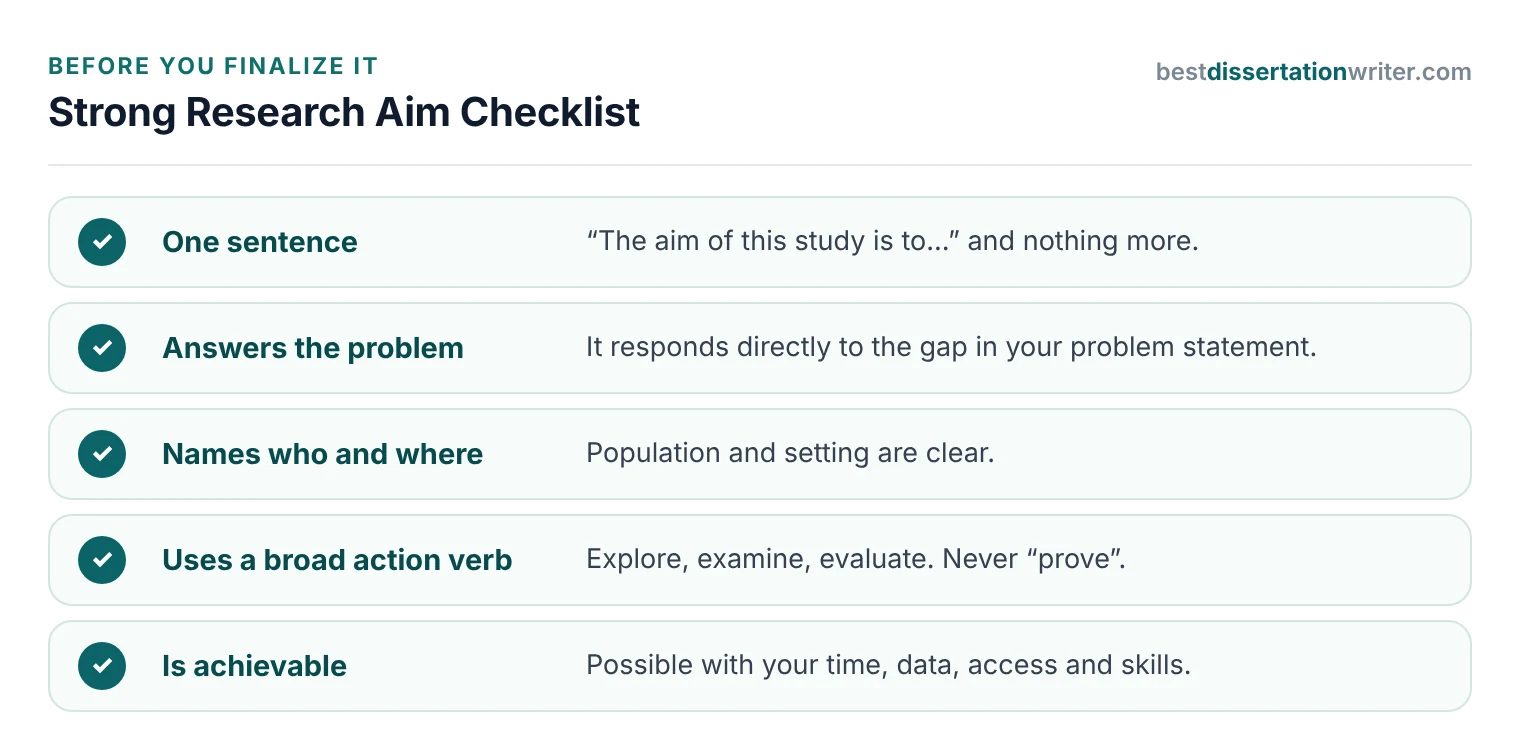
- Keep the aim achievable within your time, data and resources.
What Is a Research Aim?
The research aim is the overall purpose of your study, stated in one sentence. It tells readers what you want to find out or achieve, without listing the detailed steps.
- A plain definition: a research aim is a broad statement of the intended outcome of your research, linked directly to the research problem.
- Its scope: it is a broad research statement that covers the whole study but is specific enough to name the topic, population and setting.
- Its form: it usually begins with “The aim of this study is to…” followed by a broad action verb such as “examine”, “explore” or “evaluate”.
- Its position: it appears in the introduction section, after the problem statement and before the objectives.
Sheffield Hallam University’s guide to dissertation introductions describes the aim as the single overarching goal of a project, with three to five objectives as the steps toward it.
Research aim vs research objective vs research question
The three elements work as a set. Each one is narrower than the one before.
| Element | What it does | Example |
|---|---|---|
| Research aim | States the overall goal | To examine how remote work flexibility influences employee retention in small technology firms. |
| Research objective | A specific, measurable step toward the aim | To measure employees’ intention to stay under different levels of flexibility. |
| Research question | The exact question an objective answers | How does the degree of remote work flexibility relate to intention to stay? |
For more on questions, see our guide on how to write a research question.
Why clear aims and objectives matter
Clear aims and objectives give your research project direction from the proposal to the conclusion. They also make your work easier to assess.
- They establish the scope: the aim sets boundaries, so you know what to include and leave out.
- They guide the research process: each objective points to the data and research design you need.
- They structure the dissertation: your results and discussion chapters can follow the objectives in order.
- They help examiners: clear expected outcomes show what success looks like for your study.
How Aims and Objectives Work Together
Think of the research aim as the destination and the objectives as the route. Every objective should help you reach the aim, and nothing in the aim should be left without an objective.
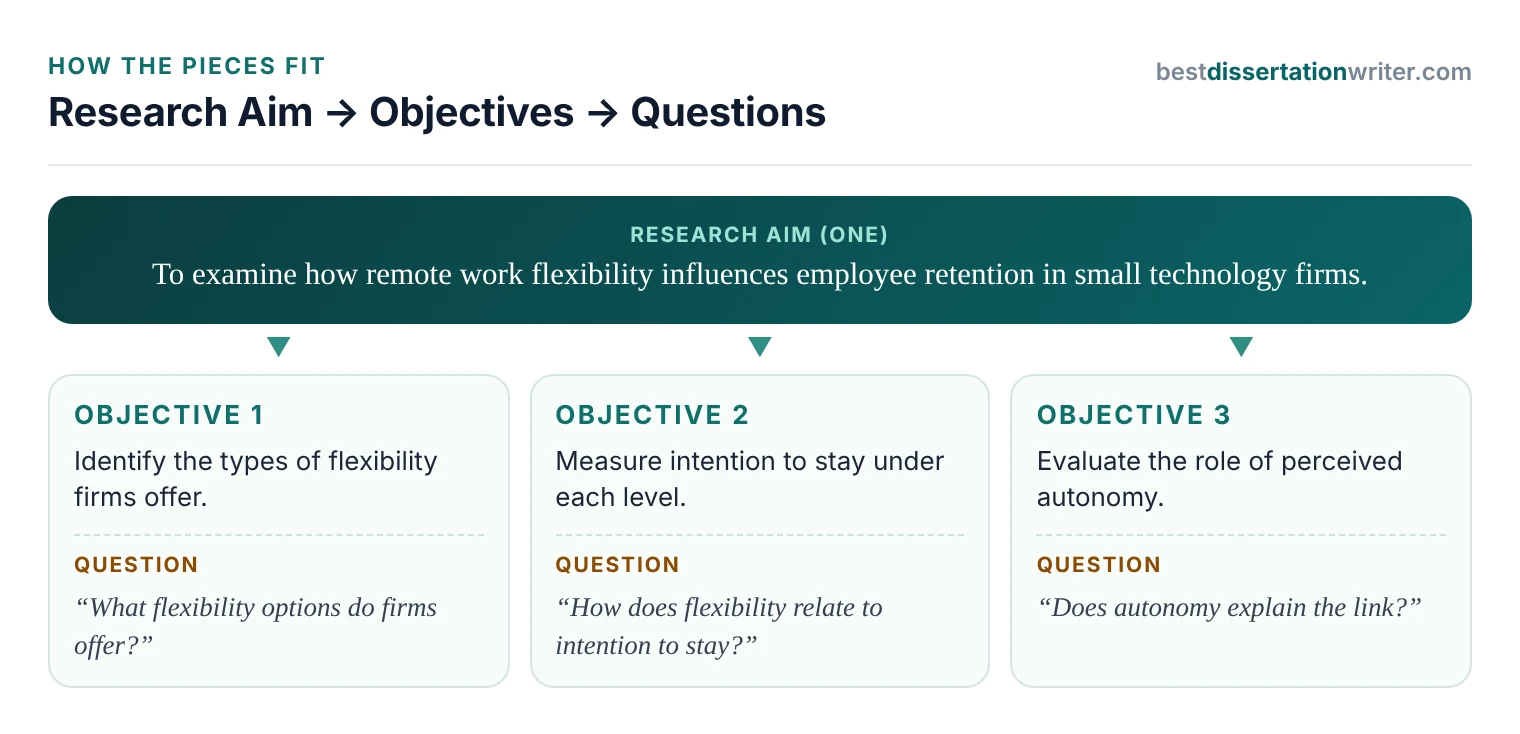
- One overall aim: most dissertations have a single aim; some large projects have two closely linked aims.
- Specific objectives: usually three to five, each starting with an action verb.
- Linked questions: each objective is answered by at least one research question.
- Consistent terms: use the same names for variables and populations in all three.
Types of research aims
Different types of research call for different aims. Your verb signals which type you are doing.
- Exploratory aims: explore a new or poorly understood topic, common in qualitative studies; for example, “to explore how nurses experience…”.
- Descriptive aims: describe the characteristics of a group or situation; for example, “to describe patterns of…”.
- Explanatory aims: examine relationships or causes, common in quantitative studies; for example, “to examine the relationship between…”.
- Evaluative aims: assess how well a program or intervention works; for example, “to evaluate the effectiveness of…”.
Qualitative research usually uses open verbs such as “explore” or “understand”, while quantitative research uses verbs such as “examine” or “determine”. Our guides to qualitative research questions and quantitative research questions show how each type is phrased.
How to Formulate a Strong Research Aim: Step-by-Step
Use this step-by-step guide to formulate a research aim that is clear, focused and achievable. The flowchart shows the five steps at a glance.
- Define the problemWhat needs solving
- Find the gapFrom the literature
- Choose a verbExplore, examine…
- Add focusTopic, people, setting
- Test and refineClear and achievable
- Define your research problem. Start from your problem statement. The aim must respond to that problem, so write the problem in one sentence first; see our problem statement guide.
- Identify the research gap. Use your literature review to find what is not yet known. The aim should promise to address this specific gap, not the whole topic.
- Choose a broad action verb. Pick a verb that matches your approach: “explore” for qualitative research, “examine” or “evaluate” for quantitative research.
- Add the focus, population and setting. Name the main concept or variables, the group you will study and where. This turns a broad area of interest into a well-defined aim.
- Test and refine your aim. Check that it is one sentence, clear to a non-specialist and achievable with your data, time and skills. Ask your supervisor to review it.
Refine and narrow: refining your research aim
Your first draft will usually be too broad. Refining your research aim means narrowing it until it is specific enough to guide a single study.
- Narrow the population: “employees” becomes “full-time employees in small and midsize technology firms”.
- Narrow the focus: “wellbeing at work” becomes “burnout”.
- Narrow the setting: add a sector, region or organization type.
- Remove promises you cannot keep: drop words such as “solve” or “prove”.
How to Write Research Objectives From Your Aim
Once the research aim is fixed, you can write research objectives that break it into steps. Writing research objectives well is what makes the aim achievable.
- Start each objective with an action verb: identify, measure, compare, analyze, evaluate or develop.
- Make them SMART: SMART research objectives are specific, measurable, achievable, relevant and time-bound.
- Order them logically: objectives often move from describing, to analyzing, to recommending.
- Keep them specific enough: each objective should describe one specific research task, not several.
The University of Manchester Library’s guide to writing research objectives includes a useful list of action verbs. For a full guide with examples, see how to write research objectives.
Write aims and objectives for a research proposal
When you write aims and objectives for a research proposal, reviewers read them first to judge feasibility. This applies to dissertation proposals and grant proposals alike.
- Lead with the aim: state it early and in one sentence so reviewers can follow the logic.
- Show feasibility: objectives should match your timeline, budget and access to data.
- Link to methods: each objective should point to a method in your research design.
Advice for PhD students and grant proposals
Doctoral and funded projects raise the stakes. Reviewers want a clear direction and objectives that are specific and achievable.
- PhD students: doctoral aims can be more ambitious, but still need objectives you can complete within the program.
- Grant proposals: funders look for actionable objectives with expected outcomes they can monitor.
- Both: show that the study addresses a specific research gap rather than a broad research area.
Research Aims and Objectives Examples: Weak vs Strong
These research aim examples show how the study aims of a strong project differ from weak ones. Each pair uses a topic from our example studies.
Too broad
Weak
“The aim of this study is to look at remote work.”
No focus, population, setting or outcome.
Strong
“The aim of this study is to examine how remote work flexibility influences employee retention in small and midsize technology firms.”
Names the variables, the population and the setting.
Not achievable
Weak
“The aim is to solve burnout among all teachers in the United States.”
No single study can do this; it is not achievable.
Strong
“The aim is to examine the relationship between emotion regulation strategies and burnout among early-career teachers in public schools.”
Focused, realistic and researchable.
Aim written as an objective
Weak
“The aim is to send a survey to 200 nurses.”
This is a method step, not the goal of the study.
Strong
“The aim is to explore how mental health nurses use therapeutic communication to build relationships with patients in inpatient units.”
States what the study wants to understand; the methods come later.
Full research aims and objectives examples
Business example: remote work and retention
Aim: To examine how remote work flexibility influences employee retention in small and midsize technology firms.
Objectives: (1) To identify the types of remote work flexibility offered by small technology firms. (2) To measure employees’ intention to stay under different levels of flexibility. (3) To evaluate whether perceived autonomy explains the relationship. (4) To recommend policy options for managers. A full study is available on remote work flexibility and employee retention.
Psychology example: attachment style
Aim: To examine whether attachment style moderates changes in relationship satisfaction when young adult couples move from long-distance to living in the same place.
Objectives: (1) To measure relationship satisfaction before and after the move. (2) To classify participants’ attachment styles. (3) To test whether attachment style moderates the change in satisfaction.
Research aim and objectives template
Copy this template and replace the highlighted parts.
Template
Aim: The aim of this study is to [broad verb: explore/examine/evaluate] [focus or variables] among [population] in [setting]. Objectives: (1) To [identify/describe] [first step]. (2) To [measure/analyze] [second step]. (3) To [compare/evaluate] [third step]. (4) To [recommend/develop] [final step].
Common Mistakes and Tips for Writing Research Aims
Avoid common mistakes that make aims hard to assess. These tips for writing will help you communicate your intent succinctly.
Common mistakes, from vague verbs to a mismatched research design
- Overly broad objectives: objectives that repeat the aim in different words add nothing.
- Too many aims: several unrelated research goals split the study and confuse readers.
- Vague verbs: “look at” or “study” do not say what you will actually do.
- Mismatch with the design: an aim to “determine causes” needs a design that can test causes.
- Promising results: aims to “prove” or “show that” assume the answer.
Tips for writing strong aims
- Write it last, too: revise your aim after the literature review and again before submission.
- Read it aloud: if it does not fit in one breath, it is probably too long.
- Use it everywhere: repeat the aim’s key terms in your methodology, results and conclusion.
- Check academic writing style: use formal, precise language with no rhetorical questions.
For how the aim fits into Chapter 1, see our dissertation introduction chapter guide, or return to how to write a dissertation.
Research Aim FAQs
What is a research aim?
A research aim is a single, broad statement of what your study intends to achieve. It describes the overall goal of the research, usually in one sentence beginning with “The aim of this study is to…”, followed by a verb such as “explore”, “examine” or “evaluate”.
A good aim names the topic or variables, the population and the setting, and responds directly to the research problem. It is broader than your objectives, which break the aim into specific steps, and your research questions, which say exactly what you will answer.
What is the difference between aims and objectives?
The aim is the overall goal of your study, while the objectives are the specific steps you will take to reach it. An aim is broad and usually written as one sentence. Objectives are narrower, measurable and action-focused, often starting with verbs such as identify, measure, compare or evaluate.
For example, the aim might be to examine how remote work affects retention, while one objective is to measure employees’ intention to stay. Most dissertations have one aim and three to five objectives that together achieve it.
How many research aims should a dissertation have?
Most dissertations have one research aim. A single aim keeps the study focused and makes it easier to judge whether you achieved what you set out to do. Some large doctoral projects have two closely related aims, but more than that usually means the study is trying to do too much.
If you find yourself writing several aims, check whether some are really objectives, which are specific steps toward one overall goal. Your supervisor or program handbook may also set expectations, so confirm them early.
How do I write a research aim for a qualitative study?
For a qualitative study, use an open verb such as “explore”, “understand” or “describe”, and focus on a central phenomenon or experience rather than relationships between variables. Name the participants and the setting.
For example: “The aim of this study is to explore how mental health nurses use therapeutic communication to build relationships with patients in inpatient units.” Avoid verbs that suggest measurement or prediction, such as “determine” or “test”, which fit quantitative research. Keep the aim open enough to allow unexpected findings to emerge from the data.
Where do the aims and objectives go in a dissertation?
The aims and objectives usually appear in Chapter 1, the introduction, after the background and problem statement and before or alongside the research questions. Many programs use a subheading such as “Research Aim and Objectives”.
In a research proposal, they often appear near the start because reviewers use them to judge feasibility. You will also return to them in your conclusion, where you explain how each objective was met. Repeating the same wording in both places makes it easy for examiners to check your work.
Best Dissertation Writers
Need help writing your dissertation introduction?
Our expert writers can help you draft your background, problem statement, purpose and research questions to your brief.