Social Isolation and Loneliness Among Community-Dwelling Adults and Nursing Interventions: A Systematic Review
 By Dr. Robertson Prime, Research Fellow
Updated October 12, 2026
14 min read
About 2,800 words
In this review
Abstract
Background: Social isolation and loneliness are common among adults living in the community and are linked to poorer physical and mental health. Community nurses regularly visit people who are housebound, frail or living alone, and are often among their few regular contacts.
Aim: This systematic review aimed to examine the health effects of social isolation and loneliness among community-dwelling adults and the interventions that may reduce them.
Methods: Evidence was identified through targeted searches of openly accessible bibliographic records, publisher websites and the reference lists of key reviews. Five sources published between 2011 and 2024 were included: two meta-analyses of health risks, a meta-analysis and an integrative review of interventions, and a national survey, synthesised narratively.
Findings: Social isolation, loneliness and living alone were associated with 29%, 26% and 32% greater likelihood of death respectively, and poor social relationships with 29% higher risk of coronary heart disease and 32% higher risk of stroke. In England, 7% of adults felt lonely often or always, rising to 15% of disabled adults. Interventions had small effects overall; those addressing unhelpful thinking were most effective, and successful community programmes were adaptable and involved productive engagement.
Conclusion: Community nurses should ask about loneliness, recognise those at risk and connect people with tailored support, while recognising that evidence on interventions remains limited.
Keywords: social isolation and loneliness, social isolation, loneliness interventions
Introduction
This systematic review critically examines recent evidence on social isolation and loneliness and its implications for community nursing practice.
Social isolation describes having few social contacts or relationships, while loneliness is the painful feeling that one’s relationships are not as many or as close as one would like. The two often occur together but are not the same: some people who live alone and see few others are content, while some who are surrounded by people feel deeply lonely. Both have attracted growing attention as public health problems, and the UK appointed a minister for loneliness in 2018.
Community nurses meet many people at risk. Housebound older people, people with long-term conditions or disabilities, people who have recently been bereaved and carers whose lives have narrowed around caring may all experience isolation. For some, a district nurse or community matron may be one of the few people they see each week. This gives nurses both an opportunity and a responsibility to notice loneliness and to respond.
A systematic review approach was chosen to bring together meta-analyses of health risks and reviews of interventions, so that the strength of evidence for each could be judged.
Loneliness is also often hidden. Many people feel ashamed to admit it, fearing that it reflects a personal failing, and older people in particular may not want to be seen as a burden. Health and care services tend to focus on physical problems, so loneliness may never be discussed unless a professional asks. Community nurses, who build relationships over repeated visits, may be among the few professionals who hear about it.
Review question
What are the health effects of social isolation and loneliness among community-dwelling adults, and which interventions may reduce them?
Background to Social Isolation and Loneliness
Several mechanisms may link isolation and loneliness to poorer health. People with few social contacts may receive less practical help, be less likely to seek care and be more likely to smoke, drink or be inactive. Loneliness may also act through stress, affecting sleep, blood pressure, inflammation and immune function. Isolation and loneliness are associated with depression and cognitive decline, and the relationship may run in both directions, since illness and disability can themselves lead to isolation.
Risk factors include older age, living alone, bereavement, poor health, disability, sensory impairment, low income, caring responsibilities and lack of transport. Younger adults are also affected, particularly those who are disabled, unemployed or living in deprived areas. Life transitions, such as retirement, moving home or the death of a partner, are periods of particular risk.
Interventions to address social isolation and loneliness take many forms. They include one-to-one approaches such as befriending, group activities and community programmes, social prescribing, technology to help people stay in touch, and psychological approaches that address unhelpful thoughts about relationships. Community nurses may deliver some of these directly but more often identify people in need and connect them with services.
Understanding which approaches work, and for whom, is important. Many services have been developed with limited evaluation, and some interventions may not reach the people who are most isolated, such as those who are housebound or who find groups difficult.
Measurement adds a further complication. Social isolation is usually measured objectively, for example by counting contacts, living arrangements or participation in groups, while loneliness is measured through self-report questions or scales. Because the two concepts differ, an intervention that increases contact may reduce isolation without necessarily reducing loneliness, and studies need to be clear about which outcome they target.
Search Strategy and Methods
Evidence for this example was identified through targeted searches of openly accessible bibliographic records, publisher websites and the reference lists of key reviews. Search terms combined keywords for the concept (“social isolation”, “loneliness”, “living alone”, “social relationships”) with terms for outcomes and interventions (“mortality”, “cardiovascular disease”, “intervention”, “befriending”, “community”, “older people”), joined with the Boolean operators AND and OR. A full systematic review for assessment would run the same strategy in CINAHL, PubMed/MEDLINE, the Cochrane Library and Social Care Online and report the number of records screened in a PRISMA flow diagram.
Sources were eligible if they examined the health effects of social isolation and loneliness in community-dwelling adults or evaluated interventions to reduce them. Systematic reviews and meta-analyses were prioritised, and a large national survey was included to describe current prevalence in England. Studies limited to children or to hospital and care home residents were excluded.
Five sources published between 2011 and 2024 were included: two meta-analyses of health risks, a meta-analysis of interventions, an integrative review of interventions and a national survey (Table 1). The quality of each source was considered using the Critical Appraisal Skills Programme (CASP) checklists, and findings were synthesised narratively.
Key Findings on Social Isolation and Loneliness
Three themes were identified: the scale of loneliness in the community, the health risks of social isolation and loneliness, and the effectiveness of loneliness interventions. Table 1 summarises the included sources, and Figure 1 shows how loneliness varies between groups in England.
| Author, year | Design | Setting and sample | Key finding |
|---|---|---|---|
| Masi et al. (2011) | Meta-analysis of interventions | Randomised and non-randomised studies of loneliness interventions | Small significant effect overall; interventions addressing maladaptive social cognition most effective. |
| Holt-Lunstad et al. (2015) | Meta-analysis of prospective studies | Studies published 1980–2014, multiple world regions | Social isolation, loneliness and living alone linked to 29%, 26% and 32% increased likelihood of death. |
| Valtorta et al. (2016) | Systematic review and meta-analysis | 23 papers, 16 longitudinal datasets, high-income countries | Poor social relationships: coronary heart disease RR 1.29; stroke RR 1.32. |
| Gardiner et al. (2018) | Integrative review | 38 studies of interventions for older people, 2003–2016 | Most reported some success but evidence weak; adaptability, community development and productive engagement key. |
| DCMS (2024) | National survey (Community Life Survey 2023/24) | More than 170,000 responses, England | 7% of adults lonely often or always; 15% of disabled adults vs 3% of non-disabled adults. |
Theme 1: The Scale of Loneliness in the Community
The Community Life Survey 2023/24, with more than 170,000 responses in England, found that 7% of adults, around 3.1 million people, felt lonely often or always (Department for Culture, Media and Sport, 2024). Loneliness was highest among younger adults (10% of those aged 16 to 24) and varied widely between groups: 15% of disabled adults felt lonely often or always compared with 3% of non-disabled adults, and rates were 15% among those who had never worked or were long-term unemployed and 11% in the most deprived areas.
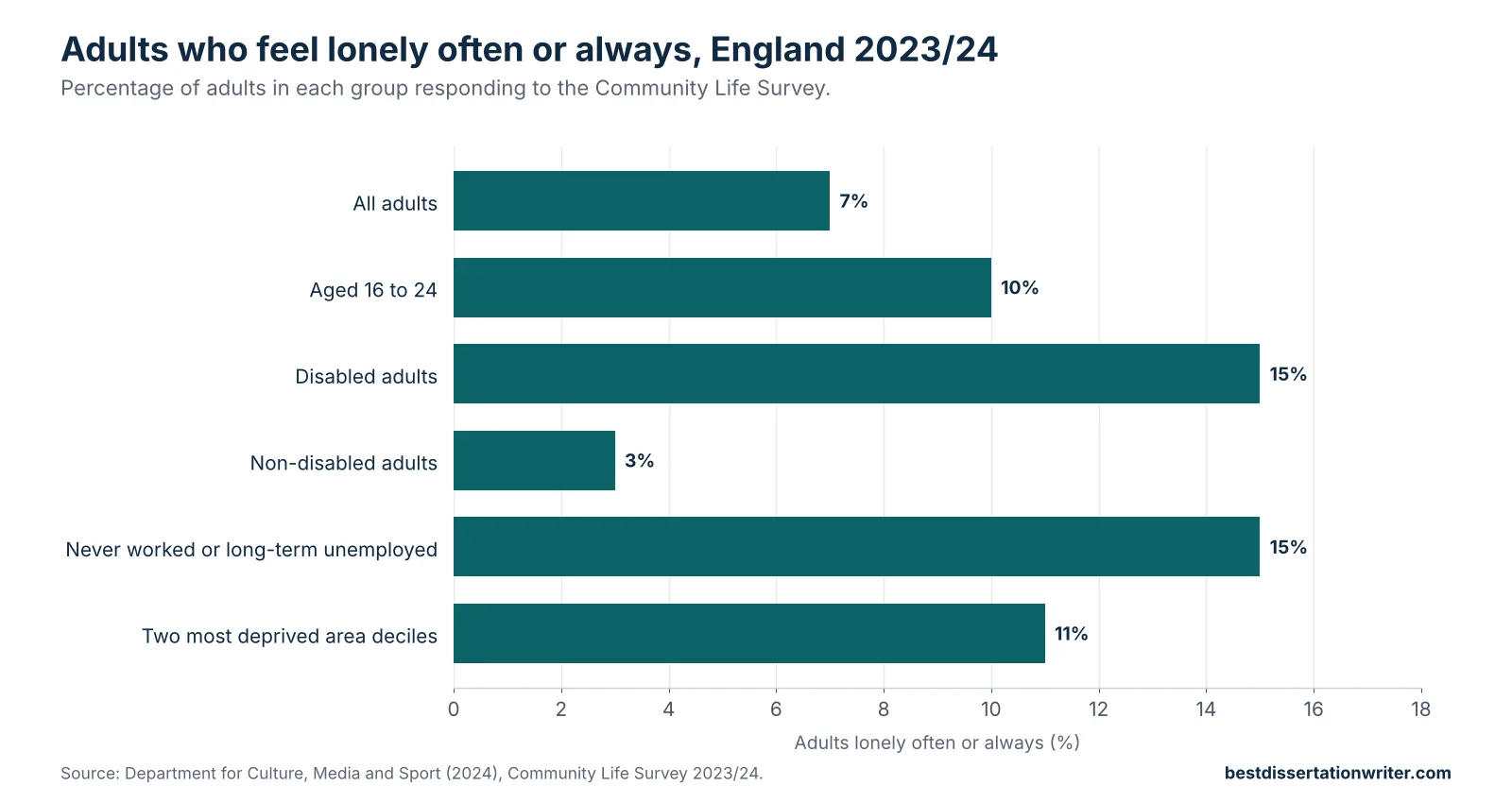
The survey also found that most adults had someone they could call on for help or company, but disabled adults and people in deprived areas were less likely to have such support. These figures show that loneliness is not confined to older people and is closely linked to disability and disadvantage, groups well represented on community nursing caseloads. As a self-report survey, it may underestimate loneliness among people who find it hard to admit, or who are too unwell to take part.
Theme 2: The Health Risks of Social Isolation and Loneliness
A meta-analysis of prospective studies examined social isolation and loneliness as risk factors for mortality (Holt-Lunstad et al., 2015). After controlling for confounders, social isolation was associated with a 29% increased likelihood of death, loneliness with 26% and living alone with 32%. There was no difference between objective isolation and subjective loneliness, and results were consistent across gender, length of follow-up and world region. The authors concluded that these risks are comparable with well-established risk factors for mortality.
A systematic review and meta-analysis of 23 papers from 16 longitudinal datasets examined loneliness and isolation as risk factors for cardiovascular disease (Valtorta et al., 2016). Poor social relationships were associated with a 29% higher risk of coronary heart disease (relative risk 1.29, 95% CI 1.04 to 1.59) and a 32% higher risk of stroke (relative risk 1.32, 95% CI 1.04 to 1.68), with no differences between men and women.
Both reviews were based on observational studies, so they cannot prove that isolation and loneliness cause poorer health. Reverse causation is possible, since people who are unwell may become isolated, and the measures of isolation and loneliness varied between studies. Nevertheless, the size and consistency of the associations suggest that social isolation and loneliness deserve the same attention as other recognised risk factors.
For practice, the strength of these associations matters because isolation and loneliness are, at least in principle, modifiable. Many traditional risk factors that community nurses address, such as smoking, inactivity and poorly controlled blood pressure, carry risks of a similar order. Treating social connection as part of health assessment is therefore consistent with a preventive approach to community nursing.
Theme 3: The Effectiveness of Loneliness Interventions
A meta-analysis of interventions to reduce loneliness grouped them into four types: improving social skills, enhancing social support, increasing opportunities for social contact and addressing maladaptive social cognition, that is, unhelpful thoughts about oneself and others (Masi et al., 2011). Across randomised trials, loneliness interventions had a small but significant effect. Interventions that addressed social cognition were more effective than the other types, and group interventions were not more effective than individual ones.
An integrative review of 38 studies published between 2003 and 2016 mapped interventions to reduce social isolation and loneliness among older people (Gardiner et al., 2018). Most interventions reported some success, but the evidence was generally weak. The most effective interventions shared three features: adaptability to local contexts and individual needs, a community development approach that involved older people in designing and running activities, and productive engagement in meaningful activities rather than passive contact.
Together, these reviews suggest that loneliness interventions can help but that their effects are modest and the evidence base is limited. Approaches that address how people think about relationships, that are tailored and that involve people in meaningful activity appear most promising. Simply increasing contact may not be enough for people whose loneliness is linked to low mood, anxiety or negative expectations of others.
An important gap is the lack of evidence for people who are housebound or severely disabled. Many group and community programmes require people to travel and take part in activities, which is not possible for those who cannot leave home. Telephone and video befriending, visits from volunteers and support delivered alongside home care may be more suitable, but they have been less rigorously evaluated, and community nurses often have to rely on local knowledge when deciding what to suggest.
Discussion
This review found that social isolation and loneliness are common, unequally distributed and associated with substantially higher risks of death, heart disease and stroke. In contrast, the evidence for interventions is modest: effects are small, studies are often weak and few interventions have been tested with the people most at risk. This gap between the size of the problem and the strength of the solutions is an important finding in itself.
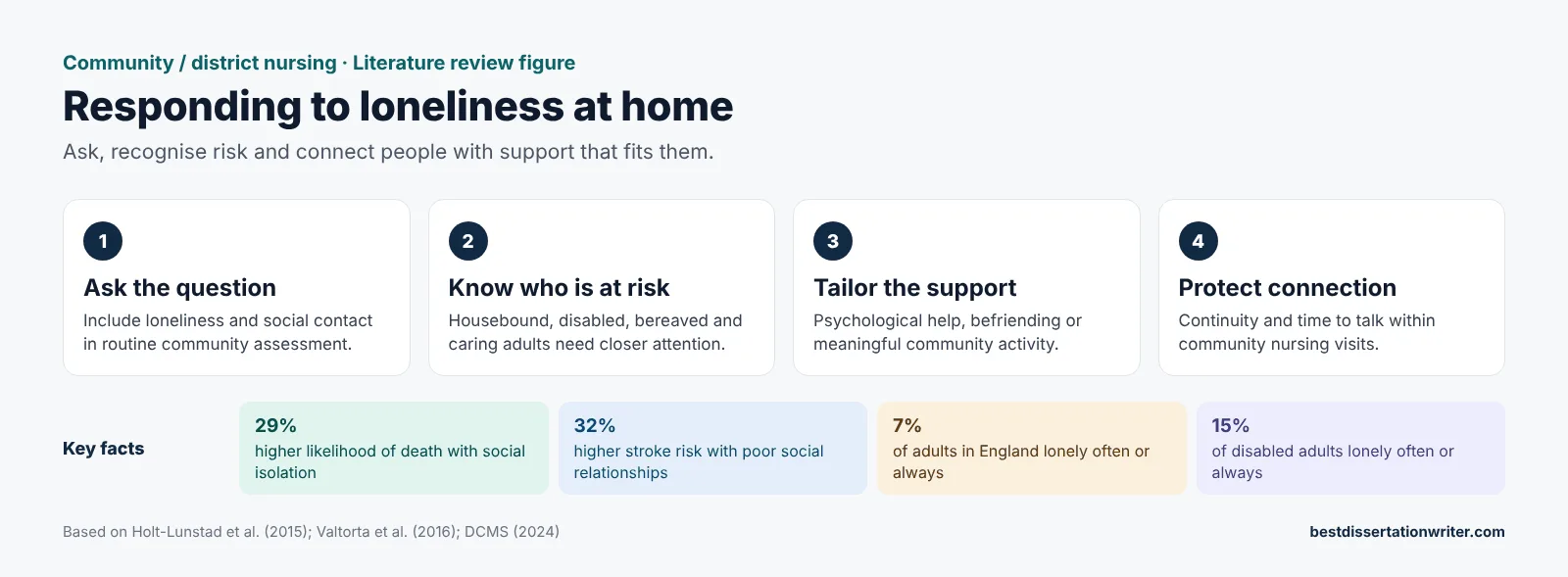
For community nurses, the findings suggest that asking about loneliness should be part of routine assessment, particularly for people who live alone, are housebound, are disabled, are recently bereaved or are caring for someone else. A simple question, asked sensitively, can uncover loneliness that might otherwise remain hidden, and it signals that the nurse sees the person as a whole, not just a set of clinical tasks.
The evidence on what works suggests that nurses should think carefully about the support they suggest. A person whose loneliness is linked to low mood or anxiety may benefit from psychological support, while another may value meaningful activity or a community group adapted to their needs. Social prescribing link workers and voluntary organisations can help to match people with suitable options, but housebound people may need approaches that come to them, such as telephone befriending.
Community nurses’ own visits may also matter. Continuity of care, time to talk and a relationship with a familiar nurse can provide a sense of connection, although this should not replace wider social networks. As community nursing teams come under pressure and visits become shorter and more task-focused, this relational element of care is at risk, which may have consequences for isolated patients.
This review has limitations. The evidence on health risks was observational, the intervention reviews included studies of varying quality and the most robust meta-analysis of interventions is now dated. This review relied on openly accessible, English-language sources and did not involve independent double screening. Future research should test nurse-initiated approaches to identifying and responding to loneliness, particularly among housebound and disabled adults.
There may also be risks in poorly designed interventions. Activities that do not match people’s interests, or that make them feel patronised, may increase disengagement. Interventions that focus only on increasing contact may overlook the emotional and cognitive aspects of loneliness. Involving people in designing their own support, as the community development approach suggests, is therefore both respectful and more likely to be effective.
Implications of Social Isolation and Loneliness Evidence for Practice
Community nurses should routinely ask about loneliness and social contact, record concerns and refer people to tailored support, including social prescribing, befriending and psychological therapies where loneliness is linked to low mood. Particular attention should be paid to housebound patients, people with painful or distressing conditions such as venous leg ulcers that can lead to withdrawal, and carers experiencing caregiver burden.
Isolation can also increase vulnerability to neglect, exploitation and abuse, so nurses should consider it as part of safeguarding vulnerable adults. Protecting time for conversation and continuity within community nursing visits is an important part of the response.
Conclusion
This systematic review examined the evidence on social isolation and loneliness among community-dwelling adults. Both are common, particularly among disabled people and those in deprived areas, and are associated with higher risks of death, coronary heart disease and stroke. Interventions have small effects, with the strongest evidence for approaches that address unhelpful thinking and for tailored, engaging community programmes.
Community nurses are well placed to recognise social isolation and loneliness and to connect people with support. Doing so requires time, awareness of local services and recognition that loneliness is a health issue, not simply a social one. Even a brief conversation about how someone spends their days can be the first step towards reconnection.
Addressing social isolation and loneliness will also require action beyond health services, including transport, housing, accessible community spaces and support for carers. Community nurses can contribute by sharing what they see with local partners and advocating for the people they visit.
References
Department for Culture, Media and Sport. (2024). Community Life Survey 2023/24: Loneliness and support networks. GOV.UK. https://www.gov.uk/government/statistics/community-life-survey-202324-annual-publication/community-life-survey-202324-loneliness-and-support-networks–2
Gardiner, C., Geldenhuys, G., & Gott, M. (2018). Interventions to reduce social isolation and loneliness among older people: An integrative review. Health & Social Care in the Community, 26(2), 147–157. https://doi.org/10.1111/hsc.12367
Holt-Lunstad, J., Smith, T. B., Baker, M., Harris, T., & Stephenson, D. (2015). Loneliness and social isolation as risk factors for mortality: A meta-analytic review. Perspectives on Psychological Science, 10(2), 227–237. https://doi.org/10.1177/1745691614568352
Masi, C. M., Chen, H.-Y., Hawkley, L. C., & Cacioppo, J. T. (2011). A meta-analysis of interventions to reduce loneliness. Personality and Social Psychology Review, 15(3), 219–266. https://doi.org/10.1177/1088868310377394
Valtorta, N. K., Kanaan, M., Gilbody, S., Ronzi, S., & Hanratty, B. (2016). Loneliness and social isolation as risk factors for coronary heart disease and stroke: Systematic review and meta-analysis of longitudinal observational studies. Heart, 102(13), 1009–1016. https://doi.org/10.1136/heartjnl-2015-308790
Cite this example
Best Dissertation Writers (2026) Social Isolation and Loneliness Among Community-Dwelling Adults and Nursing Interventions: A Systematic Review. Available at: https://bestdissertationwriter.com/social-isolation-and-loneliness-review/
Best Dissertation Writers
Get expert help with your nursing literature review
Share your topic and deadline with Best Dissertation Writers and get support tailored to your module brief.