

How Long Should a Literature Review Be?
 By Dr. Robertson Prime, Research Fellow
Updated November 16, 2026
17 min read
About 3,300 words
How long should a literature review be? It is one of the most common questions students ask, and the honest answer is that literature review length depends on several factors: your level of study, your discipline, the type of project and your program’s rules. There is no single number that fits every thesis or dissertation.
There are, however, reliable rules of thumb. This guide explains how long a literature review should be in a research paper, a master’s thesis and a PhD dissertation, how many sources should be in a literature review, how many pages that usually means, and how to plan your own word count step by step.
- The short answer: a widely used rule of thumb for dissertations, with worked word-count examples.
- Length by project type: how long a literature review should be in a journal article, an undergraduate or master’s dissertation, a PhD thesis and a standalone literature review.
- Planning tools: a step-by-step method for setting your literature review length, a word budget template and the signs that you have enough sources.
On this page
Key takeaways
- How long should a literature review be? In a dissertation, one widely used guide puts it at around 25 to 30% of the total word count.
- How long should a literature review be in a research paper or journal article? Usually much shorter, and it often sits inside the introduction.
- There is no fixed number of sources; you have enough when you keep meeting the same studies and authors.
- Your program’s handbook and your supervisor always override general rules about literature review length.
How Long Should a Literature Review Be? The Short Answer
For a dissertation, a useful rule of thumb is that the literature review takes up about a quarter of the total word count. The University of Sussex Skills Hub describes it as “a substantial section of your dissertation – around 25 to 30% of your word count”, drawing on Day’s (2018) guide to academic writing.
Applied to common word limits, that rule of thumb gives the literature review length shown below. These are planning figures worked out from the 25 to 30% guide, not fixed requirements.
| Total dissertation word count | Literature review length at 25% | Literature review length at 30% |
|---|---|---|
| 8,000 words | 2,000 words | 2,400 words |
| 10,000 words | 2,500 words | 3,000 words |
| 12,000 words | 3,000 words | 3,600 words |
| 15,000 words | 3,750 words | 4,500 words |
| 20,000 words | 5,000 words | 6,000 words |
Literature review length figures calculated from the 25 to 30% guidance in the University of Sussex Skills Hub’s “Structuring your dissertation”. Always check your own program’s rules.
- Why the proportion varies: a literature-based or theoretical dissertation may give the review a larger share, because the review is the main analysis. An empirical dissertation with a large data chapter may give it a smaller share.
- Why it depends on several factors: the breadth of your research topic, the amount of literature on it and whether you use more than one theory all change how long a literature review should be. Texas A&M University-San Antonio’s library notes that more focused topics can mean fewer sources to review, while referencing more than one theory can increase the amount of literature you need.
- Why your program matters most: some programs set a page limit or word limit for each chapter, and different expectations apply in different departments. Those rules always come first.
Why literature review length can vary significantly
Literature reviews vary in length for good reasons, and knowing them helps you answer how long should a literature review be for your own project. The rough rule above is a starting point; these factors move it up or down.
- The question being posed: a narrow research problem needs fewer sources and words than a broad one. A question that crosses two fields, or relies on more than one theory, needs more of both.
- The amount of literature: some topics have decades of existing research, while new projects on emerging topics may have very little. A review of a small, current research base will be shorter, and should say so, than one covering a large, established field.
- Your research methodology: qualitative studies often draw on theory and debate, which can lengthen the review, while a quantitative study may need a tighter review focused on key themes and variables. A literature-based dissertation treats the literature review as its main analysis, so the review takes up most of the word count.
- Your subject area: in the humanity subjects, the review of the literature may run through the whole thesis. In the sciences and social sciences, it is more often one chapter with clear subsections.
- Whether you are writing for a course or a degree: a course paper, a master’s thesis and a doctoral research project have very different expectations, so get an idea of the norm by reading two or three recent examples from your own program.
In every case, what the literature review involves stays the same: a literature search, reviewing literature critically, synthesizing key themes and showing what new research or future research is needed. Only the scale changes.
How Long Should a Literature Review Be in a Research Paper?
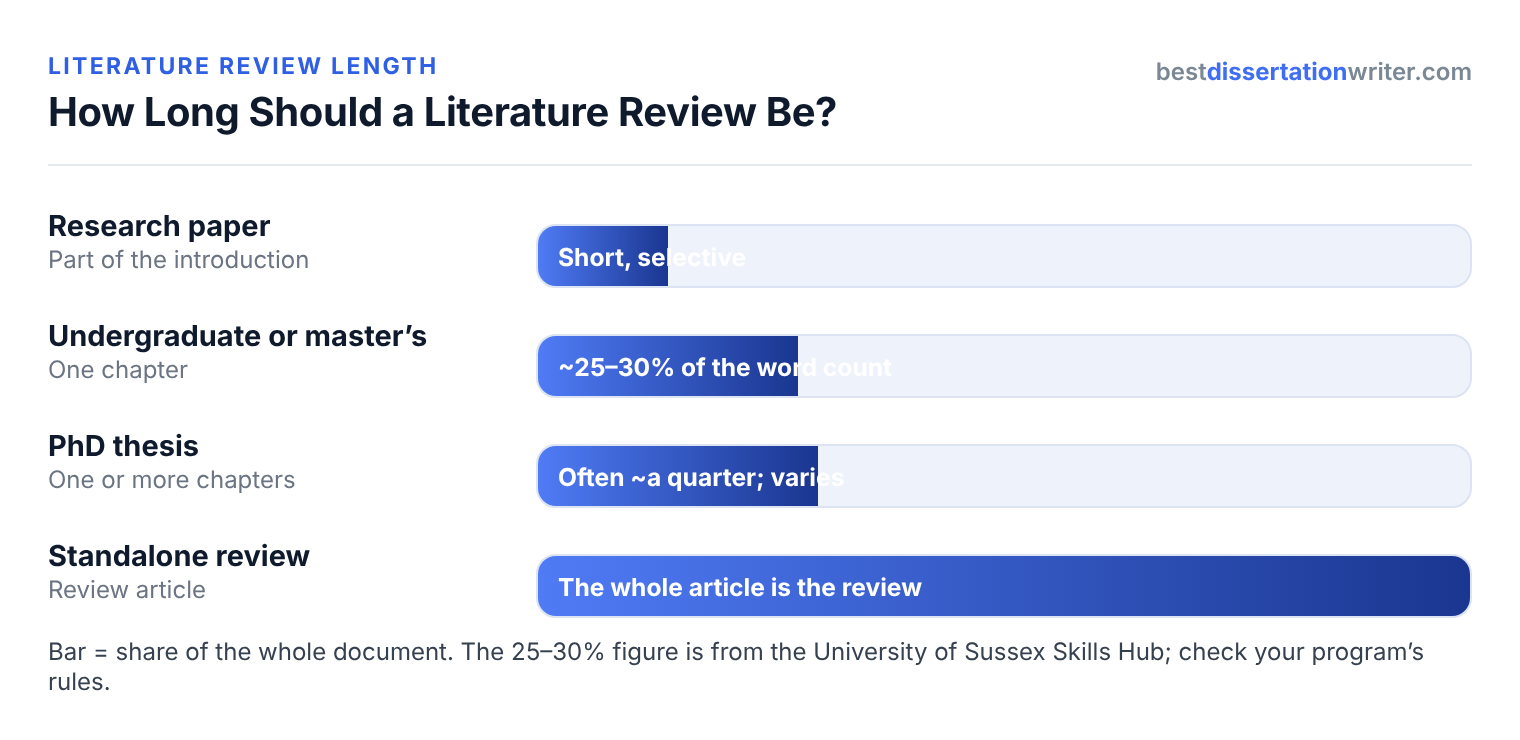
How long should a literature review be in a paper? In a research paper or journal article, the literature review is part of a larger paper rather than a chapter. It is usually short and selective, and it often appears inside the introduction.
- Course research papers: in a term paper, the literature review might be a few paragraphs to a few pages, depending on the total length set by your instructor. It should cover only the studies needed to justify the paper’s question, as in most academic papers on a particular topic.
- Journal articles: in an original research article, the review of the literature is usually woven into the introduction and kept brief, because the journal’s word limit has to cover methods, results and discussion too. Check the journal’s author guidelines for its total word limit.
- Standalone literature reviews: a review article published in a journal is a literature review from start to finish, so its literature review length is the length of the whole article. These are often longer and more exhaustive than the review inside a research paper.
Whatever the format, literature review length in a paper should be proportionate. If the review is longer than your results and discussion combined, it is probably too long for a research paper.
How Long Should a Literature Review Be in a Master’s Thesis or Undergraduate Dissertation?
How long should a literature review be in a dissertation or thesis below doctoral level? In undergraduate dissertations and master’s theses, the literature review is usually one chapter, often Chapter 2. The 25 to 30% rule of thumb is a sensible starting point for planning its length.
- Undergraduate dissertations: with typical totals of 8,000 to 12,000 words, the 25 to 30% guide gives a literature review of roughly 2,000 to 3,600 words. That is enough for a short introduction, two or three themes and a clear statement of the gap.
- Master’s theses: totals vary widely, but for a 15,000-word master’s thesis, the same guide suggests about 3,750 to 4,500 words. Master’s examiners expect more critical analysis than at undergraduate level, not just more words.
- Structure, not just size: at this level, a well-structured literature review chapter usually has an introduction, a search strategy, a theoretical framework if required, three or four thematic subsections and a summary. Planning words per section is the easiest way to hit your target.
How Long Should a Literature Review Be in a PhD Thesis?
How long should a literature review be at doctoral level? For a PhD thesis or doctoral dissertation, there is no standard literature review length. Doctoral theses are much longer overall, and the literature review must show a deep, critical command of the current state of research.
- Proportion still applies: many doctoral candidates still plan the literature review as roughly a quarter of the thesis, but the exact share depends on the design. In a thesis by publication, the review may be spread across the introductions of several papers.
- One chapter or several: some doctoral dissertations have one long literature review chapter, while others split it into a theoretical chapter and an empirical review. In the humanities, the review of the literature may run through the whole thesis rather than sitting in one chapter.
- Depth over length: examiners judge whether the review identifies significant pieces of research, evaluates them critically and shows where your original research fits. A shorter, sharper review often scores better than a long descriptive one.
How Many Sources Should Be in a Literature Review?
How many sources should be in a literature review is closely linked to how long should a literature review be, but there is no fixed answer. Walden University’s library puts it simply: “There is no magical number when it comes to the number of articles needed for a literature review.”
- Your topic decides much of it: a narrow, focused research topic has fewer relevant studies than a broad one. If your topic draws on several theories or disciplines, the amount of literature you need grows.
- Your level decides the rest: undergraduate reviews usually need fewer sources than master’s theses, and doctoral dissertations need the most, because they must cover the existing scholarship comprehensively.
- Quality beats quantity: to summarize the field well, a review built on the key studies in your field, including recent research and influential older work, is stronger than one that lists every source found.
- Your program may set expectations: some rubrics specify a minimum number of sources or types of source. Texas A&M University-San Antonio’s library advises checking whether your instructor or program has set expectations about the amount and types of literature required.
Signs you have enough sources
Rather than counting to decide how many sources should be in a literature review, look for signs of saturation. Walden’s library suggests asking whether you keep seeing the same articles and authors over and over; if so, you have probably been comprehensive.
- The same names keep appearing. New searches return studies you have already read, and the reference lists of new articles cite authors you already know.
- Each theme has enough evidence. Every theme in your outline is supported by several studies, including at least one strong one, so you can compare and evaluate rather than describe.
- You can explain the debates. You can say where researchers agree, where they disagree and why, without needing more sources to fill obvious holes.
- Your gap is clear. You can state what has not been studied with confidence, because you have checked that it really has not.
How to Plan Your Literature Review Length: A Step-by-Step Guide
The best way to answer how long should a literature review be for your own project is to plan it. These steps turn a total word count into a target for each section.
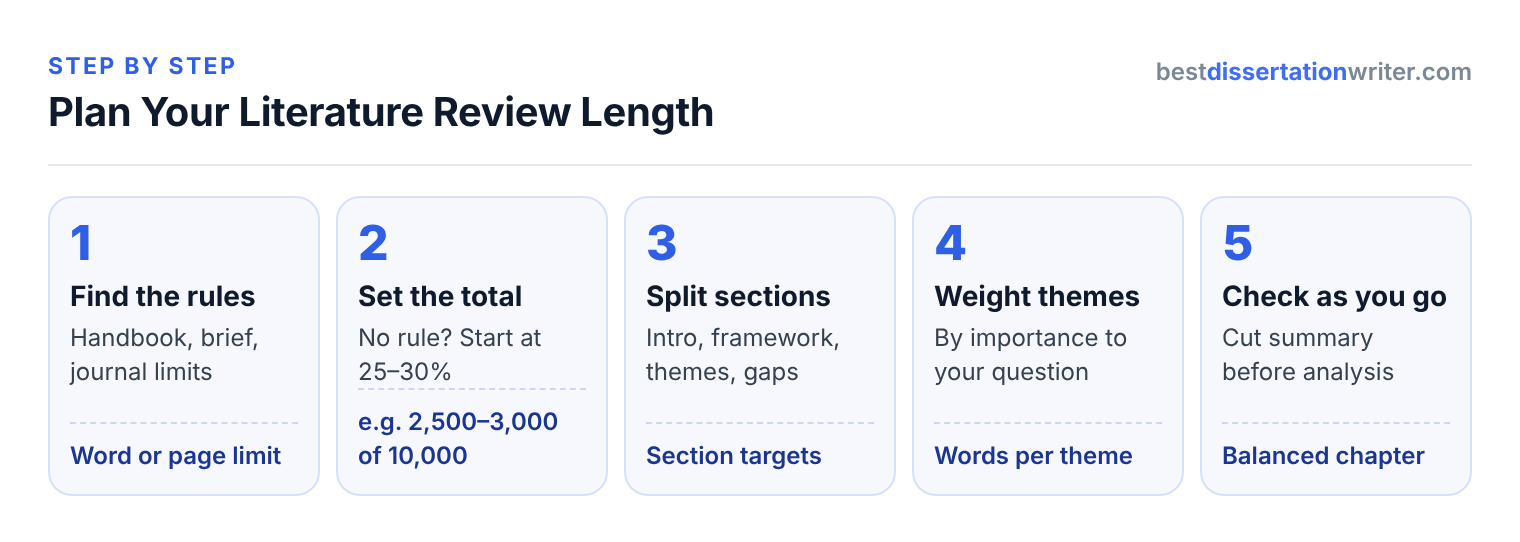
- Find the rules that apply to you. Read your handbook, the assignment brief or the journal’s guidelines for word limits and page limits. If none are given, ask your supervisor how long the literature review chapter should be.
- Set the overall literature review length. If there is no rule, start with about 25 to 30% of the total word count, as the Sussex guide suggests, and adjust for your design. For a 10,000-word dissertation, that gives 2,500 to 3,000 words.
- Divide it into sections. Give a short share to the introduction and summary, a larger share to the theoretical framework if you need one, and most of the words to the thematic subsections where your critical analysis happens.
- Match themes to words. Allocate words to each theme according to how important it is to your research question, not according to how much you have read about it.
- Check as you draft. Compare each section’s word count with its budget as you write. If a theme runs long, ask whether it is analyzing the evidence or only summarizing it, and cut summary first.
Template
Total word count: [number] | Literature review length (25–30%): [number] | Introduction and scope: [number] | Theoretical framework: [number] | Theme 1: [number] | Theme 2: [number] | Theme 3: [number] | Gaps and summary: [number]
See a worked word budget for a 10,000-word dissertation
Literature review length: 2,800 words (28% of 10,000). Introduction and search strategy: 250 words, and the theoretical framework: 400 words.
Theme 1, workload and burnout: 650 words; theme 2, organizational support: 600 words; theme 3, coping strategies: 550 words. Gaps and chapter summary: 350 words.
For help writing each section once your plan is set, see our step-by-step guide on how to write a literature review and our tips on writing a literature review.
How Many Pages Should a Literature Review Be? Pages, APA Format and Common Mistakes
Many assignments state length in pages rather than words. How many pages should a literature review be depends on your formatting as well as your word count, so the answer to how long should a literature review be in pages always starts with the word limit.
- Converting words to pages: when asking how many pages should a literature review be, remember that in a double-spaced document with 12-point font, a page usually holds roughly 250 to 300 words, so a 3,000-word literature review is around 10 to 12 pages. Treat this as an estimate, because headings, tables and block quotations change the count.
- APA formatting: APA style uses double spacing and set heading levels, which affects page counts. A standalone literature review in APA also has a title page and reference list, which are usually not counted in the main body’s length.
- What counts toward the limit: check whether your program counts the reference list, appendices and tables. Many do not count the reference list, but some include everything.
Word count for a standalone literature review vs a literature review chapter
A standalone literature review, such as a review article or a literature review assignment, is a complete piece of work. A literature review chapter is one part of a larger document, so its word count has to fit around the other chapters.
- Standalone literature reviews: these usually have an abstract, an introduction, a methods section describing the literature search, a main body organized by key themes and a conclusion. Their length is set by the assignment or the journal, and the whole word count goes to the review.
- Literature review chapters: these share the word count with the introduction, methodology, results and discussion. That is why the 25 to 30% rule of thumb is so useful: it keeps the chapter in proportion.
- Annotated bibliography vs review: an annotated bibliography lists and summarizes each source with a citation and a short note, so its length grows with the number of sources. A literature review synthesizes those sources, so it can cover many sources in fewer words.
What a literature review involves at different lengths
The content of a short and a long literature review differs in depth more than in kind. Use this as a guide when deciding how long should a literature review be for your project.
| Length | What it can cover well |
|---|---|
| Under 1,500 words | One or two themes, the most relevant literature and a clear gap; typical inside a research paper |
| 2,000–4,000 words | An introduction, a short framework, three or four themes with critical analysis, and a summary; typical in undergraduate and master’s work |
| Over 5,000 words | A full theoretical framework, several themes with subsections and an in-depth evaluation of existing scholarship; typical in doctoral work and standalone reviews |
Illustrative ranges to help planning, not rules. A literature review typically grows with the level of study and the breadth of the topic.
Common mistakes with literature review length
These problems are the most common reasons students get how long should a literature review be wrong: they make a review too long, too short or badly balanced. Check your draft against them.
- Summarizing every source: one paragraph per study inflates literature review length quickly without adding analysis. Group studies by theme and synthesize instead.
- Too much background: long histories of the topic or definitions everyone knows use up words that should go to critical analysis of the existing literature.
- An unbalanced chapter: one theme with most of the words and others with a single paragraph suggests the structure needs rethinking.
- Too short to show depth: a review far below the expected literature review length often lacks evaluation and a clear gap. Add analysis of the evidence, not more summaries.
- Ignoring the rules: going far over a set word limit can cost marks, even if the content is strong.
For full chapter samples of different lengths, browse our literature review examples. The UNC Writing Center guide to literature reviews offers more advice on scope, and our guide on how to write a dissertation shows how the chapter fits the whole project.
FAQs: How Long Should a Literature Review Be?
What is the average length of a literature review?
There is no single average, because literature review length depends on the project. In a research paper, the review may be a few paragraphs or pages inside the introduction. In a dissertation, a widely used rule of thumb is around 25 to 30% of the total word count, as the University of Sussex Skills Hub suggests.
Standalone review articles and doctoral theses are usually longer. Always check your program handbook, assignment brief or journal guidelines, because their rules override any general average.
How long should a 10,000 word dissertation lit review be?
Using the common rule of thumb of 25 to 30% of the total, a literature review in a 10,000-word dissertation would be about 2,500 to 3,000 words. That usually allows a short introduction, a theoretical framework if needed, two or three themes and a summary of the gaps.
Your program may set a different figure, and literature-based dissertations often give the review more space. Agree the target with your supervisor, then plan a word budget for each section so the chapter stays balanced. That is the practical answer to how long should a literature review be in a short dissertation.
How many sources should a literature review have?
There is no fixed number. As Walden University’s library puts it, there is no magical number of articles for a literature review. The right number depends on your topic, your level of study and what your program expects, and doctoral reviews usually need far more than undergraduate ones.
A practical test is saturation: when new searches keep returning studies and authors you have already read, you have probably been comprehensive. Focus on including the key studies for each theme rather than reaching a count, and cite each one accurately in your bibliography.
How long is a literature review in a PhD thesis?
There is no standard literature review length for a PhD thesis. Many candidates plan it as roughly a quarter of the thesis, but it may be one long chapter, two chapters, or spread across the introductions of several papers in a thesis by publication.
What matters most at doctoral level is depth: the review must evaluate the significant research critically and show where your original research fits. Your supervisor and your university’s regulations are the best guide to how long should a literature review be in your thesis.
Best Dissertation Writers
Need help with your literature review?
Get a critical, well-structured review with current sources and a clear research gap.