Mental Illness Stigma Among Healthcare Professionals and Its Impact on Care: A Narrative Review
 By Dr. Robertson Prime, Research Fellow
Updated October 12, 2026
15 min read
About 3,100 words
In this review
Abstract
Background: Mental illness stigma affects employment, housing, relationships and self-esteem, and it can stop people from seeking help early. Many service users identify health staff as a source of stigma and discrimination, and because nurses are present across mental and physical healthcare, their attitudes and behaviour can either reinforce or reduce it.
Aim: This narrative review aimed to examine how common and how harmful stigma towards people with mental health problems is in healthcare settings, and which interventions reduce stigmatising attitudes among health professionals and the wider public.
Methods: Evidence was identified through targeted searches of openly accessible bibliographic records, publisher websites and the reference lists of key reviews. Six sources published between 2013 and 2022 were included: a series of national service user surveys, a review of stigma in healthcare settings, a systematic review of stigma and help-seeking, a narrative overview of interventions, a meta-analysis of randomised trials and an international commission report, appraised with CASP checklists and synthesised narratively.
Findings: Discrimination was almost universal among people using mental health services in England, reported by 91% of participants in 2008 and 88% in 2011. Professional experience did not reliably reduce negative attitudes and diagnostic overshadowing was described, while a review of 144 studies found that stigma had a small to moderate negative association with help-seeking, with disclosure concerns the most common barrier. Social contact was the most effective intervention in the short term, and a meta-analysis of 62 trials found that contact and education reduced stigmatising attitudes immediately, although attitude gains after education were not sustained at six months.
Conclusion: Nurses should reflect on their own assumptions, take physical symptoms seriously, challenge discrimination and involve people with lived experience in teaching. Anti-stigma work should be embedded in education, supervision and clinical culture rather than delivered as a one-off event.
Keywords: mental illness stigma, mental health stigma, stigmatising attitudes
Introduction
This narrative review critically examines recent evidence on mental illness stigma and its implications for mental health nursing practice.
Around one in eight people worldwide live with a mental health condition, and many describe the prejudice and discrimination they face as worse than the condition itself (Thornicroft et al., 2022). Mental illness stigma affects employment, housing, relationships and self-esteem, and it can stop people from seeking help early. It also reaches into healthcare, where people with mental health problems may find that their physical symptoms are dismissed, their concerns are not taken seriously or their access to treatment is delayed.
Healthcare professionals, including nurses, are often assumed to be free of prejudice because of their training and values. However, many service users identify health staff as a source of stigma and discrimination (Thornicroft et al., 2016). Because nurses are present across mental and physical healthcare, their attitudes and behaviour can either reinforce or reduce mental illness stigma. Understanding how stigma operates in clinical settings, and what works to reduce it, is therefore an important question for nursing.
A narrative approach was chosen because the evidence spans surveys of service users, systematic reviews of observational studies, meta-analyses of trials and an international commission, which are too varied to combine statistically but can be synthesised critically to inform practice. The focus throughout is on what the evidence means for nurses, who are both potential sources of mental illness stigma and potential agents of change.
Review question
How common and how harmful is stigma towards people with mental health problems in healthcare settings, and which interventions reduce stigmatising attitudes among health professionals and the wider public?
Background to Mental Illness Stigma
Stigma is usually described as having three linked components: problems of knowledge (ignorance or misinformation), problems of attitudes (prejudice) and problems of behaviour (discrimination). It operates at several levels. Structural stigma is built into policies, funding and organisational practices; public stigma refers to the views held by the general population; and self-stigma, or internalised stigma, occurs when people with mental health problems come to accept negative stereotypes about themselves.
Within healthcare, mental illness stigma can take subtle forms. Henderson et al. (2014) described diagnostic overshadowing, in which physical symptoms are wrongly attributed to an existing mental health condition, and reported evidence that people with mental illness receive lower-quality physical healthcare. These patterns may contribute to the large gap in life expectancy between people with severe mental illness and the general population, although the causes of this gap are complex.
Self-stigma deserves particular attention in nursing. When people absorb negative stereotypes, they may feel ashamed, expect rejection and decide that seeking help is not worthwhile. Nurses can unintentionally strengthen this process through pessimistic language about recovery, a focus on risk rather than strengths, or care that is delivered to people rather than with them. Equally, nurses can weaken internalised mental illness stigma by conveying hope, recognising expertise by experience and supporting people to make their own decisions about treatment.
In England, the national Time to Change programme, run by the charities Mind and Rethink Mental Illness, aimed to reduce mental health stigma and discrimination through social marketing, community events and contact with people with lived experience. Professional bodies such as the Royal College of Psychiatrists have also campaigned on stigma. National guidance, including that from the National Institute for Health and Care Excellence (NICE), emphasises respect, dignity and shared decision-making for people using mental health services.
Search Strategy and Methods
Evidence for this example was identified through targeted searches of openly accessible bibliographic records, publisher websites and the reference lists of key reviews. Search terms combined keywords for the problem (“mental illness stigma”, “stigma”, “discrimination”, “prejudice”, “stigmatising attitudes”, “mental illness”, “mental health”) with terms for the setting and response (“health professional*”, “nurs*”, “health care”, “help-seeking”, “intervention”, “anti-stigma”, “contact”), joined with the Boolean operators AND and OR. A full narrative review for assessment would run the same strategy in CINAHL, PubMed/MEDLINE, the Cochrane Library and Embase and report the number of records screened in a PRISMA flow diagram.
Sources were eligible if they examined experiences or consequences of mental illness stigma, stigma in healthcare settings, or interventions to reduce stigma, and were systematic reviews, meta-analyses, large national surveys or major international reports. Priority was given to sources published since 2010 and to those relevant to healthcare staff. Studies limited to a single profession outside healthcare, or to stigma associated with physical conditions, were excluded.
Six sources on mental illness stigma published between 2013 and 2022 were included: a series of national service user surveys, a review of stigma in healthcare settings, a systematic review of stigma and help-seeking, a narrative overview of interventions, a meta-analysis of randomised trials and an international commission report (Table 1). The quality of each source was appraised using the Critical Appraisal Skills Programme (CASP) checklist appropriate to its design, and findings were synthesised narratively.
Key Findings on Mental Illness Stigma
Three themes were identified: the extent of discrimination experienced by people using mental health services, the effects of stigma in healthcare and on help-seeking, and the effectiveness of anti-stigma interventions. Table 1 summarises the included sources, and Figure 1 presents pooled effects of contact and education interventions on stigmatising attitudes and desire for social distance.
| Author, year | Design | Setting and sample | Key finding |
|---|---|---|---|
| Corker et al. (2013) | Repeated cross-sectional surveys | Separate annual samples of mental health service users, England, 2008–2011 | 91% reported discrimination in 2008 and 88% in 2011; reduction smaller than the Time to Change target. |
| Henderson et al. (2014) | Narrative review | Studies of stigma among mental health and general health professionals | Professional experience does not reliably reduce stigma; diagnostic overshadowing and poorer physical healthcare reported. |
| Clement et al. (2015) | Systematic review (quantitative and qualitative) | 144 studies, 90,189 participants | Stigma had a small to moderate negative effect on help-seeking (median d = −0.27); disclosure concerns most common. |
| Thornicroft et al. (2016) | Narrative overview of reviews and studies | Anti-stigma interventions in high-income and low- and middle-income countries | Social contact most effective in the short term; long-term and behavioural evidence weak. |
| Morgan et al. (2018) | Systematic review and meta-analysis | 62 randomised trials; severe mental illness | Contact and education gave small-to-medium immediate reductions in stigma; attitude change after education not sustained. |
| Thornicroft et al. (2022) | International commission report | More than 50 contributors including people with lived experience | Social contact most effective; mandatory anti-stigma training recommended for health and social care staff. |
Theme 1: How Common Is Discrimination?
Corker et al. (2013) reported annual surveys of separate samples of people using mental health services in England between 2008 and 2011, carried out to evaluate the Time to Change programme. In 2008, 91% of participants reported at least one experience of discrimination, compared with 88% in 2011. The proportion reporting no discrimination rose significantly and the overall median discrimination score fell by 11.5%, but the improvement was smaller than the programme’s target, and the authors warned that gains might be hard to maintain during economic austerity.
These figures show that discrimination was almost universal among people using services, even during a national campaign. The surveys used a validated instrument, the Discrimination and Stigma Scale, and large samples, which are strengths. However, they relied on self-report and on people who were in contact with services, so they may not capture the experiences of those who had disengaged. The surveys also covered many areas of life, not only healthcare.
Even so, the survey findings help to explain why mental illness stigma is regarded as a public health problem rather than a matter of individual hurt feelings. When nearly nine in ten people using services report unfair treatment, discrimination is a routine part of their lives. For nurses, this means that patients may arrive expecting to be judged, and that early experiences of respect, or the lack of it, are likely to influence trust, disclosure and engagement with care.
Theme 2: Mental Illness Stigma in Healthcare and Help-Seeking
Henderson et al. (2014) reviewed evidence on stigma among mental health and other health professionals. They found that stigma operates at structural, interpersonal and personal levels, that professional experience does not reliably reduce negative attitudes, and that burnout is associated with more negative attitudes. Contact with patients in a professional role was linked to more positive views about civil rights but did not reduce stigma in the way that social contact with friends or family members does.
The consequences of stigma for help-seeking were examined by Clement et al. (2015) in a systematic review of 144 studies with 90,189 participants. Stigma had a small to moderate negative association with help-seeking (median effect size d = −0.27). Internalised stigma and stigma about treatment were most often linked to reduced help-seeking, and stigma was the fourth highest ranked barrier. Concern about disclosure was the most commonly reported stigma-related barrier.
Clement et al. (2015) also found that some groups were disproportionately deterred from seeking help, including people from ethnic minorities, young people, men, and people in military and health professions. The last finding is particularly relevant for nursing: nurses who experience mental health problems may themselves delay seeking help because of mental health stigma within their own profession, which could also shape how they view patients.
Theme 3: Interventions to Reduce Mental Illness Stigma
In a narrative overview of systematic reviews and primary studies, Thornicroft et al. (2016) concluded that social contact with people who have lived experience was the most effective intervention for improving knowledge and attitudes in the short term, especially for adults. However, evidence for longer-term benefit was weak, few studies measured behaviour, and interventions aimed at healthcare staff were uncommon and mostly education-based. Filmed contact appeared to be as effective as live contact for staff.
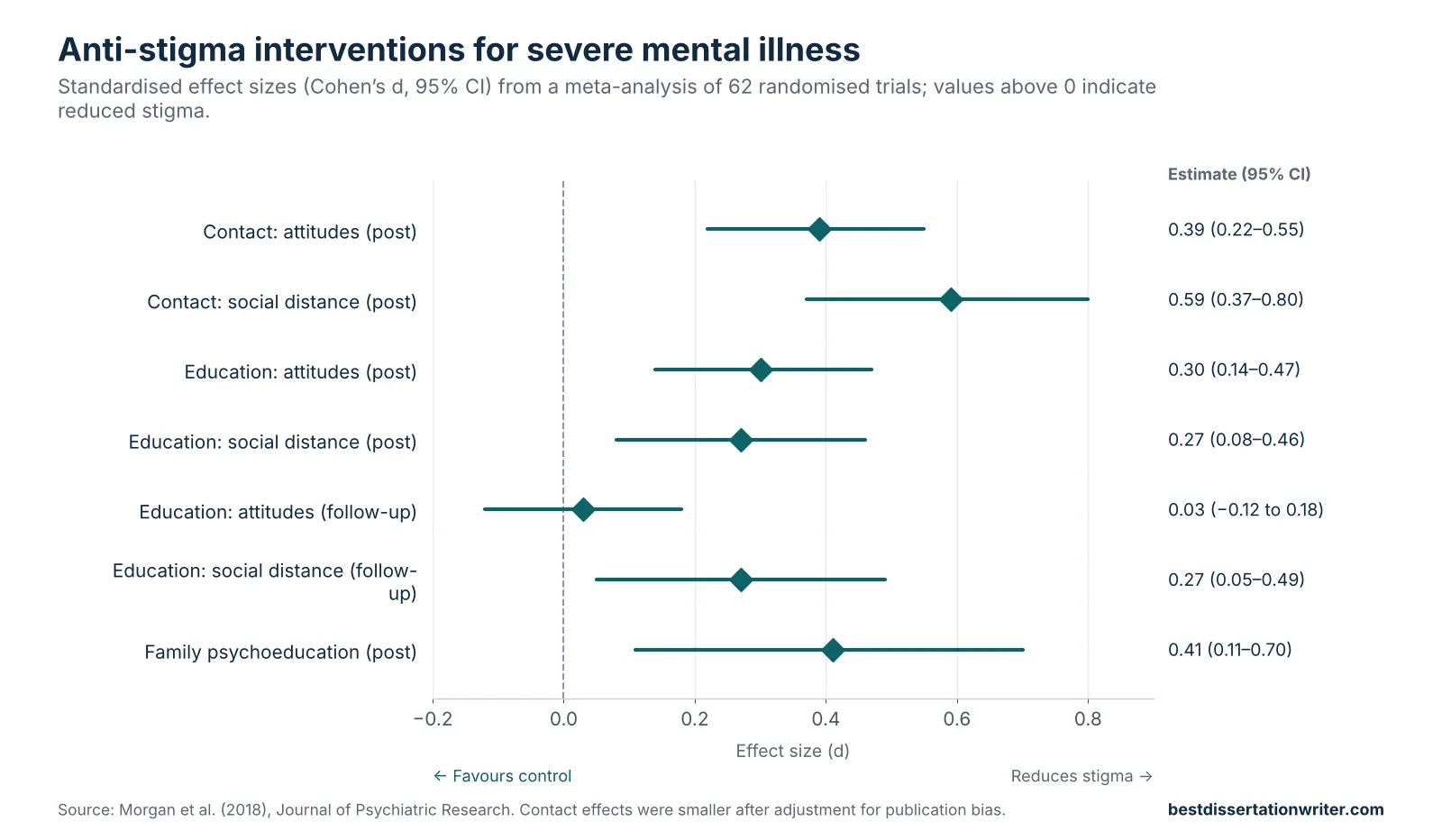
Morgan et al. (2018) meta-analysed 62 randomised controlled trials of interventions to reduce stigma towards people with severe mental illness. Contact interventions produced small-to-medium immediate reductions in stigmatising attitudes (d = 0.39) and desire for social distance (d = 0.59), although these effects fell after adjustment for publication bias. Education reduced stigmatising attitudes (d = 0.30) and social distance (d = 0.27); the effect on social distance persisted at six months, but the effect on attitudes did not (d = 0.03).
Most recently, the Lancet Commission on ending stigma and discrimination in mental health (Thornicroft et al., 2022), developed with more than 50 contributors including people with lived experience, confirmed social contact as the most effective way to reduce stigma. It recommended that people with lived experience should be directly involved in designing and delivering anti-stigma programmes and that pre-qualifying training for health and social care staff should include mandatory anti-stigma sessions.
Taken together, these sources suggest that interventions to reduce mental illness stigma work best when they involve people with lived experience, are interactive and are repeated over time. The Lancet Commission placed particular weight on lived experience leadership, which goes beyond inviting service users to tell their stories and involves them in designing and evaluating programmes. This represents a shift in how stigmatising attitudes are tackled, from expert-led teaching about mental illness towards shared learning and partnership.
Discussion
This review shows that mental illness stigma is widespread, that it reaches into healthcare and that it discourages people from seeking help. Encouragingly, both contact and education can reduce stigmatising attitudes in the short term. The evidence is broadly consistent across surveys, systematic reviews, trials and the Lancet Commission, which strengthens confidence in these conclusions.
A central tension concerns the durability of change. Morgan et al. (2018) found that improvements in attitudes after education were not maintained at six months, and Thornicroft et al. (2016) described weak evidence for longer-term benefits. Single training sessions are therefore unlikely to be enough. For nursing, this suggests that anti-stigma work should be built into pre-registration education, continuing professional development and everyday clinical culture rather than delivered as a one-off event.
Another tension lies in the gap between attitudes and behaviour. Most studies measured what people think or say they would do, rather than how they actually behave towards patients. Henderson et al. (2014) noted that the most important outcomes for service users, such as the quality of physical healthcare and equal access to treatment, are rarely measured. It is possible for nurses to score well on attitude scales while still engaging in subtle discrimination, such as diagnostic overshadowing or excessive use of restrictive practices.
Structural factors also matter. Henderson et al. (2014) argued that organisational and policy change, such as reasonable adjustments and fairer funding, is needed alongside individual training. Mental illness stigma among staff is likely to be sustained by heavy workloads, burnout and services that separate mental and physical healthcare. Nurses can challenge mental illness stigma most effectively when organisations give them time, supervision and leadership support to deliver person-centred care, rather than expecting individual attitude change to overcome system pressures alone.
The evidence has limitations. Many trials involved students rather than practising clinicians, follow-up was usually short, and most studies came from high-income countries. Corker et al. (2013) relied on self-report from people in contact with services. This review relied on openly accessible, English-language sources and did not involve independent double screening. Future research should evaluate long-term, behaviour-focused interventions for nurses and measure outcomes that matter to service users, including the quality of physical healthcare.
Implications of Mental Illness Stigma Evidence for Practice
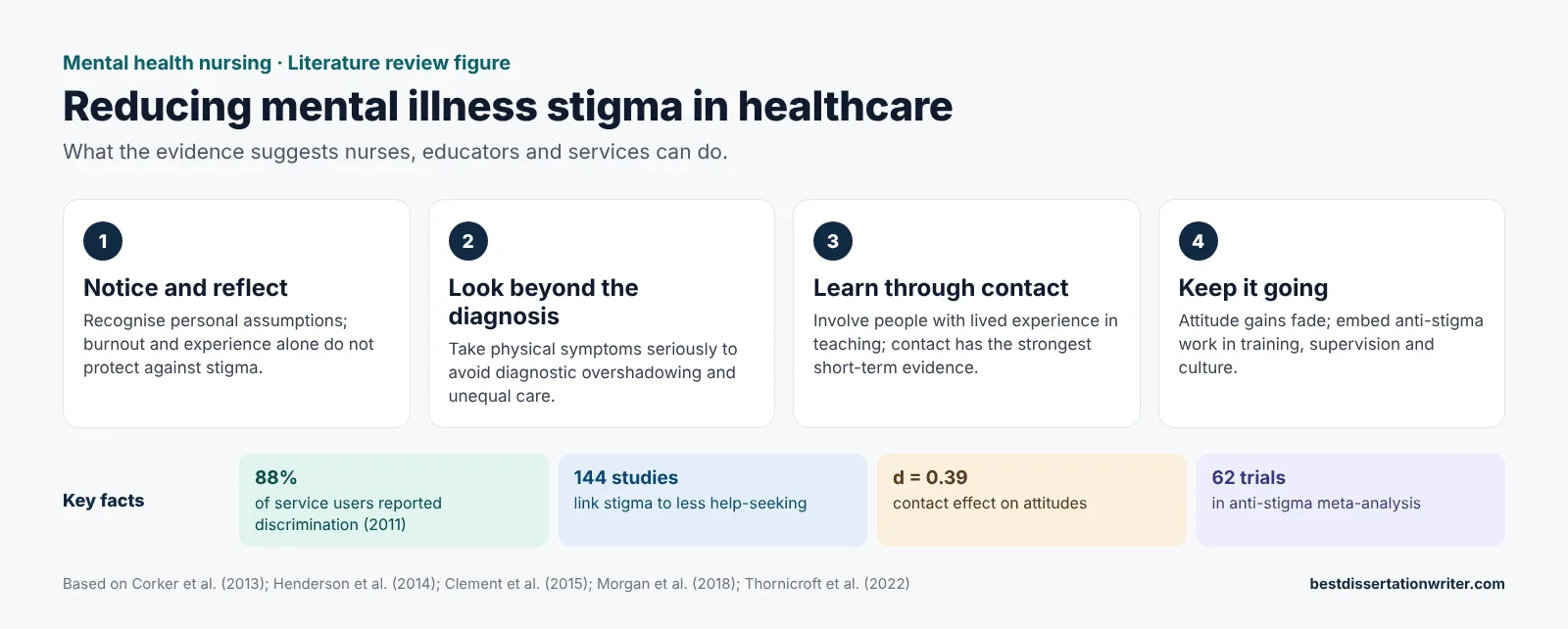
For mental health nurses, the evidence supports reflecting on personal assumptions, using respectful and person-first language, and challenging stigmatising attitudes and practices among colleagues. Nurses should take physical symptoms seriously to avoid diagnostic overshadowing, involve service users in decisions about their care and support people who are reluctant to seek help because of fear of disclosure. Nurse educators can involve people with lived experience in teaching, since contact-based learning has the strongest evidence. Ward teams can also use clinical supervision and reflective practice to discuss situations in which mental health stigma may have influenced decisions, such as delays in physical assessment or dismissive comments during handovers.
Tackling mental health stigma is particularly important for groups who face additional prejudice, such as people with a dual diagnosis of mental illness and substance misuse, people who present with self-harm and people with schizophrenia. Services can also draw on peer support workers, whose own lived experience offers a powerful form of social contact for both patients and staff.
Conclusion
This narrative review examined evidence on mental illness stigma among healthcare professionals and its impact on care. Discrimination is reported by the great majority of people using mental health services, stigma is present within healthcare and it deters help-seeking, particularly through fear of disclosure and internalised stigma.
Social contact and education can reduce stigmatising attitudes, although effects often fade without continued effort. Mental health nurses are well placed to reduce mental illness stigma by modelling respectful care, challenging discrimination, involving people with lived experience and supporting help-seeking among patients and colleagues alike.
References
Clement, S., Schauman, O., Graham, T., Maggioni, F., Evans-Lacko, S., Bezborodovs, N., Morgan, C., Rüsch, N., Brown, J. S. L., & Thornicroft, G. (2015). What is the impact of mental health-related stigma on help-seeking? A systematic review of quantitative and qualitative studies. Psychological Medicine, 45(1), 11–27. https://doi.org/10.1017/S0033291714000129
Corker, E., Hamilton, S., Henderson, C., Weeks, C., Pinfold, V., Rose, D., Williams, P., Flach, C., Gill, V., Lewis-Holmes, E., & Thornicroft, G. (2013). Experiences of discrimination among people using mental health services in England 2008–2011. British Journal of Psychiatry, 202(s55), s58–s63. https://doi.org/10.1192/bjp.bp.112.112912
Henderson, C., Noblett, J., Parke, H., Clement, S., Caffrey, A., Gale-Grant, O., Schulze, B., Druss, B., & Thornicroft, G. (2014). Mental health-related stigma in health care and mental health-care settings. The Lancet Psychiatry, 1(6), 467–482. https://doi.org/10.1016/S2215-0366(14)00023-6
Morgan, A. J., Reavley, N. J., Ross, A., Too, L. S., & Jorm, A. F. (2018). Interventions to reduce stigma towards people with severe mental illness: Systematic review and meta-analysis. Journal of Psychiatric Research, 103, 120–133. https://doi.org/10.1016/j.jpsychires.2018.05.017
Thornicroft, G., Mehta, N., Clement, S., Evans-Lacko, S., Doherty, M., Rose, D., Koschorke, M., Shidhaye, R., O’Reilly, C., & Henderson, C. (2016). Evidence for effective interventions to reduce mental-health-related stigma and discrimination. The Lancet, 387(10023), 1123–1132. https://doi.org/10.1016/S0140-6736(15)00298-6
Thornicroft, G., Sunkel, C., Alikhon Aliev, A., Baker, S., Brohan, E., el Chammay, R., Davies, K., Demissie, M., Duncan, J., Fekadu, W., Gronholm, P. C., Guerrero, Z., Gurung, D., Habtamu, K., Hanlon, C., Heim, E., Henderson, C., Hijazi, Z., Hoffman, C., … Winkler, P. (2022). The Lancet Commission on ending stigma and discrimination in mental health. The Lancet, 400(10361), 1438–1480. https://doi.org/10.1016/S0140-6736(22)01470-2
Cite this example
Best Dissertation Writers (2026) Mental Illness Stigma Among Healthcare Professionals and Its Impact on Care: A Narrative Review. Available at: https://bestdissertationwriter.com/mental-illness-stigma-literature-review/
Best Dissertation Writers
Get expert help with your nursing literature review
Share your topic and deadline with Best Dissertation Writers and get support tailored to your module brief.