

Patient Satisfaction With Care Provided by Nurse Practitioners: A Systematic Review
 By Dr. Robertson Prime, Research Fellow
Updated November 2, 2026
15 min read
About 2,900 words
In this review
Abstract
Background: Patient satisfaction is a key measure of the quality of care and a common argument for expanding nurse practitioner roles. Satisfaction reflects communication, time, access and trust as well as clinical results, so it is important to understand how patients rate the care they receive from nurse practitioners compared with doctors.
Aim: This systematic review aimed to examine the evidence on patient satisfaction with care provided by nurse practitioners and other advanced practice nurses, including how it compares with physician-led or usual care and what factors may explain differences.
Methods: Evidence was identified through targeted searches of openly accessible bibliographic records, publisher websites and repositories. Five sources published between 2002 and 2021 were included: three systematic reviews of randomised trials or trials and observational studies, a Cochrane review and a systematic review of advanced practice nurse outcomes. The sources were appraised using CASP checklists and synthesised narratively.
Findings: A systematic review of 11 randomised trials and 23 observational studies found that patients were more satisfied with nurse practitioners and that health status did not differ. A systematic review of 10 articles covering 10,911 patients found equal or better satisfaction with advanced practice nurses. A Cochrane review of 18 trials found that patient satisfaction was probably slightly higher with nurse-led primary care. A systematic review of 13 trials found that advanced nurse practitioner care was associated with higher satisfaction and shorter waiting times. A review of advanced practice nurse outcomes from 1990 to 2008 found similar and in some ways better outcomes.
Conclusion: Patients are at least as satisfied with care from nurse practitioners as with care from doctors, and often more satisfied. Longer consultations may contribute, and evidence is limited by variable measures and designs, so services should collect patient experience data locally.
Keywords: patient satisfaction, nurse practitioner care, patient experience
Introduction
This systematic review critically examines recent evidence on patient satisfaction and its implications for advanced clinical practice.
When a new role is introduced into health care, one of the first questions is whether patients will accept it. Nurse practitioners and other advanced practitioners now see large numbers of patients with undifferentiated problems, long-term conditions and urgent needs. If patients were dissatisfied, they might avoid the service or ask for a doctor, and the role would struggle to achieve its goals of improving access and using the workforce well.
Satisfaction is more than politeness. It reflects whether patients feel listened to, whether the practitioner explains clearly, whether the consultation is long enough and whether the outcome meets their needs. Satisfied patients are more likely to follow advice and to return when they need care, so satisfaction is often considered an indicator of quality as well as a measure of experience.
It is also an imperfect measure. Ratings may be influenced by waiting times, the physical environment or expectations, and patients may find it hard to judge technical quality. Studies use many different tools, and results can be affected by who is asked and when.
Review question
What does the evidence show about patient satisfaction with care from nurse practitioners and other advanced practice nurses, how does it compare with care from doctors and how strong is the evidence?
Background to Patient Satisfaction in Advanced Clinical Practice
Early research on nurse practitioners in primary care compared them with doctors in first-contact consultations, and many later studies have followed this design. They ask whether nurse practitioners provide equivalent care, and satisfaction has been one of the main outcomes. Over time, the question has widened to cover hospital, specialist and urgent care settings, and to compare advanced practice roles with usual care that is not always physician-led.
Patient satisfaction is closely linked to other themes in advanced practice. A fuller comparison of clinical outcomes is the subject of the review of nurse-led versus physician-led care, and the use of video and telephone is covered in the review of telehealth consultations. Patient views on safety and on the proper use of antibiotics are relevant to the review of antimicrobial stewardship.
It is also worth noting that satisfaction is shaped by the way the role is introduced. Patients who understand what a nurse practitioner can do, and who are told how to see a doctor if they wish, are likely to feel more comfortable. Clear explanations of roles, and consistency in the way that practitioners introduce themselves, are therefore part of the patient experience.
Patient satisfaction also matters to commissioners and regulators, who use it as one measure of the performance of services. National surveys and local feedback ask patients to rate their care, and the results can influence service design and funding. Evidence on patient satisfaction with advanced practice roles is therefore relevant not only to clinicians but also to those who decide how many posts to create and where to place them.
Patient satisfaction can be measured in different ways, from single questions about overall care to detailed scales covering communication, access and technical quality. The choice of measure affects the result. A service that asks only whether patients were happy may find high scores, while a service that asks about specific aspects of the consultation may identify areas for improvement, so the reader should consider how satisfaction was assessed in each review.
Search Strategy and Methods
Evidence for this example was identified through targeted searches of openly accessible bibliographic records, publisher websites and repositories. Search terms combined keywords for the practitioners (“nurse practitioner”, “advanced practice nurse”, “advanced nurse practitioner”) with terms for the outcome and design (“patient satisfaction”, “patient experience”, “quality of care”, “systematic review”, “randomised controlled trial”), joined with the Boolean operators AND and OR. A full review for assessment would run the same strategy in CINAHL, PubMed/MEDLINE, Embase and the Cochrane Library and report how records were screened.
Sources were eligible if they were systematic reviews or Cochrane reviews that compared outcomes, including patient satisfaction, of care by nurse practitioners or advanced practice nurses with physician-led or usual care. Single trials, opinion pieces and reviews of nursing care in general were excluded.
Five sources published between 2002 and 2021 were included (Table 1). The quality of each source was considered using the Critical Appraisal Skills Programme (CASP) checklists, and findings were synthesised narratively under themes.
The findings are presented from the general to the specific. First the evidence from the earlier reviews is considered, then the more recent and rigorous reviews, and finally the explanations for the findings and the limits of the evidence. Because the sources use different measures and designs, the results are described in each source’s own terms and are not combined statistically.
Key Findings on Patient Satisfaction
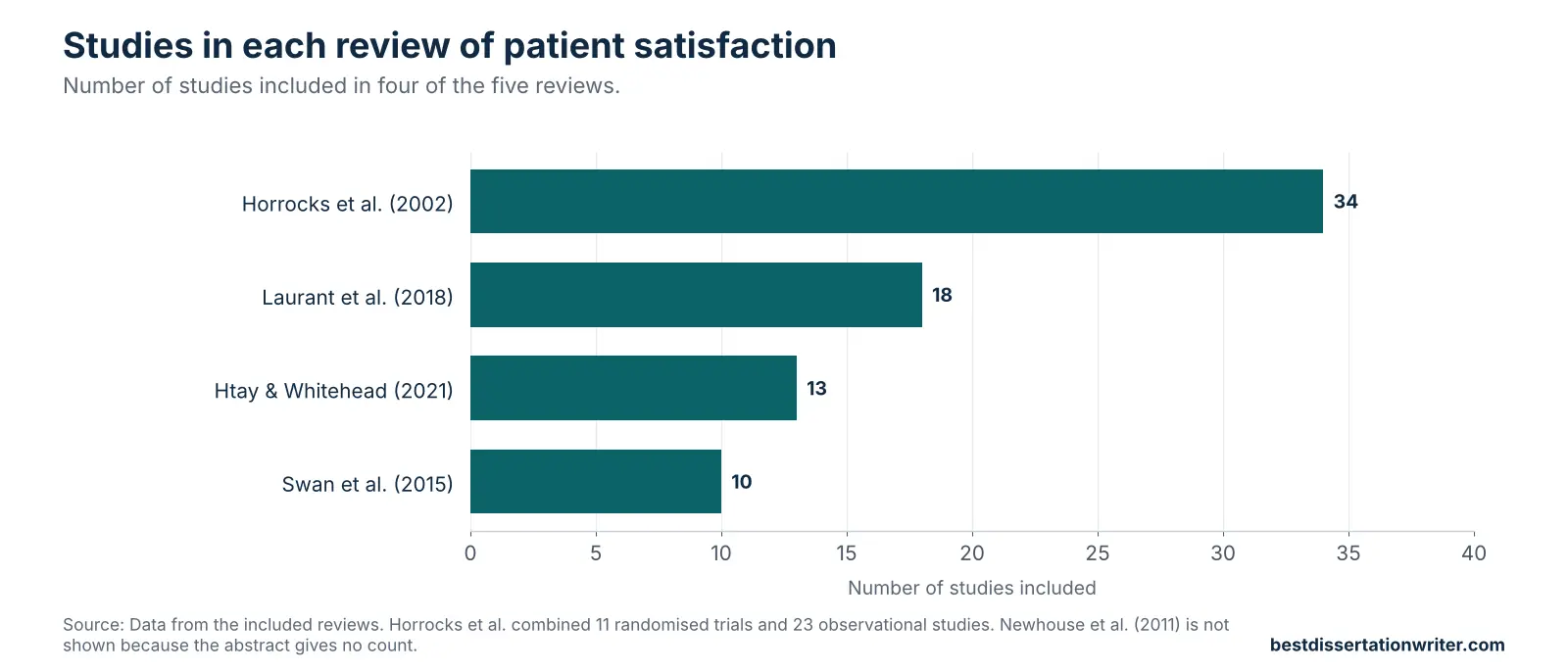
Three themes were identified: satisfaction compared with doctors, evidence from trials, and explanations and limits. Table 1 summarises the included sources, and Figure 1 shows the number of studies in four of the reviews.
| Author, year | Design | Setting and sample | Key finding |
|---|---|---|---|
| Horrocks et al. (2002) | Systematic review | 11 randomised trials and 23 observational studies | Patients more satisfied with nurse practitioners; health status did not differ. |
| Htay & Whitehead (2021) | Systematic review of randomised trials | 13 trials of advanced nurse practitioners | Higher satisfaction, shorter waiting times and lower costs. |
| Laurant et al. (2018) | Cochrane review | 18 randomised trials | Satisfaction probably slightly higher with nurse-led care; consultations longer. |
| Newhouse et al. (2011) | Systematic review | Advanced practice nurse outcomes, 1990–2008 | Outcomes similar to and in some ways better than physician-only care. |
| Swan et al. (2015) | Systematic review | 10 articles; 10,911 patients | Satisfaction equal or better with advanced practice nurses. |
Theme 1: Satisfaction Compared with Doctors
Horrocks et al. (2002) carried out a systematic review of whether nurse practitioners working in primary care can provide equivalent care to doctors. They included 11 randomised controlled trials and 23 prospective observational studies of first-contact care. Patients were more satisfied with nurse practitioners, and health status did not differ. Quality of care was better in some respects.
Nurse practitioner consultations were longer and involved more investigations, while prescriptions, return consultations and referrals did not differ. The authors concluded that increasing the availability of nurse practitioners in primary care is likely to produce high levels of patient satisfaction and high-quality care. This is an early and influential review, but it covers studies from the 1980s and 1990s and may not reflect current roles.
Newhouse et al. (2011) carried out a systematic review of advanced practice nurse outcomes from 1990 to 2008, which included all types of advanced practice nurse and a broad range of outcomes, populations and settings. They concluded that nurse practitioners and certified nurse midwives working with physicians achieve outcomes similar to and in some ways better than physician-only care in the populations and settings studied, and that clinical nurse specialists in acute care can reduce length of stay and costs.
Together, these two reviews established that advanced practice nurses are at least comparable to doctors in the settings studied and that patients are often more satisfied. They are relatively old, and both covered a period when advanced practice roles were developing. They also reported outcomes broadly, and the abstracts of the second do not give separate figures for satisfaction, so later and more focused reviews are needed to examine satisfaction in more detail.
Theme 2: Evidence from Trials
Swan et al. (2015) carried out a systematic review of the quality of primary care provided by advanced practice nurses. They included 10 articles: seven randomised controlled trials, two economic evaluations and a two-year follow-up of included trials, covering 10,911 patients receiving ongoing primary care or same-day care for acute conditions. Patient satisfaction was equal or better in the advanced practice nurse groups than in the physician groups.
The authors also reported that advanced practice nurse groups matched or outperformed physicians on physiologic measures and on cost. Advanced practice nurses generally had longer consultations, but two studies found that their patients needed fewer consultations over time. The authors concluded that differences between the two were few, and that advanced practice nurse care was superior on some measures, while noting that longer-term studies were needed.
Laurant et al. (2018) carried out a Cochrane review of nurses as substitutes for doctors in primary care. It included 18 randomised trials, and it found that patient satisfaction was probably slightly higher with nurse-led care, with moderate certainty. Consultations were probably longer, and attended return visits probably slightly more frequent. The authors concluded that, for some ongoing and urgent physical complaints and chronic conditions, trained nurses probably achieve equal or better health outcomes than doctors.
Htay and Whitehead (2021) carried out a systematic review of randomised controlled trials of advanced nurse practitioners compared with physician-led or usual care. They included 13 trials from high-income countries, spanning primary and hospital care and children and adults, of which five were rated high quality and eight low to moderate. Advanced nurse practitioner care was associated with higher patient satisfaction, shorter waiting times and lower costs, and the authors concluded that the evidence supports a positive effect on clinical and service outcomes.
The abstract of the most recent review presents some figures in a way that is hard to interpret, including a wide range of mean differences for satisfaction, so the conclusion is best read in qualitative terms. The consistent message across the trial-based reviews is that satisfaction with nurse practitioners and advanced practice nurses is equal to or higher than with doctors. This is supported by moderate-certainty evidence from the Cochrane review.
Theme 3: Explanations and Limits
Several reviews note that nurse practitioner consultations were longer. This may help to explain higher patient satisfaction, since patients value time and explanation, and it also has implications for efficiency and cost. The sources do not test this explanation directly, so it remains a plausible hypothesis. Services that wish to match the satisfaction found in trials may need to ensure that practitioners have enough time to listen and explain.
Limits to the evidence are apparent in each review. Swan et al. noted that longer-term studies were needed, Laurant et al. rated some evidence as low or very low certainty, and Htay and Whitehead found that eight of 13 trials were of low to moderate quality. Patient satisfaction was measured using different tools, and patients in trials may differ from patients in routine care. Few studies examined whether satisfaction was equal among groups such as older people, people with disabilities or those who do not speak English.
A further limit is that patient satisfaction depends on context. The trials were conducted mainly in primary care in high-income countries, and the way nurse practitioners are used in the United Kingdom, where roles overlap with those of advanced clinical practitioners, may differ. For advanced practitioners, the implication is to collect their own data on patient experience, for example through short surveys and feedback, so that local services can see whether they are achieving the satisfaction reported in the trials.
The question of who is satisfied also deserves attention. Patients who choose to see a nurse practitioner may differ from those who are allocated, and patients who complete a survey may differ from those who do not. In randomised trials, allocation reduces the first problem, which is one reason why trial-based reviews carry more weight, but even there, response rates and the timing of the survey may affect the results. Services should consider who is missing from their feedback.
Finally, satisfaction should be considered alongside safety and outcomes. A patient who is satisfied with a short or reassuring consultation may not have received the best advice, and a patient who is dissatisfied may have received appropriate but unwelcome advice. The reviews examined here reassure that satisfaction is high and that outcomes are similar, but local services still need to look at both together when assessing the quality of patient satisfaction with advanced practice.
Discussion
This systematic review suggests that patients are at least as satisfied with care from nurse practitioners and advanced practice nurses as with care from doctors, and in several reviews more satisfied. The finding is consistent across reviews published over nearly two decades, and it is supported by moderate-certainty evidence from a Cochrane review.
The evidence base has limits. The reviews overlap in the trials they include, and the older reviews cover studies from earlier periods. Patient satisfaction measures differ and are rarely validated against other indicators of quality. Longer consultations may account for part of the difference. Most evidence is from primary care in high-income countries, and the more recent review reports its results in a form that is difficult to interpret.
Other limitations should be noted. Few studies examine the satisfaction of specific groups, or of patients who prefer to see a doctor. The sources do not report the views of doctors or other colleagues. This review relied on openly accessible, English-language sources, and it did not include primary studies published after the reviews’ search dates.
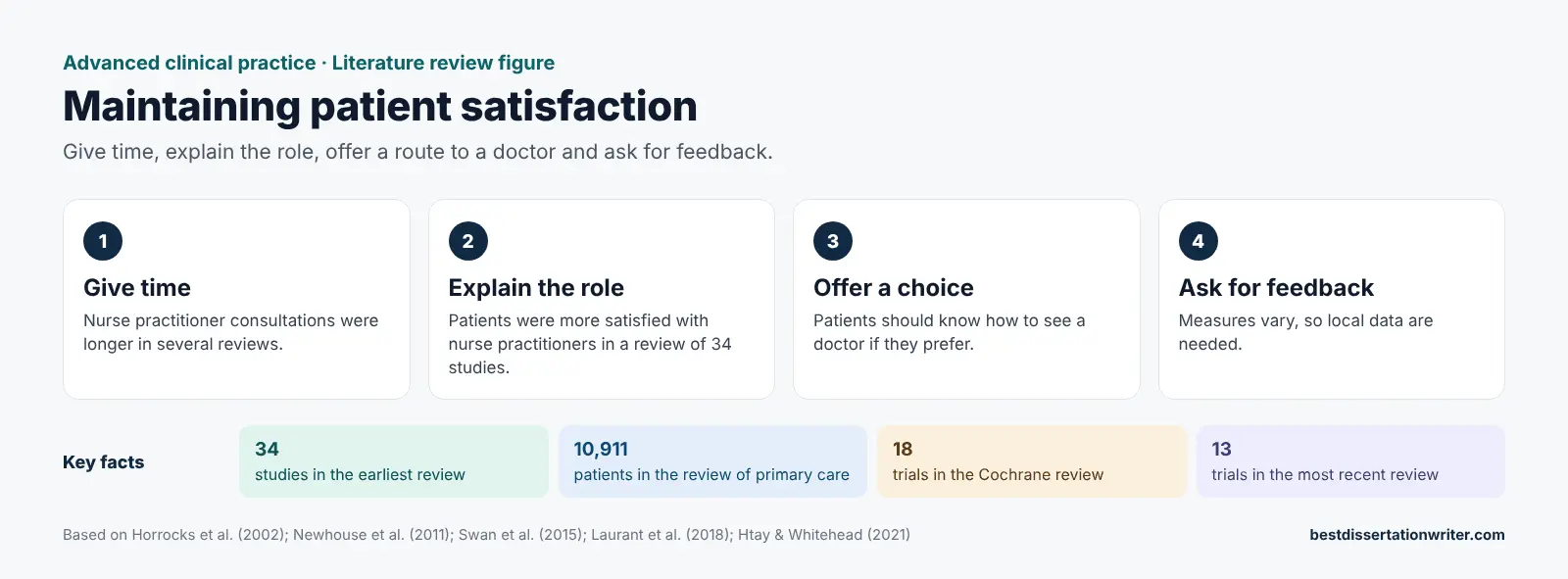
Even so, the sources are consistent. Patient satisfaction with nurse practitioner care is high, and no review found that patients were less satisfied. For advanced clinical practitioners, protecting time for consultations, explaining their role clearly and asking patients for feedback are practical ways of maintaining satisfaction.
Implications of Patient Satisfaction Evidence for Practice
For practice, the evidence supports the use of advanced practitioners as first-contact clinicians, with time to listen and explain, a clear introduction to the role and a route to see a doctor when needed. Guidance is available from NHS England, the Nursing and Midwifery Council and the Royal College of Nursing.
Managers should collect patient experience data for advanced practice services, use validated tools where possible, report results by group and act on feedback. They should also allow enough time per consultation, since time appears to be one of the factors that patients value.
Future research should use validated measures of patient satisfaction, compare satisfaction in hospital and specialist roles, examine groups that are under-represented in trials, test whether consultation length explains differences and include the views of patients in the United Kingdom. Studies of satisfaction with advanced clinical practitioners would be particularly valuable.
Conclusion
This systematic review found that patients are at least as satisfied with care from nurse practitioners and advanced practice nurses as with care from doctors, and often more satisfied, although evidence is limited by variable measures and designs.
Advanced clinical practitioners can maintain satisfaction by giving patients time, explaining their role and seeking feedback.
References
Horrocks, S., Anderson, E., & Salisbury, C. (2002). Systematic review of whether nurse practitioners working in primary care can provide equivalent care to doctors. BMJ, 324(7341), 819–823. https://doi.org/10.1136/bmj.324.7341.819
Htay, M., & Whitehead, D. (2021). The effectiveness of the role of advanced nurse practitioners compared to physician-led or usual care: A systematic review. International Journal of Nursing Studies Advances, 3, Article 100034. https://doi.org/10.1016/j.ijnsa.2021.100034
Laurant, M., van der Biezen, M., Wijers, N., Watananirun, K., Kontopantelis, E., & van Vught, A. J. A. H. (2018). Nurses as substitutes for doctors in primary care. Cochrane Database of Systematic Reviews, (7), Article CD001271. https://doi.org/10.1002/14651858.CD001271.pub3
Newhouse, R. P., Stanik-Hutt, J., White, K. M., Johantgen, M., Bass, E. B., Zangaro, G., Wilson, R. F., Fountain, L., Steinwachs, D. M., Heindel, L., & Weiner, J. P. (2011). Advanced practice nurse outcomes 1990–2008: A systematic review. Nursing Economic$, 29(5), 230–250.
Swan, M., Ferguson, S., Chang, A., Larson, E., & Smaldone, A. (2015). Quality of primary care by advanced practice nurses: A systematic review. International Journal for Quality in Health Care, 27(5), 396–404. https://doi.org/10.1093/intqhc/mzv054
Cite this example
Best Dissertation Writers (2026) Patient Satisfaction With Care Provided by Nurse Practitioners: A Systematic Review. Available at: https://bestdissertationwriter.com/patient-satisfaction-literature-review/
Best Dissertation Writers
Get expert help with your nursing literature review
Share your topic and deadline with Best Dissertation Writers and get support tailored to your module brief.